Tag: VisitingaMuseum.com

Beach Haven Library & Museum                                    219 North Beach Avenue                                               Beach Haven, NJ 08008

Beach Haven Library & Museum 219 North Beach Avenue Beach Haven, NJ 08008

The library at 219 North Beach Haven Avenue

https://www.beachhavenlibrary.org/

https://www.instagram.com/bhpl1924/

My review on TripAdvisor:

The front of the library and museum in the Fall of 2025

The historic sign

I recently visited the Beach Haven Library and Museum in Beach Haven during the holiday season and discovered a historical library with a rich history in both the community and on Long Beach Island.

The museum on the second floor

On the second floor of the library is the history room of the Beach Haven Library that contains a collection of historic artifacts and ledgers from hotels and businesses on the island. Each of the case lines tells a different story of the community from the grand hotels that once lined the shore and have since disappeared to the lives of the families that once called the island home. When I talked with one of the librarians, she told me that estates from the area donate these items to the library and this has established their collection.

The second floor fireplace

The antique kitchen equipment

The second floor of the library has another fireplace where vintage pottery and kitchen items are on display. There are also decorative pieces of pottery lining the shelves.

Historic China inside the Emily Lloyd Wilson Secretarial desk. Her father designed the Baldwin Hotel in Beach Haven.

The historic ledger from the Parry Hotel

The library has another fireplace where extensive collection of hotel ledgers and artifacts.

Letters from Elizabeth Pharo proposing the Library in 1923

Short History of the Library:

(From the library pamphlet)

Mrs. Pharo presented to the library board a proposal to build the library entirely at her own expense. She contacted Philadelphia architect, R. Brognard Okie to design the library. He chose the model of a Pennsylvania Farmhouse. The library was completed in the Fall of 1924. The museum is now over a hundred years old.

The dedication to Elizabeth Pharo, who dedicated the museum.

The Long Beach Island House Guest Ledger and historic items from the historic Bond Hotel

The records of the past resort town Long Beach Island used to be with guests coming from New York City, Philadelphia and beyond.

Historic items from the Tuckerton & Long Beach Building Land and Improvement Association

The Engleside Hotel ledger and items from the hotel

The New Jersey Declaration towards the Declaration of Independence

Historic books and periodicals

The library has an interesting collection of vintage and antique books that have been donated to the collection.

Photo display on historic sites in Beach Haven and pictures of the original library

Some of the pictures are from the old library and the artifacts come from ships ground ashore. The library has a diverse collection of items to view.

The Compass from the historic shipwreck ‘Fortuna’ that wrecked off Ship Bottom in 1910 and historic boat

The second floor museum gallery holds the diverse collection of artifacts

The second floor of the 1928 building

The first floor of the library has all sorts of historical artifacts along the walls

The Holiday Kickoff in 2025:

I visited during the library’s Holiday Open House with games, trivia and activities. There was also live music in the afternoon. It was a way that the library gives back to the community. It was a nice family event with good food and nice conversation with people from the community.

The Holiday Open House

The fireplace was going when I was talking to the librarians

It was a very nice family event where patrons families could relax, have something to eat and play games with their children. The Liberians could not have been more friendly and engaging with the public.

The Children’s Room had a holiday challenge

The museum is a rare gem tucked not just on the second floor but along the shelves and tables of the entire historic library giving visitors a chance to see all these historic artifacts mixed in with the library book collection.

The History of the Beach Haven Library:

(from the library website)

Attempts to establish a library in Beach Haven had begun as early as the 1880’s with a gift of books for the town’s children by Dr. Edward Williams. Williams, along with Charles Parry of the Parry House and the Baldwin Hotel, was a partner in the Baldwin Locomotive Works. The library collection was first housed in the home of Samuel Copperthwaite on Engleside Avenue. It was later moved into one of the Sunday School rooms of the Kynett Methodist Church, which had been built in 1890.

After the old Quaker Meeting House was donated to the town by Walter Pharo, the Reverend Alexander Corson of the Methodist Church began work, with the help of his wife, to turn the former Meeting House into a viable library. By the time they left in 1908, it was well on its way.

In 1923, Walter’s widow, Elizabeth Pharo, presented the library’s board of trustees with a proposal to build, entirely at her own expense, a new library for the town. It would be sited two blocks away from the Methodist church on a corner lot which she owned at Third Street and Beach Avenue. The library would be dedicated to the memory of her husband’s parents, Archelaus Ridgway Pharo and Louisa Willits Pharo–the founders of Beach Haven–as well as to her late husband Walter. 

Mrs. Pharo contracted R. Brognard Okie, one of Philadelphia’s finest architects, to design the new library. He chose as his model a Pennsylvania farmhouse–not an early lifesaving station, as some believed. Unlike a traditional farmhouse, however, it would be constructed entirely of brick and steel and include several stunning features: three working fireplaces, a vaulted ceiling, and an interior balcony encircling the first floor.

Tons of concrete were poured and steel girders for the new, two-story structure were already up by the spring of 1924 on the southeast corner of Beach Avenue at Third Street. Okie moved to Beach Haven to supervise every step of the construction, which was all done by local builder Floyd Cranmer. Ten railcar loads of bricks were used to build the solid outer walls and it was soon evident that the town was to have the finest library on the New Jersey coast.

As the library neared completion in the late fall of 1924, its beauty was already drawing praise. Every window in the structure was framed with long shutters of pale green, which gleamed against the white brick exterior. A sweeping, multi-dormered black roof added a grace seldom seen in a public building. Surrounded by a low, white picket fence and later, a well-kept green lawn, it added an incomparable dignity to what, in that time period, was the town’s main street, Beach Avenue.

There are two large colonial-style working fireplaces on the first floor. One is in the main room and the other is behind it in the long back room on the ocean side of the library. Today this room houses the Mystery collection and its solid, ten-foot table makes it useful as a meeting room. In the early years, however, it served a different function–it was designated as the men’s reading room, and there male patrons could sit in large comfortable chairs to read magazines and newspapers. It was well lit by two tall French windows and it opened out onto the screened porch on the north side.

The main reading room with its vaulted ceiling is encircled with a balcony reached by a spiral stone staircase, its steps topped with thick slabs of slate. The balcony flooring is of oak, as are all of the spindles in the railings. The upstairs walls are lined with books. One great window on the west side rises ten feet to the ceiling. The rest are all set into dormers. On the east wall behind the upstairs balcony there is a door where one may step down into a well-furnished little museum with high, beamed ceilings and a huge stone fireplace. It is filled with old hotel registers, deeds, diaries, photographs and other mementos of Beach Haven’s vibrant history.

The Beach Haven Public Library is a prime architectural treasure on Long Beach Island and a direct link to a colorful past that is the town’s most precious heritage. Mrs. Elizabeth Pharo’s gift to the town, itself now almost 100 years old, is as stunning as the day it was built. The taxpayers who support it are proud of its status as the only independent library in Ocean County and have chosen to keep it that way.

Day Three Hundred and Sixty-Five Artist Party-Ruth Asawa-Member’s Night at the MoMA November 22nd, 2025

Day Three Hundred and Sixty-Five Artist Party-Ruth Asawa-Member’s Night at the MoMA November 22nd, 2025

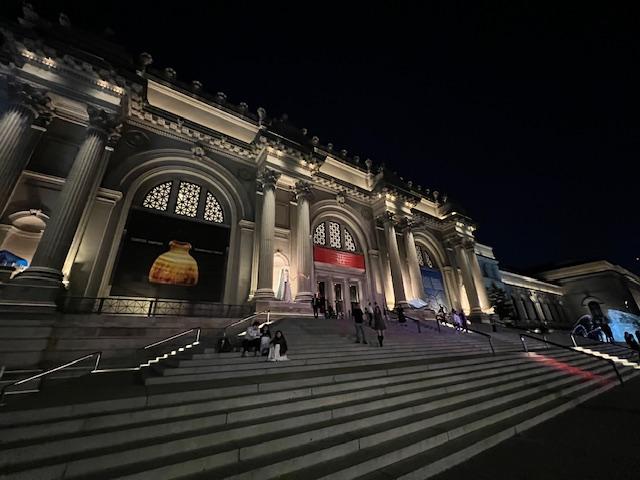
The front of the Museum of Modern Art on 11West 53rd Street

https://www.moma.org/

My review on TripAdvisor:

https://www.tripadvisor.com/ShowUserReviews-g60763-d105126-r1040038069-The_Museum_of_Modern_Art_MoMA-New_York_City_New_York.html?m=19905

There is always a lot of excitement when a new art exhibition is ready to open. It is even better when the museum opens it to its members first before the public gets a glimpse. It gives a chance to see the exhibitions before it opens to the public.

The long line of MoMA members waiting to get into the museum for the opening night of Artist Ruth Asawa’s exhibition

I noticed this year especially and right before Thanksgiving, all the museums are throwing open their doors for Member’s Nights. I have been invited to five Members Nights at museums all over the City. You can’t attend them all.

The excitement the museum creates for these evenings

Video of entering the museum at the start of the opening with 80’s Japanese Pop Music

I think in an economy like this, these Members Nights are one of the best ways to engage with the membership for both donations and renewals of memberships especially before the holiday season. Plus it gives the members a wonderful night out to see the exhibitions ahead of time and enjoy the evening after a long week at work.

The opening of the Ruth Asawa Retrospect

Artist Ruth Asawa

https://en.wikipedia.org/wiki/Ruth_Asawa

The biography of the artist and her works

https://www.moma.org/artists/21-ruth-asawa

Biography of Artist Ruth Asawa:

(from the Museum of Modern Art website)

Born on a farm in Southern California, Asawa began her arts education when she was a teenager and she and her family were among the thousands of persons of Japanese descent who were forcibly incarcerated by the US government during World War II. It was at the internment camp that Asawa began taking classes in painting and drawing. After her release, Asawa studied to be a teacher but was unable to get a license because of her Japanese heritage, so she enrolled at Black Mountain College, an experimental art school in North Carolina. Asawa took classes from and worked alongside fellow artists Josef AlbersRobert RauschenbergMerce Cunningham, and R. Buckminster Fuller. Black Mountain was also where she met her husband, the architect Albert Lanier.

I loved her wire woven sculptures.

The wire woven sculptures were the standouts of the exhibition

I thought these were a unique design

I liked here colorful paintings, these are of her child’s footprints. I loved the idea that her children were involved with the art

The patrons enjoying the art

The display of the wire art

The displays were impressive and graceful

The colorful faces looked tired

The look of nature in the wire art in the form of trees

I loved her works of food

At the end of the exhibition and the evening, I joined everyone on the main floor where the bar and gift shop were located. The main floor was the busiest part of the museum. I wondered if some of these people even went upstairs to see the exhibition or just stayed downstairs to socialize.

The main floor of the museum is always packed with people

Share in the excitement of the Membership opening

These evenings always get my mind off the stress of life. It is nice to just be in Midtown Manhattan and be in the moment. It is nice to see art, hear music and walk through the museum.

Shivers House Museum/Sign of Key Tavern                           68 North Main Street                                                 Woodstown, NJ 08098

Shivers House Museum/Sign of Key Tavern 68 North Main Street Woodstown, NJ 08098

Shivers House Museum/Sign of Key Tavern

68 North Main Street

Woodstown, NJ 08098

(609) 216-8815

http://www.salemcountyclocks.com/the-big-red-house

Open: By Appointment Only-Please call/Special Events

My review on TripAdvisor:

https://www.tripadvisor.com/ShowUserReviews-g46943-d34027431-r1039569744-Shrivers_House_Museum-Woodstown_New_Jersey.html?m=19905

The Shivers House at 68 North Main Street in Woodstown, NJ

The front of the Shivers House Museum at 68 Main Street from across the street

I got a personal tour of the Shivers House Museum and the Sign of Key Tavern, which is attached to the main house of the Shivers Family. The first part of the tour was of the Sign of Key Tavern, which consisted of The Hearth Room, where all the cooking took place and the Cage Bar room, where meals would be eaten and used for socialization.

I could see that the family business was very popular at the time when transportation was slower and these areas in the early 1700’s were barely populated. So this became the focal point of the communities. These taverns were part of the communication and transport systems of the country up until the Revolutionary War.

Later, family members built the the main house of which the tavern would be attached and thus began the home’s transformation to modern times. The house from the outside has a more symmetrical appearance but these changes on the outside altered the historic inside.

The History of the Shivers House:

In 1668, John Shivers at the bequest of King William of England was given thousands of acres to promote the hamlet development with what was then known as West Jersey.

Upon arrival, Shivers constructed on the property, utilizing Native American labor, a dam and saw mill on what would become Woodstown Lake. From here he milled the timber for his tavern. The tavern, The Sign of the Key, operated for 65 years on the corner of what is today Routes 40 and 45. Travelers could sleep, eat meals, communicate and trade furs from the area. After Shivers death, it was moved to its present location by his son, Samuel, as an addition to the current house.

The Shivers family owned the house through marriage through the Nineteen century.

The outside sign of the house

The informational sign on the history of the home and construction

The sign of the clock repair and antique shop business inside the house

(Much of the following research comes from owner Gregg Perry’s personal research on the house and family and from the personal tour Mr. Perry gave me of the house and grounds).

The first part of the house tour I took was of the old tavern section of the house. This had once been in a different area and moved here by the family and connected to the newly built house around 1726 when Tavern owner, John Shivers died.

The Cage Bar/ Dining room

The Dining Room area

The pewter materials in the Dining Room

The tavern was open in 1669 for business. The tavern has been here open for business from 1669 to 1720 until John Shivers died. The first part of the building served as the Kitchen area with an open hearth for cooking and serving. Meals were prepared here as well as keeping the building warm for guests who might stay overnight upstairs.

The second part of the building served as the Dining Room for the old Tavern. Visitors would have their meals served here and converse and socialize in this room. There is a rebuilt Cage Bar for serving alcohol. The old Tavern section of house has since been restored and has period furnishings and decorations.

The Cage Bar in the Tavern Room

The Tavern kitchen

The Hearth of the Kitchen is eleven feet wide by three feet deep by five feet high in opening containing two mobile cranes. The back firebox bricks are laid in a herringbone style pattern. A tavern hearth of this dimension would have allowed the cook to have multiple fires going in the firebox (Gregg Perry research).

The Kitchen of the Tavern

This is the room where all meals were prepared and served. It was also used as the central heating for the tavern in colder weather. It is decorated in period furnishings and pewter ware decorates the walls. This would have been used in serving at that period in the 1700’s.

The pewter materials

For the price of a penny today, a patron could have his choice of a tankard of ale or hard cider and a plate of whatever the entree was of the day as well as have the option to spend the night on the floor of the second floor with a burlap blanket. They could also have the horse fed and boarded if needed. The tavern had been in business in one form or another until the 1930’s when it closed for business during the Great Depression (Gregg Perry research).

The Main Part of the house was build 1723. This section of the home was built by John Shivers, whose portrait sits above the mantle.

The Grand Reception Room

The Grand Reception Room was built to impress visitors to the house and for entertaining for this prominent family. As the family accumulated wealth and social prominence in the area, the house was meant to impress people with its large fireplaces and tall ceilings.

The Portrait of John Shivers in the Grand Reception Room

The Grand Room

Much of the period furniture of the room has been restored back to its original form and the woodwork to the room is from the original house. Period clocks and decorations are from that period and part of the owners collection.

The Grand Room looking into the old Tavern

In the back of the Grand Reception room is the Keeping of Family Room where things were less formal. The room had been set up for Christmas. In the Keeping Room is the portrait of Samuel Shivers, John Shivers son above the fireplace.

The Keeping Room

This cosy room was set up and lit for the holidays. The lights put a nice glow on the original woodwork.

The Keeping Room at Christmas

Samuel Shivers painting in the Keeping Room

The house decorated for the Christmas holiday season

The Social Media for the house:

Video on the tour of the Tavern

Part Two:

Montville Township Museum/Montville Historical Society                                                                              6 Taylortown Road                                                Montville, NJ 07045

Montville Township Museum/Montville Historical Society 6 Taylortown Road Montville, NJ 07045

Montville Township Museum/Montville Historical Society

6 Taylortown Road

Montville, NJ 07045

https://montvillenj.org/426/Montville-Museum

https://www.montvilletwphistoricalsociety.com/museums

https://www.montvilletwphistoricalsociety.com/

Open: The third Sunday of each month 1:00pm-4:00pm

My review on TripAdvisor:

https://www.tripadvisor.com/Attraction_Review-g46639-d27079954-Reviews-Montville_Township_Museum-Montville_Morris_County_New_Jersey.html

The front of the Montville Township Museum at 6 Taylortown Road

The front sign

I stopped at the Morris Township Museum on a busy Sunday afternoon. The museum, housed in a building that once served the community as a school, post office and a government center.

Each of the cases holds all sorts of artifacts that reflects the towns developments and growth. The first case line is filled with fossils found in the area and small artifacts from the Lenape Indians.

The next case was filled with accessories from Victorian objects from jewelry to household items. Lining the walls are objects from the high school, personal family records for people to search on their loved one’s genealogy. The docents are hand from the Historical Society to answer any questions about the museum.

The History of the Building:

(from the museum website)

The building was originally “Old Schoolhouse #10”.  It was built in 1867 and occupies the site of a former 1837 school.  One of the early superintendents of Morris Canal, Mr. William Hickson , was its builder.​

Located at 6 Taylortown Road just down the street from Route 202 is a red brick building with a sign out front proclaiming it the “Montville Township Historical Museum”. Within its walls are articles, pictures, tapes, and memories that will carry you back through the years to times long past.

The front of the museum

About the Building: The building was constructed following the Civil War, in the year 1867. It was one of the first one-room schools in the area. The land was donated by the eastern district superintendent of the then-thriving Morris Canal, one of the many waterways then in existence to help promote trade and travel in America. William Hixson gave the land to the town for public purposes, with the stipulation that it could be reclaimed if used for a purpose with which his family disagreed.

The historic sign of the school

Reconstruction: The building began serving Montville as a one-room school heated by a potbellied stove. It also served as an auxiliary to the local Methodist Church. It became the gathering place for the local temperance league in the 1890s, and was the scene of many temperance meetings in the town.

The gardens of the front the museum

The historical collection of the museum

The history of the property:

(from the Museum website)

Entrance: Today, as you enter the museum, you walk into an entrance foyer. Probably once used to hold the boots and coats of school children, it is now an entrance hallway. The door to the main room is straight ahead, and upon entering, you step into history.

Building Uses: Forty-four years after being erected, it changed from a school to the center of political activities as the town hall. It was the town hall until 1939, when it became the town’s post office. It served as such until 1961, when a post office was constructed close by (Taylortown Road and Route 202).

Making it a Museum: After the postmen moved out of the building, the township considered selling the property to a business concern but the original Hixson agreement was recalled, and the building remained unused – until the celebration of New Jersey’s 300th Anniversary.

At that time, a Tercentenary committee was founded in the Township to help celebrate the anniversary and the Committee decided to make the establishment of a museum its main project. Armed with donations from local residents, committee members renovated the building and reopened it in 1963 as a museum.

The inside of the museum

The part of the canal that exists around the museum

Around the corner from the museum is the corner from where the Morris Canal lock was located which was on display at the museum.$

The area around where the Morris Canal was located

https://en.wikipedia.org/wiki/Morris_Canal

https://www.morriscanalgreenway.org/

I traveled further down the road to see what is left as the canal that has since grown over. Before railroads and cars, the canal system is where goods and services from the interior of the state to the cities such as New York City and Newark.

The sign marking the site of the canal and the lock system

The lock location

The grown over canal system

It is an interesting museum whose artifacts represent the three communities in Montville township.