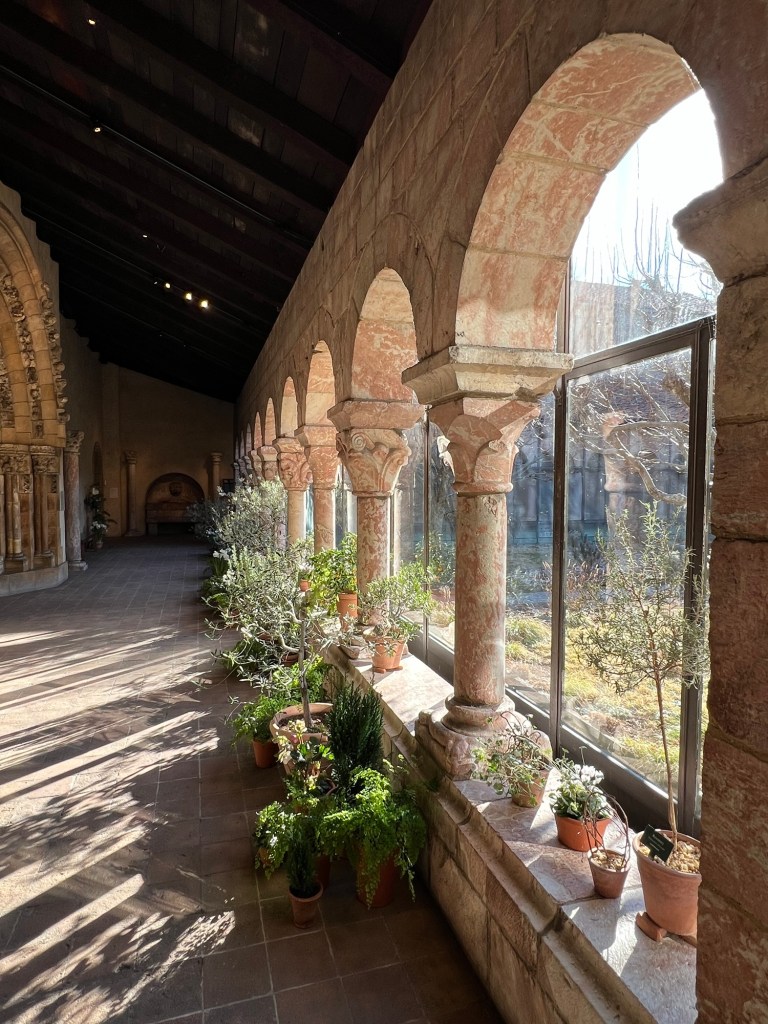
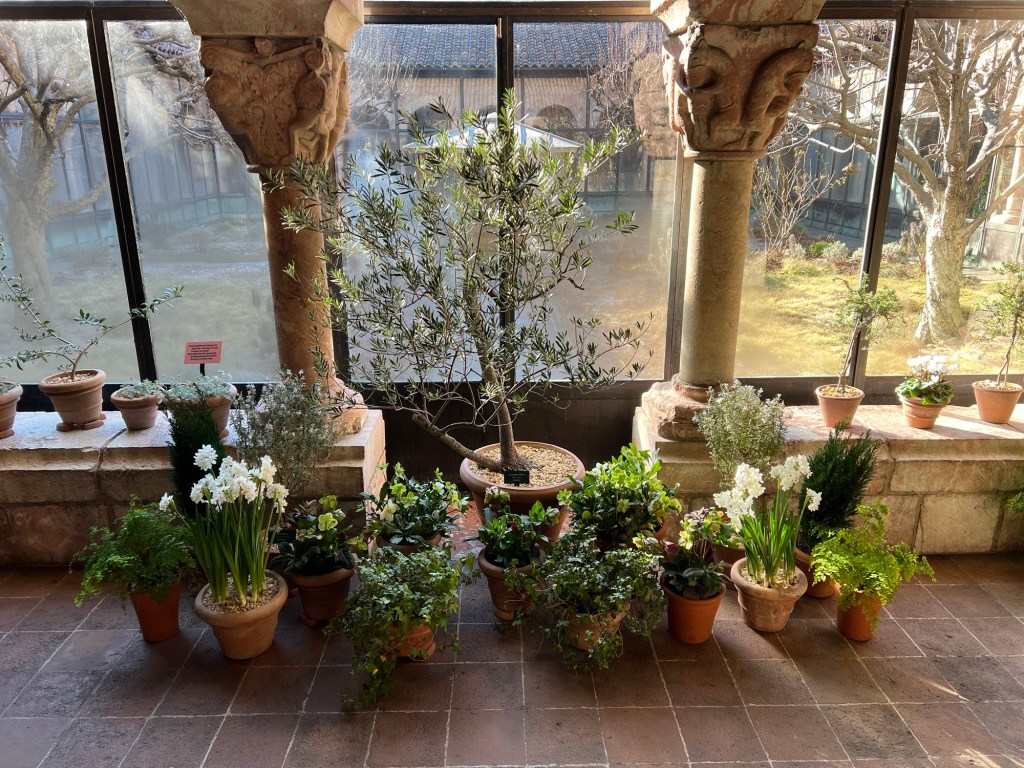
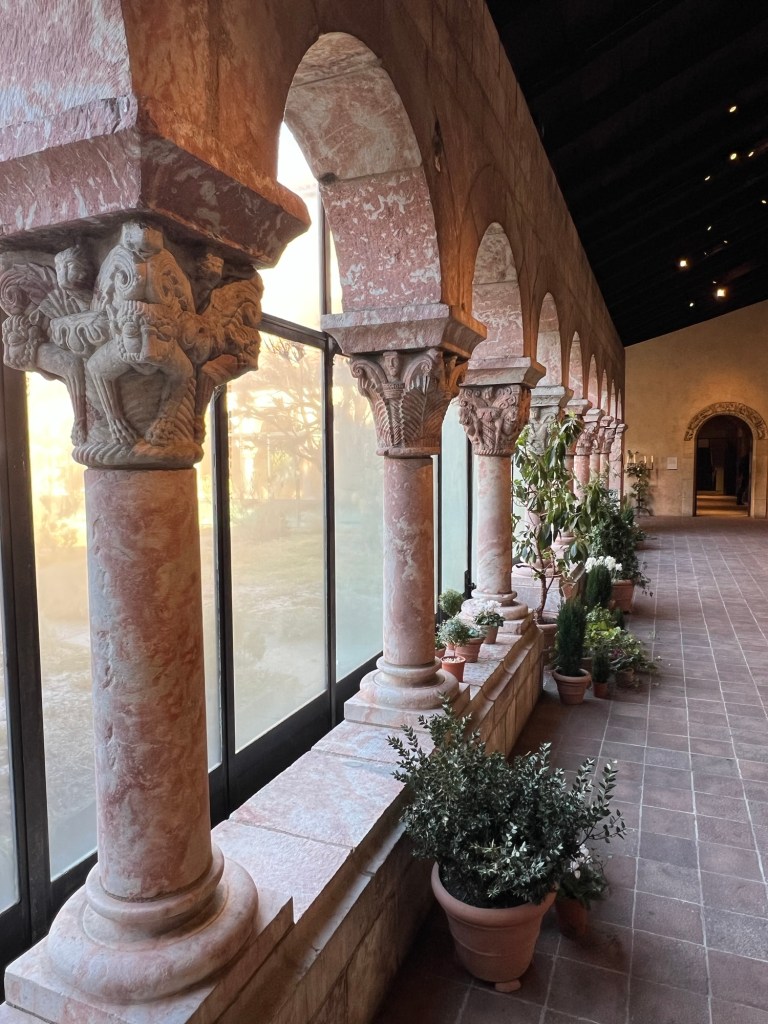
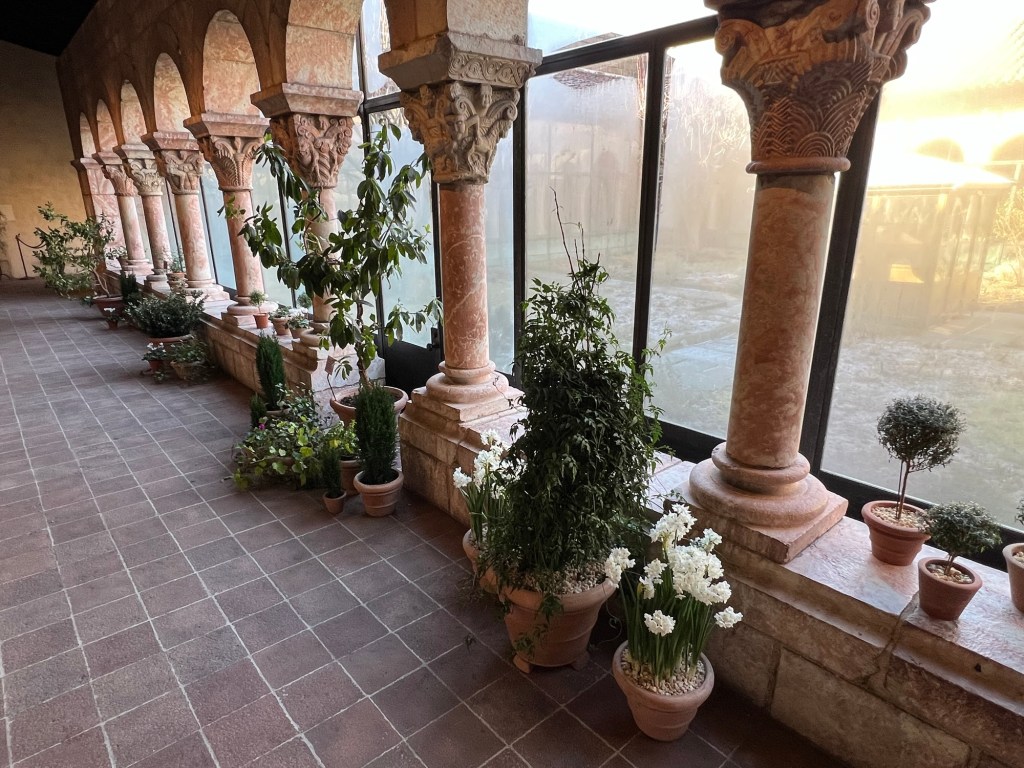
Fee: Adults $30.00/Seniors/Students $17.00/Children $12.00/Members & Patrons and Children under 12 are free (prices do fluctuate). NY, NJ and CT students and NY residents Pay as you wish.
Museum Hours:
Hours: Open 7 days a week
March-October 10:00am-5:15pm
November-February 10:00am- 4:45pm
Closed Thanksgiving Day, December 25th and January 1st.
*Some galleries may be closed for construction or maintenance.
I went on the Spring Garden tour at the Cloisters Museum with a discussion on Spring plantings and the use of those plants during Medieval times. The museum studied what plants were used for religious and medical practices.
We started the discussion of the plantings out in the first Cloister by the Hudson River
The Tour of the Gardens at The Cloisters in the Spring 2026:
(From the Museum website)
The gardens of the Middle Ages included both real and ideal gardens. Poets and artists delighted in the depiction of fantasy gardens like the Garden of Love or of Paradise, but no real garden of the time remains to us. Historical records are rare and incomplete; the ninth-century plan for the monastery of St. Gall, with its carefully drawn and labeled garden beds, is unique. Archaeological excavations are yielding valuable new evidence, but we still know more about infirmary gardens of medicinal plants and aristocratic pleasure gardens than we do about humble kitchen plots of potherbs and vegetables (Met.org).
The gardens of the Museum, planted in reconstructed Romanesque and Gothic cloisters, evoke those that provided sustenance and spiritual refreshment within the medieval monastery. Designed as an integral feature of the Museum, the gardens have been a major attraction of The Cloisters since its opening in 1938, enhancing both the setting in which the Museum’s collection of medieval art is displayed and the visitor’s understanding of medieval life.
My tour of walking the gardens that afternoon:
My video
The gardens are designed and maintained by a horticultural staff actively engaged in researching and developing the living collection (Met.org).
The plantings of the first Cloister we visited
We walked through the Cloister discussing how plantings were determined by medical and religious purposes
The flower beds in the Cloister
The view of the Hudson River was amazing
The flowers in bloom
Flowers in bloom
Flowers in bloom
Flowers in bloom
We moved the next Cloister looking over the medical plants and flowers
The Cloister in bloom
Walking around the Cloister
The plants around the sills of the Cloisters
Touring the Cloisters and admiring the flowers
Everything in bloom
We toured the last Cloister while the tour guide explained the plantings
The last Cloister we toured
The garden in full bloom
The growth of the hops growing on a trellis
The hops planting up close
The flowers in bloom in the Cloister
A very interesting video of “Art and Gardens at the Met”
We ended the tour admiring the art in the Tapestry Room and having a discussion about the use of plants and flowers in Medieval art. The artists at that time thought of the natural world with awe and respect. They admired the beauty of the natural world where in some points was still feared,
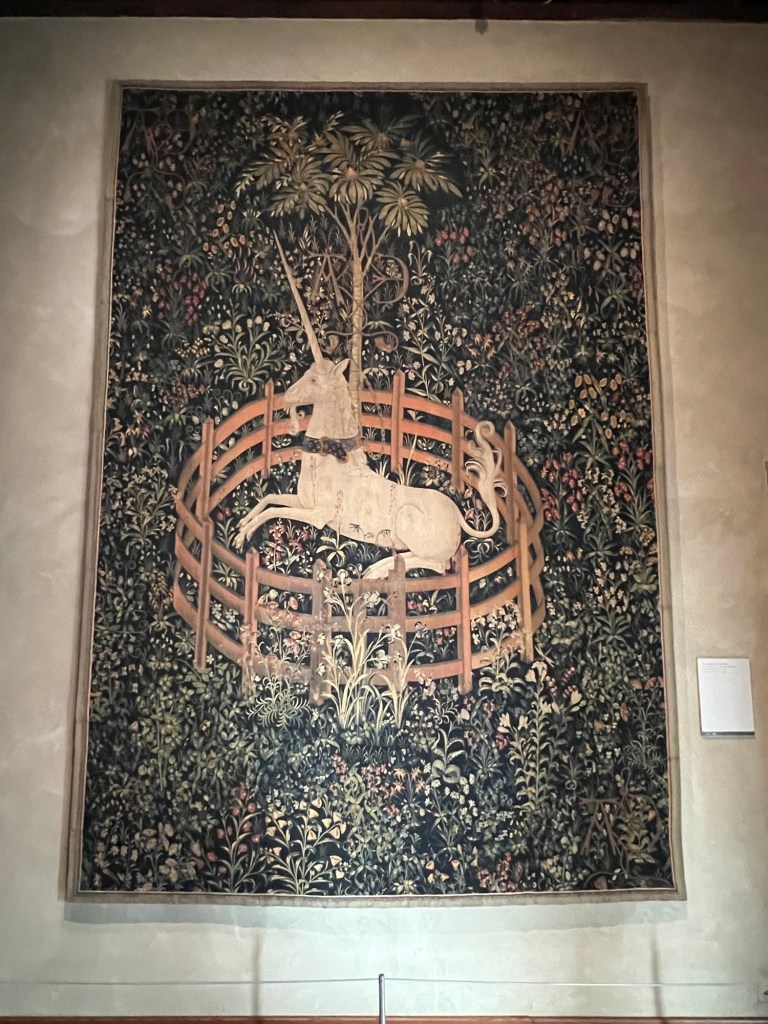
‘The Hunt of the Unicorn’ tapestry discussion
I then visited the ‘Creatures of Myth and Imagination-European and the Americas’ exhibition.
This exhibition was an interesting look at mythical beasts of the era of great exploration from European to the Americas. It reminded me of the book “In Search of Ancient Astronauts” with many golden creatures that look like they are visitors from another planet, Ancient Gods to worship and one civilization’s outlook on the unknown. The artwork was a cross between mysticism and respect.
The exhibition sign for “Creatures of Myth and Imagination: Europe and the Americas”
Set in the evocative atmosphere of The Met Cloisters, Creatures of Myth and Imagination: Europe and the Americas sheds light on a selection of works created on either side of the Atlantic Ocean between 500 and 1500 CE. The exhibition’s exploration of hybrid creatures deepens our understanding of their apparent necessity among diverse peoples. In the Americas, a complex gold pendant by a Tairona artist of northern Colombia, depicting a confrontational figure with hands on hips, a crocodile-like head, and an enormous headdress, would have reflected and expressed the wearer’s status and power. In Europe, ferocious dragons such as the one depicted on a monumental fresco from the monastery of San Pedro de Arlanza, Spain, took center stage to convey a multiplicity of meanings both sacred and profane (Met.org).
The exhibition gallery
Unusual mythical creature
(From the museum website)
For as long as humans have told stories, we’ve imagined creatures that transcend the natural world. Fantastical beings combining the features of animals, humans, and even plants appear across cultures, emerging in the most ancient myths and enduring in contemporary epics. The widespread presence of these supernatural beings, possessing the power to transform and be transformed, reflects a global impulse to make sense of both known and unknown worlds. Visual artists have given form to these imaginary creatures, resulting in some of the most fearsome, beloved, and extraordinary works of art ever made (Met.org).
Small gold ancient Gods
Ritual Knives
Double pendants
Earth Deity
I took one last tour of the museum gardens before I left for the afternoon. On the balcony overlooking the Hudson River offered beautiful views and beautiful potted plants.
Walking out of the back Cloister
The back Cloister
The beautiful white flowers
The balcony overlooking the Hudson River
The potted plants by the doorway
The view of the Hudson River
Looking north up the Hudson River
The tour of the Gardens was amazing and the exhibition on the Pre-Columbian art interesting. It was a wonderful tour of the Cloisters.
In the months of March and May right before the Memorial Day holiday, many of the museums I belong to held their private ‘Members Night’, where they hold extra hours for members after the museums are closed to the public to come and see the exhibitions, listen to music, have something to eat and drink and listen to talks about the exhibitions. The funny part is that the museum’s are more crowded on these nights than when they are open to the public.
Walking inside the soaring dining space at the Morgan Library
The first set of ‘Members Nights’ I went to were on March 24th with my first stop at the Morgan Library. I was there to see the ‘Mozart’ exhibition again.
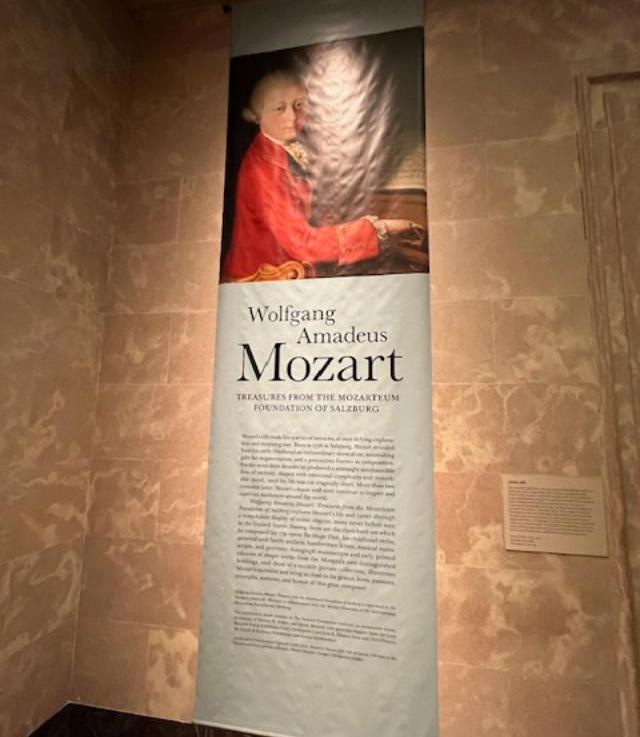
Wolfgang Amadeus Mozart: Treasures from the Mozarteum Foundation of Salzburg, an exhibition that traces the extraordinary life and enduring legacy of Wolfgang Amadeus Mozart (1756–1791). On view March 13th through May 31st, 2026, this two-gallery exhibition combines the Morgan’s significant holdings in Mozart manuscripts and first editions with remarkable objects, on view in the United States for the first time, from the Mozarteum Foundation of Salzburg. These include Mozart’s clavichord on which he composed The Magic Flute and his childhood violin, as well as famous portraits, letters, and personal objects of Mozart and his family (Morgan Library.com).
Touring the exhibition
Video on the exhibition:
The concert of Mozart as a child
The Magic Flute music and costumes
I happen to love ‘The Magic Flute’ and it was interesting to see the notes and some of the original costumes from the opera at the exhibition.
The costumes from the Magic Flute
After I toured the Mozart exhibition, I toured the rest of the museum that included the original part of the mansion.
The old Living Room
The ceiling outside the exhibition hall
The old Library and Rare book collection
The ceiling in the old Library
I then visited the exhibition of ancient Mesopotamia art scrolls. This was really interesting how this form of written art worked into the collection.
After touring the museum, I went to see what everyone was eating in the museum’s small restaurant was eating because it was getting crowded. The counter was filled with delicious looking desserts.
The sweet treats at the dessert bar at the Morgan Library
The selection of desserts at the Morgan Library the night of Member’s Night
I then visited their very interesting Gift Shop
Admiring the flowers at the Coat Check on the way out. I thought this was a nice touch.
All good things come to an end and I made my way up Fifth Avenue to the Museum of Modern Art for the second part of the evening
I could not believe that the museums arranged these ‘Members Nights’ on the same night. They would plan this three weeks late when the Museum of Modern Art and the Metropolitan Museum of Art. I just had to enough time at one museum and see what I wanted to see and then go up the next.
The Museum of Modern Art (MoMA) at 11 West 53rd Street
Frida and Diego: The Last Dream celebrates Frida Kahlo and Diego Rivera—two of Mexico’s most beloved icons of 20th-century art—in a first-of-its-kind collaboration with the Metropolitan Opera. Organized in conjunction with the Met’s new production of El Último Sueño de Frida y Diego, the presentation at MoMA features artworks by Kahlo and Rivera in an elaborate setting designed by Jon Bausor, the set and co-costume designer of the opera. For both the opera and installation, Bausor evokes the artists’ lives and artworks in his theatrical designs (MoMA.org).
Key participants in a movement to redefine Mexican culture and identity after the revolution of 1910–20—Rivera through monumental murals and Kahlo through intimate self-portraits—the artists were romantically involved from 1928 until Kahlo’s death in 1954. The fictional narrative of the opera El Último Sueño de Frida y Diego begins three years after Kahlo’s death and follows an aging Rivera as he summons the deceased Kahlo back to life on the Day of the Dead, a Mexican holiday honoring passed loved ones. As the opera and installation design attest, the pair continue to have an enduring influence on artists across the visual and performing arts (MoMA.org).
Video on the exhibition:
The opening of the ‘Frida and Diego’ exhibition brought members out in droves
The description of the exhibition
The tree dominates the center of the exhibition
The signature piece from the exhibition
One of the dominate drawings
Looking over costume designs
Some of my favorite costume designs
Another great costume design
After touring the exhibition, I visited some of the other galleries and looked over other works of art that I admired in the past. I took a quick tour of the Modern Galleries before I left that evening.
The Jackson Pollack work
I loved this creative food service work
After touring the museum, I joined the rest of the crowd on the main floor for music.
The main lobby of the MoMA the night of Member’s Night
A few weeks later, the Metropolitan Museum of Art had planned their Member’s Night and then the Museum of Modern Art planned a Member’s Night the same night. So I planned another night of running back and forth between museums.
Member’s Night at the Museum of Modern Art
The schedule of events
There was a lot of activities happening that evening and I wondered around museum to see all of them. I started in the Museum Garden to hear the singers who were performing that evening.
The first performer was Lizzy Hilliard, who performed the guitar and was really enjoyable to hear. She is a very lively and engaging entertainer.
The crowds were outside enjoying the beautiful weather that evening
My video on the performance by Lizzy Hilliard: that evening:
The video:
Lizzy Hilliard performing that evening in the garden
After the performance, I wondered around the museum to see some of the exhibitions and started on the first floor which was really active.
I love wondering through the lobby of the MoMA.
While most of the crowds were still listening to the entertainment in the garden, I went up to the Marcel Duchamp exhibition and toured the galleries again (I had been there the previous week and quickly walked the exhibition).
The Marcel Duchamp exhibition was the biggest retrospect of the artist’s work in years
Marcel Duchamp is organized by The Museum of Modern Art, New York, and the Philadelphia Art Museum, with the generous collaboration of the Centre Pompidou. “Contemporary artworks often prompt viewers to ask, ‘Why is this art?’ It is virtually impossible to answer this question without referring to the work of Duchamp,” said Temkin. “More than any other modern artist, Duchamp challenged and transformed the very definition of an artwork.” Kuo added, “Duchamp’s influence is incalculable and his myriad contributions have established him as one of the most important figures in modern culture (MoMA.org).
Our exhibition will foreground the ways in which Duchamp upended conventional oppositions between hand and machine, original and copy, intention and chance, and matter and idea.” MoMA and PMA have a longstanding history with Duchamp’s work. MoMA was the first museum to acquire a work by Duchamp, in addition to including his work in early landmark exhibitions such as Fantastic Art, Dada, Surrealism (1936) and The Art of Assemblage (1961) (MoMA.org).
Video on the exhibition from the MoMA curator:
I joined the start of the walking tour with one of the docents at the MoMA at the beginning of the exhibition
The gallery was so crowded with people listening to the one docent that was describing the exhibition that I continued on my own. I had never seen much of this artist’s work in museums before and had heard about his piece of changing the look of the Mona Lisa. I really enjoyed seeing it up close.
The 1919 original “L.H.O.O.Q.” was on a card
The 1930 replica “L.H.O.O.Q.”
The information on the replica piece
I then moved on to other works that he was well known for especially his controversial urinal piece.
The work “Fountain” (I thought this was unusual)
The write up on the piece
The last piece that I saw in the exhibition before I left the museum for the Met was his spoke wheel piece.
The work “Bicycle Wheel”
I wondered around the museum for a bit after the tour of the exhibition and admired works in the Modern Wing.
I love Picasso’s Cubism works
After I finished touring the exhibition, I left the MoMA for The Met. The weather was beautiful and with it being light out until almost 8:30pm. It was a beautiful walk up Fifth Avenue with the trees and the flower beds in full bloom.
Arriving at The Metropolitan Museum of Art for “The Met After Hours”
The lobby and rotunda for the event seemed very quiet to me
The beautiful floral arrangements in the lobby area were fresh Cherry Blossoms
The Cherry Blossoms in the urns around the lobby
The American Wing where the Member’s Bar and entertainment was located
The Met seemed very quiet that night. Being the Tuesday after Memorial Day Weekend, I guess most members were getting back to work or still tired from the weekend. It had been a rainy mess the whole weekend and I could not see many people going away.
The bar and the entertainment in the American Wing were located that evening.
I had about two hours before the museum closed for the evening, so I wondered through some of the special exhibitions and started with the “Raphael-Sublime Poetry” exhibition on the second floor.
Raphael: Sublime Poetry is the first comprehensive exhibition on Raphael in the United States, bringing together more than 170 of the artist’s greatest masterpieces and rarely seen treasures to illuminate the brilliance of Raphael’s extraordinary creativity. The son of a painter and poet, Raphael engaged with the foremost writers and thinkers of his age in Rome, displaying a poetic sensibility that captivated his peers and generations that followed. Follow the full breadth of his life and career, from his origins in Urbino to his rise in Florence, where he began to emerge as a peer of Leonardo da Vinci and Michelangelo, to his final, prolific decade at the papal court in Rome (Met.org).
Dive into the artistic process of one of history’s most beloved and influential artists. A true titan of the Italian Renaissance, Raffaello di Giovanni Santi (1483–1520)—better known as Raphael—matched ambition with lyricism to create works with both intellectual heft and emotional depth, a necessary skill in the complex political landscape of Renaissance courts. In his short life of only 37 years, he achieved such profound success as a painter, designer, and architect that he was regarded as the pinnacle of artistic perfection for centuries after his death (Met.org).
Video on the exhibition with the MoMA:
Video on the exhibition with CBS This Morning:
The work admired as I was walking around the exhibition.
This was my favorite piece from the exhibition
The Raphael Exhibition I know was a big deal for the museum but it really was not my taste in art. As much as I admired the work, the whole exhibition did not ‘grab me”.
I was not as impressed with the art in the exhibition and took a quick tour of the works. I had seen the exhibition on a previous tour of the museum so I just wanted to walk around again to see the works that I missed.
I then went back to the first floor and spent more time at the Costume Art exhibition. There had been so much media on the exhibit that you could not get in without timed tickets but because it was quiet on Member’s Night, I just walked in.
The Costume Institute’s spring 2026 exhibition explores depictions of the dressed body across The Met’s vast collection, pairing garments with artworks to reveal the inherent relationship between clothing and the body (Met.org).
Focusing primarily on Western art from prehistory to the present, Costume Art presents connections between garments from The Costume Institute and objects from the Museum’s other collecting areas. Pairings between fashions and artworks will present a spectrum of connections and experiences: from the formal to the conceptual, the aesthetic to the political, the individual to the universal, the illustrative to the symbolic, and the playful to the profound. These pairings are organized into a series of thematic body types that reflect their pervasiveness and endurance through time and cultures (Met.org).
Video on the Costume Art exhibition:
Walking through the entrance of the exhibition
This gallery was newly created for this collection and I had display the pieces that stood out to me the most in the Costume Art exhibition.
One of the pieces I admired
Some of the Evening clothes I admired
Another piece I admired
I thought this was really unusual
I really enjoyed looking over the exhibition yet wondering how many people would actually wear some of these pieces out in public. It really asks the question “What is art?” Still, I loved the dress with all the human organs on it. Now that would stop everyone in mid conversation at a party.
All good things come to an end again and I left the Met as it was closing for the evening. It really is a pretty site at night looking down Fifth Avenue.
How beautiful the Upper East Side is at night
I was starved when I left the museum and knew not too many places outside the bars would be open this late at night. I remembered Asian 83 on East 83rd Street that still might be open for the evening and I was one of their last customers that night. The food is excellent at this little ‘hole in the wall’ on the Upper East Side.
Dinner at Asian 83, Beef and Broccoli with Fried Rice
I ordered a combination platter of Beef and Broccoli with Fried Rice and an Egg Roll with a Coke. Their prices are so reasonable and their portion sizes are very fair. It was a nice dinner before I left Manhattan that evening.
The Beef and Broccoli entree
Their Egg Rolls are excellent
Being a member of many museums, this is one of the perks about membership. You get to enjoy these wonderful evenings while supporting the museums which in this economy really helps. That’s why I have enjoyed supporting them for years. The donation benefits everyone.
One of the things I love about being a member the Metropolitan Museum of Art is the private Member’s Night ‘Met After Hours’ they hold about four times a year. The museum is open after the closing hours and it is a night of wondering the museum galleries, great music and entertainment and wonderful tours and talks in the galleries. You really experience the museum at its best and it does shine.
The lines move very quickly to get into the museum and with traffic getting into the City that night, I arrived about twenty minutes after opening and there were no crowds to face and I got right in. There’s always a sense of excitement on these nights.
The Grand Hall in the front of the museum decorated with Spring flowers
The beautiful Spring flowers lined all the urns around the Great Hall
The museum welcoming all the members of the museum at ‘The Met After Hours’
I started my walk around the galleries in the Greek Wing touring the main hallway. It still boggles my mind how old these statues are and I am looking at something almost two thousand years old.
The Museum’s collection of Greek and Roman art comprises more than thirty thousand works ranging in date from the Neolithic period (ca. 4500 BCE) to the time of the Roman emperor Constantine’s conversion to Christianity in 312 CE. It includes the art of many cultures and is among the most comprehensive in North America. The geographic regions represented are Greece and Italy, but not as delimited by modern political frontiers: Greek colonies were established around the Mediterranean basin and on the shores of the Black Sea, and Cyprus became increasingly Hellenized. For Roman art, the geographical limits coincide with the expansion of the Roman Empire. The department also exhibits the art of prehistoric Greece (Helladic, Cycladic, and Minoan) and pre-Roman art of Italic peoples, notably the Etruscans (Metropolitan Museum of Art website).
One of the statues that stood out that evening
I spent some time admiring the statues and the craftsmanship of the works along the hallway. The only problem is that most of the Greek and Roman Galleries were closed for the evening so I headed off to the Renaissance Wing. I love the luxury objects in the collection of silver and gold and again their craftsmanship is still unrivaled today. To make these objects takes intensive work and talent.
The timepieces show how advanced science had become and the importance of it in not just measurements but in beauty.
The lobby of the American Wing with the facade of what was a former bank and a Wall Street private mansion. I love the quiet elegance of this building and to think they moved it here piece by piece. The American Wing Cafe was open for the evening and the area was busy throughout the evening. It is nice to just sit and enjoy the views by the fountain. The artwork is beautiful.
Visitors to the American Wing will experience in more than 75 galleries on three floors varied art, design, and culture from the mid-seventeenth to the mid-twentieth century, with some contemporary expressions, by a diverse array of artists from across North America. Since our founding in 1924, this curatorial department has evolved its collecting to include some 20,000 artworks in many mediums by African American, Asian American, Euro-American, Latin American, and Native American makers, affirming ever more inclusive definitions of American art and identity. These dynamic holdings include painting, sculpture, drawing, furniture, textiles, regalia, ceramics, basketry, glass, silver, metalwork, jewelry, as well as historic interiors and architectural fragments, produced by highly trained and self-taught artists, both identified and unrecorded (Metropolitan Museum of Art website).
The evening then moved to the Egyptian Wing and the Temple of Dendur, where the entertainment and the cocktail bar was located.
The Temple of Dendur is the hub of activity on Members Nights
This small temple, built about 15 B.C., honored the goddess Isis and, beside her, Pedesi and Pihor, deified sons of a local Nubian ruler. On the outer walls between earth and sky are carved scenes of the king making offerings to deities who hold scepters and the ankh, the symbol of life. The figures are carved in sunk relief. In the brilliant Egyptian sunlight, shadows cast along the figures’ edges would have emphasized their outlines. Isis, Osiris, their son Horus, and the other deities are identified by their crowns and the inscriptions beside their figures (Metropolitan Museum of Art).
These scenes are repeated in two horizontal registers. The king is identified by his regalia and by his names, which appear close to his head in elongated oval shapes called cartouches; many of the cartouches simply read “pharaoh.” This king was actually Caesar Augustus of Rome, who, as ruler of Egypt, had himself depicted in the traditional regalia of the pharaoh. Augustus had many temples erected in Egyptian style, honoring Egyptian deities (Metropolitan Museum of Art).
The area was packed with patrons enjoying music and talking by the bars. The crowds were so large at the beginning of the evening that I waited until after 9:00pm for the second performance of the group playing. So I headed into the section of the Egyptian Wing to look at the galleries that were open. I love walking around the Egyptian Wing of the Met. It is one of the most extensive collections outside of Egypt and the most fascinating Mummy exhibition.
Admiring one of the Mummy exhibits in the Egyptian Wing
The Department of Egyptian Art was established in 1906 to oversee the Museum’s already sizable collection of art from ancient Egypt. In the same year, the Museum’s Board of Trustees voted to establish an Egyptian Expedition to conduct archaeological excavations in Egypt. Between 1906 and 1935, The Met’s Egyptian Expedition worked at a number of important sites, including Lisht in the north and Thebes in the south, and the objects gifted to The Met by the Egyptian antiquities service form the core of our collection. Over the years, the Department of Egyptian Art has also been able to acquire, through purchase and bequest, several important private collections (Metropolitan Museum of Art website).
The ancient tablets outside of the Mummy Exhibition
The Egyptian artwork outside the Mummy Room
The tablets outside the Mummy Room
When the whole gallery is open, it is a treasure trove of objects and information from each Dynasty. I have been mind-boggled by these galleries since I first visited the museum in the third grade for a class field trip. I remember sketching artifacts for a class project and am still fascinated about how old some of these objects are and condition they are still in after thousands of years. It is my favorite part of the museum.
By 9:00pm, the entertainment was starting again, so I joined other members for a cocktail and enjoyed the music in the Temple of Dendur Gallery.
The Temple of Dendur fully lit for the evening before the start of the entertainment
The signature cocktail of the evening, the Starlight Spritz
Enjoying a Starlight Spritz while listening to the music
The bartenders can mix a drink
After a long week at work, it was nice to relax and enjoy the music. The music that night was performed by artist Jasim Perales and Friends, an Afro-Latin Jazz performance. The music was relaxing and soulful and the crowd had a wonderful time.
The start of the music again at 9:00pm
The trio performing
A clip from the entertainment that night
The Master of Ceremonies that night, Jasim Perales
All good things come to an end and it was time leave. The night was dark and the winter air was crisp creating the perfect Winter evening to set out into for the walk back to Port Authority. The Upper East is so beautiful at night.
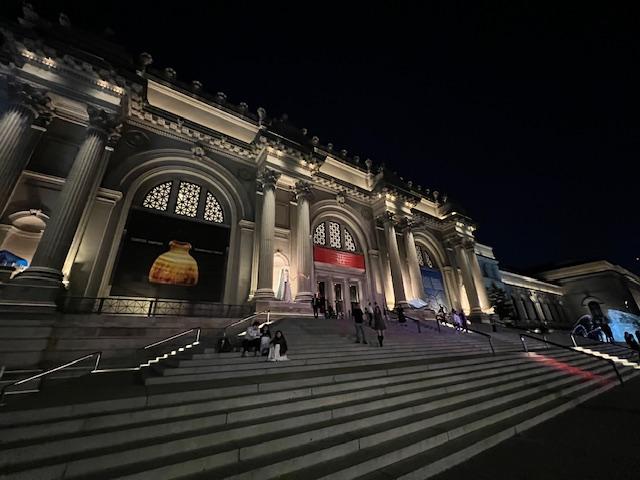
The front of the Met that night
The artwork is always so impressive outside the Met
It was in the low 40’s that evening and the perfect night for a walk around the Upper East Side and Midtown. It still surprises me after all these years of walking around Manhattan how beautiful the City really is at night.
It was another spectacular evening at the Metropolitan Museum of Art. Thank you to the Membership and Special Events Departments for hosting another wonderful evening.
I love the holidays in New York City. There are so many Christmas themed events to go to and decorated homes to visit. One of my favorite tours is at the Met Cloisters for their Christmas themed walking tours that take place from December through early January.
The Cloisters Museum & Gardens: A Branch of The Metropolitan Museum of Art
To finish my weekend of holiday festivities before the Epiphany, I took the annual Christmas walking tour of the Met Cloisters. The museum hosts an interesting walking tour of the history of the holidays during the Medieval era. Each tour has a different theme to it. There is the history of Christmas in that era, the use of plants and flowers in the decorating of the religious sites and the historic significance of the visit of the Three Kings.
Each tour guide incorporates the artwork, architecture and plants into the discussion. On average you will have about forty people on the tour.
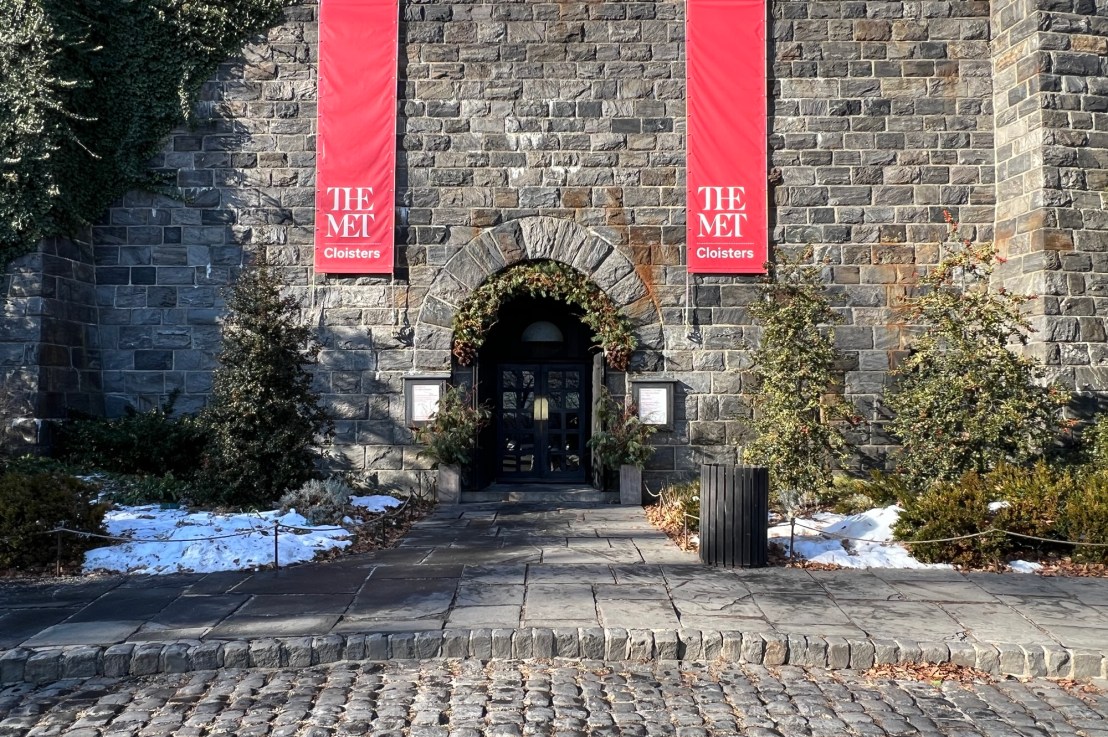
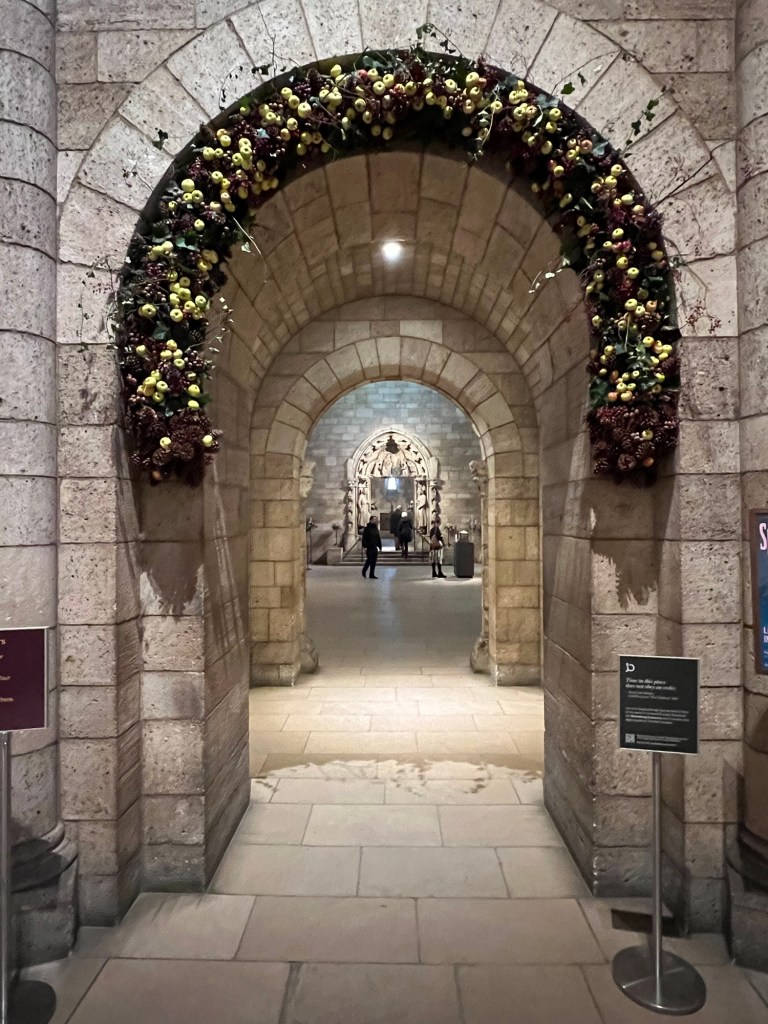
The entrance of the Cloisters decorated for the holidays
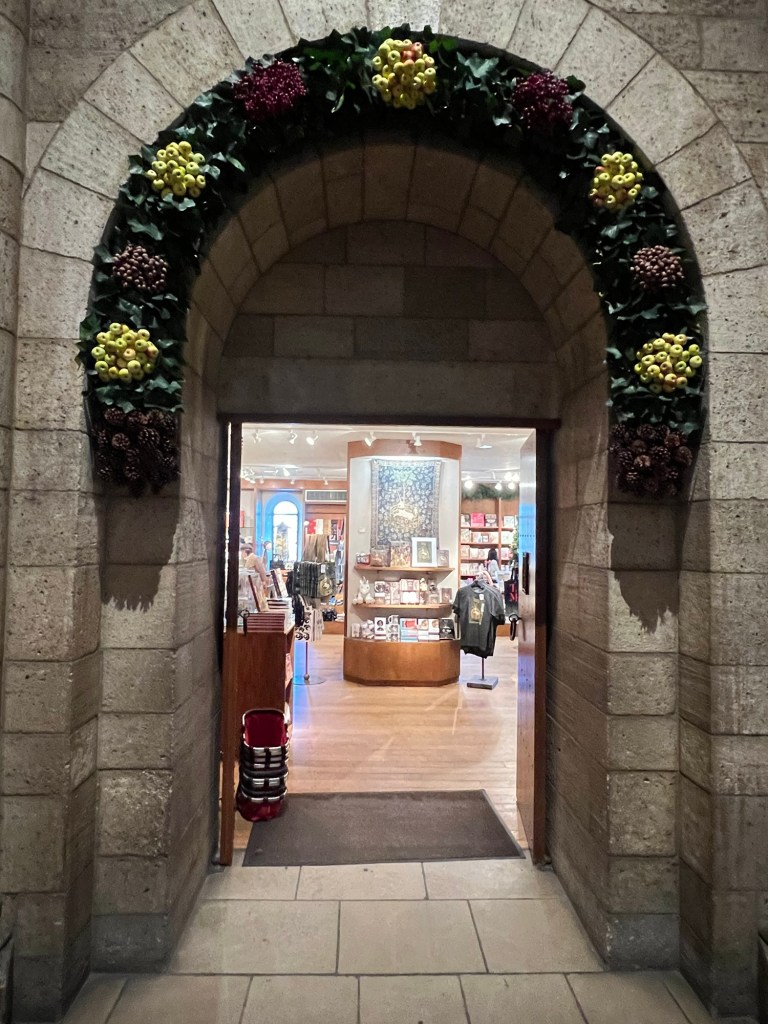
The entrance of the gift shop decorated for the holidays
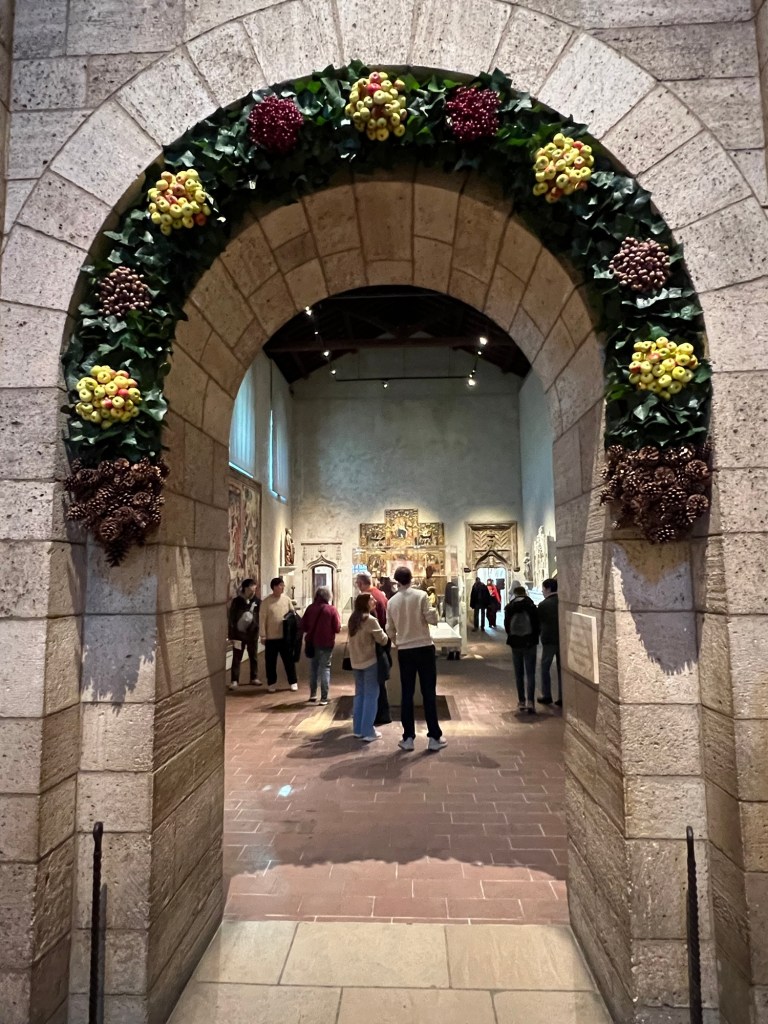
The archways were decorated with seasonal plants and fruits. I read online that the volunteers went into Fort Tyron Park and collected ivy from the wild to decorate the museum. Every day the museum is open during the holidays these are replaced on a daily basis.
The entrance to the galleries decorated for the holidays
We started the tour with a discussion of plants that once decorated churches and ministries
With the change in attitude towards the Christmas holidays during the Middle Ages and its incorporation into church traditions, decorating for the holidays came back into style. The use of holly, evergreen and mistletoe became part of the Christmas tradition and to justify the decorating, they were related to Christian symbols.
The beauty of the life plants in winter
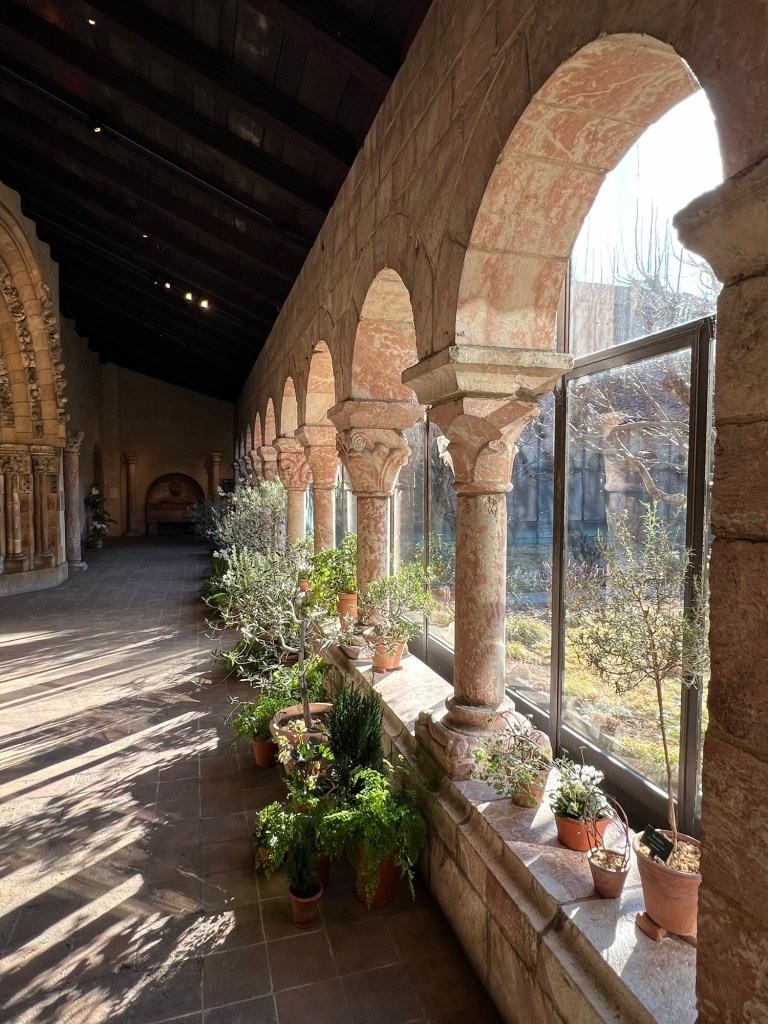
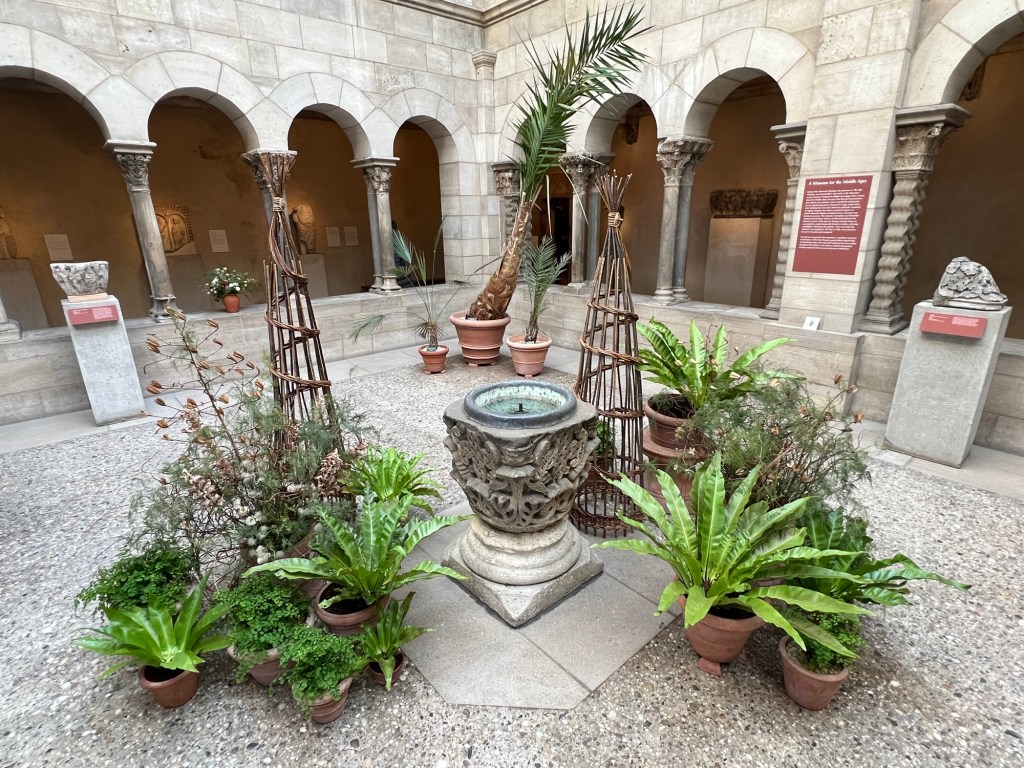
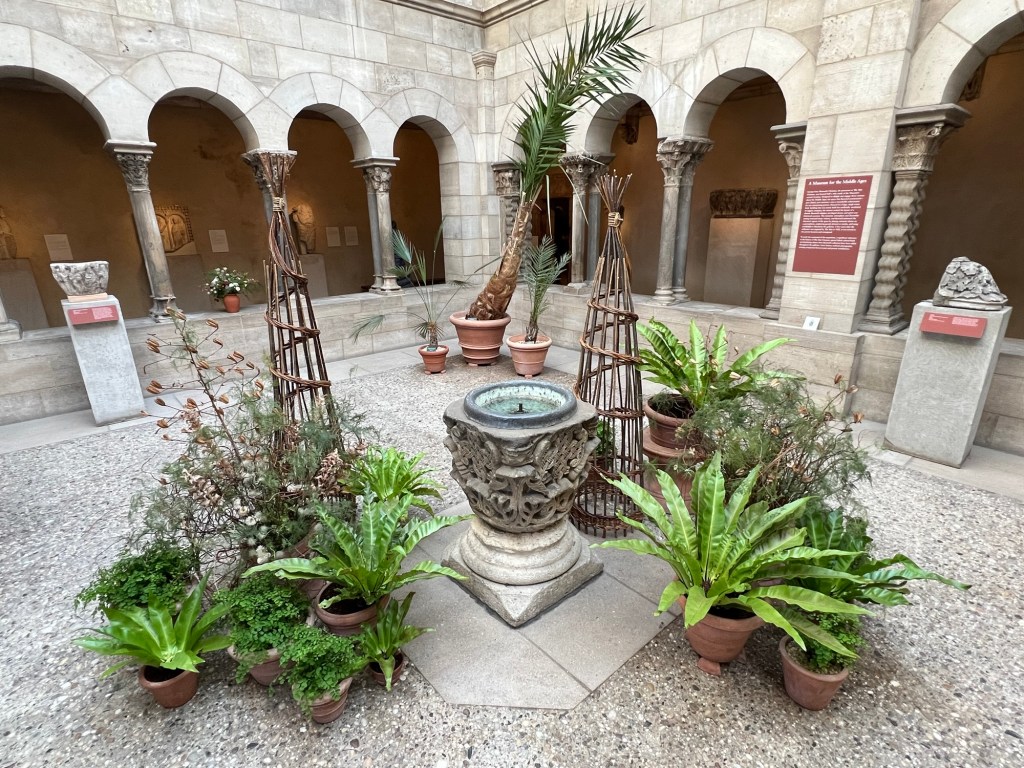
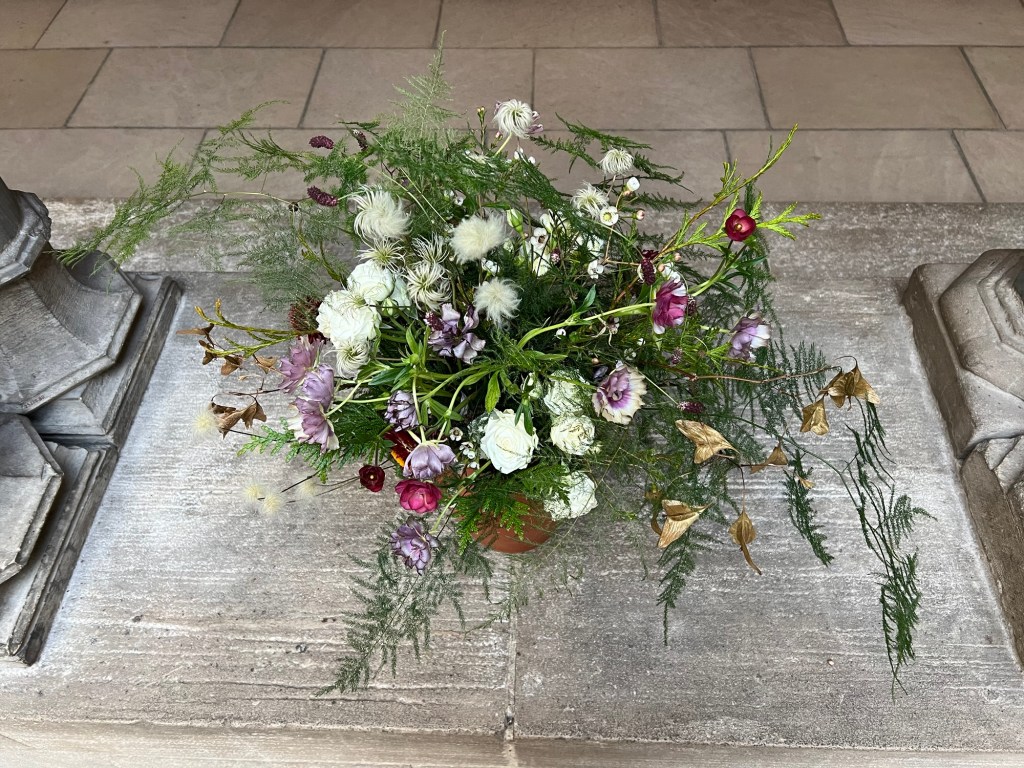
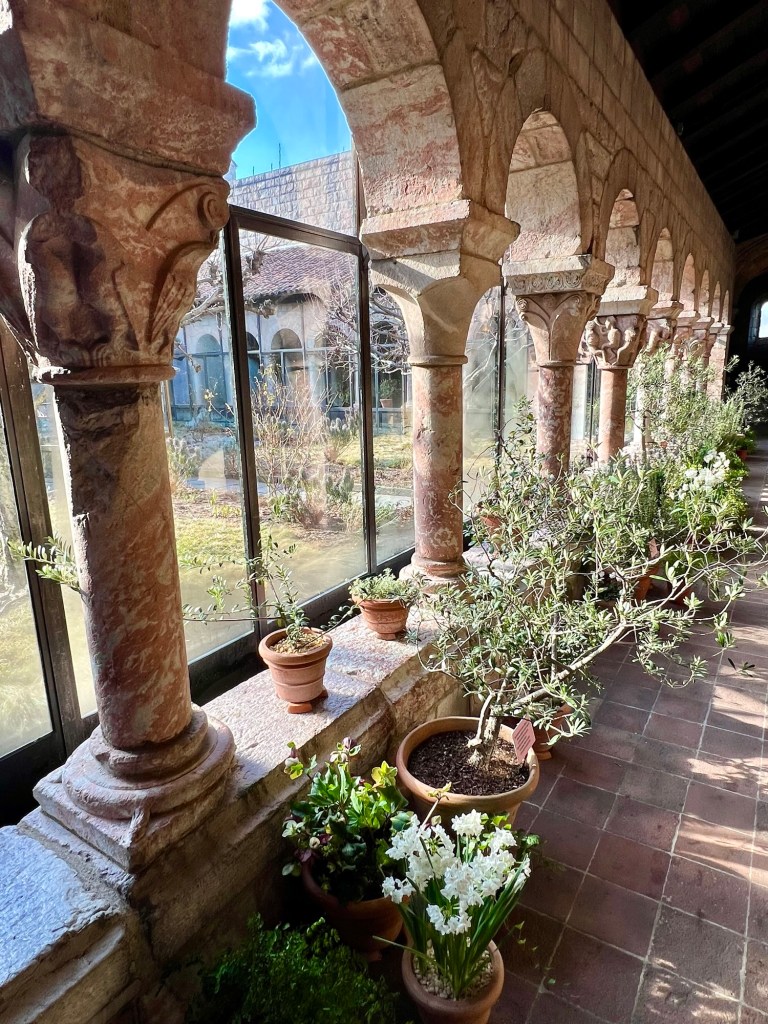
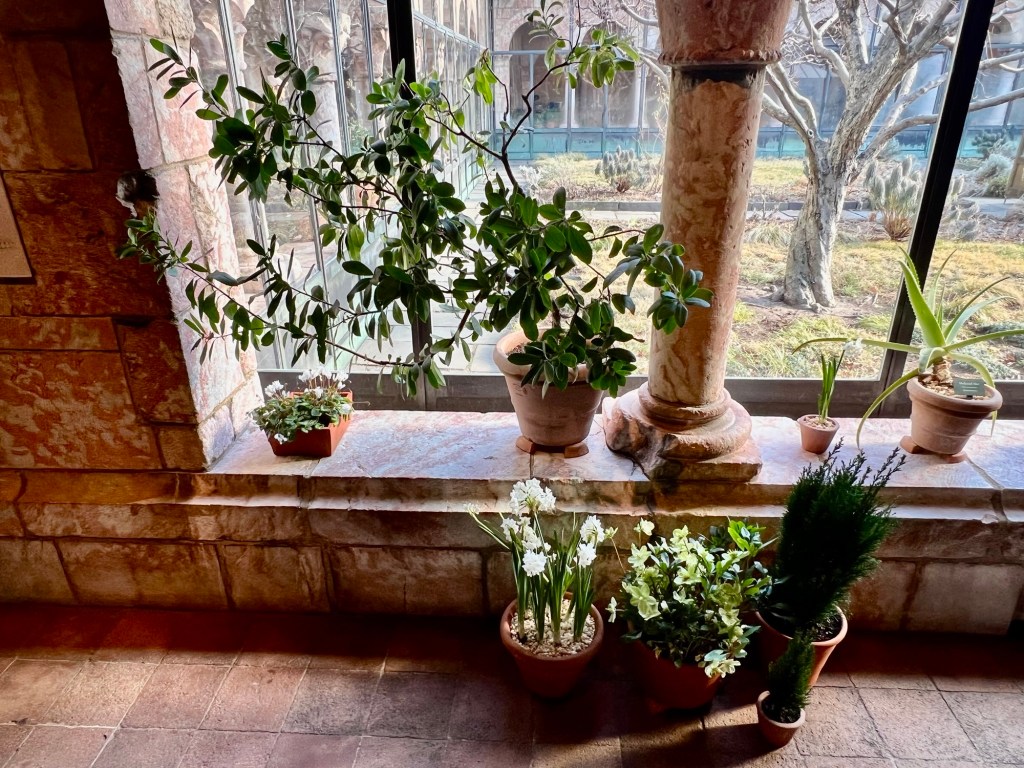
Each of the Cloisters were lined with fresh greens and potted plants giving each of the Cloisters its own special mood.
One of the Cloisters bright with plants
The stairs leading into the chapel decorated for the holidays
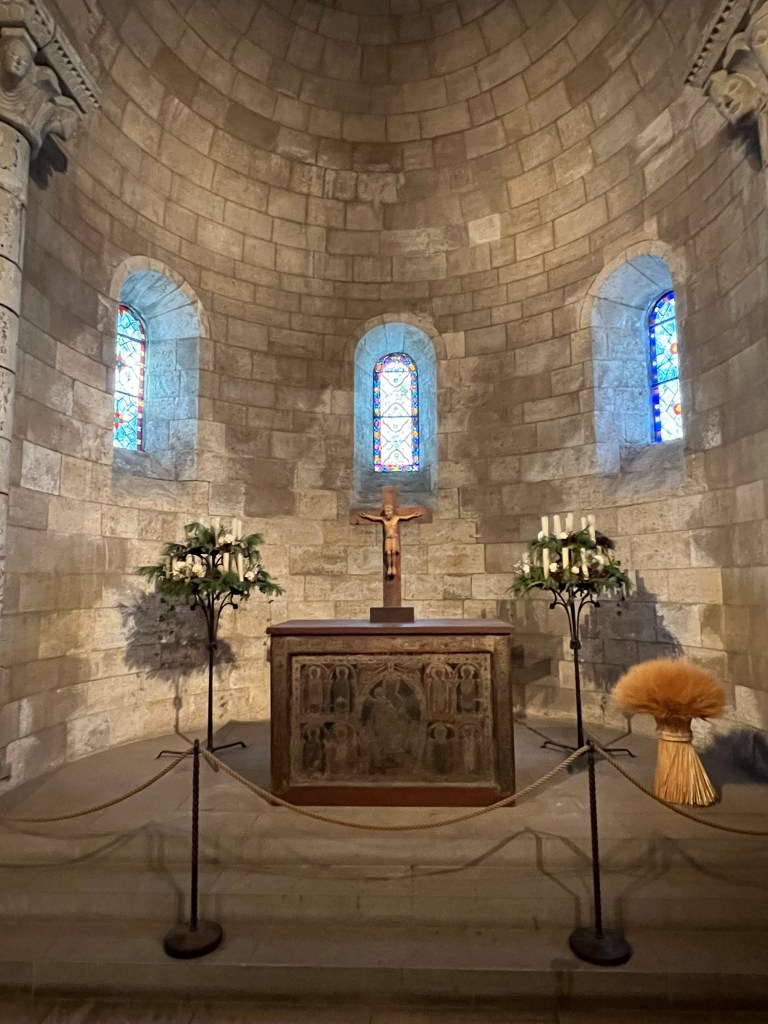
The chapel on the main floor decorated for the holidays
The colorful floral displays lining the window sills of the chapel
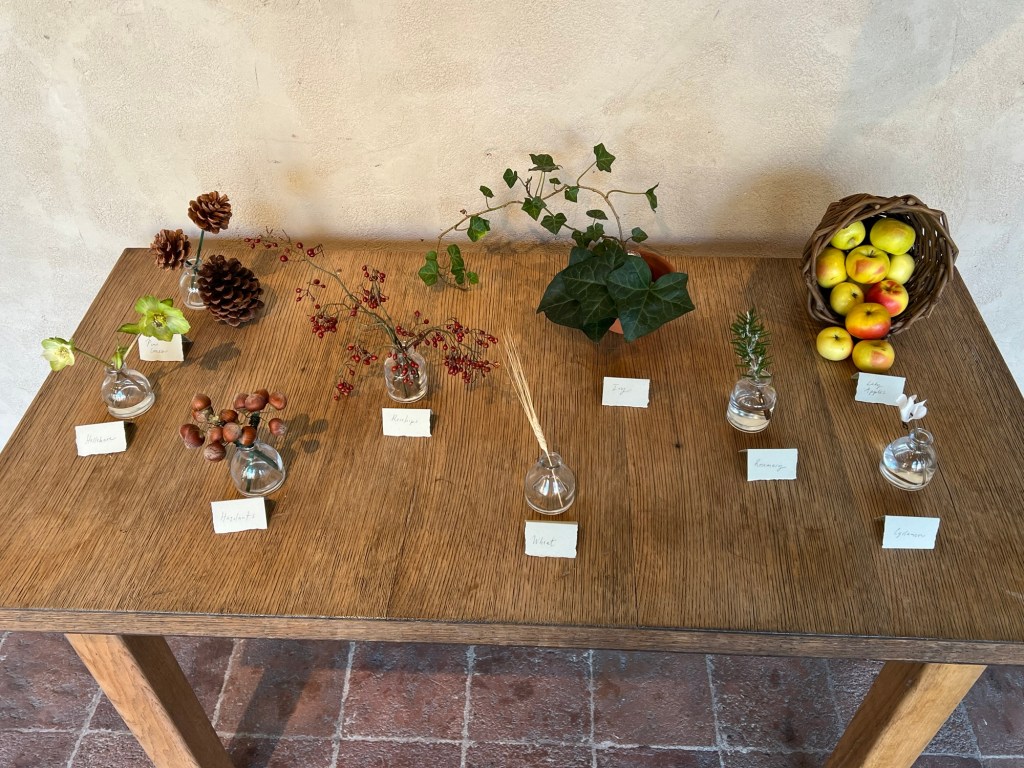
This led to a discussion about what each plant, flower and fruit meant in the Christian tradition, a clever way to justify decorating and celebrating during the holidays. Ivies, pine, winter flowers and even late season apples not only lined places of worship but gave a festive look and district smell to these buildings. A symbol of life in the cold winter months while they waited for the arrival of Spring.
The plant types that decorated the houses of worship
The flowers and plants lining the chapel
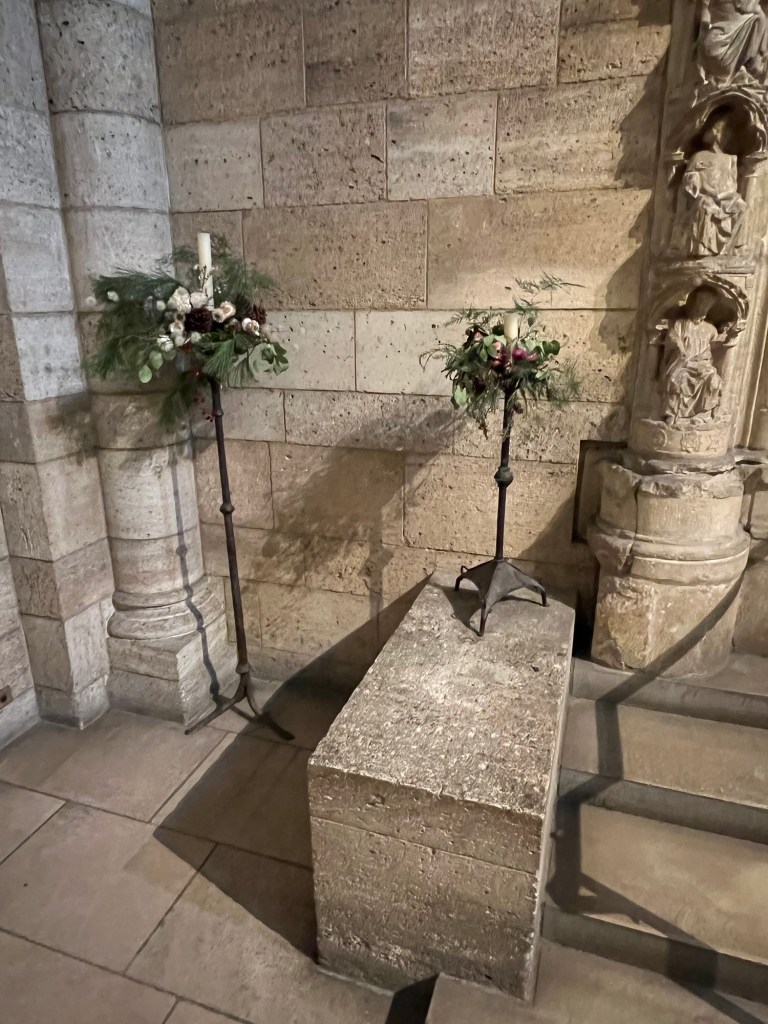
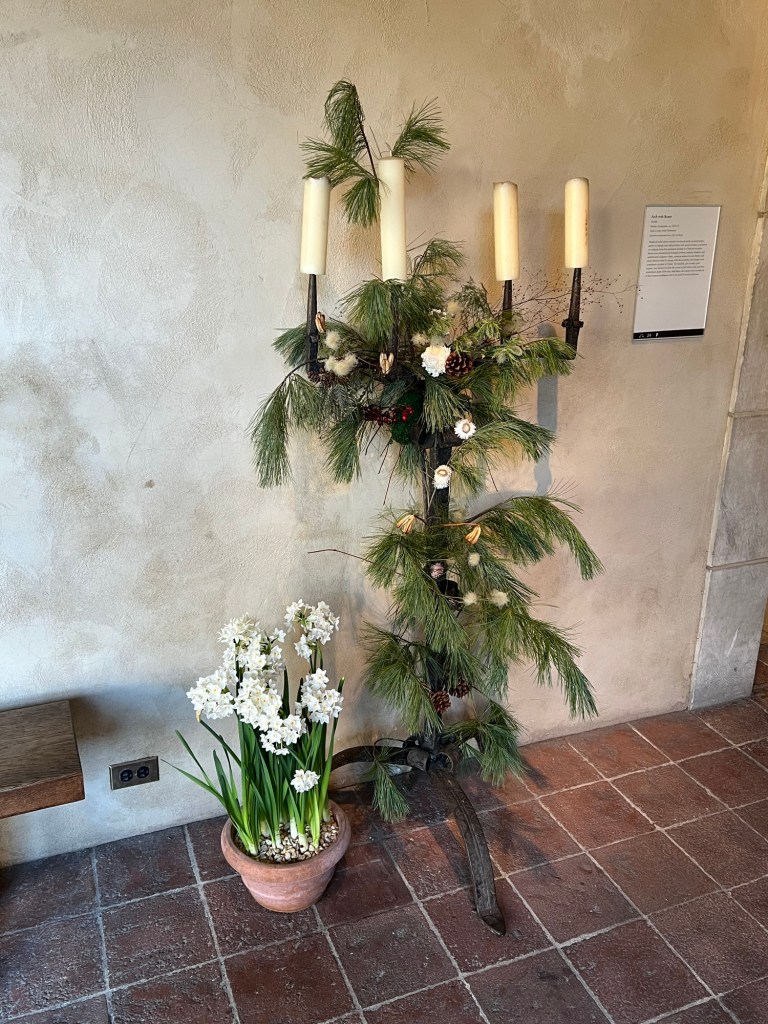
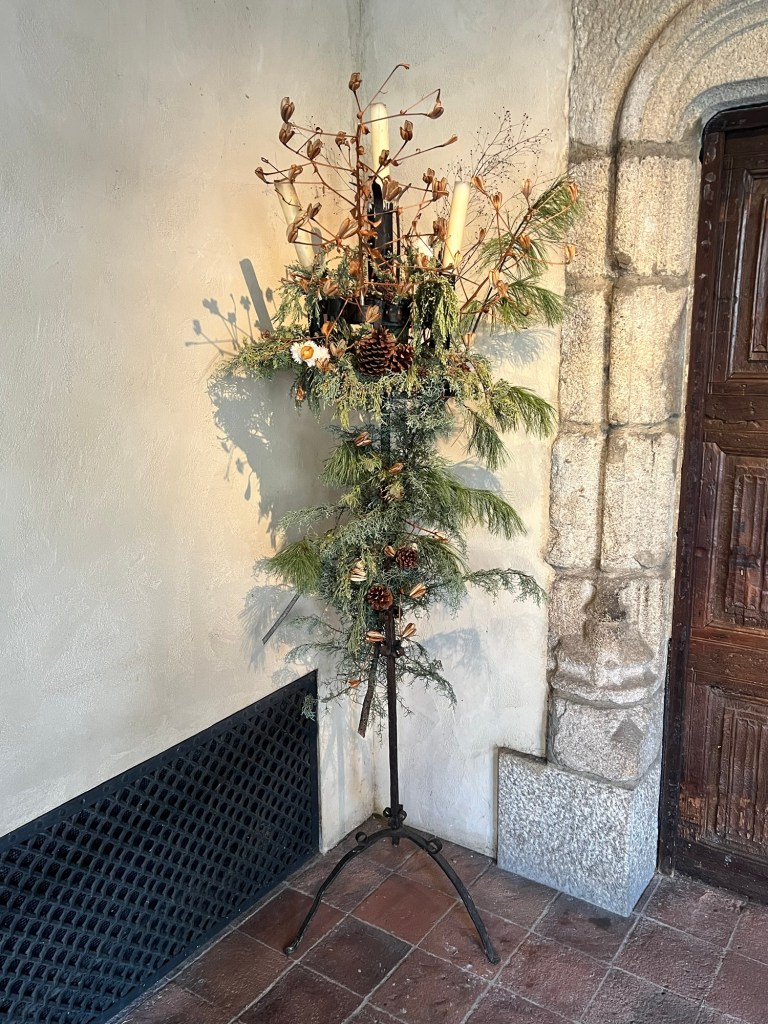
The decorative candle stands lining the walls of the chapel
We then toured the main Cloister, closed for the Winter but was lined with plants, flowers and greens brighting every corner of the building. These were examples of plants and flowers that would have decorated these halls at the holidays.
Walking the halls of the Cloisters
Touring the halls of the Cloisters with flowers and plants to celebrate the season
Walking the halls of the Cloisters
The flowering plants of the Cloisters
The flowering plants and vines that would have decorated churches in Medieval times
We then toured the Tapestry Room and discussed the use of plants in art form and the use of the detail as symbolism in art. These tapestries were meant to cover the drafty walls of palaces and bring in color and decoration to the stone walls.
The famous ‘Hunt of the Unicorn’ tapestry
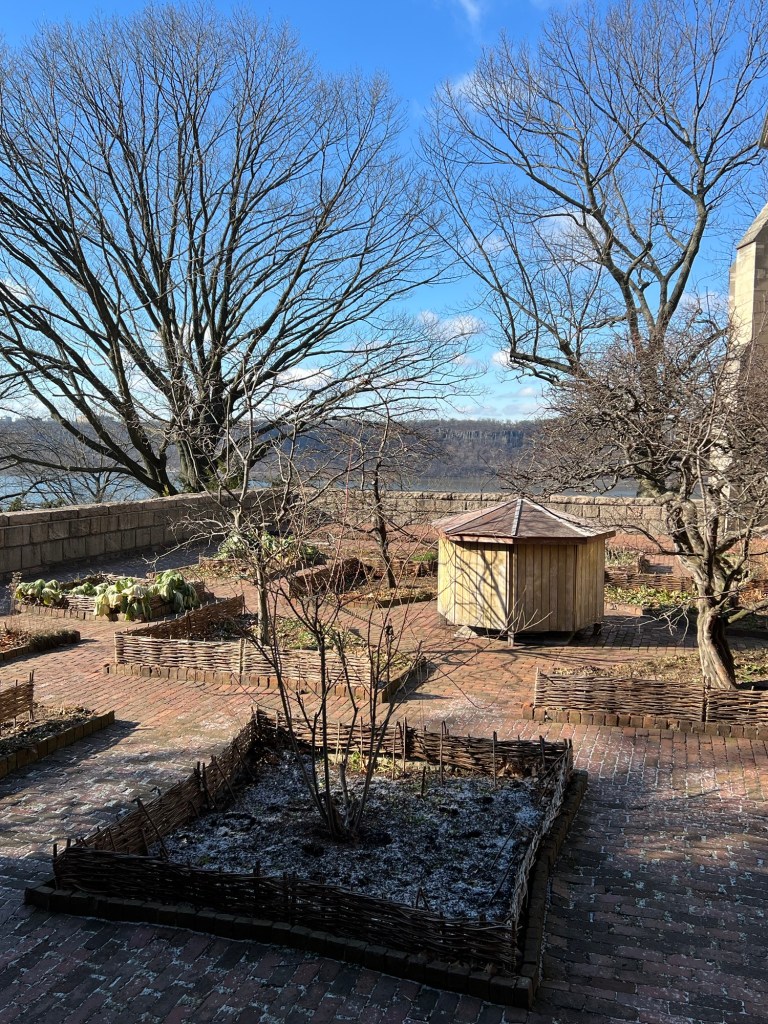
We then took a detour to the outside gardens that are enjoying their winter slumber. These gardens were used by the cloisters for food, medicines and decorative use. They will start coming to life in a few months.
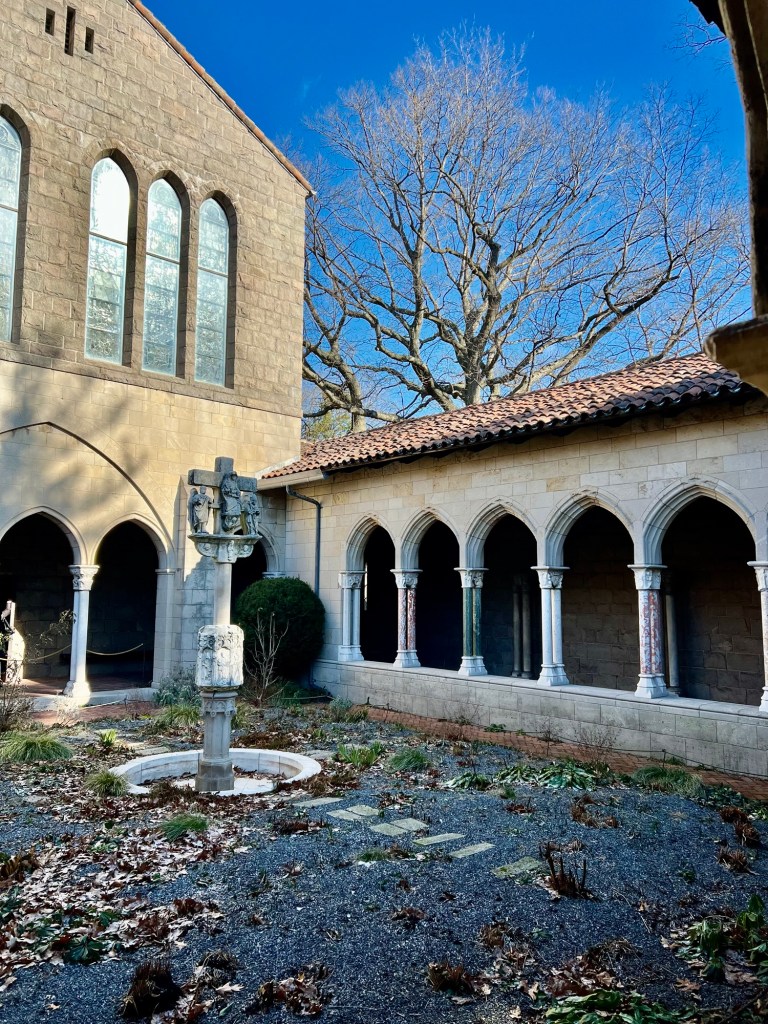
The Cloisters Gardens
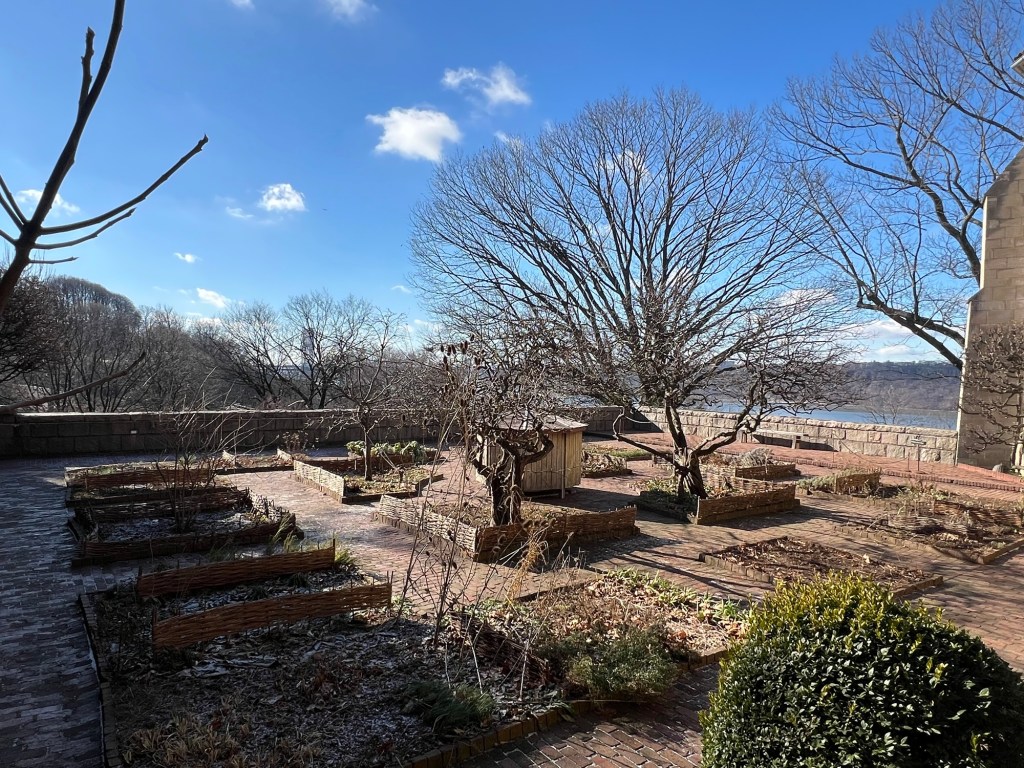
The garden terrace over looking the Hudson River
The terrace gardens in the winter waiting to come to life
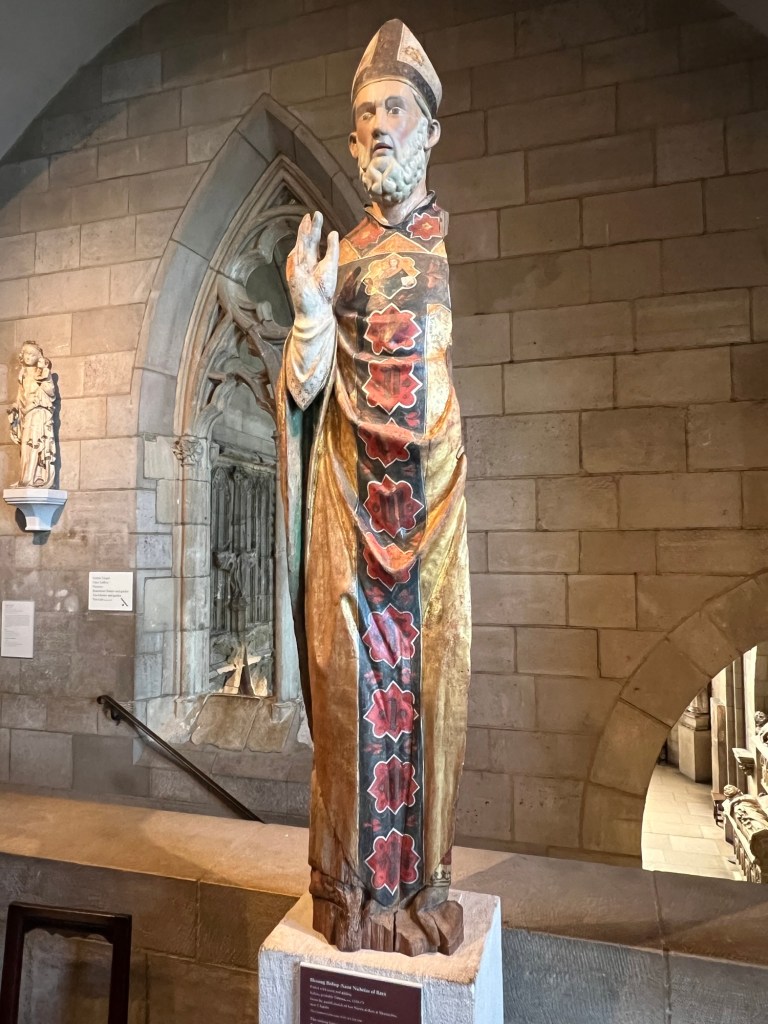
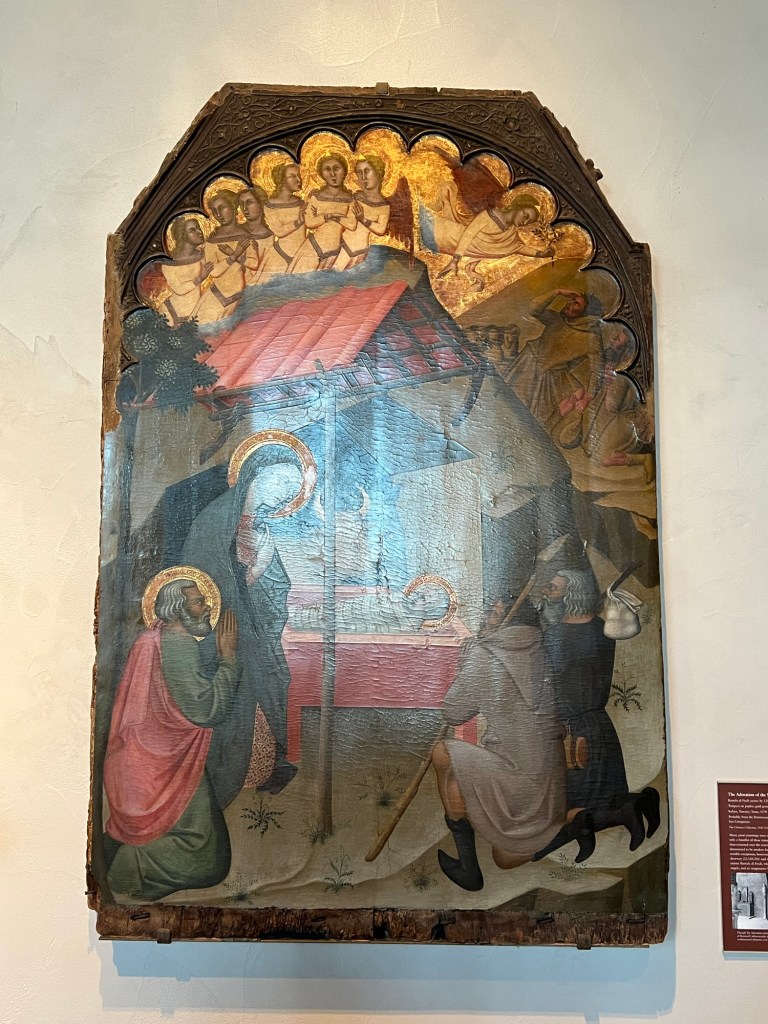
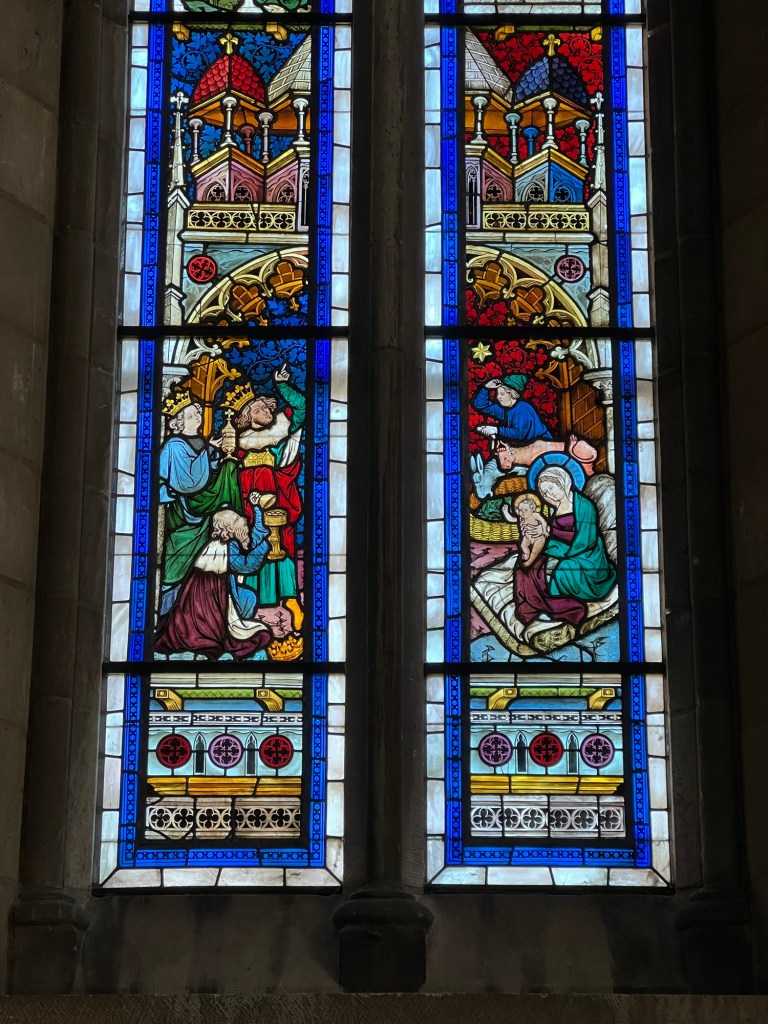
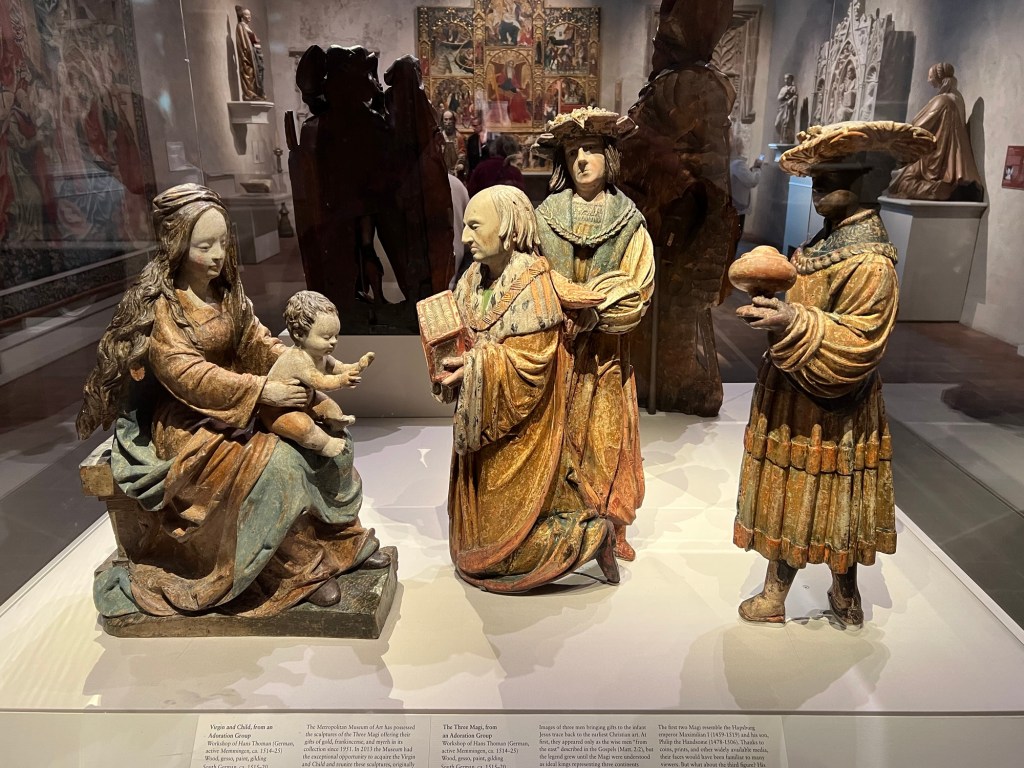
Then we went back inside for a discussion of the Three Kings and the Epiphany and its symbolism in art at the Cloisters. These are some of the works featured on the ‘Christmas Tide’ tour to symbolize that visit.
Some of the woodwork from that era
The Visitation of the Three Kings
The Visitation of the Three Kings depicted in stained glass
The Visitation of the Three Kings depicted in statuary
We visited the last of the Cloisters and discussed some of the plants in the collection
We were admiring the plants and flowers
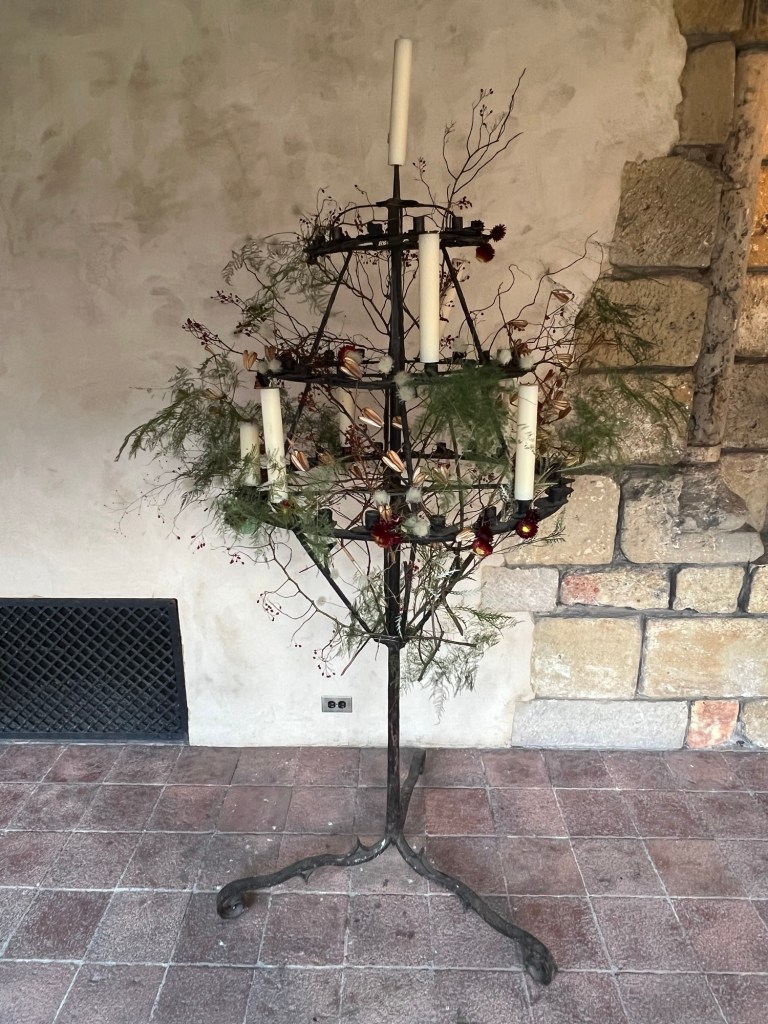
A candelabra in the hallway of the Cloisters
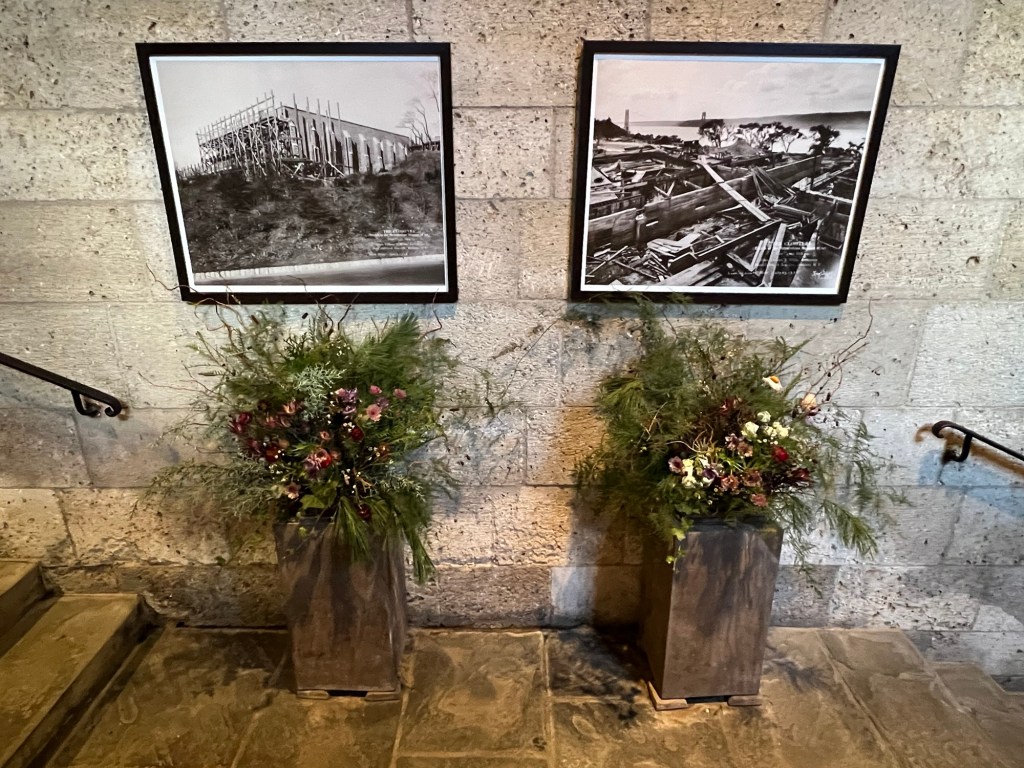
As I exited the building that afternoon, there were potted plants at the entrance of the Cloisters. It was a real treat to walk around the building at the holidays.
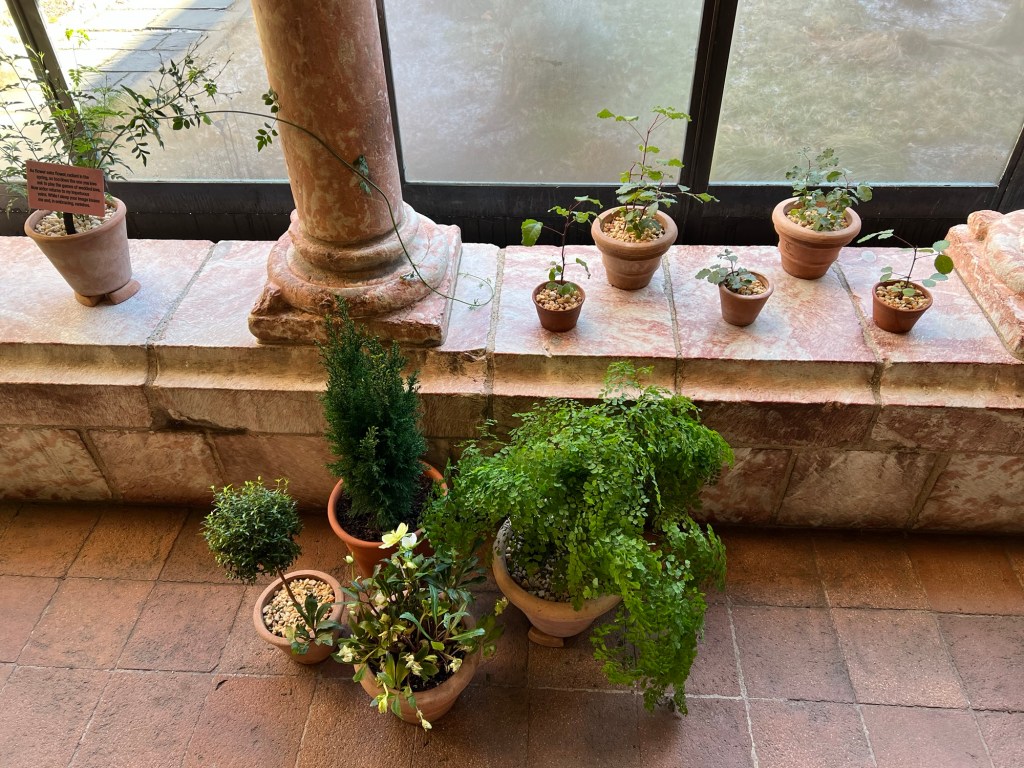
The potted plants outside the entrance of the museum
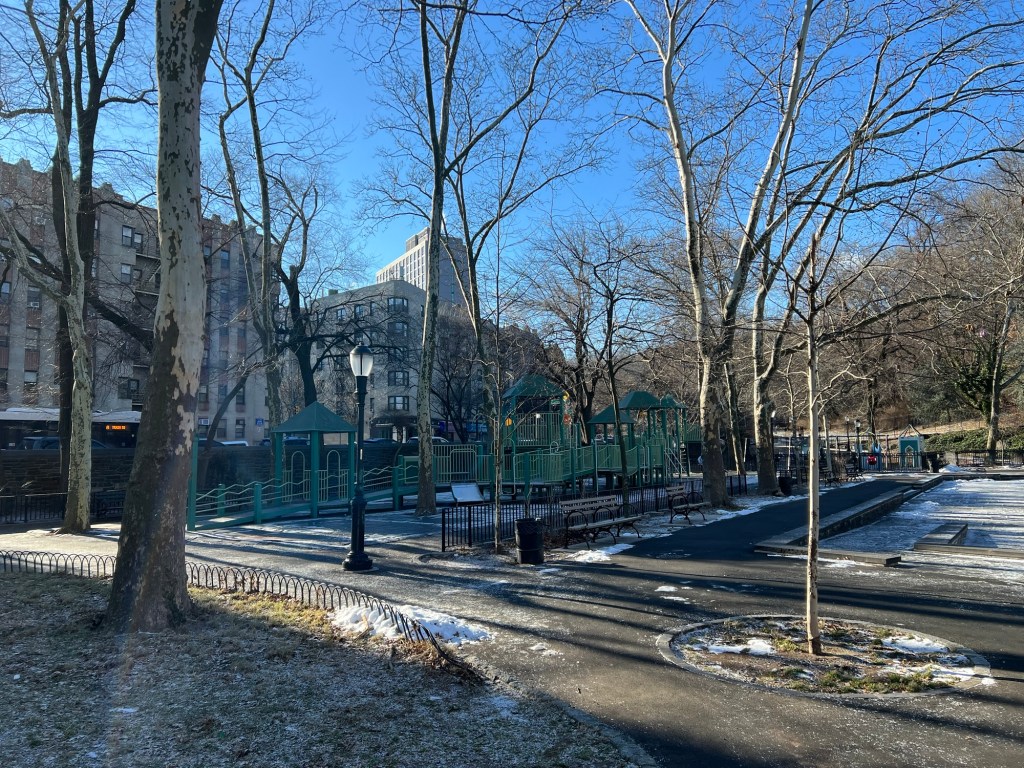
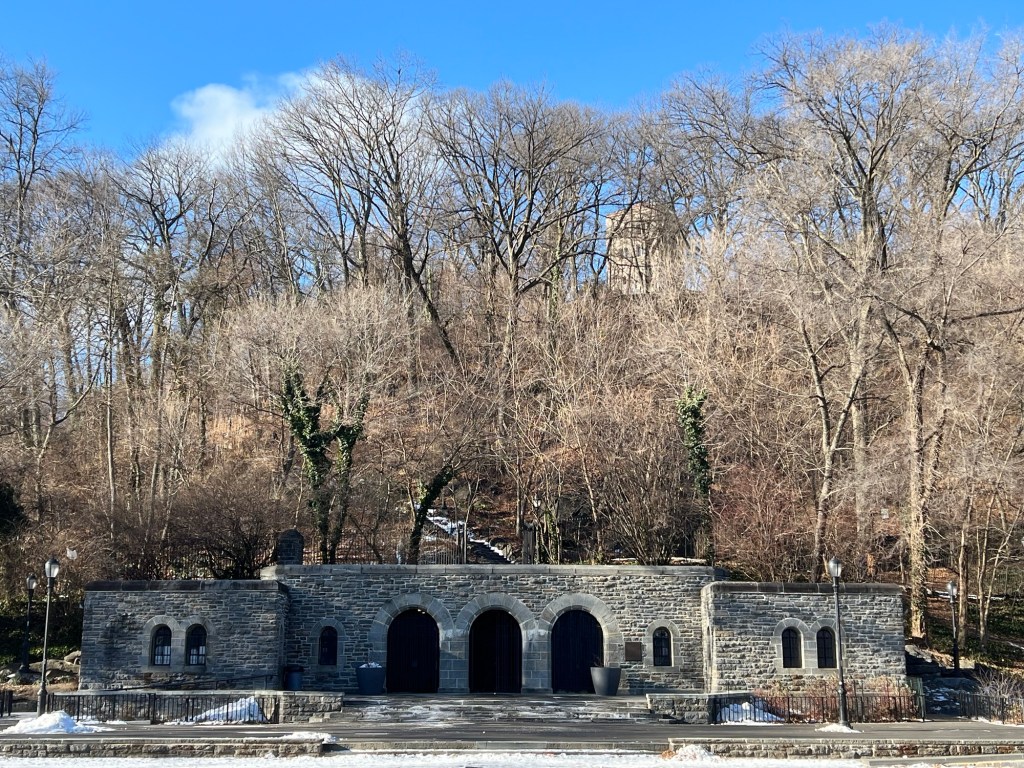
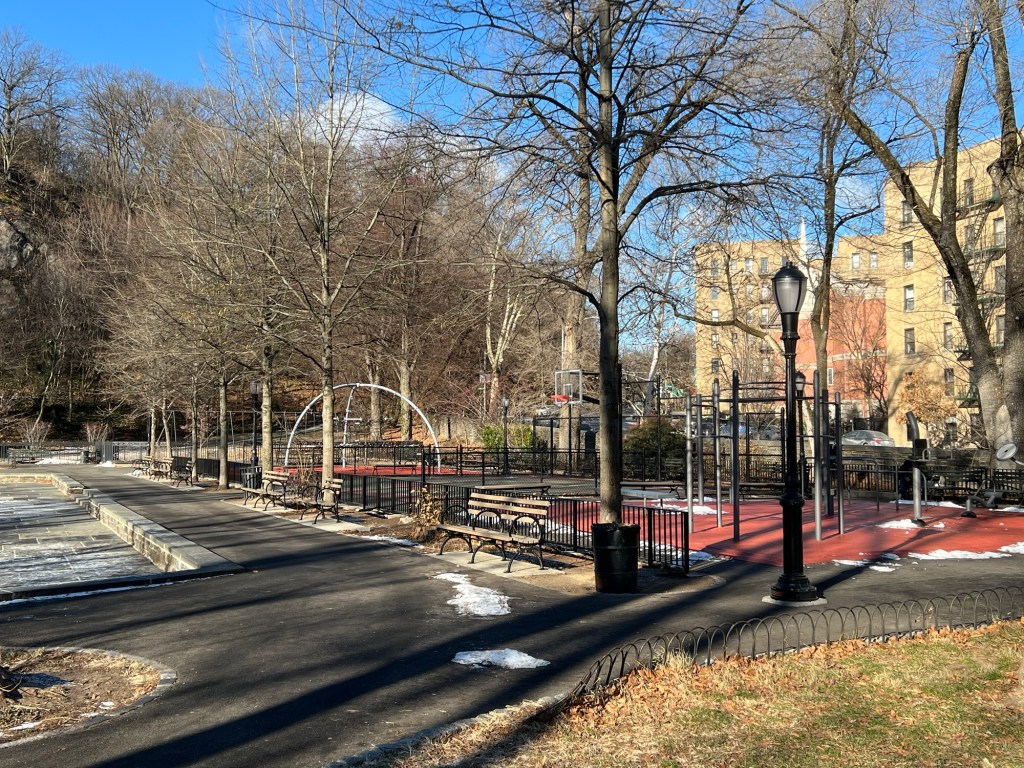
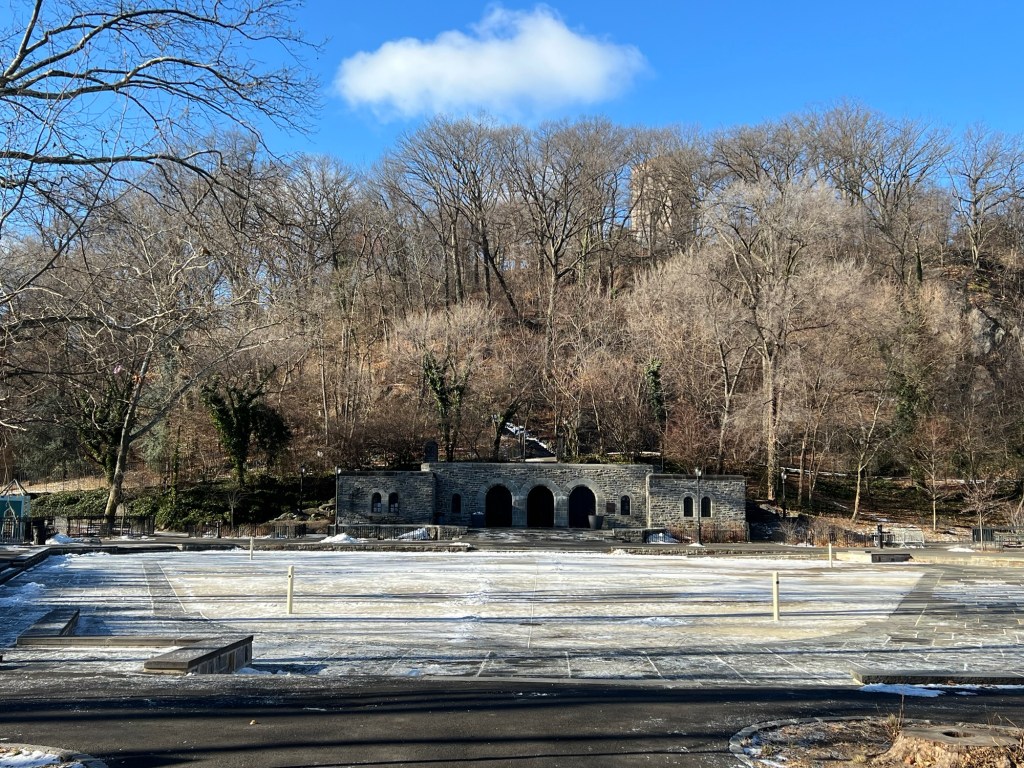
On my way down the stairs and out the door to Fort Tryon Park, I took another walk down the stone steps and walked through Ann Loftus Park. This popular playground was quiet this time of year, awaiting the Spring and the wonderful warm afternoons ahead.
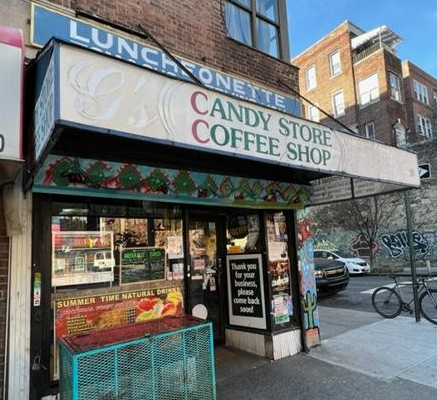
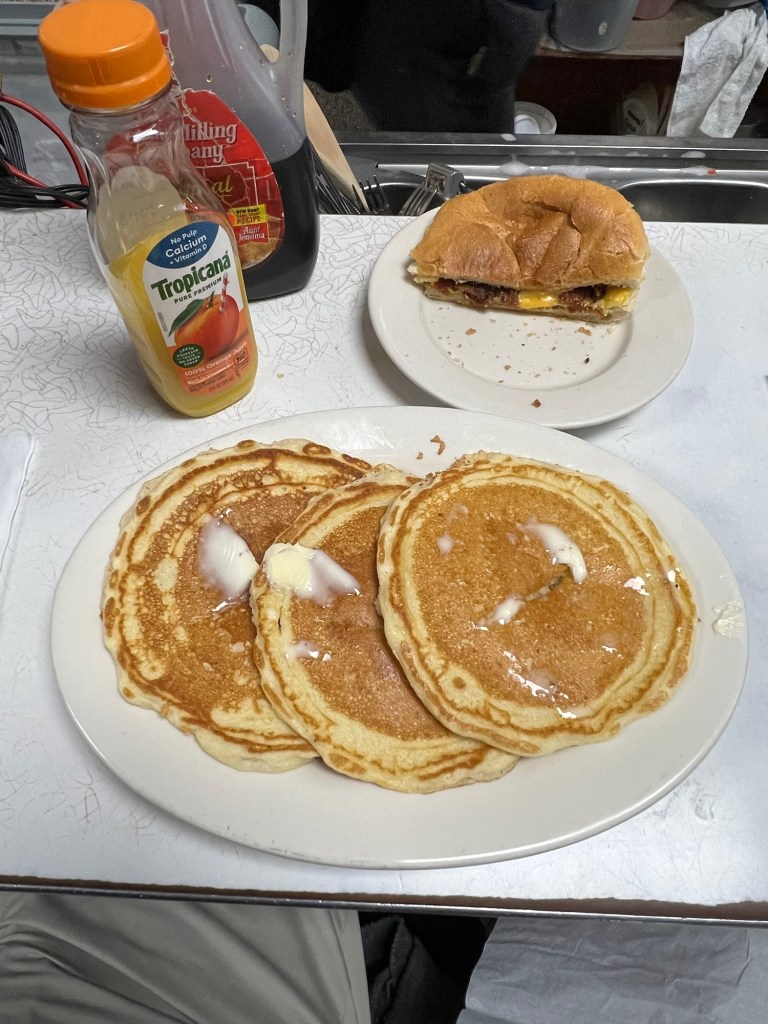
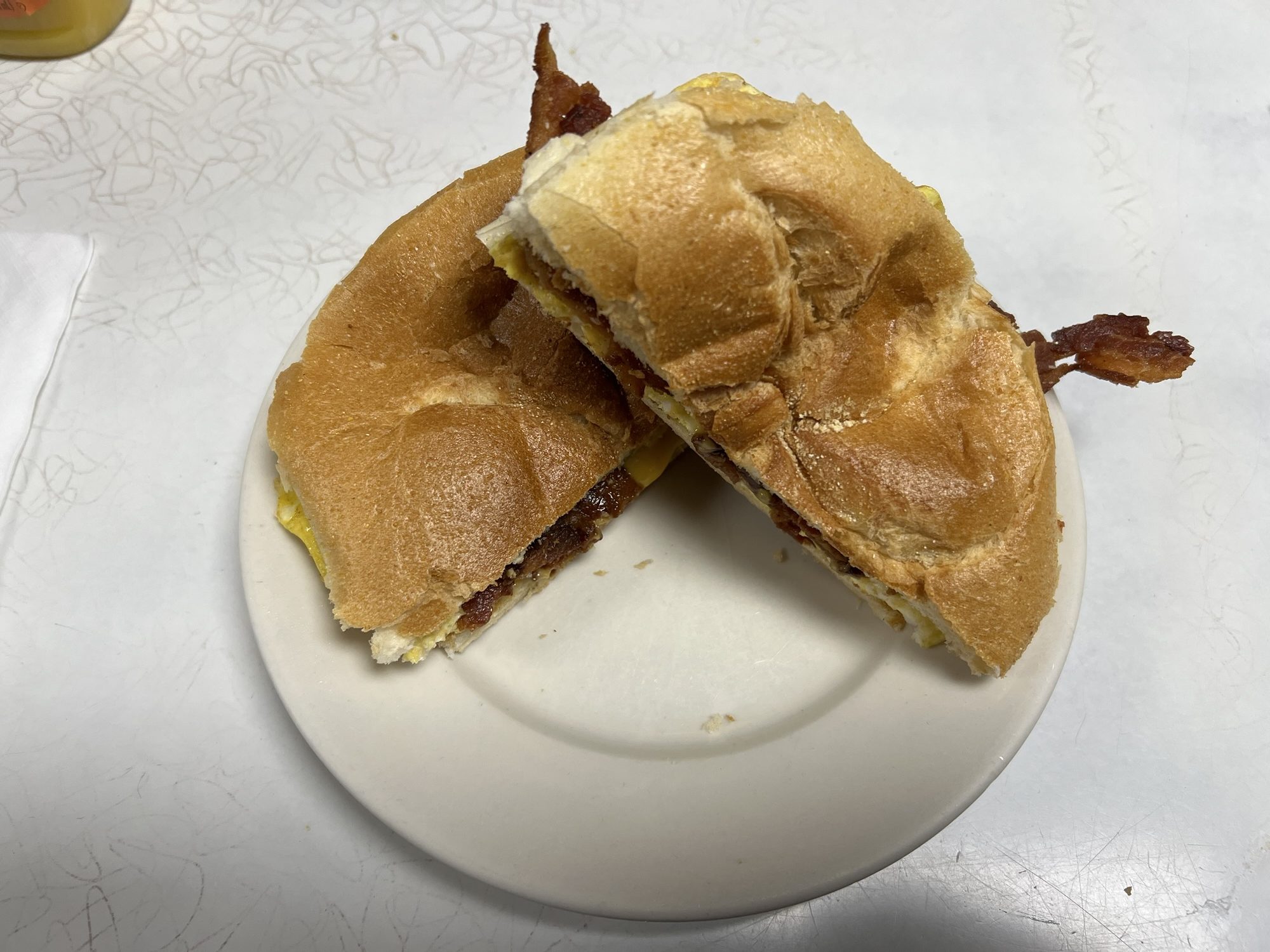
I love coming for breakfast at G’s Coffee Shop after a tour of The Cloisters. The food and service of this small ‘hole in the wall’ diner is wonderful. The meals are so reasonable and when you dine at the counter, you can watch the food cooked right in front of you. I had a wonderful Bacon, Egg and Cheese sandwich with a side of golden pancakes. What a great meal on a cold winter morning.
The Bacon, Egg and Cheese sandwich
The breakfast sandwiches here are so good
The pancakes were wonderful. The perfect comfort food on a winter day.
It was a really great tour and it was fun to walk around the neighborhood through the parks and seeing all the post Christmas decorations. Inwood is a really beautiful section of Manhattan with lots to do and see. It is the perfect place to spend the Christmas break.