The Empire State Railway Museum is housed in the historic, restored Phoenicia Railway Station, which was built in 1899 and example of the stations built by the Ulster & Delaware Railroad.
From the 1800’s through the 1940’s, the steam locomotives of the Ulster & Delaware climbed the mountain grades bound for the grand hotels and boarding houses of the Catskills. The trains carried thousands of passengers over the years. This transportation system was instrumental in the region becoming famous. All the trains stopped at the Phoenicia Station. Beside the passenger trains, there were many freight trains carrying lumber, blue stone, dairy and agricultural products bound for New York City and beyond.
The History of the Museum:
(From the museum website)
Founded in 1960 and then moved to Phoenicia in 1983. The historic Phoenicia Station, built in 1899, allow visitors to view the three interior rooms of the building. Enjoy the unique architecture of the Waiting Room with its framed artwork, photographs and artifacts on display. Step into the Agent’s Office and view the diorama with the HO-scaled layout of the Ulster & Delaware Railroad as it was in the early 1900s, plus several other dioramas and antique telegraph equipment (The Empire State Railway Museum website).
The front of the museum station
The welcoming sign to the Museum in the Summer of 2026
The Mission of the Museum:
The Empire State Railway Museum’s mission is to preserve the history of the Catskill Mountain and surrounding railroads and their impact on our culture, society, economy and communities through education, interpretation, restoration and preservation of not only railroad records, photographs, equipment, cars and locomotives, but also that of the personal histories and recollections of those involved with and affected by the railroads (Empire State Railway Museum website).
The Rail Explorers Building
When I visited the museum for the first time, I started with a tour of the grounds where the tracks are still being used for recreation purposes by the bike business that runs on the tracks next to the museum.
The railway on the museum’s grounds
I then toured the caboose that has been restored and displayed outside where the trains used arrive from the City. The museum did a nice job with the restoration showing was life was like on the train lines back at the turn of the last century.
The caboose car at the museum
The caboose car was acquired recently is from the Leigh Valley, PA line and is from the 1940’s (Museum pamphlet).
The inside of the caboose
The view from the back of the caboose
The cooking area of the caboose
The views from the caboose of the railways
I then toured the barn where train cars were being restored. This was fascinating. The volunteers are restoring all these train pieces back to their original glory with a small staff of volunteers.
The barn where the train cars are being restored and renovated
The cars being renovated
The front of the locomotive
Fixing the locomotive equipment
The sides of the cars being restored
It was fascinating to see how these train cars were being cared for by a small army of people and for the many hours it takes to care for these train pieces.
The inside of the museum and the building once served as the train station bringing people from the City to the Hudson River Valley for recreation and tourism to the Grand Hotels. The original waiting room has a rustic opened ended look about it and still looks like it is ready to welcome people from the early 1900’s.
The inside of the old train station that serves as the gallery
I love how elaborate the main Waiting Room was with the dark woods and rustic appearance, which must have fascinated visitors to the hotels when they arrived.
The history of the train station
The hallway that leads to waiting rooms and the old offices
The artifacts from railways
The sides of the museum displayed all sorts of artifacts that would have been used on the lines for maintenance and construction. There is all sorts of lanterns and lights on the tables and shelves.
The train artifacts
Lanterns, spikes and oil cans used on the rail lines
The lanterns used on the rail lines by workers at the station
The signal lights used on the train lines
All around the museum, the history of the area is told in pictures from the turn of the last century. People arriving to the area, the construction of the rail lines, the development of the Grand Resorts and the functions of the trains. It was an interesting history of the affects of the railroads on rural areas.
The development on three rail industry in the area
The construction of the Ashoken Reservoir
The Grand Hotels that brought tourism to the area
The area once boast the Grand Hotels of the Catskills long before air travel. Once upon a time, this was only accessible to the wealthy by carriage but with the coming of the railroads, opened these resorts up to a larger clientele. The famous Mountain House Hotel and others are featured in this display.
A video discussions on the tools to repair the rails
Rail and tourism artifacts from the era
In the center of the museum, there was a display case of many artifacts used in the rail service. All sorts of tools of the trade, functions of the rails and memoribilia are displayed in these cases.
The museum artifacts in the displays cases
The display of the rail cars and movements
Servicing the railroad
The deeds and business of the railroad
The workings of the railroads
The old Brake Stand of the rail yard on display
Off to the side of the old Waiting Room was the Conductor’s old office, which was now another gallery of model trains. The displays showcased the old railroads and have all sorts of artifacts on the Conductor’s old office and life at the station.
The Conductor’s old office now the Model Train Room
The model of the old railways
The Conductor’s old desk
A picture of the old station
The pot belly stove that kept him warm in the colder months
At the end of the tour is a small gift shop and information area of other cultural sites to visit. There is all sorts of information about the area and other cultural sites in the area.
The Gift Shop
The information area
The museum is an interesting look at travel after the Civil War until after WWII when the area opened up to automobiles. Jet travel in the 1960’s changed the area again as families left these grand hotels and traveled to places like Florida and the Caribbean.
It is an interesting peek at the past and the volunteers really showcase all their restoration work.
I had never heard of the Hill-Hold Museum and I happened to come across it when I saw a sign on the local highway that the museum was open that day. I thought it was a very interesting home and grounds with historical homes and buildings. Some came from other parts of Orange County, NY.
There are group tours on the hour with the last tour at 3:00pm. I took the last tour by myself with the tour guide and got a one on one tour of the house and grounds. The tour takes you into a step back in time to an agricultural society that no longer exists and times were slower and more structured.
The Hill-Hold Museum
The estate in the background
The Hill-Hold Museum:
A Farm for Two Centuries. This stone farmhouse was built in 1769. This museum reflects the life of the Bull-Jackson family spanning over 200 years. Hill-Hold Museum has circa 1830 Furnishings, a one room School House, a historic 1870 barn, Goosetown Gift Shop, picnic benches, and parking (Museum website).
The house on the estate grounds
The Mission Statement:
(From the museum website)
The Friends of Hill-Hold and Brick House Museums serve to preserve and enhance the preservation of history in Orange County, by maintaining, furnishing and operating programs at both these exemplary 18th century houses. These museums include portraits, memorabilia, photographs, and furnishings pertinent to them, the county and the past ages that touched each house (Museum website).
The front of the Hill-Hold Museum at the start of the tour
History of the Hill-Hold house museum:
(From the museum website)
Visit Hill-Hold museum and see what life was like on a Hudson Valley farm in the 1830s. This was still the era of candlelight, fireplace heat, homegrown food, and homespun clothing. The stone farmhouse was built in 1769 with wide plank floors, handsome paneling, and huge fireplaces (Museum website).
It was the home of a prosperous farmer, Thomas Bull, and his family. Original furnishings range from a prized old mahogany sideboard to made-on-the-farm pieces. Most of the rural family’s needs – food, clothing, fuel came directly from the farm. The property was gifted to the County in 1968 by Eleanor Jackson and the house went through an extensive restoration in the 1970’s to return it to how it appeared when it was originally built in the 18th century. (Museum website).
The Hill-Hold farm served the Bull-Jackson family for more than two hundred years. Now visitors are welcome to tour the farm. As we wander through Orange County, reveling in its rolling farmland scenery, we can go back to when the early Americans brought the gracious living and energetic husbandry to this unique part of the Hudson Valley (Museum website).
The Parlor-sitting room on the first floor was once a bedroom
We started the tour in the formal parlor, which the tour guide told me was once a bedroom along with the Living Room before the house was expanded. The house is filled with Bull family heirlooms that were donated back to the house by distance family members.
The family portrait’s in the Parlor-sitting room with the family piano that was used in the evening for entertainment
The portrait below is of the last member of the Bull family to live in the house before it was donated to the State of New York.
A portrait of the last family member to live in the house
The room was used by the family for entertainment, relaxation and for every evening activities. The room was used for pursuits such a sewing, needlepoint, conversation and with a piano in the room, evening activities with the family. With so much going on the farm, people retired in the evening early as the morning brought a lot of work on this working farm.
The spinning wheel by the fireplace
The Dining Room again was a former bedroom that was expanded for a formal eating as the both the house was expanded as well as the family. Breakfast and a late lunch/supper were served in this room. The Dining Room table, chairs, sideboards and china were pieces that part of the house donated back by the family.
The family dining room
The family China in the sideboard cub-bard in the Dining Room
The complete formal china set was displayed in the china closet as if ready to be used for a formal dinner party.
The sitting area in the Dining Room
The upstairs bedroom
We toured the master bedroom on the second floor of the home. Each of the rooms had fireplaces to keep them warm in the long winter nights with a canopy bed to keep the warmth inside. I could not believe how small people were at this time. This would have barely held one person today.
The canopy bed in the upstairs bedroom
The other bedroom would have been used by the children of the family. Now it contains sewing and weaving machines as well as spinning wheel to create the family clothing.
The second bedroom
The Sewing Room on the second floor with the oven/heater and family spinning wheels
Fabric and clothing was created in the home. Whether flax and wool, material was spun on the farm and the family wardrobe was created here.
The family spinning wheels
The sitting area on the second floor
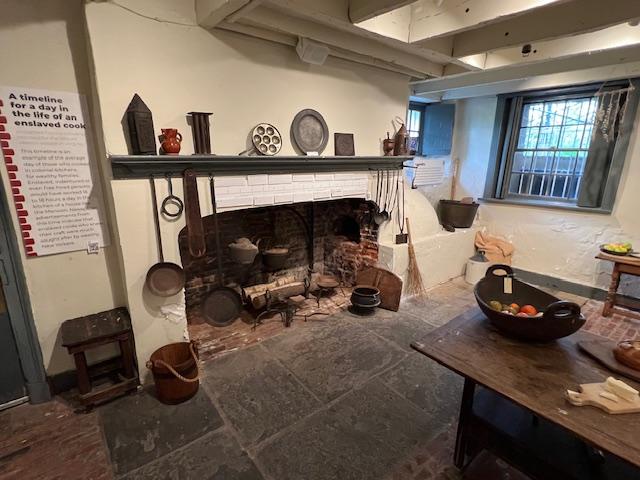
The last part of the house tour was of the family kitchen in the main house. The Summer kitchen was on the other side of the garden outside. The main kitchen inside the house had the fireplace, cooking materials, the family pewter and everything you would need to cook a complete meal.
The family kitchen
The family table set for cooking
Items for bread and dessert baking, butter making, roasting and stewing and all the items needed to cook three meals a day. The bounty of the Spring, Summer and Fall had to supply the long winters when there was no grocery shopping available.
The equipment for washing clothes and other household chores
Wash Day was a whole day reserved for sorting, boiling, scrubbing and hanging clothing to dry. Until the more modern machines were invented in the 1920’s after WWII, this was the weekly ritual for the farm housewife or the staff.
The open hearth and cooking equipment
The cooking equipment
The family pewter set
After we finished the house tour, we explored the outer buildings which included a Summer Kitchen, a smoke house, the vegetable and flower gardens. These buildings were spread around the main house.
The Summer Kitchen
The inside of the Summer kitchen
This Summer Kitchen came from a different property but the use is still the same. As the warmer months of the Summer were upon them, cooking was done in a separate building to keep the house cooler.
Some of the cooking and baking equipment
The flower beds on the side of the house
The flower and vegetable beds on the side of the property and the smoke house
Outside the main house were the vegetable, fruit and flower gardens. Items used in the household for meals, decorations and entertaining.
The barn, the outhouse and the smoke house in the distance
The inside of the smoke house where meats once hung used for family meals
All the family meats were placed in here for cooking and smoking for the family meals. The process took much longer than it does today.
The well in the middle of the property
They also moved an old school house to the property and it was furnished as a complete turn of the last century school house. It was used until 1936.
The schoolhouse on the property
The inside of the school room
The classrooms of the 1700’s and 1800’s to today have not changed much. With the exception of modern heating and air conditioning, the class room set up has not changed much. There is still a board in the front of the room, chairs facing the teacher, who is in charge and books lining the walls.
The teachers desk and the furnace that kept the room warm in the cold months
Games and amusements that were used in recess
Wheels and bikes were part of the games children played at the turn of the last century
Before modern electronics took over starting in the 1970’s, bicycles, hoops and games such as tag and hopscotch were part of playground activities. Playing outside has not changed much throughout the centuries.
Looking over the grounds at the end of the tour
Before I left for the afternoon, I was able to tour the gift shop before the museum closed for the day.
The Goosetown gift shop at the museum entrance at the end of the tour
The Goosetown Gift Shop at Hill-Hold features books, gifts, toys, craft items, and souvenirs. The shop is operated by the Friends of Hill-Hold, Inc., a not-for-profit organization, which aids in the operation of Hill-Hold and Brick House museums (The Museum website).
It really is an interesting tour and a step back in time for a glimpse into the life of a Upper Middle Class farming family.
I had a five week break from the college when my first Summer class was cancelled. So I concentrated on traveling through New Jersey and New York, both the City and Upstate for my blog. I wanted to revisit many historical sites that I had seen during the holiday season (was Christmas six months ago?) or in the past. There were places like Central Park, where I had not seen certain sections in the Spring. This lead to me being part of many walking tours of gardens during the month of June.
With all the wet weather we had in the Spring, the gardens in June were lush with flowers and flowering trees and plants. Pathways lined with color and walled gardens beautifully laid out. It was interesting to see how these were planted, designed and maintained.
The entrance to the Brooklyn Botanic Garden in June 2026
All the rain we had in April and May and the warm days of early June had awakened the Cherry Blossoms and I visited as many locations to see them in full bloom.
Please read my blog on visiting the Cherry Blossoms:
Once they were finished, gardens came to life all over the tri-state area and many historical homes and parks came to life in a sea of color and smells that showed the power of Mother Nature to make things beautiful. I was impressed with the work of many volunteer staffs and their dedication in taking care of these sites for all of us to enjoy.
Visiting to Amour-Steiner House for the Spring Garden Tour:
The Amour-Steiner House the day of the Garden Tour
The beds were in full bloom when we toured the gardens
The colors of the flowers were patriotic red, white and blue
In between the hedges, there was elegant statuary and potted urns with colorful flowers blooming with bright hues.
The urns were filled with bright colors of the season
Statuary representing the arts and music lined the hedges
The flowers were so brilliant that afternoon
I enjoyed looking at the statuary
The gardens were so beautiful with the house in the background
As we left the gardens, I admired the ornate Fox and the Glove gate on the way out
We then crossed the lawn to tour the greenhouse, where many of the flowers were and still are grown for decorating the house both inside and out.
The landscaping has a romantic spin on it as the property was planted to accent not just the property but the house as well giving it a natural but balanced look to it.
Touring the formal greenhouse
Even the working greenhouse had a romanticized look about it that reflected the house
The inside of the greenhouse. Each side of the counters seasonal flowers are grown for the property. This greenhouse is used all year long supplying the house with a steady stream of flowers.
In the middle of the greenhouse was a beautiful Victorian aquarium that was lined with more flowers. There were no fish at this time.
I loved the beautiful flowers that lined the counters
The Spring colors were breathtaking
We then started the tour of the house starting with the outside veranda that held more urns and planters of fresh flowers
The beautiful veranda lines the entire house
The beautiful colors from the potted and hanging plants
The veranda decorated for the upcoming ‘250th Anniversary of the United States
The hanging plants
The potted plants
We even admired the birdhouse that matched the house
We then went inside to tour the house. It would be interesting to see the house without all the Christmas decorations that I saw the last time I toured the house.
The triangle room off the foyer once used as the Receiving Room
The beautiful foyer to the second floor
The main Parlor/Living Room used for entertaining
The formal Dining Room
The decorative sideboard
The other decorative sideboard
The Dining Room table set for a Spring dinner
We then started the tour of the second floor which started in the game room at the top of there landing. I remember the big Christmas tree being here when the house was decorated for the holidays.
I liked the room was the way it is here
Then we toured the bedrooms which were not that elaborate but functional and comfortable as they are today.
One of several bedrooms on the second floor
The bathroom which is considered normal today was ahead of its time with flushing toilets and hot and cold running water
The office off the side in one of the Octagon corners
The Egyptian Room was the height of fashion with travel and new discovers in Egypt at the time.
The ceiling and decorations of Egyptian Room
The decor of the Egypt
The beautiful porcelain in the room
Then we toured the Curio Room. I thought the room was a lot of fun with small objects that people would have collected from their journeys at that time.
The shelves, counters and walls were filled with all sorts of interesting objects
Many types of object’s
The Victorian Terrarium that was becoming fashionable at the time
The fold out desk with small objects in each slot
A Victrola and Terrarium
The last part of the tour was of the newly renovated kitchen. The shelves were lined with a collection of shiny pots and pans.
The ‘modern’ Victorian kitchen
When the tour was over, I visited the gift shop and looked over the kitchen once more. It is interesting to see how ‘modern’ back then is ‘contemporary’ today. Victorians set the tone for the modern American home of today and the expectations of the American dream.
Before I left the grounds, I visited the gardens once more. It was such perfect weather to walk around and I enjoyed the beauty of these gardens. Mother Nature creates this all this.
Walking around the grounds of the home
I enjoyed walking around the gardens that day
I found this tour one of the most relaxing I have taken in a long time. The beauty of both the house and the gardens was wonderful. Just sitting on the veranda and looking over the grounds was the perfect way to spend the afternoon.
Taking the Clermont Garden Walking Tour 2026:
I returned in the Spring of 2026 for the an updated walking tour of the gardens “Gardens and Grounds: Evolving Landscaping of Clermont”, where the State of New York horticulturalist who had just been hired to maintain the gardens, explained to us the developments and goals that the State wanted for the direction of the landscaping on the property. They wanted it brought back to the 1930’s blueprint of what Alice Livingston had originally envisioned for the estate when she returned from Europe.
Arriving to the Clermont estate at 1 Clermont Avenue in Germantown, NY
We started the tour with a history of the house and Alice Livingston’s return from Europe to create her famous gardens
The front of the mansion in the Spring of 2026
We started the tour at the Walled Garden which was just finished being restored. The back wall had just been finished and the site’s main horticulturalist explained that she was working with a group of volunteers to maintain the gardens.
The Walled Garden designed by Alice Livingston
The Walled Garden in the Spring of 2026
The inside to the entrance of the Walled Garden
The back part of the Walled Garden
The next garden we toured was the Wilderness Garden which included wildflowers and a fish pond
The Wilderness Garden sign
The back part of the Walled Garden leads to the Wilderness Garden
The entrance to the Wilderness Gardens
The lecture on the design and plantings of the Wilderness Garden
The colorful wildflowers that line the grass paths
The fish pond in the Wilderness Garden
We then followed the path and walked up and toured the Cutting and Children’s Garden. These colorful gardens once supplied the house with an assortment of fresh flowers. It also taught the Livingston girls the attributes of gardening.
The Cutting Garden and Greenhouse sign
The main Cutting Garden
The Cutting garden
The Cutting Garden in the late Spring
The in season flowers in the Cutting Garden
The Children’s Playhouse and Garden is next to the Cutting Garden
The Children’s Garden in the Spring
Touring past the old Greenhouses
Part of the former greenhouse
The tour through the grounds with my group
The pathway back to Clermont
Touring along the river
The former roadway between the house and the river
The South Spring Garden
Our last garden toured was the one closest to the house and that was the South Spring Garden of which Alice could see from her window. When the porch was removed from the home and Alice developed plans for other gardens, this garden went ‘native’.
The South Garden
The South Garden in bloom
The views from the South Garden
The flower planters near the South Garden
The planters filled with Spring geraniums
Walking back after the tour was over and looking at the beautiful grounds
Ending the tour that day with a walk along the river
It was a beautiful day to walk the gardens and the perfect way to spend the afternoon. Each time I take a tour of the gardens, I am amazed how different they seem. I love the different times of the year and how it changes these gardens.
I returned to Manhattan the next week and as I was working in Inwood and Washington Heights neighborhoods, I took a tour of Isham Park with the Bruce Reynolds Gardens and Fort Tyron Park with the Heather Gardens, when they were in full bloom. It was breathtaking with the back drop of the Hudson River on a sunny afternoon.
In Isham Park, I toured the Bruce Reynolds Gardens, which is in the center of the park. They were in full bloom when I walked around the gardens and relaxed under the shade trees.
The new Bonnefont Restaurant is open for lunch and brunch
The restaurant was closed that afternoon but I was able to look at the menu online and it is an interesting menu. The cuisine is a mixture of French and Contemporary cooking.
Walking back through the gardens to the Fort Tryon location
Walking to the Fort Tryon site
The Fort Tryon site
Visiting the Brooklyn Botanic Garden before Rose Night in 2026:
I got an email from the Brooklyn Botanic Garden saying that the Cranford Rose Garden was at its peak of blooming and that I should see it while it was at its prime. I was busy at work and was able to travel down to down to the gardens a few days later. Talk about perfect timing as the petals just started to fall.
The Cranford Rose Garden at peak is one of the most beautiful sites. The colors and the fragrances are just amazing. I could not attend “Rose Night” in 2026 because of a prior commitment plus it would be a gloomy night with the threat of rain. So I went the Friday afternoon before the event, which would be held the next Wednesday. By that point, the flowers would be out of peak.
The Cranford Rose Garden in bloom at the Brooklyn Botanic Garden
The Cranford Rose Garden is amazing from every angle and the views from the top of the hill overlooking the garden shows the extensive amounts of roses planted and the array of colors.
The beds of roses of all colors and species
The entrance to the Cranford Rose Garden is full of an array of different types of colorful flowers
The beautiful and diverse flowers in the Cranford Rose Garden
The beauty of flowers up close
All sorts of roses line the trellis borders of the Rose Garden
What I love about walking around is that you can see the diversity of the roses. The garden is planted with different species so they bloom at different times giving the beds an array of colors at different times. Along the beds and trellis everything bloomed so vibrantly.
The beautiful orange roses that lined the trellis
The colorful trellis pathways
The reds and pinks in full bloom
Roses lining the lamppost
Admiring the beds of roses at the Cranford Rose Garden
Purple reins supreme
Walking through the trellis pathways of red
The beauty of the trellis
The back part of the garden
The back terrace of the Cranford Rose Garden
The elegant statuary of the rose garden and the sun dial
The back Terrace area
The back of the Cranford Rose Garden is lined with all sorts of flowering plants having a rainbow of colors.
Walking through the terrace gardens
The beautiful roses in the back of the garden
The roses in the back of the Cranford Gardens
Walking out the back of the gardens
The back path of the Cranford Rose Garden
The fountain in the back of the Cranford Garden
Visiting the Cranford Rose Garden when it flowering is one of the most interesting collection of colors and scents. This is why I try to time my visits around the blooming of the flowers.
The Tour of the Gardens at The Cloisters in the Spring 2026:
One of my favorite places with in the Metropolitan Museum of Art to visit is The Cloisters in any season. One of my favorite places when it is decorated for the Christmas holiday season, the Spring and Summer offer such beautiful displays of historical plants that try to match the theme of each Cloister and its historical background.
The docent led a very large group of us through each Cloister and told us of the way the curators plant the gardens to represent what may have been planted during the Medieval era for medical and nutritional functions of those peoples lives.
(From the Museum website)
The gardens of the Middle Ages included both real and ideal gardens. Poets and artists delighted in the depiction of fantasy gardens like the Garden of Love or of Paradise, but no real garden of the time remains to us. Historical records are rare and incomplete; the ninth-century plan for the monastery of St. Gall, with its carefully drawn and labeled garden beds, is unique. Archaeological excavations are yielding valuable new evidence, but we still know more about infirmary gardens of medicinal plants and aristocratic pleasure gardens than we do about humble kitchen plots of potherbs and vegetables (Met.org).
The gardens of the Museum, planted in reconstructed Romanesque and Gothic cloisters, evoke those that provided sustenance and spiritual refreshment within the medieval monastery. Designed as an integral feature of the Museum, the gardens have been a major attraction of The Cloisters since its opening in 1938, enhancing both the setting in which the Museum’s collection of medieval art is displayed and the visitor’s understanding of medieval life. The gardens are designed and maintained by a horticultural staff actively engaged in researching and developing the living collection (Met.org).
The Cloisters at 99 Margaret Corbin Drive in Fort Tryon blooming in the late Spring
We walked through the Cloister discussing how plantings were determined by medical and religious purposes
The flower beds in the Cloister
The view of the Hudson River was amazing
The flowers in bloom
Flowers in bloom
Flowers in bloom
Flowers in bloom
We moved the next Cloister looking over the medical plants and flowers
The Cloister in bloom
Walking around the Cloister
The plants around the sills of the Cloisters
Touring the Cloisters and admiring the flowers
Everything in bloom
We toured the last Cloister while the tour guide explained the plantings
The last Cloister we toured
The garden in full bloom
The growth of the hops growing on a trellis
The hops planting up close
The flowers in bloom in the Cloister
A wonderful video on “Art and Gardens at the Met”
We ended the tour admiring the art in the Tapestry Room and having a discussion about the use of plants and flowers in Medieval art.
‘The Hunt of the Unicorn’ tapestry discussion
I then visited the ‘Creatures of Myth and Imagination-European and the Americas’ exhibition.
This exhibition was an interesting look at mythical beasts of the era of great exploration from European to the Americas. It reminded me of the book “In Search of Ancient Astronauts” with many golden creatures that look like they are visitors from another planet, Ancient Gods to worship and one civilization’s outlook on the unknown. The artwork was a cross between mysticism and respect.
The exhibition sign for “Creatures of Myth and Imagination: Europe and the Americas”
Set in the evocative atmosphere of The Met Cloisters, Creatures of Myth and Imagination: Europe and the Americas sheds light on a selection of works created on either side of the Atlantic Ocean between 500 and 1500 CE. The exhibition’s exploration of hybrid creatures deepens our understanding of their apparent necessity among diverse peoples. In the Americas, a complex gold pendant by a Tairona artist of northern Colombia, depicting a confrontational figure with hands on hips, a crocodile-like head, and an enormous headdress, would have reflected and expressed the wearer’s status and power. In Europe, ferocious dragons such as the one depicted on a monumental fresco from the monastery of San Pedro de Arlanza, Spain, took center stage to convey a multiplicity of meanings both sacred and profane (Met.org).
The exhibition gallery
Unusual mythical creature
(From the museum website)
For as long as humans have told stories, we’ve imagined creatures that transcend the natural world. Fantastical beings combining the features of animals, humans, and even plants appear across cultures, emerging in the most ancient myths and enduring in contemporary epics. The widespread presence of these supernatural beings, possessing the power to transform and be transformed, reflects a global impulse to make sense of both known and unknown worlds. Visual artists have given form to these imaginary creatures, resulting in some of the most fearsome, beloved, and extraordinary works of art ever made (Met.org).
Small gold ancient Gods
Ritual Knives
Double pendants
Earth Deity
I took one last tour of the museum gardens before I left for the afternoon. On the balcony overlooking the Hudson River offered beautiful views and beautiful potted plants.
Walking out of the back Cloister
The back Cloister
The beautiful white flowers
The balcony overlooking the Hudson River
The potted plants by the doorway
The view of the Hudson River
Looking north up the Hudson River
The tour of the Gardens was amazing and the exhibition on the Pre-Columbian art interesting. It was a wonderful tour of the Cloisters.
I had a private function at the Museum of the City of New York across the street from the Central Park Conservatory Gardens. When the event was over, I took a walk around the gardens when they were in full bloom.
The gardens just went through a major renovation and each of the paths had rows of colorful flowers that were beautifully taken care of and designed to bloom at different stages of the growing season so there was always color in the gardens. The effect was amazing.
The entrance of the Central Park Conservatory lawn and fountain
The fountain and the geometric garden
Central Park Conservatory gardens at the entrance
The entrance of the gardens from the Harlem Meer area
The entrance to the flower gardens from the Central Park Conservatory lawn
The Central Park Conservatory garden beds
The gardens in full bloom in the Summer of 2026
The flower beds in the central of the gardens
The Central Park Conservatory Fountain and Lotus pools
I walked behind Hippo Park in Central Park one afternoon to discover a beautiful floral garden that was the 91st Street Garden that I had missed on previous walks in the park. The Garden did not look like this in the Fall.
The 91st Street Garden in the Summer of 2026
Then I remembered the scene in “You Got Mail” and remembered that this was the garden where they met. I always thought it was closer to Riverside Drive than it was here in the park.
The sign for the garden
As I passed the garden, I remember this was the garden in the last scene of the movie, “You Got Mail” when Meg Ryan realizes that her secret email pal is Tom Hanks. It was such a great scene and the perfect end to a great Rom-Com.
The end of the movie “You Got Mail” with Meg Ryan and Tom Hanks
The Gardens from the front
The flowers in full bloom
The flowers in full bloom in July 2026
All I could think about was this scene as I walked around the garden. The funny part is this was the first time I had ever visited this garden as I did not know where it was located. I knew it was on 91st Street but could never figure out where. You have to walk on the path behind the Hippo Playground and follow it to the other path.
The gardens from the front
Walking back up through Riverside park from the Hippo Playground
Walking in Riverside Park in the 90’s
You have to find your way through Riverside Park to find the garden but in the Spring and Summer it is worth the walk up and down the hill.
These are just some of the places that I am still visiting as the Summer season begins and there are more historical sites to see and more smaller gardens to visit. Let’s see what the rains produce in the coming months.
Places to Visit:
*Bloggers Note: the prices of these sites vary from season to season and can change from year to year. This is the same with the hours depending on what season you visit.
Fee: Adults $30.00/Seniors $17.00/Children $12.00/Members & Patrons and Children under 12 are free (prices do fluctuate). NY, NJ and CT students and NY residents Pay as you wish.
Museum Hours:
Hours: Open 7 days a week
March-October 10:00am-5:15pm
November-February 10:00am- 4:45pm
Closed Thanksgiving Day, December 25th and January 1st.
*Some galleries may be closed for construction or maintenance.
Fee: Adults $30.00/Seniors/Students $17.00/Children $12.00/Members & Patrons and Children under 12 are free (prices do fluctuate). NY, NJ and CT students and NY residents Pay as you wish.
Museum Hours:
Hours: Open 7 days a week
March-October 10:00am-5:15pm
November-February 10:00am- 4:45pm
Closed Thanksgiving Day, December 25th and January 1st.
*Some galleries may be closed for construction or maintenance.
I went on the Spring Garden tour at the Cloisters Museum with a discussion on Spring plantings and the use of those plants during Medieval times. The museum studied what plants were used for religious and medical practices.
We started the discussion of the plantings out in the first Cloister by the Hudson River
The Tour of the Gardens at The Cloisters in the Spring 2026:
(From the Museum website)
The gardens of the Middle Ages included both real and ideal gardens. Poets and artists delighted in the depiction of fantasy gardens like the Garden of Love or of Paradise, but no real garden of the time remains to us. Historical records are rare and incomplete; the ninth-century plan for the monastery of St. Gall, with its carefully drawn and labeled garden beds, is unique. Archaeological excavations are yielding valuable new evidence, but we still know more about infirmary gardens of medicinal plants and aristocratic pleasure gardens than we do about humble kitchen plots of potherbs and vegetables (Met.org).
The gardens of the Museum, planted in reconstructed Romanesque and Gothic cloisters, evoke those that provided sustenance and spiritual refreshment within the medieval monastery. Designed as an integral feature of the Museum, the gardens have been a major attraction of The Cloisters since its opening in 1938, enhancing both the setting in which the Museum’s collection of medieval art is displayed and the visitor’s understanding of medieval life. The gardens are designed and maintained by a horticultural staff actively engaged in researching and developing the living collection (Met.org).
The plantings of the first Cloister we visited
We walked through the Cloister discussing how plantings were determined by medical and religious purposes
The flower beds in the Cloister
The view of the Hudson River was amazing
The flowers in bloom
Flowers in bloom
Flowers in bloom
Flowers in bloom
We moved the next Cloister looking over the medical plants and flowers
The Cloister in bloom
Walking around the Cloister
The plants around the sills of the Cloisters
Touring the Cloisters and admiring the flowers
Everything in bloom
We toured the last Cloister while the tour guide explained the plantings
The last Cloister we toured
The garden in full bloom
The growth of the hops growing on a trellis
The hops planting up close
The flowers in bloom in the Cloister
A very interesting video of “Art and Gardens at the Met”
We ended the tour admiring the art in the Tapestry Room and having a discussion about the use of plants and flowers in Medieval art. The artists at that time thought of the natural world with awe and respect. They admired the beauty of the natural world where in some points was still feared,
‘The Hunt of the Unicorn’ tapestry discussion
I then visited the ‘Creatures of Myth and Imagination-European and the Americas’ exhibition.
This exhibition was an interesting look at mythical beasts of the era of great exploration from European to the Americas. It reminded me of the book “In Search of Ancient Astronauts” with many golden creatures that look like they are visitors from another planet, Ancient Gods to worship and one civilization’s outlook on the unknown. The artwork was a cross between mysticism and respect.
The exhibition sign for “Creatures of Myth and Imagination: Europe and the Americas”
Set in the evocative atmosphere of The Met Cloisters, Creatures of Myth and Imagination: Europe and the Americas sheds light on a selection of works created on either side of the Atlantic Ocean between 500 and 1500 CE. The exhibition’s exploration of hybrid creatures deepens our understanding of their apparent necessity among diverse peoples. In the Americas, a complex gold pendant by a Tairona artist of northern Colombia, depicting a confrontational figure with hands on hips, a crocodile-like head, and an enormous headdress, would have reflected and expressed the wearer’s status and power. In Europe, ferocious dragons such as the one depicted on a monumental fresco from the monastery of San Pedro de Arlanza, Spain, took center stage to convey a multiplicity of meanings both sacred and profane (Met.org).
The exhibition gallery
Unusual mythical creature
(From the museum website)
For as long as humans have told stories, we’ve imagined creatures that transcend the natural world. Fantastical beings combining the features of animals, humans, and even plants appear across cultures, emerging in the most ancient myths and enduring in contemporary epics. The widespread presence of these supernatural beings, possessing the power to transform and be transformed, reflects a global impulse to make sense of both known and unknown worlds. Visual artists have given form to these imaginary creatures, resulting in some of the most fearsome, beloved, and extraordinary works of art ever made (Met.org).
Small gold ancient Gods
Ritual Knives
Double pendants
Earth Deity
I took one last tour of the museum gardens before I left for the afternoon. On the balcony overlooking the Hudson River offered beautiful views and beautiful potted plants.
Walking out of the back Cloister
The back Cloister
The beautiful white flowers
The balcony overlooking the Hudson River
The potted plants by the doorway
The view of the Hudson River
Looking north up the Hudson River
The tour of the Gardens was amazing and the exhibition on the Pre-Columbian art interesting. It was a wonderful tour of the Cloisters.