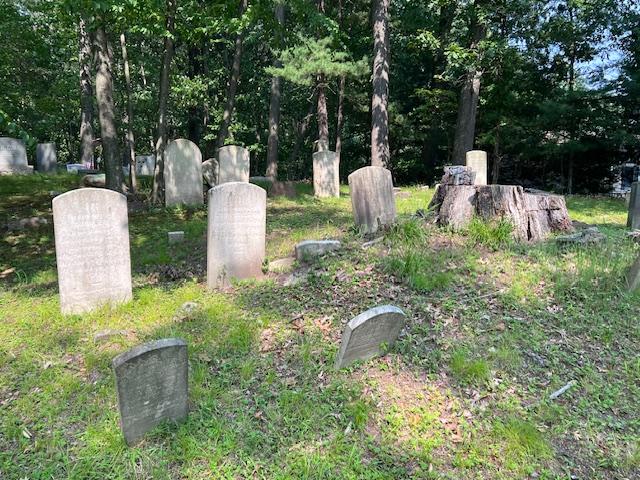
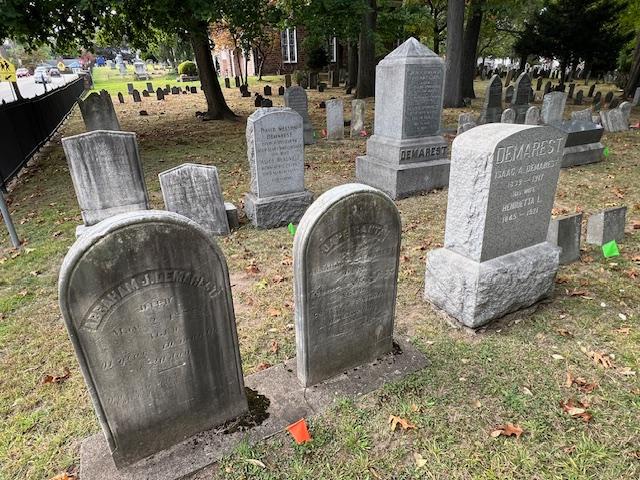
The historic Woodside Cemetery in Dumont, NJ. It is the home of many ‘founding families’ of Bergen County, NJ., such as the Demarest’s, Hopper’s, Van Buskirk’s, Haring’s (Hering’s), Van Saun’s, DeBaun’s, Westervelt’s and Zabriskie’s. These are the families that dominated the farming industry in Bergen County before and after the Revolutionary War. It is one of the many historical cemeteries and graveyards in Bergen County, NJ.
My mapping of historical cemeteries and graveyards in Bergen County, NJ:
The inside of the cemetery in the historical section of the cemetery
The historical Woodside cemetery is the resting place of many of the founding families of Bergen County and the surrounding communities of New York State.
Lining the historical Main Street of Downtown Dumont, the older part of the cemetery holds the family plots of some of the original settlers who shaped this country from its beginning.
The Voorhis family plot
The Zabriskie family plot
The Brinkerhoff family plot
The Waite Van Bushkirk family plot
The Van Bushkirk family family plot
The large Demarest family plot
The Hasbrouck family plot (the family who Hasbrouck Heights is named for)
The Blauvelt family plot
The DeBaum-Westervelt family plot
The Van Saun-Demarest family plot
The Demarest-Haring-Van Vliet-Vorhees family plot
The Demarest-Van Bushkirk family plot
The Brinkerhoff-Doremus-Demarest family plot
The Van Bushkirk-Hopper family plot
The grave of James Blauvelt DeMott
The cemetery is the resting place of many War of 1812, Civil War, the World Wars, Korean and Vietnam and the modern wars.
The cemetery is a place of respect and quiet contemplation. To see the contributions of these members of the community is to reflect on the history of Bergen County. These families and many people buried here have helped shape Bergen County and the State of New Jersey to what it is today.
I visited the Alpine Cemetery, which is a historical active cemetery just off Closter Dock Road. This is the resting place of Revolutionary War Veteran, William Wilson and many other veterans from the Civil, Spanish American, World War I and II as well as from Vietnam, Korea and Desert Storm. All the graves were marked with American flags as we just finished Memorial Day weekend.
The family plots that separate the site
My International Marketing class at Bergen Community College recently did a complete study and marketing plan for the “Bergen250” on the Revolutionary War veterans buried at graveyards and cemeteries all over Bergen County, NJ:
For a Mapping of all the historic graveyards and cemeteries, I had the students visit all the sites that the Daughters of the American Revolution had researched and I had the students find all the locations, photo the tombstones and create a bio on each of the veterans. I enclosed a copy of their work above.
My blog on the historic graveyards and cemeteries of Bergen County:
There are many family plots of “First Family’s” of Bergen County like the Westervelt’s, the Haring’s and the Campell’s. The family plots are separated by small fences and some are marked by the family names.
The cemetery on the hill in Alpine, NJ
The separate family burial plots
The Campbell Family burial plot
The Campbell family plots
The Van Sciver family plots
The Anthony Family plots
The Anthony family plot
The Haring Family plot
The Haring family obelisk
The Westervelt family plot
The Jordan/Wilson family plot
I looked at the Wilson family plot for the Revolutionary War veteran but the burial spot is probably has been lost to time. William Wilson may be lost to history but I know he was buried here.
The front part of the cemetery
The Veteran’s Memorial Rock with the names of World War I and II, Vietnam and Korea veterans
The Van Valen family plots
The Pearsall family plots
The Older family plots
The burial grounds from the front
There is a quiet elegance to these historic cemeteries. Who were these people? What did they do? Do people remember them? They are very interesting places to visit.
The history of the cemetery:
(From the historic sign)
The cemetery was founded in 1822 by resident William Gecox along Closter Dock Road when he bought 23 and a half acres as a burial ground for neighbors and for laborers who worked in the area. Mr. Gecox sold these plots on what had already been a burial ground.
The people buried in the cemetery were farmers, laborers, and tradesmen and their family. By 1870, the village “in the Closter Mountain” had take the name “Alpine” in the 1890’s. When William and his wife, Susan Helms pass in the 1890’s, their children sold the remaining plots. The cemetery has continued to be used into the twenty-first century.
One of the last places I visited in the 2026 Pathways tour of Morris County was the Historical Society of Boonton Township which is located in the former Oscar Kincaid Farm Homestead. The house and what was left of the acreage of the farm was part of the current museum. The museum was an example of early New Jersey farming that dated from the 1800’s to the Twenty-First century. There was not much in the way of period furniture or farm equipment (items of the home were sold off since Mr. Kincaid’s passing), but the new historical society is buying artifacts and bringing them back to the farm. This includes one of Mr. Kincaid’s tractors. His roll up desk is also still in the display room which was once the Living Room of the home.
The Kincaid Homestead
History of Oscar Kincaid and Homestead:
(From the Morris County Historical Society website)
Originally a part of the extensive tract belonging to William Penn, the earliest portion of the home was constructed in 1785 by Adam Miller and Anna DeMouth Miller. Just over a decade later, they sold the property to Adam’s cousin, Sarah Miller Parlimen (of the Miller/Dixon homestead) and her husband, John, who built a sawmill there. After a brief ownership by William Scott of Powerville, a Miller relative, the land was sold to John Decker in 1828. An industrious man, Decker operated both a farm and successful forge, shipping his goods to New York via the Morris Canal. By 1837, he expanded the home, adding a distinctive folk-art painting of a face and unique plasterwork that can still be seen today (MCHS website).
The homestead passed through generations of Decker’s family, ultimately being inherited by Oscar Kincaid Sr. in the early 20th century. Kincaid ran a popular ice cream stand and dairy business throughout the 1920s and 30s. Following World War II, the family opened Valley Farm on the site, which continued until the death of Oscar Kincaid Jr. in 2000. Added to the National Register of Historic Places in 2005, the Decker-Kincaid Homestead today operates as a museum and headquarters of the Historical Society of Boonton Township (MCHS website).
The Kincaid House
The historical marker for the house
The front yard
The entrance to the house
The main foyer of the house
The house is a small farmhouse built in two sections. The original part of the house dates back to the late 1700’s and the newer part in the early 1800’s. The once furnished rooms now hold displays of Morris County and the farming industry of the time plus community artifacts.
The former Living Room
Oscar Kincaid’s desk
There were not much left in the way of family furnishings and heirlooms but this desk was Oscar Kinkaid’s.
The back bedroom
The Flag display for the ‘250th Anniversary’
Story of Oscar Kincaid’s life: Oscar Kincaid was a farmer/businessman, a politician and a conservationist.
On Community:
(From the museum website)
Oscar’s commitment to his community transcended farming. He served as a member of the Boonton Township Committee for 30 years and was mayor for two terms. He was also a founding member of the Morris County Agricultural Development Board, on which he served for 17 years, six as board chairman. Oscar led the charge for farmland preservation in Morris County. His efforts resulted in the preservation of 41 farms covering 3,100 acres spanning several municipalities throughout the county. As one person put it: “Oscar had more impact on preserving the character of Boonton than any single individual.”
But to Oscar: “Farming and being active in local politics was simply a way of life.” Oscar passed away November 11, 2000
The contractor’s face on the wall
The face came about when Oscar Kincaid did not want to pay a contractor for his work. He created this face so that he would have to live with it for the rest of his life. It can not be planted over.
The ‘Mr. Face’ in Weird NJ
On Farming:
(From the Museum website)
Oscar Kincaid, Jr., was born into farm life. It was 1824 when the Kincaid family purchased 30 acres in Boonton Township, Morris County and began farming. More than a century later, a young Oscar took over the operation, working alongside his father as they raised dairy cows, grew vegetables and developed a poultry business. For years, they delivered eggs to retail establishments and sold vegetables from their roadside stand. Over time, Oscar moved away from the dairy and poultry business and focused his efforts on vegetable and hay production.
The Kincaid house from the side
After the short tour around the house, I walked around the farm grounds. The house was set on a beautiful piece of land that sloped down to the old farmstand. There was also a swimming pond which was once part of the farm which is now private property.
The farm property from the side with the barn
The barn across the street
The property was about ten acres at the time of his death and parts have been developed. It still has some of the most wonderful views of the area.
The view of the old farm from the front porch
The farm land stretches over different sections of the road and the property is very picturesque. It is a very beautiful homestead.
The view of the farm from the lawn
The swimming pond on the edge of the property
The old farm stand that had been used for eighty years
The old Farm stand was used into the mid 2000’s
The full view of the farm
Since the house was just recently bought, there is still some design and artifacts that need to be collected to complete the look of a Jersey farm.
The Historical Society of Boonton Township is still expanding the collection of farm equipment for property and finding furniture for the home. The property is a beautiful and picturesque and shows how the traditional farm has adapted to modern times. Mr. Kincaid only passed a few years ago but kept the farm traditional and that worked for him. He left a legacy for us to appreciate the independent Jersey farmer.
I visited the Henry Doremus House during the Morris County Pathways Tour in May of 2026 and it is good look at the early farming communities of New Jersey under the Dutch and then the English. The house was used by General George Washington while he was passing through this section of New Jersey during the Revolutionary War.
The sign for the Henry Doremus House
The historic sign for the house
Montville Township Historical Society:
(from the Museum website)
Established in 1963, the Montville Township Historical Society is dedicated to the preservation and promotion of the cultural heritage of Montville Township. Our unwavering commitment to meticulous archival work, interactive educational programs, and community outreach initiatives is aimed safeguarding the rich history of our town. Our ultimate objective is to ensure that the stories and traditions of Montville Township are cherished and celebrated for years to come.
The farm and harvest equipment
General Washington’s payment to the Doremus family for use of their home during the Revolutionary War
The farming equipment
The farm and household equipment room
The farm equipment from the time of the Revolutionary War
Henry Doremus House History:
(from the Museum’s website)
The Henry Doremus House is a Dutch American stone farmhouse that has been remarkably preserved since the time the first portion was built, circa 1760. The house has never been modernized with heating, plumbing, electricity, or wiring, and is one of only seven left in New Jersey without modern electricity. What is now Route 202 was one of the main military routes during the Revolutionary War through Montville and Towaco, (then part of Pequannock Township). The Henry Doremus house was located in a small community often referred to as Doremus Town.
The main room of the original house during the tour
The kitchen and cooking equipment by the open hearth fireplace
The open hearth fireplace for cooking and heat for the home
Cooking items
(from the Henry Doremus website)
General George Washington and his troops often traveled this route between Morristown and West Point. In June of 1780, Washington’s troops (2000 soldiers and 40 aides) were in Whippany and traveled to Doremus Town after the retreat of the Battle of Springfield. General Washington and his aides (which General George Washington at age 45 about the time he stayed at the Henry Doremus House (Mount Vernon) included Alexander Hamilton) stayed two and a half days in the Doremus House as General Andre Rochambeau (NIAHD Journals) documented by Washington’s expense account and letters. A payment of $40 was made to Mrs. Doremus at Pequannock on June 25th, to house General George Washington and his soldiers after the Battle of Springfield. French General Rochambeau stayed in the orchards around the house with over 5000 of his men, women, and camp followers on his way to the Battle of Yorktown in 1781.
The items for processing wool and flack for clothing
A closer look at the equipment
Household equipment
The house addition towards the back had a spinning wheel and demonstration on how to make cloth.
The Henry Doremus House was placed, in 1972, on both the National Register of Historic Places and the New Jersey Register of Historic Places. It was also listed on the Montville Township Local Register in 1987, as well as the Crossroads of American Revolution Greenway. In addition, the preservation and protection of the Henry Doremus House won the New Jersey Historic House Preservation Award in 2009.
The demonstrations on spinning yarn and making clothing in the back of the house
When I toured the house, the docents described how the household functioned and how the farm worked during the season. Men and women had different roles to make the household function. There was not much buying things for the house so clothes were made, foods were preserved and pickled for the Winter and then meals had to be prepared while the men worked out in the field. Men had to grow, tend to and then pick all the fruits and vegetables. Then there was tending to the animals, sheering animals and just working on tending the farm with repairs and working through the seasons. It was a lot of physical work through all the seasons.
Household equipment and furnishings plus another open hearth for heating the house
The front of the house facing the street with twin Dutch doors and entrance to the root cellar
The Doremus House is open mostly during the Pathways tour in May and October. The Montville Historical Society also runs the Montville Historical Society Schoolhouse Museum in Montville.