Category: VisitingaMuseum.com

Van Bushkirk Burial Ground 45 East Saddle River Road Saddle River, NJ 07458

Van Bushkirk Burial Ground

45 East Saddle River Road

Saddle River, NJ 07458

https://www.findagrave.com/cemetery/2160733/edit

The Van Bushkirk Burial Ground behind the residence at 45 East Saddle River Road

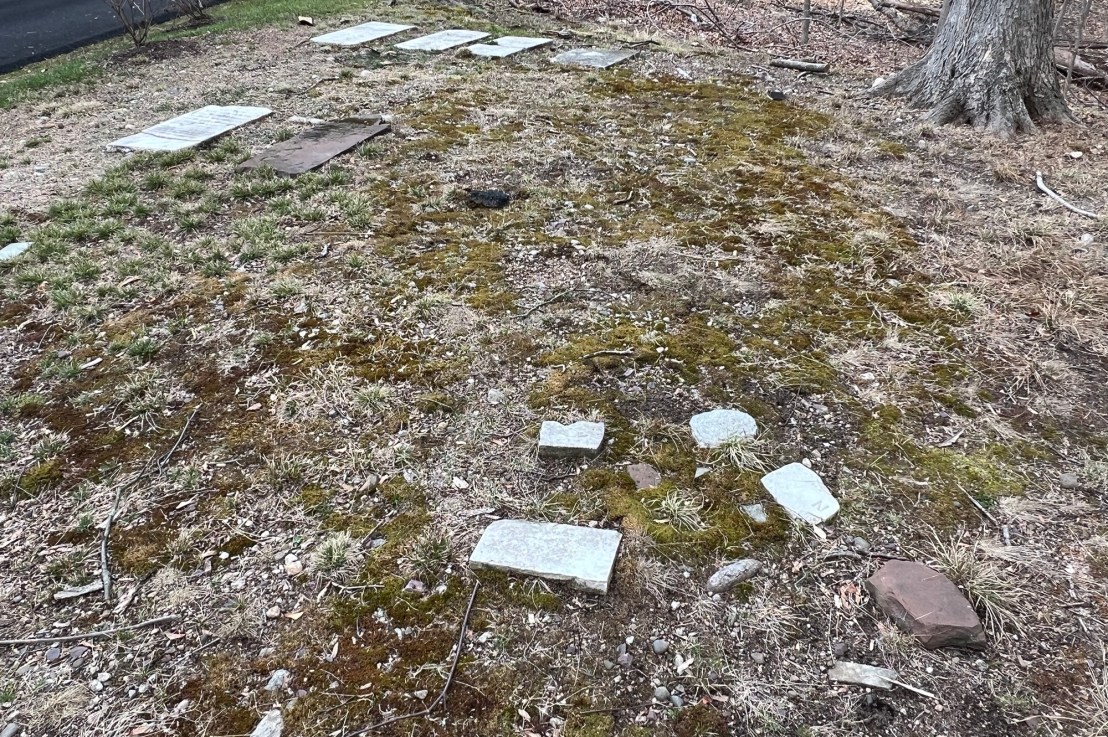
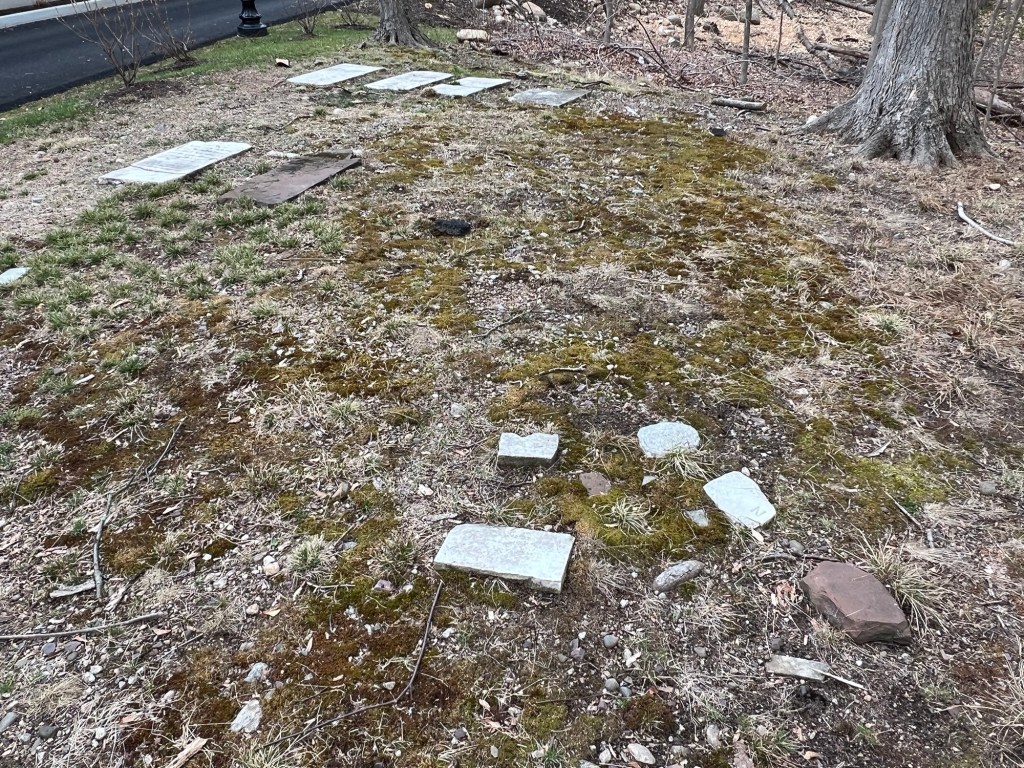
The Van Bushkirk Burial Ground is part of the history of Saddle River, NJ’s early settlement period. The burial ground has about 40 tombstones that are arched and shaped. These are some of the first residents both of Saddle River and Bergen County, NJ.

The burial ground lies next to a creek off East Saddle River Road and can only be accessed by going through private property of the residents living at 45 East Saddle River Road. Please do not enter without permission of the owner of the home. These pictures were taken with a long distance camera from the street.

The Van Bushkirk Burial Ground at 45 East Saddle River Road

The History of Saddle River:

(from the Saddle River Town website):

In 1675, Lenni Lenape tribal leaders sold a large amount of land on the Eastern side of the Saddle River (known as Werimus) to Albert Zabriskie. In 1708, Zabriskie sold this tract of land to Thomas Van Buskirk. The first house in Saddle River was built by the Van Buskirk family in 1709. The original Van Buskirk homestead still stands at 164 East Saddle River Road across from Borough Hall.

In 1709, the Lenni Lenape sold the land on the west side of the Saddle River to the English as part of the Ramapo Tract. Property on the west side of the Saddle River was acquired from this Tract throughout the 1700’s. The Ackerman Family was the most prolific buyer of these early Saddle River parcels and first settled on the West side of the Saddle River in 1745 when Johannes Ackerman acquired 245 acres.

The graves of George and Margaret Achenbach

Saddle River continued to grow and populate during the 18th century.  Families such as the Van Buskirk’s, the Ackerman’s, the Achenbach’s, the Hopper’s, the Zabriskie’s, the Stilwell’s and the Baldwin’s farmed and developed the area.

The grave of George Achenbach

The first of many Saddle River mills was built in 1714 and the first school was constructed in 1720. Another early 18th century business was the blacksmith shop operated by the Ackerman family. Over the years, these 1st families built the quintessential “Old Dutch Homesteads” from actual sandstone that was found in town.

The Revolutionary War era tombstones

The Revolutionary War was a horrendous time for the residents of Saddle River. The townsfolk had spent the entire 18th century developing the area into a well established community and all growth essentially stopped during the war. Since the Jersey Dutch initially considered the revolution to be an English issue, it was particularly shocking when the fighting came to their backyards. From December 1776 until the end of the war, both American and British forces traveled through Saddle River and many times set up camp in the center of town.

Residents were in constant fear of the British employed Hessian soldiers who would terrorize families by raiding the houses for food and then burning the fields before leaving. Although no major battles took place in Saddle River, there were small skirmishes to fend off raids and the Blue Mill on East Saddle River Road was destroyed. Even George Washington, the future father of our country, passed through Saddle River on multiple occasions and tradition has him staying overnight at the Ackerman Homestead on the East road.

When the Revolutionary War ended, Saddle River residents picked up right where they left off in terms of community and industry development. The Ackerman’s built a Foundry on what is now Waterford Gardens. Tice and Berdan both opened stores in town and the Bulls Head Tavern opened its doors to weary travelers in 1802. Old mills were re-opened and new ones such as Van Riper’s Saw Mill and Basket Factory were established. The post war growth continued for decades and culminated in the 1820s with the construction of the Zion Lutheran Church in 1821 and a new schoolhouse behind the church in 1825.

The worn tombstones in the cemetery

History of the Van Bushkirk family in Bergen County during the Revolutionary War:

(From the Bergen County Historical Society website):

Loyalists in Bergen County | Bergen County Historical Society

Loyalists in Bergen County came from all backgrounds, religions and economic classes. At the beginning of the war, a number were officers in the militia, the military force composed of all able-bodied males maintained by each province, and later the states. The lieutenant colonel of the militia was John Zabriskie of New Bridge. Zabriskie understood the sentiments of many of his neighbors, particularly those of Abraham Van Buskirk, whose property was directly across the bridge in Teaneck. Van Buskirk was a surgeon in the militia under Zabriskie, and with whom he served on Bergen County’s Committee of Correspondence, an entity established to keep in touch with other New Jersey counties and the events occurring there.

Van Houten Family Cemetery 108 Delaware Lane Franklin Lakes, NJ 07417

Van Houten Family Cemetery

108 Delaware Lane

Franklin Lakes, NJ 07417

https://www.findagrave.com/cemetery/1598327/van-houten-family-cemetery

https://www.myheritage.com/names/john_vanhouten

https://www.wikitree.com/genealogy/VANHOUTEN

My review on TripAdvisor:

The Van Houton Family Cemetery at 108 Delaware Lane on what was once the family farm

The historic Marker from 1822

The family plot from the entrance of the cemetery

About five generations of Van Houton’s have been buried in this spot, with an impressive list of family members who have served in all the nation’s wars.

From the Revolutionary War up to World War II, the family’s contribution extends not just to Bergen County but our entire country.

The family extends to other older ‘first families’ of Bergen County, such as the Snyder’s, the Demarest’s, DeBuan’s and the Van Ripper’s.

History of the Cemetery:

https://www.interment.net/data/us/nj/bergen/vanhouten/van.htm

(From the research of Richard Hrazanek)

This multi-generational cemetery is still used today by the descendents of John Van Houten, who left the property in his will. The grounds of the cemetery are well maintained. A metal fence around the property could use some minor repairs. Unfortunately a couple of the obelisk markers have fallen off their bases.

In the August 1992 Cemetery Inventory Booklet, published by the Bergen County Department of Parks, Division of Cultural and Historic Affairs, they listed Andrew Schaaf as a contact person for the cemetery, with an address of 749 High Mountain Road, Franklin Lakes, NJ 07417. The same publication mentions that an inventory of the cemetery was done by John Neafie in 1911.

The oldest tombstones in the center

The History of Franklin Lakes:

(From the Franklin Lakes Town website):

https://activerain.com/blogsview/238626/franklin-lakes-new-jersey-history

In the 17th century, Lenape Indians traveled the land we now call Franklin Lakes.  They made winter camp in the “Clove” near Buttermilk Falls and fished in Micharagrape Pond ( now Franklin Lake).

Slowly, the Dutch settlers made their way west from the Hudson River Valley.  In 1701 the East Jersey Proprietors confirmed to Michael Hawden the land around the Pond.  In 1772 Franklin Township was formed and included much of northwestern Bergen County.  Farming was the major occupation of the early inhabitants, mostly Dutch with the names of Van Winkle, Van Houten, Ackerman, Pulisfelt, Van Blarcom, etc.  They built solid farmhouses of sandstone and fieldstone.  Fourteen of these historic homes still stand in our Borough.

Some of the original family member tombstones in the cemetery

Mills sprang up along the creeks: sawmills, gristmills, tanneries and forges.  Daniel Youman’s Grist Mill on Franklin Lake was probably the first business established (it later served as a saw mill and a cider mill).

The 1876 Walker Atlas showed Franklin Lakes had about 100 residences, 5 mills, 1 tannery, 3 schools, 4 blacksmith and wagon shops, 1 church, 2 hotels, 1 store, and 2 railroad depots.

The railroad stations were built in 1869 when the New Jersey Midland Railroad was extended to Oakland.  One station stood at Campgaw on Pulis Avenue, the other at Crystal Lake on High Mountain Road.  Residents used the train for commuting, moving goods and mail.

Around the turn of the century, estate houses and mansions began to appear in the area.  The industrial revolution brought wealth, and many of the wealthy became “gentleman farmers,” sometimes living here only in the summer.  Examples of these houses include the Bartholf-Hughes house on Somerset, the Post-Terhune house on Franklin Lake Road, and the Atterbury-Brockhurst house on Ewing Avenue.

Eventually, the Campgaw section became the civic center of our Borough.  In 1922 Franklin Lakes separated from Franklin Township, incorporated, and elected William V. Pulis as its first Mayor. 

Edward May built three lakes and started the Shadow Lake Swim Club, which evolved into Shadow Lakes Estates.  On the other side of the Borough, J. Nevins McBride purchased land around Franklin Lake and began building single-family homes in Urban Farms.

When Route 208 was extended to Oakland in 1959, Franklin Lakes became more accessible, and by 1980 there were more than 8,500 residents.  The completion of Interstate 287 in the early 1990’s stimulated another boom in building.  Today, the population of our Borough is 10,422.

From a sleepy rural community to an affluent metropolitan suburb, Franklin Lakes has changed extensively, continuing to be a desirable place to live and raise families.

The Franklin Lakes Historical Society was created to help preserve our Borough’s rich history, while at the same time looking to the future of our unique community and those who choose to make this their home.

courtesy http://www.franklinlakes.org 

The family still uses the cemetery into the twenty-first century

Part of the cemetery into modern times

Multiple family members are often buried together

The cemetery in modern times

The children of Ralph Van Houten who passed within a few years of one another

The grave of Abraham Van Houton and his wife, Bridget

The front part of the cemetery shows the different branches of the family and when they were buried.

The back part of the cemetery is rather old

The Snyder branch of the family

Another branch of the Van Houten family is buried together here

Members of the Ackerman and Cooper side of the family

Conrad and Elizabeth Van Houten

Jacob and Elizabeth Van Houten

Some of the modern graves of the Van Houten’s and Ackerman sides of the family

Many of these small family plots sit on buffs and have the most amazing views. It is as if the final resting place was to be a place of beauty and contemplation.

Unfortunately the family farm is long gone and the cemetery is now surrounded by McMansions. Talk about progress!

Sturr Family Cemetery                                                                        375 Pulis Avenue                                                                                    Franklin Lakes, NJ 07417

Sturr Family Cemetery 375 Pulis Avenue Franklin Lakes, NJ 07417

Sturr Family Cemetery

375 Pulis Avenue

Franklin Lakes, NJ 07417

https://www.findagrave.com/cemetery/2227047/sturr-family-cemetery

https://www.wikitree.com/genealogy/STURR

My review on TripAdvisor:

The Sturr Family Cemetery sits on a bend of the driveway of the Chabad Jewish Center of Northwest Bergen County and is a small cemetery that once sat on the edge of the J.H, Sturr farm.

The Sturr Family Cemetery

The farmhouse of the Sturr Family sits on the lot across the street from the cemetery property. This is located on a small buff on what was the edge of the farm.

The Sturr Family cemetery tombstones

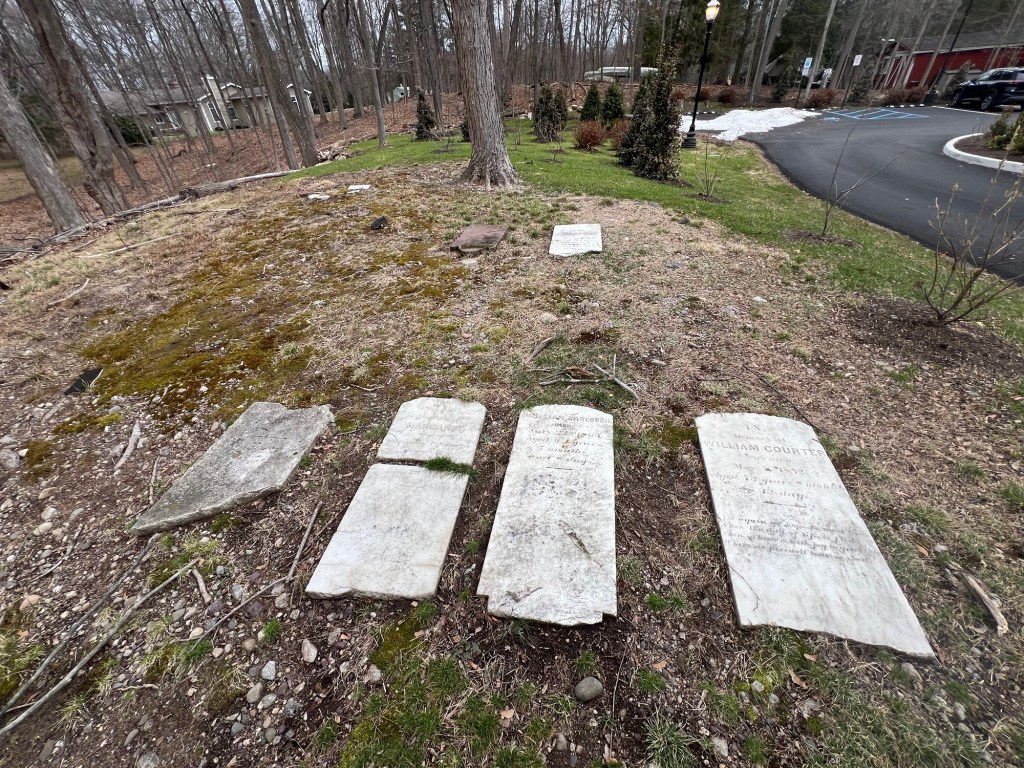
The tombstones of the Courter and Carlouch family members

The grave of William Courter

The only visible tombstones that are left in the cemetery are an Ackerman family member, Anny Ackerman and members of the Courter and the Carlouch family’s (who must have married into the family).

The Ackerman family tombstones (the one to the right was unreadable)

The other tombstones are broken and no one is sure who is buried where in the cemetery.

The History of the Cemetery:

(From Find a Grave website)

The cemetery is located in Franklin Township, Bergen County, New Jersey, on what was once the family farm of J.H. Sturr. As of October 1991 only 6 markers were still remaining.

The Sturr Family Cemetery in full view

History of the House:

(From the Franklin Lakes Municipal Website)

H. Sturr House or Blue Meadow Farm
Built 1860
378 Pulis Avenue, Block 1510, Lot 8
Franklin Lakes, New Jersey 07417 

The Sturr House – also known as Blue Meadow Farm -is a handsome and little altered example of mid 19th century vernacular architecture which incorporates several stylistic elements such as gable returns and frieze area of the early 19th century Greek Revival style. The Borough of Franklin Lakes lists the erection year of the house as 1860. 

The façade of this 2 ½ story house consists of clapboard. The front porch has five bays with square posts and a rectangular entrance door with rectangular sidelights. Two tall 1st story windows are on one side of the porch. A single hitching post with iron rings sits in front of the porch stairs. The building has a frieze area with linear design. Semi-circular headed louvered vents are in all gable ends. The rear of the house has a one story wing.  There is a detached garage to the west side of the house as well as a round frame well. Further west of the house is a stable which has been extensively remodeled and converted into a residence in recent times. The house combined with associated structures is a significant remnant of the large farmsteads which ones dotted the Borough’s landscape prior to the recent suburban housing boom.

History of the Family:

(From the Franklin Lakes Municipal website)

This Sturr house and the nearby more altered house at 402 Pulis Avenue were duplicate structures and were probably built around the same time by members of the Sturr family. The 19th century Sturr family was descended from Conraedt Sturr who purchased 190 acres of land in this area with John Coeter from Robert Livingston in 1793.

The non-extant homestead and mill was located at present-day 930 Old Mill Road. It is known that Henry Sturr, the son of Conraedt, had a fanning mill at this location in 1850. In a will dated 1852 he bequeathed his property and mill to his grandsons John, Henry, and Daniel (Maria Braun – 1976 page 26 & 27).

The property along Pulis Avenue upon which these houses are situated was probably included in this will since the homes were built around the mid-19th century. Future deed research is recommended to identify the original builder and the construction date of the house (1861: H. Sturr, 1876 Estate of H.M. Sturr). Presently the house is privately owned and occupied.

Day Three Hundred and Seventy-Nine Exploring The Met at ‘Met After Hours’                                                                        February 12th, 2026

Day Three Hundred and Seventy-Nine Exploring The Met at ‘Met After Hours’ February 12th, 2026

One of the things I love about being a member the Metropolitan Museum of Art is the private Member’s Night ‘Met After Hours’ they hold about four times a year. The museum is open after the closing hours and it is a night of wondering the museum galleries, great music and entertainment and wonderful tours and talks in the galleries. You really experience the museum at its best and it does shine.

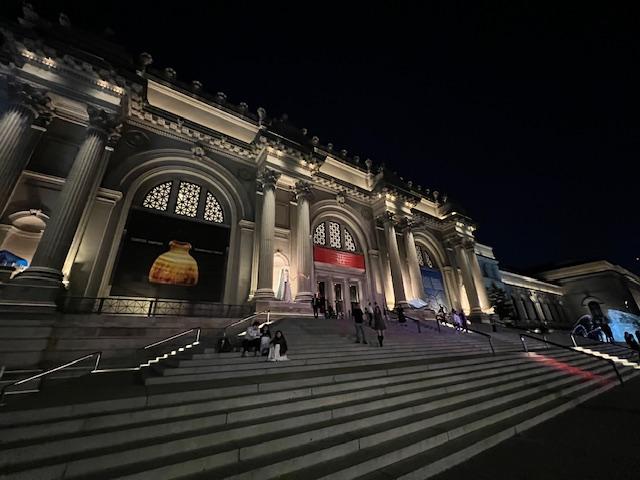
The outside of The Met at night

https://www.metmuseum.org/

My review on TripAdvisor:

My ‘Met After Hours’ reviews on MywalkinManhattan.com:

https://mywalkinmanhattan.com/category/met-after-hours-event/

The lines move very quickly to get into the museum and with traffic getting into the City that night, I arrived about twenty minutes after opening and there were no crowds to face and I got right in. There’s always a sense of excitement on these nights.

The Grand Hall in the front of the museum decorated with Spring flowers

The beautiful Spring flowers lined all the urns around the Great Hall

The museum welcoming all the members of the museum at ‘The Met After Hours’

I started my walk around the galleries in the Greek Wing touring the main hallway. It still boggles my mind how old these statues are and I am looking at something almost two thousand years old.

The Greek Gallery wing

https://www.metmuseum.org/departments/greek-and-roman-art

(From the Metropolitan Museum of Art website):

The Museum’s collection of Greek and Roman art comprises more than thirty thousand works ranging in date from the Neolithic period (ca. 4500 BCE) to the time of the Roman emperor Constantine’s conversion to Christianity in 312 CE. It includes the art of many cultures and is among the most comprehensive in North America. The geographic regions represented are Greece and Italy, but not as delimited by modern political frontiers: Greek colonies were established around the Mediterranean basin and on the shores of the Black Sea, and Cyprus became increasingly Hellenized. For Roman art, the geographical limits coincide with the expansion of the Roman Empire. The department also exhibits the art of prehistoric Greece (Helladic, Cycladic, and Minoan) and pre-Roman art of Italic peoples, notably the Etruscans (Metropolitan Museum of Art website).

One of the statues that stood out that evening

I spent some time admiring the statues and the craftsmanship of the works along the hallway. The only problem is that most of the Greek and Roman Galleries were closed for the evening so I headed off to the Renaissance Wing. I love the luxury objects in the collection of silver and gold and again their craftsmanship is still unrivaled today. To make these objects takes intensive work and talent.

The historic collection of luxury items

The time pieces of the Renaissance period

https://www.metmuseum.org/learn/educators/curriculum-resources/the-art-of-renaissance-europe

The timepieces show how advanced science had become and the importance of it in not just measurements but in beauty.

The lobby of the American Wing with the facade of what was a former bank and a Wall Street private mansion. I love the quiet elegance of this building and to think they moved it here piece by piece. The American Wing Cafe was open for the evening and the area was busy throughout the evening. It is nice to just sit and enjoy the views by the fountain. The artwork is beautiful.

https://www.metmuseum.org/departments/the-american-wing

(From the Metropolitan Museum of Art website):

Visitors to the American Wing will experience in more than 75 galleries on three floors varied art, design, and culture from the mid-seventeenth to the mid-twentieth century, with some contemporary expressions, by a diverse array of artists from across North America. Since our founding in 1924, this curatorial department has evolved its collecting to include some 20,000 artworks in many mediums by African American, Asian American, Euro-American, Latin American, and Native American makers, affirming ever more inclusive definitions of American art and identity. These dynamic holdings include painting, sculpture, drawing, furniture, textiles, regalia, ceramics, basketry, glass, silver, metalwork, jewelry, as well as historic interiors and architectural fragments, produced by highly trained and self-taught artists, both identified and unrecorded (Metropolitan Museum of Art website).

The evening then moved to the Egyptian Wing and the Temple of Dendur, where the entertainment and the cocktail bar was located.

The Temple of Dendur is the hub of activity on Members Nights

https://www.metmuseum.org/art/collection/search/547802

(From the Metropolitan Museum of Art website):

This small temple, built about 15 B.C., honored the goddess Isis and, beside her, Pedesi and Pihor, deified sons of a local Nubian ruler. On the outer walls between earth and sky are carved scenes of the king making offerings to deities who hold scepters and the ankh, the symbol of life. The figures are carved in sunk relief. In the brilliant Egyptian sunlight, shadows cast along the figures’ edges would have emphasized their outlines. Isis, Osiris, their son Horus, and the other deities are identified by their crowns and the inscriptions beside their figures (Metropolitan Museum of Art).

These scenes are repeated in two horizontal registers. The king is identified by his regalia and by his names, which appear close to his head in elongated oval shapes called cartouches; many of the cartouches simply read “pharaoh.” This king was actually Caesar Augustus of Rome, who, as ruler of Egypt, had himself depicted in the traditional regalia of the pharaoh. Augustus had many temples erected in Egyptian style, honoring Egyptian deities (Metropolitan Museum of Art). 

The area was packed with patrons enjoying music and talking by the bars. The crowds were so large at the beginning of the evening that I waited until after 9:00pm for the second performance of the group playing. So I headed into the section of the Egyptian Wing to look at the galleries that were open. I love walking around the Egyptian Wing of the Met. It is one of the most extensive collections outside of Egypt and the most fascinating Mummy exhibition.

Admiring one of the Mummy exhibits in the Egyptian Wing

https://www.metmuseum.org/departments/egyptian-art

(From the Metropolitan Museum of Art website):

The Department of Egyptian Art was established in 1906 to oversee the Museum’s already sizable collection of art from ancient Egypt. In the same year, the Museum’s Board of Trustees voted to establish an Egyptian Expedition to conduct archaeological excavations in Egypt. Between 1906 and 1935, The Met’s Egyptian Expedition worked at a number of important sites, including Lisht in the north and Thebes in the south, and the objects gifted to The Met by the Egyptian antiquities service form the core of our collection. Over the years, the Department of Egyptian Art has also been able to acquire, through purchase and bequest, several important private collections (Metropolitan Museum of Art website).

The ancient tablets outside of the Mummy Exhibition

The Egyptian artwork outside the Mummy Room

The tablets outside the Mummy Room

When the whole gallery is open, it is a treasure trove of objects and information from each Dynasty. I have been mind-boggled by these galleries since I first visited the museum in the third grade for a class field trip. I remember sketching artifacts for a class project and am still fascinated about how old some of these objects are and condition they are still in after thousands of years. It is my favorite part of the museum.

By 9:00pm, the entertainment was starting again, so I joined other members for a cocktail and enjoyed the music in the Temple of Dendur Gallery.

The Temple of Dendur fully lit for the evening before the start of the entertainment

The signature cocktail of the evening, the Starlight Spritz

Enjoying a Starlight Spritz while listening to the music

The bartenders can mix a drink

After a long week at work, it was nice to relax and enjoy the music. The music that night was performed by artist Jasim Perales and Friends, an Afro-Latin Jazz performance. The music was relaxing and soulful and the crowd had a wonderful time.

The start of the music again at 9:00pm

The trio performing

A clip from the entertainment that night

The Master of Ceremonies that night, Jasim Perales

https://www.instagram.com/jasimperales/?hl=en

All good things come to an end and it was time leave. The night was dark and the winter air was crisp creating the perfect Winter evening to set out into for the walk back to Port Authority. The Upper East is so beautiful at night.

The front of the Met that night

The artwork is always so impressive outside the Met

It was in the low 40’s that evening and the perfect night for a walk around the Upper East Side and Midtown. It still surprises me after all these years of walking around Manhattan how beautiful the City really is at night.

The beauty of Carnegie Hall in the evening

https://www.carnegiehall.org/

Passing the front of a quiet Carnegie Hall that evening

Looking up Fifth Avenue at night

Looking up Sixth Avenue and West 35th Street by Herald Square

The New York Public Library on Fifth Avenue at night

https://www.nypl.org/

It was another spectacular evening at the Metropolitan Museum of Art. Thank you to the Membership and Special Events Departments for hosting another wonderful evening.