Tag: NYC Parks

The Amiable Child Memorial                                554 Riverside Drive at West 124th Street          New York, NY 10027

The Amiable Child Memorial 554 Riverside Drive at West 124th Street New York, NY 10027

The Amiable Child Memorial

554 Riverside Drive at West 124th Street

New York, NY 10027

Open: 6:00am-1:00am

https://www.nycgovparks.org/parks/riversidepark/monuments/1206

https://riversideparknyc.org/places/amiable-child-monument

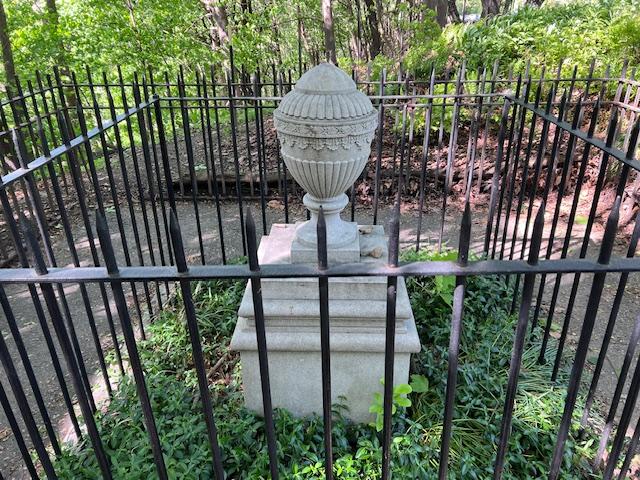
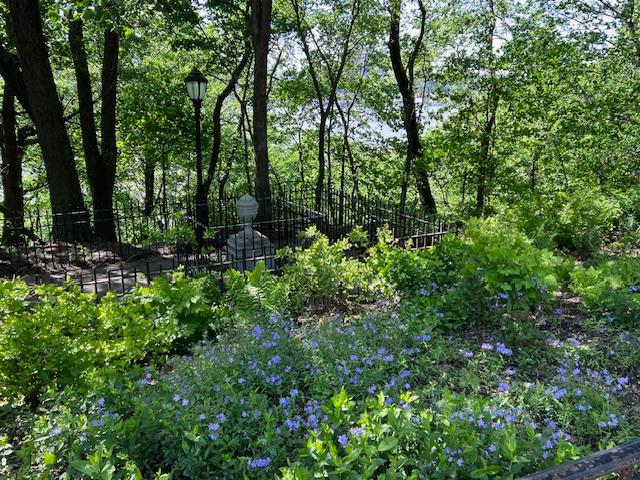
I stumbled across the Amiable Child Memorial over the summer when I was walking Riverside Drive for “MywalkinManhattan” project (see walking 155th Street) and came across this small memorial when I was passing Grant’s Tomb. It is off to the side on the path by the woods. It is a small monument and very humbling in its look. It is a small urn on a pedestal marking a grave of a small child surrounded by a fence. I got the following information from the NYC Parks Department website when I wanted to know more about the site:

The historic sign for the Tomb

This unique New York City monument marks the site of one of the few private graves on public land within the five boroughs. It belongs to St. Claire Pollock (the namesake of nearby St. Claire Place), a child who died on July 15, 1797 in the fifth year of his life, probably from a fall from the cliffs of the parkland onto the rocks near the Hudson River.
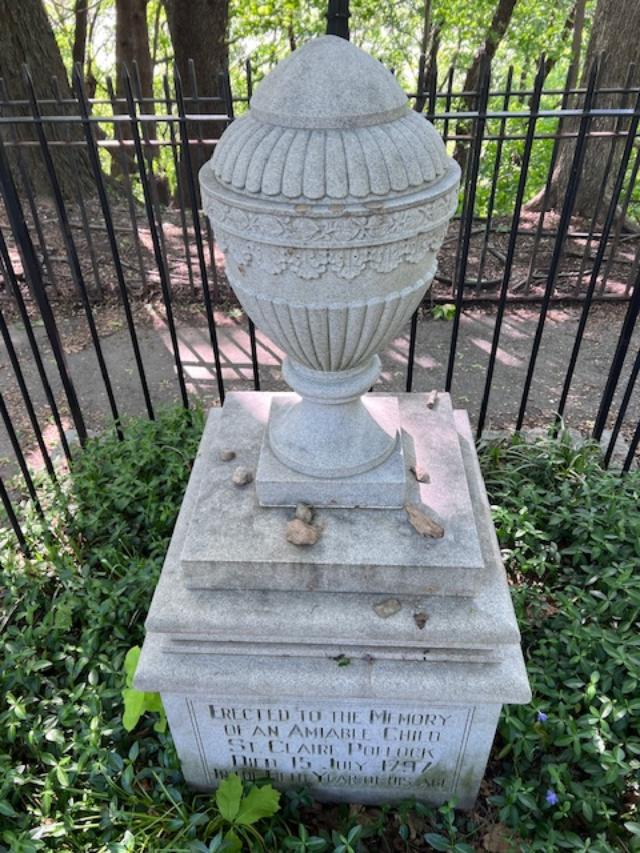
The tomb up close 

In the two centuries that have passed since the tragedy of the “Amiable Child” as he was described on his headstone-different accounts of St. Claire origins and family have persisted. George Pollock, the owner of the property on which the boy was buried, was either his father or his uncle. He was a linen merchant of Scots-Irish or possibly English descent, who lived in a mansion on Strawberry Hill (later called Claremont) in the 1790’s. He  had sold his property to Mrs. Cornelia Verplanck, his former neighbor, by January 18, 1800 when he wrote as follows:
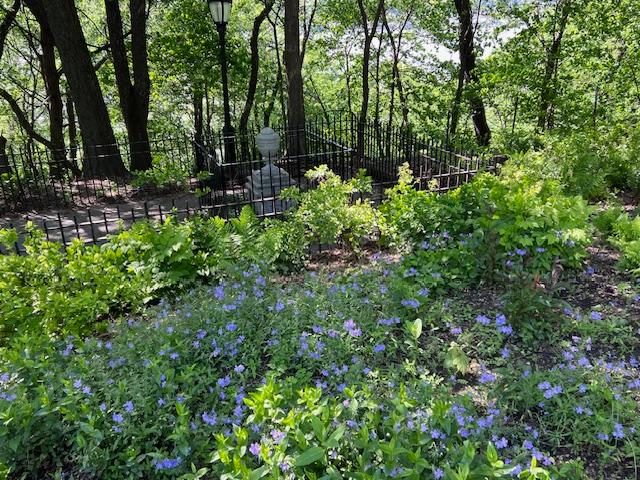
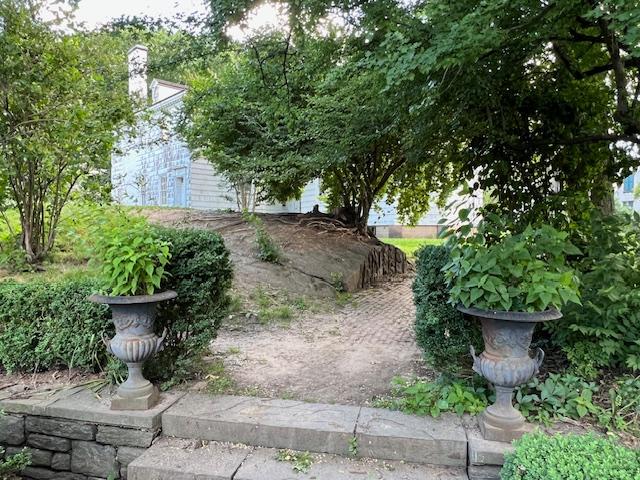
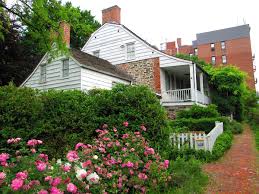
The Tomb of the Amiable Child park and flowers

“There is a small enclosure near your boundary fence within which lie the remains of a favorite child, covered by a marble monument. You will confer a peculiar and interesting favor upon me by allowing me to convey the enclosure to you so that you will consider its part of your own estate, keeping it however always enclosed and sacred.”
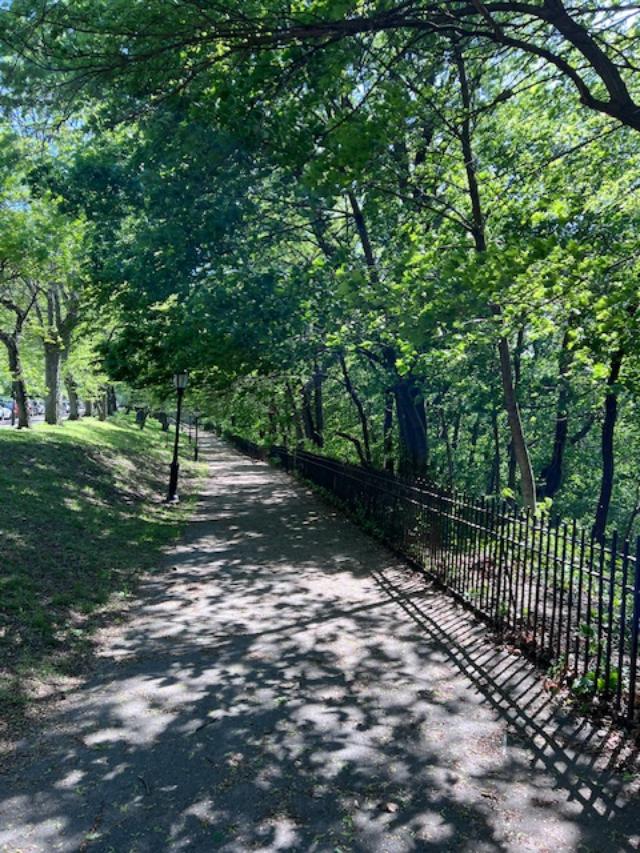
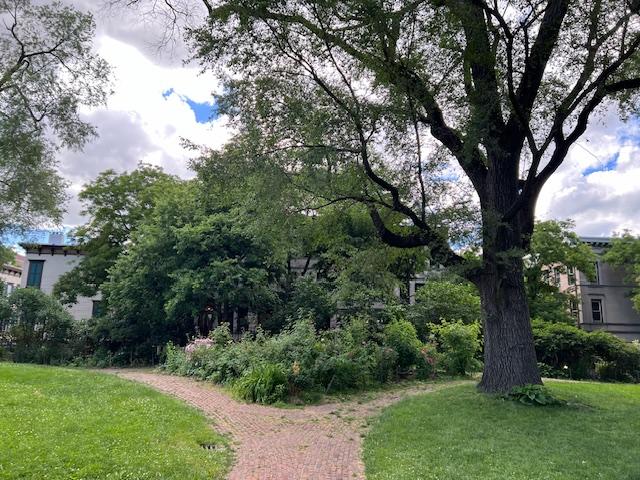
The park in the Spring of 2025

Claremont Hill was the site of the Battle of Harlem Heights, fought during the Revolutionary War on September 16, 1776. By 1806, it had been acquired by Michael Hogan, a former British Consul in Havana, who built Claremont Mansion (for which Claremont Avenue was named). Possible sources for the name are Hogan’s birthplace of County Clare, Ireland and his friend Prince William, Duke of Clarence, who would ascend the English throne as King William IV in 1830. Known as the site of a popular roadside inn by 1860, Claremont was acquired by the City from the heirs of Joel Post in 1873 for the development of Riverside Park.

The Park and the Tomb in the Spring 2025

In the 1890’s, Claremont Inn was host to numerous politicians, socialites and entertainers including the Morgan’s, Vanderbilt’s and Whitney’s, Lillian Russell and Admiral George Dewey. By 1907, the Inn had been transformed into a restaurant, serving the likes of Cole Porter and James J. Walker. It was destroyed by fire in 1950. The playground which now stands on the site was built shortly afterwards.

A century after the Tomb of the Amiable Child was laid, New York’s most famous monumental grave-Grant’s Tomb-was completed. The domed structure across Riverside Drive, designed by architect John Duncan and sculptor John Massey Rhind, was dedicated on April 27, 1897. The later structure is as grand a testimony to the accomplishments of national leader as the monument to the amiable child is a modest and touching tribute to a young boy who never had the opportunity to grow into adulthood. This monument was dedicated on May 3, 1967 (www.nycgovparks.org/parks/riverside-park/mounments/1206).

*You really have to look off the beaten path to see this unique little memorial but it is very touching and soulful. Take the time when visiting the neighborhood to visit this very touching site. You will find it by the path behind Grant’s Tomb.
Look for more sculptures  by looking at the Parks website http://www.nycgovparks.org.
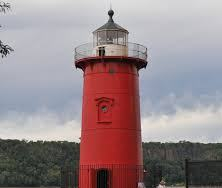
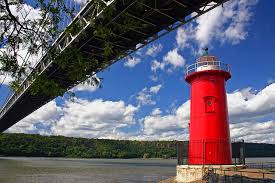
The Little Red Lighthouse in Fort Washington Park 178th Street by the George Washington Bridge New York, NY 10033

The Little Red Lighthouse: Fort Washington Park

178th Street under the George Washington Bridge

New York, NY  10033

https://www.nycgovparks.org/parks/fort-washington-park/highlights/11044

TripAdvisor Review:

https://www.tripadvisor.com/Attraction_Review-g60763-d2368581-Reviews-Little_Red_Lighthouse-New_York_City_New_York.html?m=19905


*I came across the Little Red Lighthouse when I was touring Fort Washington Park one afternoon on the walk and did not realize how famous this landmark was in literature. It was part of the book, “The Little Red Lighthouse and the Great Gray Bridge”. It is a small landmark but on a nice day it offers great views of the river and the surrounding park.

Little Red Lighthouse II.jpg

The Little Red Lighthouse & Fort Washington Park (Text is part of the Historical Signs Project).

The Little Red Lighthouse stopped being used as a functional lighthouse long ago but over the years this 40-foot-high structure has become a beacon of another kind. Located underneath the George Washington Bridge along this treacherous section of the Hudson River once known as Jeffrey’s Hook, this is one of the few surviving lighthouses in New York City and serves as a quaint reminder of the area’s history.

Long ago, Native Americans known locally as the Wiechquaesgeck-part of the Lenape tribe-inhabited much of upper Manhattan and eastern New Jersey. The Wiechquaesgeck and later the Dutch and English colonists, fished and hunted along the banks of the Hudson River. The Hudson was also an important route for travel, connecting upstate cities such as Albany to New York City and the Atlantic Ocean. As traffic increased along the river, so did the number of shipwrecks at Jeffery’s Hook. In an attempt to reduce the accidents, a red pole was placed at Jeffrey’s Hook jutting out over the river to warn travelers of danger. In 1889, two 10-candlepower lanterns were placed on the pole to aid navigation. Much of the land surrounding the lighthouse, including the riverbanks of Jeffery’s Hook was acquired by the City in 1896 and became known as Fort Washington Park.

little-red-lighthouse-iii.jpg

In the early 20th Century, barge captains carrying goods up and down the Hudson demanded a brighter beacon. The Little Red Lighthouse had been erected at Sandy Hooks, New Jersey in 1880 where it used a 1,000 pound fog signal and flashing red light to guide ships through the night. It became obsolete and was dismantled in 1917. In 1921, the U.S. Coast Guard reconstructed this lighthouse on Jeffrey’s Hook in an attempt to improve navigational aids on the Hudson River. Run by a part-time keeper and furnished with a battery-powered lamp and a fog bell, the lighthouse, then known as Jeffery’s Hook Lighthouse was an important guide to river travelers for ten years. The George Washington Bridge opened in 1931 and the brighter lights of the bridge again made the lighthouse obsolete. In 1948, the Coast Guard decommissioned the lighthouse and its lamp was extinguished.

The Coast Guard planned to auction off the lighthouse but an outpouring of support fro the beacon helped save it. The outcry from the public  was prompted by the children’s book, ‘The Little Red Lighthouse and the Great gray Bridge’, written by Hildegarde Swift and Lynd Ward in 1942. In the popular book, the Little Red Lighthouse is happy and content until a great bridge is built over it. In the end, the lighthouse learns that it still has an important job to do and that there is still a place in the world for an old lighthouse.  The classic tale captured the imaginations of children and adults, many of whom wrote letters and sent money to help save the icon from the auction block.

On July 23, 1951, the Coast Guard gave the property to Parks and on May 29, 1979, the Little Red Lighthouse was added to the National Register of Historical Places. It did not receive much attention over the years until City Comptroller Harrison J. Goldin worked with Parks Commissioner Henry J. Stern to find funding for its restoration. In 1986, Parks hosted a party in honor of the lighthouse’s 65 anniversary and to celebrate a $209,000 renovation of the lighthouse that included reconstruction of the concrete foundation and the installation of new steel doors. In the year 2000, the lighthouse received a fresh coast of red paint that is true to its original, historic color along with new interior lighting and electric lines. Today the Little Red Lighthouse remains a stalwart symbol of the area’s heritage, lighting the way into the city’s past.

The Little Red Lighthouse is owned by the New York City Department of Parks & Recreation and is a member  of the Historic House Trust of New York City.

Little Red Lighthouse.jpg

*This information comes off the New York City Department of Parks & Recreation website. I would advise because of the isolated location of the lighthouse in the park to visit at daylight hours.

The Morris-Jumel Mansion                                                        65 Jumel Terrace                                                                      New York, New York 10032

The Morris-Jumel Mansion 65 Jumel Terrace New York, New York 10032

The Morris-Jumel Mansion

65 Jumel Terrance

New York, NY  10032

(212) 923-8008

http://www.morrisjumel.org/

Fee: Adults:  $10/Seniors/Students: $8/Children under 12: Free/Members: Free

Open: Monday:  Closed to general public; visitation by advanced appointment only/Tuesday-Friday: 10:00am to 4:00pm/Saturday-Sunday: 10:00am to 5:00pm

The museum is closed on the following holidays: New Year’s Day, Memorial Day, Labor Day, Thanksgiving Day and Christmas Day.

TripAdvisor Review:

https://www.tripadvisor.com/Attraction_Review-g60763-d103500-Reviews-Morris_Jumel_Mansion-New_York_City_New_York.html?m=19905

The Morris-Jumel Mansion at 65 Jumel Place in the summer months

I came across the Morris-Jumel Mansion on my walk around Manhattan and noted it on my blog site “MywalkinManhattan.com”. This is the only remaining Colonial residence left on the island of Manhattan and is worth the time to take the tour of the house for its significance in the American Revolutionary War and in it’s later history.

The mansion is now going through a restoration

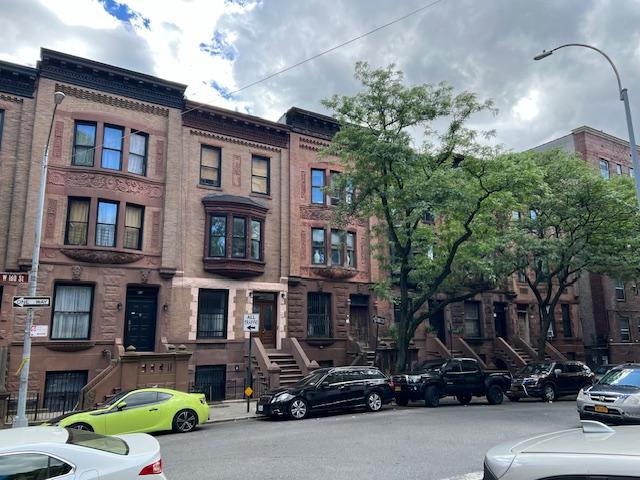
The Mansion and the historical district and grounds in the background

The historic plaque

The historic district outside the estate.

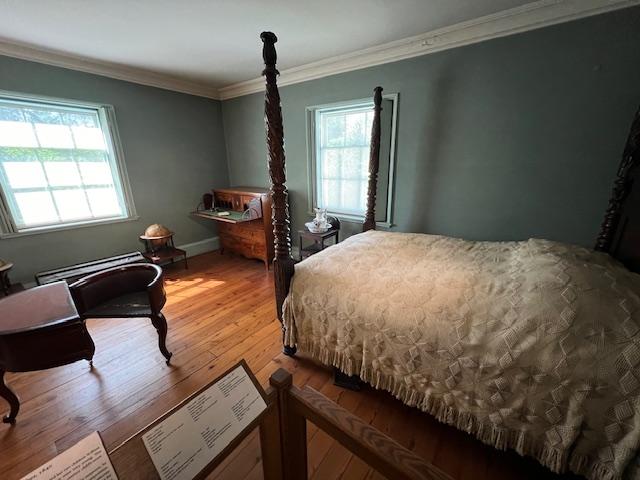
When touring the house, you get to see most of the rooms furnished with period furniture and some with the family belongings. The house had other uses over the years and the curators are trying bringing it back to the period of time when Madame Jumel lived there. The tour guides have some interesting stories on the colorful history of the house.

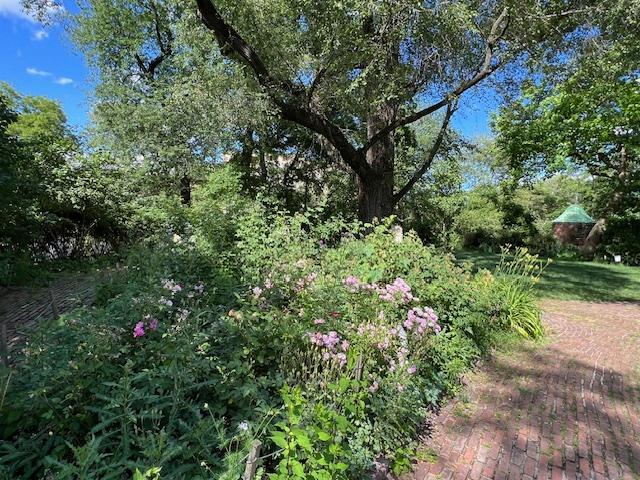
The Gardens in the early Spring months.

The crocuses and daffodils were just coming up

In the summer months, don’t miss the beautiful if somewhat rustic gardens that surround the house. It is very beautiful during the summer months. Check out their website for special events.

The Morris Jumel Gardens by the front gate.

The History of the Morris-Jumel Mansion:

The Morris-Jumel Mansion, Manhattan’s only remaining Colonial era residence is unique in its combination of architectural and historical significance. Built as a summer ‘villa’ in 1765 by the British Colonel Roger Morris and his American wife, Mary Philipse.

Roger Morris.jpg

Colonel Roger Morris

https://en.wikipedia.org/wiki/Roger_Morris_(British_Army_officer)

It originally commanded extensive views in all directions: of New York harbor and Staten Island to the south; of the Hudson and Harlem Rivers to the west and east and of Westchester county to the north. The estate named “Mount Morris” stretched over 130 acres from the Harlem to Hudson Rivers and the working farm grew fruit trees, and raised cows and sheep.

mary-philipse.jpg

Mary Philipse

https://en.wikipedia.org/wiki/Mary_Philipse

Colonel Morris was the son of the famous architect Roger Morris, a fact which may explain the extremely innovative features of the Mansion such as the gigantic portico, unprecedented in American architecture and the rear wing which was the first octagon built in the Colonies.

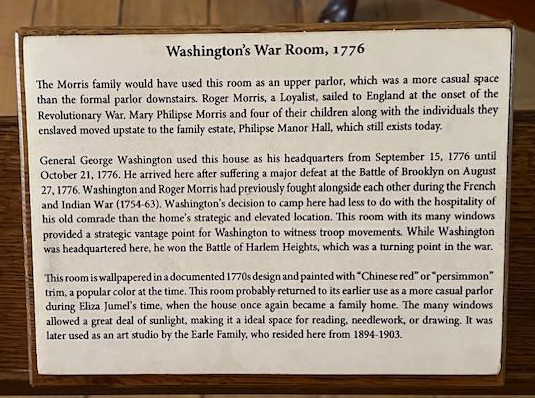
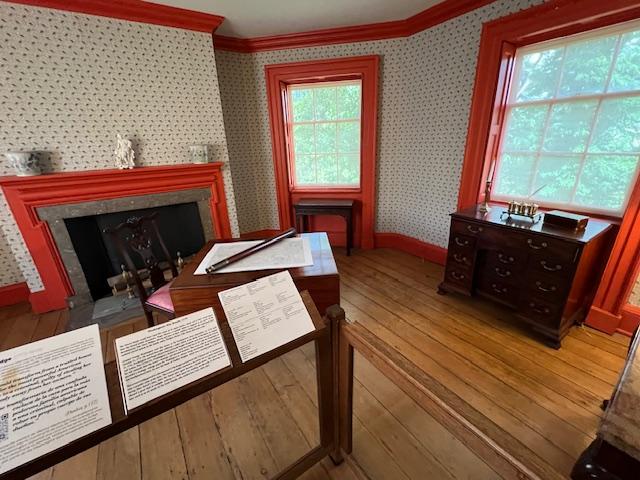
The house’s situation and large size made it ideal as military headquarters during the Revolution and it was occupied successively by Washington, General Henry Clinton and the Hessian General Baron von Knyphausen. As the Morris’s were loyal to Britain during the Revolution, so their property was seized and sold after its conclusion. In 1790, Washington returned for a cabinet dinner at which he entertained Jefferson, Adams, Madison, Hamilton and Colonel Knox among others.

George Washington’s War Room on the second floor of the mansion

The later history of the house centers on the Jumel’s. Stephen Jumel was a wealthy French émigré, who married in 1804, his beautiful and brilliant mistress, Eliza Bowen. They bought the mansion in 1810. In 1815, they sailed to France and offered Napoleon safe passage to New York after Waterloo. Although he eventually declined the offer, they did acquire from his family many important Napoleonic relics-some of which can be seen in the blue bedroom on the second floor.

Morris-Jumel Mansion IV.jpg

Eliza Jumel and her family

https://en.wikipedia.org/wiki/Eliza_Jumel

Favorable tariffs and faster sailing technology made Atlantic trade in raw materials and luxury goods and luxury products highly lucrative.  Stephen made his fortune  as a merchant. Later as his business floundered, Eliza applied herself to the real estate trade, buying and selling land and renting properties downtown.

Morris-Jumel Mansion Entrance Hall with the portrait of King George’s brother

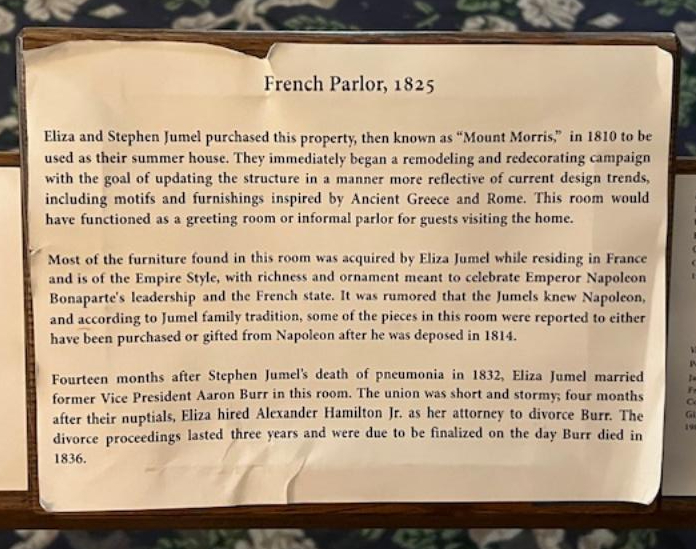
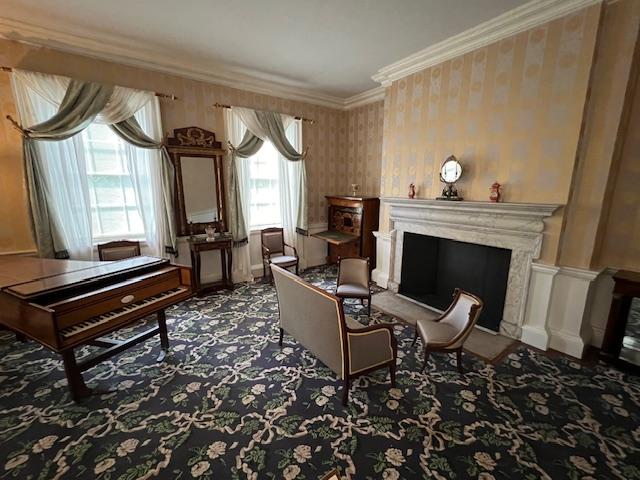
The sign for the French Parlor

The French Parlor

The historic sign for the Dining Room

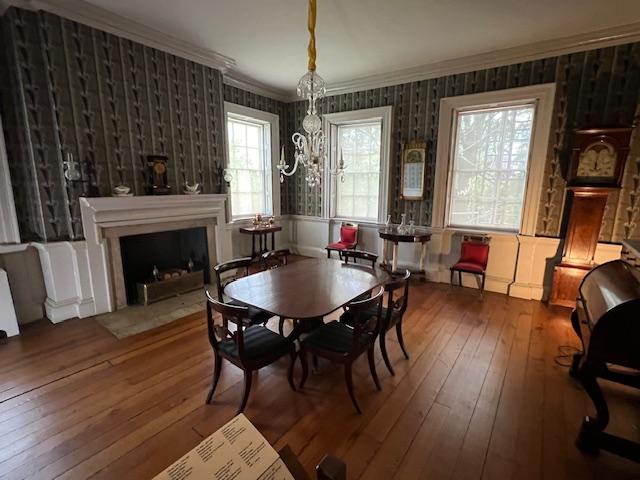
The formal Dining Room

Her success made large profits for her husband and herself  at a time when it was very unusual for a woman to be so active in business. Stephen died in 1832 and Eliza married the ex-Vice-President Aaron Burr in the front parlor one year later.

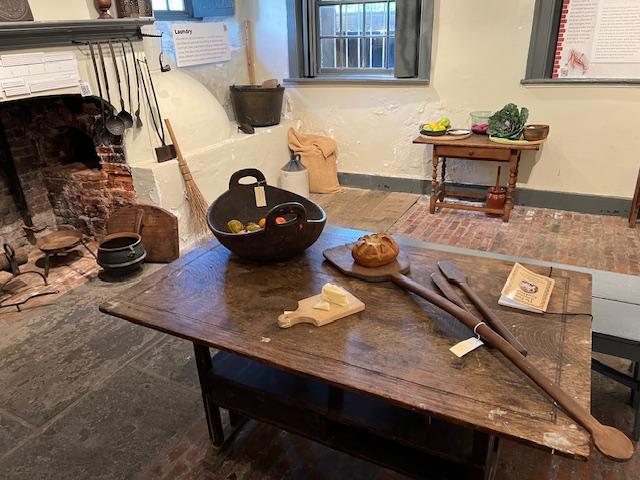
The Kitchen of the Morris Jumel Mansion is in the basement

The Kitchen preparing a Summer dinner

Preparing dinner in the Morris-Jumel Kitchen

https://www.morrisjumel.org/history

Eliza filed for divorce in 1833, a lengthy process which was not finalized until 1836 at the time of Burr’s death.  Eliza lived in the house until her death at age 90 in 1865, exactly 100 years after the mansion was built. On her death , she was considered one of the wealthiest women in America.  In 1904, the city of New York purchased the house and turned it into a museum.

The historic sign for Aaron Burr’s Bedroom

Aaron Burr’s Bedroom on the second floor.

Eliza Jumel’s Bedroom on the second floor

Eliza Jumel’s Bedroom

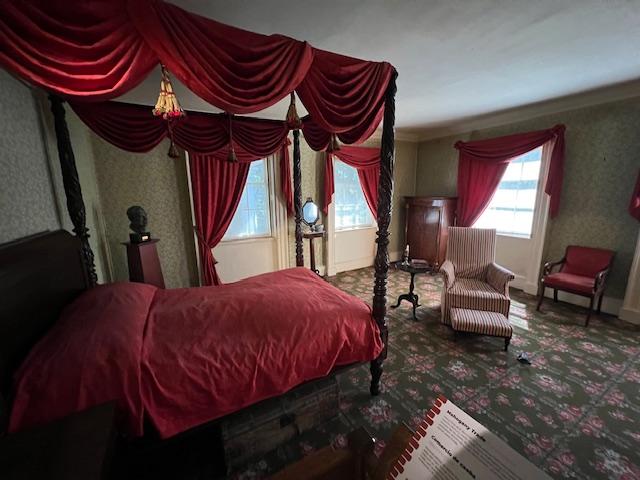
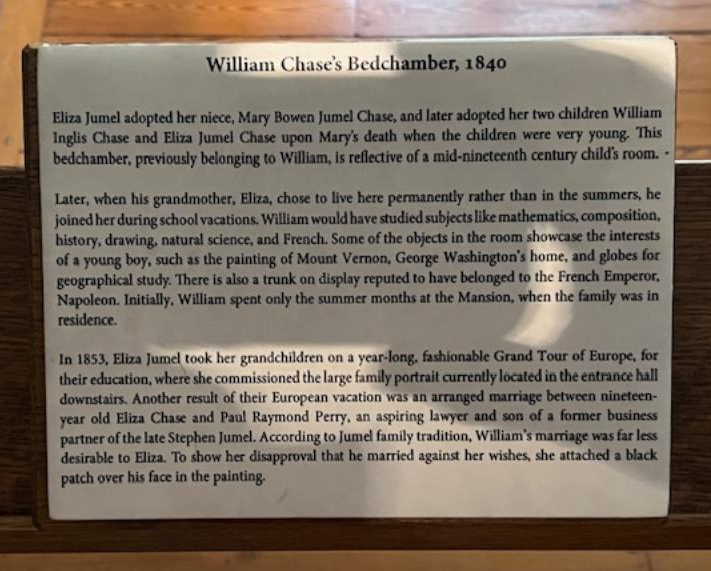
Mrs. Jumel’s grandson’s Bedroom is down the hall from the other bedrooms

William Chase, Mrs. Jumel’s grandson’s Bedroom

The upstairs Hallway and Gallery

Examples of the Mansion’s wallpaper that has been reproduced for the home.

Today, the mansion is the oldest remaining house in Manhattan and is a museum highlighting over 200 years of New York history, art and culture. The neighborhood surrounding the mansion is known as the Jumel Terrace Historic District.

The Morris-Jumel Historic District

The Morris-Jumel Historic District

Faces stare at you from some of the brownstones

The Morris-Jumel Historical District

The hill that Roger Morris once called “Mount Morris” in the 18th century became better known as “Sugar Hill” during the Harlem Renaissance of the 1920’s.

The Gardens were just starting to bloom late Spring in 2024

*The buildings in this district are protected by the New York Landmarks Commission and must be maintained as if they were new, so this is why the area has changed little over time. The Morris-Jumel Mansion is a proud member of the Historic House Trust of New York City and partner of the New York City Department of Parks & Recreation.

The Morris-Jumel Gardens in bloom in the Spring of 2024.

*This information is taken from the Morris-Jumel Mansion press release and pamphlet and from the New York City Parks Department. Please call or email the mansion in case times have changed or events planned.

The Gardens of the Morris-Jumel Estate by the historic district.

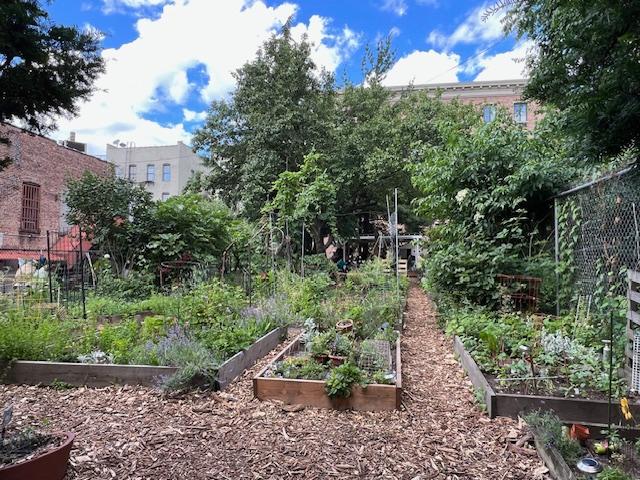
The Morris Jumel Community Garden at 455 West 162nd Street

https://www.grownyc.org/openspace/gardens/man/jumel

https://www.facebook.com/MorrisJumelGarden/

The Morris-Jumel Community Garden

The Morris-Jumel Community Garden

The Morris-Jumel Community Garden is to the north of the estate and is independent of the property. The garden is open for twelve hours a week to the outside community. It is very impressive and the residents do a good job in the planting and care of the gardens.

Welcome to ‘VisitingaMuseum.com’, a trip through unique small museums, cultural sites and parks & gardens in NYC and beyond.

Welcome to ‘VisitingaMuseum.com’, a trip through unique small museums, cultural sites and parks & gardens in NYC and beyond.

*Bloggers Note: because of the size, location and time of year these sites are open, the hours and cost to get in can change since the blog was written. Please check with the site’s website or call the site before you visit. Things change over time.

My name is Justin Watrel and welcome to ‘VisitingaMuseum.com’, a trip through cultural sites, small unique museums, historic mansions and homes and pocket parks & community gardens in New York City and beyond its borders. I created this blog site to cross reference all the cultural sites that I came across when I was traveling through Manhattan for my walking blog, “MywalkinManhattan.com”.

Bergen County Historical Society III

Historic New Bridge Landing

I was inspired by all these sites that I had missed over the years and never knew existed in New York City and its suburbs.  Many of these being in Bergen County, NJ where I live. I found that most people feel the same way. The only way you would know that these sites existed is by walking past them.

Schoolhouse Museum Ridgewood.png

School House Museum in Ridgewood, New Jersey

So I created this site to showcase all these smaller, largely unexplored ‘gems’ in Manhattan, the rest of New York City and places outside the greater New York City area. I concentrate on smaller, more off beat cultural sites that you might miss in the tour books or may just find by passing them on the street. This has lead me to  becoming a member of the Bergen County Historical Society in Riveredge, NJ as well as other cultural sites in the area.

Aviation Hall of Fame.jpg

The Aviation Museum in Teterboro, New Jersey

There is so many interesting historical sites, parks, gardens and homes to explore that I want to share it with all of you. They are tucked behind buildings and walls, locked behind gates or hidden behind trees only for you to want to discover them.

Ringwood Manor Christmas 2019

Ringwood Manor in Ringwood, New Jersey at Christmas

I want to give these smaller and unique ‘gems’ more exposure and ‘sing their praises’  to an audience (namely out of town tourists) who might overlook them. It is hard for a lot of these cultural site because of the lack of volunteers or volunteers getting older or the absence of money to properly advertise these sites.

Gallery Bergen Professor Show III

Juan Leon’s work at Gallery Bergen on the Bergen Community College campus in Paramus, NJ

So join me in the extension of “MywalkinManhattan.com” with my new site “VisitingaMuseum.com” and share the adventure with me. Join me also on my sister blog sites, “DiningonaShoeStringinNYC@Wordpress.com” and ‘LittleShoponMainStreet@Wordpress.com’ for restaurants and small shops.

Dyckman Farm House II.jpg

The Dyckman Farm in Washington Heights in Manhattan

These sites featuring all sorts of small restaurants, bodegas and bakeries, where a quality meal can be had for $10.00 and under and unusual stores with unique merchandise that just stand out in their respective neighborhoods. It is important to support small business owners especially in this economy.

Lucy the Elephant

Lucy the Elephant in Margate, NJ

So, join me here as I take “MywalkinManhattan” to some unique and special historical sites and open spaces the New York Metropolitan area and beyond.