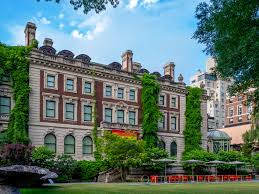

The Morgan Library at 225 Madison Avenue
My review on TripAdvisor:
My review on VisitingaMuseum.com:

The Mozart Exhibition at the Morgan Library
In the months of March and May right before the Memorial Day holiday, many of the museums I belong to held their private ‘Members Night’, where they hold extra hours for members after the museums are closed to the public to come and see the exhibitions, listen to music, have something to eat and drink and listen to talks about the exhibitions. The funny part is that the museum’s are more crowded on these nights than when they are open to the public.

Walking inside the soaring dining space at the Morgan Library
The first set of ‘Members Nights’ I went to were on March 24th with my first stop at the Morgan Library. I was there to see the ‘Mozart’ exhibition again.

The wonderful entertainment that evening

Touring the Mozart exhibition
https://www.themorgan.org/press/2026/mozart-exhibition
(from the Morgan Library Website)
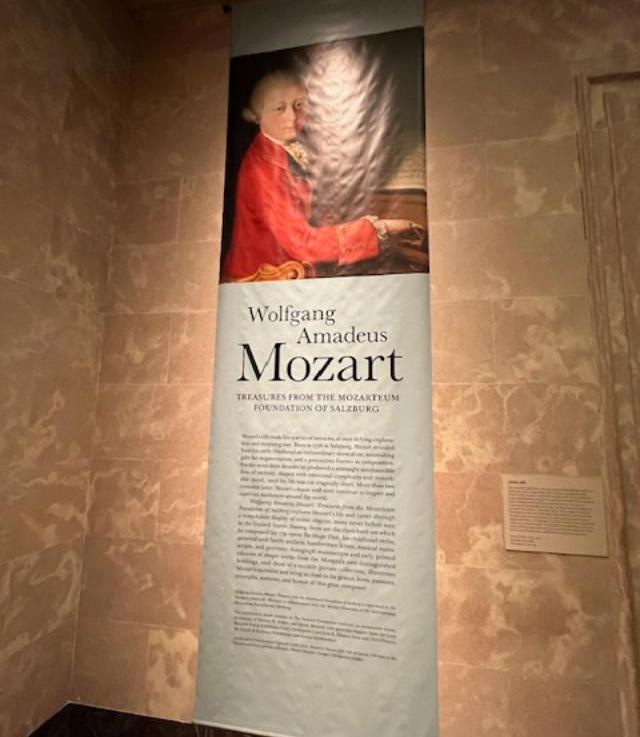
Wolfgang Amadeus Mozart: Treasures from the Mozarteum Foundation of Salzburg, an exhibition that traces the extraordinary life and enduring legacy of Wolfgang Amadeus Mozart (1756–1791). On view March 13th through May 31st, 2026, this two-gallery exhibition combines the Morgan’s significant holdings in Mozart manuscripts and first editions with remarkable objects, on view in the United States for the first time, from the Mozarteum Foundation of Salzburg. These include Mozart’s clavichord on which he composed The Magic Flute and his childhood violin, as well as famous portraits, letters, and personal objects of Mozart and his family (Morgan Library.com).

Touring the exhibition
Video on the exhibition:

The concert of Mozart as a child

The Magic Flute music and costumes
I happen to love ‘The Magic Flute’ and it was interesting to see the notes and some of the original costumes from the opera at the exhibition.

The costumes from the Magic Flute
After I toured the Mozart exhibition, I toured the rest of the museum that included the original part of the mansion.

The old Living Room

The ceiling outside the exhibition hall

The old Library and Rare book collection

The ceiling in the old Library
I then visited the exhibition of ancient Mesopotamia art scrolls. This was really interesting how this form of written art worked into the collection.

The exhibit on ancient scrolls
https://www.themorgan.org/collection/ancient-near-eastern-seals-and-tablets

I thought this was so interesting

An interesting form of communication
Video on the Exhibition

The Dining area during Members Night
After touring the museum, I went to see what everyone was eating in the museum’s small restaurant was eating because it was getting crowded. The counter was filled with delicious looking desserts.

The sweet treats at the dessert bar at the Morgan Library

The selection of desserts at the Morgan Library the night of Member’s Night

I then visited their very interesting Gift Shop

Admiring the flowers at the Coat Check on the way out. I thought this was a nice touch.

All good things come to an end and I made my way up Fifth Avenue to the Museum of Modern Art for the second part of the evening
I could not believe that the museums arranged these ‘Members Nights’ on the same night. They would plan this three weeks late when the Museum of Modern Art and the Metropolitan Museum of Art. I just had to enough time at one museum and see what I wanted to see and then go up the next.

The Museum of Modern Art (MoMA) at 11 West 53rd Street
My review on TripAdvisor:
I started this Member’s Night at the MoMA, finishing the ‘exhibition and then going to the Met.

The opening of the ‘Frida and Diego’ on Members Night
https://www.moma.org/calendar/exhibitions/5882
(From the MoMA website):
Frida and Diego: The Last Dream celebrates Frida Kahlo and Diego Rivera—two of Mexico’s most beloved icons of 20th-century art—in a first-of-its-kind collaboration with the Metropolitan Opera. Organized in conjunction with the Met’s new production of El Último Sueño de Frida y Diego, the presentation at MoMA features artworks by Kahlo and Rivera in an elaborate setting designed by Jon Bausor, the set and co-costume designer of the opera. For both the opera and installation, Bausor evokes the artists’ lives and artworks in his theatrical designs (MoMA.org).
Key participants in a movement to redefine Mexican culture and identity after the revolution of 1910–20—Rivera through monumental murals and Kahlo through intimate self-portraits—the artists were romantically involved from 1928 until Kahlo’s death in 1954. The fictional narrative of the opera El Último Sueño de Frida y Diego begins three years after Kahlo’s death and follows an aging Rivera as he summons the deceased Kahlo back to life on the Day of the Dead, a Mexican holiday honoring passed loved ones. As the opera and installation design attest, the pair continue to have an enduring influence on artists across the visual and performing arts (MoMA.org).
Video on the exhibition:

The opening of the ‘Frida and Diego’ exhibition brought members out in droves

The description of the exhibition

The tree dominates the center of the exhibition

The signature piece from the exhibition

One of the dominate drawings

Looking over costume designs

Some of my favorite costume designs

Another great costume design
After touring the exhibition, I visited some of the other galleries and looked over other works of art that I admired in the past. I took a quick tour of the Modern Galleries before I left that evening.

The Jackson Pollack work

I loved this creative food service work
After touring the museum, I joined the rest of the crowd on the main floor for music.

The main lobby of the MoMA the night of Member’s Night
A few weeks later, the Metropolitan Museum of Art had planned their Member’s Night and then the Museum of Modern Art planned a Member’s Night the same night. So I planned another night of running back and forth between museums.

Member’s Night at the Museum of Modern Art

The schedule of events
There was a lot of activities happening that evening and I wondered around museum to see all of them. I started in the Museum Garden to hear the singers who were performing that evening.
The first performer was Lizzy Hilliard, who performed the guitar and was really enjoyable to hear. She is a very lively and engaging entertainer.

The crowds were outside enjoying the beautiful weather that evening

Lizzy Hilliard performing that evening in the garden
After the performance, I wondered around the museum to see some of the exhibitions and started on the first floor which was really active.

I love wondering through the lobby of the MoMA.
While most of the crowds were still listening to the entertainment in the garden, I went up to the Marcel Duchamp exhibition and toured the galleries again (I had been there the previous week and quickly walked the exhibition).

The Marcel Duchamp exhibition was the biggest retrospect of the artist’s work in years
https://www.moma.org/calendar/exhibitions/5820
(From the MoMA website):
Marcel Duchamp is organized by The Museum of Modern Art, New York, and the Philadelphia Art Museum, with the generous collaboration of the Centre Pompidou. “Contemporary artworks often prompt viewers to ask, ‘Why is this art?’ It is virtually impossible to answer this question without referring to the work of Duchamp,” said Temkin. “More than any other modern artist, Duchamp challenged and transformed the very definition of an artwork.” Kuo added, “Duchamp’s
influence is incalculable and his myriad contributions have established him as one of the most important figures in modern culture (MoMA.org).
Our exhibition will foreground the ways in which Duchamp upended conventional oppositions between hand and machine, original and copy, intention and chance, and matter and idea.” MoMA and PMA have a longstanding history with Duchamp’s work. MoMA was the first museum to acquire a work by Duchamp, in addition to including his work in early landmark exhibitions such as Fantastic Art, Dada, Surrealism (1936) and The Art of Assemblage (1961) (MoMA.org).
Video on the exhibition from the MoMA curator:

I joined the start of the walking tour with one of the docents at the MoMA at the beginning of the exhibition
The gallery was so crowded with people listening to the one docent that was describing the exhibition that I continued on my own. I had never seen much of this artist’s work in museums before and had heard about his piece of changing the look of the Mona Lisa. I really enjoyed seeing it up close.

The 1919 original “L.H.O.O.Q.” was on a card

The 1930 replica “L.H.O.O.Q.”

The information on the replica piece
I then moved on to other works that he was well known for especially his controversial urinal piece.

The work “Fountain” (I thought this was unusual)

The write up on the piece
The last piece that I saw in the exhibition before I left the museum for the Met was his spoke wheel piece.

The work “Bicycle Wheel”
I wondered around the museum for a bit after the tour of the exhibition and admired works in the Modern Wing.

I love Picasso’s Cubism works
After I finished touring the exhibition, I left the MoMA for The Met. The weather was beautiful and with it being light out until almost 8:30pm. It was a beautiful walk up Fifth Avenue with the trees and the flower beds in full bloom.

Arriving at The Metropolitan Museum of Art for “The Met After Hours”
https://www.metmuseum.org/visit-guides/membership
My reviews on “Met After Hours” on MywalkinManhattan.com:
https://mywalkinmanhattan.com/tag/met-after-hours

The lobby and rotunda for the event seemed very quiet to me

The beautiful floral arrangements in the lobby area were fresh Cherry Blossoms

The Cherry Blossoms in the urns around the lobby

The American Wing where the Member’s Bar and entertainment was located
The Met seemed very quiet that night. Being the Tuesday after Memorial Day Weekend, I guess most members were getting back to work or still tired from the weekend. It had been a rainy mess the whole weekend and I could not see many people going away.

The bar and the entertainment in the American Wing were located that evening.
I had about two hours before the museum closed for the evening, so I wondered through some of the special exhibitions and started with the “Raphael-Sublime Poetry” exhibition on the second floor.

The entrance to the “Raphael” exhibition
https://www.metmuseum.org/exhibitions/raphael-sublime-poetry
(From the Met website):
Raphael: Sublime Poetry is the first comprehensive exhibition on Raphael in the United States, bringing together more than 170 of the artist’s greatest masterpieces and rarely seen treasures to illuminate the brilliance of Raphael’s extraordinary creativity. The son of a painter and poet, Raphael engaged with the foremost writers and thinkers of his age in Rome, displaying a poetic sensibility that captivated his peers and generations that followed. Follow the full breadth of his life and career, from his origins in Urbino to his rise in Florence, where he began to emerge as a peer of Leonardo da Vinci and Michelangelo, to his final, prolific decade at the papal court in Rome (Met.org).
Dive into the artistic process of one of history’s most beloved and influential artists. A true titan of the Italian Renaissance, Raffaello di Giovanni Santi (1483–1520)—better known as Raphael—matched ambition with lyricism to create works with both intellectual heft and emotional depth, a necessary skill in the complex political landscape of Renaissance courts. In his short life of only 37 years, he achieved such profound success as a painter, designer, and architect that he was regarded as the pinnacle of artistic perfection for centuries after his death (Met.org).
Video on the exhibition with the MoMA:
Video on the exhibition with CBS This Morning:
The work admired as I was walking around the exhibition.

This was my favorite piece from the exhibition
The Raphael Exhibition I know was a big deal for the museum but it really was not my taste in art. As much as I admired the work, the whole exhibition did not ‘grab me”.
I was not as impressed with the art in the exhibition and took a quick tour of the works. I had seen the exhibition on a previous tour of the museum so I just wanted to walk around again to see the works that I missed.
I then went back to the first floor and spent more time at the Costume Art exhibition. There had been so much media on the exhibit that you could not get in without timed tickets but because it was quiet on Member’s Night, I just walked in.

The Costume Art Exhibition
https://www.metmuseum.org/exhibitions/costume-art
(From the Metropolitan Museum of Art’s website):
The Costume Institute’s spring 2026 exhibition explores depictions of the dressed body across The Met’s vast collection, pairing garments with artworks to reveal the inherent relationship between clothing and the body (Met.org).
Focusing primarily on Western art from prehistory to the present, Costume Art presents connections between garments from The Costume Institute and objects from the Museum’s other collecting areas. Pairings between fashions and artworks will present a spectrum of connections and experiences: from the formal to the conceptual, the aesthetic to the political, the individual to the universal, the illustrative to the symbolic, and the playful to the profound. These pairings are organized into a series of thematic body types that reflect their pervasiveness and endurance through time and cultures (Met.org).
Video on the Costume Art exhibition:

Walking through the entrance of the exhibition
This gallery was newly created for this collection and I had display the pieces that stood out to me the most in the Costume Art exhibition.

One of the pieces I admired

Some of the Evening clothes I admired

Another piece I admired

I thought this was really unusual
I really enjoyed looking over the exhibition yet wondering how many people would actually wear some of these pieces out in public. It really asks the question “What is art?” Still, I loved the dress with all the human organs on it. Now that would stop everyone in mid conversation at a party.
All good things come to an end again and I left the Met as it was closing for the evening. It really is a pretty site at night looking down Fifth Avenue.

How beautiful the Upper East Side is at night
I was starved when I left the museum and knew not too many places outside the bars would be open this late at night. I remembered Asian 83 on East 83rd Street that still might be open for the evening and I was one of their last customers that night. The food is excellent at this little ‘hole in the wall’ on the Upper East Side.

Dinner at Asian 83 at 1605 Second Avenue
My review on TripAdviser:
My review on DiningonaShoeStringinNYC@Wordpress.com:

Dinner at Asian 83, Beef and Broccoli with Fried Rice
I ordered a combination platter of Beef and Broccoli with Fried Rice and an Egg Roll with a Coke. Their prices are so reasonable and their portion sizes are very fair. It was a nice dinner before I left Manhattan that evening.

The Beef and Broccoli entree

Their Egg Rolls are excellent
Being a member of many museums, this is one of the perks about membership. You get to enjoy these wonderful evenings while supporting the museums which in this economy really helps. That’s why I have enjoyed supporting them for years. The donation benefits everyone.