Located in Inwood Hill Park and part of the NYC Parks System. The rock was dedicated on February 2, 1954 by the Peter Minuet Post #1247, American Legion.
I came across the Shorakkopoch Rock, the noted spot that Peter Minuet has been said to have bought the island of Manhattan from the Indians. No one is too sure where the spot of the ‘transaction’ took place as some feel it may have been closer to downtown by the Bowling Green, where the original Dutch settlement was located or maybe he traveled to them, we will never know. What we do know is that he said the transaction took place under a tulip tree and in this spot used to be a tulip tree that was over 220 years old before it died.
The rock reads:
Shorakkopoch: According to legend, on this site of the rock, principal Manhattan Indian Village, Peter Minuet in 1626, purchased Manhattan Island for trinkets and beads them worth about 60 guilders. This boulder also marks the spot where a tulip tree (Liriodendron Tulipifera) grew to a height of 165 feet and a girth of 20 feet. It was until its death in 1932 at the age of 220 years old, the oldest living link with the Reckgawawang Indians, who lived here. Dedicated as part of New York City’s 300th Anniversary celebration by the Peter Minuet Post 1247 American Legion 1954.
For more information on the rock, please contact the Art & Antiquities at (212) 360-8143.
Disclaimer: This information was taken form the NYC Parks Department website.
Please take time out when visiting Manhattan to see this important piece of the city’s history as the city itself was founded on this very site.
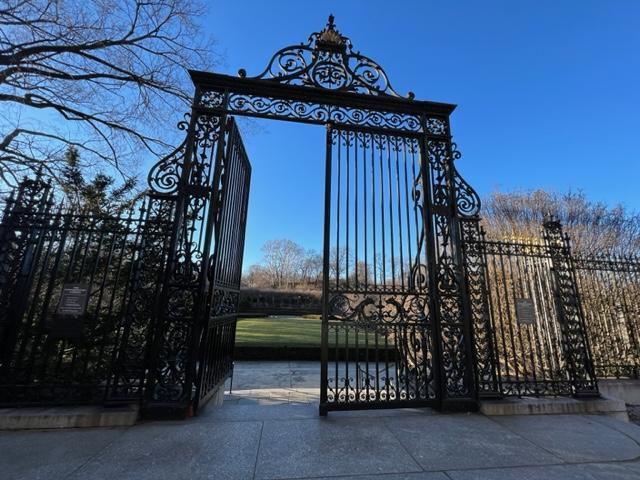
The entrance to the Central Park Conservatory Garden in Winter 2023 (The Vanderbilt Gates)
The map of the gardens
This time of the year (Spring) the Central Park Conservatory is in full bloom and its magnificence is at its finest in the Spring and Summer months. In May, the tulips and daffodils are just finishing their flowering and the lilacs are just finishing their blooming and still fragrant the garden. The lawns are all a deep green and the dogwood trees are just starting to bloom around the rings of the gardens.
The newly renovated pathways
Don’t miss walking around the Gardens off to the side closest to the Harlem Meir as they are open through the renovation. You will see beds of flowers along the fountain’s edge and can admire all the sculpture. What is most impressive is that in-between the Gardens is a vast green lawn surrounded by trees. The lawn of the Conservatory is nice to just admire with the trees lining it on all sides.
Central Park Conservatory Garden Spring 2025
The best time to come to the Conservatory Gardens is in early to late Spring and the early Summer when everything is in full bloom. This is when Mother Nature shows us her great magic.
The Central Park Conservatory in the Spring of 2025
The beauty of the Central Park Conservatory is that it blooms all year around except the winter and even then, there is a quiet elegance to the garden.
The gardens in full bloom in Summer 2025
History of The Central Park Conservatory:
The Central Park Conservatory Garden is the only formal garden in Central Park, New York City and is located approximately between 104th and 106th Street on Fifth Avenue in NYC. The Garden consists of about six acres of formal landscaping of trees, shrubs and flowers. The formal garden is divided into three smaller gardens each with a distinct style: Italian, French and English. The Central Conservatory Garden is an officially designated Quiet Zone and offers a calm and colorful setting for a leisurely stroll and intimate wedding.
The Central Park Conservatory in the Spring 2025
It takes its name from a conservatory that stood on the site from 1898 to 1934. The park’s head gardener used the glasshouses to harden hardwood cuttings for the park’s plantings. After the conservatory was torn down, the garden was designed by Gilmore D. Clarke, landscape architect for Robert Moses, with planting plans by M. Betty Sprout and constructed and planted by WPA workers, it was opened to the public in 1937.
The Garden is composed of three distinct parts, skillfully restored since the 1980’s and is accessible through the Vanderbilt Gate at Fifth Avenue and 105th Street, a quarter south of the park’s northeast corner.
The Vanderbilt Gate at the Central Park Conservatory
The Vanderbilt Gate once gave access to the forecourt of Cornelius Vanderbilt II’s chateau designed by George Browne Post, the grandest of the Fifth Avenue mansions of the Gilded Age, at 58th Street and Fifth Avenue, sharing the Plaza with Plaza Hotel. The wrought iron gates with cast iron and repousse details, were designed by Post and executed in an iron foundry in Paris.
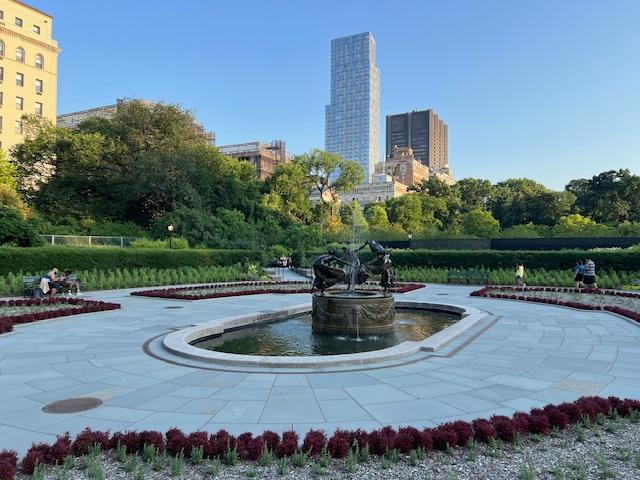
The fountain at the Central Park Conservatory
The fountain statuary in the main gardens.
Below the steps flanked by Cornelian cherry, the central section of the Conservatory Garden is a symmetrical lawn outlined in clipped yew, with a single central fountain jet at the rear. It is flanked by twin aisles of crabapples and backed by a curved wisteria pergola against the steep natural slope, that is dominated at its skyline by a giant American Sycamore.
Otherwise there is no flower color; instead on any fine Saturday afternoon in June, it is a scene of photography sessions for colorful wedding parties for which limousines pull up in rows on Fifth Avenue.
The Cherry Trees at the gardens in 2019
To the left of the south side is the garden of mixed herbaceous borders in wide concentric bands around The Secret Garden water lily pool, dedicated in 1936 to the memory of Frances Hodgson Burnett with sculpture by Bessie Potter Vonnoh.
Some large shrubs, like tree lilac, magnolias, buddleias and Cornus alba ‘elegantissima’ provide vertical structure and offer light shade to offset the sunny locations, planted by Lynden Miller with a wide range of hardy perennials and decorative grasses, intermixed with annuals planted to seem naturalized. This garden has seasonal features to draw visitors from April through October.
To the right of the central formal plat is a garden also in concentric circles, round the Untermyer Fountain, which was donated by the family of Samuel Untermyer in 1947. The bronze figures, Three Dancing Maidens by Walter Schott (1861-1938) were executed in Germany about 1910 and formed a fountain at Utermyer’s estate “Greystone” in Yonkers, New York.
This section of the Conservatory Garden has two dramatic seasons of massed display of tulips in the spring and Korean chrysanthemums in the fall. Beds of satolina clipped in knotted designs with contrasting bronze-leaved bedding begonias surround the fountain and four rose arbor gates are planted with reblooming ‘Silver Moon’ and ‘Betty Prior’ roses.
The French Gardens at the Central Park Conservatory in Summer 2025
After the Second World War the garden had become neglected and by the 1970’s became a wasteland. It was restored and partially replanted under the direction of horticulturist and urban landscape designer Lyden Miller to reopen in June 1987. The overgrown, top-heavy crabapples were freed of water shoots and pruned up to a higher scaffold for better form. The high-style mixed planting was the first to bring estate garden style to urban parks, part of the general of Central Park under Elizabeth Barlow Rogers of the Central Park Conservancy.
The Conservatory in the early Spring of 2025
(This information directly from Wikipedia and has many sources)
I recently visited the Easton Tower on a beautiful sunny day and it really is a treat to see. It is located on the Saddle River Bike Path, so you can access it from the other side of the park and park on that side of the road for easy access. After seeing the tower, take a walk up and down the Saddle River Bike Path. It is really beautiful to follow the river on a nice day. It is really picturesque and a wonderful place to take pictures and enjoy nature.
The historic Red Mill Marker
This information is provided by the Bergen County Division of Cultural and Historic Affairs:
The Easton Tower is a unique historic site in Bergen County, NJ. This stone and wood frame structure was built along the Saddle River in 1900 as part of a private landscaped park in the Arcola area Paramus. Surrounded by busy NJ roadways, it is now adjacent to the County’s Saddle River Bikeway.
The front of the tower on the bike path
The tower sits near the Saddle River in the Saddle River Park
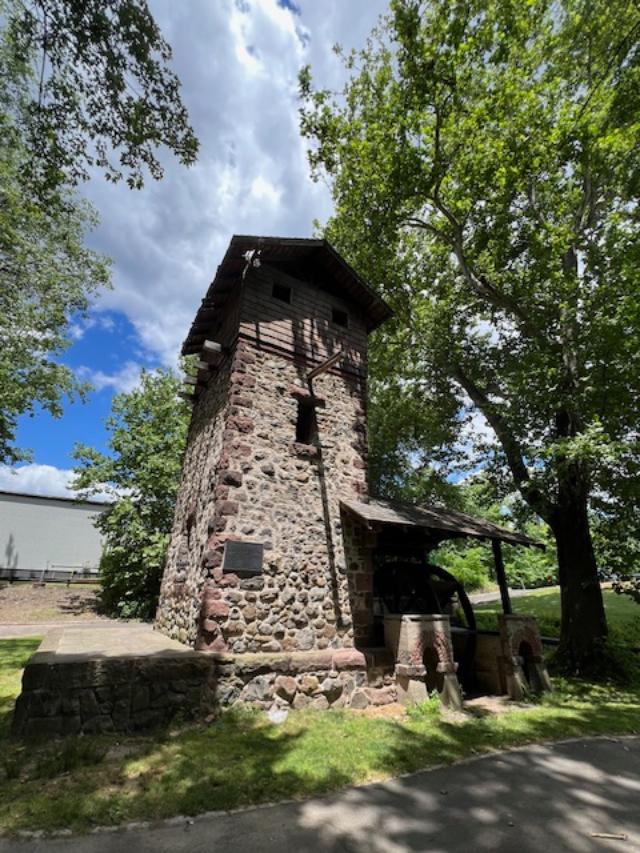
Once used to pump water to irrigate and provide a scenic setting for the estate of Edward Easton, it is a 20 foot rectangular, stone-masonry tower topped with a wood-frame structure and a wood-shingle, gabled roof. On the side is a large wood water wheel, which is under a wood-shingle roof. The architect Henry Ihnen designed it.
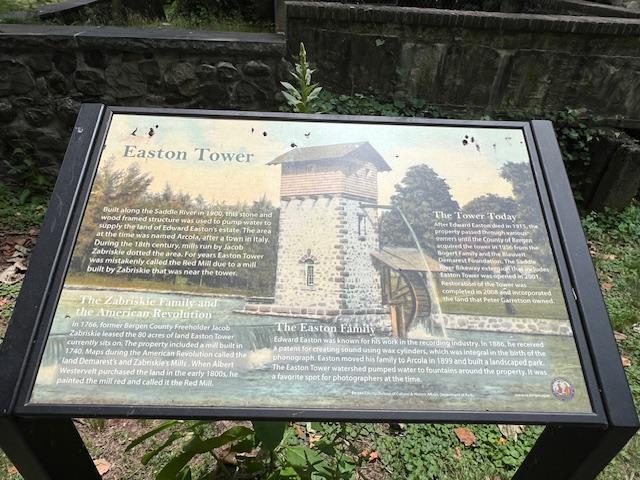
Easton Tower historical information sign
In the 18th century, this area along the Saddle River and near the heavily used Albany Post Road, was the location of many mills. Jacob Zabriskie, a Bergen County Freeholder during the Revolutionary War had leased the 80 acre mill site around 1766 and in 1771 acquired the mill that had been built in the 1740’s. Revolutionary maps identify it as “Demarest’s and Zabriskie’s Mills.”
The Easton Tower in Saddle River Park
Over time it was rebuilt or expanded and in the early 1800’s painted red by its owner Albert Westervelt. It is at this time it acquired the “Red Mill” name often mistakenly applied to Easton Tower. By the 1800’s, the mill had fallen into disrepair and was demolished circa 1894.
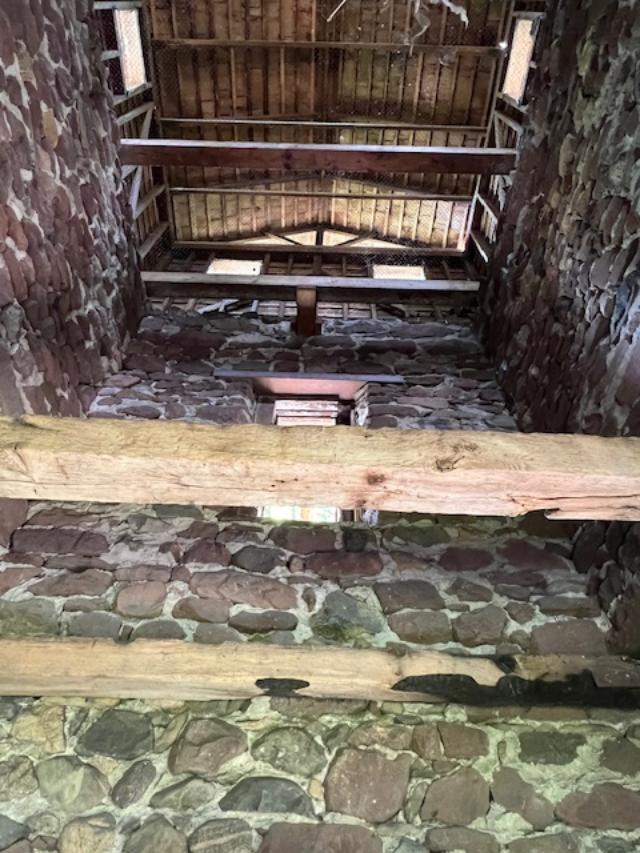
The inside of the tower
The Easton Tower inside
In 1899, Edward D. Easton (1856-1915), bought this almost 48 acre site, which included the mill pond and dam. The area was called “Arcola”. Easton’s father, a teacher, had originally brought his young family to this area and suggested the name for the new settlement after a town in Italy. Edward Easton was a notable figure in American technological history. He started out as a stenographer, reporter and then a court stenographer In Washington DC, covering many famous trials in the 1880’s. After the 1886 patent was granted for the method of engraving sound by incising wax cylinders, Easton went on to make his fortune in the recording industry. He was a founder and eventually president of the Columbia Phonograph Company, which became one of the three major recording companies at the turn of the twentieth century.
The Easton Tower from the back
After opening an office in New York City, Eaton relocated his family from Washington DC to Arcola. He had a large house built on his property and commissioned the design of a landscaped park. The tower, to be built neat the site of the old Red Mill was a functioning structure pumping water to several fountains. There were also rustic bridges, lakes and expansive lawns. The tower was a favorite of photographers and appears in many contemporary postcards. People came from miles around to this beautiful spot to take boat rides and walks and in the winter, ice skate near the tower. Sources list the Easton home and park as having been used in early silent films.
After Easton’s death in 1915, the property went through various owners. In 1931, construction of the Route 208 connection with Route 4 at “the Old Mill at Arcola” provided access to the recently opened George Washington Bridge. This destroyed sections of the landscaped park and isolated the tower. In 1940, the 1.26 acres site was sold at a sheriff’s sale to Clyde A. Bogert. The County acquired the tower from the Bogerts and the Blauvelt-Demarest Foundation in 1956. In 1967, the Bergen County Park Commission dedicated the tower. Easton Tower was placed on the State and National Register of Historic Places and in 2008 was completely restored by the County. It can be viewed from the Saddle River Bikeway and visited year round.
Disclaimer: This information is taken from the Bergen County Division of Cultural and Historic Affairs (C) 2015 pamphlet. The Bergen County Division of Cultural & Historic Affairs received an operating support grant from the New Jersey Historical Commission, a division of the Department of State.
Special Note: I visited the site recently and it is hard to get to by car. It is located right off Saddle River Road and it is off on a odd bend in the road. It is a quick turn to the right so pay attention to the directions.
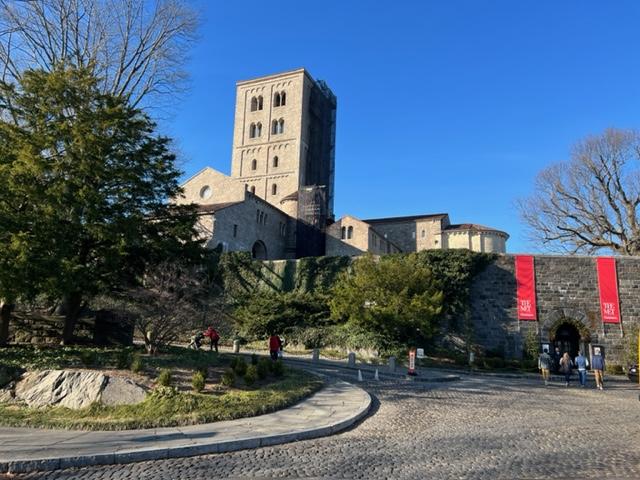
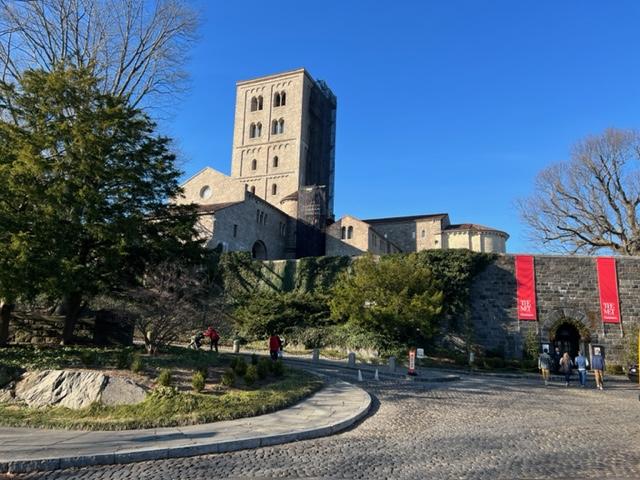
I go to The Cloisters on a pretty regular basis, and they have interesting walking tours and lectures especially in the warm months. If you like Medieval or religious art, this is a museum that is worth visiting. It is out of the way and be prepared to walk up a hill but in the summer months, the view of the Hudson River is spectacular, and the gardens are beautiful.
The Cloisters in Fort Tyron Park
Don’t miss the walking tours and gallery talks at the museum. I have recently been to a series of walking gallery talks dealing with the history of Medieval arts. There were discussions on Medieval art between Christian and Muslim religions, Traveling the Silk Road and its influences on art in the regions and the collection and how it has improved and grown over the years. It seems there has been a uptick in this type of art.
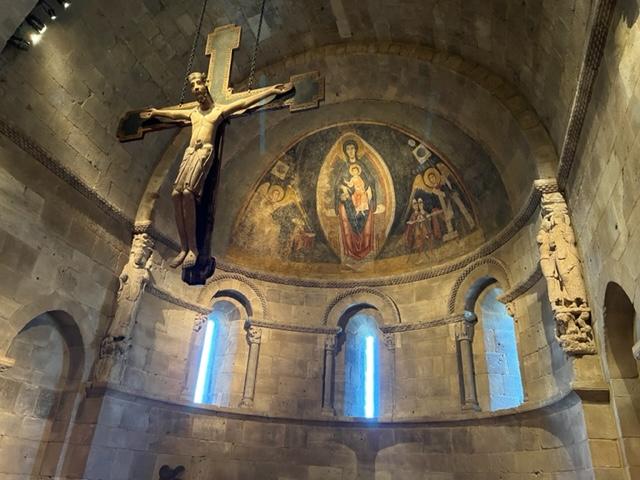
This section of the shine is on a permanent loan from Spain
The building is just beautiful as it was created from pieces of religious sites all over Europe. Many of the doorways, cloisters (archways), stone work and fountains and windows come from churches that had been destroyed by wars over the past 600 years. Bits and pieces of all of the these buildings are displayed in the architecture of the museum itself. Some are on permanent loan to the museum from foreign countries.
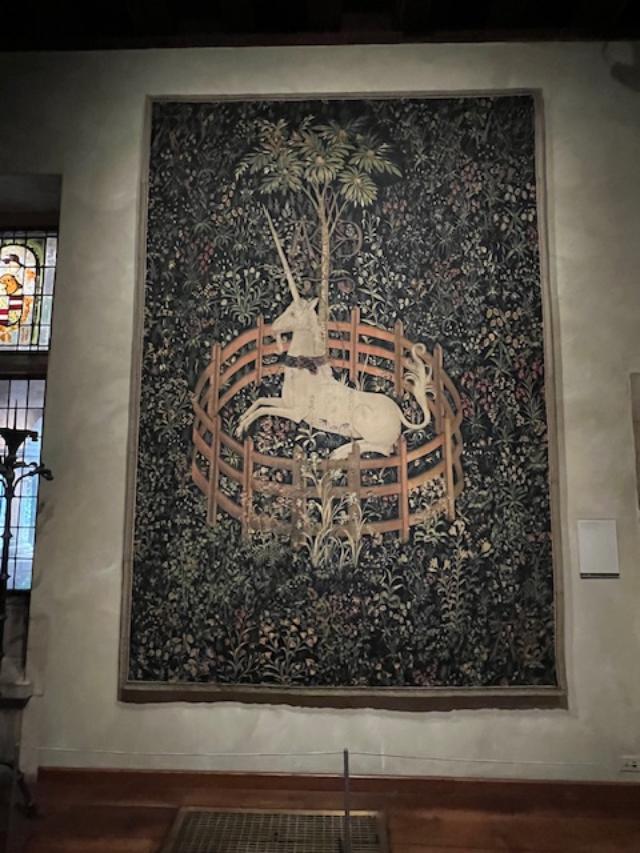
Don’t miss the famous “Hunt of the Unicorn” tapestries that are on display here. They are quite a spectacular exhibit.
The ‘Hunt of the Unicorn’ tapestries
Be sure to visit the outside terraces of the Cloisters to see the views of the Hudson River below and the beautiful gardens of Fort Tyron Park where the building is located. It is a sea of green lawns and woods and beautifully landscaped flowering paths.
The Cloisters Gardens in the winter of 2022
The Cloisters Gardens in the Spring of 2024
The view from the gardens of the Hudson River
The view of the Hudson River in Spring 2024:
There is a nice café on property but there is also a small restaurant row on Dyckman Avenue at the foot of the park right near the subway stop. There are also many terrific Spanish restaurants on Dyckman Street as you walk down the block towards Fort George Hill.
‘Christmastide’ at The Cloisters:
I recently went to the Cloisters for a very interesting walking tour called “Holly & Hawthorne: Decorating for a Medieval Christmas” in 2019 and a similar tour in 2022 entitled “Holiday Decorations at The Cloisters” the use of plants like holly, mistletoe, pine and ivy were used in the winter months to decorate the churches and homes of the people until the Puritan influences took over.
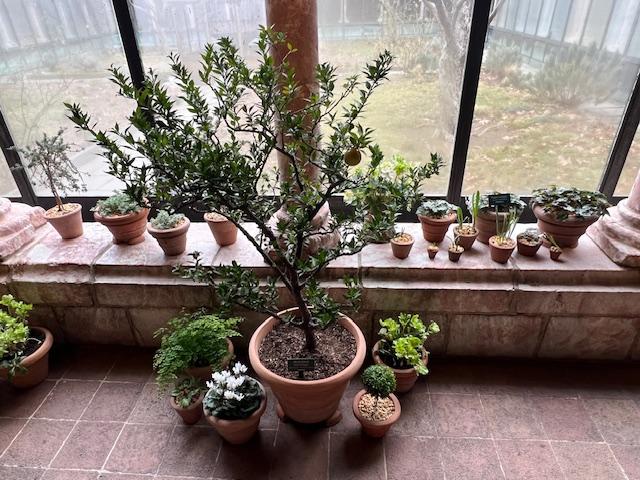
Sampling of the plants used at the holidays in Medieval times.
(Part of the description of the tour in the guidebook-credit to the Met Cloisters):
“The wreaths and garlands that deck The Cloisters from early December until early January are made from plant stuffs associated with the Medieval celebration of Christmastide. This great feast embraced the twelve days between the Nativity and the Epiphany, which commemorated the visit of the Three Kings to the infant Jesus.
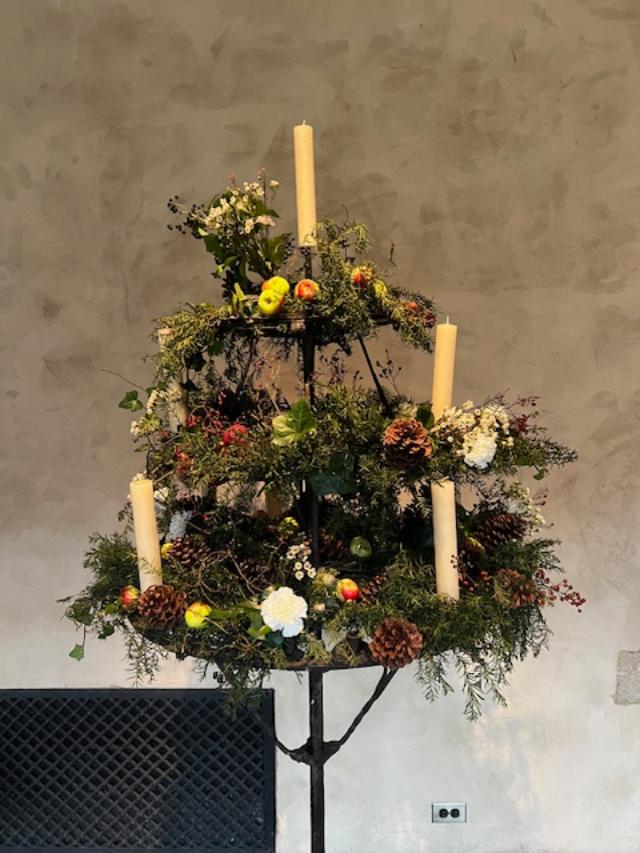
The Candelabras of the Cloisters.
Because pictorial representation of medieval Christmas decorations are rare, the Museum’s designs are based on evidence gleaned from carols, wassails, romances and artworks. Medieval churches and halls were decked for the season, a practice with roots in ancient custom. The early Church had banned the use of evergreens because of their ties with pagan winter festivals, such as the Roman Saturnalia. By the Middle Ages, these plants had been given Christian interpretations and were used to celebrate the feast days of the Church calendar. Bay Laurel, associated in ancient times with victory, became a symbol of the triumph of Christ and of eternal life.
By the Middle Ages, holly and ivy had been thoroughly Christianized, although mistletoe remained suspect. Ivy was identified with the Virgin and the red berries of the holly with the blood of Christ. The holly and ivy carols still sung today spell out these meanings older associations derived from pre-Christian winter festivals.
Apples and nuts, stored for winter consumption, were a conspicuous part of the Christmas feast, as they are today. It was also the custom in winter to wassail fruit and nut trees, to encourage them to bear plentiful crops in the coming year. Fruits and nuts were ancient symbols of fertility Christian meanings; in a medieval poem on the Nativity.
The Cloisters decorated for Medieval Christmas
The tour guide discussed by touring the paintings and tapestries where these symbolic plants took shape during this time. She even explained how ivy when it reaches sunlight that its shape goes from a three leaf shape to a heart shape which was symbolic during the Middle Ages. The gardens were a good source of inspiration for the holidays.
The stonework was decorated with garland and holly and flowering plants
The Cloisters decorated for Christmas
Don’t miss walking the halls and cloisters to look at all the decorations for the holidays. The museum keeps them simple and elegant but it really does put you in the holiday spirit. The use of flowering plants during the holiday season was not just related to the holiday season but they gave a nice smell to this musty churches and added a bit of cheer to the environment as well.
The flowers and pine when you enter The Cloisters
The “Holiday Decorations at The Cloisters” walking tour: December 2022:
The altar at The Cloisters
The Medieval plants for decorating the church including Bay Laurel, Myrtle, Rosemary and Cyclamen.
The flowers decorating the windows. Roses and pine.
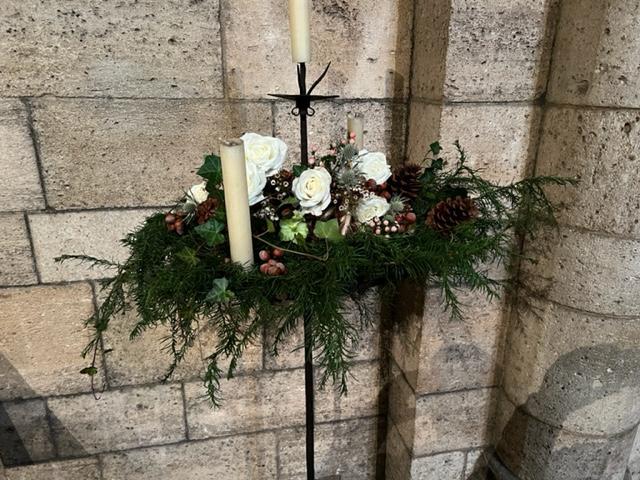
Decorated altar candles
Decorated Altar Candles
Decorated Altar Candles
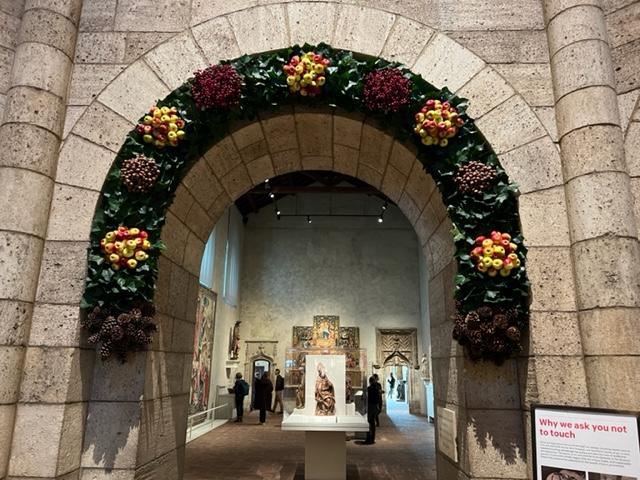
The Fruits and Ivy that decorate the archways at The Cloisters is changed regularly. Each of the ivy vines was encased in small water tubes that had to be changed each week.
The Christmas wreaths were decorated with fruits, ivy and pinecones
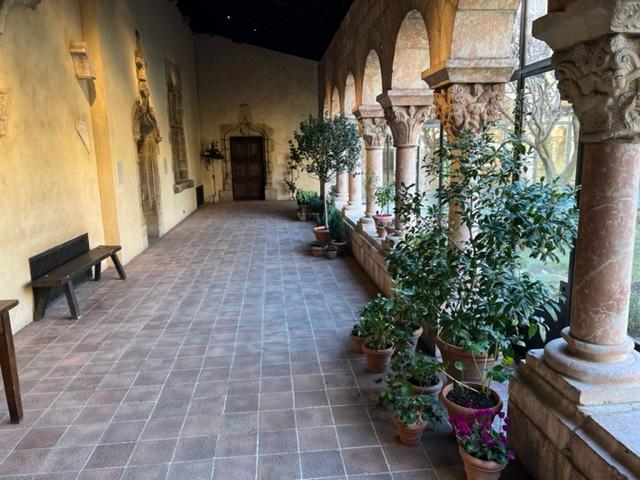
Along the walls and floors of The Cloisters were potted plants that would have been used to decorate churches during this time period. The flowering plants gave The Cloister such a nice smell and would have lighted up the inside rooms from the gloom of winter.
The hallways were lined with winter greens
The winter greens that lined the hallways of The Cloisters
The decorative winter greens lining the walls of The Cloisters
The orange tree was a symbol of gold and prosperity.
The Medieval door decorated for the holidays.
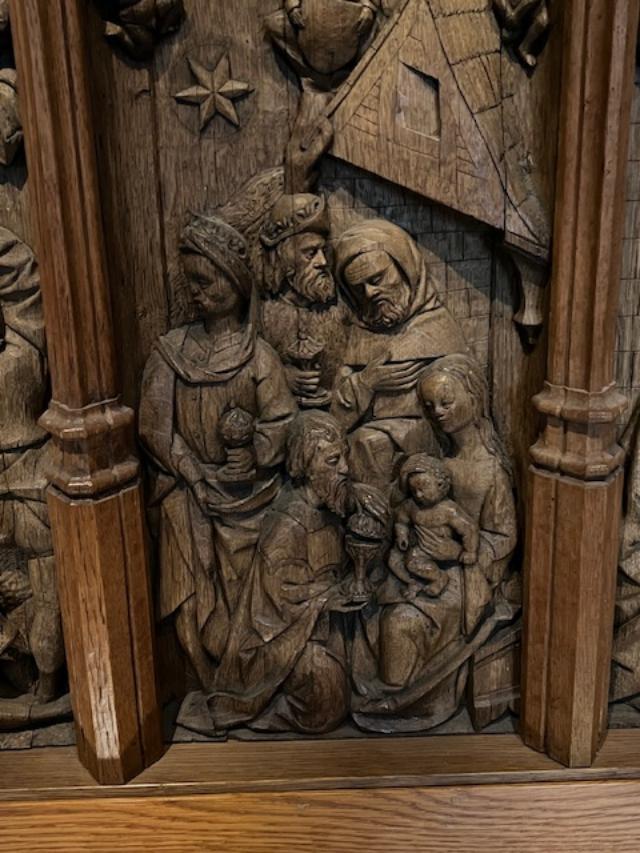
The tour guide also pointed out for the story of Christmas depictions of the three wise men in art all over the building and its importance in the holiday season. The story continued to develop on the three ‘kings’ who visited the holy child.
She explained that over the years it went from three ‘visitors’ wisemen’ that was loosely translated in older text to the modern development of ‘three kings’ from the continents of Asia, Africa and Europe. In 2024, I took a holiday tour on “Three Kings Day”, the celebrated the three kings and their visitation of the holy child.
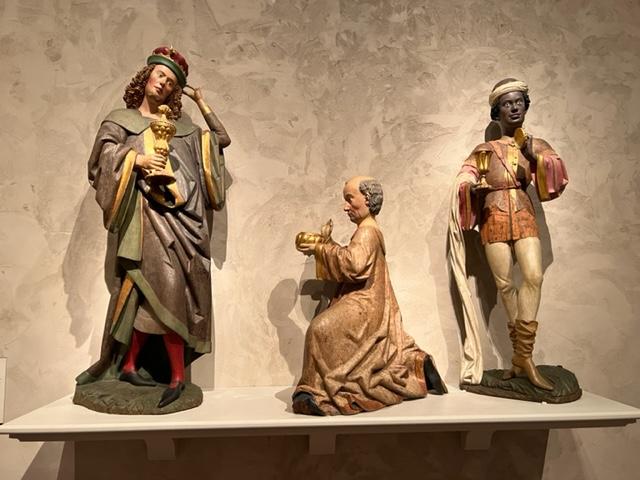
The three Wise Men and the Virgin Mary
The three Wise Men and the Virgin Mary and Child as depicted in the painting
The three Wise Men in a more modern depiction. It seemed that the story morphed over time from three Kings, one being older, one younger and one with a darker complexion became a King from each continent to represent the diversity in the church and the spread of Catholicism.
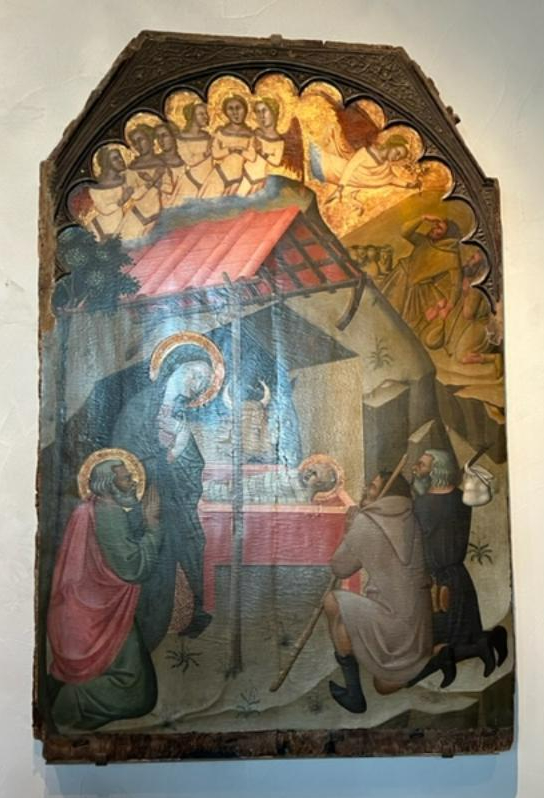
The “Adoration of the Shepherds”
The Virgin Mary with the Christ child and the three wise men in the “Adoration of the Shepard’s”.
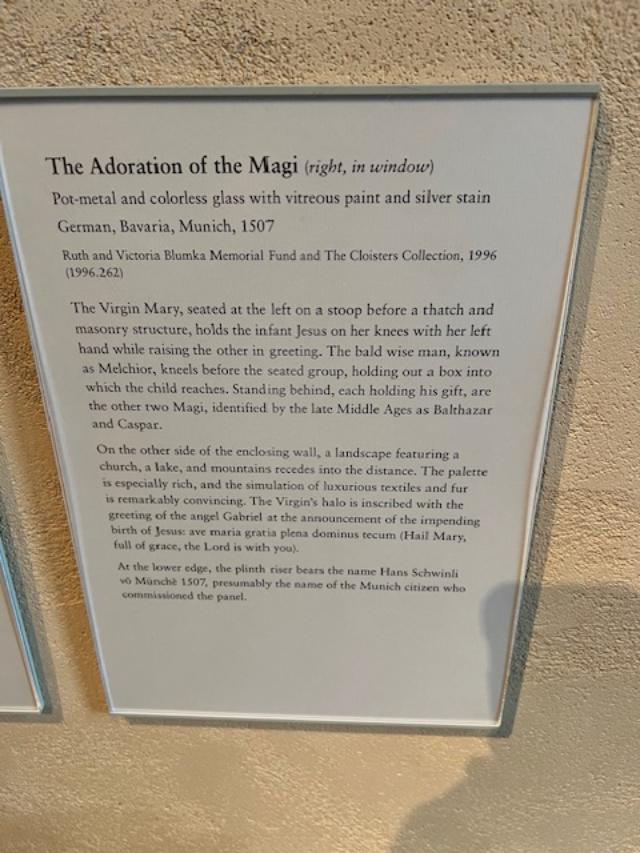
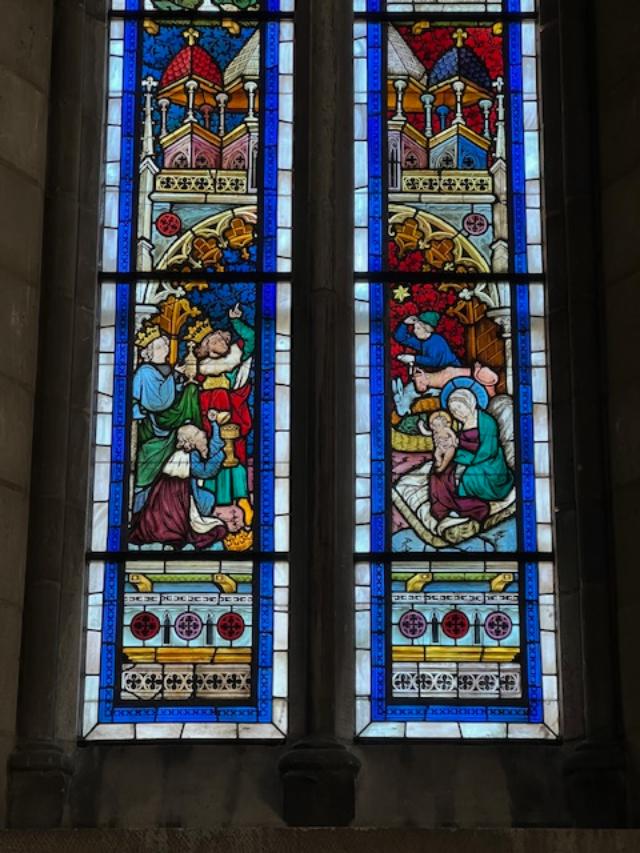
The “Adoration of the Magi”
The stained glass window of the “Adoration of the Magi”.
The “Thirty-Five Panels” of the Three Wiseman”
The Three Wisemen from the “Thirty-Two Panels”
The stained glass window of the “Three Scenes of the Infancy of Christ”
The “Three Scenes of the Infancy of Christ”
The “Christ is born as Man’s Redeemer” Tapestry.
The small section of the tapestry with the Three Wisemen.
Walking through the Cloisters during the holiday season.
The tour guide went onto explain that in more elaborate feasts, the utensils and items used during ceremonies would have been of the most elaborate that the church could show.
Elaborate vessels. plates, challices and specters used in ceremonies
Elaborate drinking glasses
I toured the Cloisters again in 2023 and saw the same symbols of Christmastime in the halls with elaborate floral displays and beautiful potted floral arrangements all over the building.
The hallways of the Cloisters decked with flowering plants.
The “Winter Roses” with other flowering plants.
More flowering plants lining the walkways.
Flowering displays
The winter plants of the Cloisters.
The Candelabra’s were quite elaborate.
I thought this Dragon painting was very interesting.
The Dragon Sign.
The Dragon Painting.
Spain 1000-1200: Art at the Frontiers of Faith” tour in 2021:
I visited again this Christmas holiday season in 2021 to see “Spain 1000-1200: Art at the Frontiers of Faith”, where the Catholic and Muslim Kingdoms of Spain influenced each other in the manner of decoration and art borrowing from each other. It was interesting to see how the two communities used each other’s art over time to develop an interesting hybrid of design that was both colorful and intricate.
“Spain 1000-1200: Art at the Frontiers of Faith” artworks
Another tour of the Cloisters that I attended was on the ‘Four Medieval Flowers: The Lily, Iris, Violet and Rose’. It was interesting how society of this era used the former Pagan and Roman/Greek symbols in their Christian religious art.
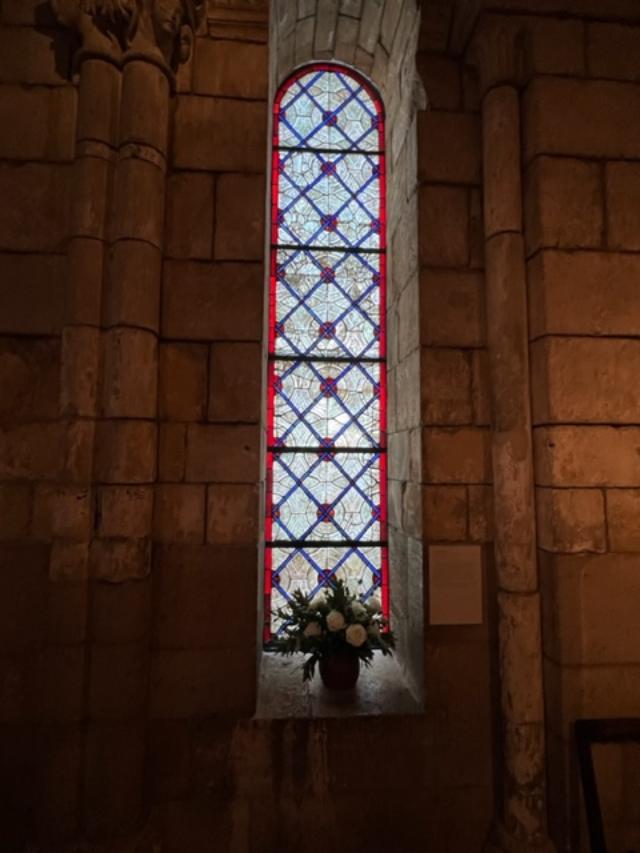
You see the Rose in the stained glass to represent strength and honor
You will see the meanings in the tapestries, stained glass art and in the sculpture to represent purity, rebirth and sexual symbols of the time. It seemed that the artisans of the time used ancient meanings to convey something that they could not out and out talk about.
In the “Hunt of the Unicorn” Tapestries you can see flowers such as Lilly, Violet and Iris woven into the work which may have meant it was a wedding present to the new owner. The tour guide said there was meaning in lots of the works which may have had a different purpose originally. It was a tour steeped in symbolism.
The Spring and Summer Time visits to The Cloisters and the Gardens:
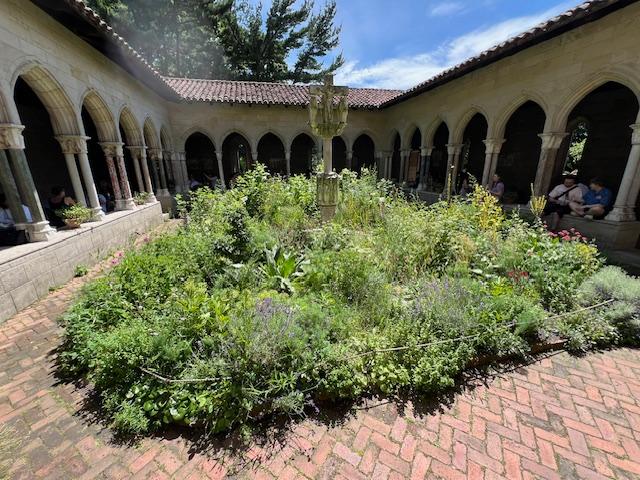
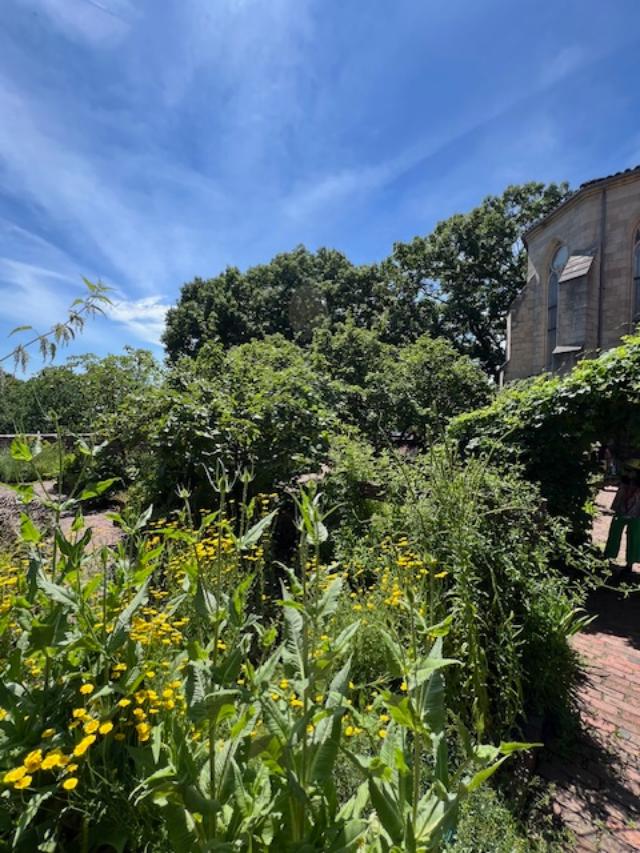
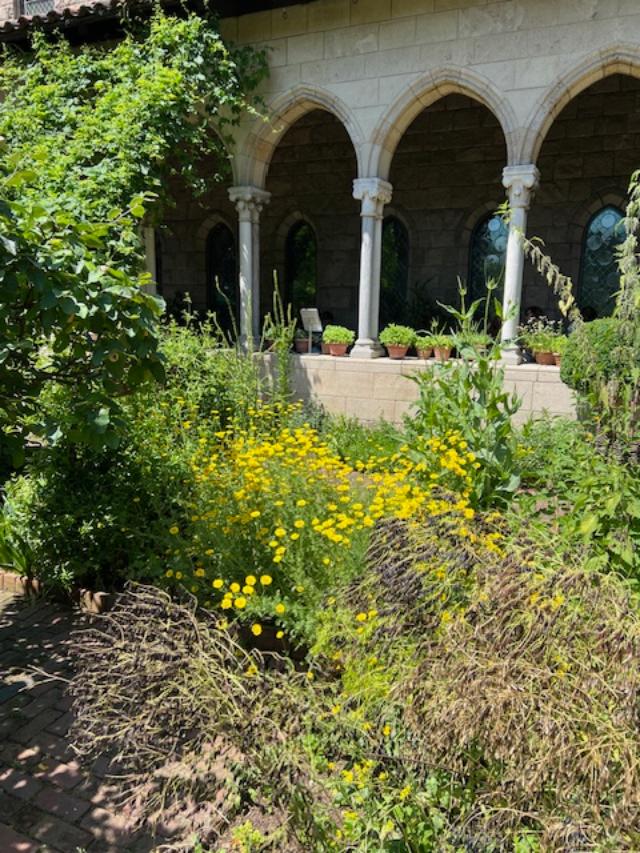
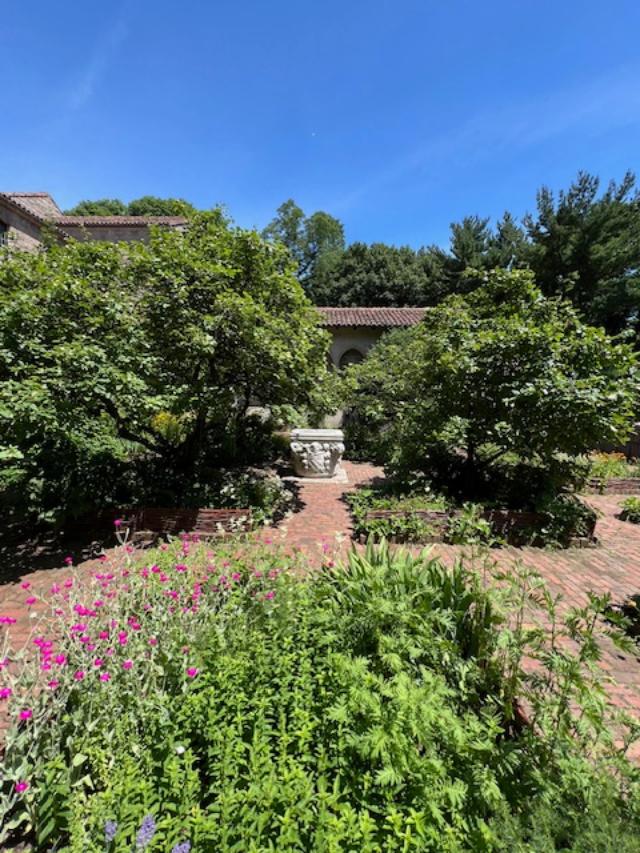
The Cloisters in the Spring and Summer months is very different. The Gardens are in full bloom, the views of the Hudson River are still amazing and the flowers look and smell so beautiful. There are three sets of gardens in the Cloisters, the potted plants on the deck facing the Hudson River and the two Cloisters on the first level and the one in the Trie Cloister where the cafe is located. Each has their unique plantings.
The potted plants on the deck of The Cloisters in the Spring of 2024
As pretty as some of these plants are some are poisonous so you have to watch out.
The view from the back decks of the museum of the Hudson River
The view of the Hudson River
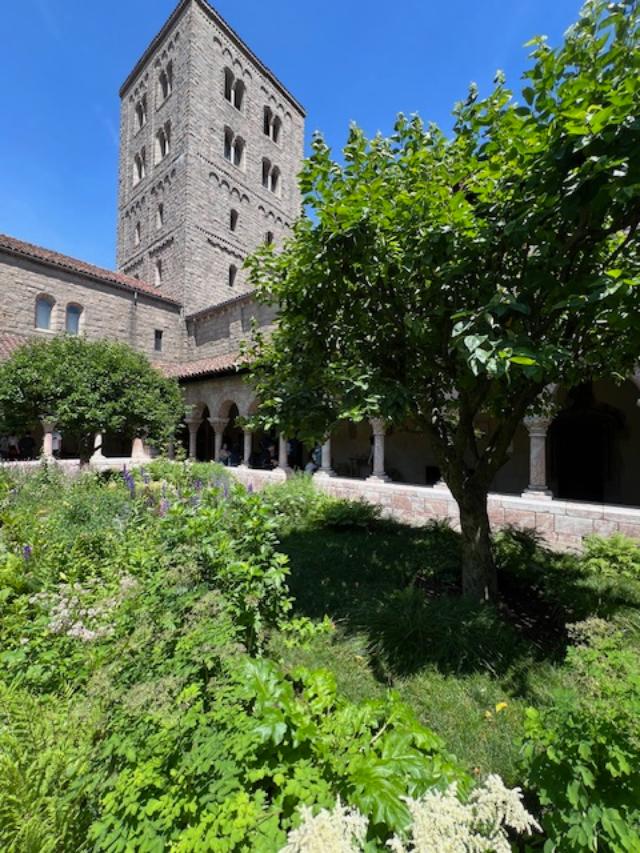
The gardens in The Cloisters
On Sunday, August 10th, I took an extensive garden tour of the separate Cloisters in each parts of the museum. The tour talked about the use of the Cloisters gardens of the past and they were used for herbs, remedies and for the simple pleasure of beauty, color and relaxation.
The religious symbols in the gardens
The gardens have been planted with historical accuracy but as the tour guide explained, to keep the gardens in bloom from the early Spring to the late Fall, you have to add different plants for color.
The beauty of the gardens in bloom
The beauty of the gardens in the Spring of 2024
The gardens were very popular over the weekend
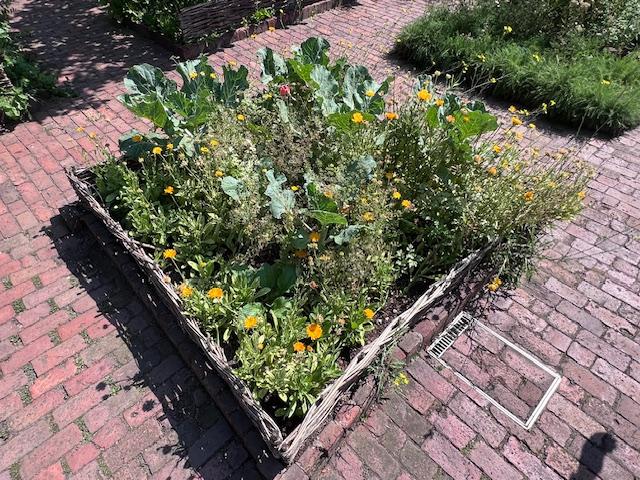
Some of the Cloisters gardens produce fruits, vegetables and herbs that the staff can take home. These gardens show not just how beautiful they look but how people used them for every day purposes.
The gardens were popular that day
The beauty of the gardens
The gardens in the Spring of 2024
These walking tours at the Cloisters happen at 12:00pm and 2:00pm on the weekends when in season.
The beauty of the Cloisters
The herb gardens in the summer in 2025
The Cloisters Mission:
Welcome to The Cloisters, the branch of The Metropolitan Museum of Art devoted to the art and architecture of medieval Europe. Set on a hilltop with commanding views of the Hudson River. The Cloisters is designed in a style evocative of medieval architecture specifically for the display of masterpiece created during that era. Arranged roughly chronologically and featuring works primarily from Western Europe, the collection includes sculpture, stained glass, tapestries, painting, manuscript illumination and metalwork. The extensive gardens feature medieval plantings, enhancing the evocative environment.
The Gardens at the Cloisters in bloom
History of the Museum
John D. Rockefeller Jr. generously provided for the building, the setting in Fort Tryon Park and the acquisition of the notable George Grey Barnard Collection, the nucleus of The Cloisters collection. Barnard Collection, the nucleus of The Cloisters collection. Barnard, an American sculptor whose work can be seen in the American Wing of the Metropolitan, traveled extensively in France, where he purchased medieval sculpture and architectural elements often from descendants of citizens who had appropriated objects abandoned during the French Revolution. The architect Charles Collens incorporated these medieval elements into the fabric of The Cloisters, which opened to the public in 1938.
Romanesque Hall
Imposing stone portals from French churches of the twelfth and thirteenth centuries open onto a gallery that features rare Spanish frescoes and French sculpture.
Fuentiduena Chapel
The twelfth-century apse from the church of San Martin at Fuentiduena, Spain and the great contemporary fresco of Christ in Majesty from a church in the Pyrenees Mountains dominate the space. Sculpture from Italy and Spain enriches the chapel, which is the setting for a celebrated concert series.
Saint-Guilhem Cloister
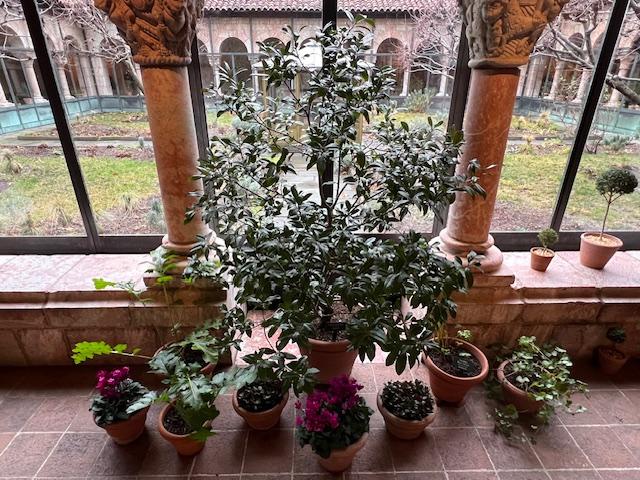
The fine carving of this cloister from the monastery of Saint-Guilhem-le-Desert, near Montpellier, harmoniously and playfully adapts the forms of Roman sculpture in a medieval context. The plants depicted in the sculpture, acanthus and palm, are growing in pots near the small fountain. The gallery also features early sculpture from Italy, Islamic Spain and elsewhere in France.
Langon Chapel
Architectural elements from the twelfth-century church of Notre-Dame-du-Bourg at Langon near Bordeaux form the setting for the display of thirteenth-century French stained glass and important Burgundian sculpture in wood and stone.
Pontaut Chapter House
Monks from the Cistercian abbey at Pontaut in Aquitaine once gathered for daily meetings in this twelfth-century enclosure known as a chapter house. At the time of its purchase in the 1930’s by a Parisian dealer, the column supports were being used to tether farm animals.
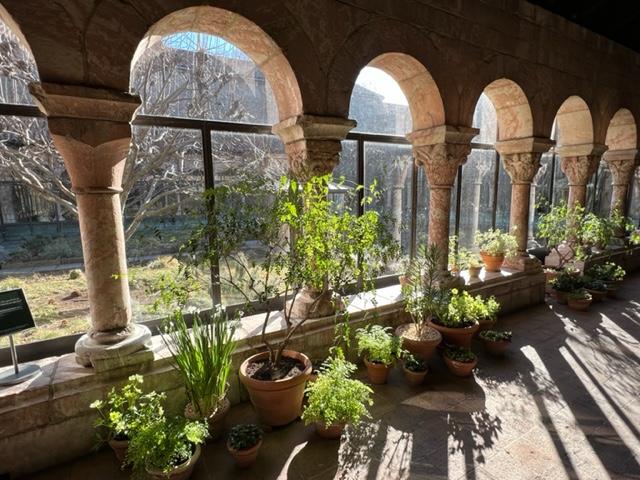
The distinctive pink stone of this cloister, featuring capitals carved with wild and fanciful creatures, was quarried in the twelfth century near Canigou in the Pyrenees Mountains for the nearby Benedictine monastery of Saint-Michel-de-Cuxa. The typical cloister garden features crossed paths and a central fountain from the neighboring monastery of Saint-Genis-des-Fountaines. Both medieval and modern species of plants are grown in the garden. In winter, the arcades are enclosed and fragrant potted plants fill the walkways.
Early Gothic Hall
With thirteenth-century windows overlooking the Hudson River, the gallery features stained glass from France’s great churches, including Saint-Germain-des-Pres in Paris. Sculptures and paintings from France, Italy and Spain evoke the great age of cathedrals.
Nine Heroes Tapestries Room
From an original series of nine hangings created about 1400 for a member of the Valois court, the tapestries portray fabled heroes of ancient, Hebrew and Christian history, including the legendary King Arthur. It is among the earliest sets of surviving medieval tapestries.
Unicorn Tapestries Room
With brilliant colors, beautiful landscapes and precise depictions of flora and fauna, these renowned tapestries depicting the hunt and capture of the mythical unicorn are among the most studied and beloved objects at The Cloisters. Probably designed in Paris and woven in Brussels about 1500 for an unknown patron, these hangings blend the secular and sacred worlds of the Middle Ages.
Boppard Room
Stained glass from the fifteenth-century Camelite convent at Boppard-am-Rhein dominates one end of the room. Fifteenth-century panel paintings and sculpture from the Rhineland and northern Spain, a brass lectern, domestic furniture, Spanish lusterware, tapestries, metalwork and sculpture further evoke a sacred space.
Merode Room
One of the most celebrated early Netherlandish paintings in the world, the Merode Altarpiece, painted in Tournai about 1425-30, forms the centerpiece of this gallery. The altarpiece, intended for the private prayers of its owners, represents the Annunciation to the Virgin Mary taking place in a fifteenth-century household. Details of the scene are echoed in the late medieval furnishings of the room in which other works made for private devotion are also exhibited.
Late Gothic Hall
Large fifteenth-century limestone windows from the refectory of the former Dominican monastery in Sens, France, illuminate the hall, which showcases sculpture and altarpieces from Germany, Italy and Spain as well as a great tapestry from Burgos Cathedral.
Gothic Chapel
Beneath richly colored stained-glass windows from fourteenth-century Austria carved images from royal and noble tombs of France and Spain fill the chapel-like setting.
Glass Gallery
Silver-stained glass roundels decorate the windows of the Glass Gallery, complementing small works of art, many made for secular use, with their lively, sometimes worldly subjects. Carved woodwork from a house in Abbeville, in northern France, forms a backdrop for paintings and sculpture.
“Bonnefont” Cloister and Garden
Long thought to be part of the abbey at Bonnefont-en-Comminges, the elements of this cloister come instead from other monasteries in the region including a destroyed monastery in Tarbes. The herb garden contains more than 250 species cultivated in the Middle Ages. Its raised beds, wattle fences and central wellhead are characteristic of a medieval monastic garden.
Trie Cloister and Garden
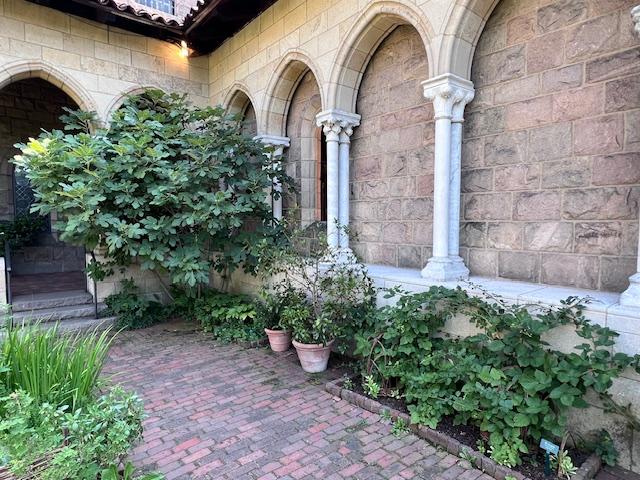
The gardens at the Trie Cloister
The stone cloister elements were created primarily for the Carmelite convert at Trie-sur-Baise in the Pyrenees. The garden is planted with medieval species to evoke the millefleurs background of medieval tapestries, such as the Unicorn series.
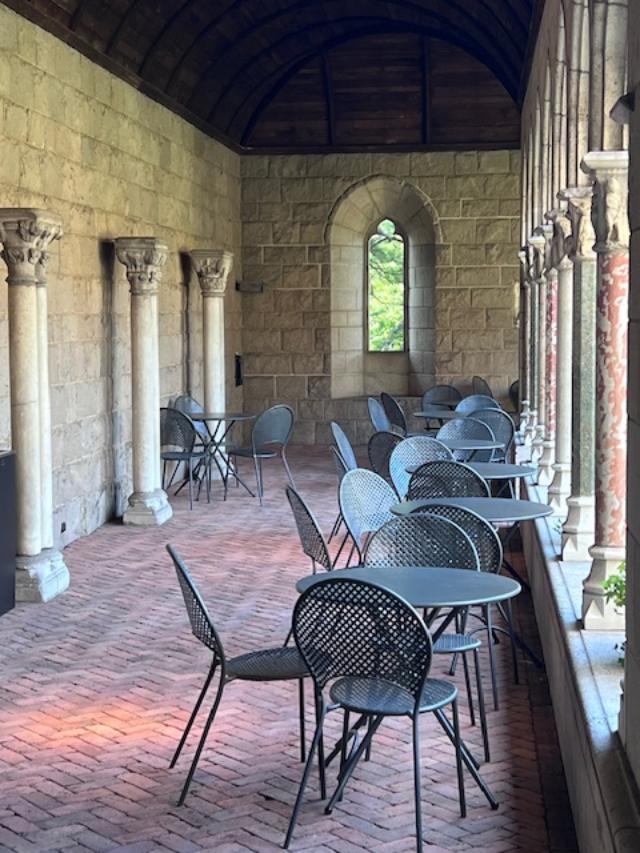
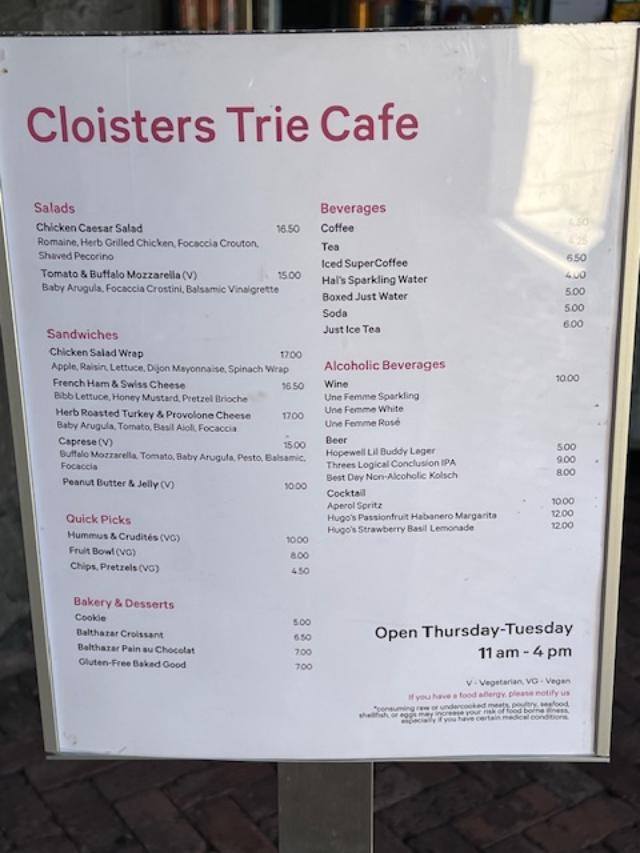
The Cloisters Trie Cafe is a seasonable restaurant that overlooks the Cloisters Gardens. This offers sandwiches , pastries and beverages and is a bit over-priced.
*Please note that the prices in the restaurant do go up every year so please look to the website for updated prices.
The Treasury
An array of precious objects in gold, silver, ivory and silk reflects the wealth of medieval churches. Illuminated manuscripts testify to the piety and taste of royal patrons such as Jeanne d’Evreux, Queen of France; jewelry and a complete set of fifteenth-century playing cards suggest more worldly pastimes.
The Gift Shop:
Even the gift shop was decked in the holiday spirit
The gift shop has all sorts of themed items from the Medieval era.
The gift shop at The Cloisters
*Disclaimer: This information is taken right from the Cloisters pamphlet from the Metropolitan Museum of Art. Please call the museum before visiting to see if anything has changed with the hours or days open. It is well worth the trip uptown to visit The Cloisters. Take the A subway up to 190th Street and take the elevator up to Fort Tryon Park and walk across the park.








































 Visiting a Museum: The Unique, Unusual, Obscure and Historical