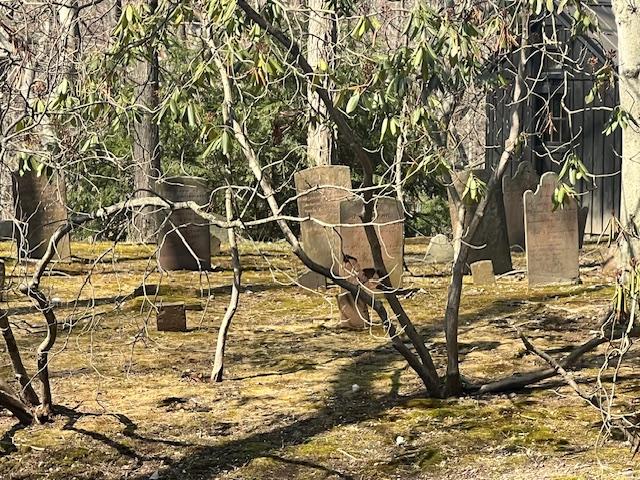
The Van Bushkirk Burial Ground behind the residence at 45 East Saddle River Road
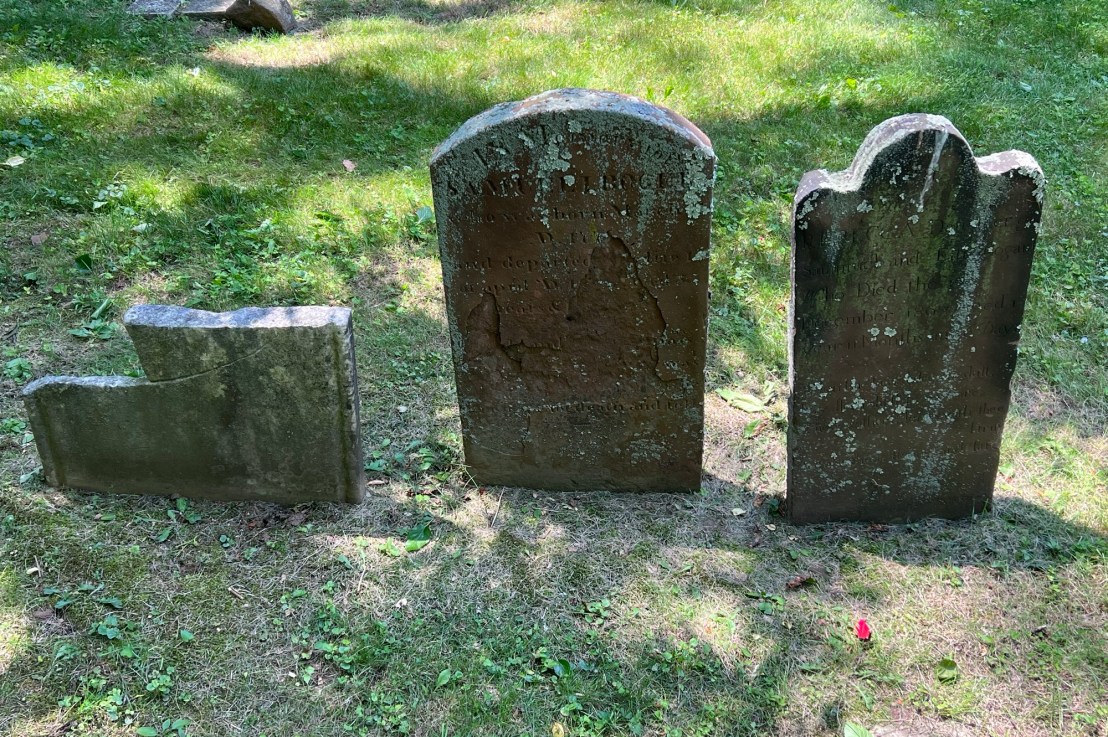
The Van Bushkirk Burial Ground is part of the history of Saddle River, NJ’s early settlement period. The burial ground has about 40 tombstones that are arched and shaped. These are some of the first residents both of Saddle River and Bergen County, NJ.
The burial ground lies next to a creek off East Saddle River Road and can only be accessed by going through private property of the residents living at 45 East Saddle River Road. Please do not enter without permission of the owner of the home. These pictures were taken with a long distance camera from the street.
The Van Bushkirk Burial Ground at 45 East Saddle River Road
The History of Saddle River:
(from the Saddle River Town website):
In 1675, Lenni Lenape tribal leaders sold a large amount of land on the Eastern side of the Saddle River (known as Werimus) to Albert Zabriskie. In 1708, Zabriskie sold this tract of land to Thomas Van Buskirk. The first house in Saddle River was built by the Van Buskirk family in 1709. The original Van Buskirk homestead still stands at 164 East Saddle River Road across from Borough Hall.
In 1709, the Lenni Lenape sold the land on the west side of the Saddle River to the English as part of the Ramapo Tract. Property on the west side of the Saddle River was acquired from this Tract throughout the 1700’s. The Ackerman Family was the most prolific buyer of these early Saddle River parcels and first settled on the West side of the Saddle River in 1745 when Johannes Ackerman acquired 245 acres.
The graves of George and Margaret Achenbach
Saddle River continued to grow and populate during the 18th century. Families such as the Van Buskirk’s, the Ackerman’s, the Achenbach’s, the Hopper’s, the Zabriskie’s, the Stilwell’s and the Baldwin’s farmed and developed the area.
The grave of George Achenbach
The first of many Saddle River mills was built in 1714 and the first school was constructed in 1720. Another early 18th century business was the blacksmith shop operated by the Ackerman family. Over the years, these 1st families built the quintessential “Old Dutch Homesteads” from actual sandstone that was found in town.
The Revolutionary War era tombstones
The Revolutionary War was a horrendous time for the residents of Saddle River. The townsfolk had spent the entire 18th century developing the area into a well established community and all growth essentially stopped during the war. Since the Jersey Dutch initially considered the revolution to be an English issue, it was particularly shocking when the fighting came to their backyards. From December 1776 until the end of the war, both American and British forces traveled through Saddle River and many times set up camp in the center of town.
Residents were in constant fear of the British employed Hessian soldiers who would terrorize families by raiding the houses for food and then burning the fields before leaving. Although no major battles took place in Saddle River, there were small skirmishes to fend off raids and the Blue Mill on East Saddle River Road was destroyed. Even George Washington, the future father of our country, passed through Saddle River on multiple occasions and tradition has him staying overnight at the Ackerman Homestead on the East road.
When the Revolutionary War ended, Saddle River residents picked up right where they left off in terms of community and industry development. The Ackerman’s built a Foundry on what is now Waterford Gardens. Tice and Berdan both opened stores in town and the Bulls Head Tavern opened its doors to weary travelers in 1802. Old mills were re-opened and new ones such as Van Riper’s Saw Mill and Basket Factory were established. The post war growth continued for decades and culminated in the 1820s with the construction of the Zion Lutheran Church in 1821 and a new schoolhouse behind the church in 1825.
The worn tombstones in the cemetery
History of the Van Bushkirk family in Bergen County during the Revolutionary War:
(From the Bergen County Historical Society website):
Loyalists in Bergen County came from all backgrounds, religions and economic classes. At the beginning of the war, a number were officers in the militia, the military force composed of all able-bodied males maintained by each province, and later the states. The lieutenant colonel of the militia was John Zabriskie of New Bridge. Zabriskie understood the sentiments of many of his neighbors, particularly those of Abraham Van Buskirk, whose property was directly across the bridge in Teaneck. Van Buskirk was a surgeon in the militia under Zabriskie, and with whom he served on Bergen County’s Committee of Correspondence, an entity established to keep in touch with other New Jersey counties and the events occurring there.
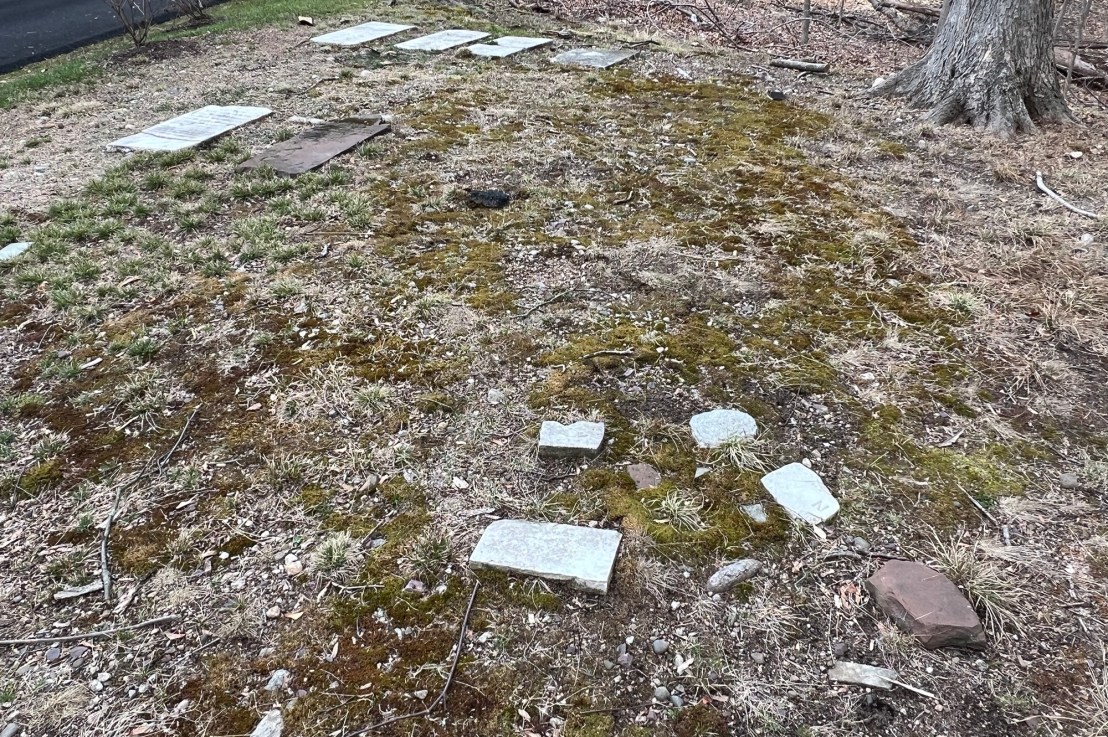
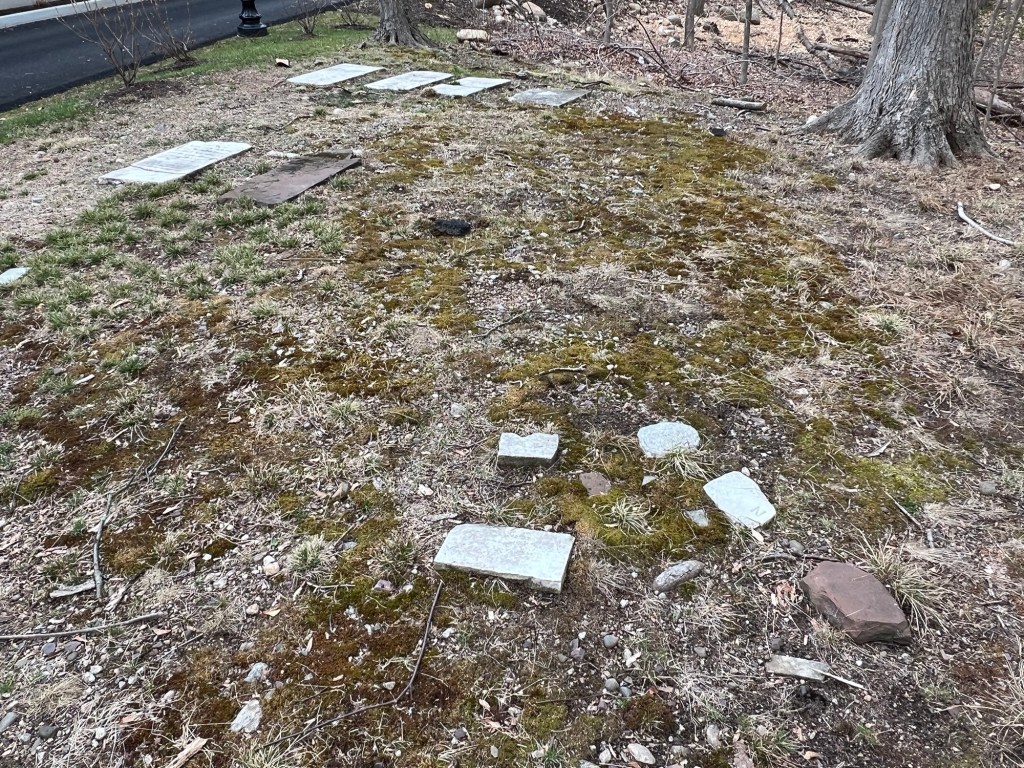
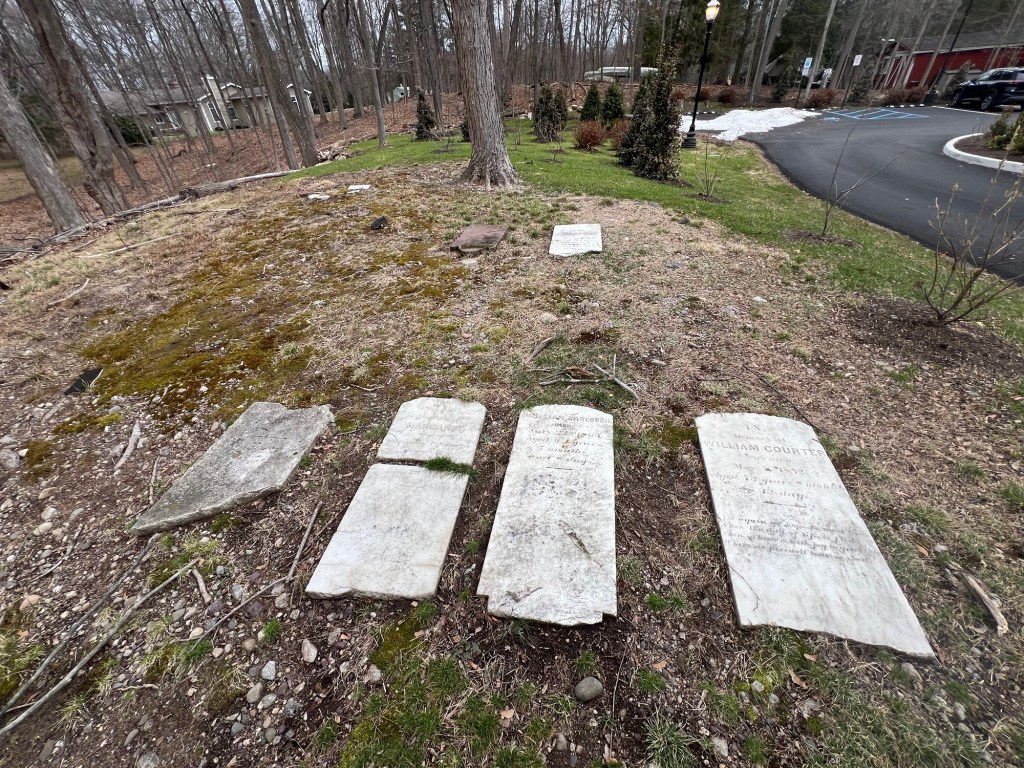
The Sturr Family Cemetery sits on a bend of the driveway of the Chabad Jewish Center of Northwest Bergen County and is a small cemetery that once sat on the edge of the J.H, Sturr farm.
The Sturr Family Cemetery
The farmhouse of the Sturr Family sits on the lot across the street from the cemetery property. This is located on a small buff on what was the edge of the farm.
The Sturr Family cemetery tombstones
The tombstones of the Courter and Carlouch family members
The grave of William Courter
The only visible tombstones that are left in the cemetery are an Ackerman family member, Anny Ackerman and members of the Courter and the Carlouch family’s (who must have married into the family).
The Ackerman family tombstones (the one to the right was unreadable)
The other tombstones are broken and no one is sure who is buried where in the cemetery.
The History of the Cemetery:
(From Find a Grave website)
The cemetery is located in Franklin Township, Bergen County, New Jersey, on what was once the family farm of J.H. Sturr. As of October 1991 only 6 markers were still remaining.
The Sturr Family Cemetery in full view
History of the House:
(From the Franklin Lakes Municipal Website)
H. Sturr House or Blue Meadow Farm Built 1860 378 Pulis Avenue, Block 1510, Lot 8 Franklin Lakes, New Jersey 07417
The Sturr House – also known as Blue Meadow Farm -is a handsome and little altered example of mid 19th century vernacular architecture which incorporates several stylistic elements such as gable returns and frieze area of the early 19th century Greek Revival style. The Borough of Franklin Lakes lists the erection year of the house as 1860.
The façade of this 2 ½ story house consists of clapboard. The front porch has five bays with square posts and a rectangular entrance door with rectangular sidelights. Two tall 1st story windows are on one side of the porch. A single hitching post with iron rings sits in front of the porch stairs. The building has a frieze area with linear design. Semi-circular headed louvered vents are in all gable ends. The rear of the house has a one story wing. There is a detached garage to the west side of the house as well as a round frame well. Further west of the house is a stable which has been extensively remodeled and converted into a residence in recent times. The house combined with associated structures is a significant remnant of the large farmsteads which ones dotted the Borough’s landscape prior to the recent suburban housing boom.
History of the Family:
(From the Franklin Lakes Municipal website)
This Sturr house and the nearby more altered house at 402 Pulis Avenue were duplicate structures and were probably built around the same time by members of the Sturr family. The 19th century Sturr family was descended from Conraedt Sturr who purchased 190 acres of land in this area with John Coeter from Robert Livingston in 1793.
The non-extant homestead and mill was located at present-day 930 Old Mill Road. It is known that Henry Sturr, the son of Conraedt, had a fanning mill at this location in 1850. In a will dated 1852 he bequeathed his property and mill to his grandsons John, Henry, and Daniel (Maria Braun – 1976 page 26 & 27).
The property along Pulis Avenue upon which these houses are situated was probably included in this will since the homes were built around the mid-19th century. Future deed research is recommended to identify the original builder and the construction date of the house (1861: H. Sturr, 1876 Estate of H.M. Sturr). Presently the house is privately owned and occupied.
Formerly The Ramapo Meeting House was organized in 1785 and built in 1798
In 1713, a small group of eleven German Lutheran families settled at the “Island,” so named because of extensive marshlands surrounding high, dry land. They formed a congregation in 1715, and c. 1720 built a log church. Prior to 1739, they built a larger, frame church.
Dutch, French, English and Scottish settlers of the Reformed faith came to the Island about mid-century and attended church in Paramus, 10 miles distant. In 1785, they organized The Ramapo Dutch Reformed Congregation at Ramapough in Bergen County.
After the Revolutionary War (1776-1783), the first task of the new nation was to repair the damages of war and neglect. Neither the Lutheran nor the Reformed congregation at the Island had sufficient means to build a new church. In spite of having fought on opposing sides during the War, they agreed to jointly repair and use the old Lutheran church. The arrangement was so successful that in 1798, they agreed to build the present church together.
Construction began on June 4th, and was finished in November. The last items purchased were “one lock and two keys” on December 12, 1798. The two congregations shared the church for fifty years until 1848, when the Lutherans sold their interest and moved to Airmont, NY and established the present Christ Evangelical Lutheran Church.
As soon as its doors opened to the public in 1798, the new Ramapough Meeting House became the heart of the daily activities. Social gatherings and civic meetings were held here all week long, and personal and official notices were posted on the doors. But on the Sabbath (from sundown Saturday to sundown Sunday) the building became a sacred place.
Ramapough – or Bellgrove, as it was called at this time – had four mills, several blacksmith shops, a general store, a stagecoach stop, and U.S. Post Office, one of the earliest in New Jersey (1797). The old Kings Highway of 1703 or Ramapough Road (Island Road) was part of the ancient 150-mile Albany Post Road from Paulus Hook (Jersey City) to Albany, NY. Dobbin & Tustin, est. 1797, ran a passenger and mail stage line on this road, right past the door of the Ramapough Meeting House.
In 1798, when pews and people were smaller, the Meeting House held 385 people. (Today, it holds 250). Though the old box-type pews are gone from the sanctuary, the gallery seats above still exist. The Island Church held an important place in the railroad hamlet of Mahwah throughout the 1800s. It was known simply as the Community Church until the 1950s, when suburbanization brought many other faiths to Mahwah.
One of the earliest public schools in the area, c. 1815, was operated on the church property until 1906, when the church sold land to the Township for the Commodore Perry School. In the cemetery is a roadbed of the old Kings Highway.
The Ramapo Reformed Church is the oldest public building in Mahwah, and a repository of more than 200 years of local and regional history. It is the older of only two remaining frame Federal-period churches in Bergen County, and is on the National Register of Historic Places.
The modern church sign
I walked through this quiet and reserved graveyard in search of ghosts from the past. The graveyard at the Ramapo Reformed Church, like many of these former Dutch churches, are steeped in memories of the past.
The historic graveyard in the back of the church
In the unique graveyard are the places of rest of many of the first families of Bergen County, NJ who not just shaped the county, but the State of New Jersey and the United States as well.
The oldest part of the graveyard surrounds the church
While the names Haring, Christie, Blauvelt, Demarest, Ramsey, Sutherland, Fox, Hopper, Van Ripper, DeBaun, Terhune and Tice may not similar to most people, to a generation of us were the names of farming families in Bergen County.
Their farms supplied us with fresh fruits and vegetables when in season and places for us to go during Halloween and Thanksgiving for our baked goods and much needed apple cider.
The 1980’s real estate boom put an end to many of these traditions but those names still live in the memories of an older generation. We see some of these traditions still hold tight at Demarest Farms in Hillsdale where hayrides and apple cider and fritters are still part of that experience.
For this trip though, I was in search of graves of our brave veterans of the American Revolution and in the faded tombstones surrounding the church, I found most of them.
The oldest part of the graveyard wraps itself around the church or faces the road, which at one time must have been a country lane.
Some of the oldest families from the community are buried closest to the church building
The graveyard is filled with family plots of most of the first families of the area once surrounded by old fences.
The graveyard is full of families and their memories. In some parts of the graveyard, family plots are organized by generations. To so the progression of mother and father to their children and grandchildren. The history of these families is in the rows of names and the intermarriages of all these families to one another.
The Fox family plot, where one of the members of the family was a veteran of the Civil War
Peter J. Ramsey was born on 23 November 1804, in Bergen, New Jersey, United States. He married Margaret Hopper in 1828, in Hohokus Township, Bergen, New Jersey, United States. They were the parents of at least 4 sons and 5 daughters. He died on 10 May 1852, in Ramapo, Bergen, New Jersey, United States, at the age of 47, and was buried in Mahwah Township, Bergen, New Jersey, United States (Family Search.org).
Closer to the church, I discovered the graves of our brave soldiers from the Revolutionary War whom I had been searching for.
The grave of John Suffern, who fought in the Revolutionary War and whose family the County of Suffern was named after
When John Suffern was born on 23 November 1741, in County Antrim, Ireland, his father, William Suffern, was 27 and his mother, Margaret Templeton, was 19. He married Mary Myers on 1 January 1766, in Burlington, New Jersey, British Colonial America. They were the parents of at least 7 sons and 4 daughters. He lived in Rockland, New York, United States in 1820 and Ramapo, Rockland, New York, United States in 1830. He died on 11 November 1836, in Suffern, Ramapo, Rockland, New York, United States, at the age of 94, and was buried in Ramapo Reformed Church Cemetery, Mahwah Township, Bergen, New Jersey, United States (Familysearch.org).
The graves of John Suffern and his wife
The Christie family plot, where John and James Christie who fought in the war were buried
When John W Christie was born on 7 May 1754, in Schraalenburgh, Bergen, New Jersey, British Colonial America, his father, William James Christie, was 33 and his mother, Catalijntje Demarest, was 32. He married Annatie Hannah Brinkerhoff about 1773, in New Barbadoes Township, Bergen, New Jersey, United States. They were the parents of at least 4 sons and 8 daughters. He died on 11 September 1815, in Bergen, New Jersey, United States, at the age of 61, and was buried in Bergenfield, Bergen, New Jersey, United States (Familysearch.org).
When James Willem Christie was born on 20 August 1744, in Bergen, New Jersey, British Colonial America, his father, William James Christie, was 24 and his mother, Catalijntje Demarest, was 22. He married Maria Banta about 1772, in Schraalenburgh, Bergen, New Jersey, British Colonial America. They were the parents of at least 5 sons and 5 daughters. He died on 23 July 1817, in Bergenfield, Bergen, New Jersey, United States, at the age of 72 (Familysearch.org).
The grave of Lawrence Sutherland another Revolutionary War Veteran
When Lawrence Sutherland was born on 12 June 1763, in Harrington Township, Bergen, New Jersey, United States, his father, James Sutherland, was 21 and his mother, Marietje, was 19. He married Elizabeth Sutherland in 1786, in New Hampstead, Rockland, New York, United States. They were the parents of at least 2 sons and 3 daughters. He died on 9 October 1846, in New Hampstead, Rockland, New York, United States, at the age of 83, and was buried in Mahwah Township, Bergen, New Jersey, United States (Familysearch.org).
The graveyard at the church dates back to before the Revolutionary War. The graveyard has veterans from all the wars since the Revolutionary War to the current wars.
The Wyckoff Reformed Church was built with local fieldstone in 1806. The carpentry inside was done by Daniel Baldwin. The style features vernacular Early Republic, Federal architecture and the windows are done in the Gothic Revival style (Wiki).
The historic graveyard in the back of the church
The back of the graveyard that reaches further back into town
The part of the graveyard from the mid to late 1800’s. There are Civil War veterans buried here.
The back of the church from the 1800’s
The graveyard from the 1800’s
The Revolutionary War era section of the graveyard
The graves of the Revolutionary War veterans
The grave of Revolutionary War veteran Albert N. Van Voorheis
When Albert Voorhees was born on 24 July 1759, in Bergen, New Jersey, British Colonial America, his father, Albert Van Voorhees, was 54 and his mother, Cornelia H. Van Gieson, was 42. He married Rachael Hopper on 26 July 1788, in Acquackanonk Township, Passaic, New Jersey, United States. They were the parents of at least 5 sons and 6 daughters. He died on 17 October 1820, at the age of 61 (FamilySearch.com).
The grave of William P. Winter
The grave of Vanithy Van Voorheis, the wife of Albert Van Voorheis.
The historic part of graveyard right behind the church
The graves of Bridget Ackerman and Martin Myers
The graves of Jack Van Saun and his wife, a descendant of the Van Ripper farm family
The graves of the Van Ripper family
The family plots
The grave of David Stagg
The graves of Peggy Willis and Margaret and Abraham Van Voorheis
The graves of the Mickler family
The graves Abraham and Sara Ann Quackenbush
This historic church and graveyard are really interesting to walk around. It is a glimpse into the past of Bergen County, NJ and the entire State of New Jersey









 Visiting a Museum: The Unique, Unusual, Obscure and Historical