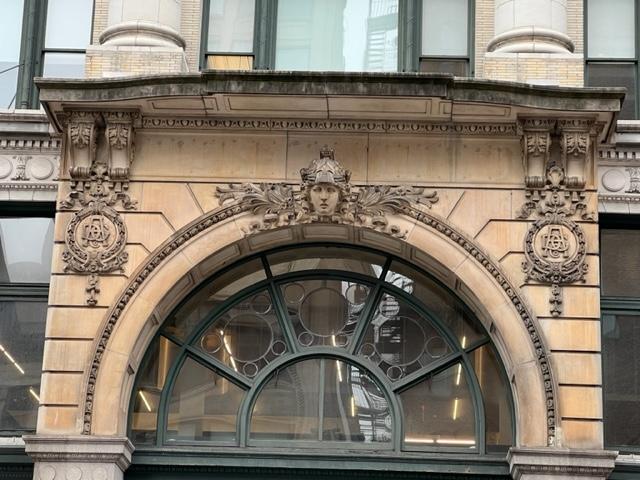
To all of you history buffs and readers who like architecture, take this Victorian Walking Tour I took last Christmas. It really shows how the City keeps changing.
On Saturday, December 15th, I met with other members of the Cornell Club to travel back to the Victorian Era and learn about the traditions of the Christmas past. We explored the Gramercy Park, Union Square and lower Sixth Avenue sections of the City to visit where a New York Victorian Christmas would be celebrated and honored.
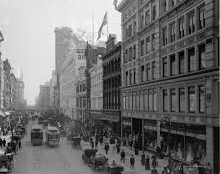
We would be walking the old “Ladies Shopping Mile” that had been built up right after the Civil War when the disposable income for Middle and Upper Middle Class residents had increased after the Civil War and people wanted to spend their money at the newly built department stores, shops and restaurants. The Industrial Revolution was in full swing and shopping had changed with the development of the department store.
The tour took us past brownstones, parks, restaurants and old department stores that line the streets of Manhattan between East and West 21st Street…
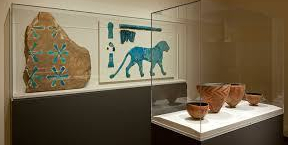
I just happened to stumble across this museum on the way back from the Metropolitan Museum of Art and saw that they were having an exhibition entitled “A Wonder to Behold: Craftsmanship and the Creation of Babylon’s Ishtar Gate”. The exhibition is on the craftsman who created the ‘Ishtar Gate’ and the ‘Processional Way’ in the Ancient City of Babylon.
Glazed brick art from the ‘Processional Way’
The small exhibition contains many examples of clay bricks that were used to build the decorative walls and pathways, artwork from the ‘Processional Way’ were displayed as well as smaller decorative art pieces from the time period.
Some of the works in the exhibition
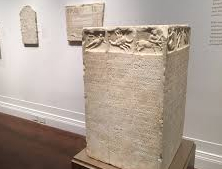
The exhibition also showed tablets from the time period, information on the digs on the site of Babylon and some of the recorded history of the civilization.
There are interesting tablets on display
For two small rooms of gallery space, the Institute for the Study of the Ancient World covers a lot of information on the time period. One nice thing about the museum is that you can see the whole exhibit in less than an hour and they do have a very nice gift shop.
The History of the Museum:
The Institute for the Study of the Ancient World is a center for advanced scholarly research and graduate education, which aims to encourage particularly the study of the economic, religious, political and cultural connections between ancient civilizations. It offers both doctoral and postdoctoral programs with the aim of training a new generation of scholars who will enter the global academic community and become intellectual leaders.
In effort to embrace a truly inclusive geographical scope while maintaining continuity and coherence, the Institute focuses on the shared and overlapping periods in the development of cultures and civilizations around the Mediterranean basin and across central Asia to the Pacific Ocean. The approaches of anthropology, archaeology, geography, geology, history, economics, sociology, art history, digital humanities and the history of science and technology are as integral to the enterprise as the study of texts, philosophy and the analysis of artifacts. The Institute’s Director and permanent faculty determine particular directions of research but both historical connections and patterns as well as socially illuminating comparisons will always be central to its mission.
The public presence matches its vision, engaging both the public and scholars worldwide in the work and findings of its scholarly community. Exhibitions, public lectures, publications, digital resources and other programs reflect the Institute’s ideal of study that bridges disciplines and ancient peoples.
The creation of the Institute for the Study of the Ancient World at New York University has its roots in the passion that Shelby White and Leon Levy had for the art and history of the ancient world, which led them to envision an Institute that would offer an unshuttered view of antiquity across vast stretches of time and place. It was founded in 2006 with funding from the Leon Levy Foundation.
Areas of specialty among the museum’s faculty include the Greco-Roman world, the Ancient Near East, Egypt, Central Asia and the Silk Road, East Asian art and archaeology, Late Antiquity and the early Middle Ages, ancient science and digital humanities.
Disclaimer: This information was taken from the museum’s website and I give them full credit for it.
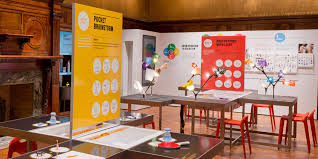
I recently visited the Cooper-Hewitt Smithsonian Design Museum for the first time. I can’t believe that all those years visiting the Met just down the road I had never stopped in the museum to take a peak. I went into see the “Nature-Cooper Hewitt Design Triennial” exhibition that was showing on all three floors of the museum. It was an interesting look on how nature plays a role in design and there is a beauty in the unusual shapes and colors that nature provides us.
Third Floor studio
The first floor was composed of design found in nature. You will see blood samples that move and shiver, electric movements and the role of it in nature and how plants and animals can be shown in simplest terms. On the second floor, you will see the prints in clothing and in home décor and see how color and design enhance beauty in an every day environment. The third floor will show more home décor and design objects.
The First Floor Elements
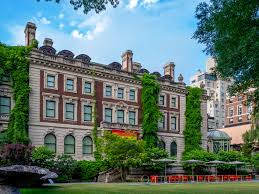
What is unique about the museum is how the mansion was converted into display areas and the use of the interior was blended into fabric of the museum. Take time to look at the areas around the staircases to admire the ceiling and the walls. It must have been a very grand home in its day.
The stairs of the mansion
Purpose of the Museum:
The Cooper Hewitt Smithsonian Design Museum is a design museum located in the Upper East side’s Museum Mile in Manhattan. It is the only museum in the United States devoted to historical and contemporary design. Its collections and exhibitions explore approximately 240 years of design aesthetic and creativity. In June 2014, the museum changed its name from Cooper-Hewitt, National Design Museum to Cooper Hewitt, Smithsonian Design Museum and reopened to the public that December (Wiki).
History of the Museum: (Provided by Wiki)
The Cooper-Hewitt Museum was founded in 1896. It was originally named Cooper Union Museum for the Arts of Decoration and it fell under the wing of the Cooper Union for the Advancement of Science and Art. In 1895, the granddaughters of Peter Cooper, Sarah Cooper Hewitt, Eleanor Garnier Hewitt and Amy Hewitt Green, asked the Cooper Union for a space to create a Museum for the Arts of Decoration. The museum would take its inspiration from the Musee des Arts Decoratifs, Paris. The museum would serve as a place for Cooper Union students and professional designers to study decorative arts collections. Cooper Union trustees provided the fourth floor of the Foundation Building. It opened in 1897. It was free and open three days a week (Wiki).
The museum and the art school started to distance themselves from on another in regards to programming. Other departments of the Cooper Union were making financial demands and the Cooper Union announced that they would close the museum. This led to the museum being closed on July 3, 1963. Public outcry was strong against the closing. A committee to Save the Cooper Union Museum was formed by Henry Francis Du Pont (Wiki).
The American Association of Museums developed a case study about the future of the museum. Negotiations then began between the Cooper Union and the Smithsonian Institution. On October 9, 1967, Smithsonian Secretary S. Dillon Ripley and Daniel Maggin, the chair of the Board of Trustees signed an agreement turning over the collection and library of the museum to the Smithsonian. On May 14, 1968, the New York Supreme Court transferred to the Smithsonian and the museum was renamed the Cooper-Hewitt Museum of Design. The following year, 1969, it was renamed as the Cooper-Hewitt Museum of Decorative Arts and Design. In October of that year, Lisa Taylor became the Director (Wiki).
The museum, which was the first Smithsonian museum outside of Washington DC, moved to its home at the Andrew Carnegie Mansion in 1970. The Mansion was renovated and the museum opened to the public on October 7, 1976 with the exhibition “Man transFORMs”. A conservation laboratory was opened in July 1978. The Samuel H. Kress Foundation funded the lab and it focuses on textile and paper conversation. Lisa Taylor retired in 1987 and in 1988 Dianne H. Pilgrim took her place as Director. In 1994, the museum’s name was changed again to Cooper-Hewitt, National Design Museum. Pilgrim retired from the museum in 2000. In 2000, Paul W. Thompson became Director. On June 17, 2014, the museum’s name was changed again to Cooper Hewitt, Smithsonian Design Museum. A new graphic identity, wordmark and new website was launched on this day. This identity was designed by Eddie Opara (Wiki).
The building is located in the Andrew Carnegie Mansion. The Georgian style mansion was built over the course of years 1899 to 1902 and has sixty rooms. The home served as not only the home for Andrew Carnegie, his wife and daughter but also as his office for his philanthropic work after his retirement. The mansion was designed by Babb, Cook & Willard. It was the first private residence in the United States to have a structural steel frame. It was the first home in New York to have an Otis elevator (Wiki).
Open Wednesday-Sunday 12:00pm-5:00pm/Monday & Tuesday Closed
Admission: Non-Member Adults $12.00/Seniors (65+) and Students with ID $10.00/Members and Children under 12 Free
My review on TripAdvisor:
The front of the Montclair Art Museum at 3 South Mountain Avenue in the early Fall
I have made many trips to the Montclair Art Museum over the years and have always found it to be a very interesting and engaging museum. The curators mount fascinating exhibitions sometimes from the permanent collection and sometimes from traveling shows.
The statue in front of the entrance of the museum
The galleries are smaller and more compact so the exhibitions are not over-whelming like in the bigger museums. You can see each exhibition in about forty-five minutes to an hour and you will still see a lot. There are also smaller exhibition spaces which specialize in one artist and you might see about a dozen pieces.
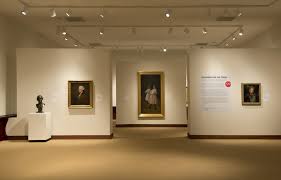
There are two exhibitions going on currently in the museum. One is “Constructing Identity in American”, which is a permanent collection show of more than 80 paintings, sculptures and works on paper that will address a variety of characteristics that contribute to one’s sense of self, including civic, cultural, artistic, religious, professional and sociopolitical identities, sense of place and personal space and non-conformity. This exhibition goes far beyond portraits to explore other aspects of sense of self (Museum pamphlet).
“Constructing Identity in America” exhibit
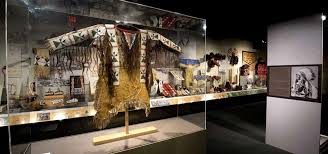
Native American Galleries
The other exhibition is called “Undaunted Spirit: Art of Native North America” which focuses on the Native American culture from Prehistoric times to the modern era. It , seems that by the end of the Civil War the Victorians were collecting art and objects of the Native Americans fearing that their cultural was disappearing. There is a lot of focus on pottery, both modern and pre-colonial, clothing construction, jewelry making with turquoise and silver and basket-making which was all the rage at the turn of last century. I like the modern aspects of the art as they are ushering a new era of artists of the southwest and giving them a voice. Take time to look at the detail work of the show.
“Undaunted Spirit: Art of Native North America” exhibit
Montclair Art Museum Mission Statement:
(This is from the Montclair Art Museum website)
Mission Statement: The Montclair Art Museum, together with its Vance Wall Art Education Center, engages our diverse community through distinctive exhibitions, educational programs and collection of American and Native American Art. Our mission is to inspire and engage people of all ages in their experience with art, including the rich inter-cultural and global connections throughout American history and the continuing relevance of art to contemporary life.
Vision, Values and Diversity Statement:
After 100 years of service, MAM is recognized as the leading American art museum and community art school in Northern New Jersey. As a organization, we value: artistic inspiration, diversity of voices, individual and group creativity and the importance of all arts to a civil, inclusive and forward-thinking society.
We respect and welcome individual differences and strive to maintain an environment that fosters productivity, creativity and individual satisfaction by celebrating the diversity of race, gender, nationality, age, religion, sexual orientation and physical abilities.
During our second century, we will invigorate our collections and curatorial presentations; expand our educational services audience; support artists, their work and connections; pursue productive institutional partnerships and embrace new media and technology. We will also secure MAM’s financial stability and preserve its facilities and other assets in a prudent and sustainable way.
A notable community institution with an international reputation, the Montclair Art Museum (MAM) is still located in the same-though now thrice expanded-building in which it opened in 1914. Situated amid a beautiful tree-lined residential area of Montclair New Jersey, just 12 miles west of New York City, the Museum is esteemed for its holdings of American and Native American Art, its exhibitions, its family and public programs and its art school. It welcomes more than 65,000 visitors annually.
The entrance of the Montclair Museum
The History of the Museum:
(from the museum website)
The Museum was a pioneer: one of the country’s first museums primarily engaged in collecting American Art (including the work of contemporary non academic artists) and among the first dedicated to the study and creation of a significant Native American art collection. This pioneering spirit still reverberates in the Museum’s pursuit and presentation of high-quality art that characterize and celebrates American’s diversity, including the recent launch of its Contemporary Art Program, in 2010, providing MAM an opportunity to showcase dynamic contemporary work and expand the Museum’s contemporary art holdings. A main showcase dynamic contemporary work and expand the Museum’s Contemporary holdings.
A main feature of the MAM program is to explore the interplay between historical and contemporary art to our understanding of the larger historical context in which art is created, presenting work that is being challenging and accessible. A key component of the Contemporary Art Program is it New Direction exhibition series of solo artists, established in 2011. Artists featured in the series include Marina Zurch, Saya Woolfalk, Spencer Finch and Sanford Biggers. Most recently in Spring 2015, MAM presented its largest and most ambitious exhibition of contemporary art to date, “Come as You Are: Art of the 1990’s”.
From its founding, the Montclair Art Museum has maintained a vital presence in its surrounding community. The Museum’s collection began with gifts from prominent Montclair residents that included both American and Native American art, laying the foundation for the Museum’s holdings. MAM’s Inness Gallery is one of the only galleries in the world dedicated to the work of America’s greatest landscape painter, who spent the last nine years of his life in Montclair, from 1885 onward and who drew inspiration from the local landscape. Other well-known artists followed in his footsteps, cementing Montclair’s reputation as an intellectual center and artist’s colony, a reputation its retains to this day.
Mam’s collection has grown to over 12,000 works. The American collection, which started with a gift of 36 paintings from William T. Evan’s, comprises paintings, prints, drawings, photographs and sculpture dating from the 18th century to the present and features excellent works by Benjamin West, Asher B. Durand, John Singer Sargent, Edward Hooper, Georgia O’Keeffe, Andy Warhol and Roy Lichtenstein as well as younger and emerging artists such as Louise Lawler, Chakaia Booker, Whitfield Lovell and Willie Cole.
The museum’s superb holdings of traditional and contemporary American Indian art and artifacts, New Jersey’s largest, represent the cultural achievements in weaving, pottery, wood carving, jewelry and textiles of indigenous Americans. The collection was begun by Annie Valentine Rand and carried on by her philanthropic daughter Florence Rand Lang, one of the Museum’s founders and continues to grow with philanthropic daughter Florence Rand Lang, one of the Museum’s founders and continues to grow with commissioned works, gifts and purchases that celebrate the vitality and modernity of traditional forms and beliefs. Among the contemporary American Indian artists represented are Tony Abeyta, Dan Namingha, Jaune Quick-to-see Smith, Allan Houser , Bently Spang and Marie Watt.
Equally important for its community presence and its reputation are the Museum’s public and family programs and art school, serving everyone from toddlers to senior citizens. Collaborations with numerous cultural and community partners bring artists, performers and scholars to the Museum on a regular basis. Guests have included Holland Cotter, John Elderfield, Bill T. Jones, Jeff Koons, Faith Ringgold, Winfred Rembert, Kiki Smith, Philip Pearlstein, Shirin Neshat and Lorna Simpson. More than 10,000 K-12 students from 190 school districts visit the Museum every year. Free Family Days, a Family Lab, MAM Park Bench, Home School Days and Birthday Art Parties allow families to experience art in variety of different ways. As the New Jersey affiliate of the Scholastic Art & Writing Awards, MAM opens opportunities to creative teenagers to gain national recognition for their work. The Museum also provides programs for seniors and special needs individuals-such as the hearing impaired and people with Alzheimer’s as well as training for teachers in the arts.
MAM’s art school, now the Yard School of Art, has been an integral part of the Museum’s life nearly from the beginning. It was founded in 1924 just 10 years after the Museum itself and has operated continuously since then offering courses year-round to kids, teens, adults and seniors. Courses cross a broad range of the artistic spectrum, including drawing, painting, collage, pastel, printing making and illustration. In 2011, the school launched two new areas: a Ceramics Studio and a Digital Media Lab.
In 2014, MAM celebrated its Centennial with a yearlong program of activities, which included a Birthday Party on January 15, exactly 100 years from the day of its founding that attracted thousands of visitors. In honor of the Centennial the Museum also commissioned internationally renowned artist Spencer Finch to create a site-specific installation that has transformed the Museum’s facade, making it a more inviting point of entry.
The first institution in New Jersey designed as a museum and one of the first in the nation to be accredited by the American Association of Museums, the Montclair Art Museum as it marks its Centennial, continues to seek novel ways, through its exhibitions, educational programs and outreach efforts to inspire and inform its growing and ever more diverse audiences.
(This information on the history of the Montclair Art Museum was taken from their website and I give the Museum full credit for the history of the Montclair Art Museum).