The Pascack Valley Historical Society is now celebrating their 75th Anniversary.
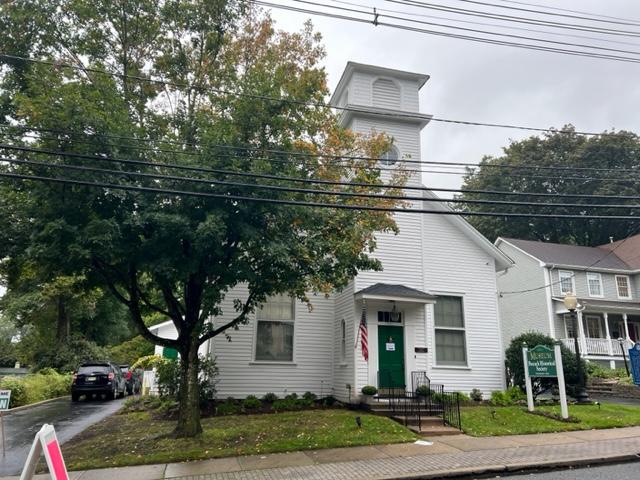
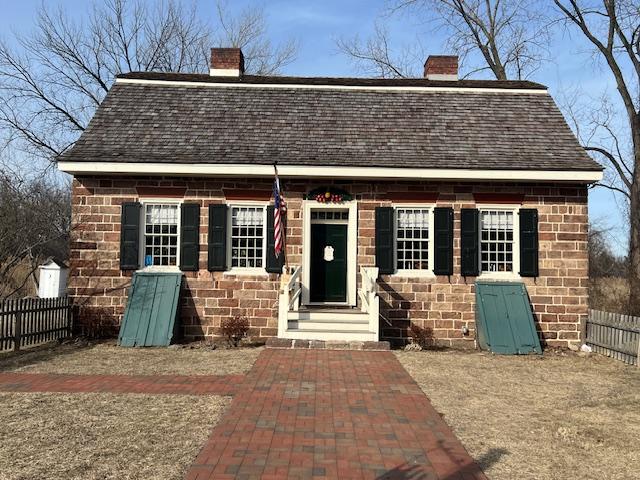
The Pascack Historical Society Museum (John C. Storms Museum), headquarters of the award-winning Pascack Historical Society, is located in the 1873 church building that was dedicated by the Reverend Henry Ward Beecher. The building and all the exhibitions have gone through an extensive renovation and have been reinstalled with more signage and information. Please check out their new displays.
The sign that greets you in the front of the building.
The Historical Marker in front of the building.
As you enter the building, you are welcomed to a comfortable spot.
The extensive exhibits include a general store, colonial kitchen, a Victorian Living Room, dolls, clothing and other displays of American life in the Pascack Valley. The front gallery as you enter serves as a classroom and lecture hall for the society. There you can see a variety of artifacts in the collection from china to guns and clothing.
Artifacts in the front room.
Artifacts in the first gallery.
A collection of antique guns in the front gallery.
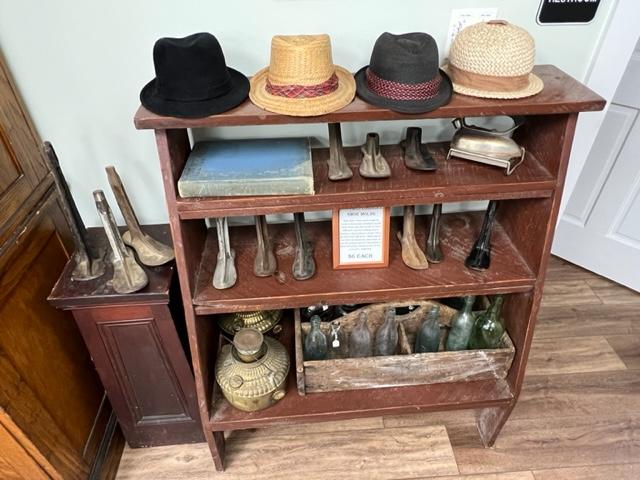
A selection of hats in the front gallery.
There is also a special exhibition that features the world’s only wampum drilling machine as well as a collection of early colonial currency.
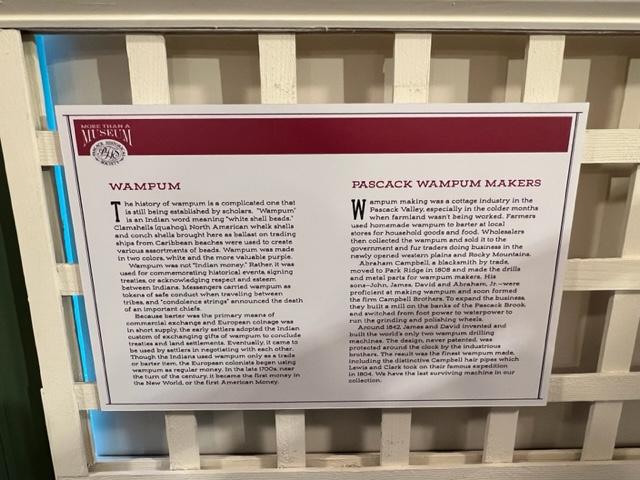
The Wampum Machine sign and how Wampum is made.
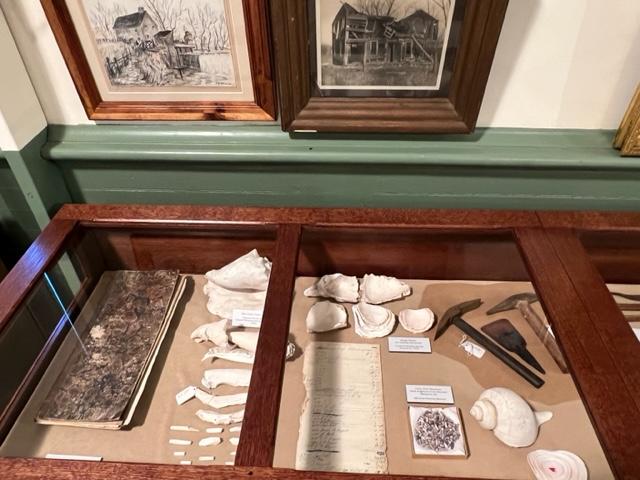
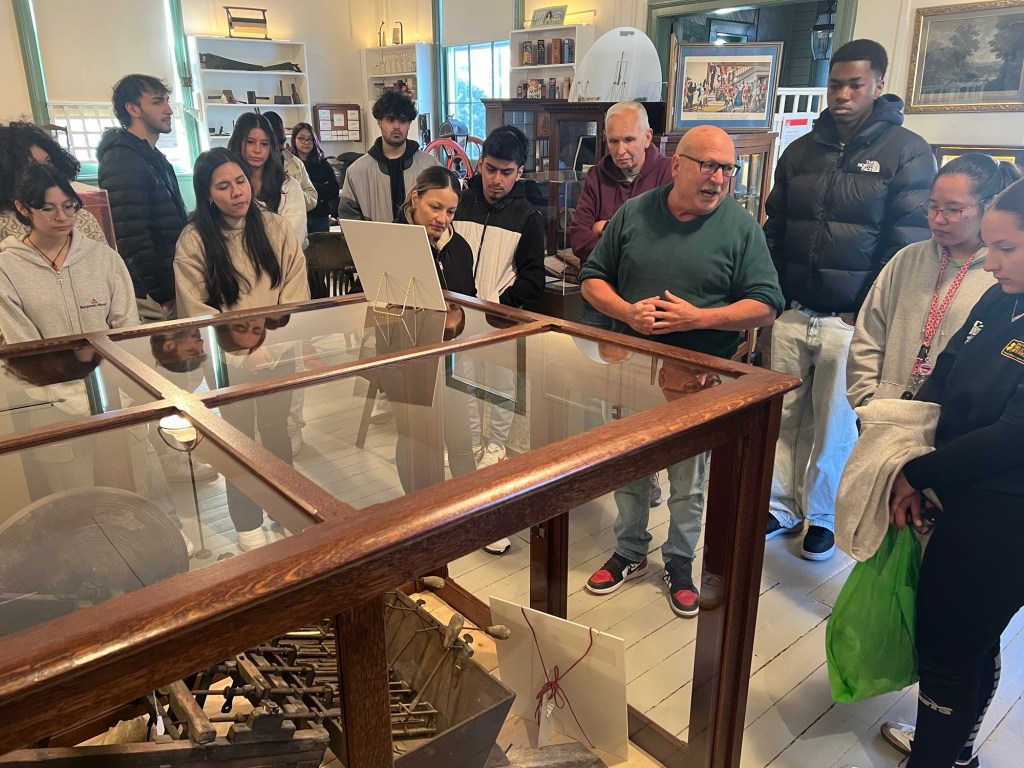
Their early Colonial Financial exhibits include an early wampum machine that the tour guide had said that it was the only one of its kind that made a type of rolled wampum from the inner section of a conch shell. Early New Jersey currency is well represented in the collection with several types of dollar bills at a time when states printed their own currency for its citizens. Really take a look at the early detail work of these bills.
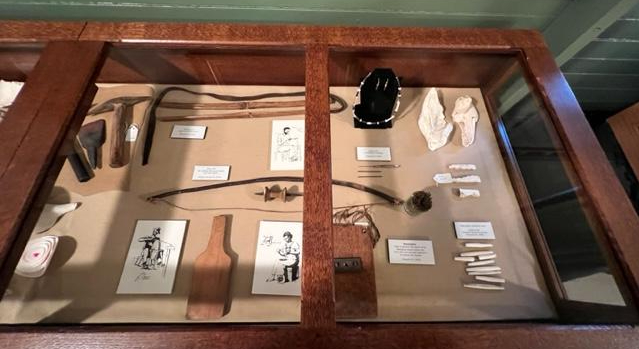
The Wampum display of shells and tools.
The uses of Wampum and how it is made.
The oldest working Wampum machine in the world.
The Van Ripper General Store exhibition features many types of early Colonial artifacts that include weights and measures, food items found in an early grocery store, turn of the last century bottles and many types of appliances for cooking. Several treasures are tucked here and there to create the mood of shopping at the turn of the last century in Bergen County. There are classic groceries, weights and measures to weight groceries and several artifacts from the Van Ripper and Stockdale Farms which used to be located in the area.
The General Store sign
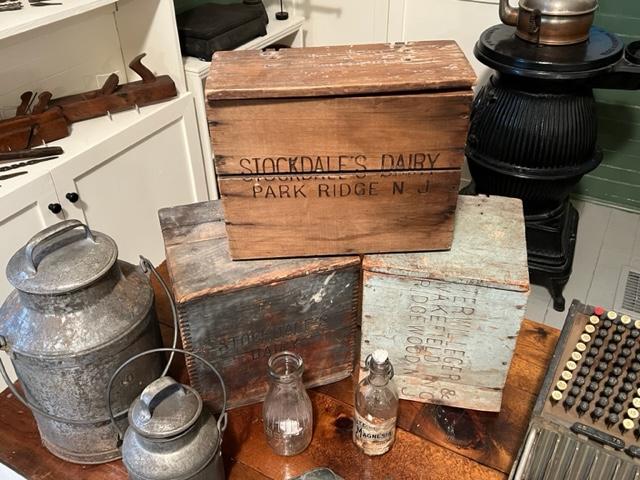
The General Store display.
Stockdale’s Dairy Farm was a popular farm in Park Ridge before the 1960’s.
Tools need on the farm and in the home.
The Tool display at the General Store.
The Toy Collection is extensive and covers several time periods. They have a interesting collection of dolls over the ages that include cloth and china dolls that would cater to children from different economic status. There are also games, wooden and metal pull toys and hobby toys such as marbles and jacks.
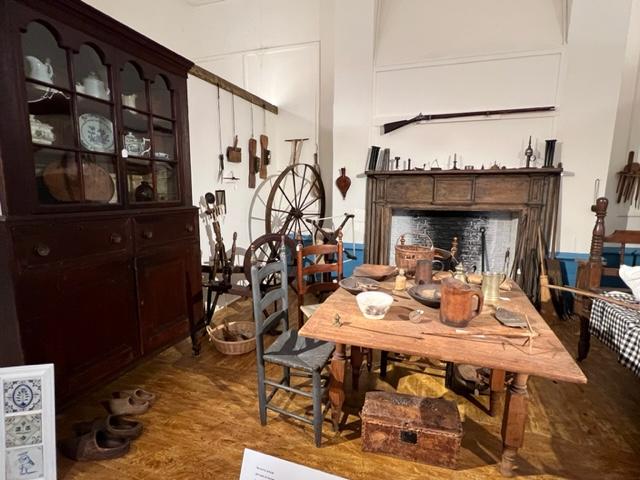
The Early Dutch Farmhouse Kitchen & Dining Room features one of the first beds that has no mattress but constructed by a series of ropes that are tightened. The tour guide explained that this might be where the expression “Sleep tight and don’t let the bed bugs bite” might have come from as the ropes needed to be tightened each evening before the family went to bed.
Early Dutch life sign.
The exhibit also had early furniture hatches, chamber pots, a butter churner, various chairs that were manufactured in the area and several detailed decorative pieces.
The Early Dutch Kitchen and Living Space
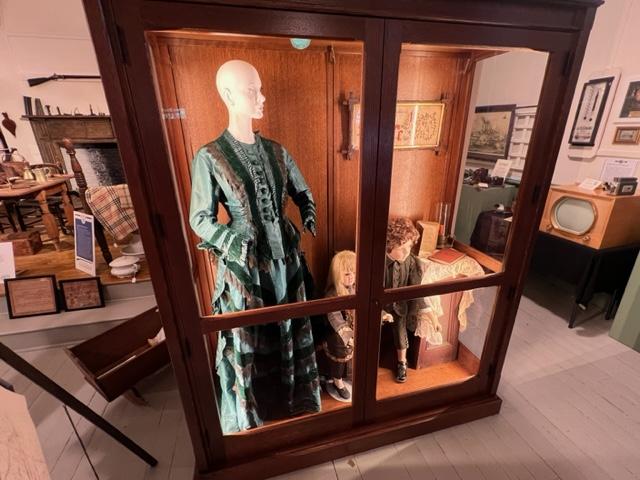
The Victorian Dress of the church visitation.
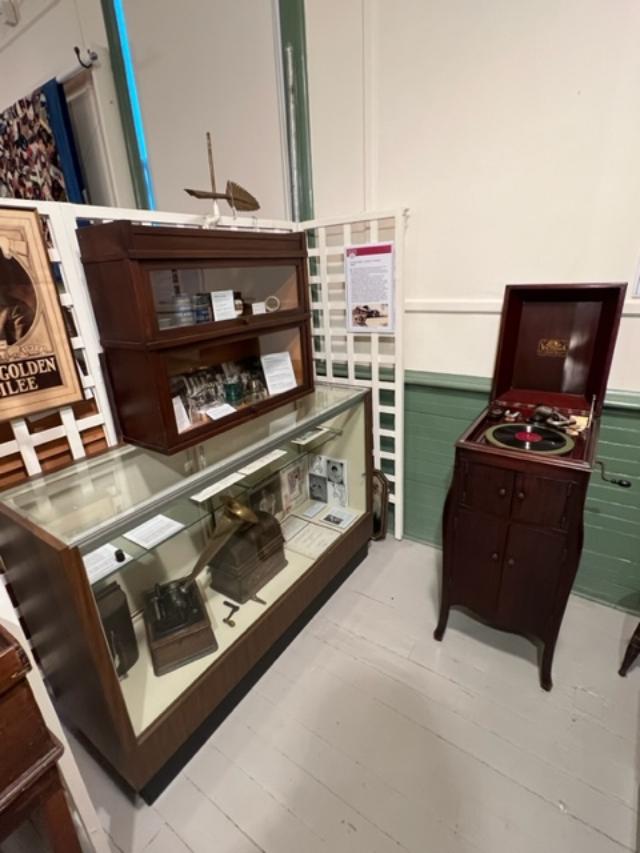
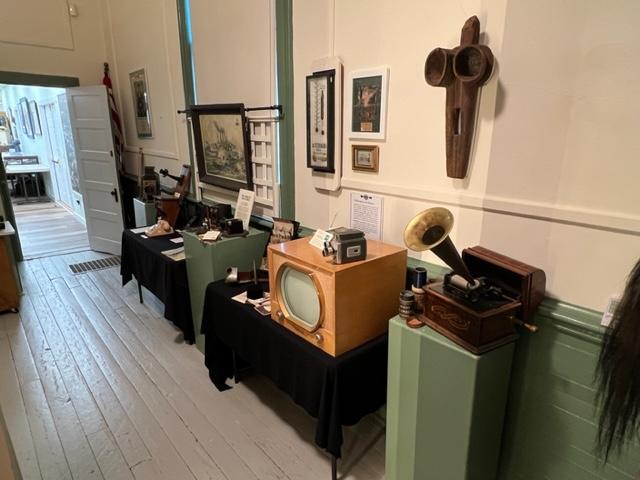
The Victorian Living Room features many plush pieces of furniture, decorative knick-knacks that used to dominate the décor and a graceful piano with mother of pearl keys and decorative carved sides. This model was one of maybe a hundred made for a very elite client. The display also featured one of the early record players that still works.
The ‘Victorian Afternoon’ exhibition in 2024:
The sign for the Victorian home:
The ideal Victorian Home ‘Parlor’
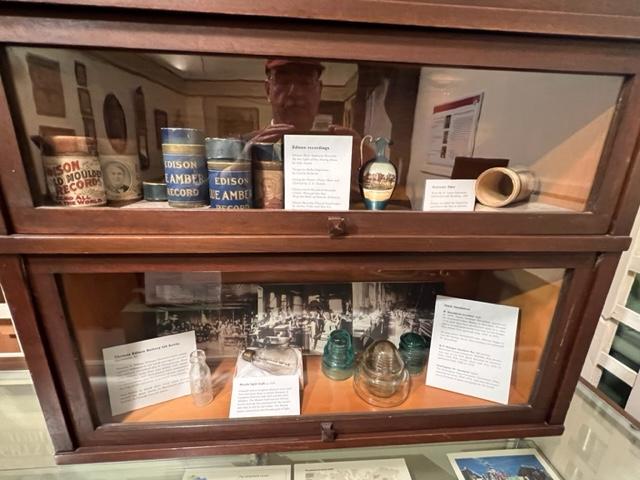
Early Edison products
Early Edison recording equipment was not just musical but decorative.
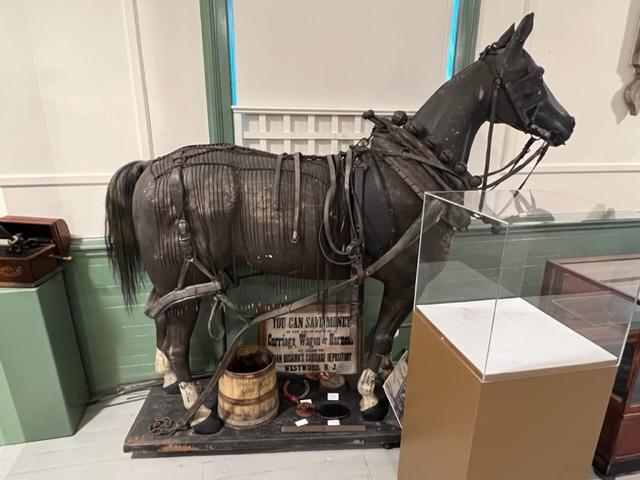
The horse display.
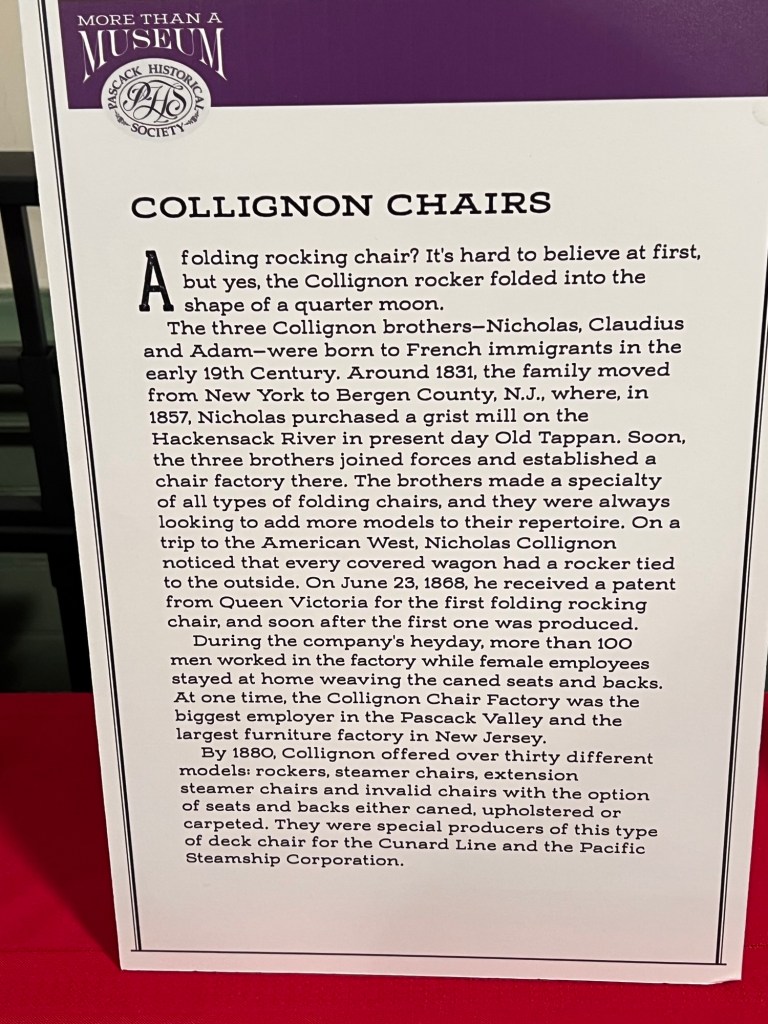
The new exhibition 2025: ‘Collignon Chairs’
The exhibition is on the Collignon Chair factory of River Vale, NJ and the selection of chairs that the factory once manufactured.
The sign from the exhibition
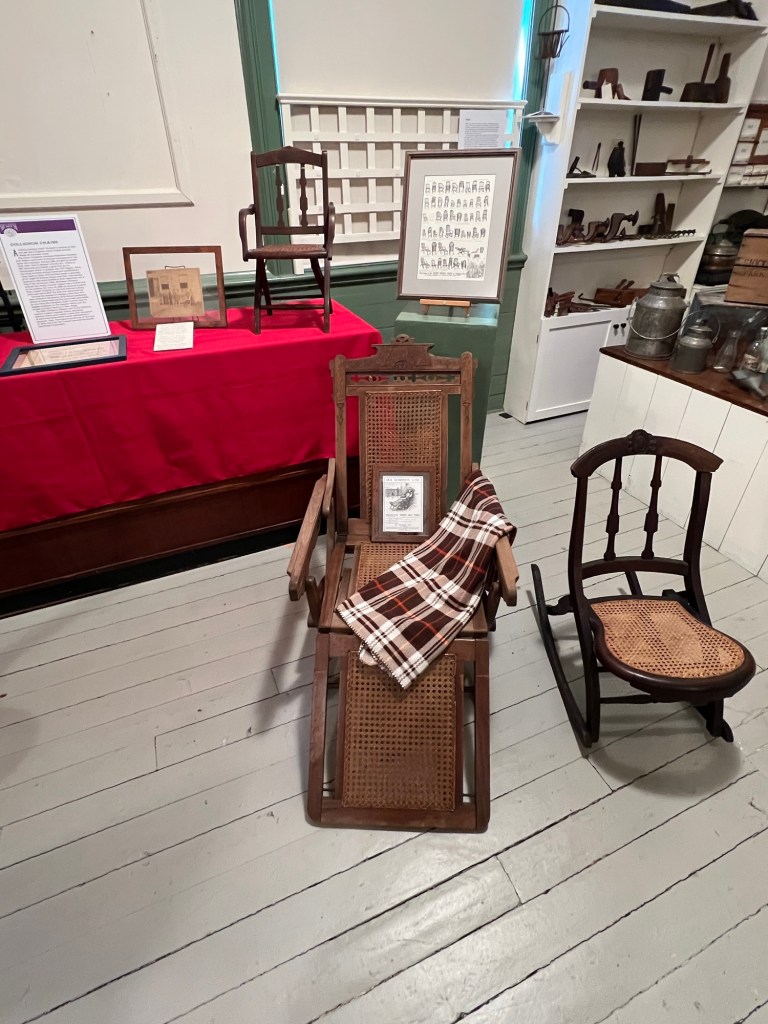
Some of the collection of Collignon chairs on display including the popular deck chair used on streamlines.
The popular folding rocker from the collection
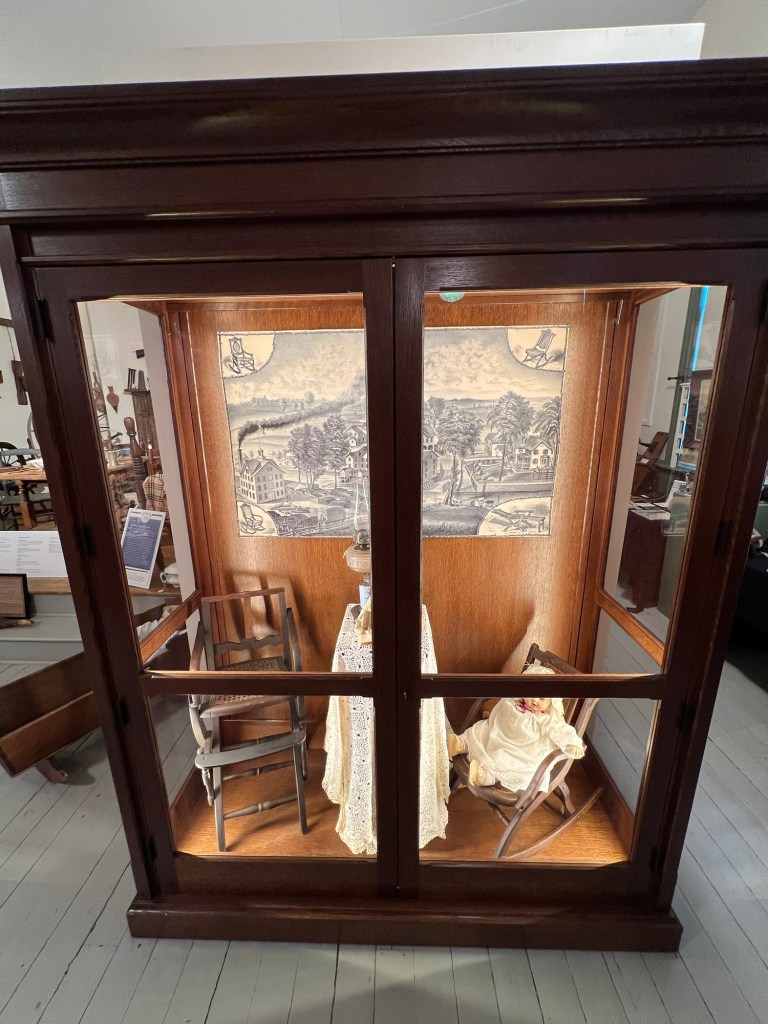
The display of chairs and a drawing of the old factory
Off to the side, there is an early sleigh and horse display, an exhibit of typewriters and carbon paper as I found out the area was once the leading manufacturer for carbon paper and a complete workshop with tools from all eras.
Typewriter collection at the museum.
Early Electronics
The schoolhouse desk of the school master.
The workshop is a very detailed in its artifacts with early saws, hammers and items that even I could not figure out what they were.
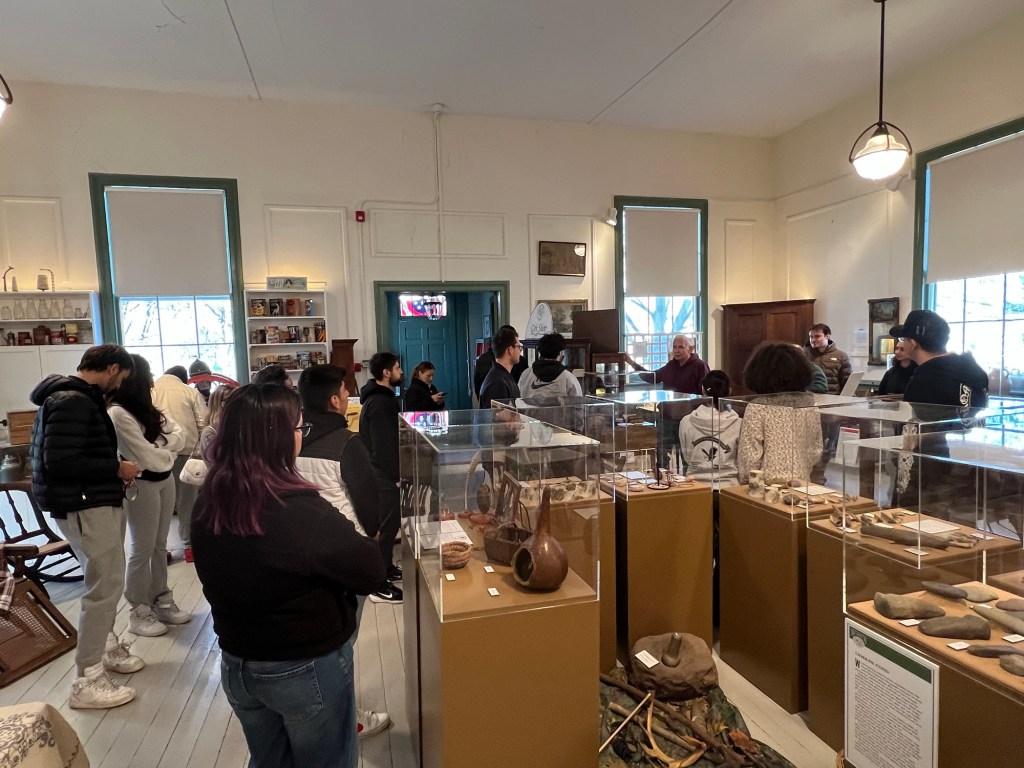
In the main room, there are more cases of toys, Revolutionary items and Native American artifacts to explore.
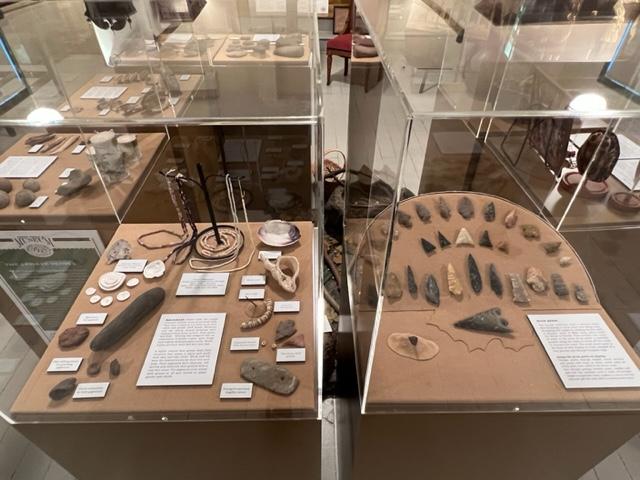
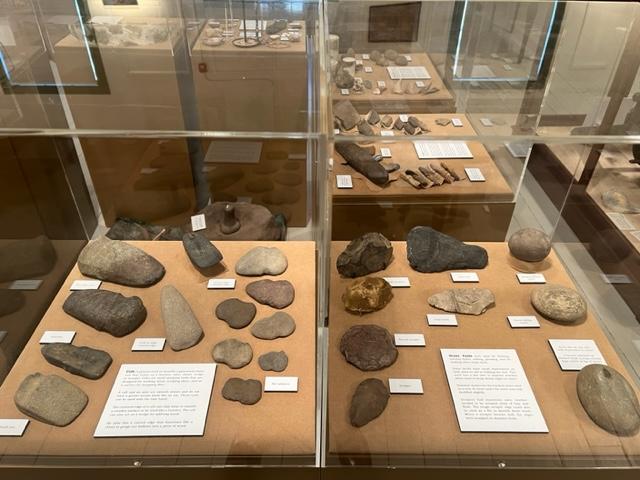
Native American Artifacts
The Lenape display
The Native American display.
A small gift shop is off to the side selling items donated by members.
Become a Friend: From the Friends of the Pascack Historical Society Museum pamphlet:
Pascack Historical Society Information and History:
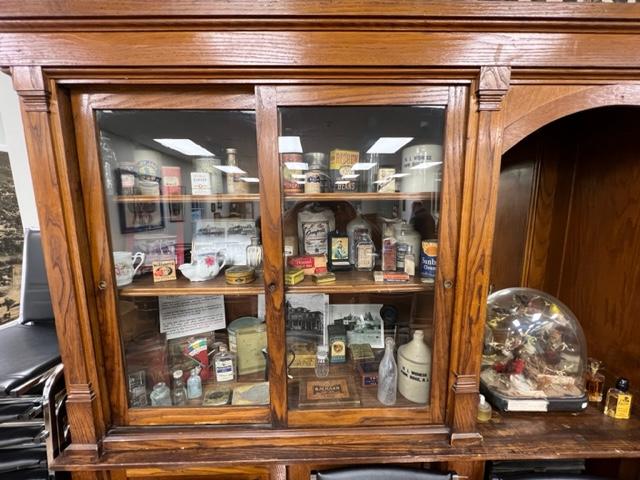
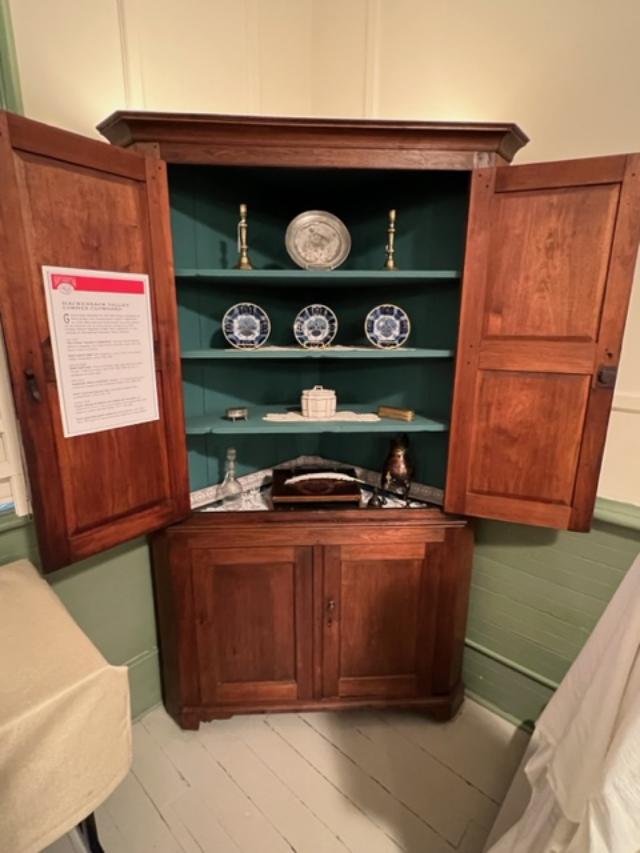
The Corner Cupboard of early American china.
(From their pamphlet):
Membership Benefits:
Become a member of the Pascack Historical Society, a 501C3 organization. Dues are modest and membership has its privileges!
One year of free admission to the museum and most of its activities.
A one year subscription to the Society’s award-winning quarterly newsletter, RELICS.
10% discount on museum gift shop items (Sale items and new books excluded).
50% discounts on programs for children and adults.
You will receive Members Only advance notice mailings and emails about upcoming events and activities.
Members only “behind the scenes tours” of the museum. (By Appointment Only).
You will have the satisfaction of knowing you have joined the ranks of the area’s most passionate historical preservationists, who have a commitment to educate and enrich their neighbors’ lives-young and old.
The Military embellishments
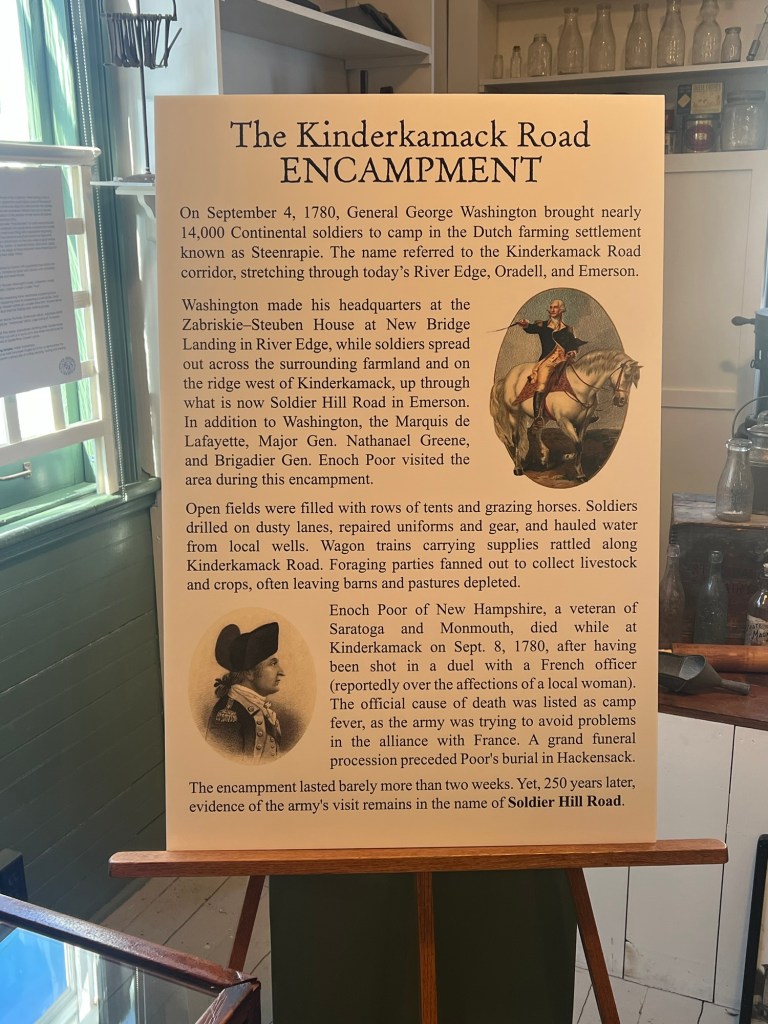
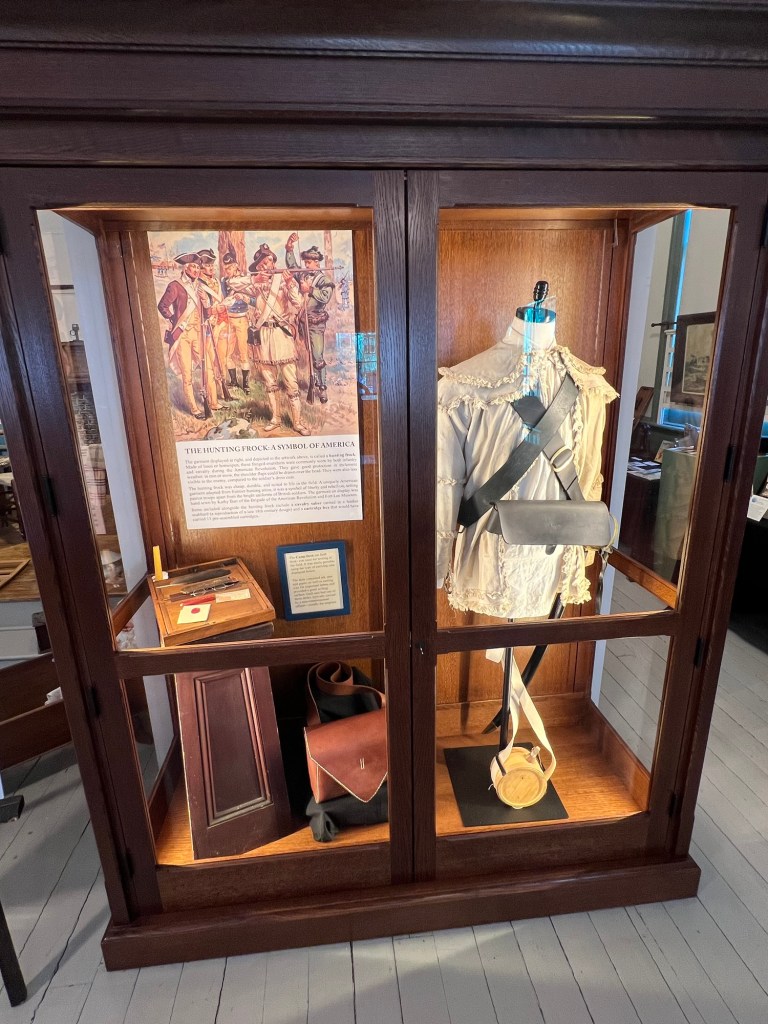
In 2026, the museum was celebrating the ‘250th Anniversary’ of the Revolutionary War and had an exhibition of artifacts from the Pascack Valley.
The ‘250th Anniversary’ of Revolutionary War
This included all the stops that General Washington made in Bergen County, battles and confrontations with British soldiers and family battles by members who were loyalists and patriots.
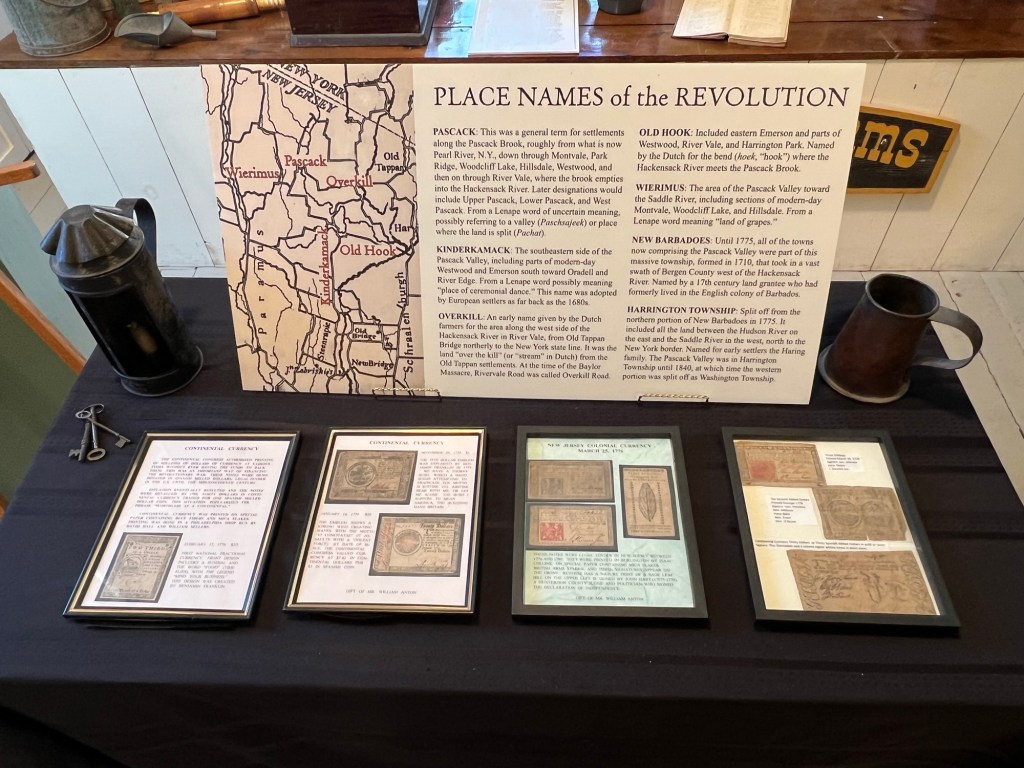
The currency of the war years
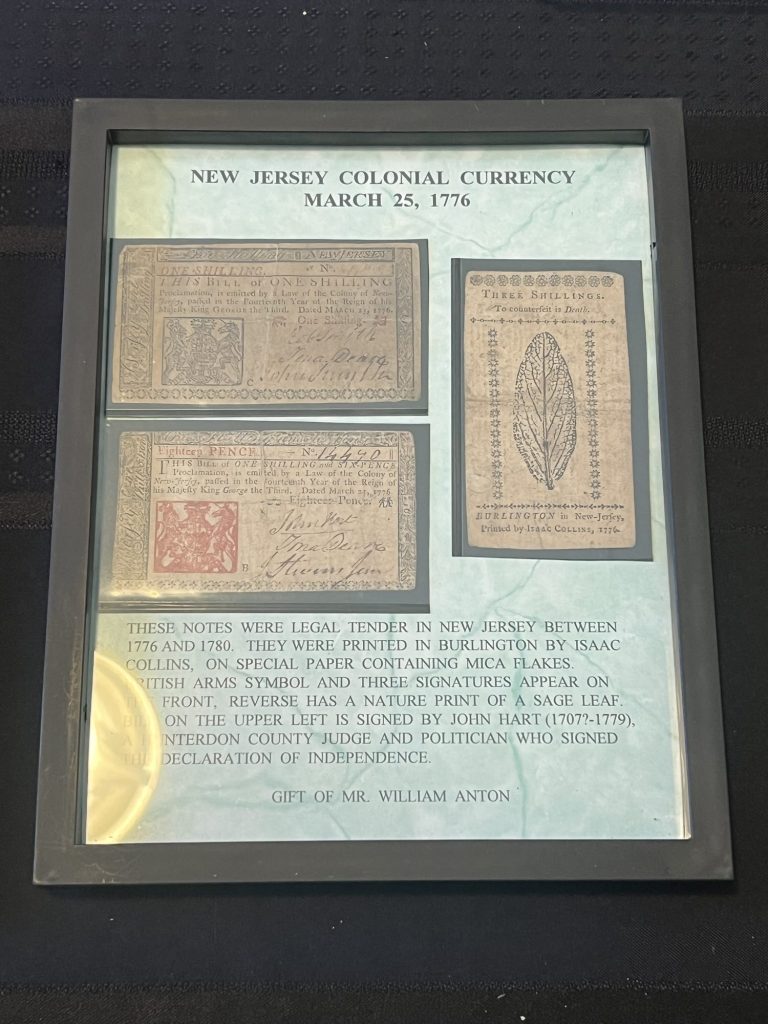
The exhibitions shows New Jersey’s contributions to the war effort. This part of the exhibition has Colonial currency from New Jersey.
New Jersey Colonial Currency
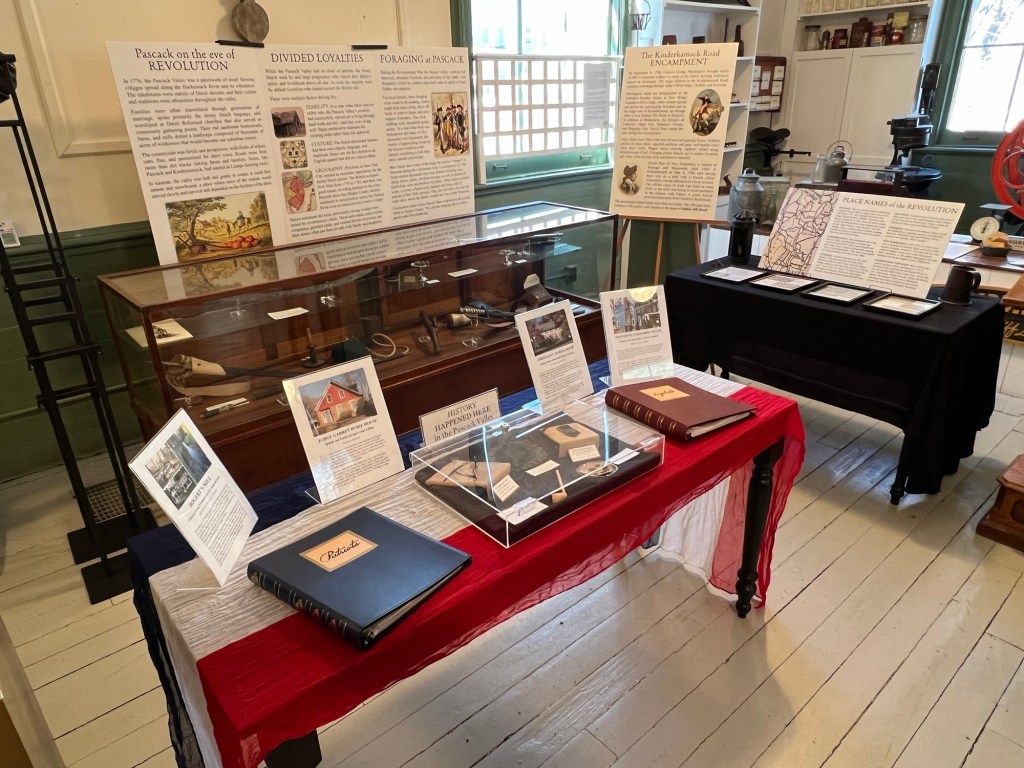
The full exhibition of the ‘250th Anniversary’ of the Revolution War
Uniforms and accessories of the War years
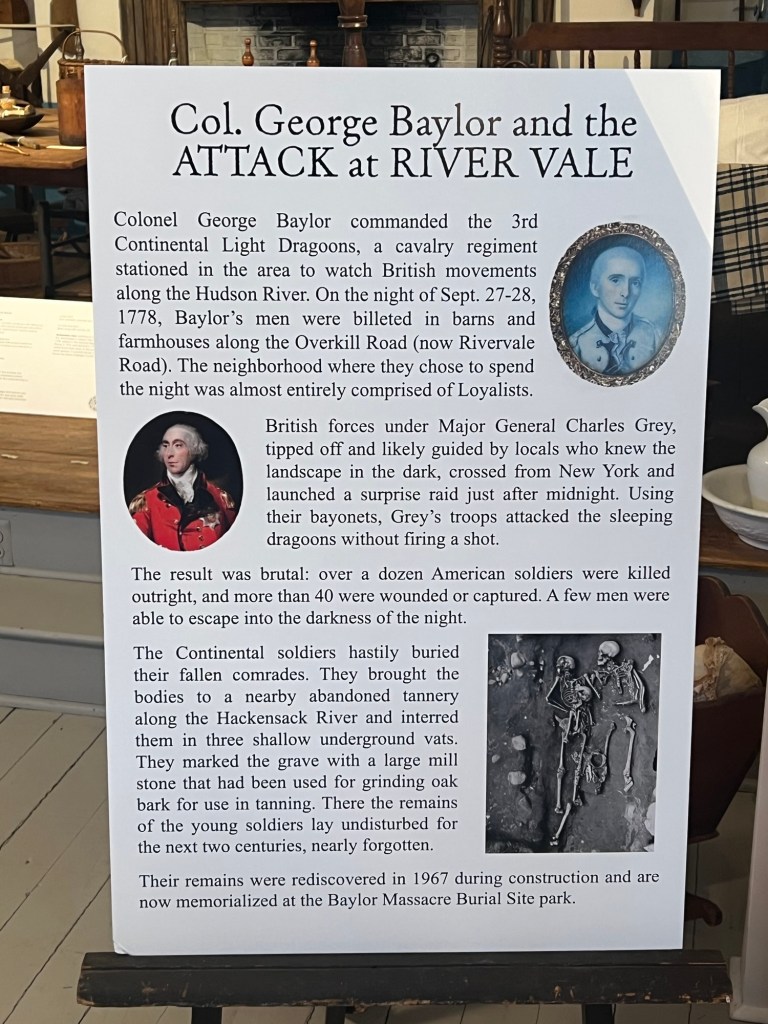
The Baylor Massacre attack
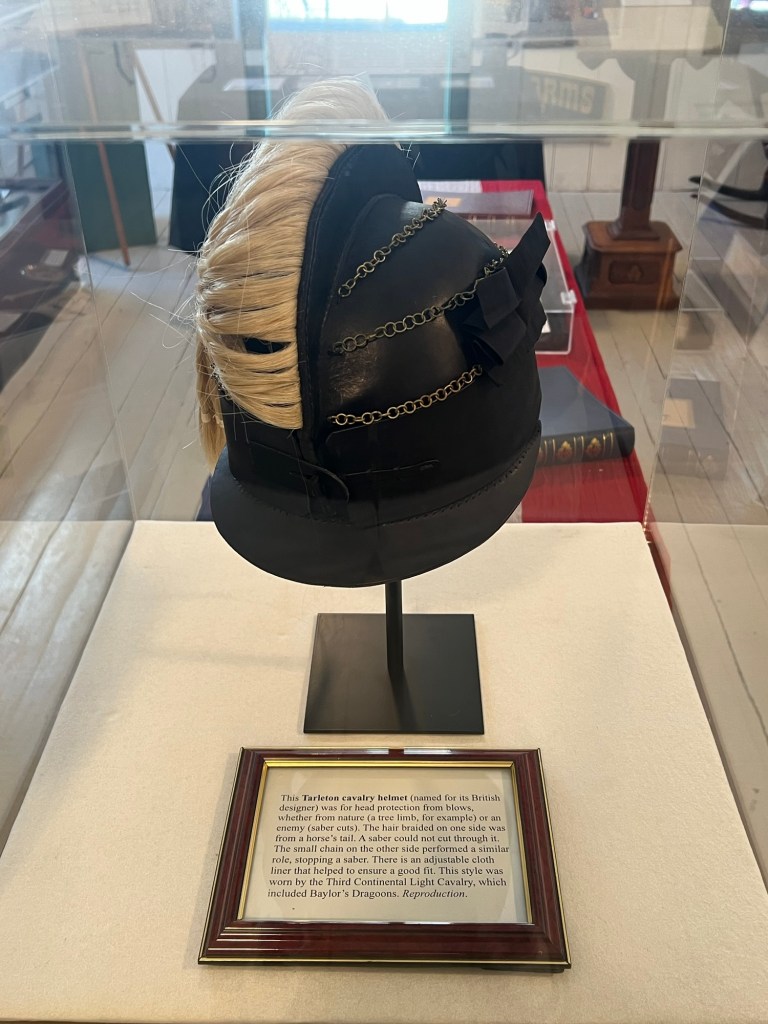
The Tarlatan Calvary helmet
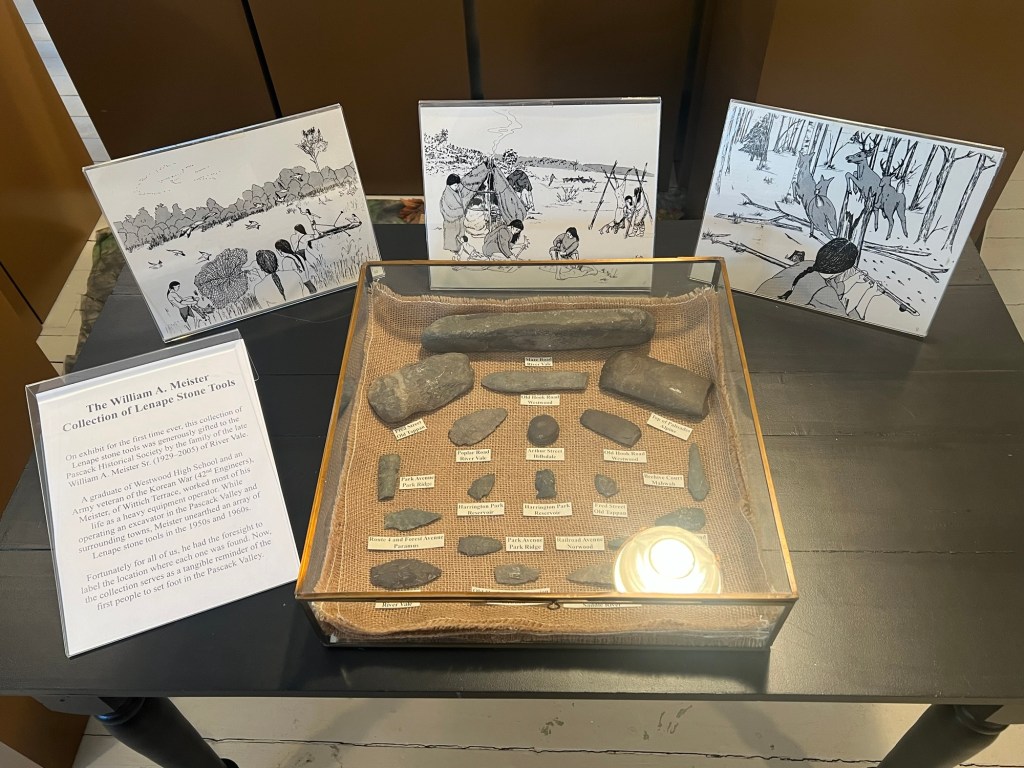
The Lenape artifacts from that era
Membership Opportunities:
Preserving and disseminating local history is a labor of love when you become a PHS member. It is a partnership between you and your fellow members. We encourage you to think about volunteering at some level at the museum or its events. Check out the volunteer opportunities below and give us a call if you would like to participate in any of them.
Docent: Act as a guide when people visit the museum. A simple one-day training session is all it takes.
Researcher: Do you like to wander through books and archives searching for answers to questions?
Archivists: Preserve and catalog the history of the Pascack Valley.
Educators: Work with youngsters and licensed teachers at Society events.
Tech Savvy: Volunteer your time to help with our website or graphic design.
Handy Helpers: Do you like to repair things? Can you sew, do carpentry? This might be for you.
*Disclaimer: Information on Volunteer and Membership opportunities are taken directly from the Pascack Historical Society Museum pamphlet. Most of the descriptions of the displays is what I was able to see in my short time visiting. The museum has a treasure trove of items to look at in detail.
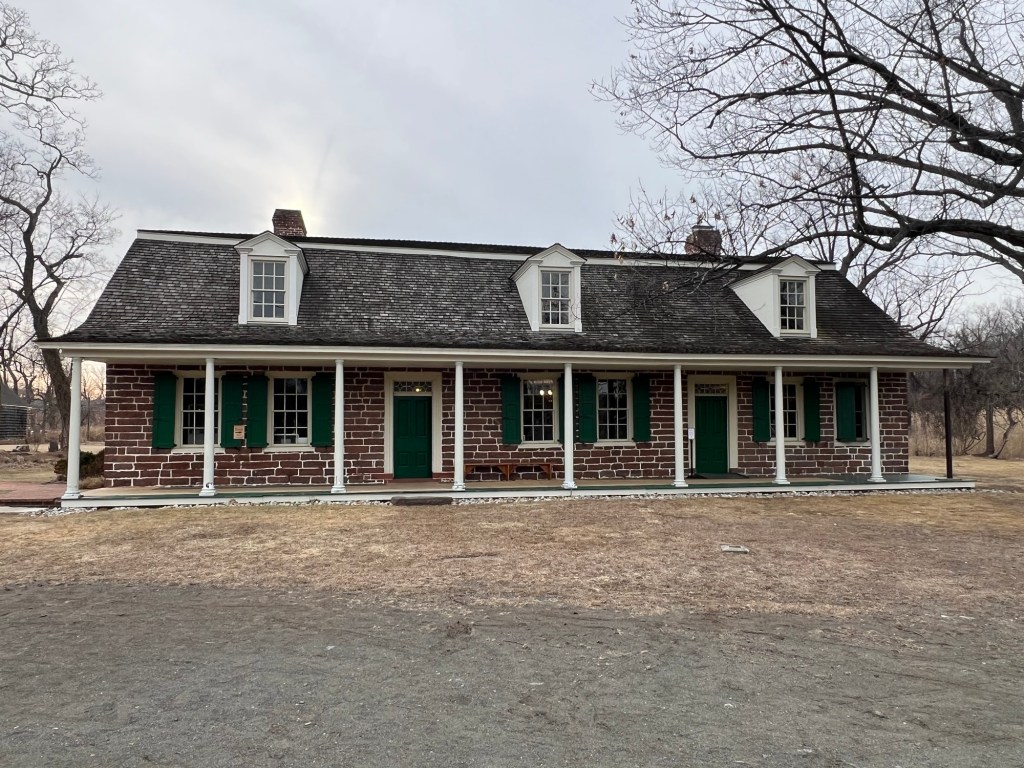
The Reformed Dutch Church with its Colonial cemetery and the Wortendyke Barn is right down the road so take a few hours to explore the area. The members of the Wortendyke family are buried in the church’s cemetery.
Visit from Bergen Community College for the Bergecco- Parc Consulting Inc. on April 9th, 2025: for the ‘Bergen 250’ project:
The project we created for the “Bergen 250: the 250th Anniversary of the Revolutionary War” that was created:
As part of my International Marketing class, I took my students to visit the three sites for our project on the ‘Bergen 250’:
The students toured the museum with the assistance of the Museum’s Board members
As part of the assignment for our ‘Farm to Table Dinner’, the project starts here with a Cocktail Party and tour of the museum. The back room of the museum was where the party takes place and then the guests would tour the museum before heading to dinner at the Wortendyke Barn down the road.
Peter Meany, the First Vice President of the Board explaining the Wampum machine to the students. This form of Native American currency is the only machine in the world like it and is a rare artifact.
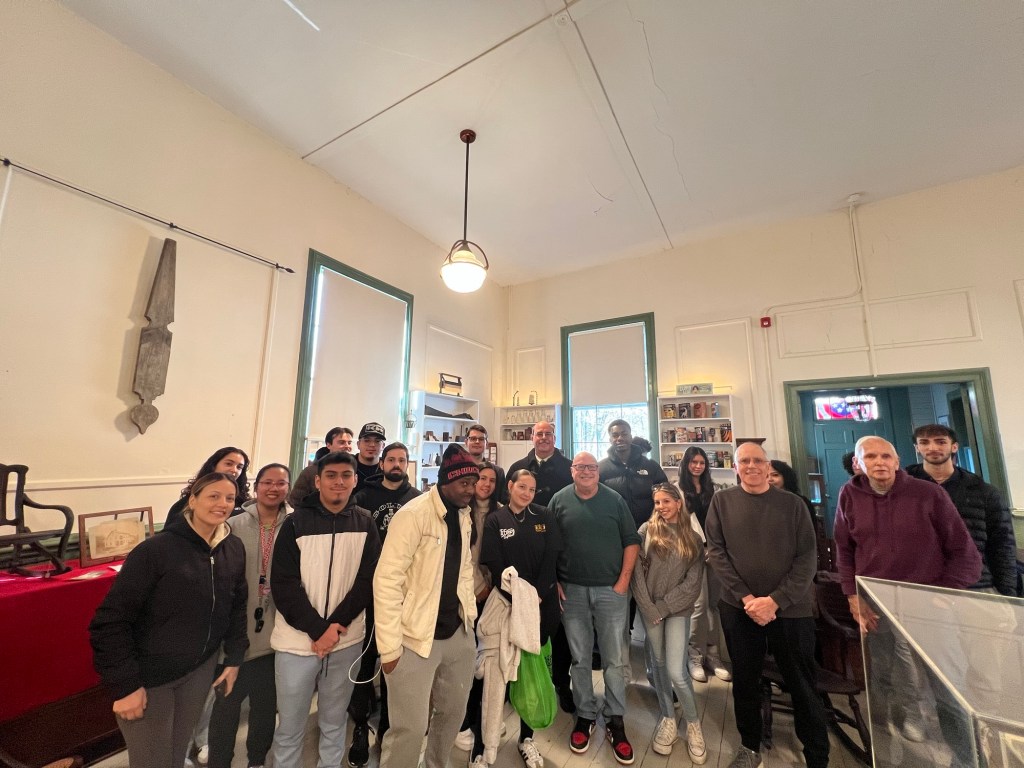
Our Team group picture at the Pascack Valley Historical Society with members of the Museum’s Executive Board Peter Meany, Ralph Donnell Jr. and Christopher Kersting.
We want to thank the Board for taking time out of their busy schedule to support the students on this project.
I recently visited the Steuben House for a Christmas concert which was an evening of Christmas songs, a talk on the history of Christmas before, during and after the Revolutionary War. It was a very lively evening of song and lecture and the ladies who entertained us sang beautifully.
The Campbell-Christie House was used as the ‘pub’ for diners that night
Linda Russell & Company sang Christmas songs of the time and then talked in between about how Christmas was celebrated during the War years. She was a delight in her discussion and her and her daughter and their friend did a wonderful job.
The concert was entertaining, and the talk was interesting in the Van Steuben House
A sample of Linda Russell’s music
It seemed that while the Puritans put a damper on the Christmas holidays in New England the Dutch New Jersey and New York thoroughly enjoyed the holiday season after all their hard work during the Fall harvest months.
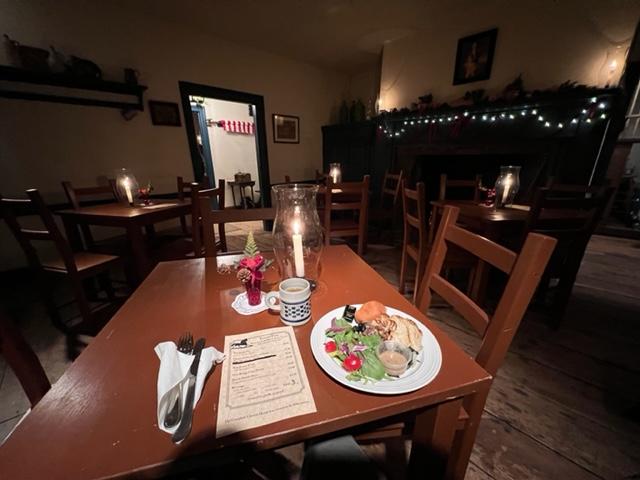
What was really nice was the Campbell-Christie House was open as a pub for dinner and light snacks and you could order things like Shepard Pie, Cheese & Onion Pie and Cake doughnuts and gingerbread for dessert while enjoying conversation by candlelight. It was an interesting and engaging history.
The Van Steuben House for the holidays was where the entertainment was that day
The house is nicely decorated for Christmas circa 1778
The Campbell-Christie House at Christmas 2020 Historical Event
Singer Linda Russell at the Christmas Tour Event at the BCHS 2020
Don’t miss their historic lectures and reenactments during the year. Check their website above for more activities.
The historic marker of the Campbell-Christie House
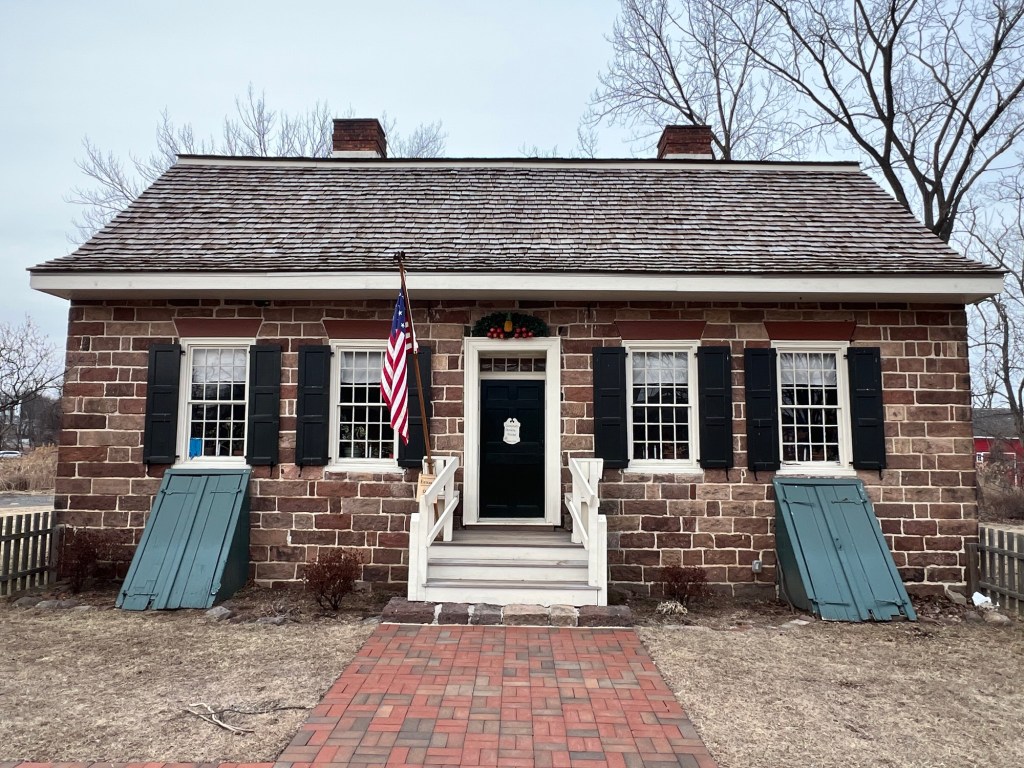
The Campbell-Christie House, an 18th century sandstone structure, is located in Historic New Bridge Landing State Park, River Edge. This historic building originally stood at the intersection of Henley Avenue & River Road, in New Milford, NJ. In 1977, in order to save it from demolition, Bergen County purchased and moved it south to this site next to the Hackensack River.
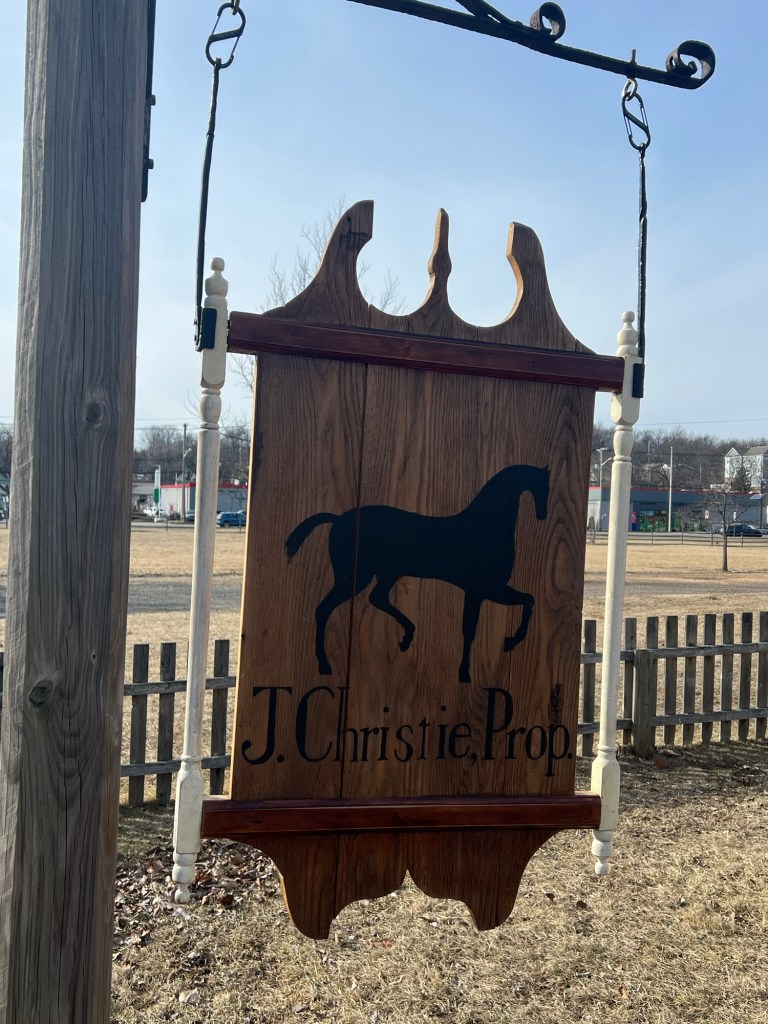
The Christie Family Pub sign
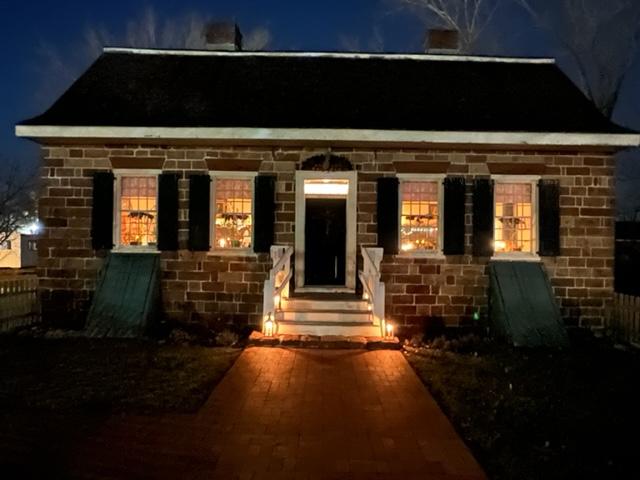
The house was used again for a pub for the Christmas concerts that returned to the site in December 2022. The house was set up as a restaurant with a limited menu before and after the concerts. The light fare was catered in and the menu was similar to what people would have eaten at that time but with a modern twist. The food was really good.
The house was used again for a pub on Christmas 2022 for the concert night
The Campbell-Christie House as the Blackhorse Pub for Christmas dinner
My Shepard’s Pie meal for the Christmas concert at the Blackhorse Pub
The Dutch Sweets dessert plate at the Blackhorse Pub in the Campbell-Christie House Christmas 2022
Sandstone houses were built continuously from the Dutch colonization of the 17th century through the founding of the Republic and the early years of the 19th century. The Campbell-Christie House, an outstanding example of this early regional architecture, is a 5 bay, 4 room center all building with two rooms to either side and two interior chimneys. This stone house form seems to have been built mainly after the Revolution and up to the turn of the century. The front wall is built out of well-dressed local sandstone with inset wooden trapezoidal lintels and side composed of roughly coursed sandstone.
The Campbell-Christie House during Washington’s Birthday Celebration
The Historic New Bridge Landing Site
Jacob Campbell, at the time of his marriage in 1774 built this house along the road (now Henley Avenue) that led from Old Bridge to the Schraalenburgh Church. Historical evidence records that Campbell, a mason by trade, also ran a tavern in his household. In 1795, the house was sold to John Christie, a blacksmith, who continued as a tavern keeper. Jacob Brinkerhoff-Christie, manager of the Comfort & Lumber Company, eventually inherited this large valuable homestead farm property along the Hackensack River. His son. John Walter, born in the house in 1865, was a famous inventor who built and raced cars (at one time holding the world’s speed record), invented the automotive front-wheel drive and is known as the “father of the modern tank”.
Historic New Bridge Landing Park is located at the narrows of the Hackensack River. Because of its strategic site along a tidal waterway it has been an active area of settlement, trade and commercial activities for thousands of years. The construction of the “New Bridge” in 1744 accelerated development of the area. Because of the nearness to Manhattan, New Bridge Landing was a principal base of operation during the Revolutionary War and considered an important strategic route, guarded by troops from both sides at different times. General George Washington, who made his headquarters in Zabriske’s house, led his soldiers in retreat across here on November 20, 1776, saving his troops from entrapment by advancing British troops.
On the Hackensack River’s west bank, near the bridge, is the Steuben House. Originally constructed by Jan Zabriskie in 1753 and doubled in size around 1765, it has been referred to as to as among the five “great houses” of Colonial Bergen County. The third stone house is the 18th century Demarest House, moved to this site in 1956 and owned by the Demarest-Blauvelt Foundation. The Historic New Bridge Landing Park Commission, a partnership of the Bergen County Historical Society, Blauvelt-Demarest Foundation, the County of Bergen, New Jersey Division of Parks & Forestry, New Milford Borough, River Edge Borough and Teaneck Township, operates the New Bridge Landing site.
This site also contains the County-owned 1888-89 Pratt-type, “pony” truss, iron swing bridge, the oldest highway swing bridge in New Jersey. The Campbell-Christie House, along with the other two houses and the bridge, is on the State & National Register of Historical Place. It is the headquarters of the Bergen County Historical Society and furnished with the furniture and collection owned by the Society. Open year round. For the FCHS calendar of event or go to http://www.bergencountyhistory.org.
(2015 Bergen County Division of Cultural & Historic Affairs)
The Bergen County Division of Cultural & Affairs received an operating support grant from the New Jersey Historical Commission, a division of the Department of the State.
Disclaimer: This information is taken directly form my pamphlet from the Bergen County Division of Cultural & Historic Affairs. The site holds it position in its participation in the Revolutionary War and should not missed. I give them full credit for this information. Please call them for more information.
The reenactment of the Historic Bridge attack during the American Revolution at the Bergen County Historical Society. I give the Historical Society full credit for this information.
I go to The Cloisters on a pretty regular basis, and they have interesting walking tours and lectures especially in the warm months. If you like Medieval or religious art, this is a museum that is worth visiting. It is out of the way and be prepared to walk up a hill but in the summer months, the view of the Hudson River is spectacular, and the gardens are beautiful.
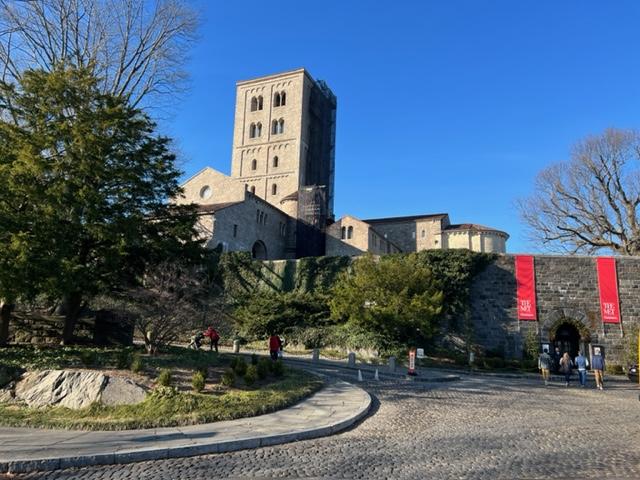
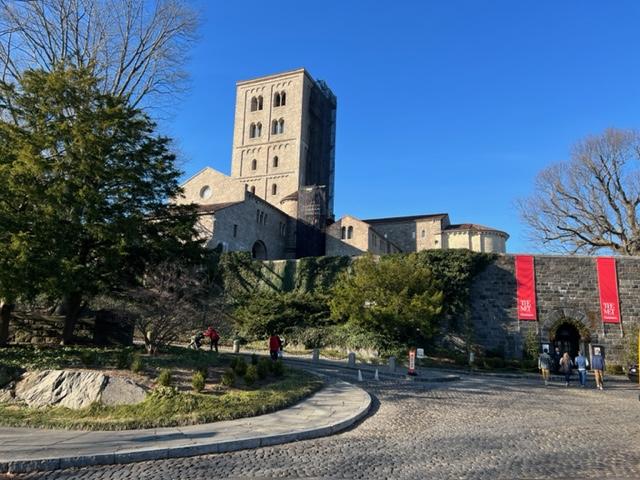
The Cloisters in Fort Tyron Park
Don’t miss the walking tours and gallery talks at the museum. I have recently been to a series of walking gallery talks dealing with the history of Medieval arts. There were discussions on Medieval art between Christian and Muslim religions, Traveling the Silk Road and its influences on art in the regions and the collection and how it has improved and grown over the years. It seems there has been a uptick in this type of art.
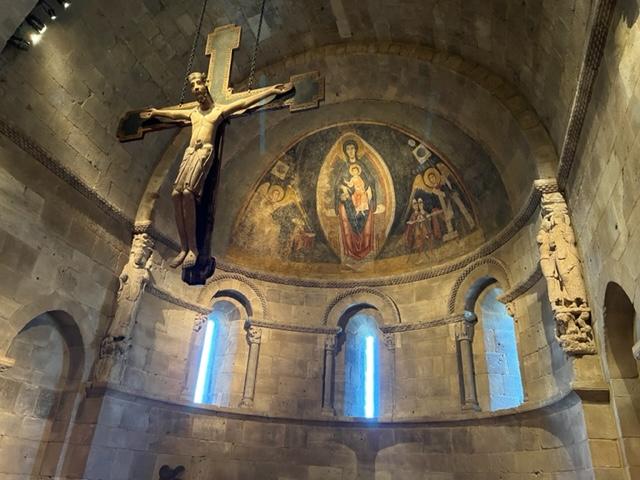
This section of the shine is on a permanent loan from Spain
The building is just beautiful as it was created from pieces of religious sites all over Europe. Many of the doorways, cloisters (archways), stone work and fountains and windows come from churches that had been destroyed by wars over the past 600 years. Bits and pieces of all of the these buildings are displayed in the architecture of the museum itself. Some are on permanent loan to the museum from foreign countries.
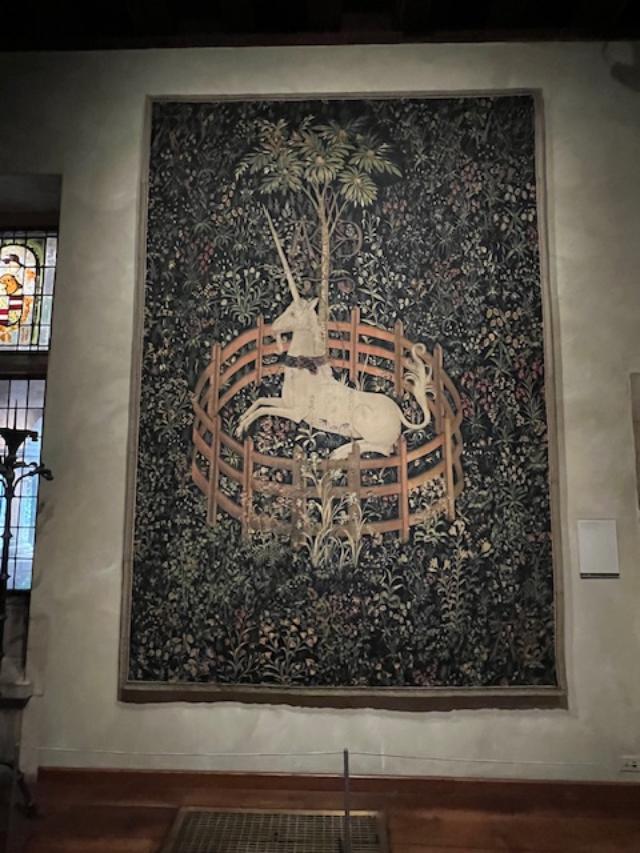
Don’t miss the famous “Hunt of the Unicorn” tapestries that are on display here. They are quite a spectacular exhibit.
The ‘Hunt of the Unicorn’ tapestries
Be sure to visit the outside terraces of the Cloisters to see the views of the Hudson River below and the beautiful gardens of Fort Tyron Park where the building is located. It is a sea of green lawns and woods and beautifully landscaped flowering paths.
The Cloisters Gardens in the winter of 2022
The Cloisters Gardens in the Spring of 2024
The view from the gardens of the Hudson River
The view of the Hudson River in Spring 2024:
There is a nice café on property but there is also a small restaurant row on Dyckman Avenue at the foot of the park right near the subway stop. There are also many terrific Spanish restaurants on Dyckman Street as you walk down the block towards Fort George Hill.
‘Christmastide’ at The Cloisters:
I recently went to the Cloisters for a very interesting walking tour called “Holly & Hawthorne: Decorating for a Medieval Christmas” in 2019 and a similar tour in 2022 entitled “Holiday Decorations at The Cloisters” the use of plants like holly, mistletoe, pine and ivy were used in the winter months to decorate the churches and homes of the people until the Puritan influences took over.
Sampling of the plants used at the holidays in Medieval times.
(Part of the description of the tour in the guidebook-credit to the Met Cloisters):
“The wreaths and garlands that deck The Cloisters from early December until early January are made from plant stuffs associated with the Medieval celebration of Christmastide. This great feast embraced the twelve days between the Nativity and the Epiphany, which commemorated the visit of the Three Kings to the infant Jesus.
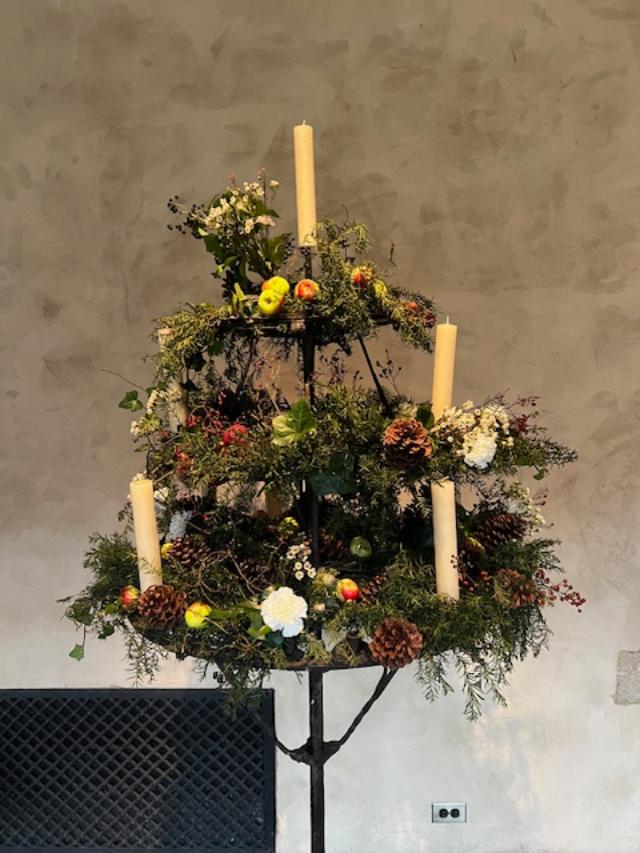
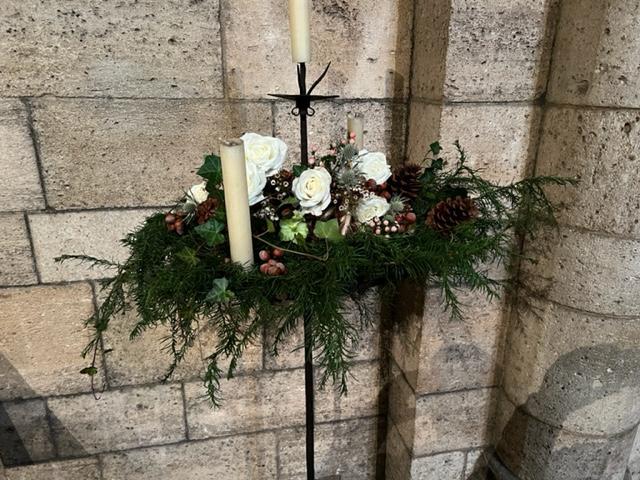
The Candelabras of the Cloisters.
Because pictorial representation of medieval Christmas decorations are rare, the Museum’s designs are based on evidence gleaned from carols, wassails, romances and artworks. Medieval churches and halls were decked for the season, a practice with roots in ancient custom. The early Church had banned the use of evergreens because of their ties with pagan winter festivals, such as the Roman Saturnalia. By the Middle Ages, these plants had been given Christian interpretations and were used to celebrate the feast days of the Church calendar. Bay Laurel, associated in ancient times with victory, became a symbol of the triumph of Christ and of eternal life.
By the Middle Ages, holly and ivy had been thoroughly Christianized, although mistletoe remained suspect. Ivy was identified with the Virgin and the red berries of the holly with the blood of Christ. The holly and ivy carols still sung today spell out these meanings older associations derived from pre-Christian winter festivals.
Apples and nuts, stored for winter consumption, were a conspicuous part of the Christmas feast, as they are today. It was also the custom in winter to wassail fruit and nut trees, to encourage them to bear plentiful crops in the coming year. Fruits and nuts were ancient symbols of fertility Christian meanings; in a medieval poem on the Nativity.
The Cloisters decorated for Medieval Christmas
The tour guide discussed by touring the paintings and tapestries where these symbolic plants took shape during this time. She even explained how ivy when it reaches sunlight that its shape goes from a three leaf shape to a heart shape which was symbolic during the Middle Ages. The gardens were a good source of inspiration for the holidays.
The stonework was decorated with garland and holly and flowering plants
The Cloisters decorated for Christmas
Don’t miss walking the halls and cloisters to look at all the decorations for the holidays. The museum keeps them simple and elegant but it really does put you in the holiday spirit. The use of flowering plants during the holiday season was not just related to the holiday season but they gave a nice smell to this musty churches and added a bit of cheer to the environment as well.
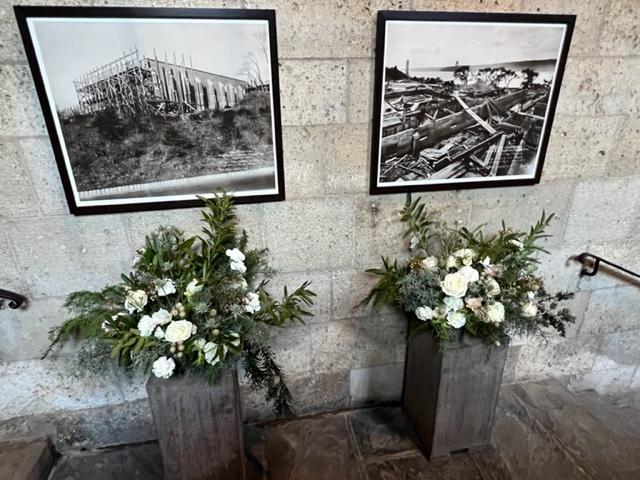
The flowers and pine when you enter The Cloisters
The “Holiday Decorations at The Cloisters” walking tour: December 2022:
The altar at The Cloisters
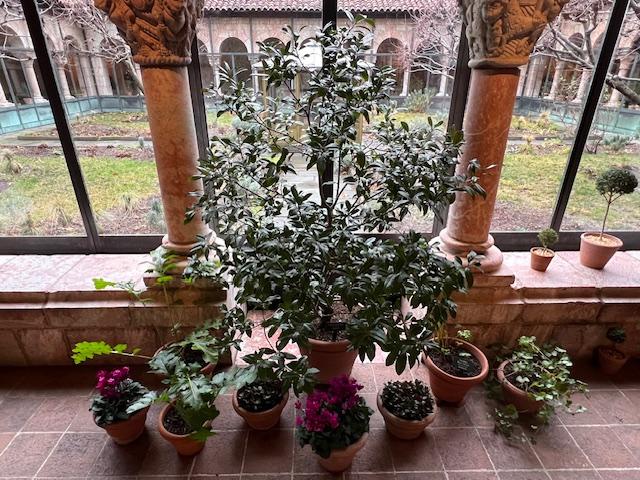
The Medieval plants for decorating the church including Bay Laurel, Myrtle, Rosemary and Cyclamen.
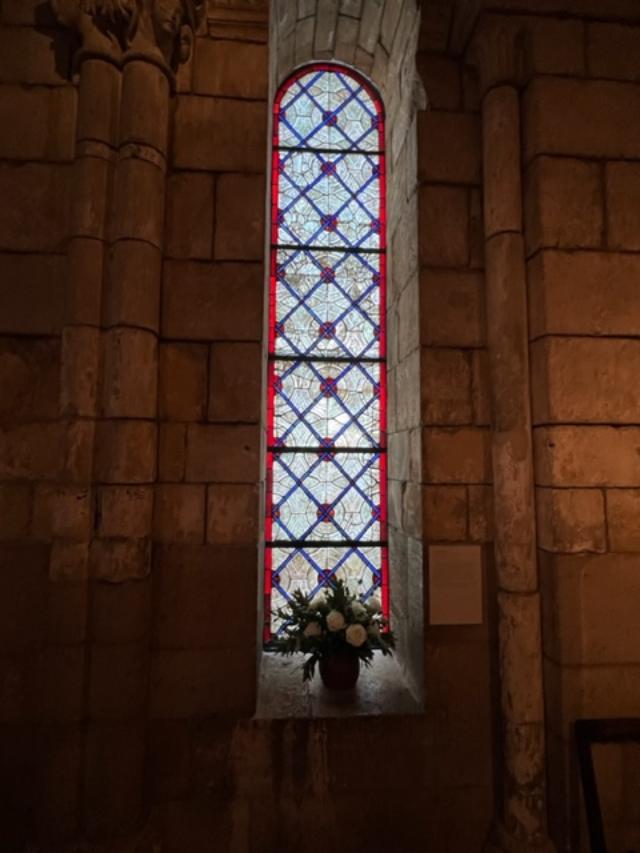
The flowers decorating the windows. Roses and pine.
Decorated altar candles
Decorated Altar Candles
Decorated Altar Candles
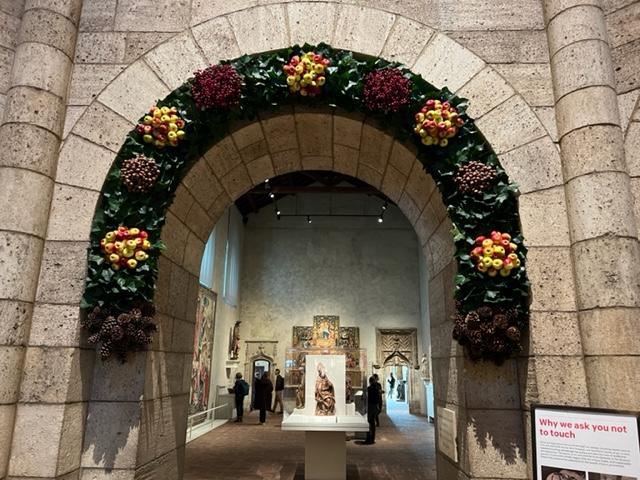
The Fruits and Ivy that decorate the archways at The Cloisters is changed regularly. Each of the ivy vines was encased in small water tubes that had to be changed each week.
The Christmas wreaths were decorated with fruits, ivy and pinecones
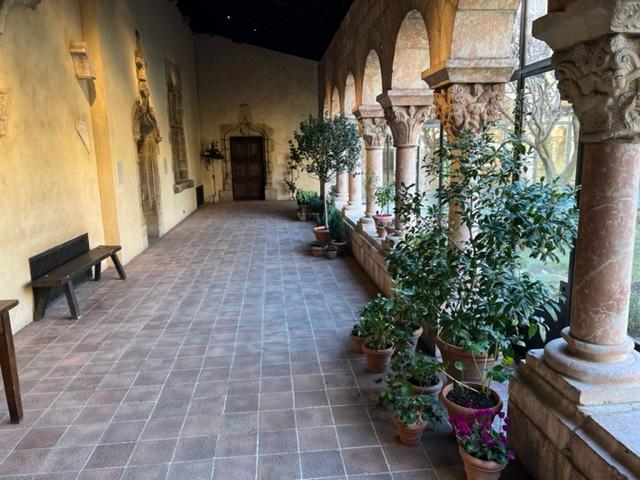
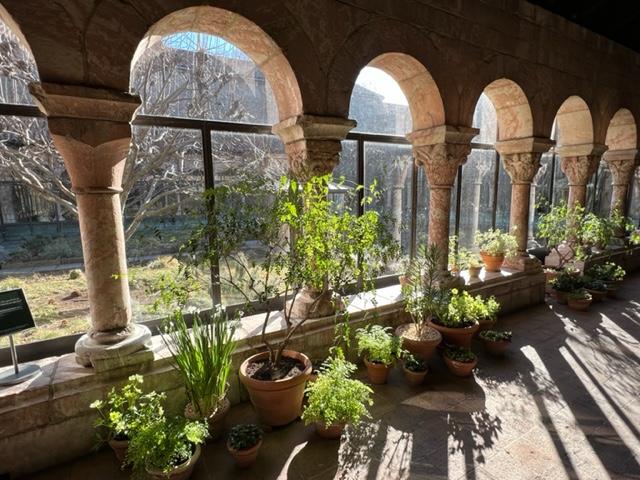
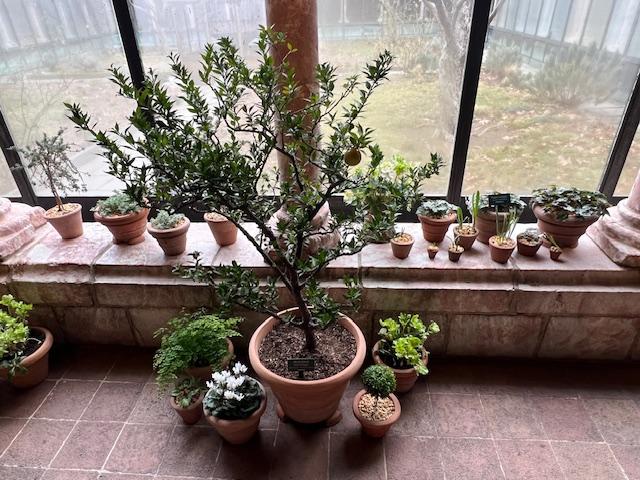
Along the walls and floors of The Cloisters were potted plants that would have been used to decorate churches during this time period. The flowering plants gave The Cloister such a nice smell and would have lighted up the inside rooms from the gloom of winter.
The hallways were lined with winter greens
The winter greens that lined the hallways of The Cloisters
The decorative winter greens lining the walls of The Cloisters
The orange tree was a symbol of gold and prosperity.
The Medieval door decorated for the holidays.
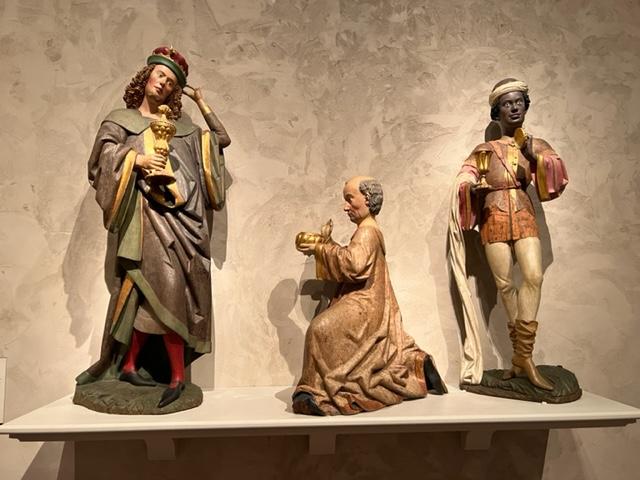
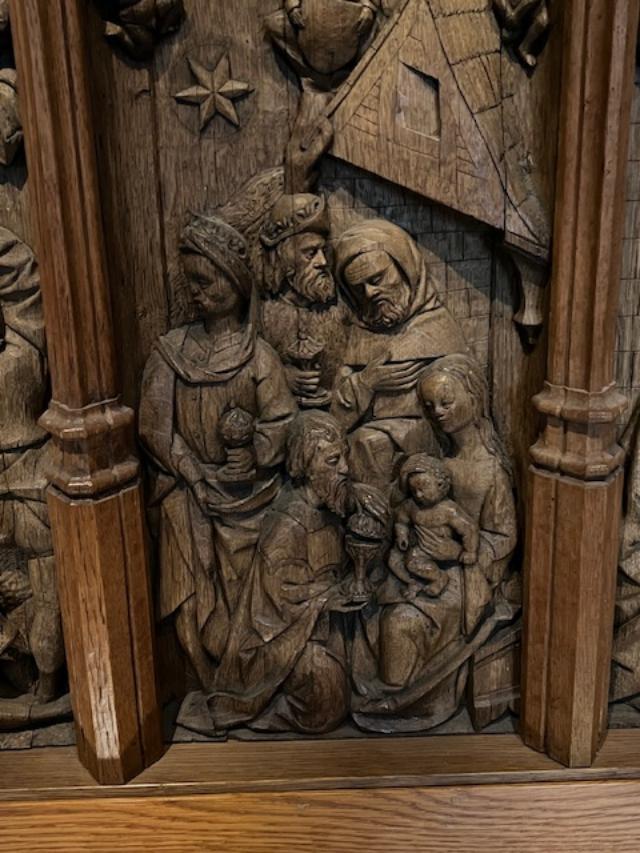
The tour guide also pointed out for the story of Christmas depictions of the three wise men in art all over the building and its importance in the holiday season. The story continued to develop on the three ‘kings’ who visited the holy child.
She explained that over the years it went from three ‘visitors’ wisemen’ that was loosely translated in older text to the modern development of ‘three kings’ from the continents of Asia, Africa and Europe. In 2024, I took a holiday tour on “Three Kings Day”, the celebrated the three kings and their visitation of the holy child.
The three Wise Men and the Virgin Mary
The three Wise Men and the Virgin Mary and Child as depicted in the painting
The three Wise Men in a more modern depiction. It seemed that the story morphed over time from three Kings, one being older, one younger and one with a darker complexion became a King from each continent to represent the diversity in the church and the spread of Catholicism.
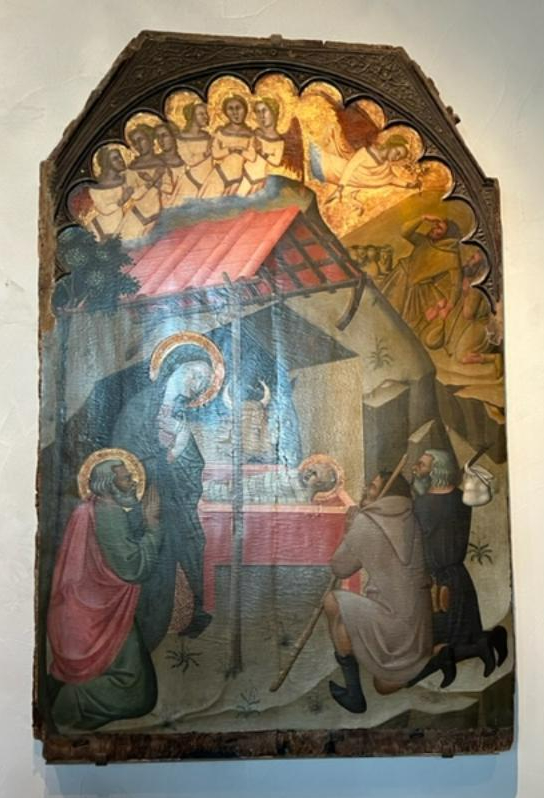
The “Adoration of the Shepherds”
The Virgin Mary with the Christ child and the three wise men in the “Adoration of the Shepard’s”.
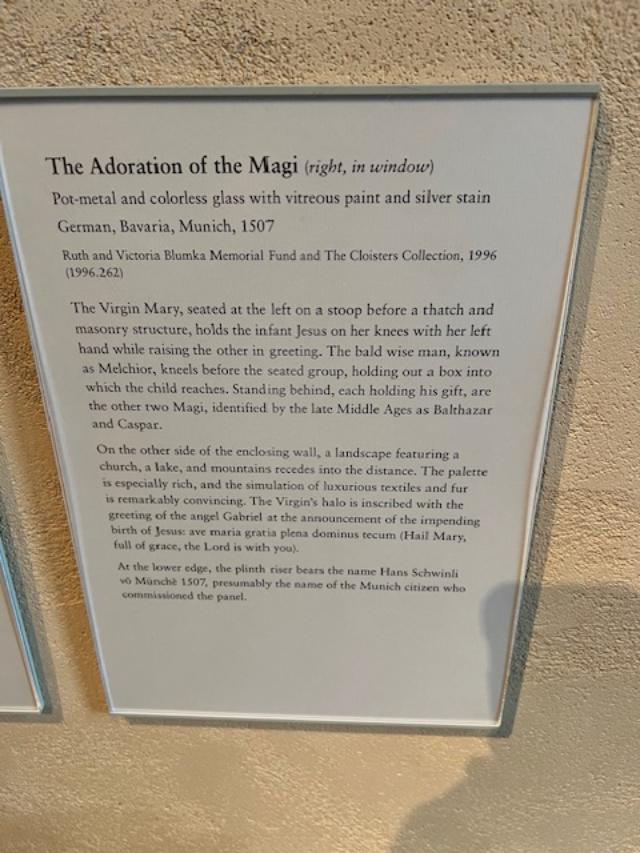
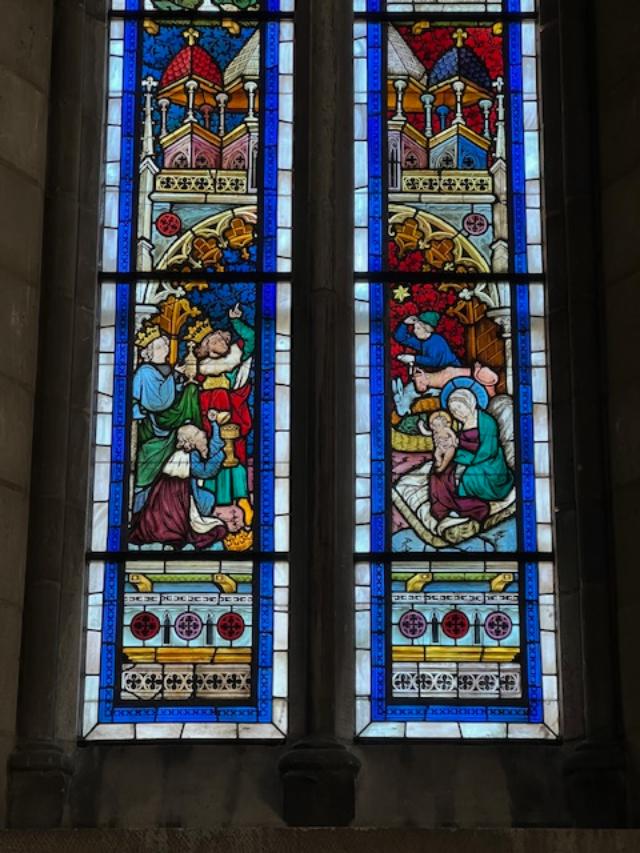
The “Adoration of the Magi”
The stained glass window of the “Adoration of the Magi”.
The “Thirty-Five Panels” of the Three Wiseman”
The Three Wisemen from the “Thirty-Two Panels”
The stained glass window of the “Three Scenes of the Infancy of Christ”
The “Three Scenes of the Infancy of Christ”
The “Christ is born as Man’s Redeemer” Tapestry.
The small section of the tapestry with the Three Wisemen.
Walking through the Cloisters during the holiday season.
The tour guide went onto explain that in more elaborate feasts, the utensils and items used during ceremonies would have been of the most elaborate that the church could show.
Elaborate vessels. plates, challices and specters used in ceremonies
Elaborate drinking glasses
I toured the Cloisters again in 2023 and saw the same symbols of Christmastime in the halls with elaborate floral displays and beautiful potted floral arrangements all over the building.
The hallways of the Cloisters decked with flowering plants.
The “Winter Roses” with other flowering plants.
More flowering plants lining the walkways.
Flowering displays
The winter plants of the Cloisters.
The Candelabra’s were quite elaborate.
I thought this Dragon painting was very interesting.
The Dragon Sign.
The Dragon Painting.
Spain 1000-1200: Art at the Frontiers of Faith” tour in 2021:
I visited again this Christmas holiday season in 2021 to see “Spain 1000-1200: Art at the Frontiers of Faith”, where the Catholic and Muslim Kingdoms of Spain influenced each other in the manner of decoration and art borrowing from each other. It was interesting to see how the two communities used each other’s art over time to develop an interesting hybrid of design that was both colorful and intricate.
“Spain 1000-1200: Art at the Frontiers of Faith” artworks
Another tour of the Cloisters that I attended was on the ‘Four Medieval Flowers: The Lily, Iris, Violet and Rose’. It was interesting how society of this era used the former Pagan and Roman/Greek symbols in their Christian religious art.
You see the Rose in the stained glass to represent strength and honor
You will see the meanings in the tapestries, stained glass art and in the sculpture to represent purity, rebirth and sexual symbols of the time. It seemed that the artisans of the time used ancient meanings to convey something that they could not out and out talk about.
In the “Hunt of the Unicorn” Tapestries you can see flowers such as Lilly, Violet and Iris woven into the work which may have meant it was a wedding present to the new owner. The tour guide said there was meaning in lots of the works which may have had a different purpose originally. It was a tour steeped in symbolism.
The Spring and Summer Time visits to The Cloisters and the Gardens:
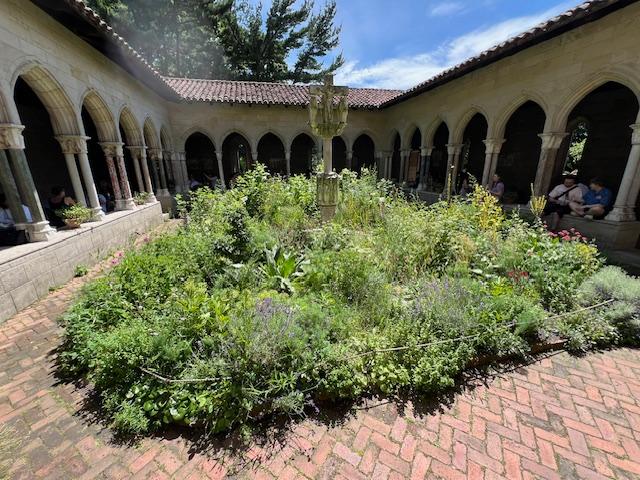
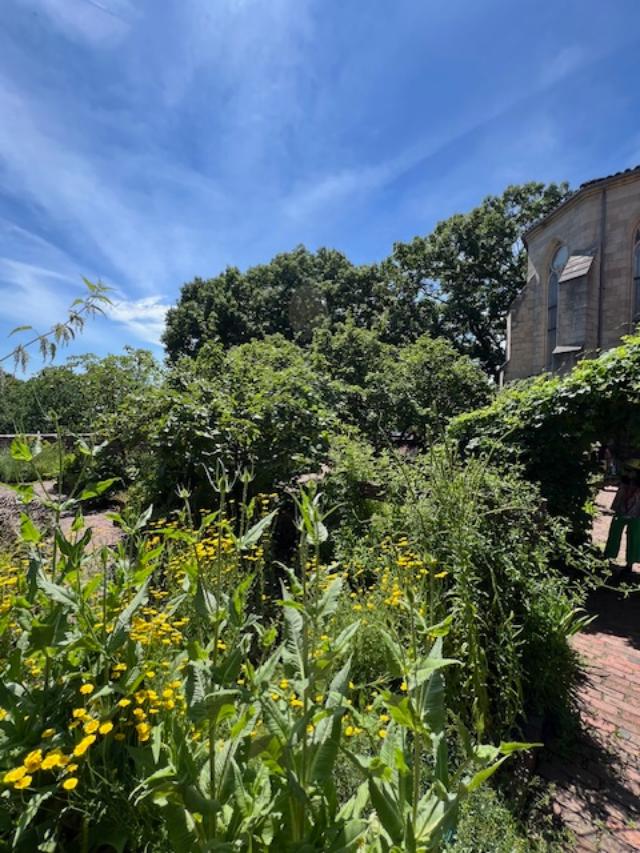
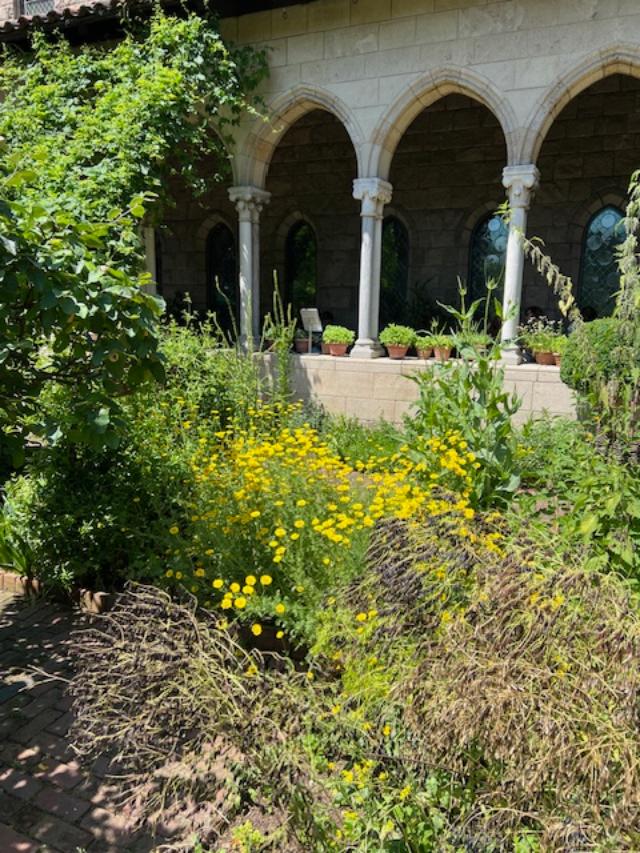
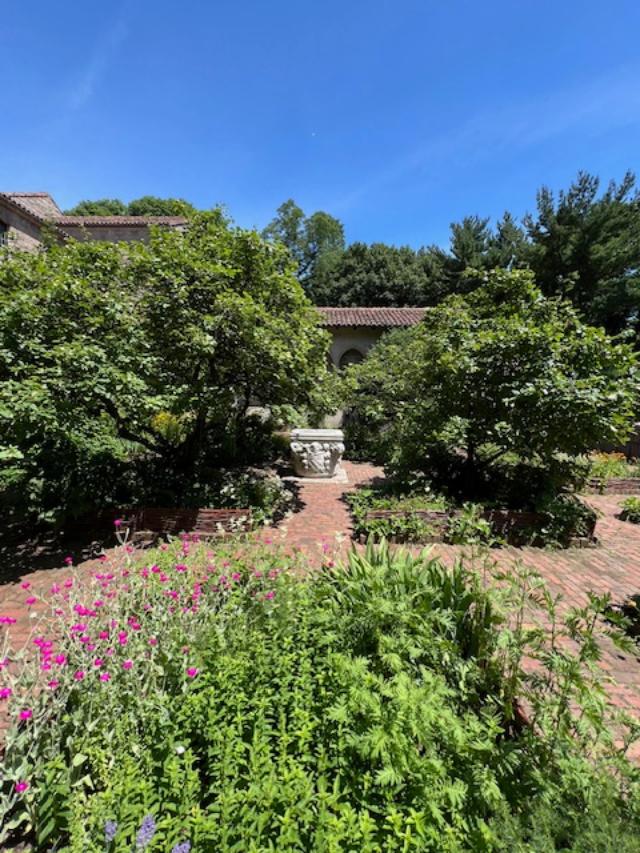
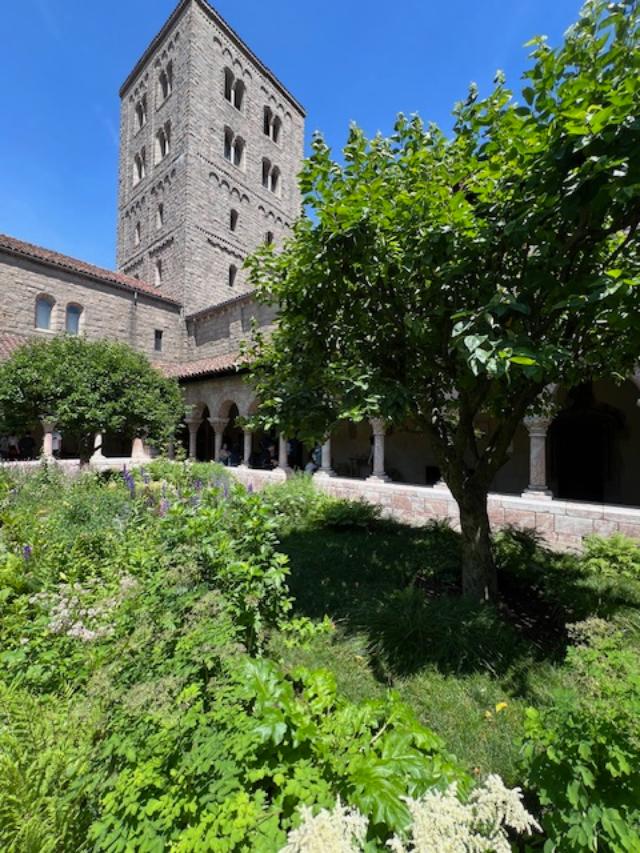
The Cloisters in the Spring and Summer months is very different. The Gardens are in full bloom, the views of the Hudson River are still amazing and the flowers look and smell so beautiful. There are three sets of gardens in the Cloisters, the potted plants on the deck facing the Hudson River and the two Cloisters on the first level and the one in the Trie Cloister where the cafe is located. Each has their unique plantings.
The potted plants on the deck of The Cloisters in the Spring of 2024
As pretty as some of these plants are some are poisonous so you have to watch out.
The view from the back decks of the museum of the Hudson River
The view of the Hudson River
The gardens in The Cloisters
On Sunday, August 10th, I took an extensive garden tour of the separate Cloisters in each parts of the museum. The tour talked about the use of the Cloisters gardens of the past and they were used for herbs, remedies and for the simple pleasure of beauty, color and relaxation.
The religious symbols in the gardens
The gardens have been planted with historical accuracy but as the tour guide explained, to keep the gardens in bloom from the early Spring to the late Fall, you have to add different plants for color.
The beauty of the gardens in bloom
The beauty of the gardens in the Spring of 2024
The gardens were very popular over the weekend
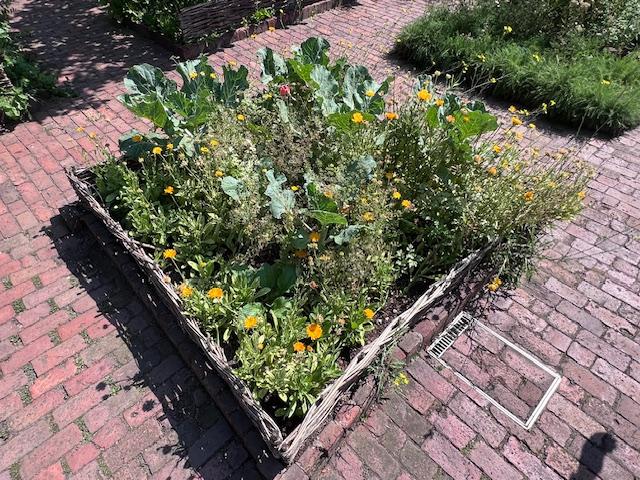
Some of the Cloisters gardens produce fruits, vegetables and herbs that the staff can take home. These gardens show not just how beautiful they look but how people used them for every day purposes.
The gardens were popular that day
The beauty of the gardens
The gardens in the Spring of 2024
These walking tours at the Cloisters happen at 12:00pm and 2:00pm on the weekends when in season.
The beauty of the Cloisters
The herb gardens in the summer in 2025
The Cloisters Mission:
Welcome to The Cloisters, the branch of The Metropolitan Museum of Art devoted to the art and architecture of medieval Europe. Set on a hilltop with commanding views of the Hudson River. The Cloisters is designed in a style evocative of medieval architecture specifically for the display of masterpiece created during that era. Arranged roughly chronologically and featuring works primarily from Western Europe, the collection includes sculpture, stained glass, tapestries, painting, manuscript illumination and metalwork. The extensive gardens feature medieval plantings, enhancing the evocative environment.
The Gardens at the Cloisters in bloom
History of the Museum
John D. Rockefeller Jr. generously provided for the building, the setting in Fort Tryon Park and the acquisition of the notable George Grey Barnard Collection, the nucleus of The Cloisters collection. Barnard Collection, the nucleus of The Cloisters collection. Barnard, an American sculptor whose work can be seen in the American Wing of the Metropolitan, traveled extensively in France, where he purchased medieval sculpture and architectural elements often from descendants of citizens who had appropriated objects abandoned during the French Revolution. The architect Charles Collens incorporated these medieval elements into the fabric of The Cloisters, which opened to the public in 1938.
Romanesque Hall
Imposing stone portals from French churches of the twelfth and thirteenth centuries open onto a gallery that features rare Spanish frescoes and French sculpture.
Fuentiduena Chapel
The twelfth-century apse from the church of San Martin at Fuentiduena, Spain and the great contemporary fresco of Christ in Majesty from a church in the Pyrenees Mountains dominate the space. Sculpture from Italy and Spain enriches the chapel, which is the setting for a celebrated concert series.
Saint-Guilhem Cloister
The fine carving of this cloister from the monastery of Saint-Guilhem-le-Desert, near Montpellier, harmoniously and playfully adapts the forms of Roman sculpture in a medieval context. The plants depicted in the sculpture, acanthus and palm, are growing in pots near the small fountain. The gallery also features early sculpture from Italy, Islamic Spain and elsewhere in France.
Langon Chapel
Architectural elements from the twelfth-century church of Notre-Dame-du-Bourg at Langon near Bordeaux form the setting for the display of thirteenth-century French stained glass and important Burgundian sculpture in wood and stone.
Pontaut Chapter House
Monks from the Cistercian abbey at Pontaut in Aquitaine once gathered for daily meetings in this twelfth-century enclosure known as a chapter house. At the time of its purchase in the 1930’s by a Parisian dealer, the column supports were being used to tether farm animals.
The distinctive pink stone of this cloister, featuring capitals carved with wild and fanciful creatures, was quarried in the twelfth century near Canigou in the Pyrenees Mountains for the nearby Benedictine monastery of Saint-Michel-de-Cuxa. The typical cloister garden features crossed paths and a central fountain from the neighboring monastery of Saint-Genis-des-Fountaines. Both medieval and modern species of plants are grown in the garden. In winter, the arcades are enclosed and fragrant potted plants fill the walkways.
Early Gothic Hall
With thirteenth-century windows overlooking the Hudson River, the gallery features stained glass from France’s great churches, including Saint-Germain-des-Pres in Paris. Sculptures and paintings from France, Italy and Spain evoke the great age of cathedrals.
Nine Heroes Tapestries Room
From an original series of nine hangings created about 1400 for a member of the Valois court, the tapestries portray fabled heroes of ancient, Hebrew and Christian history, including the legendary King Arthur. It is among the earliest sets of surviving medieval tapestries.
Unicorn Tapestries Room
With brilliant colors, beautiful landscapes and precise depictions of flora and fauna, these renowned tapestries depicting the hunt and capture of the mythical unicorn are among the most studied and beloved objects at The Cloisters. Probably designed in Paris and woven in Brussels about 1500 for an unknown patron, these hangings blend the secular and sacred worlds of the Middle Ages.
Boppard Room
Stained glass from the fifteenth-century Camelite convent at Boppard-am-Rhein dominates one end of the room. Fifteenth-century panel paintings and sculpture from the Rhineland and northern Spain, a brass lectern, domestic furniture, Spanish lusterware, tapestries, metalwork and sculpture further evoke a sacred space.
Merode Room
One of the most celebrated early Netherlandish paintings in the world, the Merode Altarpiece, painted in Tournai about 1425-30, forms the centerpiece of this gallery. The altarpiece, intended for the private prayers of its owners, represents the Annunciation to the Virgin Mary taking place in a fifteenth-century household. Details of the scene are echoed in the late medieval furnishings of the room in which other works made for private devotion are also exhibited.
Late Gothic Hall
Large fifteenth-century limestone windows from the refectory of the former Dominican monastery in Sens, France, illuminate the hall, which showcases sculpture and altarpieces from Germany, Italy and Spain as well as a great tapestry from Burgos Cathedral.
Gothic Chapel
Beneath richly colored stained-glass windows from fourteenth-century Austria carved images from royal and noble tombs of France and Spain fill the chapel-like setting.
Glass Gallery
Silver-stained glass roundels decorate the windows of the Glass Gallery, complementing small works of art, many made for secular use, with their lively, sometimes worldly subjects. Carved woodwork from a house in Abbeville, in northern France, forms a backdrop for paintings and sculpture.
“Bonnefont” Cloister and Garden
Long thought to be part of the abbey at Bonnefont-en-Comminges, the elements of this cloister come instead from other monasteries in the region including a destroyed monastery in Tarbes. The herb garden contains more than 250 species cultivated in the Middle Ages. Its raised beds, wattle fences and central wellhead are characteristic of a medieval monastic garden.
Trie Cloister and Garden
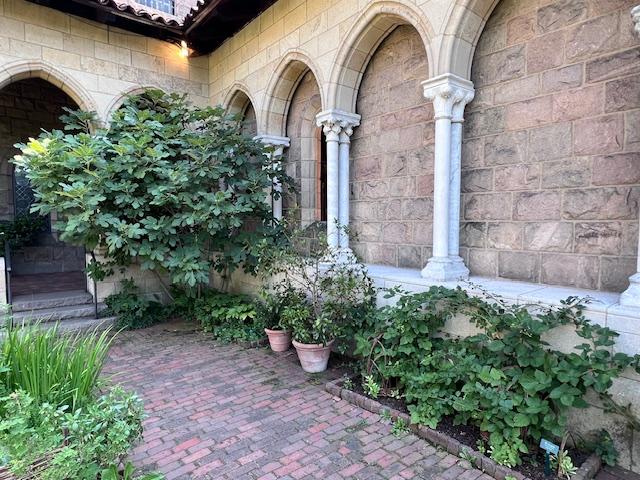
The gardens at the Trie Cloister
The stone cloister elements were created primarily for the Carmelite convert at Trie-sur-Baise in the Pyrenees. The garden is planted with medieval species to evoke the millefleurs background of medieval tapestries, such as the Unicorn series.
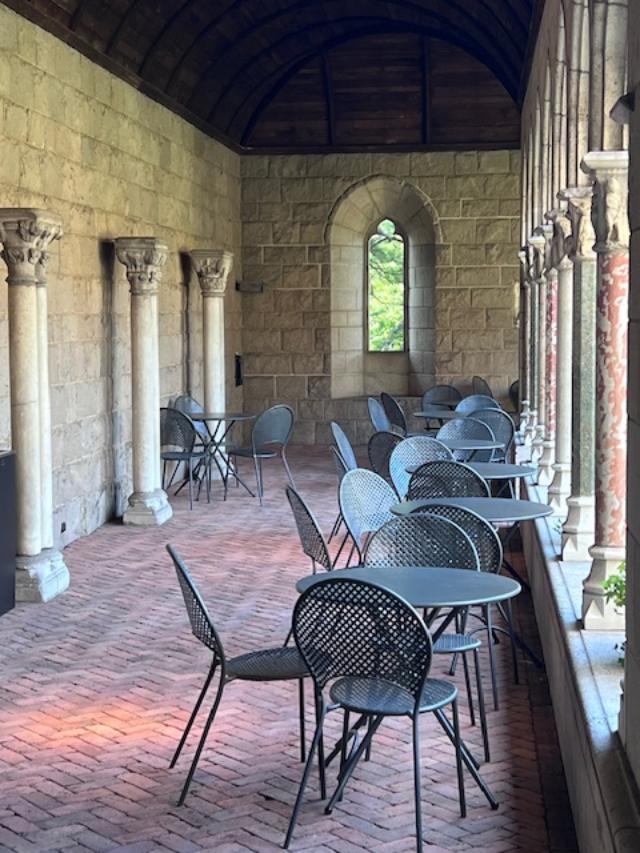
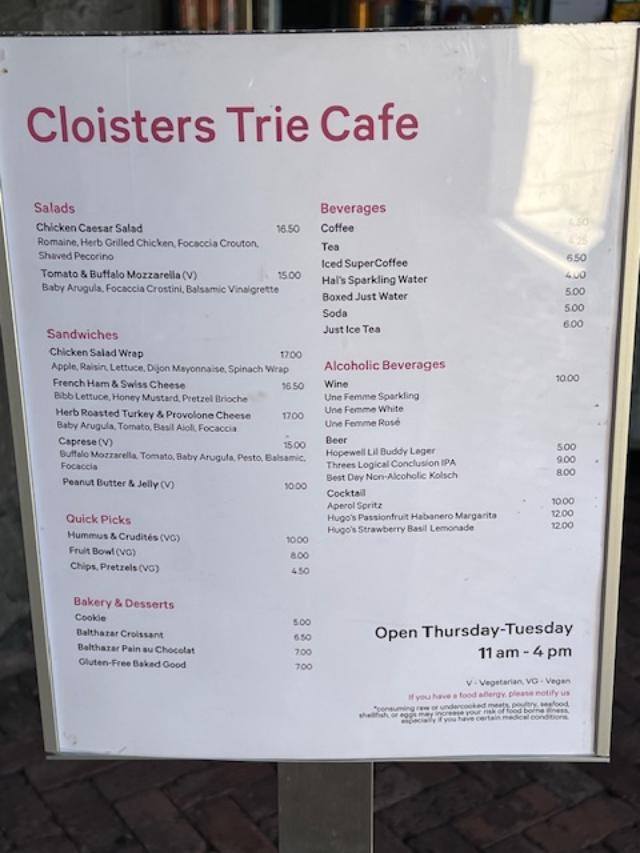
The Cloisters Trie Cafe is a seasonable restaurant that overlooks the Cloisters Gardens. This offers sandwiches , pastries and beverages and is a bit over-priced.
*Please note that the prices in the restaurant do go up every year so please look to the website for updated prices.
The Treasury
An array of precious objects in gold, silver, ivory and silk reflects the wealth of medieval churches. Illuminated manuscripts testify to the piety and taste of royal patrons such as Jeanne d’Evreux, Queen of France; jewelry and a complete set of fifteenth-century playing cards suggest more worldly pastimes.
The Gift Shop:
Even the gift shop was decked in the holiday spirit
The gift shop has all sorts of themed items from the Medieval era.
The gift shop at The Cloisters
*Disclaimer: This information is taken right from the Cloisters pamphlet from the Metropolitan Museum of Art. Please call the museum before visiting to see if anything has changed with the hours or days open. It is well worth the trip uptown to visit The Cloisters. Take the A subway up to 190th Street and take the elevator up to Fort Tryon Park and walk across the park.
This quirky little museum is located in the ‘A’ Building on the Fashion Institute of Technology campus and is a little ‘gem’ if there was ever one and I am not just saying that because I am a proud Alumnus of the college (Class of ’93). This museum is dedicated to the world of fashion and has had several revolving shows themed of fashion from the colleges extensive collection. The school really does know how to mount a show.
Please watch this video on the Museum at FIT.
About the Museum at FIT:
The Museum at FIT (MFIT) is the only museum in New York City dedicated solely to the art of fashion. Best known for its innovative and award-winning exhibitions, the museum has a permanent collection of more than 50,000 garments and accessories dating from the eighteenth century to the present, MFIT is a member of the American Alliance of Museums. Its mission is to educate and inspire diverse audiences with innovative exhibitions and programs that advance knowledge of fashion.
For more information about The Museum at FIT, please visit fitnyc.edu/museum.
The museum is part of the Fashion Institute of Technology (FIT), a college of art and design, business and technology. FIT is part of the State University of New York (SUNY) and offers nearly 50 programs leading to AAS, BFA, BS, MA, MFA, and MPS degrees.
I have been to many shows at the museum over the years and the curators do a nice job mounting show from the College’s collection and from items that they borrow from other museums.
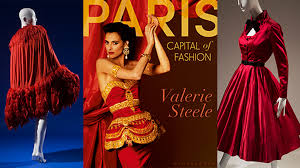
“Paris Refashioned, 1957-1968” examined the combined influence haute couture, ready-to-wear and popular culture, highlighting how changes that took place during this time period helped to shape the fashion industry as we know it today. Exhibitions and books about this era tend to focus on London as the center of innovative, youth-oriented design but this perspective overlooks the significant role that Paris continued to play in the fashion industry.
Like England, France had a large population of young people-more than eleven million of its citizens in 1958 were under 15 years old. This generation came of age during the 1960’s, listening to their own music, watching films featuring their own movie stars and frequenting their own boutiques. Paris’s creative output was singularly dynamic, far-reaching and innovative.
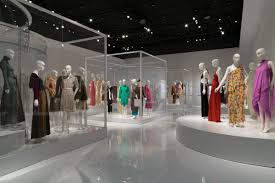
“Paris Refashioned” exhibition
Although the French ready-to-wear revolution did not truly begin until the 1960’s, the concept of lively, youth-oriented design had been set in motion during the previous decade. By the late 1950’s, a few young, talented couturiers-including Pierre Cardin, Hubert de Givenchy and Yves Saint Laurent-had made names for themselves. In 1957, the House of Christian Dior promoted 21 year old Saint Laurent to creative director.
While fashion insiders questioned the decision to place an unknown, seemingly naïve designer at the helm of such a prestigious institution, Saint Laurent’s first solo collection for Dior quickly silenced his detractors. His line of short, swinging A-line dresses-known as “Trapeze” dresses-was a critical and commercial success, ushering in an unmistakable shift toward more relaxed and ultimately, more youthful designers.
Another exhibition that I had seen in the past was “Pink: The History of Punk, Pretty and Powerful Color” running until January 5, 2019 and “Fashion Unraveled”, a guideline to ‘Behind the Seams’, ‘Repurposed Clothes’ and ‘Distressed and Deconstructed’ that ran through November 17, 2018.
The History of Pink video
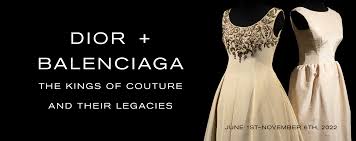
I recently visited the museum for the “Dior + Balenciaga: The Kings of Couture and their Legacies” exhibition and it was an interesting approach to fashion after WWII. Both designers brought back a very feminine and wearable look to women that accented their bodies. What I thought was interesting is that the undergarment was stitched right into the garment and was a way to fit the garment to the woman.
“Dior + Balenciaga: The kings of Couture and their Legacies”
The exhibit showed a comparison of both designers and how they approached items such as dresses, coats and evening wear. Each had a way to form fit a woman. What I thought was interesting is that Dior just designed his garments and never worked on the construction whereas Balenciaga do all the draping of garments himself.
The exhibition continued with the new designers that took up the mantles of the houses when the founders died. It was a different take on the founders ideas but with a more modern twist. I think the classics still were the best and looked more professional on a woman.
Video on “Dior + Balenciaga” exhibition
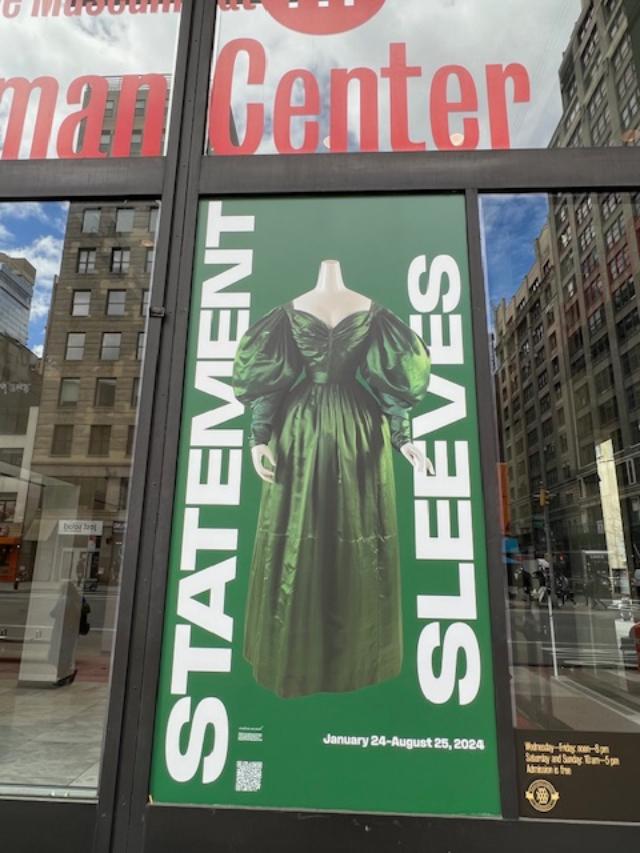
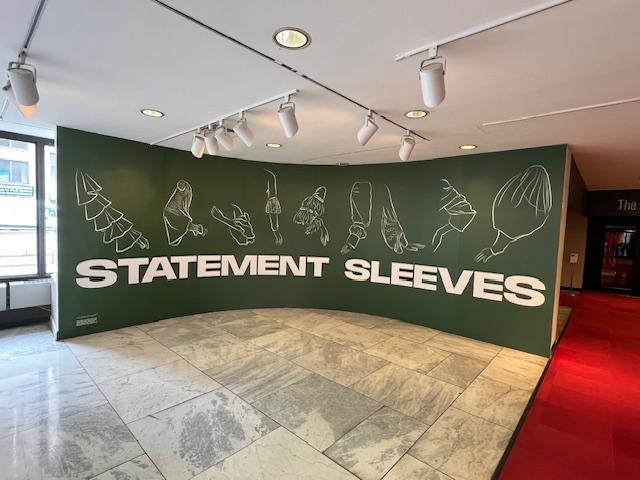
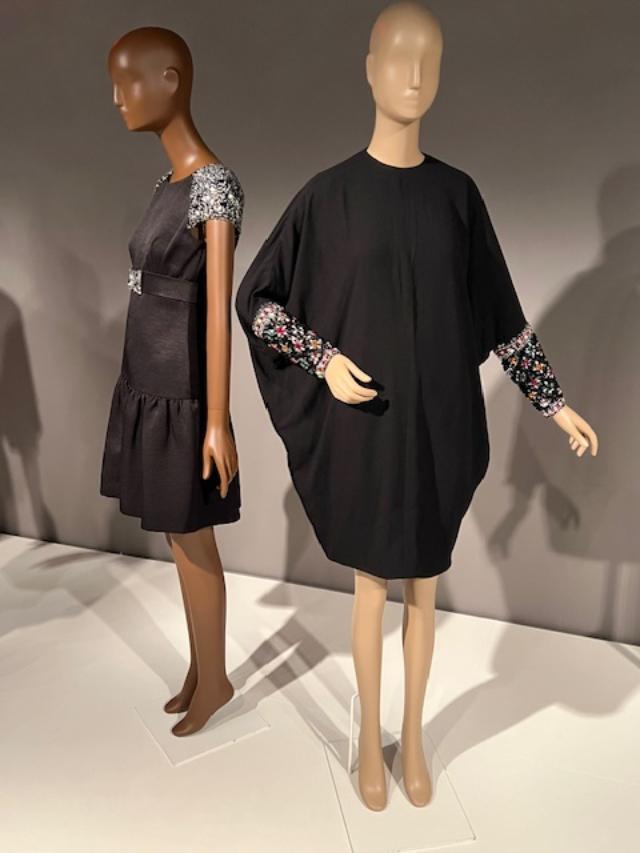
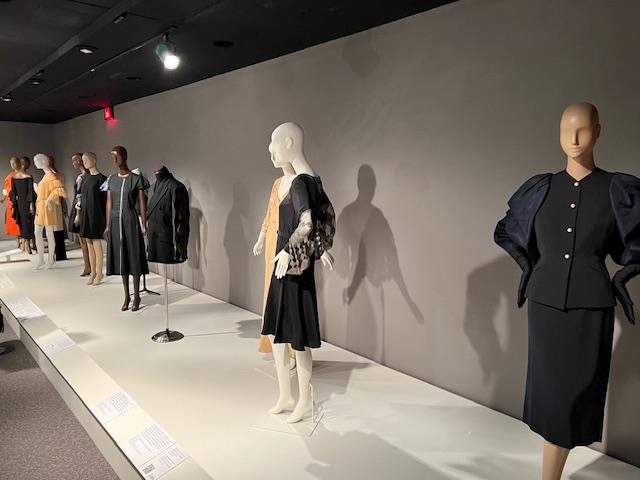
The recent exhibition “Statement Sleeves” is a retrospect on the evolution on the pattern of sleeves in a woman’s dress. These statements of fashion on the sleeve is “a sleeve, style that is exaggerated, embellished, elaborately constructed or otherwise eye-catching to the extent that it defines a garment.” (show description).
“Statement Sleeves” sign
The start of the exhibition.
The front of the gallery.
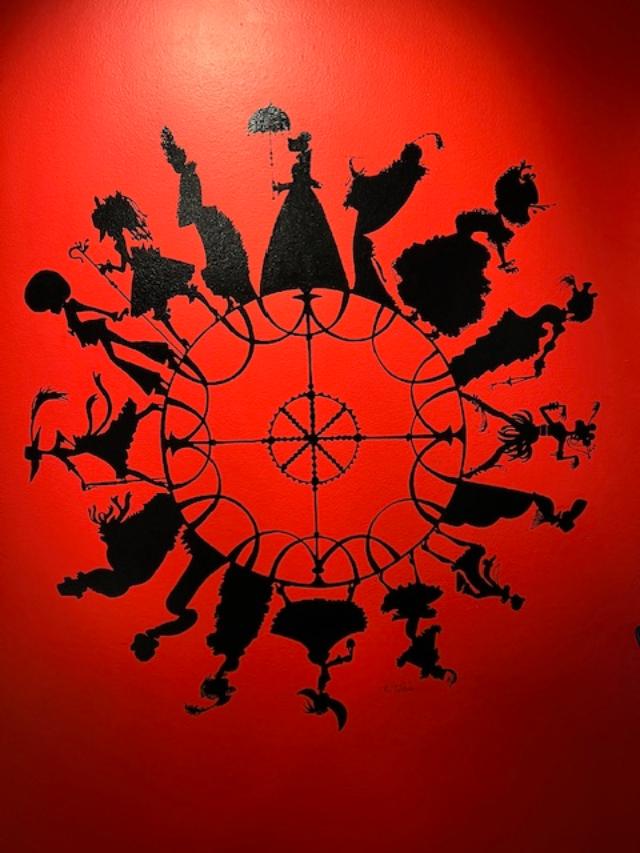
The diagram on the evolution of sleeves.
The changes in Sleeves design.
The changes in Sleeves design.
The different ways at looking at formal design.
The unique designs from the 1980’s and 1960’s.
The changes of Sleeve designs over the years.
The “Power Suit” of the 1980’s.
The colorful trends in women’s wear over the years with the changes in design of the sleeves.
The exhibition of “Statement Sleeves” runs through August of 2024.
Information and History of the Museum at FIT:
(From the Museum’s website):
For further information about the Fashion Institute of Technology, please visit fitnyc.edu.
Couture Council:
An elite membership group, the Couture Council helps to support the exhibitions and programs of The Museum at FIT. Members receive invitation to exclusive events and private viewings. Annual membership is $1,000 for an individual or couple and $350 for a young associate( under the age of 35).
For more information, write to couturecouncil@fitnyc.edu or call (212) 217-4532.
Tours and donations
Every six months, a changing selection of garments, accessories and textiles from the museum’s permanent collection is put on display in the Fashion and Textile History Gallery, on the museum’s ground floor. Tours of the Fashion and Textile History Gallery and of the Special Exhibition Gallery may be arranged for a sliding fee of approximately $350. Donations of museum quality fashions, accessories and textiles are welcome.
For more information about tours, call (212) 217-4550. For information about donations, call (212) 217-4570.
All MFIT exhibitions and public programs are supported bin part by the couture council of The Museum at FIT.
The shows are continuously changing so please check the website for more detail on the current show. Below is a sampling of one of the shows earlier last year when I visited the museum.




























































 Visiting a Museum: The Unique, Unusual, Obscure and Historical