Tag: books

Van Houten Family Cemetery                                                            108 Delaware Lane                                                                          Franklin Lakes, NJ 07417

Van Houten Family Cemetery 108 Delaware Lane Franklin Lakes, NJ 07417

Van Houten Family Cemetery

108 Delaware Lane

Franklin Lakes, NJ 07417

https://www.findagrave.com/cemetery/1598327/van-houten-family-cemetery

https://www.myheritage.com/names/john_vanhouten

https://www.wikitree.com/genealogy/VANHOUTEN

My review on TripAdvisor:

The Van Houton Family Cemetery at 108 Delaware Lane on what was once the family farm

The historic Marker from 1822

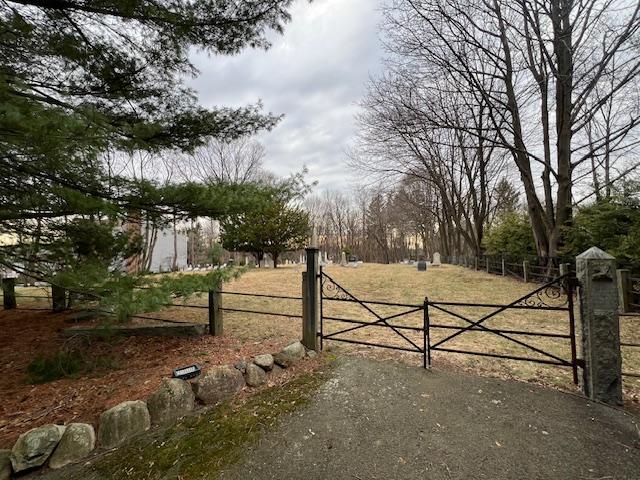
The family plot from the entrance of the cemetery

About five generations of Van Houton’s have been buried in this spot, with an impressive list of family members who have served in all the nation’s wars.

From the Revolutionary War up to World War II, the family’s contribution extends not just to Bergen County but our entire country.

The family extends to other older ‘first families’ of Bergen County, such as the Snyder’s, the Demarest’s, DeBuan’s and the Van Ripper’s.

History of the Cemetery:

https://www.interment.net/data/us/nj/bergen/vanhouten/van.htm

(From the research of Richard Hrazanek)

This multi-generational cemetery is still used today by the descendents of John Van Houten, who left the property in his will. The grounds of the cemetery are well maintained. A metal fence around the property could use some minor repairs. Unfortunately a couple of the obelisk markers have fallen off their bases.

In the August 1992 Cemetery Inventory Booklet, published by the Bergen County Department of Parks, Division of Cultural and Historic Affairs, they listed Andrew Schaaf as a contact person for the cemetery, with an address of 749 High Mountain Road, Franklin Lakes, NJ 07417. The same publication mentions that an inventory of the cemetery was done by John Neafie in 1911.

The oldest tombstones in the center

The History of Franklin Lakes:

(From the Franklin Lakes Town website):

https://activerain.com/blogsview/238626/franklin-lakes-new-jersey-history

In the 17th century, Lenape Indians traveled the land we now call Franklin Lakes.  They made winter camp in the “Clove” near Buttermilk Falls and fished in Micharagrape Pond ( now Franklin Lake).

Slowly, the Dutch settlers made their way west from the Hudson River Valley.  In 1701 the East Jersey Proprietors confirmed to Michael Hawden the land around the Pond.  In 1772 Franklin Township was formed and included much of northwestern Bergen County.  Farming was the major occupation of the early inhabitants, mostly Dutch with the names of Van Winkle, Van Houten, Ackerman, Pulisfelt, Van Blarcom, etc.  They built solid farmhouses of sandstone and fieldstone.  Fourteen of these historic homes still stand in our Borough.

Some of the original family member tombstones in the cemetery

Mills sprang up along the creeks: sawmills, gristmills, tanneries and forges.  Daniel Youman’s Grist Mill on Franklin Lake was probably the first business established (it later served as a saw mill and a cider mill).

The 1876 Walker Atlas showed Franklin Lakes had about 100 residences, 5 mills, 1 tannery, 3 schools, 4 blacksmith and wagon shops, 1 church, 2 hotels, 1 store, and 2 railroad depots.

The railroad stations were built in 1869 when the New Jersey Midland Railroad was extended to Oakland.  One station stood at Campgaw on Pulis Avenue, the other at Crystal Lake on High Mountain Road.  Residents used the train for commuting, moving goods and mail.

Around the turn of the century, estate houses and mansions began to appear in the area.  The industrial revolution brought wealth, and many of the wealthy became “gentleman farmers,” sometimes living here only in the summer.  Examples of these houses include the Bartholf-Hughes house on Somerset, the Post-Terhune house on Franklin Lake Road, and the Atterbury-Brockhurst house on Ewing Avenue.

Eventually, the Campgaw section became the civic center of our Borough.  In 1922 Franklin Lakes separated from Franklin Township, incorporated, and elected William V. Pulis as its first Mayor. 

Edward May built three lakes and started the Shadow Lake Swim Club, which evolved into Shadow Lakes Estates.  On the other side of the Borough, J. Nevins McBride purchased land around Franklin Lake and began building single-family homes in Urban Farms.

When Route 208 was extended to Oakland in 1959, Franklin Lakes became more accessible, and by 1980 there were more than 8,500 residents.  The completion of Interstate 287 in the early 1990’s stimulated another boom in building.  Today, the population of our Borough is 10,422.

From a sleepy rural community to an affluent metropolitan suburb, Franklin Lakes has changed extensively, continuing to be a desirable place to live and raise families.

The Franklin Lakes Historical Society was created to help preserve our Borough’s rich history, while at the same time looking to the future of our unique community and those who choose to make this their home.

courtesy http://www.franklinlakes.org 

The family still uses the cemetery into the twenty-first century

Part of the cemetery into modern times

Multiple family members are often buried together

The cemetery in modern times

The children of Ralph Van Houten who passed within a few years of one another

The grave of Abraham Van Houton and his wife, Bridget

The front part of the cemetery shows the different branches of the family and when they were buried.

The back part of the cemetery is rather old

The Snyder branch of the family

Another branch of the Van Houten family is buried together here

Members of the Ackerman and Cooper side of the family

Conrad and Elizabeth Van Houten

Jacob and Elizabeth Van Houten

Some of the modern graves of the Van Houten’s and Ackerman sides of the family

Many of these small family plots sit on buffs and have the most amazing views. It is as if the final resting place was to be a place of beauty and contemplation.

Unfortunately the family farm is long gone and the cemetery is now surrounded by McMansions. Talk about progress!
Sturr Family Cemetery                                                                        375 Pulis Avenue                                                                                    Franklin Lakes, NJ 07417

Sturr Family Cemetery 375 Pulis Avenue Franklin Lakes, NJ 07417

Sturr Family Cemetery

375 Pulis Avenue

Franklin Lakes, NJ 07417

https://www.findagrave.com/cemetery/2227047/sturr-family-cemetery

https://www.wikitree.com/genealogy/STURR

My review on TripAdvisor:

The Sturr Family Cemetery sits on a bend of the driveway of the Chabad Jewish Center of Northwest Bergen County and is a small cemetery that once sat on the edge of the J.H, Sturr farm.

The Sturr Family Cemetery

The farmhouse of the Sturr Family sits on the lot across the street from the cemetery property. This is located on a small buff on what was the edge of the farm.

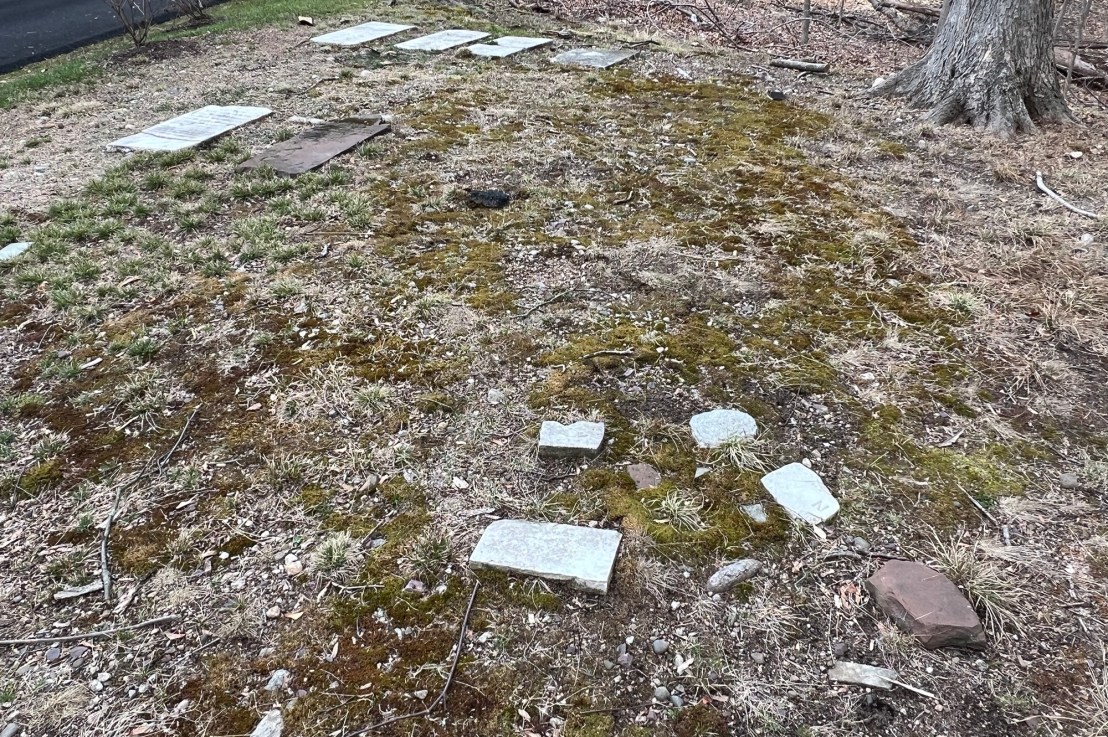
The Sturr Family cemetery tombstones

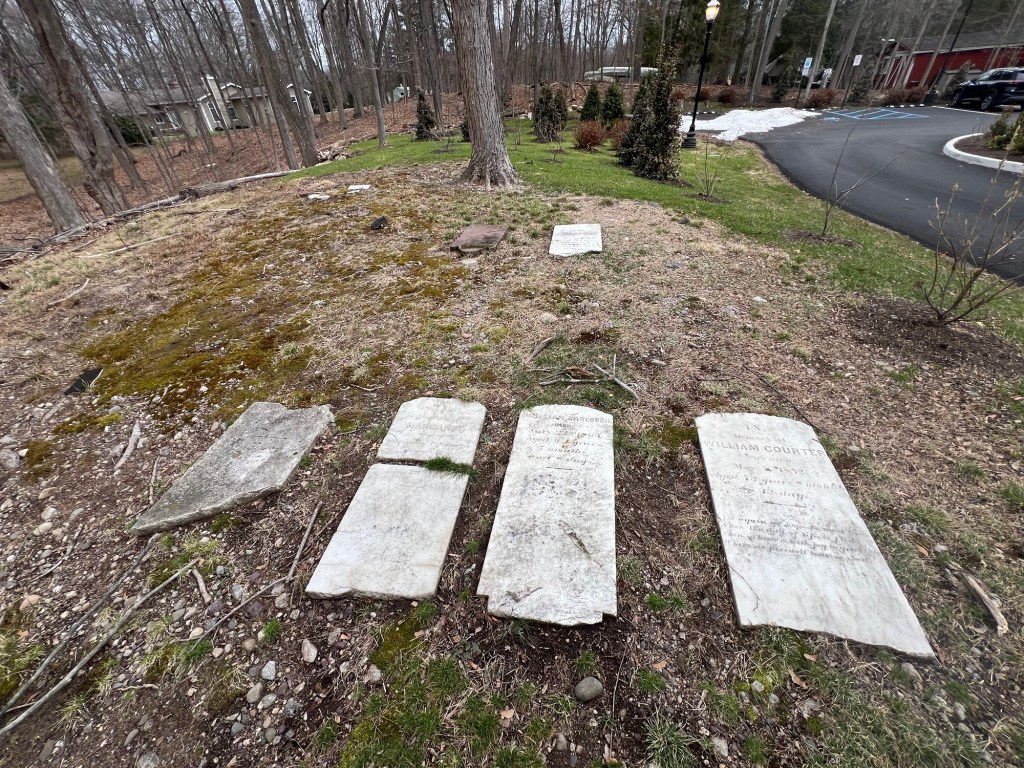
The tombstones of the Courter and Carlouch family members

The grave of William Courter

The only visible tombstones that are left in the cemetery are an Ackerman family member, Anny Ackerman and members of the Courter and the Carlouch family’s (who must have married into the family).

The Ackerman family tombstones (the one to the right was unreadable)

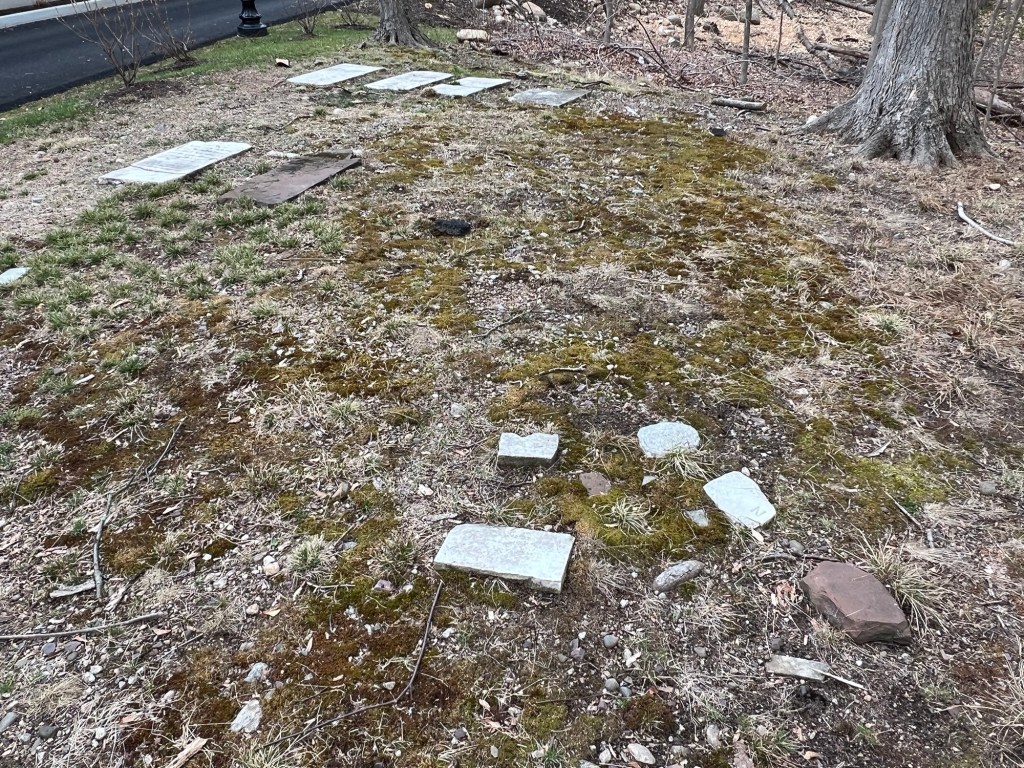
The other tombstones are broken and no one is sure who is buried where in the cemetery.

The History of the Cemetery:

(From Find a Grave website)

The cemetery is located in Franklin Township, Bergen County, New Jersey, on what was once the family farm of J.H. Sturr. As of October 1991 only 6 markers were still remaining.

The Sturr Family Cemetery in full view

History of the House:

(From the Franklin Lakes Municipal Website)

H. Sturr House or Blue Meadow Farm
Built 1860
378 Pulis Avenue, Block 1510, Lot 8
Franklin Lakes, New Jersey 07417 

The Sturr House – also known as Blue Meadow Farm -is a handsome and little altered example of mid 19th century vernacular architecture which incorporates several stylistic elements such as gable returns and frieze area of the early 19th century Greek Revival style. The Borough of Franklin Lakes lists the erection year of the house as 1860. 

The façade of this 2 ½ story house consists of clapboard. The front porch has five bays with square posts and a rectangular entrance door with rectangular sidelights. Two tall 1st story windows are on one side of the porch. A single hitching post with iron rings sits in front of the porch stairs. The building has a frieze area with linear design. Semi-circular headed louvered vents are in all gable ends. The rear of the house has a one story wing.  There is a detached garage to the west side of the house as well as a round frame well. Further west of the house is a stable which has been extensively remodeled and converted into a residence in recent times. The house combined with associated structures is a significant remnant of the large farmsteads which ones dotted the Borough’s landscape prior to the recent suburban housing boom.

History of the Family:

(From the Franklin Lakes Municipal website)

This Sturr house and the nearby more altered house at 402 Pulis Avenue were duplicate structures and were probably built around the same time by members of the Sturr family. The 19th century Sturr family was descended from Conraedt Sturr who purchased 190 acres of land in this area with John Coeter from Robert Livingston in 1793.

The non-extant homestead and mill was located at present-day 930 Old Mill Road. It is known that Henry Sturr, the son of Conraedt, had a fanning mill at this location in 1850. In a will dated 1852 he bequeathed his property and mill to his grandsons John, Henry, and Daniel (Maria Braun – 1976 page 26 & 27).

The property along Pulis Avenue upon which these houses are situated was probably included in this will since the homes were built around the mid-19th century. Future deed research is recommended to identify the original builder and the construction date of the house (1861: H. Sturr, 1876 Estate of H.M. Sturr). Presently the house is privately owned and occupied.

Demarest Family Cemetery                                                     239 Ramapo Valley Road                                                          Oakland, NJ 07436

Demarest Family Cemetery 239 Ramapo Valley Road Oakland, NJ 07436

Demarest Family Cemetery

239 Ramapo Valley Road

Oakland, NJ 07436

https://www.findagrave.com/cemetery/1617471/demarest-family-cemetery

https://sites.rootsweb.com/~njbergen/cemetery.html

Open: During the hours of the Nursery that surrounds it.

My review on TripAdvisor:

The Demarest Family Cemetery sits on a small embankment surrounded by trees and a cement island. You can only access it from one side and there is no stairs. Totally forgotten burial site.

The fencing and locked door with a rusty lock surrounds the cemetery. There is no way to access it. I was able to walk up the cement embankment and was able to walk around the fence. The trees have taken over the cemetery and have knocked over the tombstones.

You can see some of the fallen tombstones from neglect at the fence

The growth surrounding the burial site

Some of the historic tombstones are still standing like this one of the burial sites of Lettya Ann Demarest who was born in 1830. She had inherited the house in 1863.

Most of the historic tombstones have fallen down

The fallen and forgotten tombstones have growth surrounding them.

The historic Demarest homestead was around the corner from the nursery. The house had been in the family for 194 years almost five generations.

The family homestead still exists up the road around the corner from the nursery.

This tiny historical and very forgotten and neglected cemetery was once part of this branch of the Demarest family. The small cemetery sits on a small hill not far from the house. Once the farm was sold off and the town grew around it, this small cemetery sits still in its original spot in the middle of nursery.

When I talked with one of the workers there, he said the owner was very careful to built around it and let it intact. He also said that no one seems to own it. It is the final resting place of James S. Demarest, who fought in the Revolutionary War.

With all the growth, I could not find it. It has been lost to time.

Molly Maguire Historical Park                                    West Centre Street                                             Mahanoy City, PA 17948

Molly Maguire Historical Park West Centre Street Mahanoy City, PA 17948

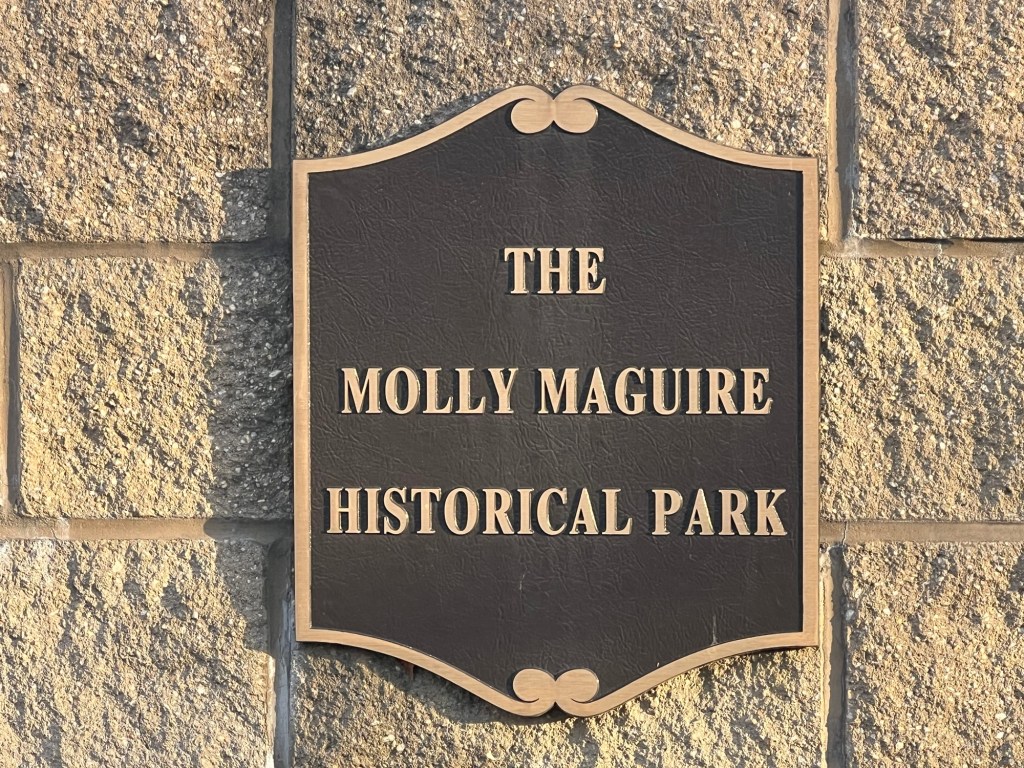
Molly Maguire Historical Park

West Centre Street

Mahanoy City, PA. 17948

(No phone at the park)

https://www.hmdb.org/m.asp?m=236538

https://mahanoyhistory.org/mollymaguires.html

Open: Sunday-Saturday 24 hours

Admission: Free

My review on TripAdvisor:

https://www.tripadvisor.com/Profile/R4960NKjustinw/mediabatch/13493199?m=19905

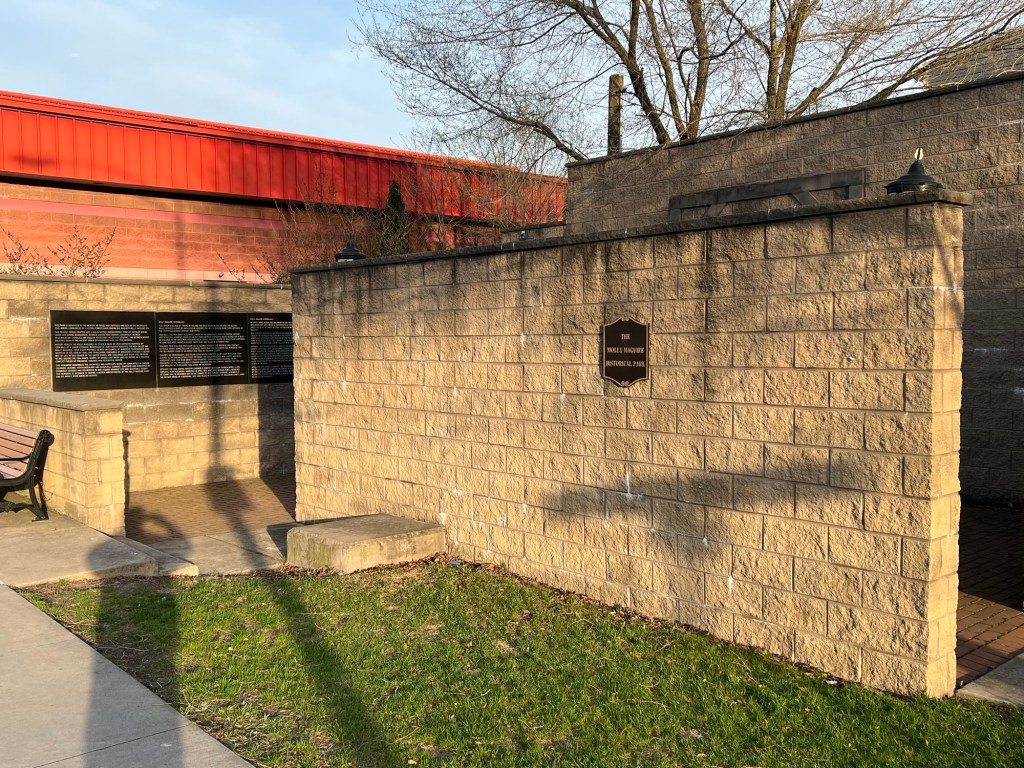
The Molly Maguire Historical Park at West Centre Street

The historical sign

The inside of the park

The History of the Molly Maguires in Mahanoy City:

(from the Mahanoy Area Historical Society website: (Terry Rang/Paul Coombe):


The Mahanoy City area’s first anthracite mine opened in 1861. As mining flourished in the area, so did the population, as many Irish families and other immigrants came to find work. Mahanoy City was incorporated as a borough in 1863, and by 1870, its population had grown to 5,500. The borough’s population hit its peak of about 16,000 in 1910. While the burgeoning anthracite industry made the coal barons rich, the workers toiled for low wages and in dangerous conditions. In the 1870s, tensions mounted between mine bosses and the labor force. Violence erupted between the Irish Catholics and the Protestant English. Mahanoy City became one of Schuylkill County’s sites of alleged Molly Maguire activity.


The Molly Maguires were considered an off-shoot of violent Irish secret societies, such as the Ribbonmen, who rebelled against landlords who treated them harshly and kept them in poverty. In Schuylkill County, Irish miners faced similar hardships. They eventually joined the Workingmen’s Benevolent Association, which had some success in winning better wages and working conditions.


But Franklin B. Gowen, president of Philadelphia & Reading Railroad and its coal land subsidiary, feared the power the union held and believed the Irish controlled it through the secret Molly Maguire society. Determined to break the union, he began accusing Irish miners, who he claimed were Molly Maguires, of murdering mine bosses and other violence.


In 1873, Gowen, a former Schuylkill County district attorney, hired Pinkerton undercover detective James McParlan, using the alias James McKenna, to destroy the Ancient Order of Hibernians. Gowen claimed the AOH was a cover for the Molly Maguires. In 1875, Gowen cut county miners’ wages by 20 percent, triggering “The Long Strike” that lasted five months, devastating the miners and their families. Gowen won that battle as he did his war against the AOH. Gowen and McParlan’s efforts sent 20 men accused of murder as Mollies to the gallows in Schuylkill and Carbon counties. Many of the convictions came on little evidence and McParlan’s testimony.


Alleged Molly events in Mahanoy City included the assassination of Chief Burgess George Major, a St. Patrick’s Day parade led by Kehoe against the Catholic Church’s orders, and the alleged plotting to kill “Bully Bill” Thomas and the Major brothers at Mickey Clarke’s saloon. A monument memorializing the tragic era stands at Centre and Catawissa streets. More than 150 years later, the debate continues whether the men considered Mollies were murderers or martyred heroes. While an incomplete history of the Molly Maguire era in Schuylkill County, this presentation highlights the people, places and events in the Mahanoy City area. We extend a special thank you to Mark T. Major, who granted the Mahanoy Area Historical Society permission to use content from “A Guide to the Molly Maguires,” which he co-wrote with H.T. Crown.

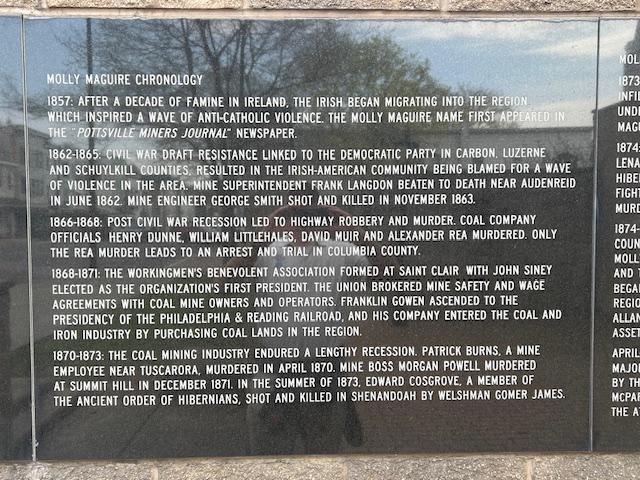
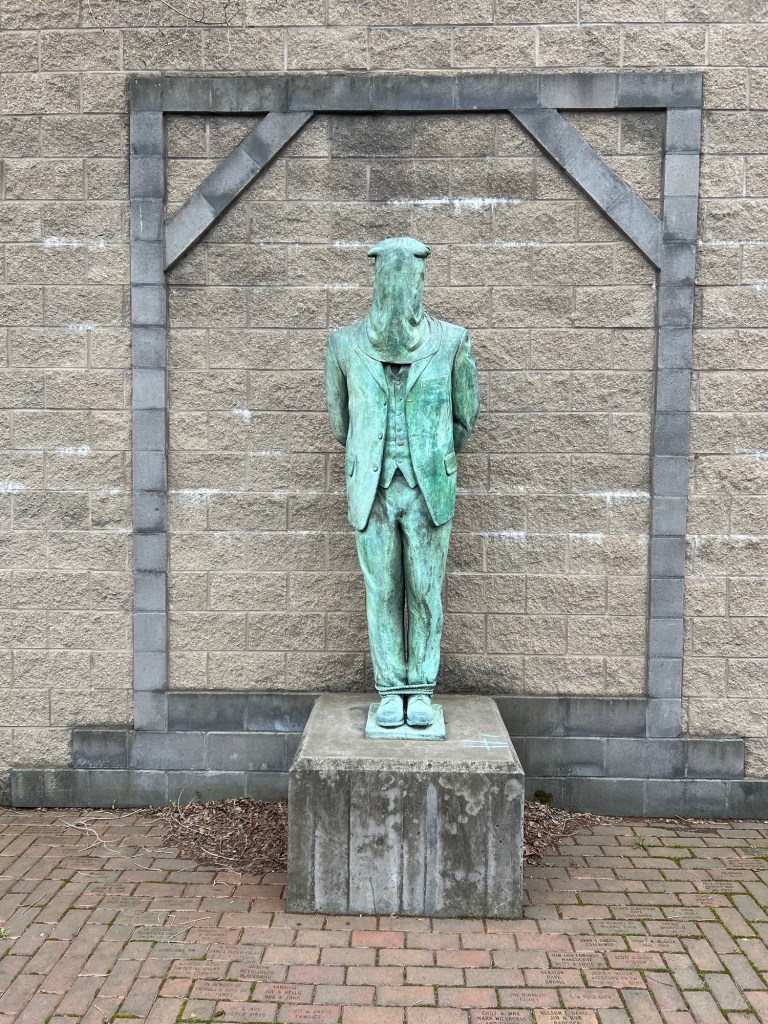
The inside of this quiet park tells the timeline of happenings in Mahanoy City at the time.

The historic plaques tell the story of who the Molly Maguire were and their lasting effects on the changing of mining conditions.

The park story

Who they were

The story and time line

The fate of these men in the end

The park is a reminder for the freedoms that were fought to make things better for future generations and for the stop of oppression in society. There will be different ways to interpret the story in the future but this is a reminder of a better way of life that we now enjoy.