The Sturr Family Cemetery sits on a bend of the driveway of the Chabad Jewish Center of Northwest Bergen County and is a small cemetery that once sat on the edge of the J.H, Sturr farm.
The Sturr Family Cemetery
The farmhouse of the Sturr Family sits on the lot across the street from the cemetery property. This is located on a small buff on what was the edge of the farm.
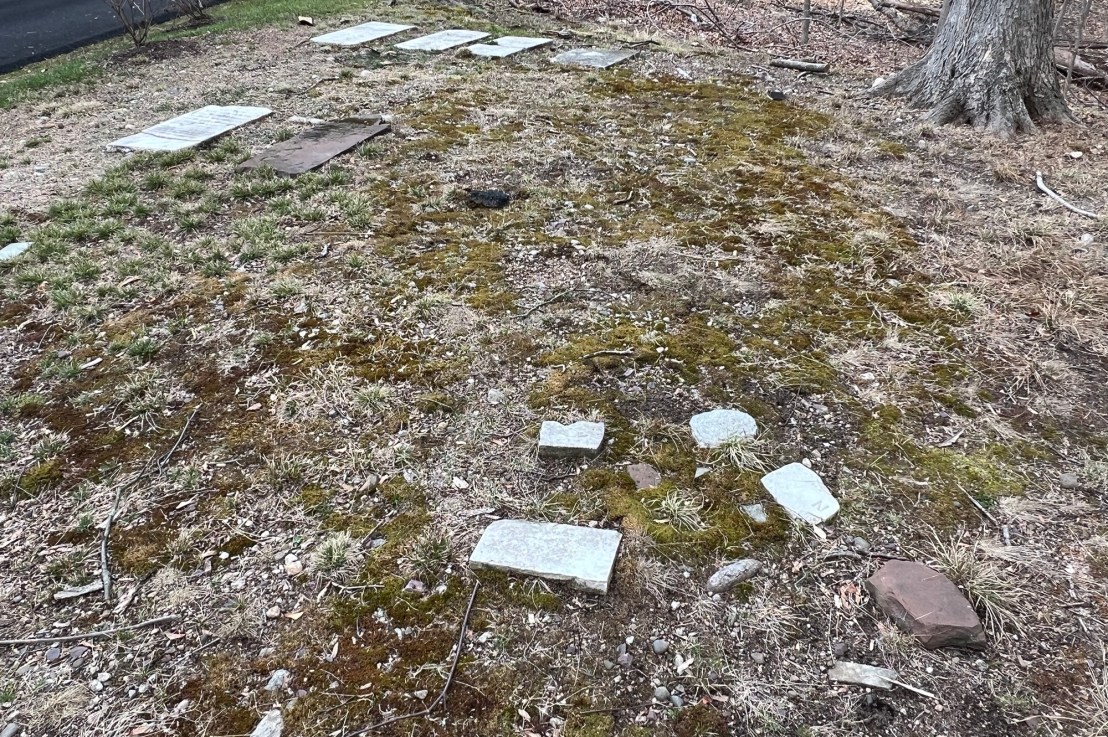
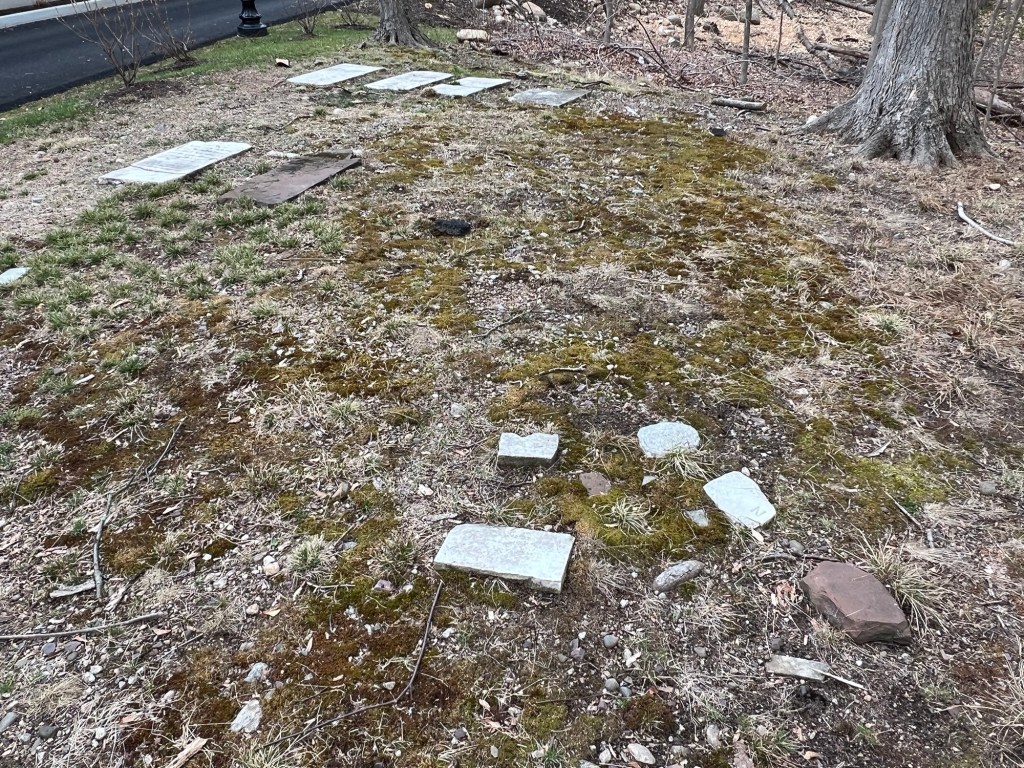
The Sturr Family cemetery tombstones
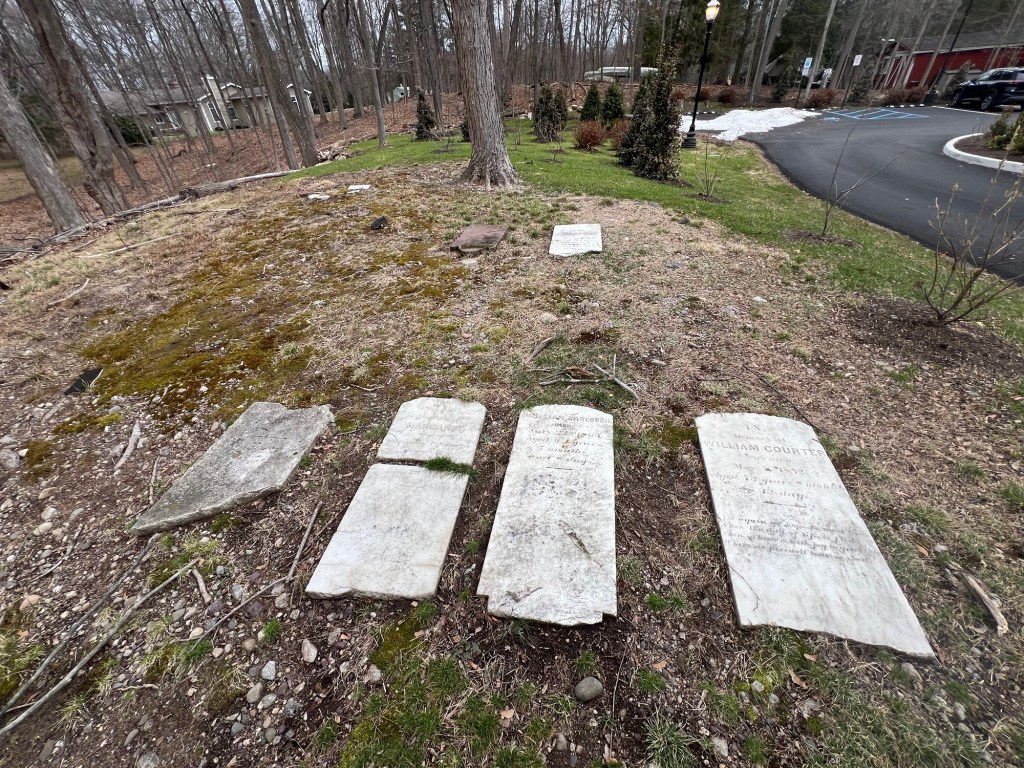
The tombstones of the Courter and Carlouch family members
The grave of William Courter
The only visible tombstones that are left in the cemetery are an Ackerman family member, Anny Ackerman and members of the Courter and the Carlouch family’s (who must have married into the family).
The Ackerman family tombstones (the one to the right was unreadable)
The other tombstones are broken and no one is sure who is buried where in the cemetery.
The History of the Cemetery:
(From Find a Grave website)
The cemetery is located in Franklin Township, Bergen County, New Jersey, on what was once the family farm of J.H. Sturr. As of October 1991 only 6 markers were still remaining.
The Sturr Family Cemetery in full view
History of the House:
(From the Franklin Lakes Municipal Website)
H. Sturr House or Blue Meadow Farm Built 1860 378 Pulis Avenue, Block 1510, Lot 8 Franklin Lakes, New Jersey 07417
The Sturr House – also known as Blue Meadow Farm -is a handsome and little altered example of mid 19th century vernacular architecture which incorporates several stylistic elements such as gable returns and frieze area of the early 19th century Greek Revival style. The Borough of Franklin Lakes lists the erection year of the house as 1860.
The façade of this 2 ½ story house consists of clapboard. The front porch has five bays with square posts and a rectangular entrance door with rectangular sidelights. Two tall 1st story windows are on one side of the porch. A single hitching post with iron rings sits in front of the porch stairs. The building has a frieze area with linear design. Semi-circular headed louvered vents are in all gable ends. The rear of the house has a one story wing. There is a detached garage to the west side of the house as well as a round frame well. Further west of the house is a stable which has been extensively remodeled and converted into a residence in recent times. The house combined with associated structures is a significant remnant of the large farmsteads which ones dotted the Borough’s landscape prior to the recent suburban housing boom.
History of the Family:
(From the Franklin Lakes Municipal website)
This Sturr house and the nearby more altered house at 402 Pulis Avenue were duplicate structures and were probably built around the same time by members of the Sturr family. The 19th century Sturr family was descended from Conraedt Sturr who purchased 190 acres of land in this area with John Coeter from Robert Livingston in 1793.
The non-extant homestead and mill was located at present-day 930 Old Mill Road. It is known that Henry Sturr, the son of Conraedt, had a fanning mill at this location in 1850. In a will dated 1852 he bequeathed his property and mill to his grandsons John, Henry, and Daniel (Maria Braun – 1976 page 26 & 27).
The property along Pulis Avenue upon which these houses are situated was probably included in this will since the homes were built around the mid-19th century. Future deed research is recommended to identify the original builder and the construction date of the house (1861: H. Sturr, 1876 Estate of H.M. Sturr). Presently the house is privately owned and occupied.
One of the things I love about being a member the Metropolitan Museum of Art is the private Member’s Night ‘Met After Hours’ they hold about four times a year. The museum is open after the closing hours and it is a night of wondering the museum galleries, great music and entertainment and wonderful tours and talks in the galleries. You really experience the museum at its best and it does shine.
The lines move very quickly to get into the museum and with traffic getting into the City that night, I arrived about twenty minutes after opening and there were no crowds to face and I got right in. There’s always a sense of excitement on these nights.
The Grand Hall in the front of the museum decorated with Spring flowers
The beautiful Spring flowers lined all the urns around the Great Hall
The museum welcoming all the members of the museum at ‘The Met After Hours’
I started my walk around the galleries in the Greek Wing touring the main hallway. It still boggles my mind how old these statues are and I am looking at something almost two thousand years old.
The Museum’s collection of Greek and Roman art comprises more than thirty thousand works ranging in date from the Neolithic period (ca. 4500 BCE) to the time of the Roman emperor Constantine’s conversion to Christianity in 312 CE. It includes the art of many cultures and is among the most comprehensive in North America. The geographic regions represented are Greece and Italy, but not as delimited by modern political frontiers: Greek colonies were established around the Mediterranean basin and on the shores of the Black Sea, and Cyprus became increasingly Hellenized. For Roman art, the geographical limits coincide with the expansion of the Roman Empire. The department also exhibits the art of prehistoric Greece (Helladic, Cycladic, and Minoan) and pre-Roman art of Italic peoples, notably the Etruscans (Metropolitan Museum of Art website).
One of the statues that stood out that evening
I spent some time admiring the statues and the craftsmanship of the works along the hallway. The only problem is that most of the Greek and Roman Galleries were closed for the evening so I headed off to the Renaissance Wing. I love the luxury objects in the collection of silver and gold and again their craftsmanship is still unrivaled today. To make these objects takes intensive work and talent.
The timepieces show how advanced science had become and the importance of it in not just measurements but in beauty.
The lobby of the American Wing with the facade of what was a former bank and a Wall Street private mansion. I love the quiet elegance of this building and to think they moved it here piece by piece. The American Wing Cafe was open for the evening and the area was busy throughout the evening. It is nice to just sit and enjoy the views by the fountain. The artwork is beautiful.
Visitors to the American Wing will experience in more than 75 galleries on three floors varied art, design, and culture from the mid-seventeenth to the mid-twentieth century, with some contemporary expressions, by a diverse array of artists from across North America. Since our founding in 1924, this curatorial department has evolved its collecting to include some 20,000 artworks in many mediums by African American, Asian American, Euro-American, Latin American, and Native American makers, affirming ever more inclusive definitions of American art and identity. These dynamic holdings include painting, sculpture, drawing, furniture, textiles, regalia, ceramics, basketry, glass, silver, metalwork, jewelry, as well as historic interiors and architectural fragments, produced by highly trained and self-taught artists, both identified and unrecorded (Metropolitan Museum of Art website).
The evening then moved to the Egyptian Wing and the Temple of Dendur, where the entertainment and the cocktail bar was located.
The Temple of Dendur is the hub of activity on Members Nights
This small temple, built about 15 B.C., honored the goddess Isis and, beside her, Pedesi and Pihor, deified sons of a local Nubian ruler. On the outer walls between earth and sky are carved scenes of the king making offerings to deities who hold scepters and the ankh, the symbol of life. The figures are carved in sunk relief. In the brilliant Egyptian sunlight, shadows cast along the figures’ edges would have emphasized their outlines. Isis, Osiris, their son Horus, and the other deities are identified by their crowns and the inscriptions beside their figures (Metropolitan Museum of Art).
These scenes are repeated in two horizontal registers. The king is identified by his regalia and by his names, which appear close to his head in elongated oval shapes called cartouches; many of the cartouches simply read “pharaoh.” This king was actually Caesar Augustus of Rome, who, as ruler of Egypt, had himself depicted in the traditional regalia of the pharaoh. Augustus had many temples erected in Egyptian style, honoring Egyptian deities (Metropolitan Museum of Art).
The area was packed with patrons enjoying music and talking by the bars. The crowds were so large at the beginning of the evening that I waited until after 9:00pm for the second performance of the group playing. So I headed into the section of the Egyptian Wing to look at the galleries that were open. I love walking around the Egyptian Wing of the Met. It is one of the most extensive collections outside of Egypt and the most fascinating Mummy exhibition.
Admiring one of the Mummy exhibits in the Egyptian Wing
The Department of Egyptian Art was established in 1906 to oversee the Museum’s already sizable collection of art from ancient Egypt. In the same year, the Museum’s Board of Trustees voted to establish an Egyptian Expedition to conduct archaeological excavations in Egypt. Between 1906 and 1935, The Met’s Egyptian Expedition worked at a number of important sites, including Lisht in the north and Thebes in the south, and the objects gifted to The Met by the Egyptian antiquities service form the core of our collection. Over the years, the Department of Egyptian Art has also been able to acquire, through purchase and bequest, several important private collections (Metropolitan Museum of Art website).
The ancient tablets outside of the Mummy Exhibition
The Egyptian artwork outside the Mummy Room
The tablets outside the Mummy Room
When the whole gallery is open, it is a treasure trove of objects and information from each Dynasty. I have been mind-boggled by these galleries since I first visited the museum in the third grade for a class field trip. I remember sketching artifacts for a class project and am still fascinated about how old some of these objects are and condition they are still in after thousands of years. It is my favorite part of the museum.
By 9:00pm, the entertainment was starting again, so I joined other members for a cocktail and enjoyed the music in the Temple of Dendur Gallery.
The Temple of Dendur fully lit for the evening before the start of the entertainment
The signature cocktail of the evening, the Starlight Spritz
Enjoying a Starlight Spritz while listening to the music
The bartenders can mix a drink
After a long week at work, it was nice to relax and enjoy the music. The music that night was performed by artist Jasim Perales and Friends, an Afro-Latin Jazz performance. The music was relaxing and soulful and the crowd had a wonderful time.
The start of the music again at 9:00pm
The trio performing
A clip from the entertainment that night
The Master of Ceremonies that night, Jasim Perales
All good things come to an end and it was time leave. The night was dark and the winter air was crisp creating the perfect Winter evening to set out into for the walk back to Port Authority. The Upper East is so beautiful at night.
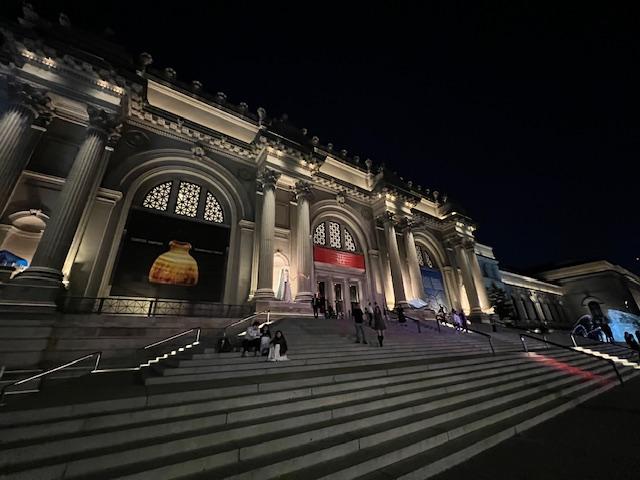
The front of the Met that night
The artwork is always so impressive outside the Met
It was in the low 40’s that evening and the perfect night for a walk around the Upper East Side and Midtown. It still surprises me after all these years of walking around Manhattan how beautiful the City really is at night.
It was another spectacular evening at the Metropolitan Museum of Art. Thank you to the Membership and Special Events Departments for hosting another wonderful evening.
Who says there’s nothing to do in the cold months? It all depends on how much you want to bundle up and enjoy the outdoors.
The last weekend of the ‘Monet & Venice’ showing at the Brooklyn Museum brought me out to Brooklyn on a sunny but chilly Saturday afternoon recently. I knew there would be crowds at the Brooklyn Museum as everyone was probably thinking of doing the same (at the end of the visit I found this to be true) so I got to the museum by noon and got tickets to the first slot open at 2:30pm.
Since I had a couple of hours until my tour of the exhibit, I decided to tour the Brooklyn Botanic Garden next door. There were no walking tours that day and the gardens were under a foot of snow from the recent storm. There was a quiet beauty of all the snow and the way it fell and shined in the sun all over the gardens. There were no lines or crowds (like the recent lightshow a few weeks earlier), so I had the gardens pretty much to myself.
The first stop on my walk was the Japanese Gardens, which has I had visited recently for the lightshow and experienced the fantastic musical display. The pond now sat under snow and ice and still it was impressive looking.
Walking through the Brooklyn Botanic Garden next to the Japanese Gardens
The Japanese Gardens in the early afternoon
The inside of the Japanese Gardens in the middle of winter. It was such a spectacular view of the pond.
The beauty of the snow covered pool
Another view of the Garden
I never realized how beautiful the Japanese Gardens were in the winter. The sun shines so nicely on the snow covered trees. It was just as beautiful snow covered as it is in the Spring and Summer when the garden is in full bloom.
The fountain in the Shakespeare Garden
I then walked through the entire gardens stopping in various gardens to see what they looked like topped with snow. My first stop was the Shakespeare Gardens and I marveled at the elegance of the snow covered fountain I like so much in the Spring. The variety of the colors of this garden are waiting just under the snow for the warmer months.
The view of the snow covered gardens
I then walked around the paths to the back of the gardens along the watershed lawns that were under a foot of snow and still impressive.
Daffodil Hill in the winter. In two months this will be covered by hundreds of brightly colored daffodils
The Magnolia tree court and sun dial
In the Spring, this is my favorite part of the garden with the hues of pinks and whites of the Magnolia trees and the yellows of the daffodils.
My favorite fountain just off the Magnolia Court on the stairs leading to the Lotus polls
The snow covered fountains by the Lotus pools
The snow covered Lotus pools shined in the sun
I then got out of the cold weather and entered into the warmth of the Tropical Garden Collection. This series of gallery of plants is a series of greenhouses at various degrees of temperatures that display a series of themed gardens. They don’t just display plants but also keep you warm in a cold day.
The indoor tropical gardens
The Tropical Garden collection
The first room I visited wasabi the Bonsai Museum room. The temperature controlled room was perfect for a stroll.
The Bonsai museum
These beautiful tiny well pruned trees lined the tables with their elegance and been so well maintained.
The Bonsai trees lining the tables in the galleries
The beautiful bonsai
The flowering bonsai
The beautifully shaped bonsai
The Cherry blossom bonsai in the middle of the winter
The other trees in the gallery
The video tour of one side of the Bonsai Gallery:
The video tour of one side the Bonsai Gallery:
My video of the gallery tour
The Tropical Room
The tropical room
I then toured the Tropical Garden collection with its series of flowering plants and palms. It was so nice and warm inside and a break from the cool temperatures outside.
A video tour of the Tropical Gallery:
The walk is amazing
The Tropical Room
Colorful tropical flowers line the walkway in the dead of winter
The blooming Lotus
The real White Lotus
I then walked through the second tropical room in the rain forest and there were more beautiful plants to see and experience. There was a wedding garden shoot going on so I was not able to tour the complex.
The flowering tiers of plants in the Tropical room
The flowering plants in the Tropical gallery
The beautiful violets
I then began the tour of the Desert Gallery and the beauty and warmth of the room made me very happy.
The Birds of Paradise in bloom
Along the walls of the gallery, more flowering plants were placed.
Flowers in bloom in the winter
The climate controlled Desert collection was filled with cactus and other plantings the defied the weather. They have a pretty extensive collection of desert flowers and cactus in the room.
The Desert Collection gallery
The flowering cactus family
Walking back through the rainforest
Walking back through the Desert Gallery before exiting to tour the snow covered gardens
Video tour of the Desert Gallery:
There was still a foot of snow on the ground when I visited the gardens that day, which did not make it popular with people wanting to visit the gardens but I found a quiet elegance in just walking the paths and admiring the snow covered plantings. It was like they were waiting to awake again in the near future.
I walked through the gardens which while under a blanket of snow still offered the most beautiful views. I was one of the few people walking through the gardens that afternoon so it was quiet and you could just enjoy watching nature.
Walking past the Children’s Garden in the Winter
Walking over the bridge in the Watershed lawn
I saw this little squirrel holding on to the tree looking cold
The geese feeding on the Watershed lawn
The Cherry Blossom lawn in the winter
The Rose Garden Fountain in the winter
Walking through the Cherry Blossom lawn
Walking back through the Magnolia garden
Taking one last walk around the Lotus Pools
Before I left the gardens that afternoon, I stopped in the Gift Shop for some warmth and see the items they were carrying. They have such beautiful selection of flowers and gifts and the perfect place to warm up on a cold day. Everything is so colorfully displayed.
The Gift Shop at the Brooklyn Botanic Garden
Everything was in full bloom and really colorful
Everything was so beautifully displayed here
Before I left for the Brooklyn Museum to start my 2:30 pm tour, I stopped at one of my favorite sandwich shops down the road from the museum, Bahn Mai Place at 824b Washington Avenue for lunch. I love their sandwiches and drinks.
I ordinarily try a restaurant a few times before I recommend it for my dining website, DiningonaShoeStringinNYC@Wordpress.com, but I had the most amazing sandwich for dinner a few years ago and I had to share this place with the world.
There are also all sorts of rice dishes on the menu, Pho (soups) and salads on the menu as well most priced around $10.00. On the Beverage menu, there is a selection of Hot, Iced and Milk drinks to choose from as well as a selection of Bubble teas and smoothies.
One sandwich I can recommend on a cold day is the Grilled Chicken Banh Mai. I had the sandwich with a mild hot sauce on a cold wintery day. The warm bun and crunchy fresh vegetables with the spicy sauce really warmed me up on a cold afternoon in Brooklyn.
The Grilled Chicken Bahn Mi with a mild spicy sauce
The grilled chicken with fresh veggies
The mild spicy sauce really brings out the flavor of the grilled meat. With a little plumb and chili sauces, it really brings out the flavor of the sandwich.
The chicken was spicy and moist
It was the perfect lunch
The service was very quick and very friendly. The woman who made my sandwich pushed my order ahead of someone else’s who ordered the same thing as me so I could be on my way which I thought was very nice of her.
After lunch, it was off to the Brooklyn Museum and the tour of the ‘Monet & Venice’ exhibition. I was so lucky that I got to the museum early and got the tickets. The show was completely sold out by the time I left.
The museum was seriously packed that afternoon, not just for the show but all over the museum. I have been coming here for over twenty years and I had never seen it so packed. Every floor was filled with people.
Claude Monet once claimed that Venice was “too beautiful to be painted,” a challenge he embraced by creating an extraordinary sequence of works depicting the Italian city. Monet and Venice is the first exhibition to focus on Monet’s luminous Venetian paintings—a radiant yet underexplored chapter in the artist’s late career—since their debut in 1912 (Brooklyn Museum website).
New York’s largest museum show dedicated to Monet in over 25 years, the exhibition features more than 100 artworks, books, and ephemera. Two masterpieces, the Brooklyn Museum’s own Palazzo Ducale and The Grand Canal, Venice from the Fine Arts Museums of San Francisco, are presented alongside selections from throughout Monet’s career—including 19 of his Venetian paintings (Brooklyn Museum website).
The artist’s singular vision of Venice is also set in dialogue with portrayals of the city by renowned artists such as Canaletto, Paul Signac, John Singer Sargent, and Pierre-Auguste Renoir. Where others focused on Venice’s busy streets and canals, Monet’s interpretation is hauntingly devoid of human presence. Instead, he captures the interplay of architecture with color and light, enveloping viewers in the city’s distinctive atmosphere. Sonic installations by Niles Luther, the Museum’s composer in residence, and other immersive elements will further transport you to this fabled place (Brooklyn Museum website).
Walking through the galleries admiring the art
These were some of my favorite pieces from the show. These also were a favorite of Monet himself to the City of Venice.
The paintings of the Grand Canal
The views along the coastline of Italy
One of Monet’s famous ‘Water Lilly’ collection
Views from the Grand Canal
Walking around the gallery
Another view of the Grand Canal
I could not believe how packed the exhibition got behind me as I double backed through the gallery on the way out. Not only did the crowds grow in the exhibition but the line outside the exhibition was over a hundred deep and wrapped around three galleries on the Fifth Floor. It was so busy on the floor, I decided to walk around other exhibitions.
My favorite painting in the American Wing of the Mountain House Hotel in the Catskills
Then I walked down to the Middle Eastern Wing with the Assyrian and Egyptian Art, one of personal favorites in the museum. Unlike the Met, the Egyptian Wing of the museum is not overwhelming and is easier to view as the exhibits are not as packed with artifacts.
I started first admiring the Assyrian panels of the genies gracing the walls of the famous palace. It blows my mind that these are almost over a thousand years old.
The panels of genies along the walls of the old palace
The panels of genies along the walls
The different versions of genies along the walks
I have been visiting the Egyptian Wing of the museum since I attended the opening of the renovation with my father over a decade ago. It has an iconic entrance to the wing of the museum.
The entrance to the Egyptian Wing of the Brooklyn Museum
Walking through the Egyptian Galleries
Admiring the art on the wall
Walking through the Mummy display
The details on the Mummy coffin
Finishing the tour of the Egyptian galleries
I had a nice time at both the Brooklyn Botanic Gardens and at the Brooklyn Museum. There is more than enough to see and do at both cultural locations in the heart of Brooklyn.
It was a wonderful walk around neighborhood and even with all the snow on the ground, it was easy to maneuver around the sidewalks and streets. The snow may have covered the ground but was a backdrop for the beauty that it displayed. The recent storm did not keep us inside but brought us outside to see how it looked and enjoy its beauty.
I promised myself I would cut back on holiday activities last year. Since almost all of my older blogs have been revamped and updated to reflect the work on my newer visits and walks of neighborhoods and towns, I took a step back and revisited one last holiday activity I enjoyed last year, The Light Show at the Brooklyn Botanic Garden.
The Gardens have been running this show for several years to increase traffic in the Gardens during the winter months to great success. These type of lightshows are gaining popularity in botanical gardens all over the country similar to the drive through holiday light shows. They are becoming a new tradition for families in usually quiet parks during the holiday season. The Brooklyn Botanic Garden has been an impressive show over the last four years that I have attended.
The directory of the ‘Lightscape Show’ at the Brooklyn Botanic Garden
The brilliance of the “The Tree of Stars” display at the entrance of the show
I love how they illuminated the trees to the music
The Christmas music illuminated the trees in the “Shadow Play” and created a festive beginning to the light shows
One of the best parts of the light shows is displayed in the Japanese Garden “Let the Magic Begin”. The water show keeps people dazzled for almost five minutes. I find myself every year having to watch it three times. Once to check it out, once to film it and then the last time to be dazzled by it myself. It is one of the reasons why I put up with 35-degree weather.
The beautiful lights illuminate the gardens at its start
Then the water show “Let the Magic Begin” begins
The video of the water show is so impressive every year (excuse my coughing)
The end of the water show was spectacular
I walked down the pathway toward Daffodil Hill and could not wait until the sea of yellow flowers returned in four months. In its place was a sea of lights and sounds in the display “Papillion’s”.
I next walked through a sea of butterflies and the skies were full of color in the ‘Papillion’s’ display
The trees were full of colorful butterflies in ‘Papillion’s’
I then walked through the Shakespeare Garden and came across the ‘Threshold’ display which was a sea of lights that flipped and sparkled around.
The ‘Threahold’ display in the Shakespeare Garden
‘Threshold’ in full color
‘Threshold’ changing colors
I walked around the spiral of spinning lights s and admired all the beautiful colors as it moved around. I walked around the Shakespeare Garden and looked at where the colorful flowers and plantings are placed in the Spring and Summer.
As I walked to the lawns of the Watershed, I passed the ‘Sway’ exhibition with its layers of colorful lights on the trees.
The colorful lights of ‘Sway’ as the music plays on CD
The video of the ‘Sway’ lights against the trees
The illumination of the trees in the gardens during the light show
The next display on the lawn of the Watershed was ‘Fluxit’, which looked like outside fire. It clicked and sparkled as the music played.
The ‘Fluxit’ display as it lit and moved
The video of the ‘Fluxit’ display
Once I left the Watershed lawns, I walked into the ‘Winter Terrace’, where in the warmer months are the Lotus Pools and seasonal plants and flowers are displayed. It was now decorated with topiary women guiding in the pools, the fountains were decorated with blinking lights and where the bar and restaurant were located. The area is really crowded with people milling around and taking a break from the walk.
The ‘Winter Terrace’ in full illumination
The Lotus Pools with the illuminated women
The ‘Illuminated’ women in the pool
One of the ‘Illuminated’ women
The fountain was shimmering with lights in the “Winter Terrace”
While I was walking around the frozen pools admiring the lights, many of the patrons were in the glassed-in banquet room having snacks and drinks. The building was packed with people eating and drinking.
I walked through the next series of displays ‘Flock’ and ‘Shadow Lantern’s on the edge of the Water Basin lawn. “Flock” looks like illuminated pigeons flying around the trees.
The display ‘Flock’ on the lawn’s edge
The ‘Shadow Lantern’s’ were quite brilliant
The ‘Shadow Lantern’s’ cast their brilliant lights all over the sidewalks with a sea of snowflakes and could hear the music in the background.
One of my favorite displays in the show was walking through the giant ‘Lilly’s of the Valley’ display to what sounded like a 1970’s folk singer. It was like a surreal trip through ‘Wonderland’ and I felt like Alice when she was shrunk walking through the gardens.
The ‘Lilly’s of the Valley’ display
Walking by the floral displays illuminated with brilliant lights
My video of walking through the giant patch of Lillie’s and watching the plants and trees change colors. It was a lot of fun to walk around.
The next display was another favorite of mine, the colorful and interactive ‘Winter Walk’ with lights and music to the song ‘Sleigh Ride’ that sounded like the New York Pops. The colors popped and popped with the music.
The ‘Winter Walk’ in full color as the music played
My pictures and videos don’t give the display justice as I filmed everything from the side view of the display.
The festive lights dancing to the song ‘Sleigh Ride’
Talk about putting you in the Christmas spirit even after the holidays were over. “Sleigh Ride” is still one of my favorite songs at the holidays.
I loved walking past the lines of trees that were illuminated
I followed the path down to where in the Spring, the Bluebell flowers bloom brightly and the whole area is a sea of purples and blues. Now it was ‘Bluebonnets’, a sea of purple lights. It was just picturesque and brought the gardens back even in the dead of winter.
‘Bluebonnets’ light display
The light flowers replacing the Spring flowers
The ‘Robin’s Trail’ display at the end of the ‘Bluebonnets’ display
As I entered the Cherry Blossom lawn, which is a sea of pinks in various hues, there was now the ‘Leaf on the Light’ display on all the trees.
The ‘Leaf on the Light’ display
Towards the end of the light display for the spectacular finish of the display in the Cherry Blossom lawn, you had to walk through the lines of Cherry Blossoms that line the pathways on both sides of the lawn. Only this side of the pathway was open and lit for the display.
I walked through ‘Pulse’ , where the trunks of the trees kept changing colors. It was an interesting walk down the pathway.
The lighting of ‘Pulse’ as I walked down the pathway
‘Pulse’ as it changed colors
All this led to the best part of the show, ‘The Sea of Light’, where the whole Cherry Blossom lawn became a dazzling sea of lights, sounds and music. I love the creation of the lawn light display every year I visit the show.
The ‘Sea of Light’ as it started
The ‘Sea of Light’ as it changed colors
The dazzling ‘Sea of Light’ performance and the lively music that accompanied it.
This was the best way to cap off the evening with its dazzling lights and music. Even as it got colder, I stayed longer to see watch it at least three times. I wanted to get the perfect video to share with everyone. If there was part of the show I enjoyed most, it was this part of the display.
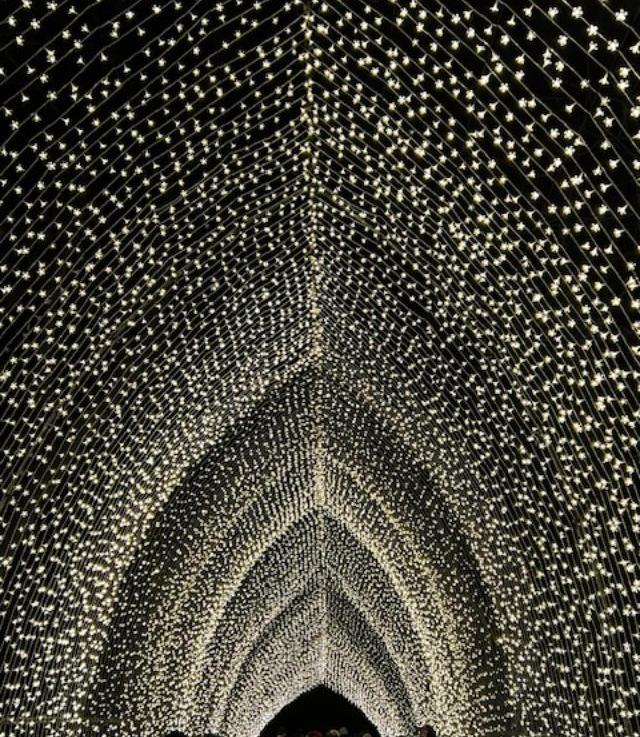
As I left the gardens that evening, I exited through the ‘Winter Cathedral’, an archway of an illumination of lights that is the one place that foot traffic stops as people always want to take pictures here. While this display has moved around the gardens over the years, it is still the one display that has been been consistent every year.
The ‘Cathedral of Lights’
Couples were stopping here asking everyone to take their pictures. It was a popular spot to take pictures.
The ‘Cathedral of Lights’
The last display I walked through to exit that night was the ‘Firefly Field’ at the old main entrance of the Gardens.
The ‘Firefly Field’ blazing with Tony lights
It was a nice way to wrap up the show. The “Lightscape” light display at the Brooklyn Botanic Garden was spectacular this year and always different. As cold as it was, it was still an amazing night of sights and sounds.
It was a nice way to rest and relax as the holiday season ended. Until next year!










 Visiting a Museum: The Unique, Unusual, Obscure and Historical