Category: Exploring New York City

Carl Schurz Park                                                   East 86th Street and East End Avenue                                    New York, NY 10028

Carl Schurz Park East 86th Street and East End Avenue New York, NY 10028

Carl Schurz Park

East 86th Street and East End Avenue

New York, NY  10028

(212) 459-4455

https://www.nycgovparks.org/parks/M081

https://www.nycgovparks.org/parks/carl-schurz-park/history

Open: Sunday-Saturday 6:00am-12:00am

Admission: Free

My review on TripAdvisor:

https://www.tripadvisor.com/Attraction_Review-g60763-d312015-Reviews-Carl_Schurz_Park-New_York_City_New_York.html

I have been visiting Carl Schurz Park many times while walking the neighborhood for my project, “MywalkinManhattan.com”. You can see the entries from Days One Hundred and Ten, Six, Four and Two. I also visited again when touring Gracie Mansion for this blog, “VisitingaMuseum” (see write up under Gracie Mansion).

Gracie Mansion at East 88th and East End Avenue

The Gracie Mansion tour should not be missed:

https://wordpress.com/post/mywalkinmanhattan.com/7156
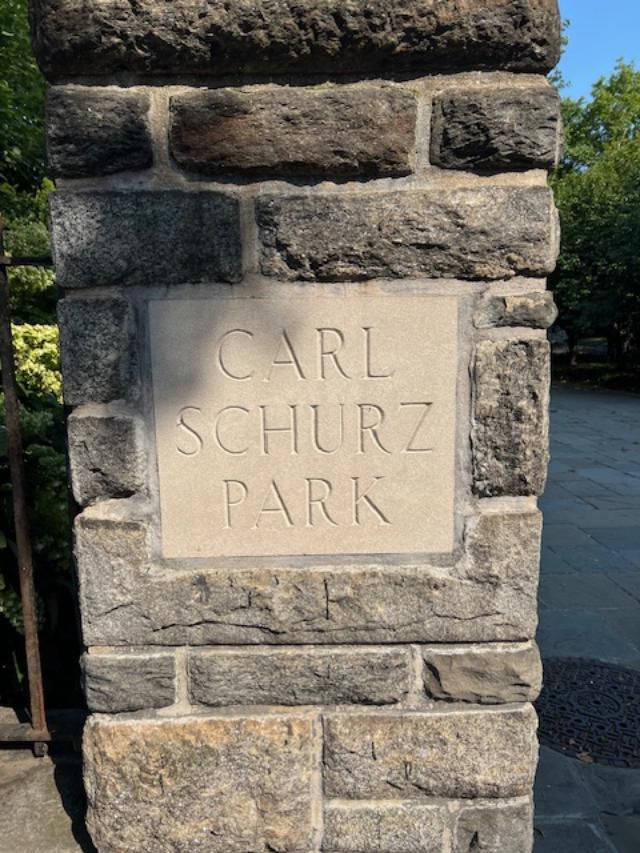
The entrance to Carl Schurz Park in the Summer of 2024

The park is such a nice place to relax in the warmer months. Being so close to the river in the winter months when the wind kicks in from the river can be brutal. In the Spring and Summer, it is one of the nicest parks to just sit and relax in. During the day, it is fun to watch the kids play in the large playground in the middle of the park. On the weekends the place is packed with kids, parents, and nannies all vying for space.
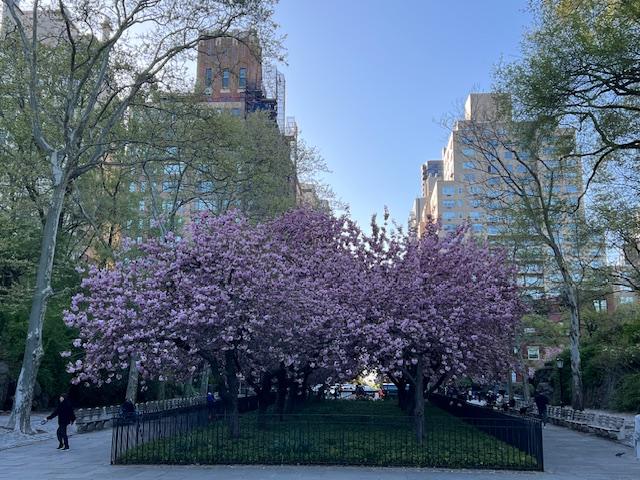
The Cherry Blossoms at the entrance of the park.
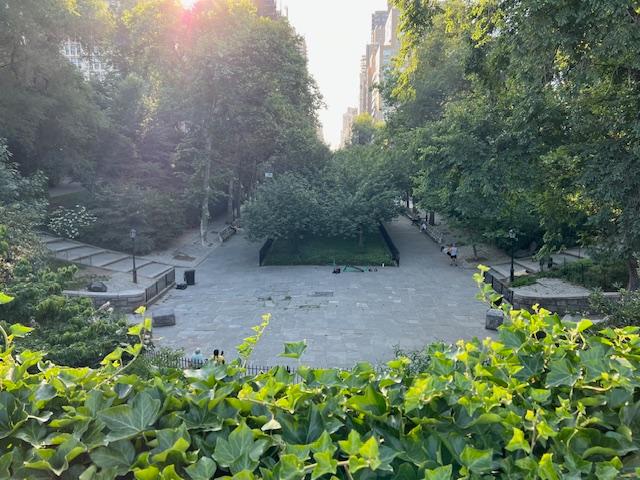
The same spot on the first day of Summer 2024

The gardens are beautiful and are very nicely maintained between the City and the Carl Schurz Park Association, who I have seen members weeding, landscaping and planting in the park during the times of my visits. It is relaxing to just sit by the river and watch the river go by and the boats sail by in the warmer months.

The entrance to the park.

The flowers return during each part of the season almost on cue and the park is awash with colors of daffodils, tulips, irises and tiger lilies. There are many flowering plants in the summer that add to the rainbow of colors that accent all the trees. It is a nice place to sit and read a book while watching people walk their dogs.
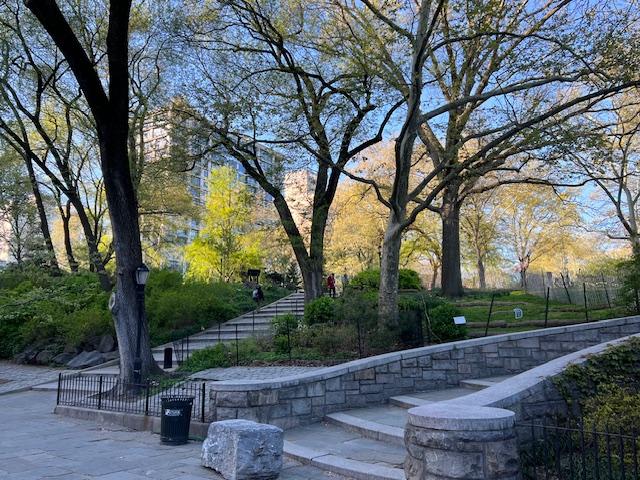
The back of the park in Spring 2024.

At twilight, it is fun to watch the lights go on in Queens across the river and the whole city come to life again in the evening. In the warm summer months, the kids are playing in the park, residents have their dogs running around the Dog Run and you can hear the activity at Gracie Mansion. Trust me, security is tight in that section of the park.

The Tulip Garden at the back of the park.

The same garden in the Summer of 2024

The pathways by the playground in the Summer of 2024

The paths that line East 84th Street to York Avenue

The Polly Gordon Walk sign in the front gardens

The Polly Gordon Walkway in the Summer of 2024

This is a nice residential park to relax in when you visiting the Upper East Side.

The walkways in Carl Schurz Park in the Summer of 2024

The History of Carl Schurz Park:

Carl Schurz Park, named by the Board of Alderman in 1910 for the soldier, statesman and journalist Carl Schurz (1829-1906), overlooks the turbulent waters of Hell Gate. The first known Dutch owner of the land was Sybout Claessen, who was granted the property in 1646 by the Dutch West India Company. Jacob Walton, a subsequent owner, built the first house on the site in 1770. During the Revolutionary War, the Continental Army built a fort surrounding the Walton residence to guard the strategic shipping passage of Hell Gate. After the British attack on September 8th, 1776, the house was destroyed and the Americans were forced to retreat from the fort, which the British retained until the end of the war in 1783.

Looking at the park from the East River walkway.

The land was purchased from Walton’s heirs in 1798 by Archibald Gracie, a Scottish shipping magnate. He built a mansion there in 1799, where his illustrious guests included future United States President, John Quincy Adams and future French King Louis Phillippe. The estate, sold by Gracie in 1819 was acquired by the City from the Wheaton family in 1891. The first home of the Museum of the City of New York from 1924-32, the mansion served as the official residence of New York’s mayor’s since Fiorello LaGuardia moved there in 1942.

Gracie Mansion during my tour of the mansion in 2025

The southern portion of the park was set aside by the City as East River Park in 1876. The former Gracie estate was added in 1891 and a new landscape design by Calvert Vaux and Samuel Parsons was completed in 1902. Maud Sargent re-landscaped the park in 1939 when the East River Drive underpass was under construction. Charles Haffen’s sculpture of Peter Pan, created in 1928 for a fountain in the lobby of the old Paramount Theater was installed in the park in 1975.

Carl Schurz Park in the Summer

The park name honors Schurz, a native of Cologne, Germany. It was strongly supported by the large German community of adjacent Yorkville. After emigrating to the United States in 1852, Schurz quickly made his reputation as a skilled orator and proved to be instrumental to Abraham Lincoln’s 1860 election campaign. His most significant political offices were that of United States Senator from Missouri (1869-1875) and Secretary of the Interior (1877-81) during the Hayes administration. In later years, Schurz was editor of the New York Tribune and an editorial writer for Harper’s Weekly. Schurz is also honored by Karl Bitter’s statue of 1913, located in Morningside Drive and 116th Street.

Carl Schurz

Carl Schurz

https://en.wikipedia.org/wiki/Carl_Schurz

Recent improvements include rebuilding of the stairs, the complete restoration of the playground and the opening of Carl’s Dog Run. These and other projects, including the planting of flowers, have been accomplished through a partnership between the Parks and the Carl Schurz Park Association, which has demonstrated the community’s commitment to restoring, maintaining and preserving this park since it formed in 1974.

(NYC Parks Official Website)

My write up on VisitingaMuseum.com:

https://wordpress.com/post/visitingamuseum.com/2182

Carl Schurz Park in the Spring.

The Gardens that face the East River and Hell Gate were in full bloom on the first day of Summer 2024

The gardens that line the esplanade on the East River
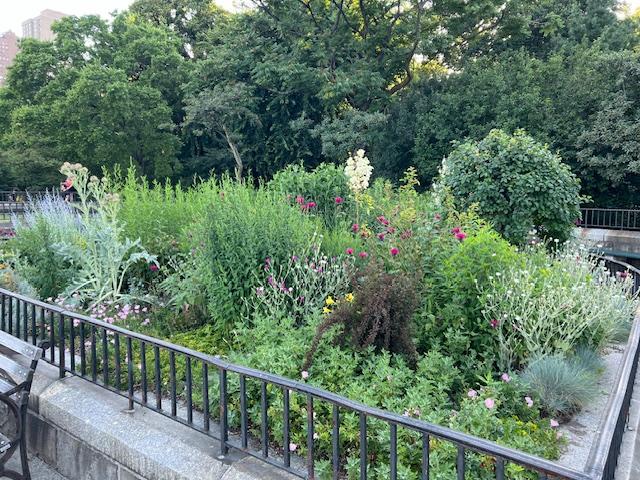
The gardens that line the esplanade on the East River

The Friends group that maintains the gardens does an excellent job with the planting and maintenance of the gardens.
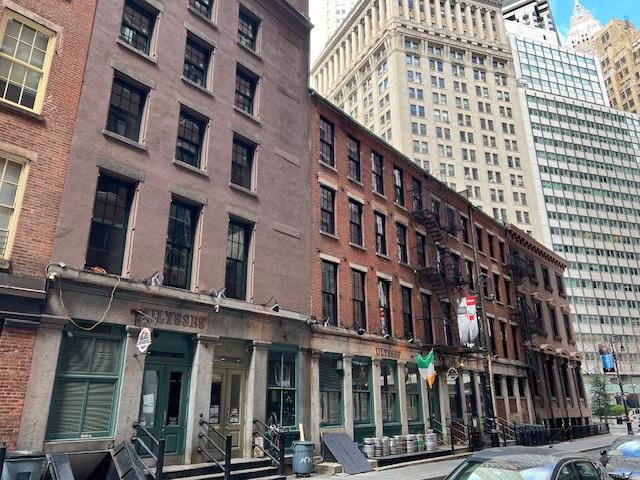
Visiting Stone Street in Lower Manhattan September 2017, November 2019 and April 2024

Visiting Stone Street in Lower Manhattan September 2017, November 2019 and April 2024

Visiting Stone Street in Lower Manhattan:

As part of my tour of Historic Bars and Pubs on Day One Hundred and Thirteen with the Cornell Club on May 9th, 2018, we toured the famous ‘Stone Street’ one of the original paved streets of Manhattan. You will not find architecture or pavings like this left in New York City. Here and there are streets or buildings that represent these times during the early to mid-1800’s but they are few and scattered in remote spots all over the island. Here the street still represents a different era of Manhattan.

Stone Street IV

The stores in the 90’s had been either boarded up or were used but in horrible shape. During the business hours not too many people inhabited this area of Lower Manhattan and it was ignored. The neighboring South Street Seaport was being transformed in the mid 80’s into a type of historic theme park and entertainment center by the Rouse Corporation. It put these old neighborhoods back into vogue and people started to return again.

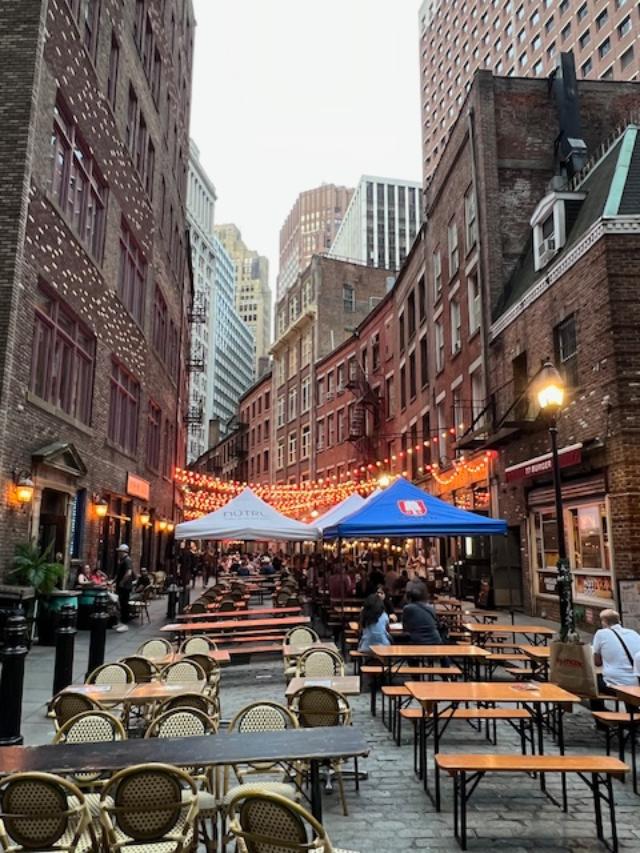
Over time, especially after 9/11 and the changes in downtown Manhattan, the street is now home to many trendy bars and restaurants and a hang out for the downtown business crowd. During the recent walking tour, the place was hopping with people spilling out of restaurants, ordering drinks during happy hour and eating pizza at the local pizzeria.

During ‘Happy Hour’ after work, the place is mobbed with people milling around having a good time. The tables toward the end of the street are filled with tourists taking pictures and at one end of the street is the famous “India House” and at the other is the Frances Tavern where George Washington gave his troops his farewell address.

Stone Street’s India House

It is not only a historical neighborhood but loaded with things to see and do. The buildings which were once in horrible shape have been brought back to life and repositioned to use for the meals and entertainment. It is interesting to see how a neighborhood comes back in full circle in a 150 years.

The Stone Street dining area in the warmer months.

History of the area:

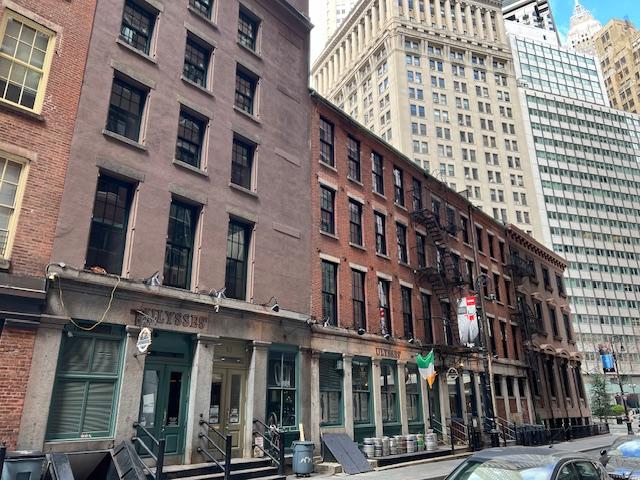
Stone Street is a short street in Manhattan’s Financial District. It originally ran from Broad Street to Hanover Square but was divided into two sections by the construction of the Goldman Sachs building at 85 Broad Street in the 1980’s. Today the cluster of historic buildings along Stone, South William, Pearl Streets and Coenties Alley form the Stone Street Historic District.

Fire of 1835 III

The area burned during the Fire of 1835

Stone Street is one of New York’s oldest streets. It was originally known by its Dutch name, Hoogh Staet (High Street). In 1632, the Dutch West India Company built the first commercial brewery in North America there. Around 1656, Hoogh Straet was shifted about twenty to twenty-five feet to align it with Brouwer Street, the extension of Hoogh Straet west of the Gracht and which in 1658 became the first paved street in Nieuw Amsterdam. Following the British conquest of the colony, the name Hoogh Straet was translated to High Street. It was then called Duke Street for the Duke of York during most of the 18th century. Leveled in 1771 and 1790, it was renamed Stone Street in 1794 because of it’s cobblestone paving as New Yorkers abandoned reminders of British Rule.

Fire of 1835

The Fire of 1835

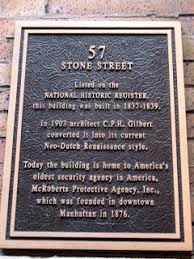
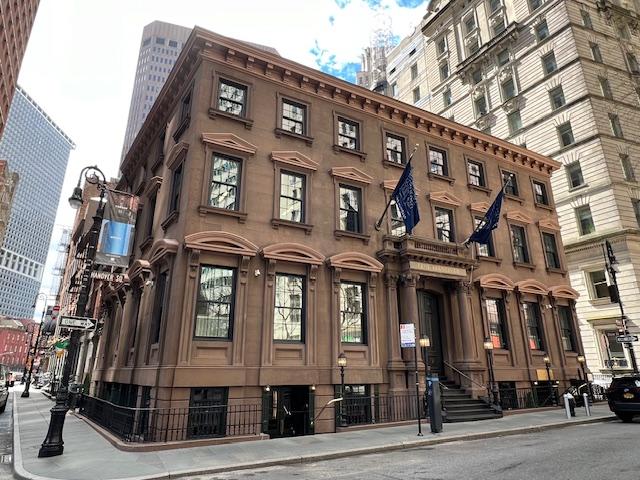
The street’s stores and loft were built for dry-goods merchants and importers, shortly after the Great Fire of 1835, which destroyed many remnants of New Amsterdam. Most buildings were used as storage. The building at 57 Stone Street was rebuilt in 1903 by C.P.H, Gilbert in Dutch Colonial Revivial architecture at the behest of the owner, Amos F. Eno as son of Amos R. Eno. The buildings to the back on South William 13-23 also were reconstructed in the Dutch revival style, evoking New Amsterdam.

Stone Street at night

Today is a busy series of bars and restaurants.

Following many decades of neglect, a joint partnership between the Landmarks Preservation Commission and other city agencies, the Alliance for Downtown New York and Stone Street owners has transformed Stone Street from a derelict back alley into one of Downtown’s liveliest scenes. Restored buildings, granite paving, bluestone sidewalks and period lights set the stage for the half dozen restaurants and cafes, whose outdoor tables are very popular on warm summer nights.

The eastern portion of the street and the surrounding buildings have been protected since 1996 by the New York City Landmarks Preservation Commission as the Stone Street Historic District and is pedestrian only. The historic district is now populated by several restaurants and bars and has a outdoor dining when the weather permits. The India House historic landmark is located at the Hanover Square end of the street.

(This information was taken directly from Wikipedia and I give them full credit)

Lambert Castle/Passaic County Historical Society                   3 Valley Road                                                                                Paterson, NJ 07503

Lambert Castle/Passaic County Historical Society 3 Valley Road Paterson, NJ 07503

Lambert Castle/Passaic County Historical Society

3 Valley Road

Paterson, NJ  07503

Phone: (973) 247-0085

Fax: (973) 881-9434

info@lambertcastle.org

http://www.lambertcastle.org

https://lambertcastle.org

Hours:

Museum Wednesday-Sunday-1:00pm-4:00pm

The Castle closed for a five year renovation starting January 2020.

Library & Archives Wednesday-Friday-1:00pm-4:00pm/2nd and 4th Saturday of each month 1:00pm-4:00pm (Memorial Day through Labor Day: 12:00pm-4:00pm)

Admission: $5.00 Donation

My TripAdvisor Review:

https://www.tripadvisor.com/Attraction_Review-g46718-d1880569-Reviews-Lambert_Castle-Paterson_New_Jersey.html?m=19905

I have visited Lambert Castle a few times, most recently to see the Christmas decorations before they were taken down for the season. I found out from one of the director’s that they had not been put back up since their Holiday Bazaar back in November. I had seen them the year before and they had been very impressive.

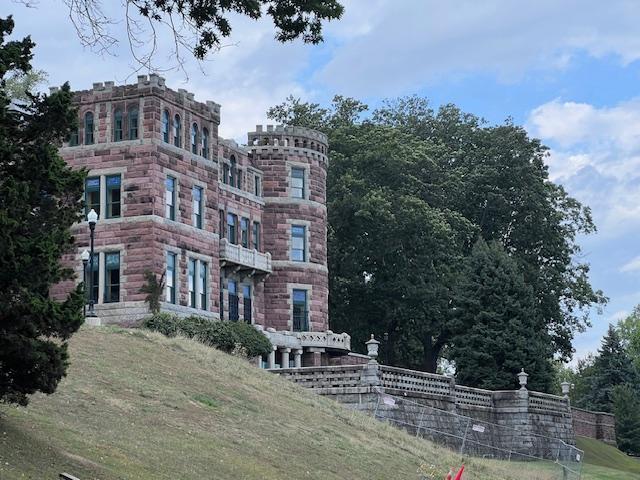
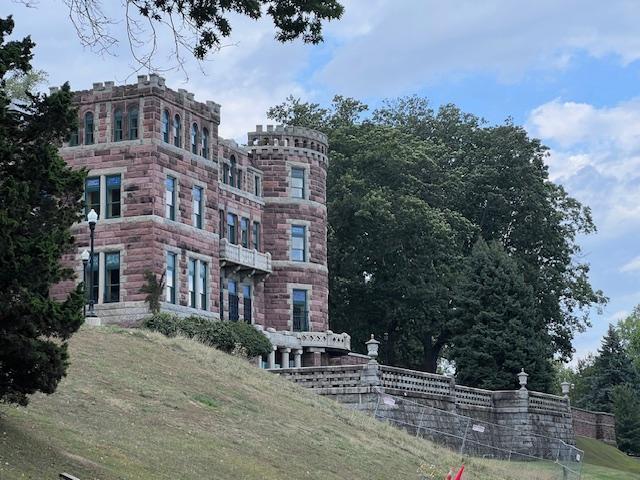
Lambert Castle during the renovation in 2025

Right now the Castle is decorated for the Annual Christmas Craft Bazaar and it is just loaded with handmade crafts for the Christmas holidays. There are three floors of crafts and then on the third floor, there is a small restaurant to relax and look over the court of the house. After the bazaar in 2019, the Castle will close for a much needed five year renovation.

lambert-castle-vi.jpg

The Lambert Castle Christmas Bazaar 2019

I had a chance to visit the floors when they were not decorated for the holidays . The first floor is set up as if the family still lived there with the Billiards Room, Dining Room, Sitting Room, Music Room and Atrium still set as the family resided there. There is period furniture and decorations in all the first floor rooms to give a feel of what it must have been like to live there at that period.

lambert castle ii

The view of Lambert Castle from the second floor

The second floor galleries hold the collection of the Passaic County Historical Society with all sorts of objects, signs and historical items from all eras of the collection. You are able to see the footprint of the living quarters of the family.

Lambert Castle V.jpg

The stained glass windows

The third floor at the time I was there was dedicated to the work of an Italian stone worker and artist who migrated and lived and worked in Paterson.

It is a very interesting way to see life at the turn of the last century in Paterson and the home offers a beautiful view of the City of Paterson and New York in the distance. I have never seen the grounds in the Spring but I am sure that they are quite lovely.

The view alone is worth the visit.

Don’t miss this virtual tour of the Castle and await until the renovations are done to visit again.

Bergecco-Parc Consulting Inc. commercial on Lambert Castle in 2019.

Bergecco-Parc Consulting Inc. Project: “Take me back to Paterson, NJ”.

History of Lambert Castle:

Catholina Lambert and his Castle:

Catholina Lambert was born in 1834 in Goose Eye, England. In 1851 at the young age of 17, Lambert left home to seek his fortune in the “Land of Opportunity” that was America. After several successful ventures in the silk industry, Lambert decided to build a home that would be reminiscent of the castles he recalled from his boyhood in England. In 1892, he built his own castle on Garret Mountain in Paterson, NJ, then known as the “Silk, City of the New World.”

Catholina Lambert II

Catholina Lambert

Lambert’s home was built to showcase his elaborate art collection  of fine European and American paintings and sculpture. At one time, his collection was so vast that it was considered to be “the nucleus of an American Louvre.” In 1913, Lambert fell into debt and his fortune started to dwindle. As a result, he was forced to mortgage the Castle and eventually sell much of his art collection. The proceeds allowed him to live comfortably in the Castle until his death at age 89 in 1923.

After Lambert’s death, his son, Walter sold the Castle to the City of Paterson, which later sold it to the County of Passaic. Today the Castle is still owned by the County and  serves as the headquarters of the Passaic County Historical Society. The Society, a private not for profit organization, owns the historical artifacts and works of art.

Catholina Lambert

Catholina Lambert and Company

The home and the museum, exist as a reminder of a bygone era and as a tribute to the great accomplishment of  the Castle’s creator. Although most of the furnishings today are not original to the Lambert’s home, they represent period furnishings that would have been found in the Castle during the Lambert era.

For more information about the rooms and decor, visit The Lambert Castle Blog at:

https://lambertcastleweb.wordpress.com/museum

Passaic Historical Society:

The Society & Museum:

The Passaic County Historical Society is a private non-profit educational organization founded in 1926 and dedicated to cultivation of interest in the history and culture of Passaic County and former home of silk magnate Catholina Lambert was built in 1892. The Castle is owned by the County of Passaic and has been the home to the Society since 1934.

Library & Archives:

Located in the lower level of the Castle is the Elizabeth A. Beam Memorial Historical Research Library, operated by the Passaic County Historical Society. Here scholarly researchers, genealogists and historical enthusiasts may find books, manuscripts, maps, photographs, genealogy records and other information that reveals the history of Passaic County. Access to the library is included with regular admission to Lambert Castle.

Membership:

The Society depends upon the support of its membership as well as museum admission to sustain its important mission. Please consider becoming a member and helping to preserve the history of Passaic County.

The Second Floor Galleries:

The Castles’s second floor has several exhibition galleries, each presenting a different historical display from the Society’s collections. To the right of the fireplace on the walls of the second floor balcony is an exhibition of works by noted Paterson artist Julian Rix. On the opposite side are portraits of notable Passaic County residents and a collection of historic engravings of the Passaic Falls. Behind the fireplace are the Lambert’s private rooms. To the left, in the former sitting room and bedroom of Mr. Lambert, are the Curiosities and Local Folk Art galleries and the famous Brass Dog Sculpture that served for many years as an advertising sign for a tinsmith’s shop in nineteenth-century Paterson. In the adjacent room, the former bedroom of Mrs. Lambert, is the Local History Gallery which features historical images of prominent businesses and people.

The Third Floor Exhibition Gallery:

The Third floor of Lambert Castle is reserved for changing or seasonable exhibitions.

Disclaimer: This information comes directly from the Passaic County Historical Society & Museum pamphlet and I give them full credit of it. Rather than transcribing the whole pamphlet with the description of rooms, I attached their website and blog on WordPress.com for more detailed viewing.

Charging Bull                                                 Bowling Green Park                                            New York, NY 10004

Charging Bull Bowling Green Park New York, NY 10004

Charging Bull

Bowling Green Park

New York City, NY  10004

http://www.chargingbull.com/

TripAdvisor Review:

https://www.tripadvisor.com/Attraction_Review-g60763-d1605557-Reviews-Charging_Bull_Wall_Street_Bull-New_York_City_New_York.html?m=19905

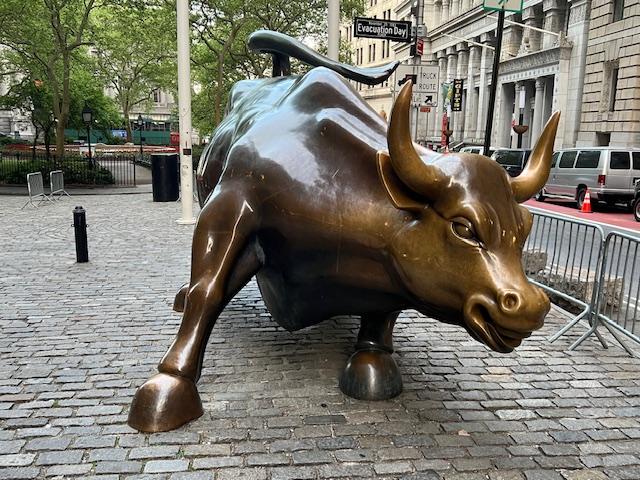
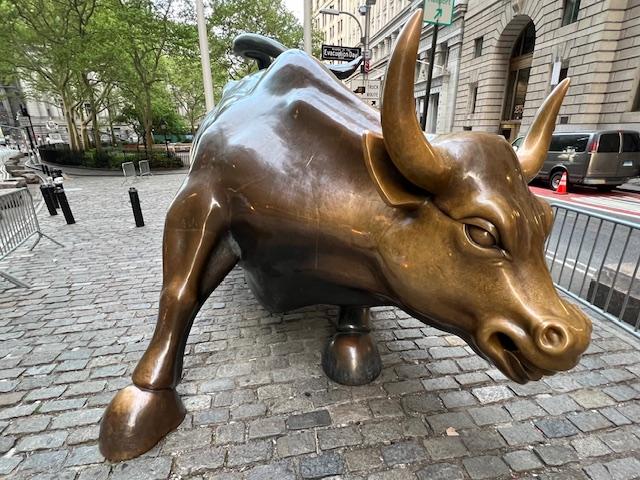
When you are in lower Manhattan and are visiting the Battery Park and/or Wall Street area don’t miss the Charging Bull statue by artist Arturo Di Modica. The artist created this piece of ‘guerrilla’ art after the Crash of 1987, when we were about to enter the depths of another major recession, one that went from the end of 1987 until the summer of 1995.

This interesting piece of New York history is actually a recent addition to the street art of New York City. The statue was created and cast in 1987 following the Crash and made its first appearance outside the New York Stock Exchange on December 15, 1989.

The bull according to the artist, “represents the symbol of the strength and power of the American people’ following the Crash. It has taken on many meanings since such as the power of Wall Street and the progressiveness of money and power in the Financial industry.

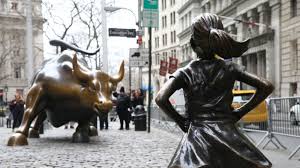
During the high tourist season expect to see the statue surrounded by tourist taking pictures in all directions. The statue of ‘Charging Bull’ is now paired with ‘Fearless Girl’ by artist Kristen Visbal. Some have commented that it has changed the meaning of the statue but I think it is how you interpret both works. Its best to visit and make your own opinion.

Fearless Girl Statue II

The ‘Charging Bull’ with ‘Fearless Girl’

While you are visiting the statue, take time to visit this historic section of Manhattan and visit the other sites that include Bowling Green Park, the Museum of the Native Americans, Frances Tavern and Stone Street as well as the boats to Governor’s, Ellis and Liberty Islands. It is a wonderful way to spend the afternoon.

Please refer to my blog, ‘MywalkinManhattan.com’- “Day One Hundred and Thirteen Tour of Historic Pubs and Bars in Lower Manhattan with the Cornell Club” for a full list of things to see in this section of the City.

History of Charging Bull:

Construction and installation:

The Bull by Bowling Green Park in the early morning hours.

The bull was cast by the Bedi-Makky Art Foundry in Greenpoint, Brooklyn. Di Modica spent around $360,000 to create, cast and install the sculpture following the 1987 stock market crash as a symbol of the ‘strength and power of the American people’. The sculpture was Di Modica’s idea and in an act of ‘guerrilla art’, Bedi Makky Art Foundry and Di Modica trucked it to Lower Manhattan. On December 15, 1989, they installed it beneath a 60 foot (18m) Christmas tree in the middle of Broad Street in front of the New York Stock Exchange as a Christmas gift to New Yorkers. That day, hundreds of onlookers stopped to admire and analyze it as Di Modica handed out copies of a flier about his artwork (Wiki).

NYSE officials called the police later that day and the NYPD seized the sculpture and placed it into a impound lot. The ensuing public outcry led the New York City Department of Parks & Recreation to reinstall it two blocks south of the Exchange in the Bowling Green, with a ceremony on December 21, 1989. It faces up Broadway at Whitehall Street (Wiki).

Confusion over ownership:

The sculpture technically has a temporary permit allowing it to stand on city property since the city does not own the sculpture but the temporary permission has lasted since 1989, when city officials said the new location would not be permanent. Art on loan is usually limited to a year’s display and although the city does not buy art, it does accept donations. A writer in the New York Daily News wrote in 1998 that the statue’s placement was ‘beginning to look a mite permanent.’ According to an article in Art Monthly, Di Modica as well as officials and New Yorkers, ‘view it as a permanent feature of Lower Manhattan (Wiki).

In 2004, Di Modica announced that the bull sculpture was for sale, on condition the buyer does not move it from its present location. Di Modica continues to own the artistic copyright to the statue. In 2006, Di Modica sued Walmart and other companies for illegally benefiting from his copyright, by selling replicas of the bull and using it in advertising campaigns. In 2009, Di Modica sued Random House for using a photo of the bull on the cover of a book discussing the collapse of financial services firm Lehman Brothers (Wiki).

Artist Arturo Di Modica:

Arturo Di Modica artist

Artist Arturo Di Modica

http://www.artnet.com/artists/arturo-di-modica/

Arturo Di Modica first conceived of the Charging Bull as a way to celebrate the can-do spirit of America and especially New York, where people from all over the world come regardless of their origin or circumstances and through determination and hard work overcome every obstacle to become successful. It’s this symbol of virility and courage that Arturo saw as the perfect antidote to the Wall Street Crash of 1987.

The artist was born in Vittoria, Italy in 1941 and studied at the Academia Del Nudo Libra in Florence, Italy in 1960. In 1973, he relocated to New York City to a Lower Manhattan space. ‘Charging Bull’ is his most famous piece (Artnet).