I recently visited the Museum of Arts & Design for the “Too Fast to Live, Too Young to Die: Punk Graphics 1976-1986” exhibition on the rise of Punk and New Wave music that came onto to the radar during the end of the Vietnam War to the Second Reagan Administration. I remember how the music was changing from folk and funk to the beginnings of ‘Underground’ music and then the rise of the Disco era.
The posters of ‘Punk Graphics’
The exhibition displayed all the posters and flyers from the clubs like the Mudd Club, CBGB’s, Max’s Kansas City and Danceteria when they were in their heyday. Groups that were included in the exhibition were such known names as DEVO, The Talking Heads, Blondie, Richard Hell and The B52’s. This was at a time of collages and photocopying so the posters and flyers could be rudimentary but made their point. It got people into the door.
It was also a time that graffiti artists could show their work off and integrated themselves into the music scene. So it is a nice combination of music, video and pictures. Take time out to listen to the songs and really look at the pictures at the music leaders at the time. It really does capture a moment in history.
‘Punk Graphics’
I also got to see the Roger Brown exhibition of paintings and ceramic work which bought to light the artists paintings along with items that he found over the years to match with his work. It was different.
The latest exhibition running through the holidays and into the new year of 2020 is the Anna Sui, the American designer, exhibition with a retrospect of her work over the last twenty years.
Designer Anna Sui at the opening of the exhibition of her work
Ms. Sui’s works can be labelled as Grunge, Surfer, Street Wise and Classic. The exhibition covers her clothing line, jewelry and accessories and extensive cosmetic line. When I was taking the walking tour of the exhibition, the docent said that she was involved in every aspects of her business as well as the runway shows. It was a unique display of her work over her career.
History of the Museum of Arts & Design:
The museum first opened its doors in 1956 as the Museum of Contemporary Crafts whose original mission of recognizing the craftsmanship of contemporary artists. Nurtured by the vision of philanthropist and craft patron, Aileen Osborn Webb, the museum mounted exhibitions that focused on the materials and techniques associated with craft disciplines. From the earliest years, the Museum celebrated the changing roles of craftsmanship in society, served as an important advocate for emerging artists and linked art to industry (Wiki).
From 1963 to 1987, under the directorship of Paul J. Smith, the Museum presented dynamic and often participatory exhibitions that reflected the social currents of the era and broke down hierarchies in the arts with the celebration of popular culture and mundane materials. In 1979, the Museum reopened as the American Craft Museum in an expanded location at 44 West 53rd Street. To accommodate its ever-growing programming, the Museum relocated again in 1986 to its 18,000 square foot home at 40 West 53rd Street, where it remained until 2008 (Wiki).
The next ten years were a period of rapid growth and change as the American Craft Council was restructured and the Museum and the Council were established as independent organizations. Holly Hotchner was appointed as director of the Museum in 1996 and served as director for 16 years until 2013. Hotchner initiated a comprehensive strategic planning process that expanded the Board of Trustees, curatorial staff and exhibition and educational program. This process led to the Museum’s name change in 2002 to the Museum of Arts & Design to reflect the institution’s increasingly interdisciplinary collections and programming. The continued growth of MAD’s collections, public programs and attendance resulted in its successful 2002 bid to the New York Economic Development Corporation to acquire the building at 2 Columbus Circle (Wiki).
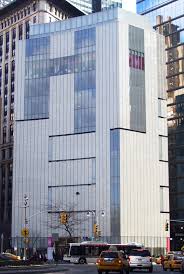
The Museum opened in its new home at 2 Columbus Circle to great controversy. The purposed changes to the building originally designed by Edward Durrell Stone sparked a preservation debate by many artists. The new building was designed by Brad Cloepfil of Allied Works Architecture in September 2008. With its facade of glazed terra-cotta tile and fritted glass, the Jerome and Simona Chazen Building reflects MAD’s craft heritage and permanent collection and animates Columbus Circle (Wiki).
I recently visited the American Folk Art Museum in New York City for the “Made in New York City” exhibition and it is a very interesting and engaging museum. The artwork for the museum was a combination of painting, sculpture, pottery and metal work created at different periods of the City’s history. It really showed the extent of manufacturing in New York City and the craftsmanship that was once here.
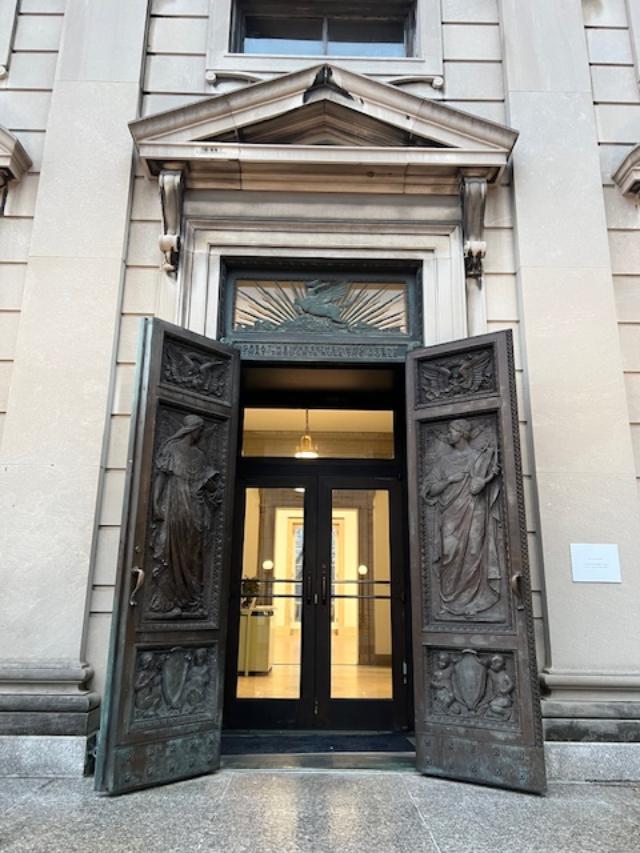
The entrance to the museum
I recently visited the American Folk Art Museum in New York City for the “Nation”exhibition and it is a very interesting and engaging museum.
The main gallery of the museum with early American art
The main gallery with one of the revolving shows
The artwork for the museum was a combination of painting, sculpture, pottery and metal work created at different periods of the City’s and the Country’s history.
Some of the permanent works were made in the Tri-state area. It really showed the extent of manufacturing in New York City and the craftsmanship that was once here.
The ‘Folk Nation’: Crafting Patriotism in the United States’ exhibition
Patriotism in the United States draws from the American Folk Art Museum’s rich collections to explore links between vernacular art and the construction of an American sense of self. Introducing visitors to the concept of “folk” as a category developed in conjunction with the art and antiques markets, this exhibition positions works as multilayered in their meanings, imbued with cultural significance by not only their creators, but also their collectors and subsequent owners. Americans have long preserved objects as a way of telling stories about themselves. Beginning after the Revolutionary War and gathering momentum in the late nineteenth and early twentieth centuries, people turned to early American things to construct a national history and sense of collective identity—an impulse often driven by lingering insecurity about the young nation’s perceived cultural provinciality compared to Europe (Folk Art Museum.com).
One of the painting’s that stood out to me was more contemporary approach to the Statue of Liberty, entitled ‘Miss Liberty reaches out to the persecuted’. A different approach to folk art.
The painting ‘Miss Liberty reaches out to the persecuted’ by Reverend Benjamin Franklin Perkins
The description of the painting
Some of the interesting things you will see are the paintings by artists in both Colonial New York and from the Hudson River School of prominent New Yorkers through its first 200 years of history. You will see how the styles of art have changed over the years.
Also there is a lot of metal work in the ways of signs and rods for the front of doors and for the roofs. The woodwork carvings that once graced the front doors of merchants all over the City is now a lost art. Here you could see the works of German and Russian carvers and the craftsmanship that was put into every piece. It was interesting too to see the racial themes and stereotypes that were used in the art.
Several revolving shows were being featured on a recent trip to the museum such as ‘Nation’ and ‘Self Made’, themed shows for the 250th Anniversary of the Country.
The show ‘Self Made’ A century of inventing artists’
Self-Made: A Century of Inventing Artists takes a critical look at the historical definition of the “self-taught artist” in the United States from the early twentieth century to today. The exhibition examines how artists without academic training have depicted, conceptualized, and identified themselves on their own terms. In doing so, it aims at challenging reductive, long-standing narratives that have cast these artmakers as amateurs or isolated geniuses working out of time, without lineage, influence, or artistic networks (Folk Art Museum.com).
The sixty artists featured here largely worked outside conventional art-school, gallery, museum, and peer-exchange systems. Their practices are rooted in diverse sites of learning, from professional expertise to community-based traditions. Drawn primarily from the American Folk Art Museum’s collection, this selection of artworks brings together outstanding examples of paintings, sculptures, photographs, videos, and artists’ notebooks by key national and international figures—many of them recent or rarely seen acquisitions (Folk Art Museum.com).
The exhibition is organized around three methods of artistic “self-making” and self-fashioning: self-portraits, alter egos, and autobiographies. Each gallery unfolds chronologically, providing grounding for the artists’ intentions. The works function as primary documents: firsthand accounts of the self, authored by the self. Akin to diaries or other personal statements, they call for close attention, asking viewers to “look at me, in this way, that I have chosen.” By centering the makers’ perspectives and aesthetic choices, Self-Made shifts the focus away from the viewer’s role in completing the creative act and places it squarely on the artist’s agency (Folk Art Museum.com).
Some of the paintings that stood out seemed to be self-portraits.
The painting ‘Untitled’
The painting ‘Untitled’
The museum takes different approaches to the way art is portrayed.
Another program that the museum does well is they have afternoon Jazz Wednesdays and Free Concerts on Friday nights.
There are family programs, walking tours, curator talks and lectures as part of the museum programming so there is something for everyone.
The American Folk Art Mission:
(From the Museum website)
Since 1961, the American Folk Art Museum has been shaping the understanding of art by the self-taught through its exhibitions, publications and educational programs. As a center of scholarship and by showcasing the creativity of individuals whose singular talents have been refined through experience rather than formal artistic training, the museum considers the historical, social and artistic context of American culture. Its collection includes more than seven thousand artworks dating from the eighteenth century to the present, from compelling portraits and dazzling quilts to powerful works by living self-taught artists in a variety of mediums (Museum bio).
Self-Taught art, past and present, tells empowering stories of everyday life. The field of American folk art was first defined at the turn of the twentieth century by collectors, professional artists, critics, dealers and curators whose search for an authentic American Art seemed to be finally answered in works that presented a nuanced of national identity, faith, progress, ingenuity, community and individuality. Under the umbrella of “folk art” expanded to also include artists working in the present. For the last twenty years, the term self-taught has more regularly come to address these artists, whose inspiration emerges from unsuspected paths and unconventional places, giving voice to individuals who may be situated outside the social mainstream. Those individuals have been active participants in the shaping of American visual culture, influencing generations of artists and establishing lively artistic traditions (Museum History).
American Folk Art Museum History:
(From the Museum website)
The museum of Early American Folk Arts as it was known initially held its first exhibition in a rented space on 49 West 53rd Street in 1961. The museum’s collection was launched in 1962 with the gift of a gate in the form of an American flag, celebrating the nation’s centennial. The gift reflected the museum’s early focus on eighteenth and nineteenth century vernacular arts from the northeast America.
In 1966, after receiving a permanent charter, the museum expanded its name and mission. As the Museum of American Folk Arts, it looked beyond the traditional definitions of American folk art. Its exhibitions and collection began to reflect “every aspect of the folk arts in America-north, south, east and west.” Founding curator Herbert W. Hemphill Jr. “expanded the notion of folk art beyond traditional, utilitarian and communal expressions.” Under his direction, the museum began to champion idiosyncratic and individualistic artwork from the fields of traditional and contemporary folk art. In doing so, the museum ushered in a new era in the field of twentieth-century folk art (Museum History).
The 1990’s brought new focus to the diversity and multiculturalism of American Folk Art. Offering a more inclusive vision. the museum began to present African American and Latino artworks in their exhibitions and permanent collections. Director Gerard C. Wertikin announced American folk art’s common heritage as “promoting an appreciation of diversity in a way that does not foster ethnic chauvinism or racial division.” (Museum History).
The museum further established its broadened outlook with the 1998 formation of the Contemporary Center, a division of the museum devoted to the work of 20th and 21st century self-taught artists as well as non-American artworks in the tradition of European art brut. In 2001, the museum opened the Henry Darger Center to house 24 self-taught artist’s works as well as a collection of his books, tracings, drawing and source materials (Museum History).
The gift shop
In 2001, the museum chose its current name, American Folk Art Museum. Recognizing that American Fold Art could be fully understood in an international context, the word American functions as an indication of the museum’s location, emphasis and principal patronage rather than as a limitation on the kind of art it collects, interprets or presents. The museum’s current programming reflects this shift in focus. Past exhibits have included folk arts of Latin America, England, Norway, among other countries and continents (Museum history).
Don’t miss this amazing little museum on the Upper West Side of Manhattan.
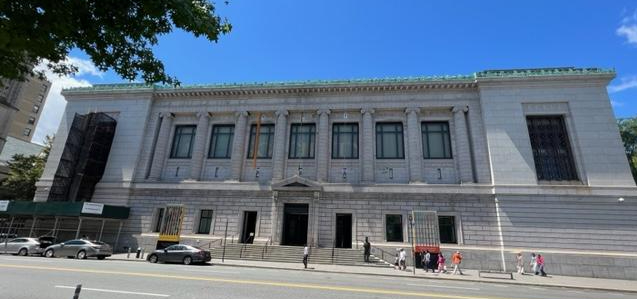
The New York Historical Society at 170 Central Park West
I have visited the New York Historical Society several times over the years and I have to say that make quite a statement on the history of New York City and the State of New York City. It has a interesting permanent collection of paintings and statuary. There are a lot of things that First Families of New York City have donated to the museum that tell the story of families born and raised here.
I was honored here years ago when a picture I took for the 9/11 Photo Album Book came out in 2002. All the photographers that contributed to it were in attendance. Another time I was here for a private event on John Adams back in the early 2000’s that was injunction with the American Museum of Natural History. Over the years, the Historical Society has brought in more interesting exhibitions. The current exhibition “Hudson Rising” on the history and ecological changes due to humans along the Hudson River. It was an interesting look of the natural changes to the river from manufacturing times today as the river is being reclaimed for recreational uses.
‘Hudson Rising’ Exhibition
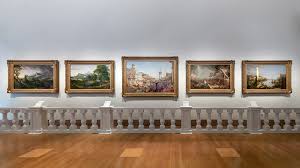
The whole museum is a retrospect on the timeline of the New York City with an array of art out any one time. There are Masters from the Hudson River School, statues from all eras and special exhibitions that tell an interesting story of some part of the City’s past.
Hudson River School Paintings for ‘Hudson Rising’
History of the NY Historical Society:
The Historical Society was founded on November 20, 1804 largely through the efforts of John Pintard. He was for some years secretary of the American Academy of Fine Arts as well as the founder of New York’s First Savings Bank. With a group of prominent group of New Yorkers on the founding board including then Mayor DeWitt Clinton, the organization was established on December 10, 1804 (Wiki).
The Collections of the NY Historical Society
The NY Historical Society had its share of growing pains over the years in that it had been in heavy debt during its first couple of decades. It also moved several times over the years as well. It moved from the Government House, which it had been housed in since 1809 to the New York Institution, the formerly the city almshouse on City Hall Park in 1816. In 1857, it moved into the first building constructed specifically for its collection at Second Avenue and 11th Street. The collection moved to its final home to Central Park West in 1908 (Wiki).
The current Society building was designed by architects York & Sawyer, who were known for bank designs. The second part of the building was designed by architects Walker and Gillette. The building has just finished a $65 million dollar renovation in 2011 and all the galleries have been refreshed. The new director of the Society, Louise Mirrer is leading the establishment into the 21st Century.
On Friday night’s from 6:00pm-8:00pm it is ‘pay as you wish’ to enter the museum.
The front of the American Museum of Arts & Letters at 633 West 155th Street
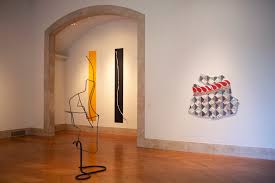
I was finally able to visit the American Academy of Arts and Letters on the last day it was open for the year to the public. It was for the ‘Ceremonial Exhibition: Work by New Members and Recipients of Awards’, an exhibition on members art that was chosen specifically for the show. Most of the work was very contemporary and some a little political. It was interesting work by new artists that filled the small gallery rooms.
The front of the American Museum of Arts & Letters
One of the buildings was used for the contemporary art while the one across the courtyard was used for the more architectural pieces. The galleries are small but the art was impressive. What I liked when I talked with one of the women who worked there said to me that after the show, the pieces would be donated to galleries and museums all over the country. The galleries are only open four months out of the year and this was the last day of the exhibition so the work being shown will be gone.
I visited the museum in January 2025 and it had just reopened after a three year renovation after it had been closed since Pre-COVID and it is now fully open with a new exhibitions. All the galleries are brightly lit and displaying new exhibitions.
The entrance to the museum from the courtyard
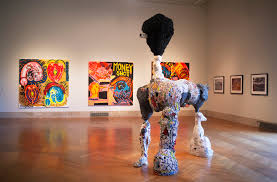
Some of the pieces that really stood out when I visited in 2019 were by Judith Bernstein, a contemporary painter who seems to not like the current administration too much. The themes were on power and money and corruption in the administration. Her work really shows what she personally thinks of our President. Her ‘Trump Genie” was very clever and I can see this in a major museum in the future.
Judith Bernstein’s work
Other work in the main gallery in 2019 were by artists Stephen Westfall with ‘Solid Gone’, Hermine Ford with ‘Paris, France’ and Paul Mogensen with several ‘Untitled’ pieces. The contemporary works I was not sure what the meaning of them were but they were colorful.
The works of the artists of the front gallery
One of the pieces in the front gallery that really stood out was by artist Francesca Dimattio, ‘She-wolf’ which was a classic Greek character made of porcelain, enamel, paint and steel.
‘She-wolf’ by Francesca Dimattio
There were light installations in 2019 that were very interesting by artist James O. Clark. He had one piece, ‘Wunnerful, Wunnerful’, which is a work that just keeps being creating itself by bubbles and ink markers moving along a turntable that stops and starts.
There was a permanent exhibition of Charles Ives home in Connecticut that was transported and recreated here. His studio and works are featured here as well as his family life. There are copies of his works in the display cases and his career.
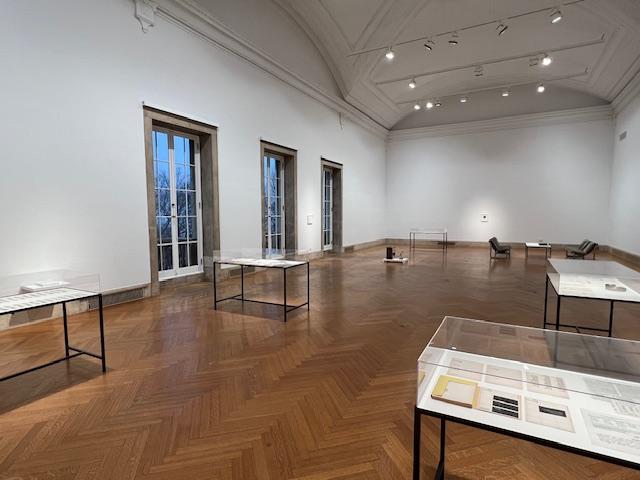
The museum in 2025 was fully open with the exhibition by artist Christine Kozlov, a contemporary Video artist whose works were being featured in the main gallery.
The main gallery of the Kristine Kozlov exhibition
In more than fifty artworks arrayed across four galleries at Arts and Letters, Christine Kozlov shows the breadth of Conceptual artist Christine Kozlov’s practice with a focus on works from the mid-1960s through the late 1970s. Nearly all of the works Kozlov contributed to public exhibitions during this period will be on view, many of which were created for landmark exhibitions of Conceptual art such as: One Month (1969), organized by Seth Siegelaub; Information (1970), curated by Kynaston McShine at the Museum of Modern Art, New York; Arte de Sistemas organized by Jorge Glusberg / CAYC—Centro de Arte y Comunicación at the Museo De Arte Moderno (1971); and the Number Shows, a series of exhibitions curated by Lucy Lippard between 1969 and 1974 (American Museum of Arts & Letters website).
Part of the Kristine Kostov exhibition
Works by artist Christine Kozlov
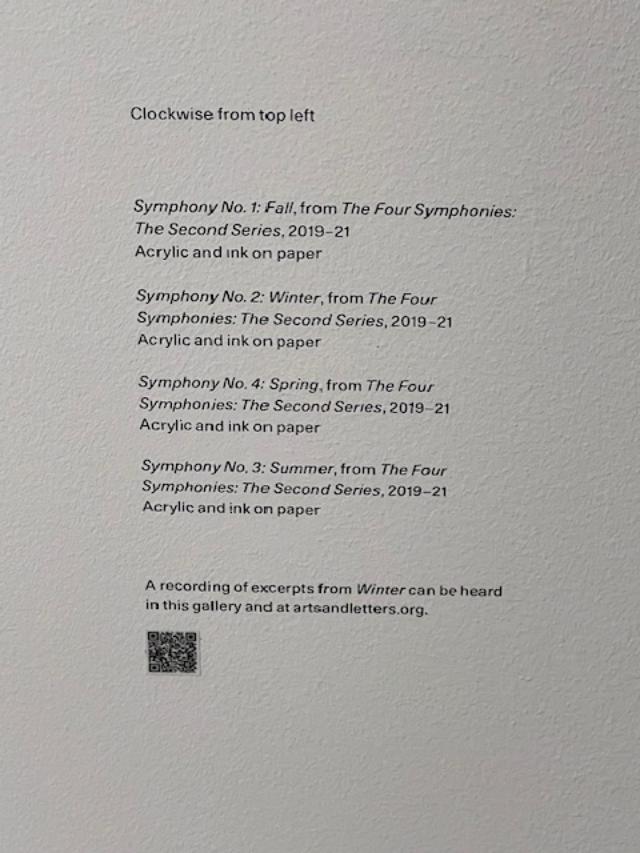
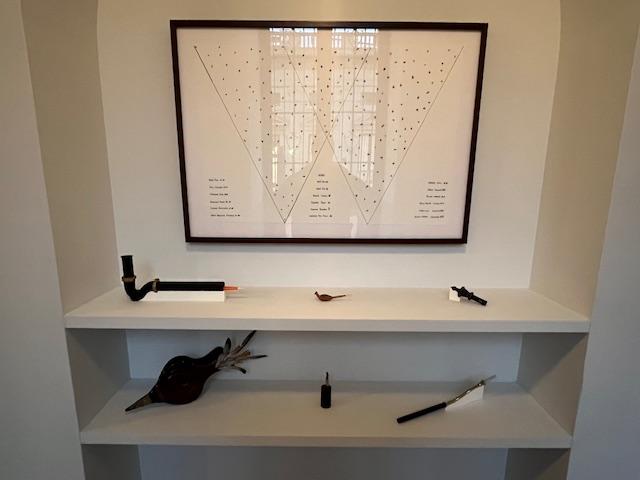
The next exhibition that I viewed was by artist Wadada Leo Smith, which consisted of an exhibition based on colors and sounds. You could take the headsets around the gallery and tour and admire the work with the sounds of the musical groups.
The gallery with works by artist Wadada Leo Smith
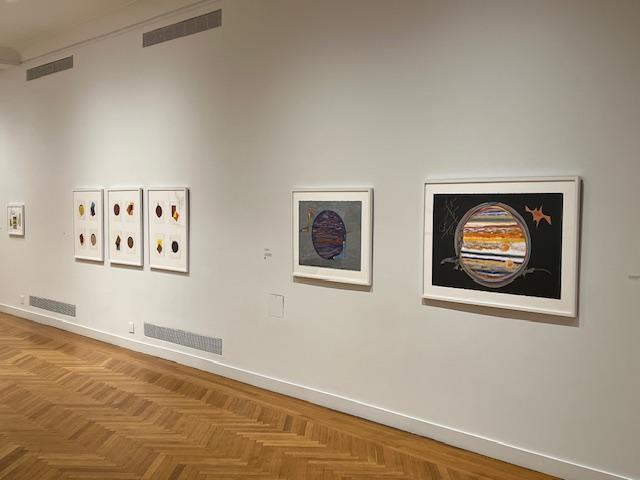
Wadada Leo Smith (b. 1941, Leland, MS) is a composer-performer and Arts and Letters member. Formerly an educator at CalArts, he has influenced decades of musicians and artists, including Raven Chacon. In Kosmic Music, Smith’s first solo exhibition in New York, he shares over fifty years of Ankhrasmation (Museum website).
The “Sphere” works by artist Wadada Leo Smith
Ankhrasmation is a musical language Smith began exploring in 1965. Smith does not consider Ankhrasmation to be his creation but rather something he discovered. The name derives from Ankh,anancient Egyptian symbol of life; Ras,an Ethiopian word for leader or father; and Ma, for mother. The distinctive language uses line, color, and shape to designate musical components such as tonal range and intensity of activity. For Smith, performing Ankhrasmation requires focused practice and “having that space in your heart and mind so that you can play from inspiration.” (Museum website).
The last exhibition I saw was in the gallery across the courtyard from the main museum was by artist Raven Chacon. You would walk in the main gallery to the sounds of birds both living and extinct. Just five minutes in the main gallery by myself and I felt like Tippi Hedren in the movie “The Birds”. There were all sorts of bird sounds with no birds around.
The instruments that the artist uses to achieve the sounds of the birds
When Raven Chacon (b. 1977, Fort Defiance, Navajo Nation) visited Arts and Letters for the first time, he paused in our North Gallery to clap his hands, then counted how long it took for the room to go silent. It took around six seconds—a long rate of decay. Standing in that echoing chamber, Chacon noted the building’s Beaux Arts design by Cass Gilbert, with its imported Spanish tile and cage-like glass ceiling that filters the sky. He became curious to learn the history of the land it sits on, once owned by John James Audubon, who purchased it in 1841 with funds from the sale of his illustrated Birds of America (Museum website).
Chacon is a composer and artist who frequently works with the materials and histories of a given site and who considers, as he puts it, “what has been silenced and what happens when it is not.” For the past year, he has worked on Aviary, his site-specific commission for the North Gallery, creating a soundscape that makes space and time for careful listening (Museum website).
Museum Mission:
(from the museum website)
The American Academy of Arts & Letters was founded in 1898 as an honor society of the country’s leading architects, artists, composers and writers. Charter members include William Merritt Chase, Kenyon Cox, Daniel Chester French, Childe Hassam, Henry James, Theodore Roosevelt, Elihu Vedder and Woodrow Wilson. The Academy’;’s 250 members are elected for life and pay no dues.
The main gallery of the museum
In addition to electing new members as vacancies occur, the Academy seeks to foster and sustain an interest in Literature, Music and the Fine Arts by administering over 70 awards and prizes, exhibiting art and manuscripts, funding performances of new works of musical theater and purchasing artwork for donation to museums across the country.
Collections:
(from the museum website)
The Academy’s collection, which are open to scholars by appointment, contain portraits and photographs of members, as well as paintings, sculptures, drawings, prints and decorative art objects. The library has more than 25,000 books by or about members. The archives house correspondence with past members, press clippings, institutional records and original manuscripts of musical and literary works.
History:
(from the museum website)
The National Institute of Arts & Letters, the parent body of the Academy, was founded in 1898 for “the advancement of art and literature”. The Institute met for the first time in New York City in February 1899 and began electing members that fall. Architects, artists, writers and composers of notable achievement were eligible and membership was soon capped at 250. In 1913, President Taft signed an act of Congress incorporating the organization in the District of Columbia.
American Academy of Arts & Letters at twilight
In 1904, The Institution created the American Academy of Arts & Letters, a prestigious inner body of its own members that modeled itself on the Academie francaise. The first seven members of the Academy were William Dean Howells, Augustus Saint-Gaudens, Edmund Clarence Stedman, John La Farge, Mark Twain, John Hay and Edward MacDowell. Those seven then chose eight more and so on, until the full complement of 30 and later 50 was reached. Only after being elected to the Institute, was a member eligible for elevation to the Academy. This bicameral system of membership continued until 1993, when the Institute dissolved itself and all 250 members were enrolled in the American Academy of Arts and Letters.
The Academy inaugurated its annual awards program in 1909 with the Gold Medal for Sculpture. Since then, over 70 awards and prizes have been endowed through gifts and bequests or established by the Academy’s board of directors in the fields of architecture, art, literature and music. There are conferred each year at the Ceremonial in May when new members are inducted and a distinguished speaker is invited to deliver the Blashfield Address.
In 2005, the Academy purchased the former headquarters of the American Numismatic Society, the neighboring building on Audubon Terrace. A Glass Link now connects the Academy’s existing galleries to newly renovated ones in the former Numismatic building. These new galleries house the permanently installed Charles Ives Studio.