I always admire Cleopatra’s Needle whenever I am touring Central Park West after an afternoon at the Metropolitan Museum of Art. The obelisk sits in back of the Metropolitan Museum of Art on Fifth Avenue and the pathways behind the museum lead to the site.
It is one of the few place where you can see hieroglyphics up close unless you are in Egypt and the sad part is that the natural surroundings are wearing them out. Still it is one of the most interesting outside artifacts that Manhattan and New York City has on display. Take time to observe all four sides of the obelisk and observe the writings.
Sometimes I think the tourists miss this interesting artifact and how it got here from Egypt.
The History of Cleopatra’s Needle:
(From Wiki)
Cleopatra’s Needle (obelisk) was erected in Central Park, just west of the Metropolitan Museum of Art on February 22, 1881. It was secured in May 1877 by Judge Elbert E. Farnam, the then United State Consul General of Cairo as a gift from the Khedive for the United States remaining friendly neutral as the European powers, France and Britain, maneuvered to secure political control of the Egyptian government.
The obelisk is a twin of the obelisk given to London at the same time and come from the ancient city of Alexandria. The name is a misnomer as they have no relationship with the Ptolemaic Queen Cleopatra VII of Egypt and were already over a thousand years old in her lifetime (please see the Wiki link attached to the blog for more information on the obelisk).
The obelisk is free to the public and can be seen by taking the path behind the Metropolitan Museum of Art. It is open all day.
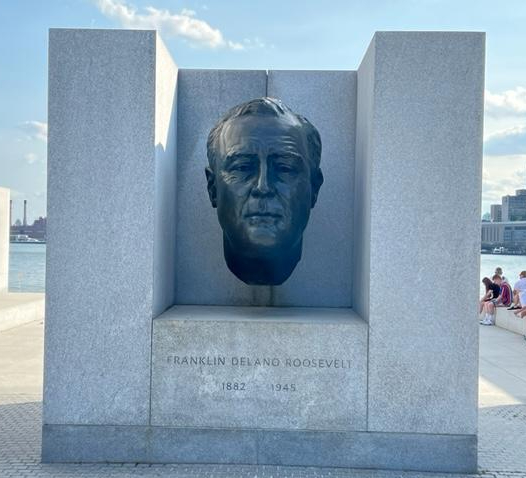
Franklin D. Roosevelt Four Freedoms Park is the first memorial dedicated to the president in his home state of New York. Located on the southern tip of Roosevelt Island in New York City, it is the last work of Louis I. Kahn, an iconic architect of the 20th Century.
The interior of the park facing Roosevelt Island
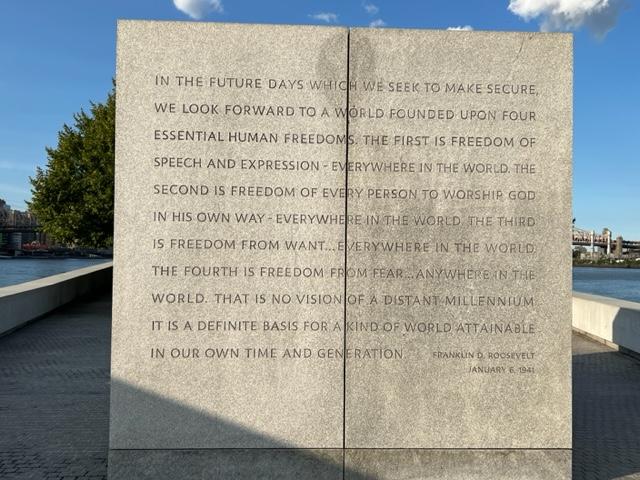
The memorial, which opened to the public in October 2012, celebrates the four freedoms, as pronounced in President Roosevelt’s famous January 6, 1941 State of the Union address: freedom of speech and expression, freedom of worship, freedom of want and freedom from fear. This has been prominently etched on the memorial.
FDR Four Freedoms Park from a view
Our Mission:
As steward of this civic space, Four Freedoms Park Conservancy advances President Roosevelt’s legacy and inspires; educates and engages the public in the ideals of the four freedoms. The Conservancy does this by:
*Safeguarding the memorial as a space for inspired use.
*Fostering community and understanding.
*Igniting conversation about human rights and freedoms today.
The Four Freedoms that were the goals of the President
On January 6, 1941, President Franklin D. Roosevelt delivered his eighth State of the Union address, now known as the Four Freedoms speech. In his address, Roosevelt presented his vision for the world, “a world attainable in our own time and generation,” and founded upon four essential human freedoms: freedom of speech and expression, freedom of worship, freedom from want and freedom from fear.
Roosevelt’s call for human rights has created a lasting legacy worldwide, forming the basis for the Universal Declaration of Human Rights adopted by the United Nations in 1948.
For a richer of FDR, his legacy and the four freedoms, visit fdr4freedoms.org.
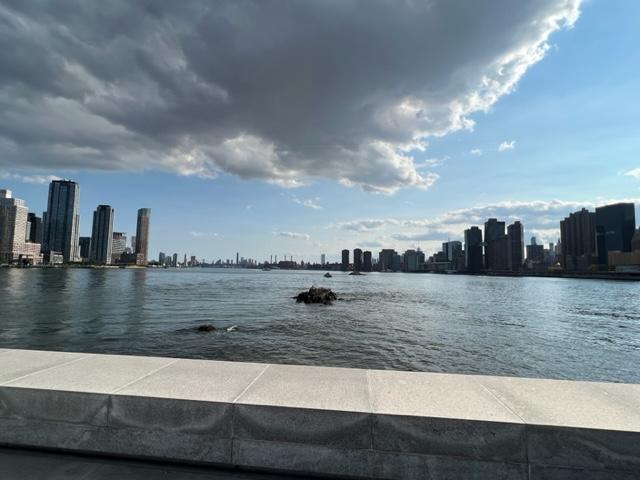
The view from Roosevelt Island of the Upper East Side
Franklin D. Roosevelt Island: A History
Originally called Minnahannock by Native Americans and Varkins Island by the Dutch settlers, the island was acquired by the Blackwell family in the 1600’s, who renamed the land Blackwell Island. The Blackwells lived on and farmed it before selling it to the City of New York in 1828 for $30,000.
In the 19th Century, the island was used by the City for institutional facilities, including the Workhouse, Penitentiary, Lunatic Asylum, City Hospital and City Home and given the name Welfare Island in 1921. These institutions served the City until the 1930’s., before gradually being relocated to areas more easily accessible to public transportation.
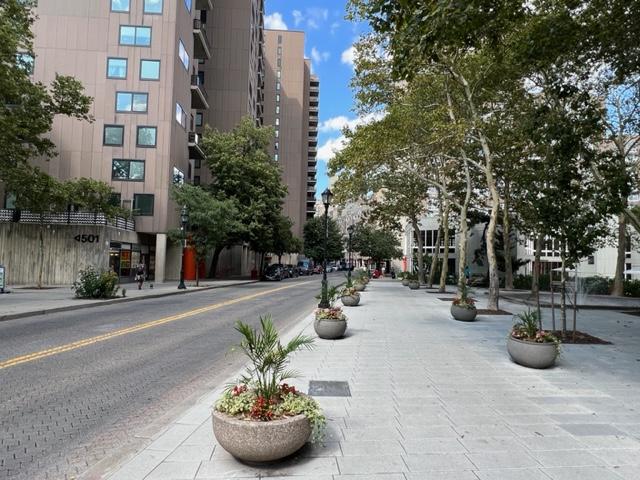
The Roosevelt Island Main Street
In 1969, this two-mile island was lease to the State of New York for 99 years. Under New York State’s Urban Development Corporation, Welfare Island became a beacon for the affordable housing movement within the City. Construction of the Island community was completed in 1975 with four housing developments. In 1973, the island was renamed Franklin D. Roosevelt Island.
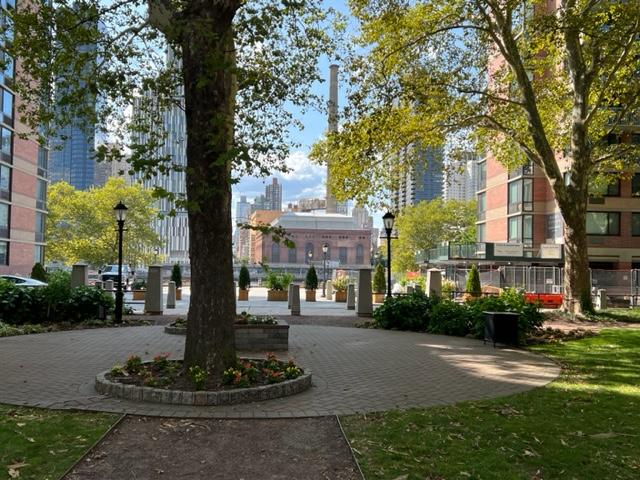
The Gardens in the Main Street of Roosevelt Island
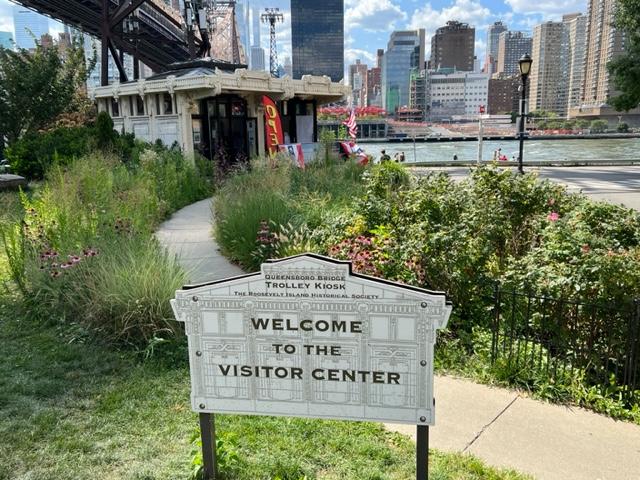
Today, Roosevelt Island has a small town feel with approximately 20 buildings and 14,00 residents. The island is home to six landmarked structures and proudly houses Four Freedoms Park, one of the original visions for the Island. To learn more, visit the Roosevelt Island Visitor Center at the Tram Plaza.
The Visitors Center at Roosevelt Island
(Judith Berdy, President, The Roosevelt Island Visitor Center)
A Memorial to Franklin D. Roosevelt
Nearly 40 years before the Park opened its gates to the public, Louis I. Kahn presented his vision for what would become Franklin D. Roosevelt Four Freedoms Park. It was a simple idea. “I had this thought,” Kahn said. “that a memorial should be a room and a garden.”
The FDR Hope Memorial
This was 1973. Less than a year later, Khan had died; Governor Nelson Rockefeller, who had announced the project with Mayor John Lindsay, became Vice President of the country and the City of New York neared bankruptcy.
The bust of President Roosevelt
The future of the memorial seemed a fragile and tenuous dream. Yet, through the power and determination of a small but dedicated group, nearly four decades after Kahn completed his architectural design, Four Freedoms Park became the place he envisioned. In 2012, following 30 months of construction, the Park opened to the public. The Park is operated and maintained by Four Freedoms Park Conservancy in partnership with New York State Parks.
(Part of the New York State of Opportunity: Parks, Recreation and Historic Preservation)
I admired the FDR Hope Memorial in which the statue of the President reaches to a young girl with a disability herself. The statue offers encouragement to those with a disability and the power to persevere.
The statue was designed by artist and sculptor Meredith Bergmann, who herself was inspired by the photos and stories of the President (FDR Hope Memorial).
Artist Meredith Bergmann (Cooper Union Alumni Picture)
Ms. Bergmann is an American born artist with BFA from The Cooper Union School of Art and attended Parsons School of Design and Wesleyan University. Her public works explore history, social justice, human rights and disabilities (Author’s bio).
Franklin D. Roosevelt Four Points Freedom Park is the first memorial dedicated to the president in his home state of New York. Located at the southern tip of Roosevelt Island in New York City. It is the last work of Louis I. Kahn, an iconic architect of the 20th century.
FDR Four Freedoms Park
The memorial, which opened to the public in October 2012, celebrates the four freedoms, as pronounced in President Roosevelt’s famous January 6, 1941, State of the Union address: freedom of speech and expression, freedom of worship, freedom from want and freedom from fear.
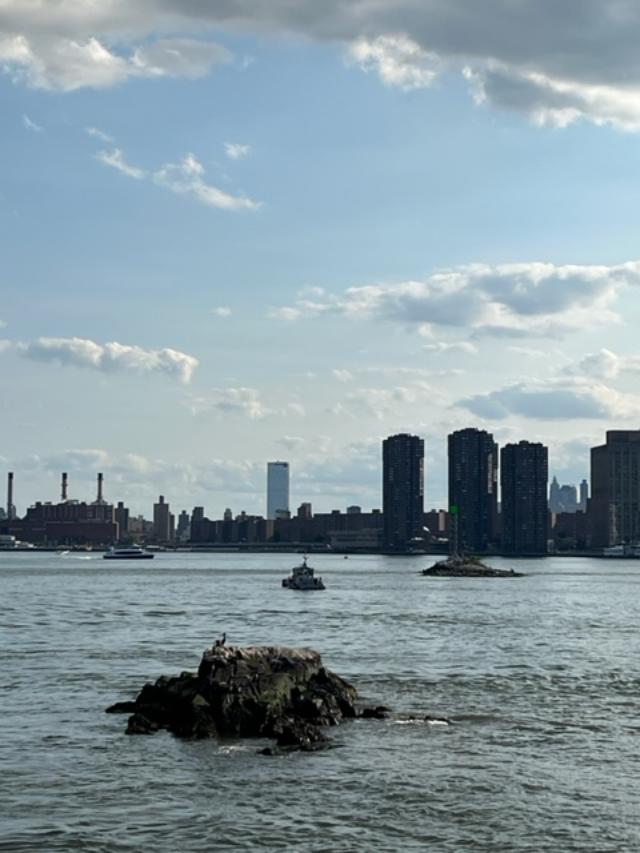
The skyline from the southern part of the park.
Disclaimer: this information was taken from the NYS Parks, Recreation and Historic Preservation pamphlet. Please call the park or email to check on opening times when in season.
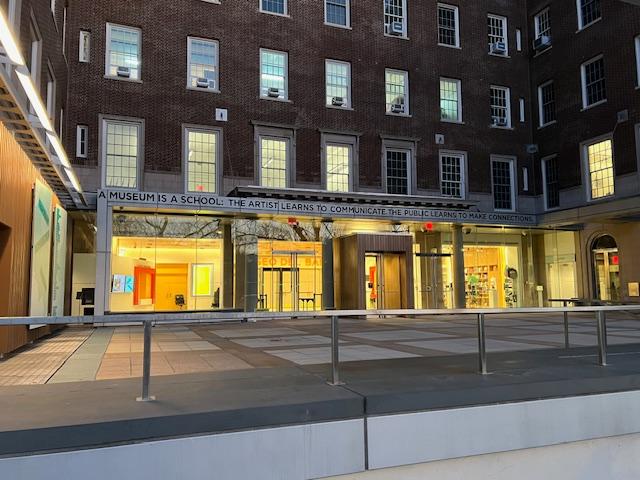
The mission of El Museo del Barrio is to present and preserve the art and culture of Puerto Ricans and all Latin Americans in the United States. Through its extensive collections, varied exhibitions and publications, bilingual public programs, educational activates, festivals and special events, El Museo educates its diverse public in the richness of Caribbean and Latin American arts and cultural history.
By introducing young people to this cultural heritage, El Museo is creating the next generation of museum-goers while satisfying the growing interest in Caribbean and Latin American art of a broad national and international audience.
The History of the Museum:
El Museo was founded 45 years ago by artist and educator Raphael Montanez Ortiz and a coalition of parents, educators, artists and activists who not that mainstream museums largely ignored Latino artists. Since its inception, El Museo has been committed to celebrating and promoting Latino culture, thus becoming a cornerstone of El Barrio and a valuable resource for New York City.
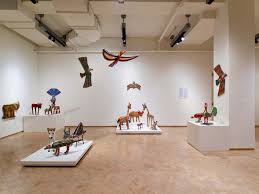
The exhibitions in the Main Gallery
El Museo’s varied permanent collection of over 6,500 objects, spans more than 800 years of Latin American, Caribbean and Latino art, includes pre-Columbian Taino artifacts, traditional arts, twentieth-century drawings, painting, sculptures and installations as well as prints, photography, documentary films and video. For a brief overview of our history and to explore the institutional chronology and exhibition history year by year.
The Galleries of El Museo del Barrio
Our Purpose:
El Museo del Barrio’s purpose is to collect, preserve, exhibit and interpret the art and artifacts of Caribbean and Latin American cultures for posterity.
To enhance the sense of identify, self-esteem and self-knowledge of the Caribbean and Latin American peoples by educating them in their artistic heritage and bringing art and artists into their communities.
To provide an educational forum that promotes an appreciation and understanding of Caribbean and Latin American art and culture and its rich contribution to North America.
To offer Caribbean and Latin American artists greater access to institutional support in the national and international art world.
To convert young people of Caribbean and Latin American descent into the next generation of museum-goers, stakeholders in the institution created for them.
To fulfill our special responsibility as a center of learning and training ground for the growing numbers of artists, educators, art historians and museum professionals interested in Caribbean and Latin American Art.
The mission reaffirms the vision of Raphael Montanez Ortiz, who founded El Museo del Barrio in 1969 and of the Puerto Rican educators, artists and community activities who worked in support of this goal.
(El Museo del Barrio pamphlet online)
The Collection:
The museum features an extensive collection of around 8,500 pieces composed of pre-Columbian and traditional artifacts, particularly a large permanent Taino exhibit as well as 20th century arts and crafts, graphics and popular media, Mexican masks, textiles from Chile and photographs and traditional art from Puerto Rico. There are often temporary exhibits on Puerto Rican and Latino modern art. The museum also sponsors numerous festivals and educational programs throughout the year including the annual Three Kings Day parade. Due to a lack of space prior to their 2009-2010 expansion, the museum began to place some of their permanent collection online. This also served as a means of audience development. (Wikipedia)
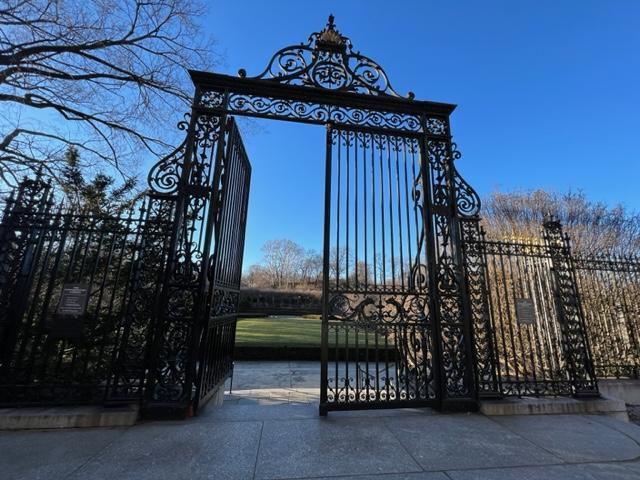
The entrance to the Central Park Conservatory Garden in Winter 2023 (The Vanderbilt Gates)
The map of the gardens
This time of the year (Spring) the Central Park Conservatory is in full bloom and its magnificence is at its finest in the Spring and Summer months. In May, the tulips and daffodils are just finishing their flowering and the lilacs are just finishing their blooming and still fragrant the garden. The lawns are all a deep green and the dogwood trees are just starting to bloom around the rings of the gardens.
The newly renovated pathways
Don’t miss walking around the Gardens off to the side closest to the Harlem Meir as they are open through the renovation. You will see beds of flowers along the fountain’s edge and can admire all the sculpture. What is most impressive is that in-between the Gardens is a vast green lawn surrounded by trees. The lawn of the Conservatory is nice to just admire with the trees lining it on all sides.
Central Park Conservatory Garden Spring 2025
The best time to come to the Conservatory Gardens is in early to late Spring and the early Summer when everything is in full bloom. This is when Mother Nature shows us her great magic.
The Central Park Conservatory in the Spring of 2025
The beauty of the Central Park Conservatory is that it blooms all year around except the winter and even then, there is a quiet elegance to the garden.
The gardens in full bloom in Summer 2025
History of The Central Park Conservatory:
The Central Park Conservatory Garden is the only formal garden in Central Park, New York City and is located approximately between 104th and 106th Street on Fifth Avenue in NYC. The Garden consists of about six acres of formal landscaping of trees, shrubs and flowers. The formal garden is divided into three smaller gardens each with a distinct style: Italian, French and English. The Central Conservatory Garden is an officially designated Quiet Zone and offers a calm and colorful setting for a leisurely stroll and intimate wedding.
The Central Park Conservatory in the Spring 2025
It takes its name from a conservatory that stood on the site from 1898 to 1934. The park’s head gardener used the glasshouses to harden hardwood cuttings for the park’s plantings. After the conservatory was torn down, the garden was designed by Gilmore D. Clarke, landscape architect for Robert Moses, with planting plans by M. Betty Sprout and constructed and planted by WPA workers, it was opened to the public in 1937.
The Garden is composed of three distinct parts, skillfully restored since the 1980’s and is accessible through the Vanderbilt Gate at Fifth Avenue and 105th Street, a quarter south of the park’s northeast corner.
The Vanderbilt Gate at the Central Park Conservatory
The Vanderbilt Gate once gave access to the forecourt of Cornelius Vanderbilt II’s chateau designed by George Browne Post, the grandest of the Fifth Avenue mansions of the Gilded Age, at 58th Street and Fifth Avenue, sharing the Plaza with Plaza Hotel. The wrought iron gates with cast iron and repousse details, were designed by Post and executed in an iron foundry in Paris.
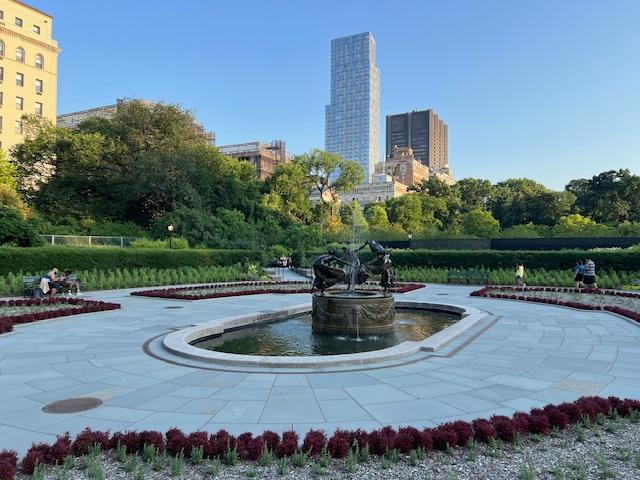
The fountain at the Central Park Conservatory
The fountain statuary in the main gardens.
Below the steps flanked by Cornelian cherry, the central section of the Conservatory Garden is a symmetrical lawn outlined in clipped yew, with a single central fountain jet at the rear. It is flanked by twin aisles of crabapples and backed by a curved wisteria pergola against the steep natural slope, that is dominated at its skyline by a giant American Sycamore.
Otherwise there is no flower color; instead on any fine Saturday afternoon in June, it is a scene of photography sessions for colorful wedding parties for which limousines pull up in rows on Fifth Avenue.
The Cherry Trees at the gardens in 2019
To the left of the south side is the garden of mixed herbaceous borders in wide concentric bands around The Secret Garden water lily pool, dedicated in 1936 to the memory of Frances Hodgson Burnett with sculpture by Bessie Potter Vonnoh.
Some large shrubs, like tree lilac, magnolias, buddleias and Cornus alba ‘elegantissima’ provide vertical structure and offer light shade to offset the sunny locations, planted by Lynden Miller with a wide range of hardy perennials and decorative grasses, intermixed with annuals planted to seem naturalized. This garden has seasonal features to draw visitors from April through October.
To the right of the central formal plat is a garden also in concentric circles, round the Untermyer Fountain, which was donated by the family of Samuel Untermyer in 1947. The bronze figures, Three Dancing Maidens by Walter Schott (1861-1938) were executed in Germany about 1910 and formed a fountain at Utermyer’s estate “Greystone” in Yonkers, New York.
This section of the Conservatory Garden has two dramatic seasons of massed display of tulips in the spring and Korean chrysanthemums in the fall. Beds of satolina clipped in knotted designs with contrasting bronze-leaved bedding begonias surround the fountain and four rose arbor gates are planted with reblooming ‘Silver Moon’ and ‘Betty Prior’ roses.
The French Gardens at the Central Park Conservatory in Summer 2025
After the Second World War the garden had become neglected and by the 1970’s became a wasteland. It was restored and partially replanted under the direction of horticulturist and urban landscape designer Lyden Miller to reopen in June 1987. The overgrown, top-heavy crabapples were freed of water shoots and pruned up to a higher scaffold for better form. The high-style mixed planting was the first to bring estate garden style to urban parks, part of the general of Central Park under Elizabeth Barlow Rogers of the Central Park Conservancy.
The Conservatory in the early Spring of 2025
(This information directly from Wikipedia and has many sources)













 Visiting a Museum: The Unique, Unusual, Obscure and Historical