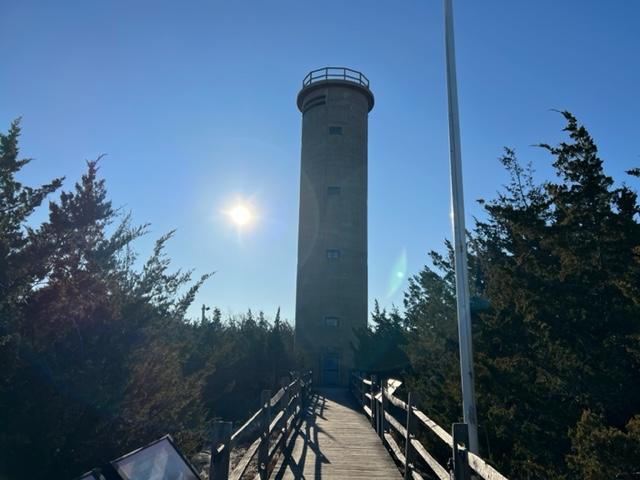
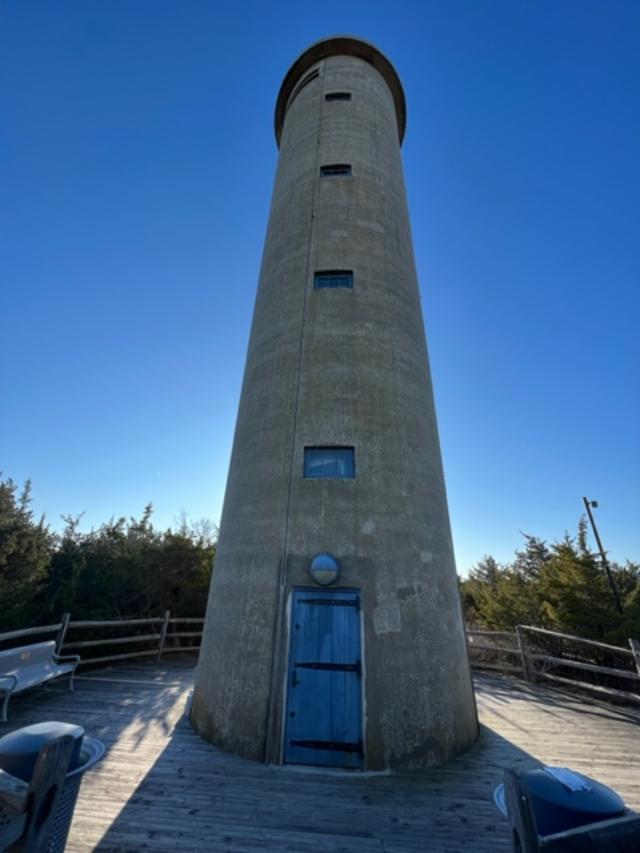
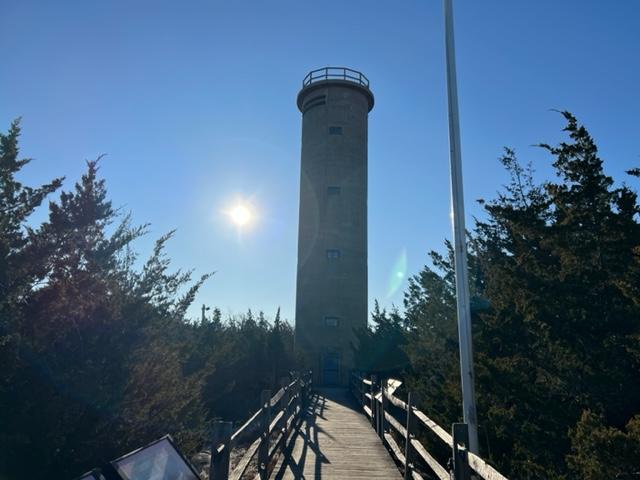
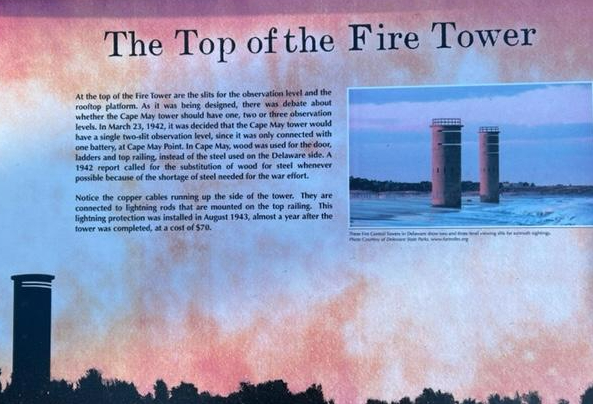
The World War II Lookout Tower Museum & Memorial is an interesting look of how our armed forces used these towers to watch the coastlines for U-boats and enemy ships during the war. Several German submarines were spotted along the coasts of New York and New Jersey during the war and the threat of attack was uncertain. As the war progressed on though, we found that this was a war being fought in the air and these towers were actually obsolete by the end of the war.
The World War II Tower
The tower is very interesting and very easy to climb. Don’t let the height fool you, there are only about a 100 stairs with landings on all three levels with displays on them.
The bottom level has a gift shop and display pictures of the history of the tower. The second level has shots of veterans of the wars before when the were enlisted and today (when they were much older). There were a lot of local veterans to the Cape May area.
World War II Tower pictures
The top level was manned by a docent who talked about the history of the tower, provided pictures of the area before and after World War II and the role it played during the war. She discussed the only ship attack since Pearl Harbor was right off the coast of New Jersey as well as the ‘Blackouts’ that were conducted in town to stymie any attacks.
World War II Tower
Take time to look over all the displays and pictures and the role Cape May had in the war to help protect the East Coast.
History of the World War II Lookout Tower Museum & Memorial:
Why is Fire Control Tower No. 23 administered by the Mid-Atlantic Center for the Arts & Humanities (MAC):
Like the Cape May Lighthouse, Fire Control Tower No. 23 is owned by the State of New Jersey (specifically the Department of Environmental Protection Division of Parks). As was the case with the Lighthouse, the State lacks the funds to restore and operate these historic structures. Instead it has leased them to the area’s leading cultural and historic preservation organization, the Mid-Atlantic Center for the Arts & Humanities (MAC). Founded in 1970, MAC saved and restored the 1879 Emlen Physick Estate and operates it as Cape May’s only Victorian house museum. Starting in 1986, MAC spent 15 years (and some $2 million) on the restoration of the Cape May Lighthouse.
In 2004, MAC signed a 20 year lease for Fire Control Tower No. 23. After raising one million dollars (from the New Jersey Historic Trust, the Casino Reinvestment Development Authority, a Small Cities Block Grant administered by the New Jersey Department of Community Affairs and Lower Township and a Save America’s Treasures Grant administered by the U.S. Department of the Interior), MAC restored the Tower in 2008-09 and opened it to the public in April 2009. MAC is also mounting permanent Memorial Plaques in the Tower that will allow family members to honor veterans of any war or engagement.
(This information was taken from the World War II Lookout Tower pamphlet proved by the Mid-Atlantic Center for the Arts & Humanities)
Was Fire Control Tower No. 23 used for spotting fires?
No, it was used for spotting enemy ships during World War II and aiming guns to fire on them.
This Fire Tower was part of Fort Miles. So, where was Fort Miles anyway?
Fort Miles was never a building. It was a number of fire control towers, gun batteries plus barracks and support buildings on both sides of Delaware Bay. By World War II, the military used a spread-out series of towers and batteries, whose firing ranges overlapped to protect a large territory. Its largest guns and headquarters were located on the Delaware side (in what is now Cape Henlopen State Park), since the shipping channel hugs the Southern shore of Delaware Bay.
Were there any other Fire Control Towers?
Yes, there were originally 15 concrete fire control towers, 11 on the Delaware side and four here in New Jersey. Of the four in New Jersey, the ones in North Wildwood and Wildwood Crest have been destroyed, while the one on Beach Avenue in Cape May has been engulfed by the Grand Hotel (with only its top visible, sticking above the roof). One of the towers in Cape Henlopen State Park in Delaware has been restored and opened to the public.
Were there any naval battles in the Delaware Bay?
No. German submarines sank many merchant vessels off the coast of Cape May but no German ships ever got up the Delaware River to attack the Philadelphia Navy Yard, Philadelphia or Camden.
Was Fire Control Tower No 23 built here or prefabricated?
The Fire Control was built here in June, 1942 by using a sliding tube shaped form. A ring of reinforced concrete was poured. When that solidified, the form was slid up and more concrete was poured. The whole Tower was formed this way except for the top, which required a form of its own. The whole process took only two and a half days.
Was the Cape May area important during World War II?
Yes, the Cape May area was a beehive of military activity during World War II. Cape May harbor had a Naval Air Station, a Coast Guard base and an airport. Naval Air Station Wildwood (where the County Airport is now) trained aircraft carrier pilots. Cape May Shipbuilders on Wilson Drive, where the Cape May Whale Watcher is now, built Navy tugboats and dredges. The Northwest Magnesite plant, which made an ingredient used in firebricks for steel mills, was located across Sunset Boulevard from Fire Control Tower No. 23.
(This information was taken from the World War II Tower pamphlet and I give them full credit for it.)
*The statue has been moved since this blog has been written and it on Broad Street near the New York Stock Exchange.
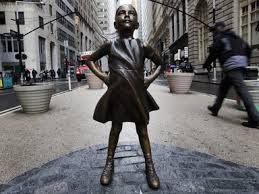
The ‘Fearless Girl’ statue is the latest addition to the street art in lower Manhattan. Placed next to the statue of the ‘Charging Bull’, she portrays a defiance and a look that almost says, “I am standing up to the power and I am standing up to fear’. She has a look of determination on her face that clearly shows that she is standing her ground. She was designed by artist Kristen Visbal.
The statue is located at the northern tip of Bowling Green Park in Lower Manhattan both statues are an easy find on the Broadway side of the park. Be aware that this is a big tourist area for pictures so there will be a crowd.
There has been some controversy from Arturo Di Modica the creator of ‘Charging Bull’ who says that it takes away from the meaning of his own work. Di Modica has challenged that the piece exploits his work and distorts the meaning of his own work by turning the ‘Charging Bull’ into a villain instead of the his true meaning for the work which is a ‘symbol of prosperity and for strength’. Both statues are being planned to be moved by the NYC Parks Department in the future (Wiki and the New York Times 2018).
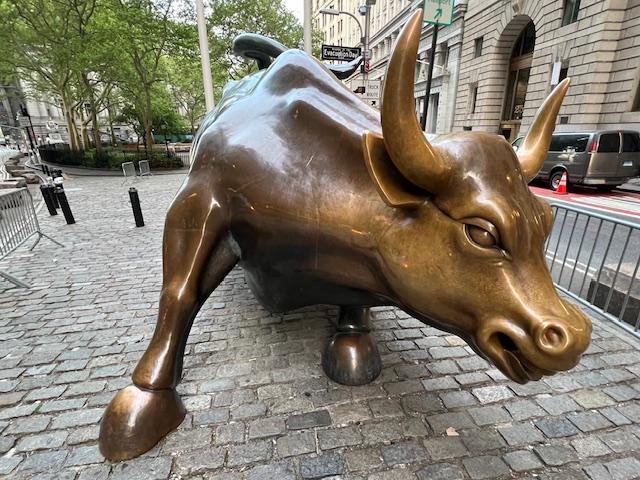
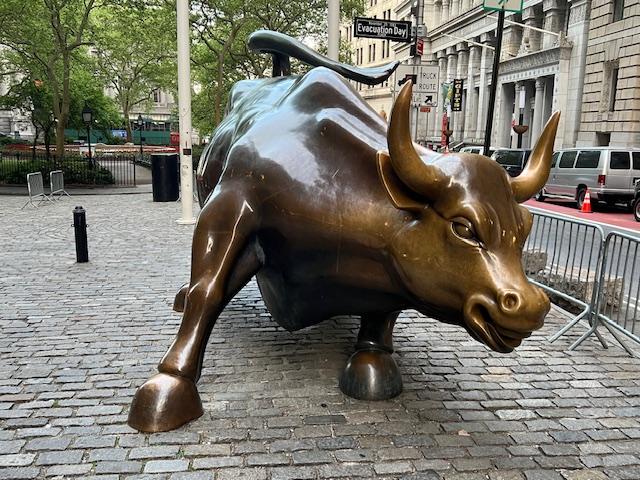
The Charging Bull
History of ‘Fearless Girl’:
The statue was installed on March 7, 2017, the day before International Women’s Day, by State Street Global Advisors, in a campaign developed by advertising agency McCann New York. SSgA was celebrating the first anniversary of its “Gender Diversity Index” fund that “invests in U.S. large-capitalization companies that rank among the highest in their sector in achieving gender diversity across senior leadership. The concept for the statue was developed by Senior Art Director Lizzie Wilson and Senior Copywriter Tali Gumbiner. Wilson and Gumbiner established both the idea for the statue as well as the overall look of the girl using countless mood boards and imagery, which Visbal referenced (Wiki).
Fearless Girl was originally given a one week City Hall permit that was later extended to 30 days. Later, it was announced that the statue would remain in place through February 2018. Among those advocating for the statue to stay longer was U.S. Representative Carolyn Maloney of New York’s 12th congressional district who stated, “This statue has touched hearts across the world with its symbolism of the resiliency of women. New York City Public Advocate Letitia James wrote a letter that supported keeping the statue, “Fearless Girl stands as a powerful beacon, showing women, young and old, that no dream is too big and no ceiling is too high” (Wiki).
A petition on Change.org asking for the statue to be made permanent gathered 2,500 signatures in the first 48 hours. Efforts to make the statue permanent continued after the statue was granted a one-year permit. In April 2018, after ‘Fearless Girl’ had been in place for thirteen months, New York City Mayor Bill de Blasio announced that both ‘Charging Bull’ and ‘Fearless Girl’ would be moved to a location facing the New York Stock Exchange. The move would occur before the end of 2018 (Wiki).
The plaque below the statue states: “Know the power of women in leadership. SHE makes a difference.” (Wiki)
The statue is available to be seen 24 hours a day.
Disclaimer: The history of the statue was taken from Wikipedia and I give them full credit on the information. The rest is my personal opinions on the statue.
When you are in lower Manhattan and are visiting the Battery Park and/or Wall Street area don’t miss the Charging Bull statue by artist Arturo Di Modica. The artist created this piece of ‘guerrilla’ art after the Crash of 1987, when we were about to enter the depths of another major recession, one that went from the end of 1987 until the summer of 1995.
This interesting piece of New York history is actually a recent addition to the street art of New York City. The statue was created and cast in 1987 following the Crash and made its first appearance outside the New York Stock Exchange on December 15, 1989.
The bull according to the artist, “represents the symbol of the strength and power of the American people’ following the Crash. It has taken on many meanings since such as the power of Wall Street and the progressiveness of money and power in the Financial industry.
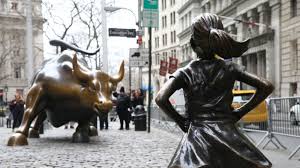
During the high tourist season expect to see the statue surrounded by tourist taking pictures in all directions. The statue of ‘Charging Bull’ is now paired with ‘Fearless Girl’ by artist Kristen Visbal. Some have commented that it has changed the meaning of the statue but I think it is how you interpret both works. Its best to visit and make your own opinion.
The ‘Charging Bull’ with ‘Fearless Girl’
While you are visiting the statue, take time to visit this historic section of Manhattan and visit the other sites that include Bowling Green Park, the Museum of the Native Americans, Frances Tavern and Stone Street as well as the boats to Governor’s, Ellis and Liberty Islands. It is a wonderful way to spend the afternoon.
Please refer to my blog, ‘MywalkinManhattan.com’- “Day One Hundred and Thirteen Tour of Historic Pubs and Bars in Lower Manhattan with the Cornell Club” for a full list of things to see in this section of the City.
History of Charging Bull:
Construction and installation:
The Bull by Bowling Green Park in the early morning hours.
The bull was cast by the Bedi-Makky Art Foundry in Greenpoint, Brooklyn. Di Modica spent around $360,000 to create, cast and install the sculpture following the 1987 stock market crash as a symbol of the ‘strength and power of the American people’. The sculpture was Di Modica’s idea and in an act of ‘guerrilla art’, Bedi Makky Art Foundry and Di Modica trucked it to Lower Manhattan. On December 15, 1989, they installed it beneath a 60 foot (18m) Christmas tree in the middle of Broad Street in front of the New York Stock Exchange as a Christmas gift to New Yorkers. That day, hundreds of onlookers stopped to admire and analyze it as Di Modica handed out copies of a flier about his artwork (Wiki).
NYSE officials called the police later that day and the NYPD seized the sculpture and placed it into a impound lot. The ensuing public outcry led the New York City Department of Parks & Recreation to reinstall it two blocks south of the Exchange in the Bowling Green, with a ceremony on December 21, 1989. It faces up Broadway at Whitehall Street (Wiki).
Confusion over ownership:
The sculpture technically has a temporary permit allowing it to stand on city property since the city does not own the sculpture but the temporary permission has lasted since 1989, when city officials said the new location would not be permanent. Art on loan is usually limited to a year’s display and although the city does not buy art, it does accept donations. A writer in the New York Daily News wrote in 1998 that the statue’s placement was ‘beginning to look a mite permanent.’ According to an article in Art Monthly, Di Modica as well as officials and New Yorkers, ‘view it as a permanent feature of Lower Manhattan (Wiki).
In 2004, Di Modica announced that the bull sculpture was for sale, on condition the buyer does not move it from its present location. Di Modica continues to own the artistic copyright to the statue. In 2006, Di Modica sued Walmart and other companies for illegally benefiting from his copyright, by selling replicas of the bull and using it in advertising campaigns. In 2009, Di Modica sued Random House for using a photo of the bull on the cover of a book discussing the collapse of financial services firm Lehman Brothers (Wiki).
Arturo Di Modica first conceived of the Charging Bull as a way to celebrate the can-do spirit of America and especially New York, where people from all over the world come regardless of their origin or circumstances and through determination and hard work overcome every obstacle to become successful. It’s this symbol of virility and courage that Arturo saw as the perfect antidote to the Wall Street Crash of 1987.
The artist was born in Vittoria, Italy in 1941 and studied at the Academia Del Nudo Libra in Florence, Italy in 1960. In 1973, he relocated to New York City to a Lower Manhattan space. ‘Charging Bull’ is his most famous piece (Artnet).
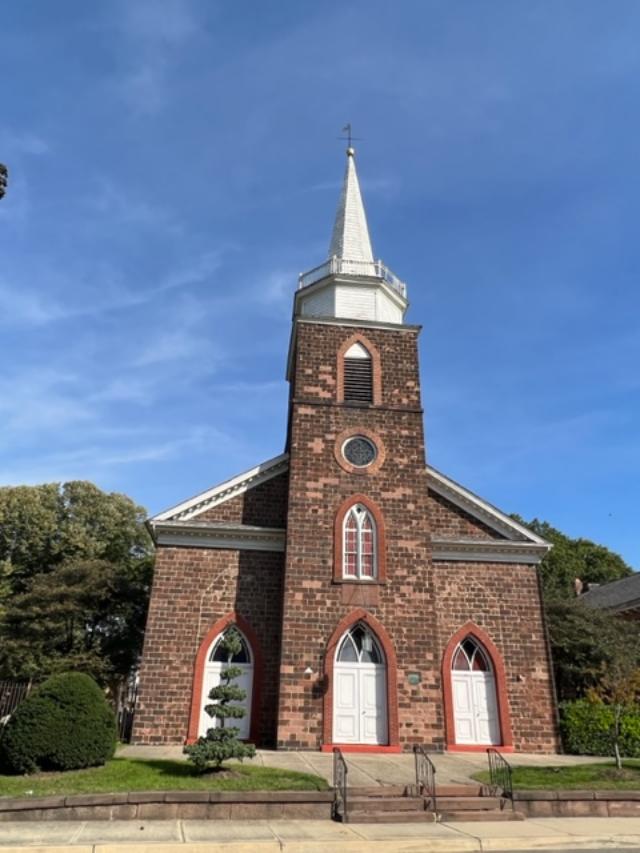
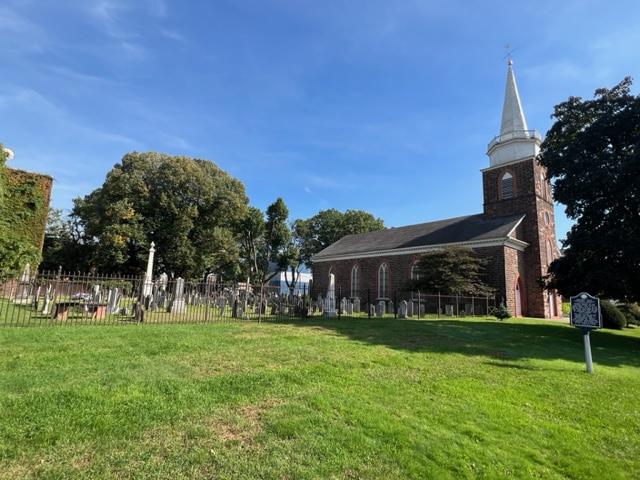
The First Reformed church of Hackensack at 43 Court Street
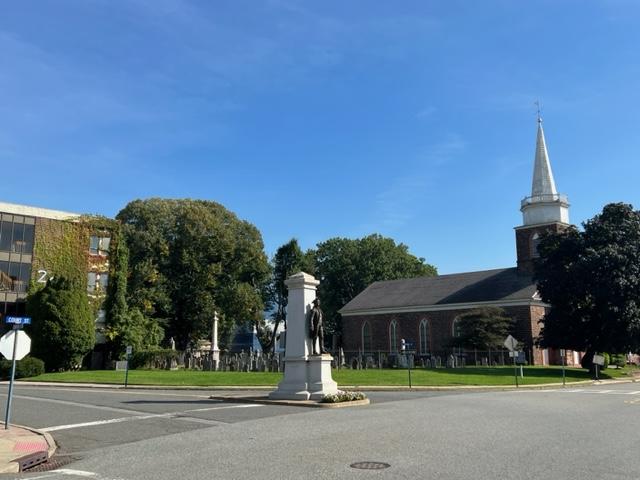
Due to their national historic significance the church, graveyard and the adjacent Hackensack Green were placed on the National Register of Historic Places in 1983. The Green dates back to 1696 and is one of the oldest public squares in NJ.
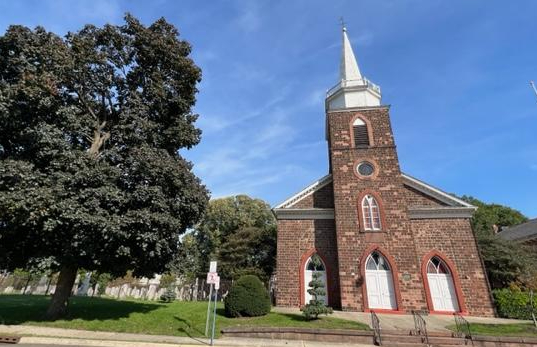
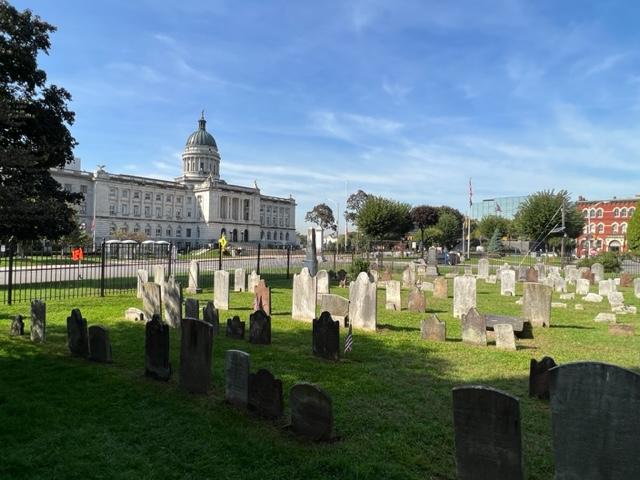
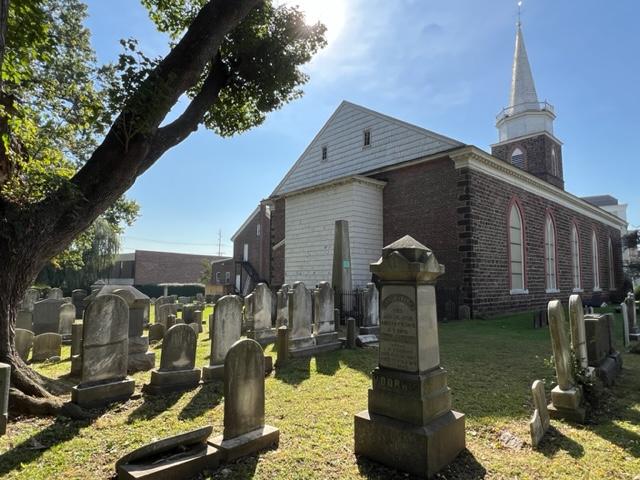
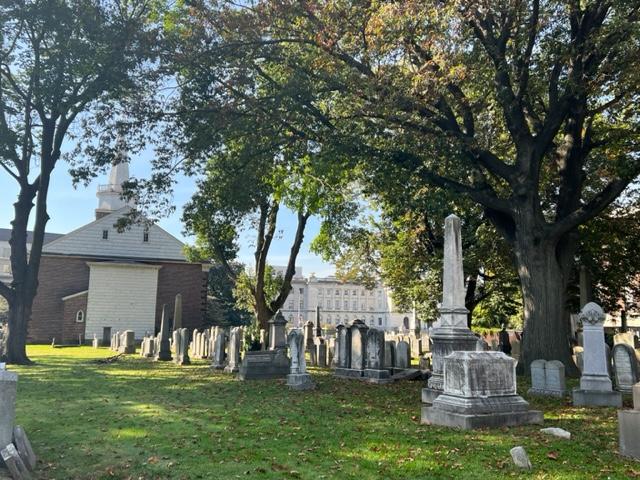
The church and its interesting cemetery.
The inside of the church was visited by General George Washington visited and worshipped here. The church still has the original pews and fixturing. I visited the church for Sunday services which is now run by the Korean Joy Catholic Church. I had a very nice time visiting with the parishioners and the Pastor.
The inside of the church
The inside of the church
The bell tower and gas light fixture
The light fixture
A strategic point during the American Revolution, Hackensack was a small village centered on The Green, a public meeting place where public notices were posted. In the 18th century it was where punishments were inflicted on criminals and where the local militia trained.
The Hackensack Green
The Hackensack Green
General Washington headquartered here in November 1776, while he surveyed the local roads and bridges. On November 20, 1776, he led his army into Hackensack. The army camped on The Green as Washington made the important decision to continue the retreat from overwhelming British and Hessian forces. On March 23, 1780, the British raided Hackensack and burned the courthouse that stood on the Green at that time. Since 1715, a Bergen County courthouse building faced The Green in Hackensack, the County Seat since 1710, making it the historic heart of Bergen County (County of Bergen Division of Cultural and Historic Affairs).
The historic Courthouse of Hackensack, NJ facing the cemetery at the Church.
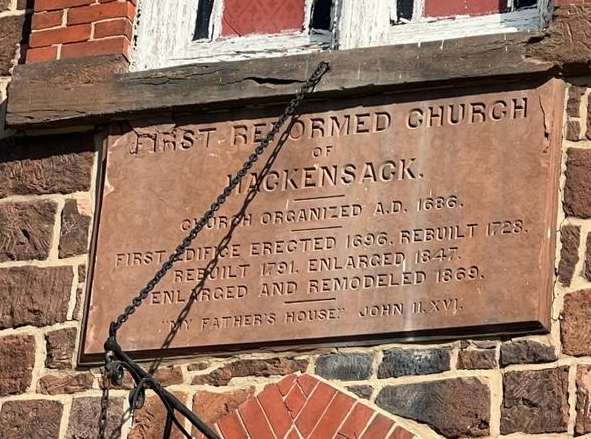
The Cornerstone
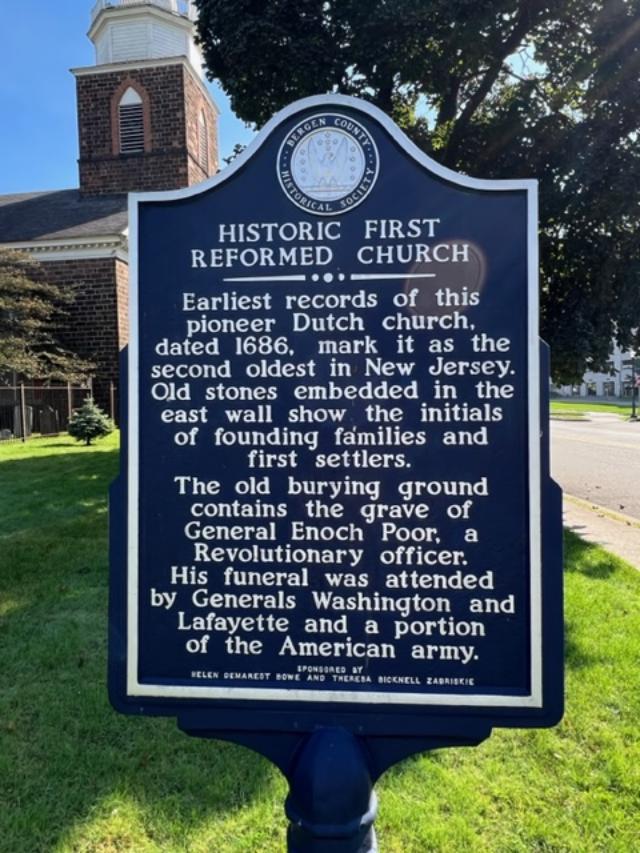
The First Dutch Reformed Church congregation was organized in 1686, the oldest Reformed Dutch congregation in Bergen County and second oldest in NJ. (County of Bergen Division of Cultural and Historic Affairs).
The historic marker outside the church.
The historic marker
The cornerstones of the original church with the names of the ‘First Families’ of Bergen County. The original spelling of the Zabriskie’s, Paulson’s, Haring’s, and Terhune’s are embedded in the history of this church.
The First Families of Bergen County keystones on the Church:
The family keystones
John Paulson keystone
Henry Berry keystone
Albert C. Zabrifky keystone
The stone of Peter Zabrfky
The stone of Jacob Brinckerhoff
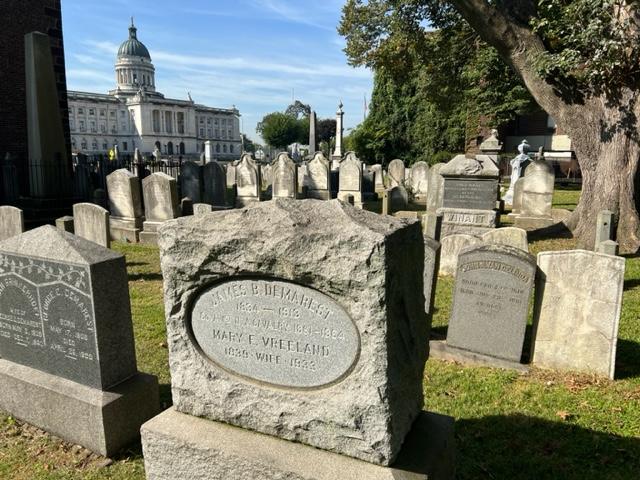
The Hackensack Reformed Church graveyard is one of the most famous in the State of New Jersey with many prominent families of Bergen County whose contributions helped shape not just the State of New Jersey but the United States as well. The graveyard contains the graves of many who fought for our freedom in the Revolutionary War.
The front of the church
The back of the graveyard
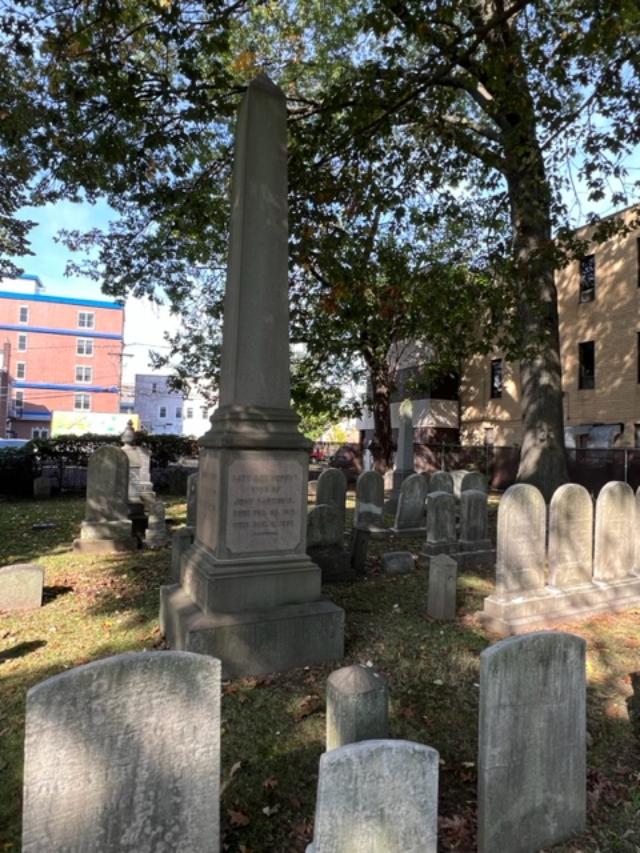
The historic graveyard
During the first ten years, churchgoers worshiped in a private home outside the limits of modern-day Hackensack. The official name of the congregation was the “Dutch Reformed Church of Ackensack” and comprised thirty-three residents from Hackensack, New Barbadoes and Acquackanonk. All three of these townships made up most of northeastern New Jersey.
Acquackanonk was located in the northern portion of modern Essex County. New Barbadoes was comprised of land west of the Hackensack River, while Ackensack was located to the east. In April of 1696, Captain John Berry (1619-1712), the proprietor of a large portion of land in northeastern New Jersey, donated two and three-quarter acres of his property to the congregation to support their efforts to build the church.
Most of present-day Hackensack at that time was called “New Barbadoes Township” and Hackensack is thought to have gotten its unofficial name when the Church relocated to New Barbadoes and brought the name “Ackensack” with it (Church website).
The historic church and cemetery in the back.
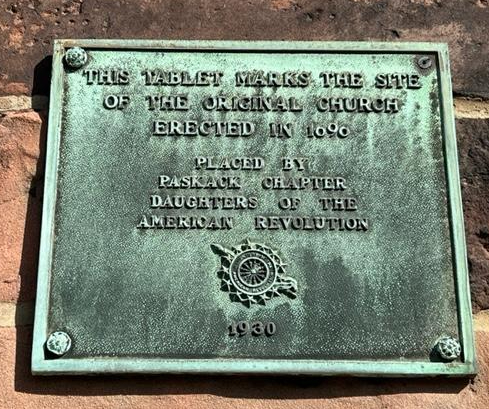
The emergence of the Dutch Reformed Church in America developed from Dutch colonization of New York and New Jersey during the 17th century. Dutch settlement was prominent in these areas before the British took control of the area in the late 1600’s. Still, the Dutch were freely allowed to practice their religion in America, even under British sovereignty. The Hackensack First Reformed Church would become the second oldest Reformed Church in New Jersey and the first in Hackensack. Construction of the church was completed in the latter part of 1696.
The historic cemetery at the church
John Berry’s donation of land was appropriately dubbed, “The Green” and the church soon became known as “The Church on the Green”. The first sermon was preached on November 15th, 1696, based on Psalm 26:8 “Lord, I have loved the habitation of thy house and the place where thine honor dwelleth.” Although the first church was largely completed in 1696, the steeple was not built until 1708. The entire structure was rebuilt in 1728 on the same site. These two early church buildings were thought to have been octagonal structures.
The Schuyler Family marker
In 1780, during the Revolutionary War, the British invaded Hackensack. They burned the courthouse and jail and threatened to destroy the Church on the Green, which was located adjacent to the aforementioned buildings. Fortunately, the church was spared. Dutch Colonial architecture with sandstone walls being the prominent feature of the building. Some aspects, especially the arched and pointed windows, appear to have Gothic elements.
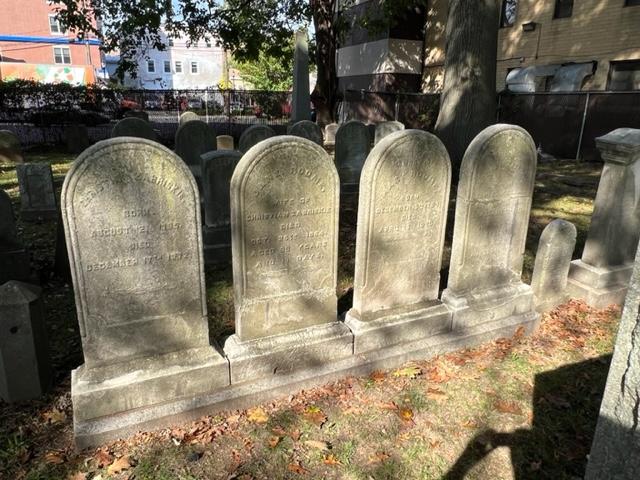
The Zabriskie Family plot
The front of the church has three sets of double doors with similarly arched doorways and transom windows. This style was a precursor for many of the Reformed Dutch churches that were eventually build in New Jersey. Although the present-day building dates from 1791, the church was enlarged in 1847 and again in 1847 and again in 1869, thus containing newer elements.
The Demarest Family plot.
The attached cemetery is original to the first building’s construction in the late seventeenth century but during the renovation in 1847, it was also enlarged. The neighboring service house was built in 1867 and was used as a Sunday school, lecture hall and chapel.
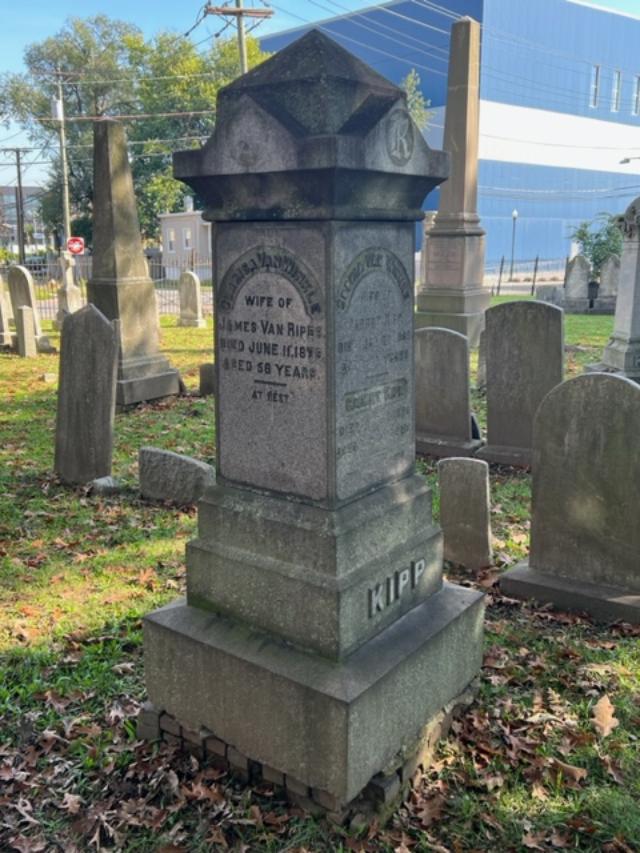
The Van Riper/Kipp Family plot
The Hackensack graveyard
The First Reformed Church of Hackensack
I recently visited both the church and the graveyard of the church which is home to many veterans of both the Revolutionary and Civil War. It is home also to the family plots of ‘Founding Families’ of Bergen County who worshipped at this famous church.
As one of my Team Projects, my students were mapping the cemetery for veterans of the Revolutionary War, many of them buried in the church graveyard. We came to pay our respects.
The Van Buren family plot
The Van Saun family plot
The Westervelt family plot
The Banta family plot
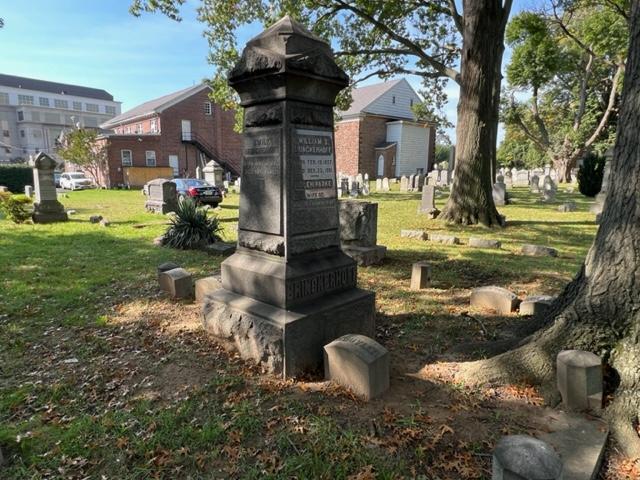
The Brinckerhoff-Terhune family
The Herring family
The Kipp family plot
The Paulson family plot
The Demarest-Doremus family plot
The Zabriskie family
Easter at the First Reformed Church of Hackensackwith the Korean Joy Catholic Church:
I visited the church during the Easter Holidays as a invitation by members of the congregation and it was a very nice experience. I found that the service being very inspiring. The service was followed by an Easter Dinner with the congregation and I was very honored to be invited. It was a wonderful time and I really enjoyed the experience. I had never been to a Christian service that was done all in Korean, The Paster was very inspiring and knew how to inspire to the congregation. The whole service was very uplifting. Then members of the congregation invited me to stay for Easter Dinner which was very nice. A combination of classic Easter dishes mixed with traditional Korean specialties. It was one of the most enjoyable Easter’s I had had in a long time.
The beginning of the service
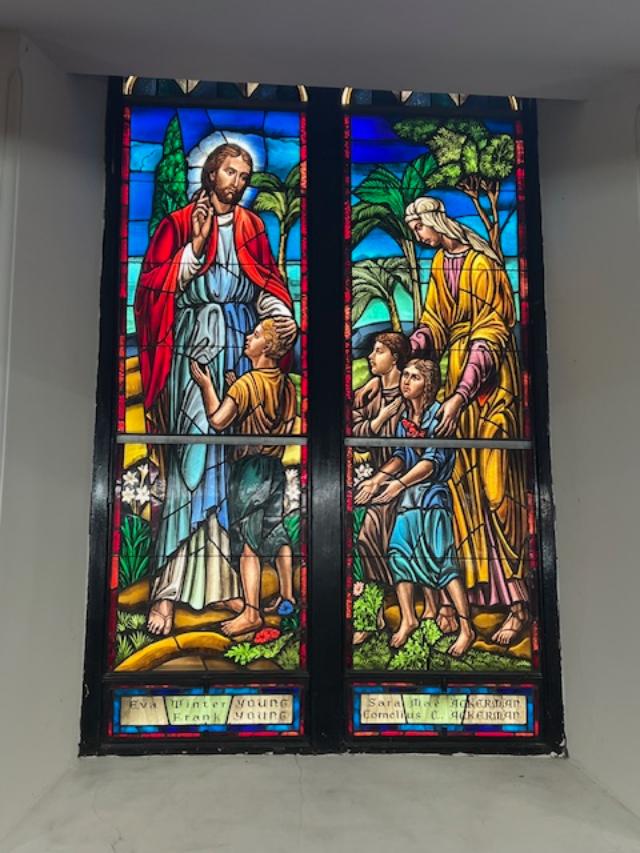
The Historic First Reformed Church of Hackensack pews and stained glass windows. Each one of the stained glass windows were dedicated by a well known “First Family” of Northern New Jersey:
The first floor of the church
The stained glass windows inside the church dedicated by the Ackerman family
The Child’s family windows
Voorhis-Lozier-Moore Windows
The Kraissi family windows
The Van Valen windows
The War years windows
The alter at Easter in the Spring of 2026
The Easter flowers on the alter
After the Easter service was over, I joined the other members of the congregation for dinner. This was a combination of Korean and American foods for the holidays. What a wonderful experience!
Easter Dinner
Easter dinner with the other parishioners
Yam rice cakes for dessert
Layer cake for dessert
Enjoying the service so much, I have returned for Sunday Service a few more times, enjoying the music, the sermons and the comradery. Even though I do not speak Korean, I can follow the inspiring words of Pastor Jung just by emotion and passion in the sermon.
What I like after the service is that after the sermon is over, the congregation joins with the English speaking congregation to have supper, which I think is a nice way for everyone to talk and get to know each other.
Enjoying a recent supper with the rest of the congregation and getting to know the members of the church. Everyone makes you feel so welcome. I think this is really how we celebrate God by joining in and getting to know one another. We have the same traditions in both the Polish and Italian churches I have attended.
Supper with the Congregation
Fish Tofu Soup
Korean specialties for supper
My International Marketing class at Bergen Community College recently did a complete study and marketing plan for the “Bergen250” on the Revolutionary War veterans buried at graveyards and cemeteries all over Bergen County, NJ:
For a Mapping of all the historic graveyards and cemeteries, I had the students visit all the sites that the Daughters of the American Revolution had researched and I had the students find all the locations, photo the tombstones and create a bio on each of the veterans. I enclosed a copy of their work above.
My blog on the historic graveyards and cemeteries of Bergen County:
My Team Project from Bergen Community College “Bergen 250: Exploring the Revolutionary War era Cemeteries and Graveyards of Bergen County, NJ”:
The recent tour with my students hosted by members of the church, we were able to see the second floor, take a full tour of the church and graveyard. We got to see parts of the church that you do not see during service plus many of the artifacts the church owns from different eras of the church’s history. The church served as an important part of the American Revolutionary where later members of the same families, both Loyalists and Patriots, broke away from each other and some formed their own churches in other parts of Bergen County. This church still stands as a testament to Bergen County’s religious beginnings.
We toured the inside of the church, the second floor with its historical artifacts and views of the stained glass windows and then toured the historic graveyard where the majority of the Revolutionary War veterans were buried. Our Team covering this graveyard spent of their time walking amongst the tombstones searching for our veterans.
The inside pews
The alter
The view of inside of the church
The Revolutionary War artifacts
My student visit:
Tour of the church
The Team picture in front of the church
Many of the veterans of the American Revolution were buried closest to the church which was the tradition of the time to be buried as close to the church as possible. Their graves were marked by Revolutionary War medallions and American flags.
The Demarest-Voorhis Revolutionary War graves
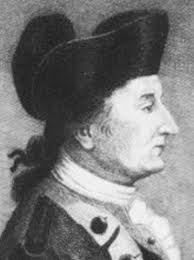
General Poor’s grave
Albert Romin grave Revolutionary War veteran
The front part of the church by the Hackensack Green was the resting place of many of these heros
Our Team of Student Consultants picture inside the historic graveyard
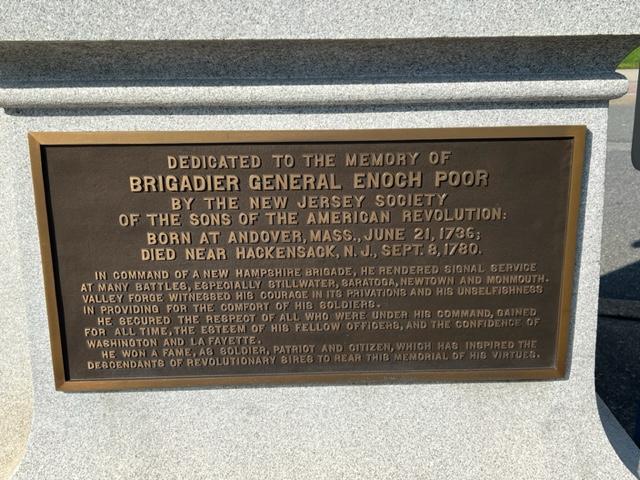
The churchyard cemetery features simple stone tablets and obelisks that are surrounded by a wrought iron fence. Some notable burials include General Enoch Poor (1736-1780), Colonel and New York Mayor Richard Varick (1753-1831), Congressman George Cassedy (1783-1842) and Congressman Adam Boyd (1746-1835). General Enoch Poor’s burial is especially noteworthy as he served alongside George Washington during the Revolutionary War.
Additionally, both Washington and the Marquis de Lafayette were in attendance at Poor’s funeral. Enoch Poor’s gravestone reads: “In Memory of the Hon’ble Brigadier General Enoch Poor of the State of New Hampshire who Departed this Life on the 8 day of Sept: 1780 aged 44 years/Washington, Lafayette and a portion of the American army attended the burial of Gen. Poor.
The Team picture in front of General Poor’s grave
In 1824, Lafayette visited this grave and turned away much affected, exclaimed, “Ah, that was one of my Generals!” Poor died in 1780, before the close of the Revolutionary War, so this gravestone is clearly not the original (Church website).
The graveyard at the Dutch Reformed Church
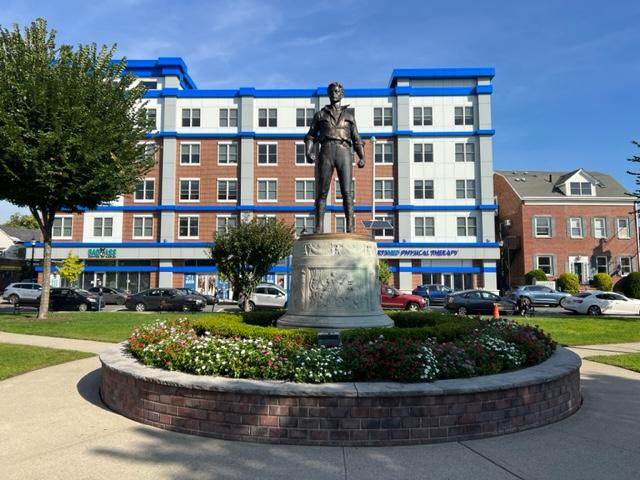
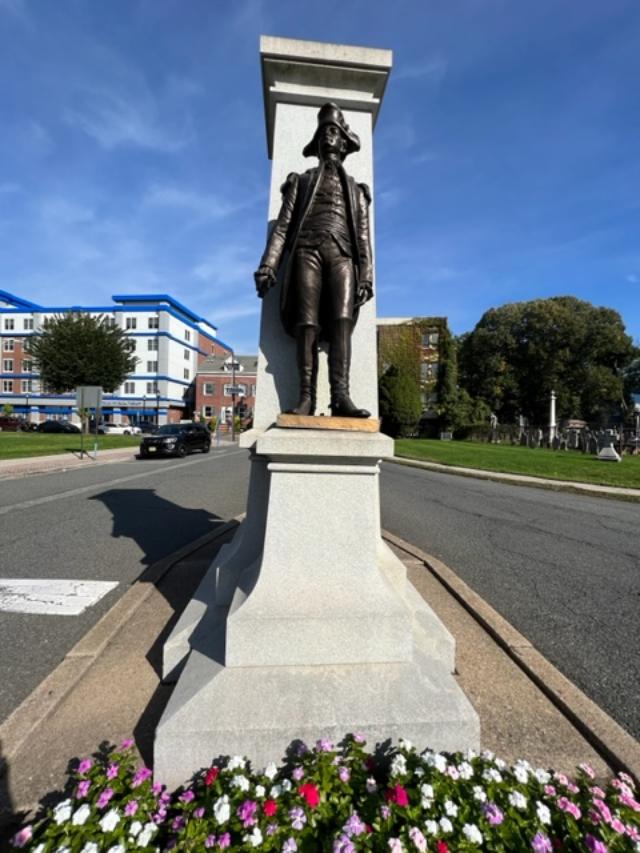
The Reformed Church was nominated to the National Register of Historic Places on April 25, 1983. Included in this nomination was the “Green”, which is one of the oldest public squares in New Jersey. This area encompasses the Churchyard, the cemetery, the church outbuilding and the green area that is adjacent to the Bergen County Courthouse. There are a few monuments that occupy this space, including a statue memorial to General Enoch Poor, which was dedicated in 1904 and the Hackensack War Memorial, which dates to 1924.
The church continues to be a prominent feature of the history of Hackensack through community and self-guided walking tours. In addition to this, there are yearly Memorial Day commemorations, where a wreath is placed over General Enoch Poor’s grave and a tour of the church is provided to the attendees of the celebration.
Surrounding the Green, there are a few other historical buildings:
*The Peter Zabriskie Mansion site at 50 Main Street.
*Archibald Campbell’s Tavern Site at 41 Main Street
*The Hackensack War Memorial
*Site of the Burned Jail
Christmas at the First Reformed Church of Hackensack:
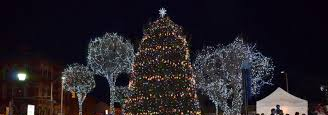
During the holidays, this evergreen serves as the Christmas tree for the City of Hackensack at the historical Green other downtown. The entire Green is decorated for the entire Christmas season and the light display is amazing in the early evenings of December. Santa is on his way!
The Hackensack Town Green
The Christmas tree from downtown
*The Annual Christmas Tree on the Hackensack Town Green
Disclaimer: This information was taken directly from the Bergen County Historical Society pamphlet and the Clio Website on the First Dutch Reformed Church of Hackensack and from visiting downtown Hackensack. Please call the church at (201) 342-7050 for details on visiting it. Please remember this is a resting place.