Category: Historic Sites in New Jersey

Historical Society of Boonton Township/Oscar A. Kincaid Home of History                                                                              591 Powerville Road                                                                       Boonton Township, NJ 07005

Historical Society of Boonton Township/Oscar A. Kincaid Home of History 591 Powerville Road Boonton Township, NJ 07005

Historical Society of Boonton Township/Oscar A. Kincaid Home of History

591 Powerville Road

Boonton Township, NJ 07005

https://historicalsocietyofboontontownship.org/

Open: For Special Events and Pathways Tours only

Admission: Free on the Pathways Tour

My Review on TripAdvisor:

https://www.tripadvisor.com/Profile/R4960NKjustinw/mediabatch/14296162?m=19905

The Historical Society of Boonton Township

One of the last places I visited in the 2026 Pathways tour of Morris County was the Historical Society of Boonton Township which is located in the former Oscar Kincaid Farm Homestead. The house and what was left of the acreage of the farm was part of the current museum. The museum was an example of early New Jersey farming that dated from the 1800’s to the Twenty-First century. There was not much in the way of period furniture or farm equipment (items of the home were sold off since Mr. Kincaid’s passing), but the new historical society is buying artifacts and bringing them back to the farm. This includes one of Mr. Kincaid’s tractors. His roll up desk is also still in the display room which was once the Living Room of the home.

The Kincaid Homestead

History of Oscar Kincaid and Homestead:

(From the Morris County Historical Society website)

Originally a part of the extensive tract belonging to William Penn, the earliest portion of the home was constructed in 1785 by Adam Miller and Anna DeMouth Miller. Just over a decade later, they sold the property to Adam’s cousin, Sarah Miller Parlimen (of the Miller/Dixon homestead) and her husband, John, who built a sawmill there. After a brief ownership by William Scott of Powerville, a Miller relative, the land was sold to John Decker in 1828. An industrious man, Decker operated both a farm and successful forge, shipping his goods to New York via the Morris Canal. By 1837, he expanded the home, adding a distinctive folk-art painting of a face and unique plasterwork that can still be seen today (MCHS website).

The homestead passed through generations of Decker’s family, ultimately being inherited by Oscar Kincaid Sr. in the early 20th century. Kincaid ran a popular ice cream stand and dairy business throughout the 1920s and 30s. Following World War II, the family opened Valley Farm on the site, which continued until the death of Oscar Kincaid Jr. in 2000. Added to the National Register of Historic Places in 2005, the Decker-Kincaid Homestead today operates as a museum and headquarters of the Historical Society of Boonton Township (MCHS website).

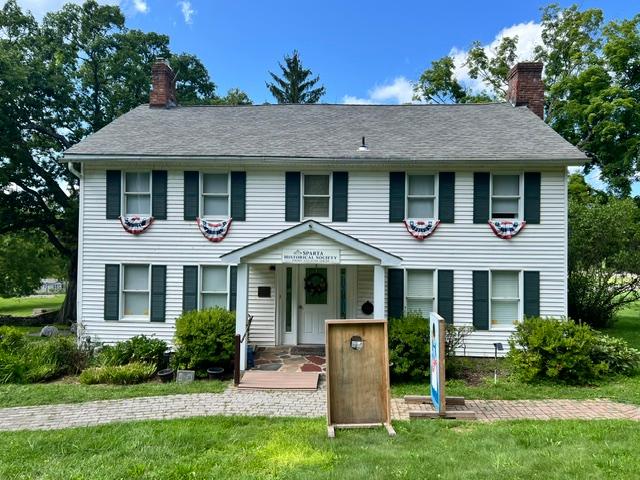
The Kincaid House

The historical marker for the house

The front yard

The entrance to the house

The main foyer of the house

The house is a small farmhouse built in two sections. The original part of the house dates back to the late 1700’s and the newer part in the early 1800’s. The once furnished rooms now hold displays of Morris County and the farming industry of the time plus community artifacts.

The former Living Room

Oscar Kincaid’s desk

There were not much left in the way of family furnishings and heirlooms but this desk was Oscar Kinkaid’s.

The back bedroom

The Flag display for the ‘250th Anniversary’

Story of Oscar Kincaid’s life: Oscar Kincaid was a farmer/businessman, a politician and a conservationist.

On Community:

(From the museum website)

Oscar’s commitment to his community transcended farming. He served as a member of  the Boonton Township Committee for 30 years and was mayor for two terms. He was also a founding member of the Morris County Agricultural Development Board, on which he served for 17 years, six as board chairman. Oscar led the charge for farmland preservation in Morris County. His efforts resulted in the preservation of 41 farms covering 3,100 acres spanning several municipalities throughout the county. As one person put it: “Oscar had more impact on preserving the character of Boonton than any single individual.”

But to Oscar: “Farming and being active in local politics was simply a way of life.” Oscar passed away November 11, 2000

The contractor’s face on the wall

The face came about when Oscar Kincaid did not want to pay a contractor for his work. He created this face so that he would have to live with it for the rest of his life. It can not be planted over.

The ‘Mr. Face’ in Weird NJ

On Farming:

(From the Museum website)

Oscar Kincaid, Jr., was born into farm life. It was 1824 when the Kincaid family purchased 30 acres in Boonton Township, Morris  County and began farming. More than a century later, a young Oscar took over the operation, working alongside his father as they raised dairy cows, grew vegetables and developed a poultry business.  For years, they delivered eggs to retail establishments and sold vegetables from their roadside stand. Over time, Oscar moved away from the dairy and poultry business and focused his efforts on vegetable and hay production. 

The Kincaid house from the side

After the short tour around the house, I walked around the farm grounds. The house was set on a beautiful piece of land that sloped down to the old farmstand. There was also a swimming pond which was once part of the farm which is now private property.

The farm property from the side with the barn

The barn across the street

The property was about ten acres at the time of his death and parts have been developed. It still has some of the most wonderful views of the area.

The view of the old farm from the front porch

The farm land stretches over different sections of the road and the property is very picturesque. It is a very beautiful homestead.

The view of the farm from the lawn

The swimming pond on the edge of the property

The old farm stand that had been used for eighty years

The old Farm stand was used into the mid 2000’s

The full view of the farm

Since the house was just recently bought, there is still some design and artifacts that need to be collected to complete the look of a Jersey farm.

The Historical Society of Boonton Township is still expanding the collection of farm equipment for property and finding furniture for the home. The property is a beautiful and picturesque and shows how the traditional farm has adapted to modern times. Mr. Kincaid only passed a few years ago but kept the farm traditional and that worked for him. He left a legacy for us to appreciate the independent Jersey farmer.

Henry Doremus House                                                                   490 Main Road                                                                             Towaco, NJ 07082

Henry Doremus House 490 Main Road Towaco, NJ 07082

Henry Doremus House

490 Main Road

Towaco, NJ 07082

https://www.montvilletwphistoricalsociety.com/museums

https://en.wikipedia.org/wiki/Henry_Doremus_House

https://www.facebook.com/groups/1141264633508766/posts/1764205224548034

Open: Special Events and Pathways Tours in Spring and Fall-Please contact through their website

Admission: Free but donations are accepted

My review on TripAdvisor:

https://www.tripadvisor.com/ShowUserReviews-g46639-d4814175-r1059078529-Henry_Doremus_House-Montville_Morris_County_New_Jersey.html?m=19905

a

The Henry Doremus House during the Pathway’s tour

I visited the Henry Doremus House during the Morris County Pathways Tour in May of 2026 and it is good look at the early farming communities of New Jersey under the Dutch and then the English. The house was used by General George Washington while he was passing through this section of New Jersey during the Revolutionary War.

The sign for the Henry Doremus House

The historic sign for the house

Montville Township Historical Society:

(from the Museum website)

Established in 1963, the Montville Township Historical Society is dedicated to the preservation and promotion of the cultural heritage of Montville Township. Our unwavering commitment to meticulous archival work, interactive educational programs, and community outreach initiatives is aimed safeguarding the rich history of our town. Our ultimate objective is to ensure that the stories and traditions of Montville Township are cherished and celebrated for years to come.

The farm and harvest equipment

General Washington’s payment to the Doremus family for use of their home during the Revolutionary War

The farming equipment

The farm and household equipment room

The farm equipment from the time of the Revolutionary War

Henry Doremus House History:

(from the Museum’s website)

The Henry Doremus House is a Dutch American stone farmhouse that has been remarkably preserved since the time the first portion was built, circa 1760. The house has never been modernized with heating, plumbing, electricity, or wiring, and is one of only seven left in New Jersey without modern electricity. What is now Route 202 was one of the main military routes during the Revolutionary War through Montville and Towaco, (then part of Pequannock Township). The Henry Doremus house was located in a small community often referred to as Doremus Town.​

The main room of the original house during the tour

The kitchen and cooking equipment by the open hearth fireplace

The open hearth fireplace for cooking and heat for the home

Cooking items

(from the Henry Doremus website)

General George Washington and his troops often traveled this route between Morristown and West Point. In June of 1780, Washington’s troops (2000 soldiers and 40 aides) were in Whippany and traveled to Doremus Town after the retreat of the Battle of Springfield. General Washington and his aides (which General George Washington at age 45 about the time he stayed at the Henry Doremus House (Mount Vernon)  included Alexander Hamilton) stayed two and a half days in the Doremus House as General Andre Rochambeau (NIAHD Journals)   documented by Washington’s expense account and letters. A payment of $40 was  made to Mrs. Doremus at Pequannock on June 25th, to house General George Washington and his soldiers after the Battle of Springfield. French General Rochambeau stayed in the orchards around the house with over 5000 of his men, women, and camp followers on his way to the Battle of Yorktown in 1781.​

The items for processing wool and flack for clothing

A closer look at the equipment

Household equipment

The house addition towards the back had a spinning wheel and demonstration on how to make cloth.

​The Henry Doremus House was placed, in 1972, on both the National Register of Historic Places and the New Jersey Register of Historic Places. It was also listed on the Montville Township Local Register in 1987, as well as the Crossroads of American Revolution Greenway. In addition, the preservation and protection of the Henry Doremus House won the New Jersey Historic House Preservation Award in 2009.

The demonstrations on spinning yarn and making clothing in the back of the house

When I toured the house, the docents described how the household functioned and how the farm worked during the season. Men and women had different roles to make the household function. There was not much buying things for the house so clothes were made, foods were preserved and pickled for the Winter and then meals had to be prepared while the men worked out in the field. Men had to grow, tend to and then pick all the fruits and vegetables. Then there was tending to the animals, sheering animals and just working on tending the farm with repairs and working through the seasons. It was a lot of physical work through all the seasons.

Household equipment and furnishings plus another open hearth for heating the house

The front of the house facing the street with twin Dutch doors and entrance to the root cellar

The Doremus House is open mostly during the Pathways tour in May and October. The Montville Historical Society also runs the Montville Historical Society Schoolhouse Museum in Montville.

Harding Township Historical Society/Tunis-Ellicks House                  16 Village Road                                                                                      New Vernon, NJ 07976

Harding Township Historical Society/Tunis-Ellicks House 16 Village Road New Vernon, NJ 07976

Harding Township Historical Society/Tunis-Ellicks House

16 Village Road

New Vernon, NJ 07976

(973) 272-3661

https://www.hths.org/museum

Open: Special Events and Pathways Tours

Admission: Free but donations are accepted

My review on TripAdvisor:

https://www.tripadvisor.com/ShowUserReviews-g46670-d24085125-r1058924664-Tunis_ellicks_House_Museum-New_Vernon_Morris_County_New_Jersey.html?m=19905

I visited the Tunis-Ellicks House on the Morris County ‘Pathways’ tour of historical sites throughout the County and enjoyed the self-guided tour of this well maintained and displayed home. Unlike many sites I have visited over the years where things are left out and jumbled on tables, the Tunis-Ellicks House offers a look at small family farms from before the Civil War. The displays depict and discuss the life of a farming family in Central New Jersey.

The Tunis-Ellicks House in New Vernon, NJ

The house sign

The house is located in the New Vernon Historic District

The house was located in one of the oldest sections of the community, facing other structures in the historical district of New Vernon, NJ.

The house and front garden from the road

The vegetable garden in the front of house

In front of the house was a large vegetable and fruit garden with a grape arbor for spirits on the side of the house. These items would be jarred and pickled for the winter months or sold at market.

Mission Statement:

(From the Museum website)

The Harding Township Historical Society is a private, not-for-profit corporation founded in 1977 to stimulate interest in the history of Harding Township. The Society shall support, assist in and seek to achieve the preservation of documents, buildings and sites related to Harding Township. It shall also collect, preserve, maintain and interpret original cultural material, which illuminates this history. In addition, The Society is responsible for preserving and maintaining the Tunis-Ellicks House and environs. Through use of its historic site, collections and programs, the society endeavors to document and illustrate the history of Harding Township for present and future generations (Tunis-Ellicks website).

You enter the museum from the back of the house. In the backyard of the home, there were all sorts of activities going on while you could start a self-guided tour of the house.

The back of the Tunis-Ellick’s House

The beautiful view from the back door of the home

The inside of the main part of the museum

The main part of the museum was the newer extension of the home where the living room and dining rooms were located. There were displays on the walls discussing farm life in New Jersey during the late 1700’s and early 1800’s.

The Dining Room section of the house

The workings of the Dining Room

The story of ‘Country Life’ and the gentleman farmer

Pieces of the decor on display

The kitchen area of the older part of the home offers a homey fireplace for cooking and summer storage for jarred and pickled food stuffs for the winter.

The kitchen and storage areas of the home

Pottery collection in the museum

The pottery collection

The kitchen dining and cooking area of the home

The fireplace for cooking, roasting and stewing of foods

The oven for baking breads, cookies and pies and the baking equipment

The Summer storage area for canned and jarred provisions for the winter months and for cooking.

The bathrooms were on the second floor of the home/museum and I got a quick tour of the upstairs bedrooms.

Bedroom One

Bedroom Two

These were not part of the self-guided tour but I was able to see them and how they were decorated.

History of the Harding Township Historical Society:

(From the Museum website)

The Harding Township Historical Society was formed in 1977 to save the circa 1795 Tunis-Ellicks House and restore it as it appeared in the early 19th century. The society discovered an original 18th century hearth and Federal-style mantel and a water-fed cooling room besides the well.  Areas of the house were left exposed to showcase the post-and-beam construction. A permanent exhibit on 19th century farming was created as well as space for temporary exhibits. 

The Society saved a circa 1870 Tramp House from destruction when the Great Swamp National Wildlife Refuge was created by having the building moved the Tunis-Ellicks House property.  The Harding Township Historical Society maintains an extensive archive containing records, maps, and objects since the colonial era pertaining to the town. The archive is open to researchers, genealogists and the public. Each year we provide an award  to a student at the Harding Township School that excels in the subject of history. The Society produces exhibits, lectures, tours, and interactive events to bring history to the public.

I then joined many of the other visitors to hear an historical reading on the patio of the home from a descendant of a Colonial family. He was discussing life in Colonial New Jersey.

The Colonial talks

They also had a table set up for arts and crafts. The volunteers were making corn husk dolls with some of the visitors.

They also had corn husk doll making as an activity

Then I was able to tour the grounds and visit the ‘Tramp House’ that was used for workers of these farms. This had been moved from the ‘Great Swamp’ to this location. It showed the living conditions of workers on the farm.

Walking on the grounds of the farm

The Wine Arbor on the side of the house

History of the Tunis-Ellicks House:

(From the Museum website)

The Tunis-Ellicks House was built in 1795 when George Mitchell bought it from Michael Pearce, a Minuteman in the Revolutionary War. The deed for 7 acres of land is dated April 22, 1795. Interestingly, the ledgers of Daniel Tunis, who lived down Millbrook Rd and had a store, show that, beginning May 9, 1795, Mitchell bought items consistent with building a house: a load of timber and half a bushel of hair (used for plaster).

In 1838, a local farmer named Silas Tunis bought the farm and his descendants owned the house until 1923. Eva and Lee Ellicks sold the house to the township in 1968. In 1977, the Harding Township Historical Society began to restore the home as it would have appeared in the early 19th century. The house is a post-and-beam East Jersey cottage complete with a cooling room fed by the well outside. The museum features a permanent exhibit entitled A Country Life about the workings of 18th-century farms.

The ‘Tramp House’ for farm workers

The historic sign

The inside of the small living quarters

The farm equipment used in processing crops

History of the Tramp House:

(from the Museum website)

The Tramp House is a simple stone building built about 1870 by the Morris Overseer of the Poor as a place to stay for wandering Civil War veterans searching the countryside for work.  By providing a place to stay, farmers protected their barns from accidental fires by the men trying to cook or keep warm. The men would work on the farms in exchange for a safe and warm place to sleep

The house was located in one of the oldest sections of the community, facing other structures in the historical district.

The house and front garden from the road

I really enjoyed visiting the site and got a good view how life on a New Jersey farm was before the Civil War. The museum was very nicely organized and the displays were engaging. The volunteers and docents could not have been nicer and it was a fun afternoon.

Van Bushkirk Burial Ground                                                      45 East Saddle River Road                                                              Saddle River, NJ 07458

Van Bushkirk Burial Ground 45 East Saddle River Road Saddle River, NJ 07458

Van Bushkirk Burial Ground

45 East Saddle River Road

Saddle River, NJ 07458

https://www.findagrave.com/cemetery/2160733/edit

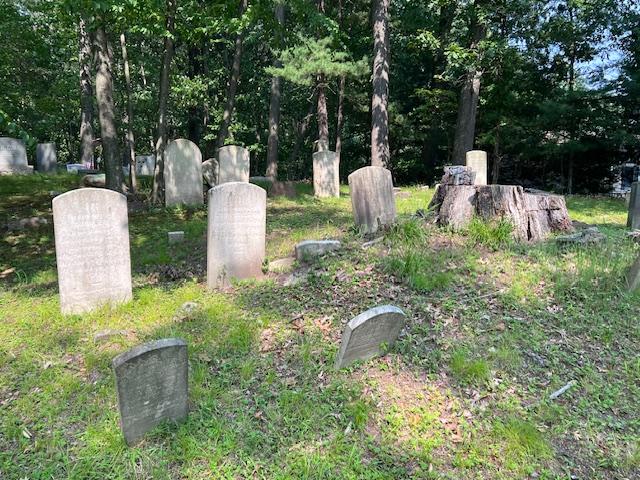
The Van Bushkirk Burial Ground behind the residence at 45 East Saddle River Road

The Van Bushkirk Burial Ground is part of the history of Saddle River, NJ’s early settlement period. The burial ground has about 40 tombstones that are arched and shaped. These are some of the first residents both of Saddle River and Bergen County, NJ.

The burial ground lies next to a creek off East Saddle River Road and can only be accessed by going through private property of the residents living at 45 East Saddle River Road. Please do not enter without permission of the owner of the home. These pictures were taken with a long distance camera from the street.

The Van Bushkirk Burial Ground at 45 East Saddle River Road

The History of Saddle River:

(from the Saddle River Town website):

In 1675, Lenni Lenape tribal leaders sold a large amount of land on the Eastern side of the Saddle River (known as Werimus) to Albert Zabriskie. In 1708, Zabriskie sold this tract of land to Thomas Van Buskirk. The first house in Saddle River was built by the Van Buskirk family in 1709. The original Van Buskirk homestead still stands at 164 East Saddle River Road across from Borough Hall.

In 1709, the Lenni Lenape sold the land on the west side of the Saddle River to the English as part of the Ramapo Tract. Property on the west side of the Saddle River was acquired from this Tract throughout the 1700’s. The Ackerman Family was the most prolific buyer of these early Saddle River parcels and first settled on the West side of the Saddle River in 1745 when Johannes Ackerman acquired 245 acres.

The graves of George and Margaret Achenbach

Saddle River continued to grow and populate during the 18th century.  Families such as the Van Buskirk’s, the Ackerman’s, the Achenbach’s, the Hopper’s, the Zabriskie’s, the Stilwell’s and the Baldwin’s farmed and developed the area.

The grave of George Achenbach

The first of many Saddle River mills was built in 1714 and the first school was constructed in 1720. Another early 18th century business was the blacksmith shop operated by the Ackerman family. Over the years, these 1st families built the quintessential “Old Dutch Homesteads” from actual sandstone that was found in town.

The Revolutionary War era tombstones

The Revolutionary War was a horrendous time for the residents of Saddle River. The townsfolk had spent the entire 18th century developing the area into a well established community and all growth essentially stopped during the war. Since the Jersey Dutch initially considered the revolution to be an English issue, it was particularly shocking when the fighting came to their backyards. From December 1776 until the end of the war, both American and British forces traveled through Saddle River and many times set up camp in the center of town.

Residents were in constant fear of the British employed Hessian soldiers who would terrorize families by raiding the houses for food and then burning the fields before leaving. Although no major battles took place in Saddle River, there were small skirmishes to fend off raids and the Blue Mill on East Saddle River Road was destroyed. Even George Washington, the future father of our country, passed through Saddle River on multiple occasions and tradition has him staying overnight at the Ackerman Homestead on the East road.

When the Revolutionary War ended, Saddle River residents picked up right where they left off in terms of community and industry development. The Ackerman’s built a Foundry on what is now Waterford Gardens. Tice and Berdan both opened stores in town and the Bulls Head Tavern opened its doors to weary travelers in 1802. Old mills were re-opened and new ones such as Van Riper’s Saw Mill and Basket Factory were established. The post war growth continued for decades and culminated in the 1820s with the construction of the Zion Lutheran Church in 1821 and a new schoolhouse behind the church in 1825.

The worn tombstones in the cemetery

History of the Van Bushkirk family in Bergen County during the Revolutionary War:

(From the Bergen County Historical Society website):

Loyalists in Bergen County | Bergen County Historical Society

Loyalists in Bergen County came from all backgrounds, religions and economic classes. At the beginning of the war, a number were officers in the militia, the military force composed of all able-bodied males maintained by each province, and later the states. The lieutenant colonel of the militia was John Zabriskie of New Bridge. Zabriskie understood the sentiments of many of his neighbors, particularly those of Abraham Van Buskirk, whose property was directly across the bridge in Teaneck. Van Buskirk was a surgeon in the militia under Zabriskie, and with whom he served on Bergen County’s Committee of Correspondence, an entity established to keep in touch with other New Jersey counties and the events occurring there.