Category: Historic Libraries

American Academy of Arts Letters                                     633 West 155th Street                                        New York, NY 10032

American Academy of Arts Letters 633 West 155th Street New York, NY 10032

American Academy of Arts & Letters

633 West 155th Street

New York, NY 10032

(212) 368-5900

Academy@Artsandletters.org

https://artsandletters.org/

Hours: Thursday-Sunday-1:00pm-4:00pm/Open During Exhibitions times only or by appointment (Mid-March-Mid-April; Mid-May-Mid-June)

Fee: Free

My review on TripAdvisor:

https://www.tripadvisor.com/ShowUserReviews-g60763-d548512-r682038708-American_Academy_of_Arts_and_Letters-New_York_City_New_York.html?m=19905

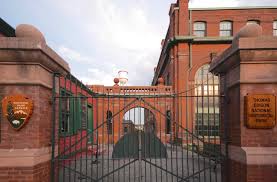
The front of the American Museum of Arts & Letters at 633 West 155th Street

I was finally able to visit the American Academy of Arts and Letters on the last day it was open for the year to the public. It was for the ‘Ceremonial Exhibition: Work by New Members and Recipients of Awards’, an exhibition on members art that was chosen specifically for the show. Most of the work was very contemporary and some a little political. It was interesting work by new artists that filled the small gallery rooms.

The front of the American Museum of Arts & Letters

One of the buildings was used for the contemporary art while the one across the courtyard was used for the more architectural pieces. The galleries are small but the art was impressive. What I liked when I talked with one of the women who worked there said to me that after the show, the pieces would be donated to galleries and museums all over the country. The galleries are only open four months out of the year and this was the last day of the exhibition so the work being shown will be gone.

I visited the museum in January 2025 and it had just reopened after a three year renovation after it had been closed since Pre-COVID and it is now fully open with a new exhibitions. All the galleries are brightly lit and displaying new exhibitions.
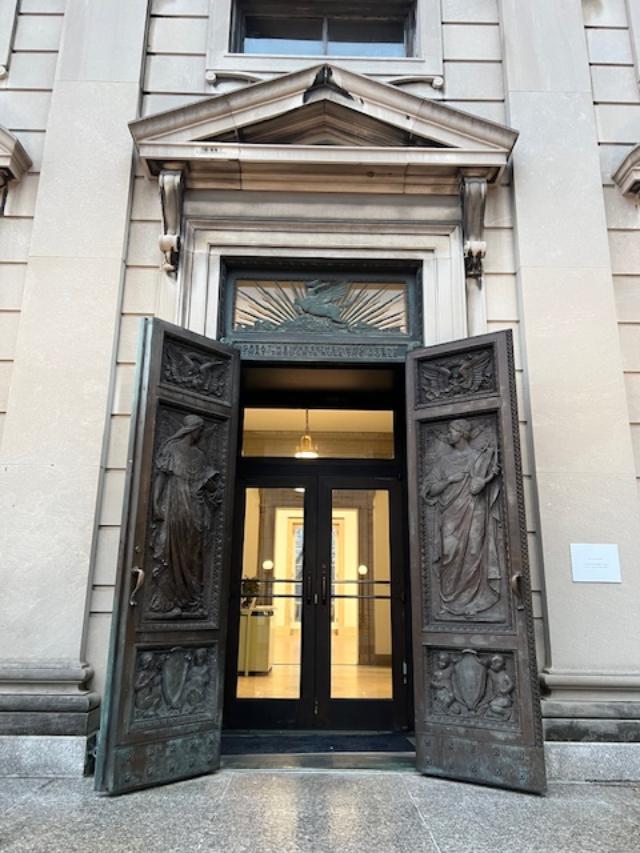
The entrance to the museum from the courtyard

Some of the pieces that really stood out when I visited in 2019 were by Judith Bernstein, a contemporary painter who seems to not like the current administration too much. The themes were on power and money and corruption in the administration. Her work really shows what she personally thinks of  our President. Her ‘Trump Genie” was very clever and I can see this in a major museum in the future.

American Academy of Arts & Letters III

Judith Bernstein’s work

Other work in the main gallery in 2019 were by artists Stephen Westfall with ‘Solid Gone’, Hermine Ford with ‘Paris, France’ and Paul Mogensen with several ‘Untitled’ pieces. The contemporary works I was not sure what the meaning of them were but they were colorful.
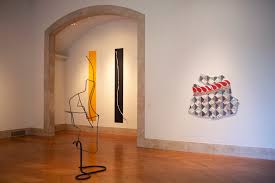
American Academy of Arts & Letters V

The works of the artists of the front gallery

One of the pieces in the front gallery that really stood out was by artist Francesca Dimattio, ‘She-wolf’ which was a classic Greek character made of porcelain, enamel, paint and steel.
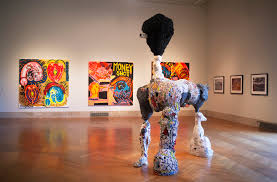
American Academy of Arts & Letters VI

‘She-wolf’ by Francesca Dimattio

There were light installations in 2019 that were very interesting by artist James O. Clark. He had one piece, ‘Wunnerful, Wunnerful’,  which is a work that just keeps being creating itself by bubbles and ink markers moving along a turntable that stops and starts.

There was a permanent exhibition of Charles Ives home in Connecticut that was transported and recreated here. His studio and works are featured here as well as his family life. There are copies of his works in the display cases and his career.
The museum in 2025 was fully open with the exhibition by artist Christine Kozlov, a contemporary Video artist whose works were being featured in the main gallery.

The main gallery of the Kristine Kozlov exhibition

In more than fifty artworks arrayed across four galleries at Arts and Letters, Christine Kozlov shows the breadth of Conceptual artist Christine Kozlov’s practice with a focus on works from the mid-1960s through the late 1970s. Nearly all of the works Kozlov contributed to public exhibitions during this period will be on view, many of which were created for landmark exhibitions of Conceptual art such as: One Month (1969), organized by Seth Siegelaub; Information (1970), curated by Kynaston McShine at the Museum of Modern Art, New York; Arte de Sistemas organized by Jorge Glusberg / CAYC—Centro de Arte y Comunicación at the Museo De Arte Moderno (1971); and the Number Shows, a series of exhibitions curated by Lucy Lippard between 1969 and 1974 (American Museum of Arts & Letters website).

Part of the Kristine Kostov exhibition

Works by artist Christine Kozlov

The next exhibition that I viewed was by artist Wadada Leo Smith, which consisted of an exhibition based on colors and sounds. You could take the headsets around the gallery and tour and admire the work with the sounds of the musical groups.
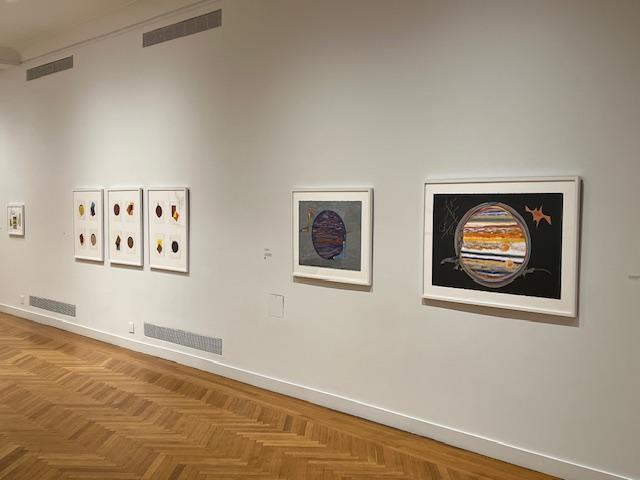
The gallery with works by artist Wadada Leo Smith

Wadada Leo Smith (b. 1941, Leland, MS) is a composer-performer and Arts and Letters member. Formerly an educator at CalArts, he has influenced decades of musicians and artists, including Raven Chacon. In Kosmic Music, Smith’s first solo exhibition in New York, he shares over fifty years of Ankhrasmation (Museum website).

The “Sphere” works by artist Wadada Leo Smith
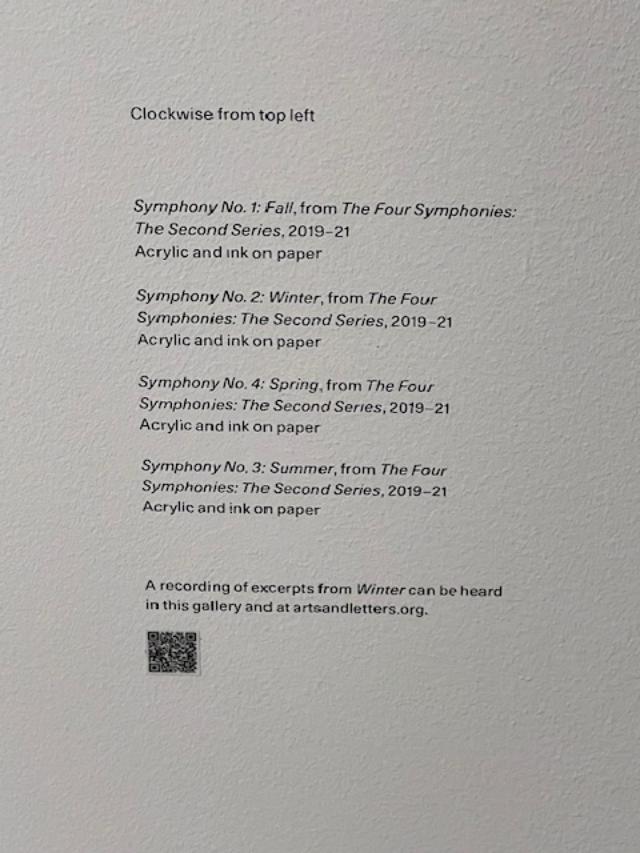
Ankhrasmation is a musical language Smith began exploring in 1965. Smith does not consider Ankhrasmation to be his creation but rather something he discovered. The name derives from Ankh, an ancient Egyptian symbol of life; Ras, an Ethiopian word for leader or father; and Ma, for mother. The distinctive language uses line, color, and shape to designate musical components such as tonal range and intensity of activity. For Smith, performing Ankhrasmation requires focused practice and “having that space in your heart and mind so that you can play from inspiration.” (Museum website).

The last exhibition I saw was in the gallery across the courtyard from the main museum was by artist Raven Chacon. You would walk in the main gallery to the sounds of birds both living and extinct. Just five minutes in the main gallery by myself and I felt like Tippi Hedren in the movie “The Birds”. There were all sorts of bird sounds with no birds around.
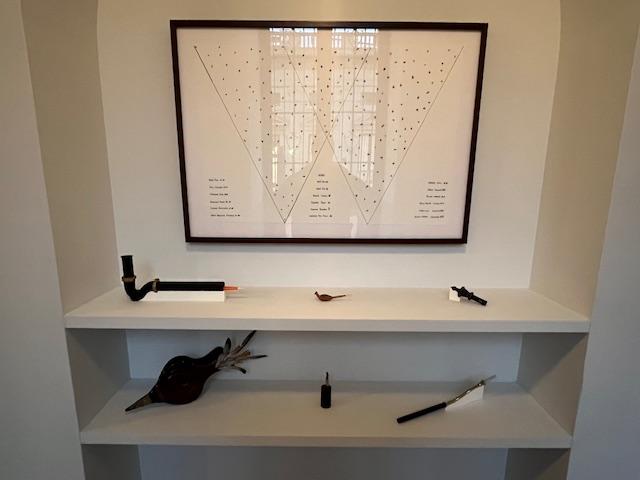
The instruments that the artist uses to achieve the sounds of the birds

When Raven Chacon (b. 1977, Fort Defiance, Navajo Nation) visited Arts and Letters for the first time, he paused in our North Gallery to clap his hands, then counted how long it took for the room to go silent. It took around six seconds—a long rate of decay. Standing in that echoing chamber, Chacon noted the building’s Beaux Arts design by Cass Gilbert, with its imported Spanish tile and cage-like glass ceiling that filters the sky. He became curious to learn the history of the land it sits on, once owned by John James Audubon, who purchased it in 1841 with funds from the sale of his illustrated Birds of America (Museum website).

Chacon is a composer and artist who frequently works with the materials and histories of a given site and who considers, as he puts it, “what has been silenced and what happens when it is not.” For the past year, he has worked on Aviary, his site-specific commission for the North Gallery, creating a soundscape that makes space and time for careful listening (Museum website).

Museum Mission:

(from the museum website)

The American Academy of Arts & Letters was founded in 1898 as an honor society of the country’s leading architects, artists, composers and writers. Charter members include William Merritt Chase, Kenyon Cox, Daniel Chester French, Childe Hassam, Henry James, Theodore Roosevelt, Elihu Vedder and Woodrow Wilson. The Academy’;’s 250 members are elected for life and pay no dues.
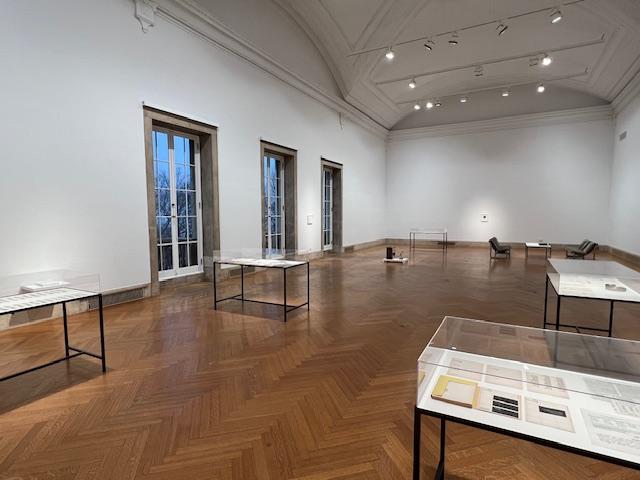
The main gallery of the museum

In addition to electing new members as vacancies occur, the Academy seeks to foster and sustain an interest in Literature, Music and the Fine Arts by administering over 70 awards and prizes, exhibiting art and manuscripts, funding performances of new works of musical theater and purchasing artwork for donation to museums across the country.

Collections:

(from the museum website)

The Academy’s collection, which are open to scholars by appointment, contain portraits and photographs of members, as well as paintings, sculptures, drawings, prints and decorative art objects. The library has more than 25,000 books by or about members. The archives house correspondence with past members, press clippings, institutional records and original manuscripts of musical and literary works.

History:

(from the museum website)

The National Institute of Arts & Letters, the parent body of the Academy, was founded in 1898 for “the advancement of art and literature”. The Institute met for the first time in New York City in February 1899 and began electing members that fall. Architects, artists, writers and composers of notable achievement were eligible and membership was soon capped at 250. In 1913, President Taft signed an act of Congress incorporating the organization in the District of Columbia.

American Academy of Arts & Letters at twilight

In 1904, The Institution created the American Academy of Arts & Letters, a prestigious inner body of its own members that modeled itself on the Academie francaise. The first seven members of the Academy were William Dean Howells, Augustus Saint-Gaudens, Edmund Clarence Stedman, John La Farge, Mark Twain, John Hay and Edward MacDowell. Those seven then chose eight more and so on, until the full complement of 30 and later 50 was reached. Only after being elected to the Institute, was a member eligible for elevation to the Academy. This bicameral system of membership continued until 1993, when the Institute dissolved itself and all 250 members were enrolled in the American Academy of Arts and Letters.

The Academy inaugurated its annual awards program in 1909 with the Gold Medal for Sculpture. Since then, over 70 awards and prizes have been endowed through gifts and bequests or established by the Academy’s board of directors in the fields of architecture, art, literature and music. There are conferred each year at the Ceremonial in May when new members are inducted and a distinguished speaker is invited to deliver the Blashfield Address.

In 2005, the Academy purchased the former headquarters of the American Numismatic Society, the neighboring building on Audubon Terrace. A Glass Link now connects the Academy’s existing galleries to newly renovated ones in the former Numismatic building. These new galleries house the permanently installed Charles Ives Studio.

(The Academy of Arts & Letters Website)
Thomas Edison National Historical Park, Laboratory Complex and Glenmont                   211 Main Street                                                  West Orange, NJ 07052

Thomas Edison National Historical Park, Laboratory Complex and Glenmont 211 Main Street West Orange, NJ 07052

The Thomas Edison National Historical Park

211 Main Street

West Orange, NJ  07052

(973) 736-0550

https://www.nps.gov/edis/index.htm

Open: Sunday 10:00am-4:00pm/Closed Monday-Tuesday/Wednesday-Saturday 10:00am-4:00pm

Note: There are renovations going on at the site so please call ahead to check on hours and fees.

The Thomas Edison National Historical Park, Laboratory Complex and Glenmont home are a step back in time when machines were run by belts and pulleys and music was played on phonographs. Where to the passerby, the buildings betray little evidence of the industries they once started. Discover where America’s greatest inventor changed our world forever.

The Laboratory site Complex contains:

  1. Visitor Center (Restrooms & Gift shop)
  2. Chemistry Laboratory
  3. Chemical Storage and Pattern Shop
  4. Metallurgical Laboratory
  5. Main Laboratory
  6. Powerhouse
  7. Blacksmith Shop
  8. Building 11
  9. Vault 12
  10. Black Maria
  11. Water Tower
  12. Vault 32
  13. Vault 33
  14. Building 35 (Maintenance Facility)

Park Information:

The Laboratory Complex is open Wednesday through Sunday. The Glenmont Estate is open Friday, Saturday and Sunday. Glenmont tickers are limited and are distributed on a first-come, first-serve basis from the Laboratory Visitor Center. Please call for specific hours.

Fees:

Entrance Fee-$10 (Under 16 years old free)

Optional Laboratory Audio Tour-$5

Park Annual Pass-$40

Inter-agency Passes Accepted

Group Reservations: Call 973-736-0550 ext. 33

Filming and Photography: Call 973-736-0550 ext. 50

Corporate Events: Call 973-736-0550 ext. 50

For more Information: http://www.nps.gov/edis (973) 736-0550 ext. 11

Calendar of Events: http://www.nps.gov/edis/planyourvisit/events/htm

*Thomas Edison National Historical Park Facebook.

Directions to Glenmont:

*Please respect the privacy of our neighbors by driving directly to and from Glenmont.

Directions to Glenmont:

*Put your pass on the dashboard of your car

*Right out of the parking lot

*Right at the first light and stop at the gatehouse

*Go up Park Way

*Right onto Glen Avenue

*Left onto Honeysuckle Road

*Right into paved parking lot

*Tour begins in front of the home

*Restrooms located in Potting Shed/Visitor Center

*Information is taken from National Park Service, US Department of the Interior, Thomas Edison National Historical Park, West Orange, New Jersey.

My review on TripAdvisor:

https://www.tripadvisor.com/Attraction_Review-g60796-d1023095-Reviews-Thomas_Edison_National_Historical_Park-West_Orange_New_Jersey.html?m=19905

I had visited the Laboratories of Thomas Edison and it is very interesting to tour the floors of inventions. There are very innovative items that I never knew he invented, things like talking dolls and many household items for the kitchen and home.

Edison National Site.jpg

Another room they showed was his private office where he did most of his personal work and spent his sleeping hours when working at the laboratory. Each of the rooms show how and at what stages of the invention process that each object.

Edison National Site II.jpg

Glenmont, the family home, can be a musty place in the colder months. The house smells like it is old. It needed a good airing out. The period furniture are very interesting. The house is full of Victorian elegance but it needs a good renovation. The walls and ceilings  need some plastering and the home needs a good deep cleaning. Still it is interesting that for all their prestige, they still lived more like an upper middle class family.

The history Edison National Historical Park:

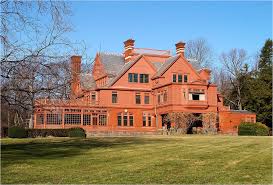
Thomas Edison National Historical Park preserves Thomas Edison’s laboratory and residence, Glenmont, in Llewellyn Park in West Orange in Essex County, NJ. These were designed, in 1887, by Henry Hudson Holly. For more than 40 years, the laboratory had a major impact on the lives of people worldwide. Out of the West Orange laboratories came the motion picture camera, improved phonographs, sound recordings, silent and sound movies and the nickel-iron alkaline electric storage battery (Wiki).

Edison’s home was designated as the Edison Home National Historic Site on December 6, 1955. The laboratory was designated as Edison Laboratory National Monument on July 14, 1956. On September 5, 1962, the 21 acre site containing the home and the laboratory were designated the Edison National Historic Site and overseen by the National Park Service. On March 30, 2009, it was renamed Thomas Edison National Historical Park, adding “Thomas” to the title in hopes to relieve confusion between the Edison sites in West Orange and Edison, NJ. Following extensive renovations of the laboratory complex, there was a grand reopening on October 10, 2009 (Wiki).

Historic Glenmont Mansion:

Thomas Edison resided at Glenmont, his 29 room Victorian mansion, for over half his lifetime. Its architect, Henry Hudson Holly, is considered to be the father of the Queen-Anne style architectural movement in the United States. Holly’s crowning achievement, Glenmont, was part of a working estate which presently contains six outbuildings including a barn and a greenhouse. Examples of Thomas Edison’s poured concrete structures, the auto garage and the potting shed are also still in existence. (Wiki).

Glenmont

Thomas Edison’s Home “Glenmont”

The interior of the fully furnished Victorian home is a rare example of Pottier & Stymus interiors, a New York decorating firm that lost the majority of its records in a catastrophic warehouse fire in the year 1888. Glenmont’s interiors display rare examples of the firm’s modern Gothic style furniture suites and also include decorative arts objects chosen by the company to outfit this home in Victorian style. The Edison family appreciated the original interiors, consequently making only minimal changes to the home’s decoration during their residency (Wiki).

Glenmont’s period rooms reflect examples of the era’s Eastlake style and Aesthetic Movement style interiors. The first floor library boasts hand stenciled walls in flat, stylized floral patterns with a ceiling of distemperment. Tall case cabinets store leather bound volumes. The decorative arts collection at Glenmont ranges from major works of art and sculpture to everyday objects. The collection, consisting of 40,000 items, includes remarkable examples of Hudson River School artists and antiques (Wiki).

Glenmont II

Examples of more utilitarian items include the Edison china collection, still housed in the historic Butler’s Pantry, the household linen collection, family toiletry items, books and household receipts that detail purchases made by the Edison family.  These vouchers reveal to us the Edison’s choice of household products and their spending habits (Wiki).

Disclaimer: The above information on the history of the house and labs came from Wiki and I give the format full credit for the information. The above information also comes from the National Parks Services pamphlet and I give them full credit for the Visitor’s information.

Americas Society Museum                                   680 Park Avenue                                                 New York, NY 10021

Americas Society Museum 680 Park Avenue New York, NY 10021

Americas Society Museum

680 Park Avenue

New York, NY 10021

(212)628-3200

https://www.as-coa.org/visual-arts/arts_americas_circle

https://www.as-coa.org/arts-culture-americas-society

Open: Wednesday-Saturday: 12:00pm-6:00pm/Closed Sunday-Tuesday
Varies with exhibitions

Admission: Free

http://www.as-coa.org/visual arts

My review on TripAdvisor:

https://www.tripadvisor.com/Attraction_Review-g60763-d548518-Reviews-Americas_Society-New_York_City_New_York.html

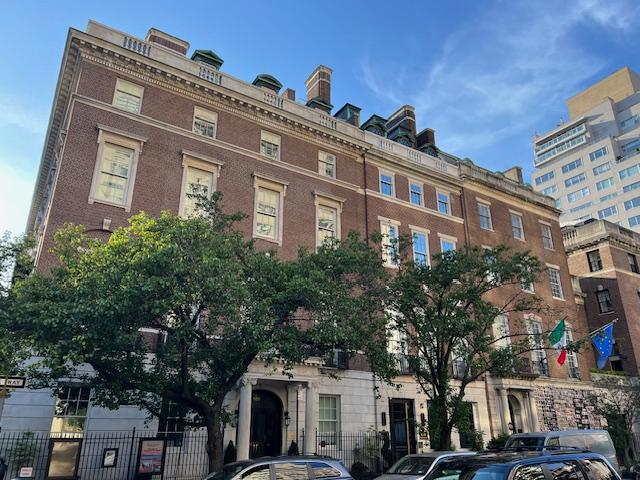
 The Americas Society Museum at 680 Park Avenue

I came across the Americas Society Museum when walking on Park Avenue on the Upper East Side for my walking project, “MywalkinManhattan.com”. I noticed the sign for the exhibition, “The Metropolis in Latin America 1830-1930”. The exhibition was on the transformation of cities in Latin America from their traditional path starting with Spanish colonization to a more European layout that was developed between the Revolutionary and Civil Wars with the ‘Gilded Age’ thrown in as the third generation of settlers became long time citizens and became more wealthy.

They wanted to live like they were still in Europe. It showed how the cities developed over time with planning and then with extended, unintended growth that lead to the outlaying slums. Very interesting exhibition (now closed).

Americas Society Museum II

A exhibition at the Americas Society Museum

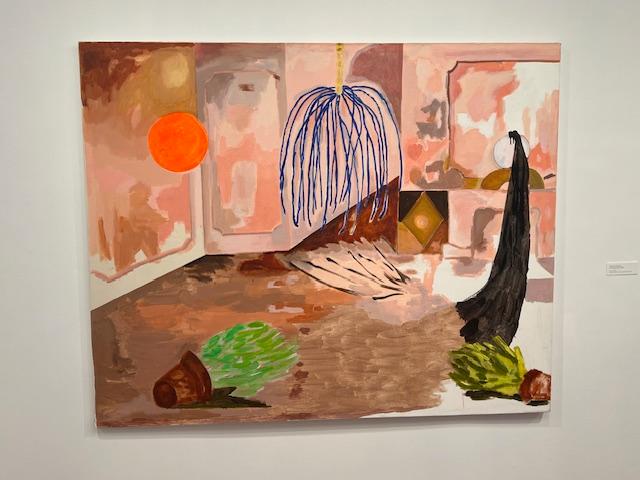
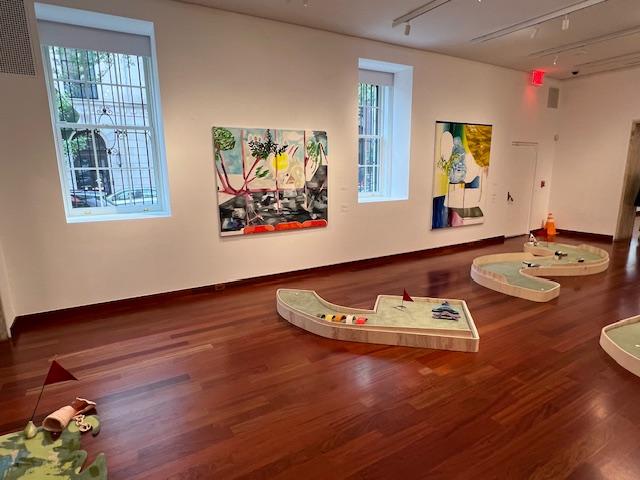
In the summer of 2024, the museum had an interesting exhibition on artist Alejandra Seeber. Her colorful interactive works had some of the patrons playing golf inside of the galleries. I thought her work was vibrant and exciting. She draws you in with the bright invigorating colors and on the floor pieces of carpet whose colors lead your golf balls from hole to hole as you travel the exhibition.

The museum press release on the Alejandra Seeber exhibition:

The description of the show:

(from the museum’s website):

Americas Society presents the first solo exhibition and career survey of the Argentine artist Alejandra Seeber in New York, starting June 5. Seeber (b. 1969, Buenos Aires, Argentina) is a painter who centers representations of various spaces to explore the tension between representation and abstraction in painting. Seeber utilizes bold color and gesture to examine liminal spaces within built and domestic environments. Later work veers further into abstraction, implementing visual devices like Rorschach drawings or knit grids to structure the composition. 

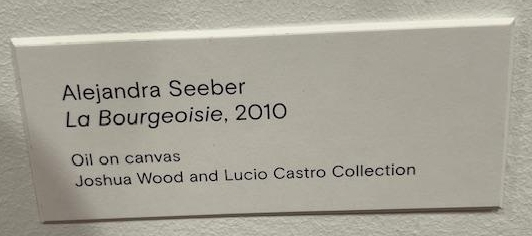
My favorite painting in the show by Alejandra Seeber “La Bourgeoisie”

The sign of the painting

The exhibition  pairs these paintings with Seeber’s contemporary explorations of the built landscape with an installation. This survey of her work is organized around a playable golf course installed inside the gallery space in which visitors will be invited to play golf as they walk through the show. The golf obstacles become active sculptures in the exhibition, creating porous boundaries between artwork and audience. This playful environment manifests the explorations of edges, doorways, windows, and borders in the artist’s painting. As they play, visitors will be able to trace Seeber’s artistic trajectory and see how her interventions in the form and practice of painting continue to this day. 

The vibrance of the art with its colorful details

The interactive art in the gallery

The art golf course

History:

The Americas Society is an organization dedicated to education, debate and dialogue on the Americas and is located at 680 Park Avenue on the Upper East Side of Manhattan. The Americas Society was established by David Rockefeller in 1965. The Americas Society promotes the understanding of the economic, political and social issues confronting Latin America, the Caribbean and Canada; its mission is “to increase public awareness and appreciation of the diverse cultural heritage of the Americas and the importance of the inter-American relationship.

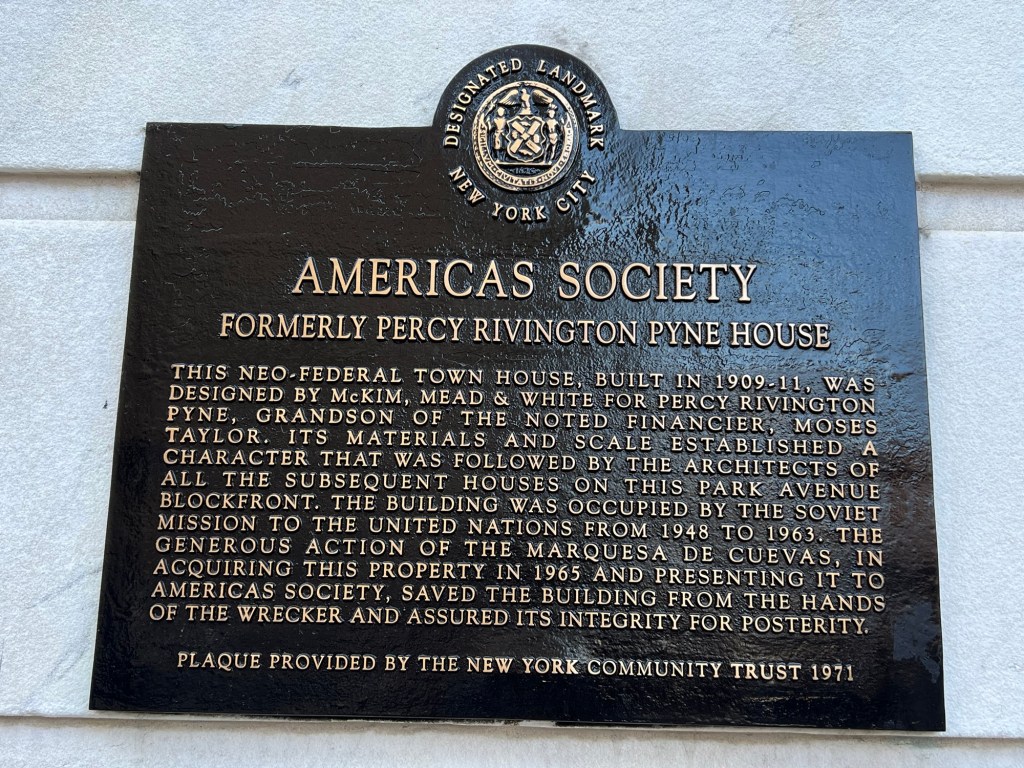
The buildings historical past as the Percy Rivington Pyne House

https://en.wikipedia.org/wiki/Percy_Rivington_Pyne_I

The Americas Society Building is listed in the National Register of Historic Places. The building was previously the Percy Rivington Pyne House before serving as the Soviet Mission to the United Nations until its current usage. along with the neighboring buildings of the Queen Sofia Spanish Institute and the Italian Consulate General, the house constitutes one of the few remaining unified architectural ensembles on Park Avenue. The Center for Inter-American Relations was later to be absorbed into Americas Society 1985.

Activities:

The Americas Society organizes interviews, speeches, podcasts, exhibitions, readings and musical performances at its headquarters and reports on Congressional updates and local events. Many events are held at the Salon Simon Bolivar, an expansive room in the building’s Neo-Federal style with wide windows, a 15 foot ceiling and wood-paneled and silk fabric walls.

Americas Society Museum III

An Exhibition at the museum:

The Americas Society produces the MetLife Music of the Americas (concert series) to showcase the diversity of styles and genres of music in the Americas. The concert series is held at the Society’s headquarters.

The Americas Society, together with Council of the Americas, produces the publication ‘Americas Quarterly’, a policy journal for the Western Hemisphere. The Americas Society also publishes ‘Review Magazine’, which was first founded in 1968. ‘Review Magazine’ is an English language journal for literature from Latin America, the Caribbean and Canada. ‘Review Magazine’ also helped support the first English translation of “One Hundred Years of Solitude” by Gabriel Garcia Marquez as well as other translations.

The Americas Society has also organized working groups on the topics of women’s empowerment and leadership. Cuba, energy policy, immigration, trade facilitation and Venezuela.

Americas Society Museum

Council of the Americas (COA)

Is the premier international business organization whose members share a common commitment to economic and social development, open markets, the rule of law and democracy throughout the Western Hemisphere. The Council’s membership consists of leading international companies representing a broad spectrum of sectors, including banking and finance, consulting services, consumer products, energy and mining, manufacturing, media, technology and transportation.

(This information was taken directly from Wiki and Americas Society publications)

The New Jersey Historical Society                        52 Park Place                                                 Newark, NJ 07102

The New Jersey Historical Society 52 Park Place Newark, NJ 07102

The New Jersey Historical Society

52 Park Place

Newark, NJ  07102

Phone: (973) 596-8500

Fax: (973) 596-6957

http://www.jerseyhistory.org

New Jersey Historical Society

Fee: Adults $3.00/Research Library $5.00

Open: Sunday-Monday Closed/Tuesday-Saturday 10:00am-5:00pm

Library: Sunday-Monday Closed/Tuesday-Saturday 12:00pm-5:00pm


TripAdvisor Review:

https://www.tripadvisor.com/Attraction_Review-g46671-d217958-Reviews-Newark_Museum-Newark_New_Jersey.html?m=19905

I was able to visit the New Jersey Historical Society (See TripAdvisor review) after a morning at the Newark Museum. It has some interesting exhibitions right now on the Newark riots of the 60’s , the New Jersey Watershed and Louis Bamberger, the founder of Bamberger’s. It was an interesting history of a former grand department store.

The New Jersey Historical Society has changing exhibitions and lectures, talks and walking tours. It is an interesting museum dealing with the history of New Jersey.


The New Jersey Historical Society

Founded 1845

New Jersey Historical Society

The New Jersey Historical Society is the oldest private, non-profit cultural institution in the state. It was founded in 1845 as an archive, which later evolved into a research library and museum. Award-winning exhibits, education programs, publications, lectures and events for all communities in New Jersey have been our legacy over the past century.

Mission:

The New Jersey Historical Society collects, preserves, teaches and interprets New Jersey history through our archives, research library and educational programs. We do so in the belief that an understanding and appreciation of historical issues, decisions and actions can inform and inspire the people of New Jersey.

Vision:

To be a state of the art center for the study of New Jersey history with convenient access to all archival collections and educational programs for all ages.

New Jersey Historical Society II

New Jersey Historical Society

Current Museum Exhibitions: (January 2018)

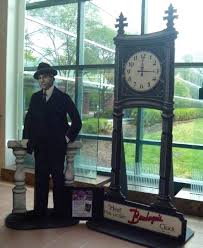
*”Meet Me under the Bamberger’s Clock”: a celebration of the life and contribution of Louis Bamberger.

New Jersey Historical Society III

The Bamberger Exhibition

*Ebb and Flow: New Jersey and its Rivers

*Send the Word: NJ during the Great War

*Newark: Revolution to Revival

New Jersey Historical Society IV

Newark Industry

*Military Park Tours: available every Friday and Saturday at 12:00pm, May-November

Education Programs:

Our affordable educator-led programs include hands-on activities tailored to the age and development level of your students, challenging and inspiring them to grow as learners and thinkers.

Discover:

Students will discover the state’s unique past through handling objects, exploring exhibits and engaging in fun, stimulating activities. Teaches will discover all the interdisciplinary connections to the Common Core State Standards for English Language Arts & Literary in History/Social Studies.

Learn:

Educators and students will learn together how to analyze photographs, paintings and historical objects and interact with history in a variety of ways, including role play, observation and group participation.

Research:

Students will learn to research history and present their ideas and findings through oral presentations, writing and art.

Building and Exhibition Tours are available upon request. Call (973) 596-8500 to schedule!

Research Library:

The New Jersey Historical Society contains manuscripts, rare books, photographs, maps, broadsides, pamphlets and other materials that document the cultural and historical heritage of New Jersey from the colonial era through the 21st century. The collections form the most comprehensive privately-funded library on New Jersey’s past. The research library is open to the public by appointment and serves a diverse clientele including scholars, students, historians and genealogists.

Membership:

Why become a member? In addition to individual benefits such as free admission to the research library and museum exhibits, you are helping to sustain 350 years of New Jersey history, a history we’ve been collecting and preserving since 1845. NJHS has a commitment to the people of our state to treasure our shared history; your membership helps us keep that commitment.


Contact:

For research library appointment, email: library@jerseyhistory.org

For all other questions, email: contactnjhs@jerseyhistory.org

Membership Email information: doug@jerseyhistory.org (973) 596-8500 ext. 224

Disclaimer: This information was taken directly from the New Jersey Historical Society (NJHS) pamphlet. Please call the society for any information of hours and admissions in case they change. It really is a very interesting museum.