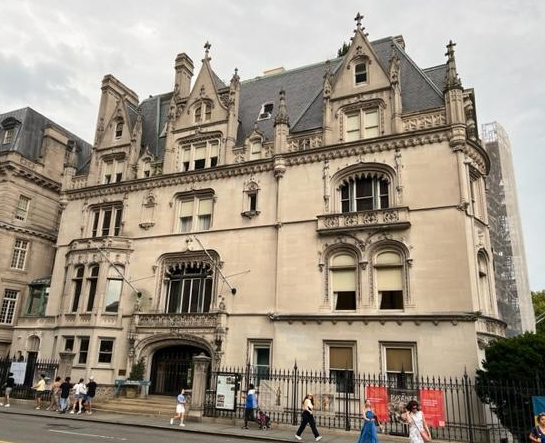
The Ukrainian Institute of America at 2 East 79th Street
I was really impressed by the Ukrainian Institute of America on a recent visit. I must have passed this building a hundred times on my way to the Metropolitan Museum of Art and never thought twice of it. I was sorry I did as you will miss a lot by not walking in. The galleries are really impressive and the main gallery on the bottom gives you an interesting look at the history of the Ukrainian.
The first floor gallery discusses the formation of the country, a bit about its history and its ties to Europe and to Russia, its religious past and the current state of affairs of the country including its recent split of the eastern sections of the country and Crimea to Russia. Its a country in turmoil considering they want to join the European Union. It is a country in flux and on the cusp of entering the 21st Century with some of its past still tugging at it. Like all countries, it will prevail on the will of it’s people. There is a lot of solid history here and a country ready to enter its future.
The artwork of artist Vasyl Diadyniuk
The second and third floor galleries are full of art work from Ukrainian artists that is on sale and each of the galleries is dedicated to certain artists selling their works at somewhat hefty prices. Still you get to see the developments of the artists both here and abroad.
The forth floor is dedicated to special exhibitions. There are two shows going on now. One is by artist Vasyl Diadyniuk and another show is by artist Alexander Archipenko.
The artwork of artist Alexander Archipenko
The Museum has an interesting history.
Ukrainian Institute of America History:
The Ukrainian Institute of America Inc. is a non-profit organization whose primary mission is to showcase and support Ukrainian culture. To that end, the Institute affords the general public an opportunity to learn about Ukraine and how the Ukrainian spirit expresses itself, with special emphasis on the creative arts.
Founded more than fifty years ago by William Dzus, a prominent Ukrainian industrialist and philanthropist, the Institute sponsors:
*Art exhibitions
*Music concerts
*film screenings
*theater presentations
*Poetry readings
*Lectures and symposia
*Educational programs
*Children’s events
*Documentation center
The history of the building:
The building that is home to the Institute, the National Historic Landmark Harry F. Sinclair House is one of the few remaining examples of the splendid mansions that prominent citizens of New York City built in the 19th Century. The mansion was built in 1897 for Isaac D. Fletcher, a wealthy banker and broker, by the architect C.P.H. Gilbert. Executed in Gothic Revival style, the building is richly decorated with intricate crockets, carvings, moldings, pinnacles and other exquisite details. Six stories high, partly surrounded by a dry moat, the Institute features stately rooms that are magnificently proportioned and lavishly finished (Institute History).
The C.P.H. Gilbert house
In 1887, manufacturer, Isaac D. Fletcher, commissioned famed Gilded Age architect, C.P.H. Gilbert to design the mansion. When Mr. Fletcher died, left this mansion and his art collection to the Metropolitan Museum of Art, which sold it to Harry F. Sinclair, founder of Sinclair Oil Company and also famous for his involvement in the Teapot Dome affair. The last private owner was Augustus Van Horne Stuyvesant Jr., the last descendant of Peter Stuyvesant, who was the first governor of New Amsterdam, today’s New York City bought the house in 1930 and lived here with his sister, Anne. The house was sold as part of the estate when Mr. Stuyvesant died in 1953. The Ukrainian Institute of America acquired the mansion in 1955 (Institute History).
A key goal of the Institute is to continue to preserve this extraordinary fragment of the city’s history for the benefit of all citizens of New York. The house still retains its wooden moldings and the house looks as if its residents just moved out.
I have been visiting Carl Schurz Park many times while walking the neighborhood for my project, “MywalkinManhattan.com”. You can see the entries from Days One Hundred and Ten, Six, Four and Two. I also visited again when touring Gracie Mansion for this blog, “VisitingaMuseum” (see write up under Gracie Mansion).
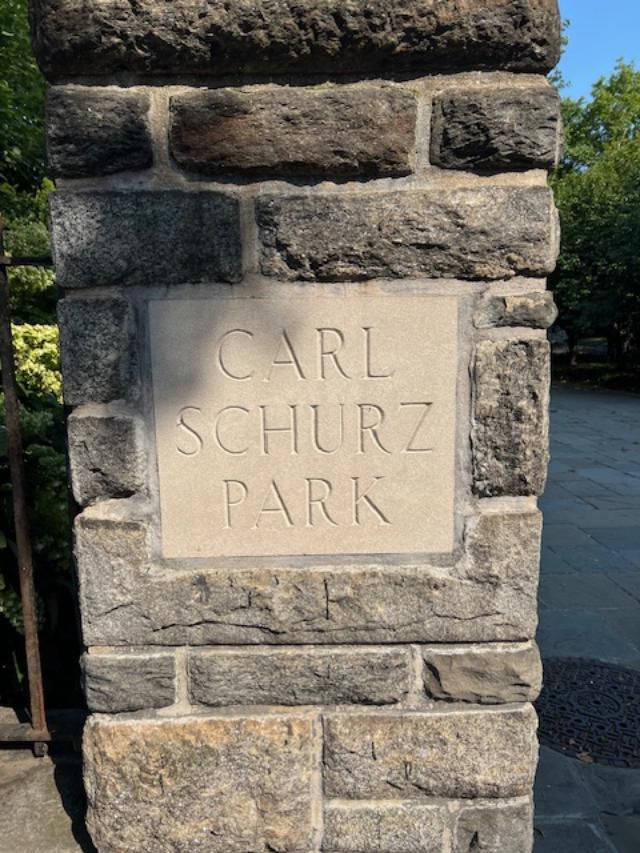
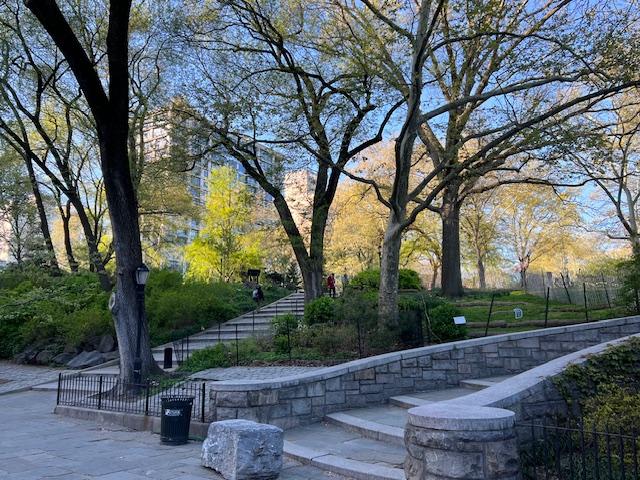
The entrance to Carl Schurz Park in the Summer of 2024
The park is such a nice place to relax in the warmer months. Being so close to the river in the winter months when the wind kicks in from the river can be brutal. In the Spring and Summer, it is one of the nicest parks to just sit and relax in. During the day, it is fun to watch the kids play in the large playground in the middle of the park. On the weekends the place is packed with kids, parents, and nannies all vying for space.
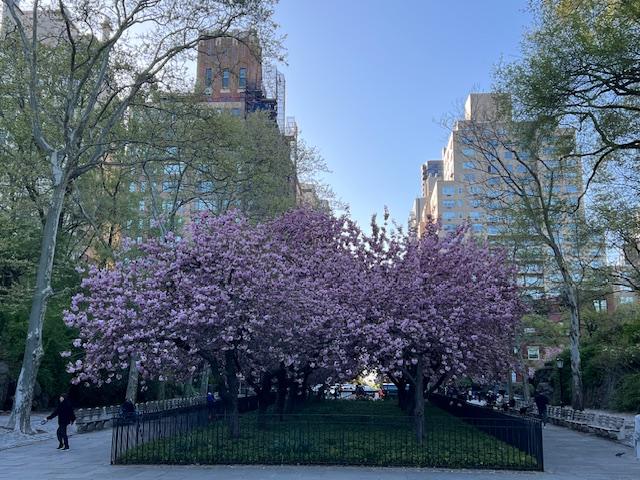
The Cherry Blossoms at the entrance of the park.
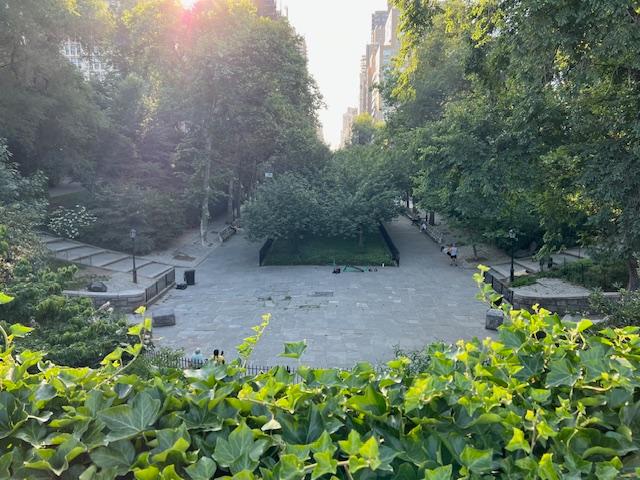
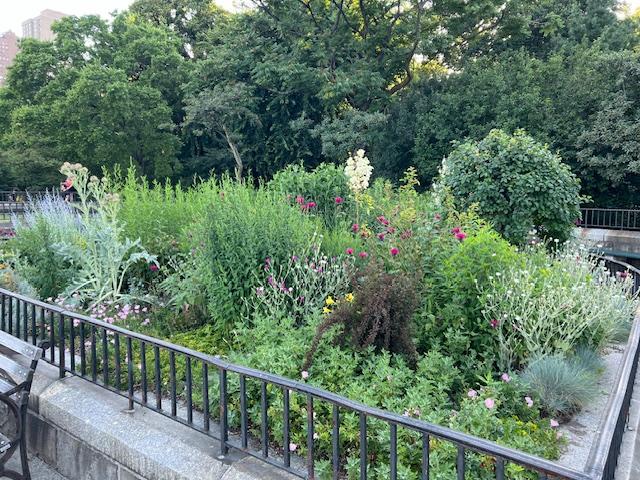
The same spot on the first day of Summer 2024
The gardens are beautiful and are very nicely maintained between the City and the Carl Schurz Park Association, who I have seen members weeding, landscaping and planting in the park during the times of my visits. It is relaxing to just sit by the river and watch the river go by and the boats sail by in the warmer months.
The entrance to the park.
The flowers return during each part of the season almost on cue and the park is awash with colors of daffodils, tulips, irises and tiger lilies. There are many flowering plants in the summer that add to the rainbow of colors that accent all the trees. It is a nice place to sit and read a book while watching people walk their dogs.
The back of the park in Spring 2024.
At twilight, it is fun to watch the lights go on in Queens across the river and the whole city come to life again in the evening. In the warm summer months, the kids are playing in the park, residents have their dogs running around the Dog Run and you can hear the activity at Gracie Mansion. Trust me, security is tight in that section of the park.
The Tulip Garden at the back of the park.
The same garden in the Summer of 2024
The pathways by the playground in the Summer of 2024
The paths that line East 84th Street to York Avenue
The Polly Gordon Walk sign in the front gardens
The Polly Gordon Walkway in the Summer of 2024
This is a nice residential park to relax in when you visiting the Upper East Side.
The walkways in Carl Schurz Park in the Summer of 2024
The History of Carl Schurz Park:
Carl Schurz Park, named by the Board of Alderman in 1910 for the soldier, statesman and journalist Carl Schurz (1829-1906), overlooks the turbulent waters of Hell Gate. The first known Dutch owner of the land was Sybout Claessen, who was granted the property in 1646 by the Dutch West India Company. Jacob Walton, a subsequent owner, built the first house on the site in 1770. During the Revolutionary War, the Continental Army built a fort surrounding the Walton residence to guard the strategic shipping passage of Hell Gate. After the British attack on September 8th, 1776, the house was destroyed and the Americans were forced to retreat from the fort, which the British retained until the end of the war in 1783.
Looking at the park from the East River walkway.
The land was purchased from Walton’s heirs in 1798 by Archibald Gracie, a Scottish shipping magnate. He built a mansion there in 1799, where his illustrious guests included future United States President, John Quincy Adams and future French King Louis Phillippe. The estate, sold by Gracie in 1819 was acquired by the City from the Wheaton family in 1891. The first home of the Museum of the City of New York from 1924-32, the mansion served as the official residence of New York’s mayor’s since Fiorello LaGuardia moved there in 1942.
Gracie Mansion during my tour of the mansion in 2025
The southern portion of the park was set aside by the City as East River Park in 1876. The former Gracie estate was added in 1891 and a new landscape design by Calvert Vaux and Samuel Parsons was completed in 1902. Maud Sargent re-landscaped the park in 1939 when the East River Drive underpass was under construction. Charles Haffen’s sculpture of Peter Pan, created in 1928 for a fountain in the lobby of the old Paramount Theater was installed in the park in 1975.
Carl Schurz Park in the Summer
The park name honors Schurz, a native of Cologne, Germany. It was strongly supported by the large German community of adjacent Yorkville. After emigrating to the United States in 1852, Schurz quickly made his reputation as a skilled orator and proved to be instrumental to Abraham Lincoln’s 1860 election campaign. His most significant political offices were that of United States Senator from Missouri (1869-1875) and Secretary of the Interior (1877-81) during the Hayes administration. In later years, Schurz was editor of the New York Tribune and an editorial writer for Harper’s Weekly. Schurz is also honored by Karl Bitter’s statue of 1913, located in Morningside Drive and 116th Street.
Recent improvements include rebuilding of the stairs, the complete restoration of the playground and the opening of Carl’s Dog Run. These and other projects, including the planting of flowers, have been accomplished through a partnership between the Parks and the Carl Schurz Park Association, which has demonstrated the community’s commitment to restoring, maintaining and preserving this park since it formed in 1974.
I visited The Frick Collection for the first time when I was walking the Upper East Side for my project, “MywalkinManhattan” Day One Hundred and Twelve-Walking the Upper East Side”. In all the years I had been coming into Manhattan I had never been inside. So I stopped for the afternoon to see what it was like inside the old Frick Mansion.
When you first walk into the museum, in the inside of the main foyer of the house there is fountain with a large indoor pool with benches, the perfect place to relax after the long walk outside. All around the pool are various doors and windows that lead to the rooms that house the collection.
The Fountain area
All around the house you will see famous Old Master’s paintings, statuary and porcelain figurines. While I was visiting there, I stopped in to see the new exhibition “George Washington Statuary Collection”.
The “George Washington” exhibition showed the creation of the statue for the Virginia State Capital that was destroyed by fire in the last century. All of the models and drawings were accompanying the display to see how the work was created.
After that, I just walked through the galleries to see all the paintings and sit by the fountain in the middle of the old house. Each of the rooms houses each part of the Mr. Frick’s Collection plus new pieces that continue to be added.
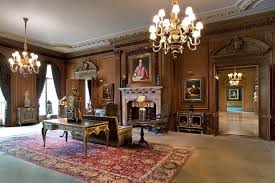
The inside galleries
Before you leave, remember to check out their gift shop which has interesting items for sale and copies of the art in various forms to take home. Also on a nice day take time to walk around the gardens. For a mansion on Fifth Avenue, it is cared for beautifully and is well cared for just as the Frick’s would have done.
History of The Frick Collection:
The Frick Collection is house in the former residence of Henry Clay Frick (1849-1919), which was designed by Thomas Hastings and constructed in 1913-14. After Mrs. Frick’s death in 1931, changes and additions to the building were by the architect John Russell Pope and in 1935 the Collection was opened to the public.
The Collection preserves the ambiance of Mr. Frick’s private house and visitors are therefore asked to observe regulations necessary for protecting the works of art and their domestic setting:
*Because few ropes or cases are used to guard fragile objects, children under ten are not admitted to the Collection.
Inside the Frick Collection
*Group visits are by appointment only and large groups must be divided into parties of no more than ten. Lecturing in the galleries is prohibited.
*Free checking is provided in the coat room. Coats (if not worn), packages, umbrellas and large handbags must be checked.
The Collection includes some of the best known paintings by the greatest European artists, major works of sculpture (among them one of the finest groups of small bronzes in the world), superb eighteenth-century French furniture and porcelains, Limoges enamels, Oriental rugs and other works of remarkable quality.
Inside the Frick Collection
Disclaimer: This information was taken directly from The Frick Collection Museum pamphlet and I give the museum full credit for this information. Please check out times and dates before you visit.
The Mount Vernon Hotel Museum at 421 East 61st Street
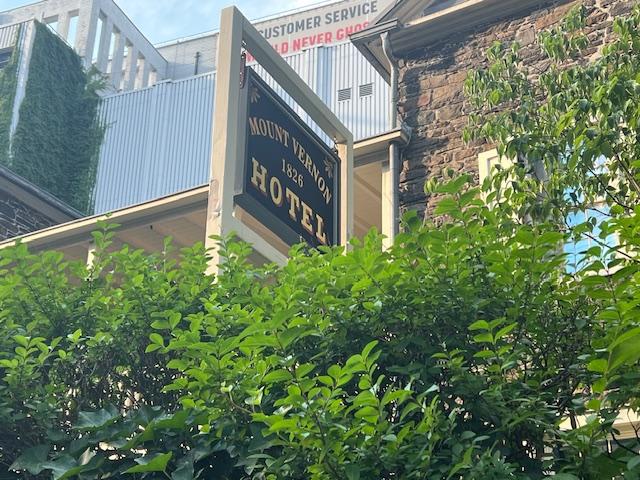
Mount Vernon historical sign during the summer months
The history of the building
The model of the building
I had come across the Mount Vernon Hotel Museum when I was walking on East 61st Street for my blog and went to take the tour of the building. It is a one hour (or more as I there for almost two hours but I was by myself) tour of both floors. You start with a film and a quick talk about the history of the building. The hotel building has had several owners and uses over its over hundred years.
I visited the museum during the holiday season in 2025 and I got to see all the decorations around the hotel. There was elegant decorations in most of the rooms and got to see how people ate during the holiday season as well as with visits guests would have indulged in when they came for the day.
Then you start the tour of the upper room where the ladies would gather and talk. This is where they might have tea, musical recitals and read and sew. They would gather with other women for conversation and debate.
The Upstairs foyer gallery
The foyer landing decorated for the holidays with the former traveler, James Taylor, who discussed in his memoir about visiting the hotel
The Ladies Parlor
The upstairs is where the sleeping rooms and the ladies parlors are located, where female guests would enjoy tea, games, music and reading. The main landing was for dancing and for gatherings.
The Ladies Palour with the Chinese writing desk and festive decorations.
The room set for tea with Englishware
The holiday set up afternoon service
The sleeping rooms were kept simple and functional
The Men’s game room
The main floor was the Men’s gaming rooms, where there is a bar and two rooms for male activities such as cards, gambling and reading. Here the men would discuss politics and business over a drink and games of chance.
The main games room
The main entrance was used as the dining room for dinner (our lunch), which was the biggest meal of the day served around 2:00pm.
The bar area where spirits are sold
The afternoon supper was part of the package and couples would join one another for a several course meal, which would serve as the main meal of the day.
Dinner time at the Mount Vernon Hotel Museum
The tour guide went over what would have been served, menu’s and meal times. Dinner would have been served at 2:00pm, tea time would have been around 4:00pm-6:00pm and Supper around 8:00pm.
The multi course meal for everyday on display
The meal would include popular dishes such as turkey and oysters and a specialty, Turtle soup. Fresh vegetables and fancy desserts would be part of the package.
The tour of the kitchen show preparation of foods, recipe books and all kitchen equipment including the stoves and baking materials.
The kitchen for both the hotel and house
The kitchen used to cook afternoon meals
The area used for baking and roasting
If you like the history of “Old New York” and like old homes, hotels and buildings, this is a very interesting tour that deals with the City’s growing middle-class and the new ‘leisure time’ that was coming with the changes in the work week. There are many pieces of period furniture all over the building that show the growth of affluence of the time.
The side board set with holiday desserts
The side board ladened with holiday treats
Don’t miss the formal walled in garden in the back. It is a place of relaxation from the rest of the city. There are stone walk ways and landscaped gardens as well as an herb garden. The building is owned and maintained by the Colonial Dames of America.
The walled gardens during the winter
The walled garden in the winter
I revisited the museum for the holidays and the hotel was decked out in garland and holy based on the decor traditional for the Revolutionary War era Christmas. The archways and tables were lined with greenery and the tables were loaded with oranges plunged with cloves to give the homes at that time a rich citrus smell.
The downstairs dining table was set for a Christmas meal of wild turkey, mock turtle soup, and apple and pumpkin pies. This would have been served in the afternoon as the main meal while it was still light out.
Holiday goodies at the Mount Vernon Hotel Museum getting ready for the holidays
There had been a light snow while we were touring the hotel so when we visited the gardens, it really did have that Christmas feel to it with that light snow all over the pine and the bushes.
How the neighborhood has changed
The old stable area
During the time of the Revolutionary War and afterwards, homes were not as elaborately decorated as they would have been during Victorian times after the Civil War. Homes were lined with greenery that would have given the home the fragrant smell of pine and strings of cranberries and popcorn would have been used to decorate mantles.
The hotel decorated for the holidays
The hotel was getting ready for one of its many special events during the holidays so there was a lot of commotion going on downstairs. It is a very festive looking place for the holidays so try to tour it when it is open in the month of December.
The museum in the 2025 holiday season
What is the Museum:
Constructed in 1799 as a carriage house and converted into a ‘day hotel’ in 1826, the Museum transports visitors back to Mount Vernon Hotel, a 19th Century country resort for New Yorkers escaping the crowded city below 14th Street.
The model of the original house layout
Recognizing the building as one of the few remaining 18th century sites and the only surviving day hotel in New York City Historic Landmark in 1967, added to the National Register of Historic Places in 1973 and accredited by the American Association of Museums in 1983.
History of the House:
The Mount Vernon Hotel Museum & Garden presents the period of the Mount Vernon Hotel which operated from 1826 until 1833.
Constructed in 1799 as a carriage house for a 23 acre estate and converted into the Mount Vernon in 1826, this stone building sits on land originally owned by Colonel William Stephens Smith and his wife, Abigail Adams Smith, the daughter of John Adams.
This fashionable country resort was popular among New Yorkers who wished to escape the hustle among the bustle of the city, which at that time extended only as far north 14th Street. The Hotel advertised “free from the noise and dust of the public roads and fitted up and intended for only the most gentle respectable” clientele. In those days, one could take the stagecoach or steamboat up to 61st Street spend the day at the hotel sipping lemonade in the ladies parlor or playing cards in the gentlemen’s.
In 1833, the house became the home for three generations of a New York City family. In 1905, as the area became more industrialized, the building was purchased by Standard Gas Light Company (today’s Con-Edison). The Colonial Dames of America, a woman’s patriotic society purchased the building in 1924 and did an extensive restoration to the structure, the Colonial Dames opened the site to the public in 1939. The building endures as a rare reminder of an important era in New York City’s history.
What the organization does:
*Welcome 5000 school children annually in grades-pre-K through high school for field trips.
*Summer History Weeks for children ages 6-12
*A Summer High School Internship for 15 students to support college readiness skills and career exploration.
*Two summer Hearst Fellowships for undergraduates or graduate students.
*40+public programs each year, including:
-monthly free Story time
-monthly Lunchtimes lectures
-holiday programs, garden concerts, hands on craft and cooking workshops.
*Temporary exhibitions on facets of life in early 19th century NYC, some promoting local contemporary artists.
*Special programs for individuals with Alzheimer’s and their caregivers.
*Outreach programs to schools, senior centers and homeless shelters.
*Themed group tours focused on 19th century food, decorative arts or literature.
*Three options for team building events.
*Two free admission days: Smithsonian Museum Day and Open House New York.
Programs are made possible in part by the support of the New York City Department of Cultural Affairs in partnership with the City Council and Council Member Ben Kallos, the New York State Council on the Arts with the support of Governor Andrew Cuomo and the New York State Legislature, the Manhattan Borough President Gale Brewer, the Institute of Museum and Library Services, the Rosenthal Foundation and the Michael Tuch Foundation.
(Mount Vernon Hotel Pamphlet)
The Colonial Dames of America:
With these words, spoken in April 1890, Maria Denning “May” Van Rensselaer imitated what was to become the oldest colonial lineage society for women in the United States. The Colonial Dames of America. Its mission is to preserve historic sites and objects, award scholarships, educate the public about American history, inspire patriotism and promote fellowship among its members.