Tag: nyc museums

Americas Society Museum                                   680 Park Avenue                                                 New York, NY 10021

Americas Society Museum 680 Park Avenue New York, NY 10021

Americas Society Museum

680 Park Avenue

New York, NY 10021

(212)628-3200

https://www.as-coa.org/visual-arts/arts_americas_circle

https://www.as-coa.org/arts-culture-americas-society

Open: Wednesday-Saturday: 12:00pm-6:00pm/Closed Sunday-Tuesday
Varies with exhibitions

Admission: Free

http://www.as-coa.org/visual arts

My review on TripAdvisor:

https://www.tripadvisor.com/Attraction_Review-g60763-d548518-Reviews-Americas_Society-New_York_City_New_York.html

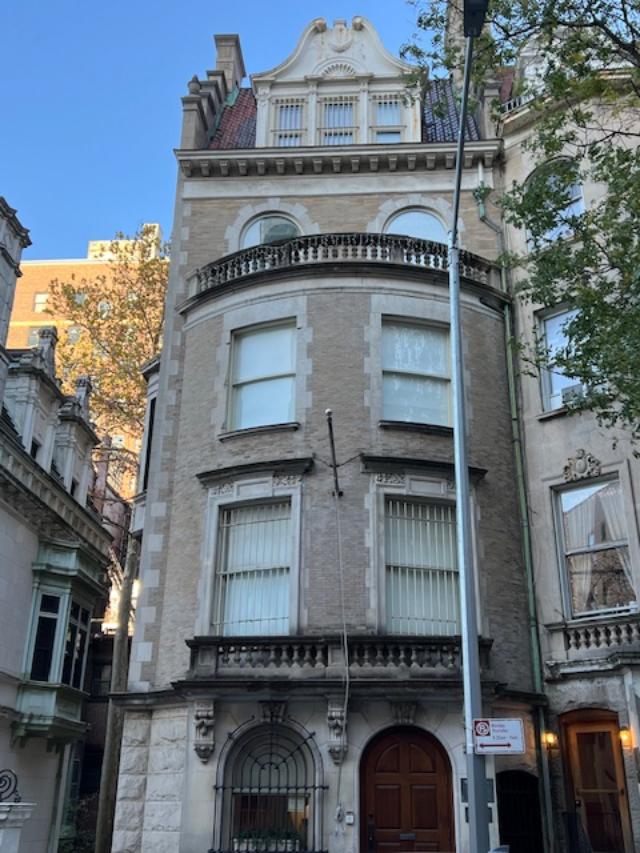
 The Americas Society Museum at 680 Park Avenue

I came across the Americas Society Museum when walking on Park Avenue on the Upper East Side for my walking project, “MywalkinManhattan.com”. I noticed the sign for the exhibition, “The Metropolis in Latin America 1830-1930”. The exhibition was on the transformation of cities in Latin America from their traditional path starting with Spanish colonization to a more European layout that was developed between the Revolutionary and Civil Wars with the ‘Gilded Age’ thrown in as the third generation of settlers became long time citizens and became more wealthy.

They wanted to live like they were still in Europe. It showed how the cities developed over time with planning and then with extended, unintended growth that lead to the outlaying slums. Very interesting exhibition (now closed).

Americas Society Museum II

A exhibition at the Americas Society Museum

In the summer of 2024, the museum had an interesting exhibition on artist Alejandra Seeber. Her colorful interactive works had some of the patrons playing golf inside of the galleries. I thought her work was vibrant and exciting. She draws you in with the bright invigorating colors and on the floor pieces of carpet whose colors lead your golf balls from hole to hole as you travel the exhibition.

The museum press release on the Alejandra Seeber exhibition:

The description of the show:

(from the museum’s website):

Americas Society presents the first solo exhibition and career survey of the Argentine artist Alejandra Seeber in New York, starting June 5. Seeber (b. 1969, Buenos Aires, Argentina) is a painter who centers representations of various spaces to explore the tension between representation and abstraction in painting. Seeber utilizes bold color and gesture to examine liminal spaces within built and domestic environments. Later work veers further into abstraction, implementing visual devices like Rorschach drawings or knit grids to structure the composition. 
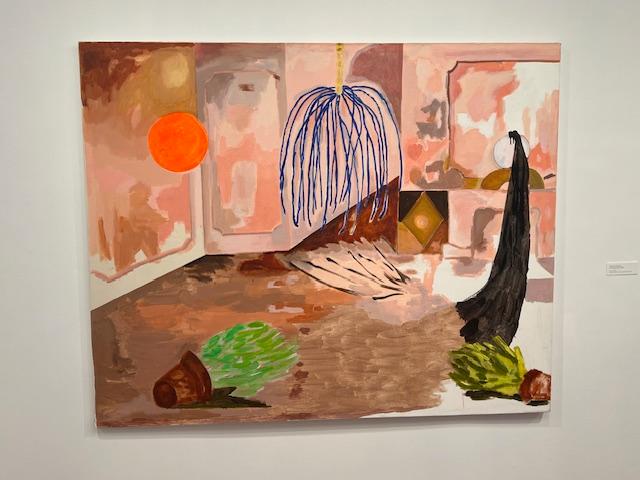
My favorite painting in the show by Alejandra Seeber “La Bourgeoisie”
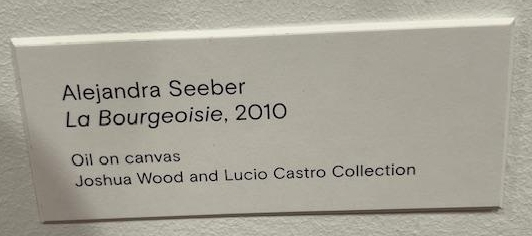
The sign of the painting

The exhibition  pairs these paintings with Seeber’s contemporary explorations of the built landscape with an installation. This survey of her work is organized around a playable golf course installed inside the gallery space in which visitors will be invited to play golf as they walk through the show. The golf obstacles become active sculptures in the exhibition, creating porous boundaries between artwork and audience. This playful environment manifests the explorations of edges, doorways, windows, and borders in the artist’s painting. As they play, visitors will be able to trace Seeber’s artistic trajectory and see how her interventions in the form and practice of painting continue to this day. 

The vibrance of the art with its colorful details
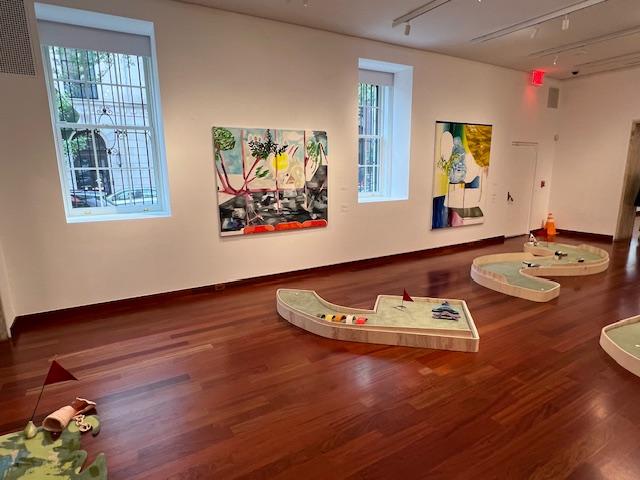
The interactive art in the gallery

The art golf course

History:

The Americas Society is an organization dedicated to education, debate and dialogue on the Americas and is located at 680 Park Avenue on the Upper East Side of Manhattan. The Americas Society was established by David Rockefeller in 1965. The Americas Society promotes the understanding of the economic, political and social issues confronting Latin America, the Caribbean and Canada; its mission is “to increase public awareness and appreciation of the diverse cultural heritage of the Americas and the importance of the inter-American relationship.
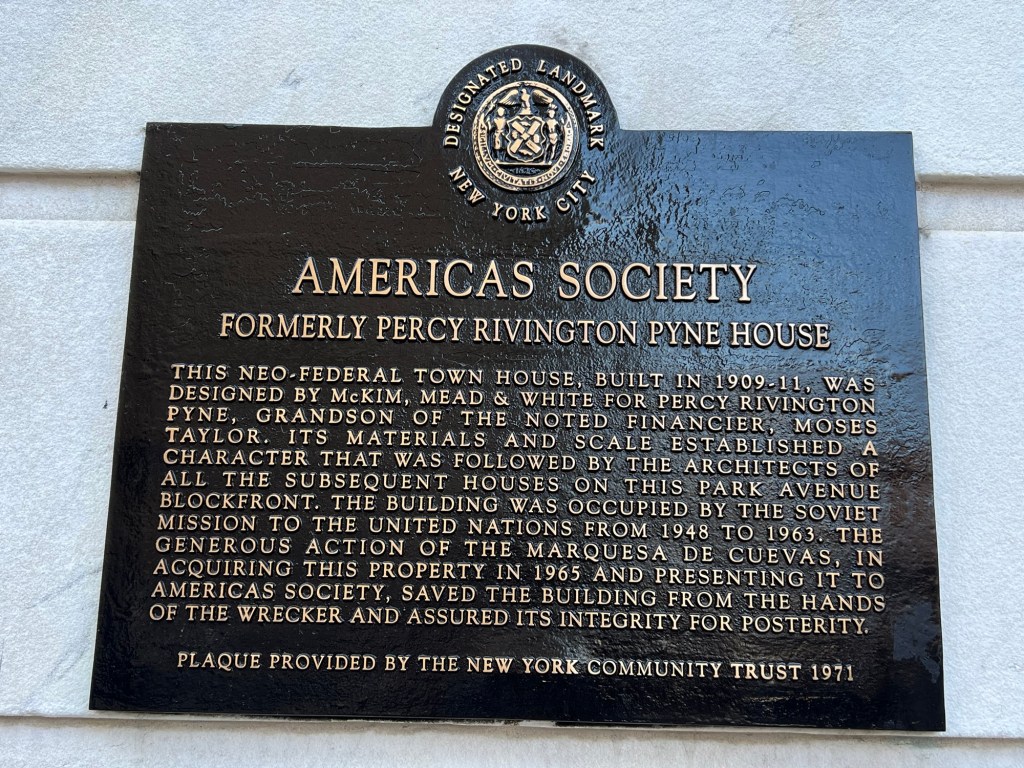
The buildings historical past as the Percy Rivington Pyne House

https://en.wikipedia.org/wiki/Percy_Rivington_Pyne_I

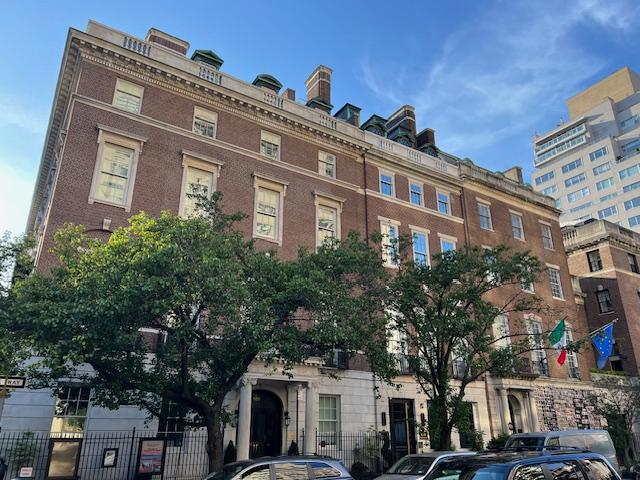
The Americas Society Building is listed in the National Register of Historic Places. The building was previously the Percy Rivington Pyne House before serving as the Soviet Mission to the United Nations until its current usage. along with the neighboring buildings of the Queen Sofia Spanish Institute and the Italian Consulate General, the house constitutes one of the few remaining unified architectural ensembles on Park Avenue. The Center for Inter-American Relations was later to be absorbed into Americas Society 1985.

Activities:

The Americas Society organizes interviews, speeches, podcasts, exhibitions, readings and musical performances at its headquarters and reports on Congressional updates and local events. Many events are held at the Salon Simon Bolivar, an expansive room in the building’s Neo-Federal style with wide windows, a 15 foot ceiling and wood-paneled and silk fabric walls.

Americas Society Museum III

An Exhibition at the museum:

The Americas Society produces the MetLife Music of the Americas (concert series) to showcase the diversity of styles and genres of music in the Americas. The concert series is held at the Society’s headquarters.

The Americas Society, together with Council of the Americas, produces the publication ‘Americas Quarterly’, a policy journal for the Western Hemisphere. The Americas Society also publishes ‘Review Magazine’, which was first founded in 1968. ‘Review Magazine’ is an English language journal for literature from Latin America, the Caribbean and Canada. ‘Review Magazine’ also helped support the first English translation of “One Hundred Years of Solitude” by Gabriel Garcia Marquez as well as other translations.

The Americas Society has also organized working groups on the topics of women’s empowerment and leadership. Cuba, energy policy, immigration, trade facilitation and Venezuela.

Americas Society Museum

Council of the Americas (COA)

Is the premier international business organization whose members share a common commitment to economic and social development, open markets, the rule of law and democracy throughout the Western Hemisphere. The Council’s membership consists of leading international companies representing a broad spectrum of sectors, including banking and finance, consulting services, consumer products, energy and mining, manufacturing, media, technology and transportation.

(This information was taken directly from Wiki and Americas Society publications)

Nicholas Roerich Museum                                                                       319 West 107th Street                                                                                  New York, NY 10025

Nicholas Roerich Museum 319 West 107th Street New York, NY 10025

Nicholas Roerich Museum

319 West 107th Street

New York, NY  10025

(212) 864-7752

Open: Monday: Closed/Tuesday-Friday: 12:00pm-4:00pm/Saturday-Sunday: 2:00pm-5:00pm

Closed: Major holidays

Admission: Admission is free, though donations are welcome.

http://www.roerich.org

http://www.roerich.org/

TripAdvisor Review:

https://www.tripadvisor.com/Attraction_Review-g60763-d136141-Reviews-Nicholas_Roerich_Museum-New_York_City_New_York.html?m=19905

The front of the museum

This small museum in the Upper West Side neighborhood of Manhattanville is easy to miss. It is in a small brownstone on West 107th Street right near Riverside Drive. You can see the plaque for the museum to the right of the building and there is a side door to get in. The admission is free but they do ask for a donation if you can do it.

The gallery on the second floor

The museum is a specialty collection of the works of artist Nicholas Roerich. They are mostly landscapes and religious themed that cover three floors of the museum.

The is a beauty to all his works especially the ones concentrated in the Himalayas with their colorful and spiritual themes.

The artist’s portrait of his mother on the third floor

It takes about an hour to an hour and a half  to see all the floors. A nice touch they had in the afternoon that I was there was a piano player whom you could hear play throughout the brownstone. When you go, it will be a pleasant afternoon where you are not fighting the crowds of the larger museums.

The art pieces enlighten you and I felt gave you a sense of hope.

(The following information is from the museum website)

Artist Nicholas Roerich

(From the museum website)

The Nicholas Roerich Museum was founded in 1949 to house a permanent collection of over two hundred paintings by the Russian-born artist, poet, philosopher and humanitarian, Nicholas Roerich. The museum also houses a library of books and maintains an archive and a collection of artifacts relating to the areas of Roerich’s interests (Museum guide).

The Mission of the Museum:

The mission of the Nicholas Roerich Museum is essentially a narrow one: to make available to the public the full range of Roerich’s accomplishments. These, however, are not narrow; they cover the realms of art, science, spirituality, peacemaking and more. Because Roerich’s  activities ranged widely, so do the museum’s.

The second floor galleries

The Museum Collection:

Nicholas Roerich is known first and foremost as a Russian-born artist. His paintings, of which there are thousands around the world, explore the mythic origins, the natural beauty and the spiritual strivings of humanity and of the world.

One of the more spiritual paintings in the collection

The museum houses approximately two hundred of these works and keeps most of them permanently on display for visitors who come from around the world. Indeed, for many of these visitors, the museum is a destination of great importance; the paintings speak to them of their own inner yearnings and possible fulfillment. For them, Roerich’s paintings are a kind of teaching-about spiritual development about culture and its role in human life and about opportunities for the achievement of peace in a fractious world.

The second floor galleries

The beautiful landscapes on the second floor

Publications & Booklist:

The museum also keeps in print a number of books by and about Roerich and his life and work and a substantial stock of postcards and reproductions of his paintings. These too are seen by many as more than just prints; they are hung in homes with a degree of appreciation that is not often given to such things.

The gallery on the first floor with some of the more religious works

Cultural Events:

In addition to these functions, the museum also maintains an active schedule of cultural activities. 

The second floor galleries

It was Roerich’s fervent belief that the role of cultural development in the peace and evolution of the world is fundamental and that it is therefore the responsibility of those who work in creative and cultural fields to strive always for that peace and evolution and for those goals to be the chief impulses guiding their creative work. Information about these ideas is always available.

The second floor gallery with Asian themed art

The Roerich Pact & the Banner of Peace:

The museum sustains an ongoing effort to spread public awareness of the intermingled roles of peace and culture and the ways in which each sustains the other. Information and materials about The Roerich Pact and the Banner of Peace are always available.

The patronage of the museum through the Katherine Campbell-Stibbe Foundation

Throughout this century of wars and national struggles, the yearning of the public for ways of achieving peace has been great; the ideas of the Pact and the Banner provide a welcome answer to those yearnings.

The history of the museum through the years

As Roerich’s ideas become better known around the world, attendance at the Museum grows and requests for information and materials about him and his art and social achievements increase.

The gift shop on the first floor. The director of the museum even sells honey from the beehives on top of his building.

*This information is from the Museum’s website.

Disclaimer: This information was taken from a combination of the museum’s website and from the biography of the artist.

The first floor galleries

The National Jazz Museum in Harlem                    58 West 129th Street, Ground Floor                  New York, NY 10027

The National Jazz Museum in Harlem 58 West 129th Street, Ground Floor New York, NY 10027

The National Jazz Museum in Harlem

58 West 129th Street, Ground Floor

New York, NY  10027

http://www.jazzmuseuminharlem.org

http://jazzmuseuminharlem.org/

https://www.facebook.com/nationaljazzmuseum/

(212) 348-8300

Suggested donation of $10.00 but whatever you can give.

Open: Sunday-Monday: 11:00am-5:00pm/Tuesday-Wednesday Closed/Thursday-Saturday: 11:00am-5:00pm

Fee: Free with Donation

Founded in 1997

Transportation: Subway 2 or 3 to 125th Street and then walk up to 129th Street

TripAdvisor Review:

https://www.tripadvisor.com/Attraction_Review-g60763-d6953125-Reviews-The_National_Jazz_Museum_in_Harlem-New_York_City_New_York.html?m=19905

I came across this little museum when I was touring Central Harlem. This museum is more like a small gallery and it is dedicated to the history of jazz in Harlem. The front section is set up like someone in Harlem’s salon with furniture from the era and sheet music from the artists. The look is based on ‘Rent Parties’ that people used to have to bring their friends over to help pay the monthly rent. The back section of the museum is dedicated to jazz and related music with a sitting area and pictures all over the wall of different era’s including the new artists of today. Jazz music plays throughout.

National Jazz Museum in Harlem

The Mission of the Museum:

The National Jazz Museum in Harlem, a Smithsonian Affiliate,  preserves, promotes and presents jazz by inspiring knowledge, appreciation and celebration of jazz locally, nationally and internationally.

It is the thriving center for jazz that stimulates hearts and minds and reaches out to diverse audiences to enjoy this quintessential American music. The museum was founded in 1997 by Leonard Garment, Counsel to two U.S. Presidents and an accomplished jazz saxophonist, Abraham D. Sofaer, a former U.S. District Judge, who gave the initial gift in honor of his brother in law, Richard J. Scheuer and matching funds from the Upper Manhattan Empowerment Zone.

National Jazz Museum in Harlem II

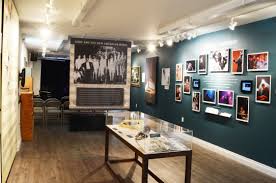
Displays inside the museum

The Museum is committed to keeping jazz present and exciting in the lives of a broad range of audiences: young and old, novice and scholar, artist and patron, enthusiast and curious listener. From its new location in the center of Harlem, the Museum serves the local community and welcomes visitors from across the U.S. and internationally.

The National Jazz Museum in Harlem’s vision is to establish a permanent home in Harlem for collections, programs and performances that stimulate creativity and excitement about the past, present and future of jazz and its artists (The Jazz Museum in Harlem vision statement-pamphlet).

In 2013, an exciting new era began for the Museum. We created and implemented a new strategic plan that made education central to our mission. The Museum now offers year-round educational programs for students of all ages. We also developed a new membership program with exclusive content and benefits to reach out to the worldwide jazz community.

National Jazz Museum of Harlem

The inside of the National Jazz Museum of Harlem

In 2015, after 15 years at the East Harlem location, we moved to 58 West 129th Street in Central Harlem. Our new space is designed to give our visitors an immersive jazz experience, in the heart of what has become Harlem’s new cultural and entertainment district. The ultimate, long-term goal is to secure a permanent home in Harlem with space enough to showcase Harlem’s vast contributions to jazz, American music and world history.

Each year, the Museum produces and presents more than 80 free programs in New York City, engaging hundreds of professional jazz artists and reaching nearly 20,000 people from around the world. The Museum is a hub for live performances, exhibitions and educational programs. It is also home to our widely acclaimed Savory Collection, which includes more than 100 hours of live recordings of jazz legends made from New York City radio broadcasts aired between 1935 and 1941 (Wiki site and Museum website).

National Jazz Museum of Harlem III

The current exhibition is Vi*bra*tion: The history of Jazz from Louis Armstrong to Miles Davis: Their Work and Harlem Air Shaft (large musical manuscripts on the wall).

The Leadership of the Museum is under musicians Jonathan Batiste, Co-Artistic Director and Christian McBride, Co-Artistic Director.


The Coney Island Museum                                 1208 Surf Avenue                                       Brooklyn, NY 11224

The Coney Island Museum 1208 Surf Avenue Brooklyn, NY 11224

The Coney Island Museum

1208 Surf Avenue

Brooklyn, NY  11224

(718) 372-5159

Open:

Summer: (June-Labor Day Weekend) Monday- Saturday 12:00pm-6:00pm/ Sunday 2:00pm-6:00pm

Fall/Winter/Spring: (September-May) Monday-Saturday 12:00pm-6:00pm/Sunday 2:00pm-6:00pm

Admission: $5.00 Adults/Members Free/Residents, Seniors & Children under 12 $3.00

http://www.coneyisland.com

https://www.coneyisland.com/event/coney-island-museum

TripAdvisor Review:

https://www.tripadvisor.com/Attraction_Review-g60827-d555621-Reviews-The_Coney_Island_Museum-Brooklyn_New_York.html?m=19905

The Coney Island Museum at 1208 Surf Avenue

The Coney Island Museum is an interesting place specializing in the history of Coney Island from the time of the Native American settlement to modern history. The history covers from the Dutch visiting the island for pleasure to the mid-1800’s and after the Civil War when time off and weekend pleasures became the rage.

The stretch of Surf Avenue where the museum is located.

The museum covers the history of the three great amusement parks, Steeplechase, Luna and Dreamland when they were all in their heyday until they all burned down or closed. This history includes the rise of Astroland and the current Luna Park.

The History of the Luxury Hotels of Coney Island

The History of the Amusement Parks:

Three great amusement parks dominated Coney Island in the early part of the last century with roots in the old Sea Lion Park and with the innovations and hope of Astroland and the rise of Luna Park again.

Sea Lion Park

Steeplechase Park

Luna Park

Dreamland Park

The rise of Astroland and the new Luna Park are showing signs of the rebirth of Coney Island.

The Astroland Exhibit at the museum

There is loads of memorabilia from all ages and all sorts of novelties from the rides such as the hall of mirrors, bumper cars and old cars and carts. Postcards from different eras also give an interesting look of the past so take time to look at each one.

The back galleries on the old amusement parks.

The history of some of the famous restaurants such as Child’s, Nathan’s and Feldman’s are discussed and their impact on the cuisine of Coney Island from the days of the clams to the revolution of the current hot dog.

The Child’s Restaurant artwork from the building.

The Feldman doors from the original restaurant

Some of the exhibitions cover the development of the area as a pleasure seeking attraction and as a luxury resort for wearied New Yorkers. What started as hotel resort and racing capital developed into an amusement area for the thrill seeking and for those who were looking for an escape for fun. It shows the growth and enhancement of the City reflected into the development of Coney Island itself mirroring what is happening in the City currently.

The amusements and bumper cars in the main gallery

The Bumper Car exhibit

Coney Island amusements

If you are interested in the history of Coney Island, then the Coney Island Museum is a nice was to spend the afternoon. There are tours daily and don’t forget to visit the Sideshow downstairs, which shows on the hour. The fee is $5.00.

The Mission of Coney Island USA:

Coney Island USA exists to defend the honor of America popular culture through innovative exhibitions and performances. Presenting and producing exciting new works, our approach is rooted in mass culture and the traditions of P.T. Barnum, dime museums, burlesque, circus sideshows, vaudeville and Coney Island itself. Preserving and championing a set of uniquely American visual and performing art  forms, we seek to create an international forum for cultural preservation and discourse and where Coney Island represents these impulses, we strive to make it once again a center for live art and entrepreneurial spirit (CIUSA).

The ‘Reinventing Coney Island’ exhibit

Coney Island USA operates a multi-arts center in a landmark building in the heart of Coney Island. We produce and present programming in three unique venues: the Coney Island Museum, Sideshows by the Seashore and the Shooting Gallery/Arts Annex. Serving both New York City and an international community that includes visitors to Coney Island and enthusiasts of various cultural forms, our signature activities include the Mermaid Parade, the Coney Island Circus Sideshow, the Coney Island Museum, Coney Island Film Festival and new theatrical work (CIUSA).

The Coney Island Wax Museum exhibit

The Wax Museum exhibit

In existence since 1980, Coney Island USA has developed and produces a number of different programs including some of New York City’s best loved summer programming, such as the Mermaid Parade and the Coney Island Circus Sideshow. Coney Island USA also operates the Coney Island Museum and produces Ask the Experts, Burlesque at the Beach, the Coney Island Hot Rod Festival, Congress of Curious Peoples, Funhouse Philosophers, Magic at Coney, The Mermaid Ball and the Coney Island Sideshow School. Coney Island USA also produces the Coney Island Film Festival in association with indiefilmpage.com (CIUSA).

The Mangel’s family history in the amusement industry.

The display of amusement offerings from the Mangel’s family company.

The Museum’s video:

Video on the Coney Island Museum

Disclaimer: This information on Coney Island USA was taken directly from their website. Don’t miss this wonderful piece of Coney Island history in one building and plan this as part of your trip to Coney Island along with the Cyclone, Nathan’s, the Wonder Wheel and the beach.

Also part of the museum is the Coney island Pinball Museum with classic pinball games to play and the Coney Island Museum bar, a great place to relax and have a drink. There is also the Coney Island Freak Show that is part of the museum and has several shows a day.

The Coney Island Pinball Museum

The Coney Island Pinball Museum is part of the Coney Island Museum

Some of the pinball machines in the museum.

The Coney Island Museum bar-the perfect place for a drink.