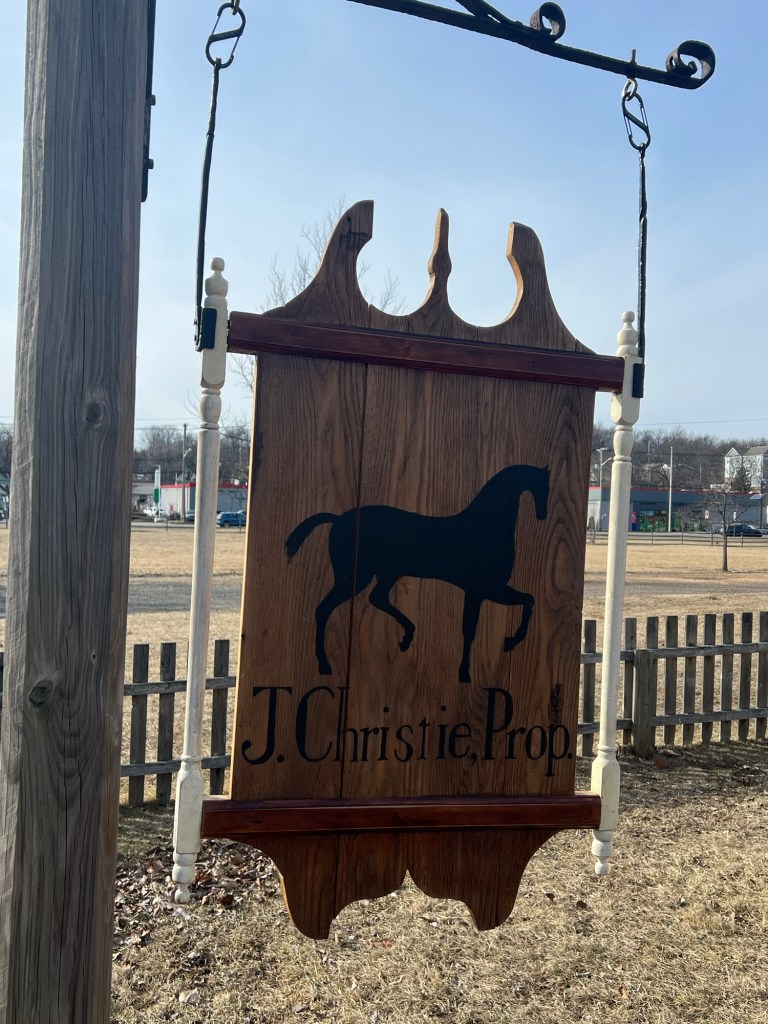
Tag: littleshoponmainstreet.com

The Schoolhouse Museum-Ridgewood Historical Society 650 Glen Avenue Ridgewood, NJ 07450

The Schoolhouse Museum-Ridgewood Historical Society

650 Glen Avenue

Ridgewood, NJ  07450

(201) 447-3242

RidgewoodHistoricalSociety@Verizon.net

Open: Sunday 2:00pm-4:00pm/Monday-Wednesday Closed/Thursday and Saturday: 1:00pm-3:00pm (please check the websites for changes in the schedule)

Admission: Donation $5.00

TripAdvisor Review:

https://www.tripadvisor.com/Attraction_Review-g46772-d10353516-Reviews-Schoolhouse_Museum-Ridgewood_New_Jersey.html?m=19905

The Ridgewood Schoolhouse Museum at 650 Glen Avenue

I have visited this interesting small history museum a few times and they do a wonderful job in presenting their displays with interesting facts catering not just to a local crowd, but anyone interested in history and events.
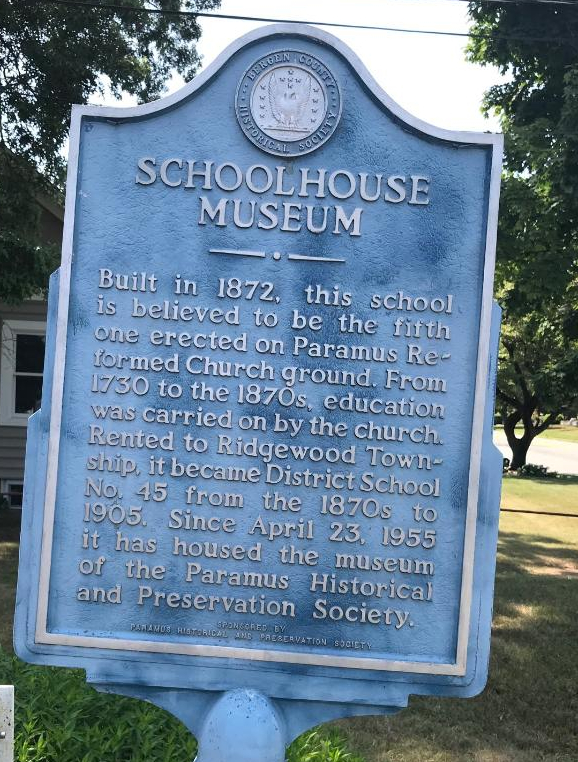
The historic marker outside the museum

The one-room schoolhouse, built in 1872, operated as a public school until 1905. It was part of the district school system formed in 1864 or 1865, which was geographically defined rather than by township. It was operated as School District No. 45. When the towns incorporated in 1894, that district system was dissolved, and the school became part of the Ridgewood school district.

The Ridgewood Schoolhouse Museum’s permanent collection

Tradition has it that the original land grant to the Dutch Reformed congregation from Pierre Fauconier and his daughter, Magdalena Valleau, stated that room should always be given upon the church land for a school. We know that a small school building opened in 1785. A second stone school was built in 1820 and eventually replaced by a frame structure in 1845.

Eventually the present schoolhouse was built in 1872 at a cost of $4600.00. It is likely that other schools existed on the church property from the time the church was built in 1735 to 1785, for the consistory assumed responsibility for education and the exact time when that responsibility was handed over to the public is not known.

The large bell summoned children from miles away to school each morning. The original belfry is gone but the bell stands in the entryway. It was used in other schools and a church after the school closed in 1905 but was returned to the historical society in 1977.

The original entry was divided into separate entrances and cloakrooms for boys and girls. The potbelly stove is original as are the windows and the two central lamps. The black boards around the room have been removed except for one behind the teacher’s platform.
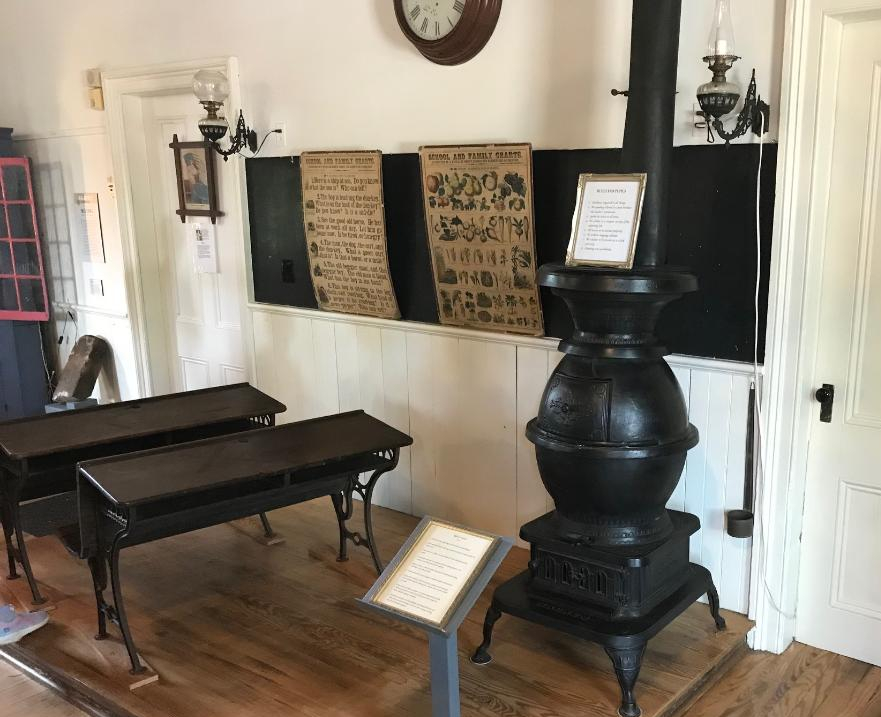
There is a recreation of the old schoolhouse when you walk into the museum

When the Historical Society started the museum, the privy building was attached to the main building to provide more display area. In their special display area, they have an exhibition space for farming and a local comedian.
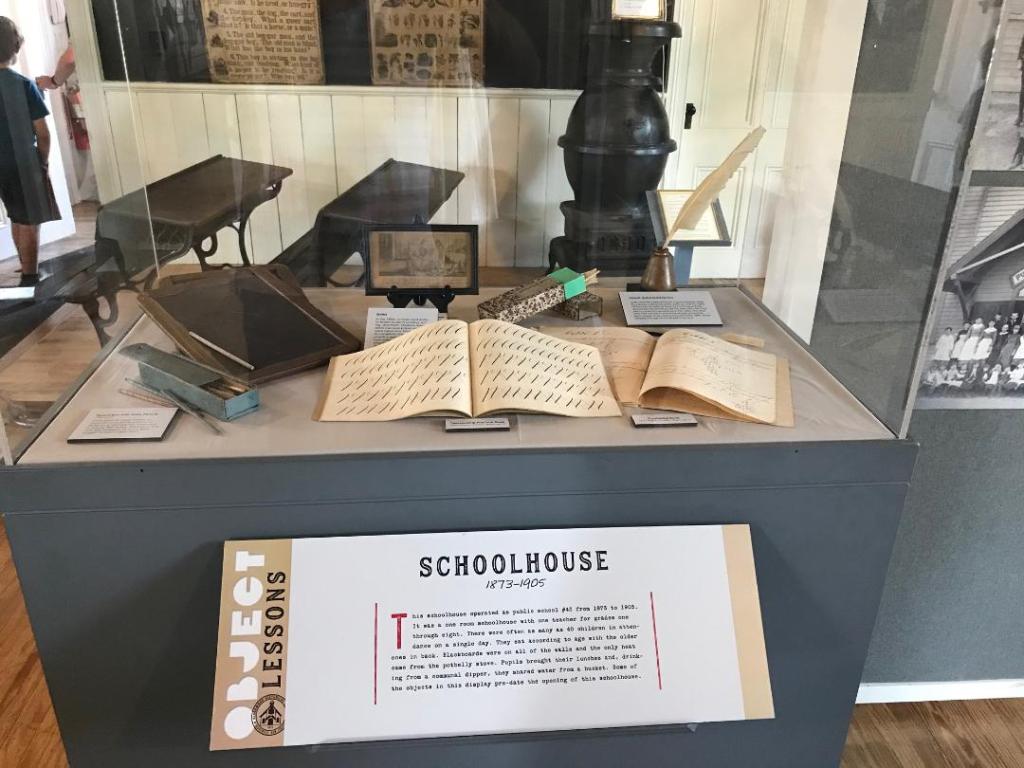
The schoolhouse display

In April 2018, they have a very interesting exhibition call “The Thread of Life” which tells the story of family’s progression in home life from the end of the Civil War until the beginning of the Depression and times changed between the Civil War and WWI. Between the Victorian Era, the sinking if the Titanic and the devastation of WWI, the baby boom of the teens and the ‘Roaring Twenties’ with the stock market built changed the attitudes.

The way of life for an entire generation until the Great Depression put a halt on it. You can see the changes of behavior in the displays of clothes and household decor. It is an interesting display.
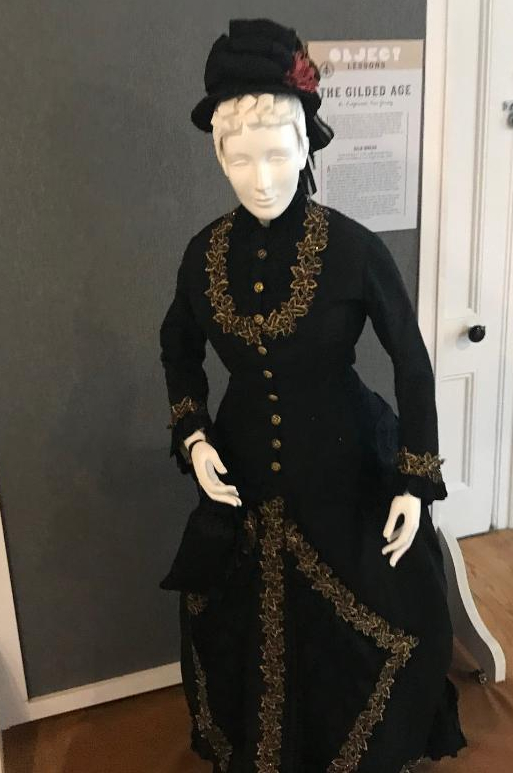
A Morning Outfit during the Victorian Age
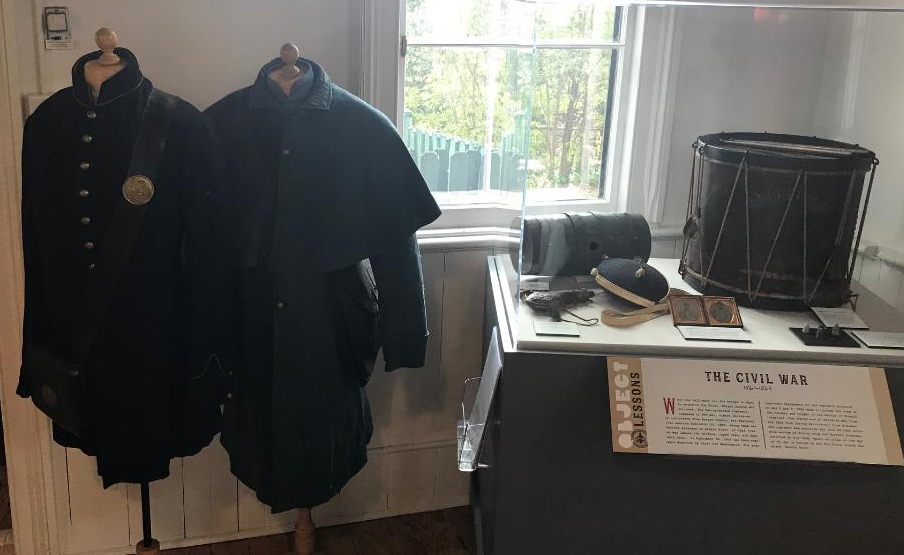
Union Army outfits and display for the “Civil War” artifacts

They also have an ongoing exhibition of farm equipment and a continuation of their “Farming in Bergen County” exhibition that just closed before this show. This is how farmers of Bergen County produced their crops.

Dutch items in the collection

The Blauvelt, Zabriskie and Haring families are known farming family names in Bergen County and were important in business and politics during the after the Revolutionary War.
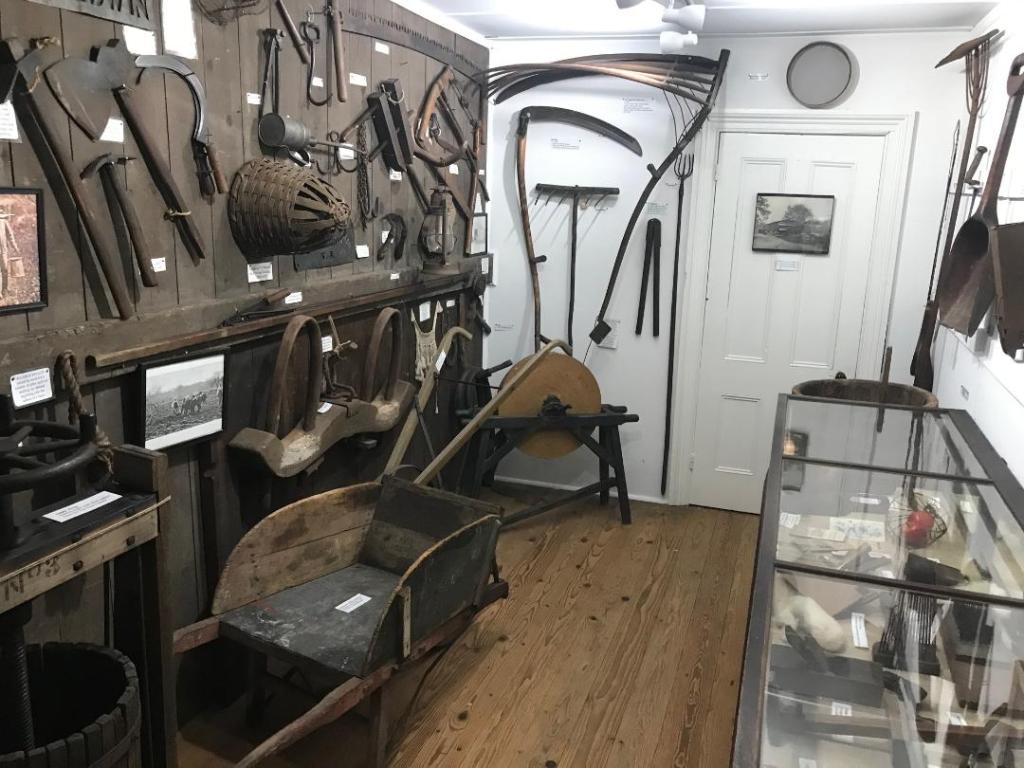
The “Farming and Agricultural” display

Also, see their ‘Halloween Cemetery Walk” in my blog, “MywalkinManhattan.com” entry “This is Halloween” Day Ninety-Six, October 31, 2017. Don’t miss it this year!

Day Ninety-Six: This is Halloween-MywalkinManhattan.com:

https://wordpress.com/post/mywalkinmanhattan.com/7062

The Cemetery Walks in October are extremely popular

Don’t miss the “Here comes the Brides” exhibition that just opened up in May of 2019. It shows the history of formal wear for weddings along with accessories, menswear, invitations and even cakes toppers.
Schoolhouse Museum II.jpg

‘Here comes the Bride’ Exhibition 2019

In July of 2020, as Phase Three of the Opening in the State of New Jersey, the Museum is now open from 2:00pm-4:00pm for viewing with a new exhibition “A” is for Artistry: Celebrating Centuries of Art, Artists & Creativity”. The exhibit is a combination of local donated art and heirlooms from Ridgewood and the surrounding towns.

The Exhibition “A is for Artistry”

There are interesting displays of early photography and portrait painting as a way of preserving a persons’ image for the future. The use of oil painting, tin and then photo ‘sittings’ came in vogue as the technology changed.

Portraits were the form of imagetry before photography was invented

There was an interesting display of Children’s toys from the handmade farm toys of clay and corn husks to the fancier toys of bisque and cloth when imports and specialty toy stores were created for children’s playthings. They even had a collection of the famous “Punch & Judy Dolls”.
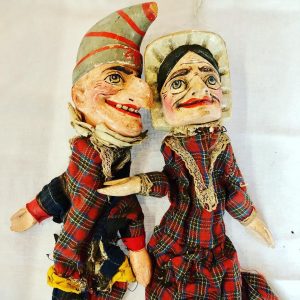
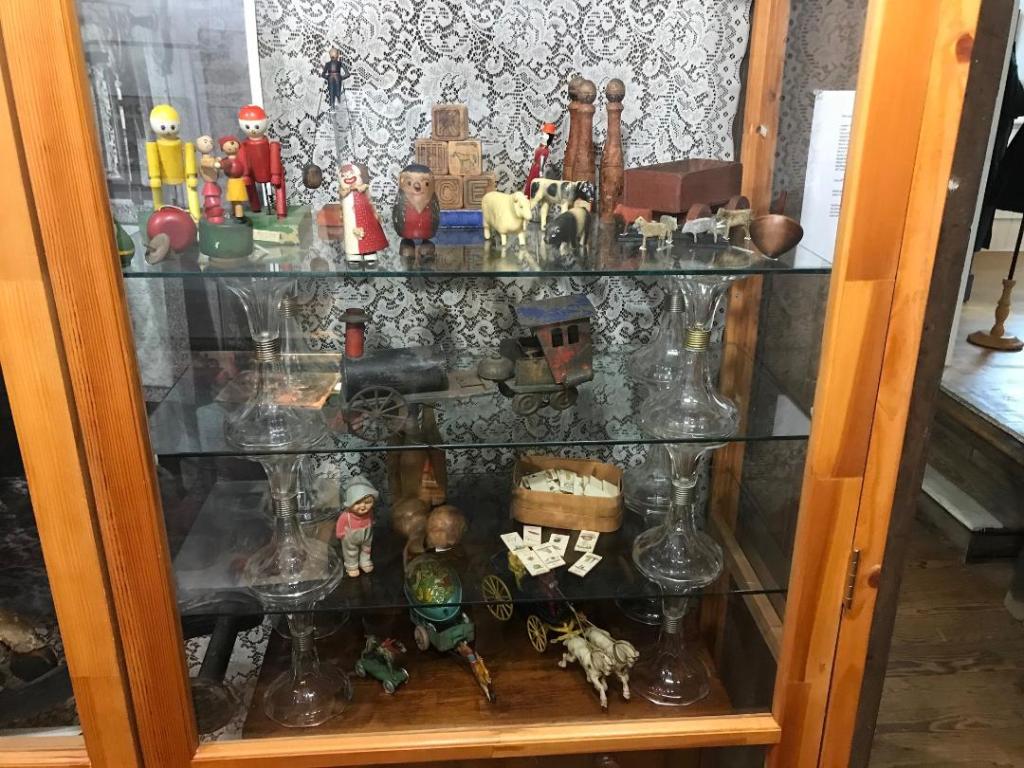
The Punch & Judy Dolls at the “A is for Artistry” exhibition

Children’s playthings over the last two hundred years

Another standout of the exhibition was the display from General Westervelt, a local citizen of Bergen County whose shipping expertise helped the North during the Civil War. His use of navigation and sailing was a detriment to the South and there was a $1000.00 bounty on his head. He died during the Civil War.
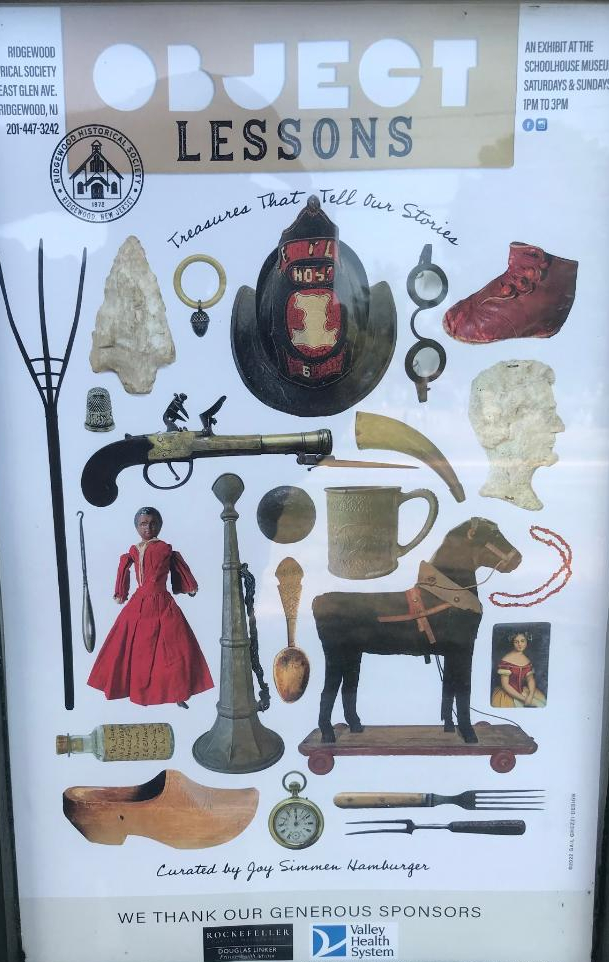
The “Object Lessons-Treasures that tell our Stories” exhibition

In 2022, when the Museum reopened after a long closure with COVID, they opened with two exhibitions: One was “Object Lessons-Treasures that tell our stories”, in which household objects, farming equipment and all sorts of artifacts from the pre-Revolution, Revolutionary War and Civil War periods were shown. It showed the progression that life took for families between the Revolutionary War and the beginnings of the Victorian Age.
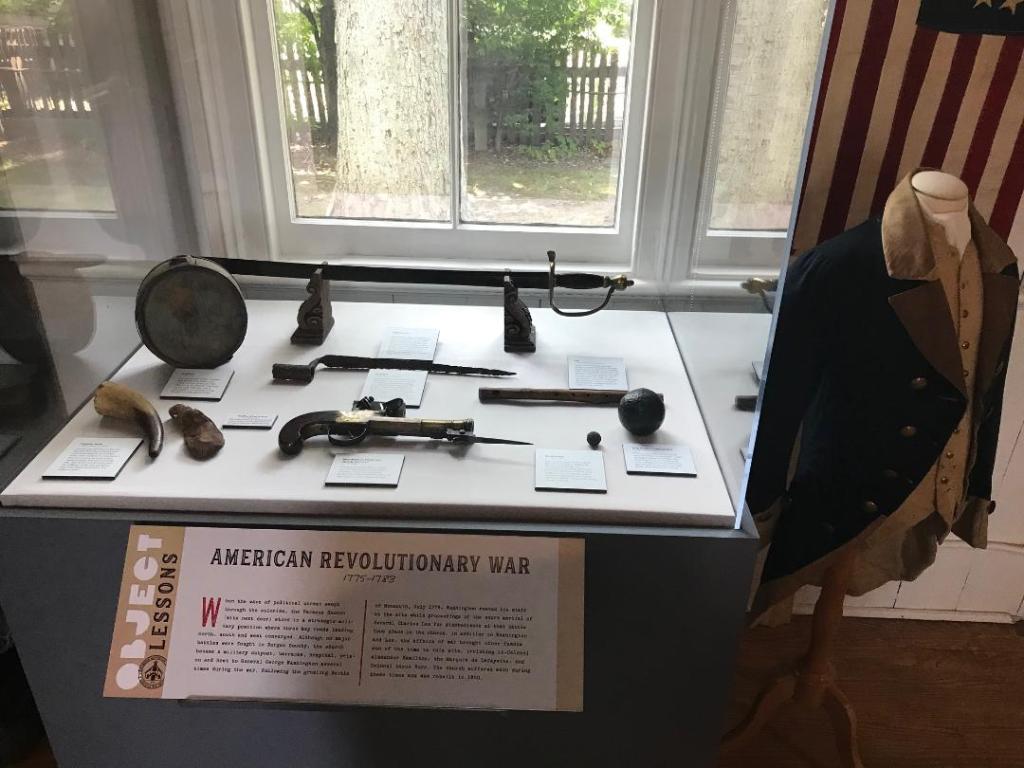
“American Revolutionary War” display

They had local Dutch family heirlooms such as chests, cabinets, china, clothing and even documents. The average Dutch family kept their family linens, china, silver and bedding in a locked chest as these were valuable family luxuries that needed protection and proper care.

Dutch Chest with family items that were locked up.

There was a “Lincoln display” at the museum. They had a copy of the poster from the night that President Lincoln was assassinated at Ford Theater during the performance of “My American Cousin”. There was a family shot of the Lincoln family and items from the period.

The “Lincoln Display” that showed an original poster from “Our American Cousin” the night Abraham Lincoln was assassinated.

The other exhibition was “Toying with the Past: Antique Toys & Games”:
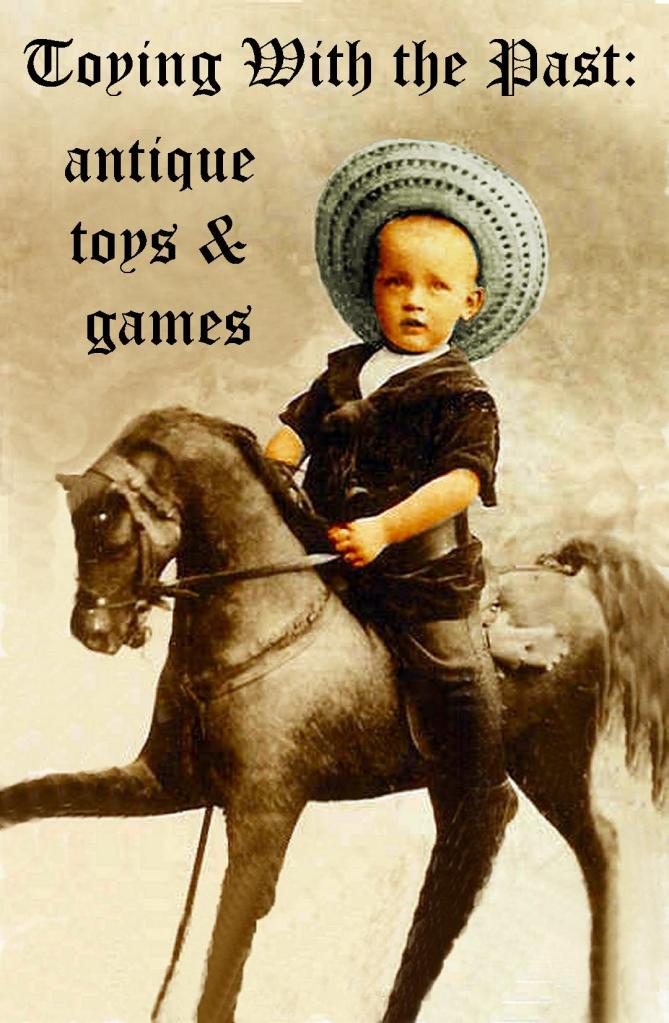
Toying with the Past was an interesting exhibition in that it showed how much toys have developed and changed over the years and how much they have stayed the same. There was a beautiful collection of china and bisque dolls, some that were made as playthings and others used as marketing tools to show women the latest fashions coming out of Europe. The dolls would be dressed in the dressmakers’ newest designs.
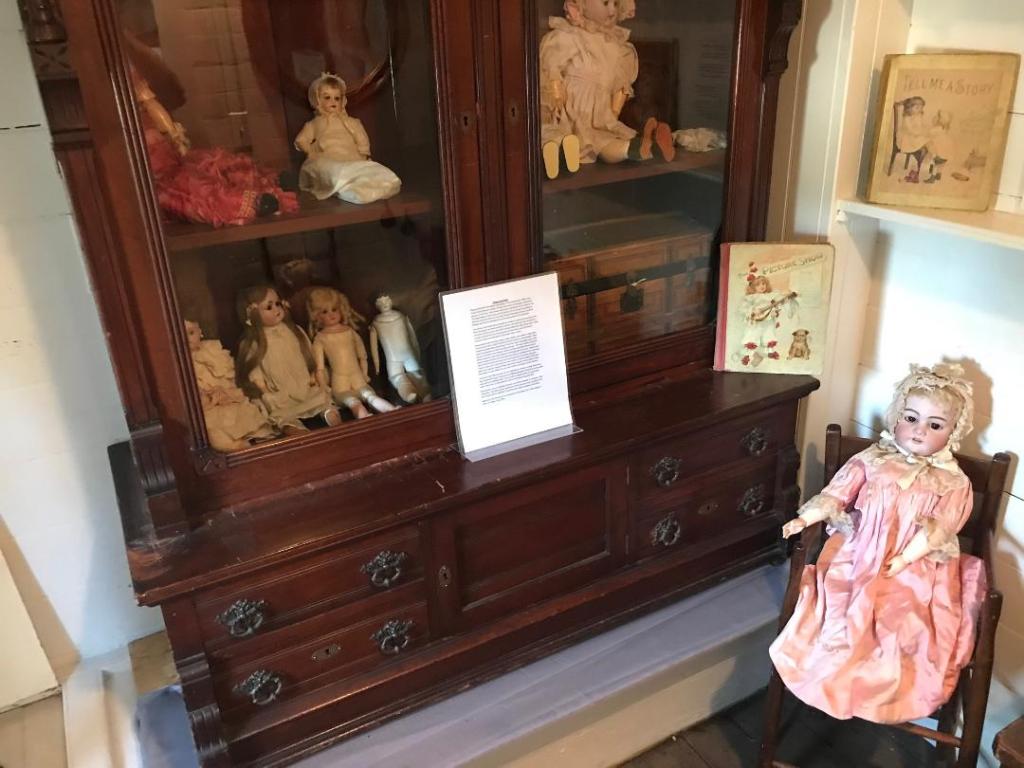
The Doll Collection is beautifully displayed

There were older versions of modern board games, everyday items like marbles and Jaxs. There were kitchen-based items that a little girl might be given to improve her domestic skills and there was even an early version of an “Easy Bake Oven”, with an electric oven that could be plugged in and boil water.

The items a young girl would receive to prepare her for homelife

Fancy rocking horses and dolls

Vehicles and Board Games that sparked children’s imagination

More dolls and vehicles over the last 100 years

There was also all sort of toys on wheels and rocking horses that could entertain a grumpy child for hours. They even had a selection of play clothes and school items to show what classroom work was like at the turn of the last century.

Childhood was changing for young people after the Civil War and during the Victorian Age

The Latest Exhibition that was on display in April 2023 was the “History of Hats” that replaced the Toy exhibiton:
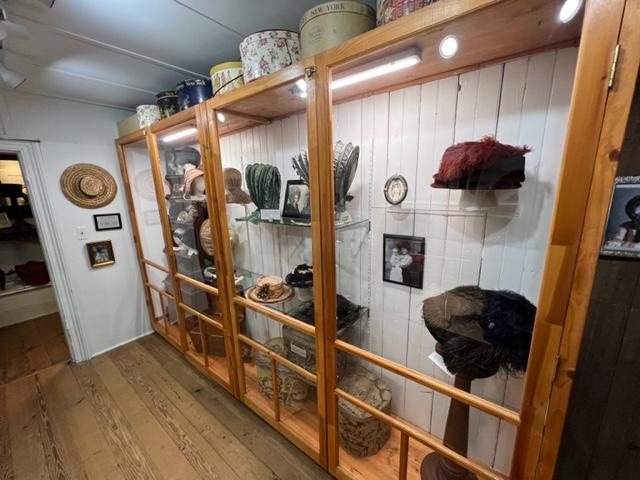
Hats from all ages
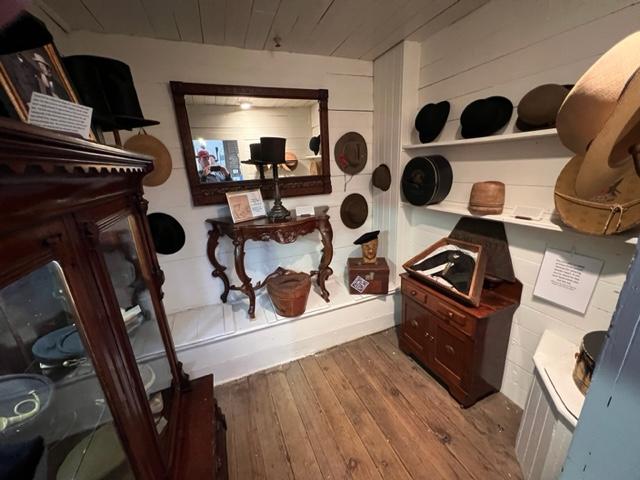
Men’s hats through the ages
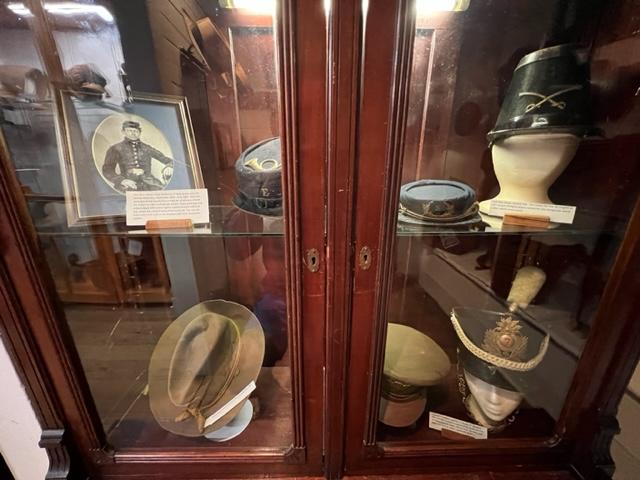
Military Hats

General’s Hat
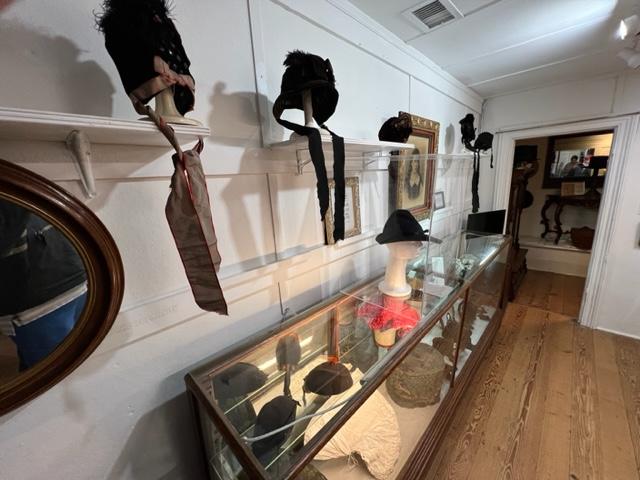
Ladies bonnets

‘Fashion of the 1880’s’

Special Events and Lectures at the Museum:

Don’t miss their ‘Cemetery Walks’ during the day. I took one recently at the old Dutch Reformed Church and we discussed the history of the church, the location of the old church versus the building of the new one, which is why the cemetery looks the way it does and the locations of the tombstones as well as how time and advancement in carving went from sandstone, which fades and chips over time when to the production of granite and marble for future tombstones.
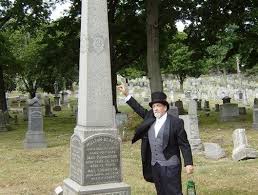
The Cemetery Walks in Valleau Cemetery across from the museum

The cemetery is filled with names famous and prominent in Bergen County and North Jersey history which includes participation in the wars and the building of Bergen County including the Westervelt’s, Van Riper’s, Haring’s, Zabriskie’s, Terhune’s, Demerest’s, Blauvelt’s and Tice’s families. It is a fascinating place to learn Bergen County history and its development.

Ridgewood Cemetery Tour

The Cemetery Tours that take place the week before Halloween are interesting as well. The paths of the Valleau Cemetery in Ridgewood are lined with candles and you follow the path with the town historian who takes you on a creepy tour of the famous dead residents of Ridgewood. These include prominent athletes, business people and local laborers. You pretty much tour about a third of the cemetery as you move from one tombstone to another met by costumed actors, who they themselves have to sit in the cemetery in the dark waiting for you. That is a horror movie into itself.

The Valleau Cemetery Walk and Lecture

The best part of the tour is you are greeted at the museum with a tour of the museum and a table laden with fresh apple cider and cider doughnuts that make the perfect refreshment on a cool fall evening. Make sure to take the 7:00pm tour when it is dark out and make the reservation well in advance as these tours fill up fast.

Taking the Cemetery Tours is interesting!

Don’t miss their upcoming tours for Halloween, Christmas and their lecture series.

Please check out the museum’s website for all their very original special programming.
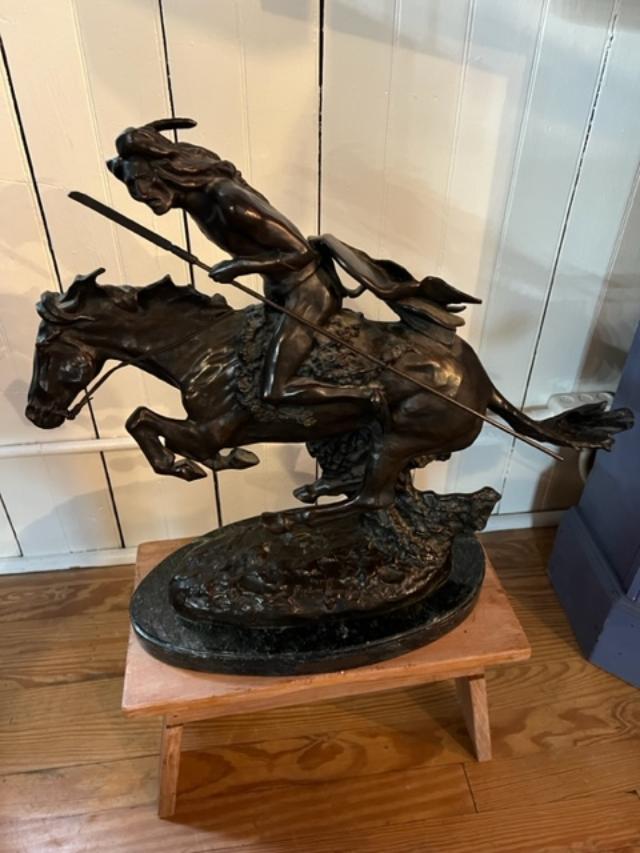
The museum’s latest acquisition, a Native American on horseback

For the 2024 Northwest Bergen Historic Coalition Day, I visited the museum again and they were having an exhibition entitled “It’s Personal-100 years of obsolete Everyday Essentials”. It made me feel old when I saw a rotary phone, ink well and some of the other items that were in the exhibit. Some of them were from my generation and I do not consider myself old.
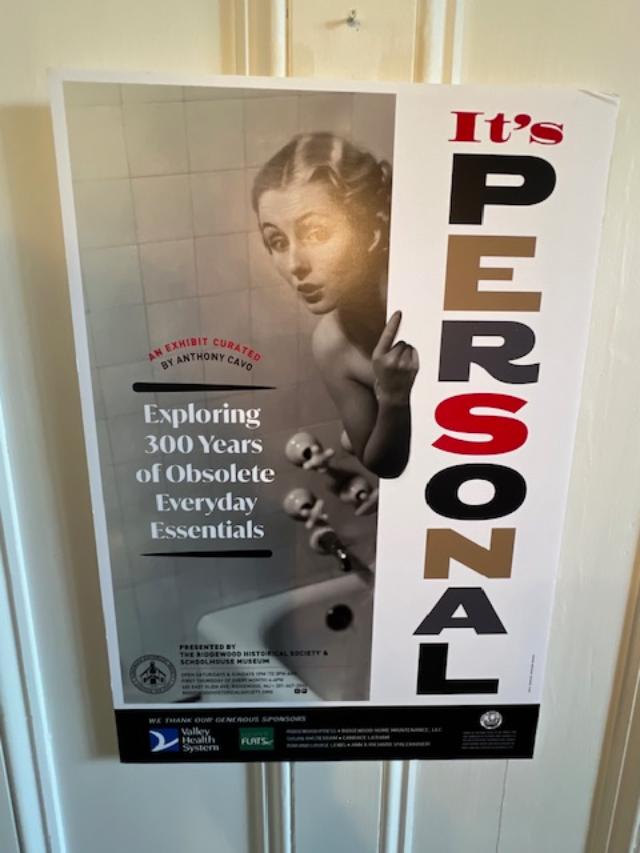
The sign from the “It’s Personal” exhibition.

The entrance to the Ridgewood Schoolhouse Museum for the “It’s Personal” exhibition

The Ridgewood Schoolhouse Museum “It’s Personal” exhibition.

The Ridgewood Schoolhouse Museum “It’s Personal” exhibition.

The Inkwell display at the “It’s Personal” exhibition to be replaced by the modern pen.
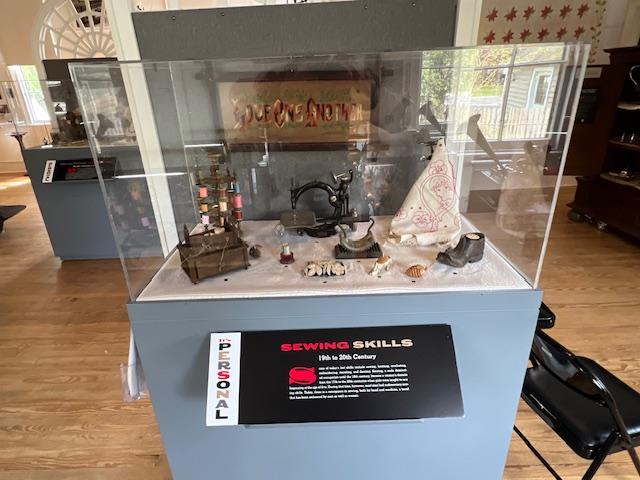
The Sewing Kit at the “It’s Personal” exhibition to be replaced by the modern sewing machine than by Ready to Wear clothing.
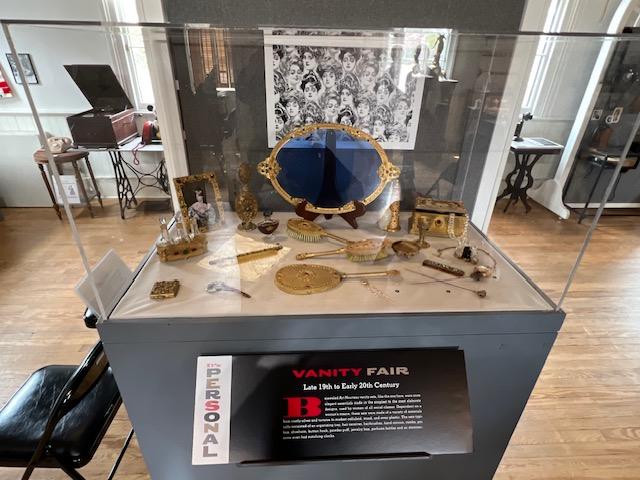
The Vanity which is still in use depending on the person in the “It’s Personal” exhibition.

The development of the phone and then the change to the modern cell phone in the “It’s Personal” exhibition.

The exhibition was interesting because its takes the modern perspective of the development of objects and their use over the last 100 years and show them with a modern twist on how times continue to change.

Shorakkopoch Rock Inwood Hill Park New York, NY 10034

Shorakkopoch Rock

Inwood Hill Park

New York, NY  10034

(212) 639-9675

https://www.nycgovparks.org/parks/inwoodhillpark

https://www.nycgovparks.org/parks/inwood-hill-park/monuments

https://www.atlasobscura.com/places/shorakkopoch

Open: Sunday-Saturday 6:00am-1:00pm

My review on TripAdvisor:

https://www.tripadvisor.com/Attraction_Review-g60763-d21055143-Reviews-Shorakkopoch_Rock-New_York_City_New_York.html?m=19905

Located in Inwood Hill Park and part of the NYC Parks System. The rock was dedicated on February 2, 1954 by the Peter Minuet Post #1247, American Legion.

I came across the Shorakkopoch Rock, the noted spot that Peter Minuet has been said to have bought the island of Manhattan from the Indians. No one is too sure where the spot of the ‘transaction’ took place as some feel it may have been closer to downtown by the Bowling Green, where the original Dutch settlement was located or maybe he traveled to them, we will never know. What we do know is that he said the transaction took place under a tulip tree and in this spot used to be a tulip tree that was over 220 years old before it died.

Shorakkopoch Rock

The rock reads:

Shorakkopoch: According to legend, on this site of the rock, principal Manhattan Indian Village, Peter Minuet in 1626, purchased Manhattan Island for trinkets and beads them worth about 60 guilders. This boulder also marks the spot where a tulip tree (Liriodendron Tulipifera)  grew to a height of 165 feet and a girth of 20 feet. It was until its death in 1932 at the age of 220 years old, the oldest living link with the Reckgawawang Indians, who lived here. Dedicated as part of New York City’s 300th Anniversary celebration by the Peter Minuet Post 1247 American Legion 1954.

For more information on the rock, please contact the Art & Antiquities  at (212) 360-8143.

Disclaimer: This information was taken form the NYC Parks Department website.

Please take time out when visiting Manhattan to see this important piece of the city’s history as the city itself was founded on this very site.

Easton Tower                                                        Red Mill Road Route 4 & Saddle River Road                           Paramus, NJ 07652

Easton Tower Red Mill Road Route 4 & Saddle River Road Paramus, NJ 07652

The Easton Tower

Red Mill Road

Route 4 & Saddle River Road

Paramus, NJ  07652

http://www.co.bergen.nj.us

http://bergencountyhistory.org/Pages/redmill.html

Open: Dawn to Dusk

Fee: Free

TripAdvisor Review:

https://www.tripadvisor.com/Attraction_Review-g46712-d12591227-Reviews-Easton_Tower-Paramus_New_Jersey.html?m=19905

The back of the Easton Tower

The historic marker on the back of the tower

I recently visited the Easton Tower on a beautiful sunny day and it really is a treat to see. It is located on the Saddle River Bike Path, so you can access it from the other side of the park and park on that side of the road for easy access. After seeing the tower, take a walk up and down the Saddle River Bike Path. It is really beautiful to follow the river on a nice day. It is really picturesque and a wonderful place to take pictures and enjoy nature.

The historic Red Mill Marker

This information is provided by the Bergen County Division of Cultural and Historic Affairs:

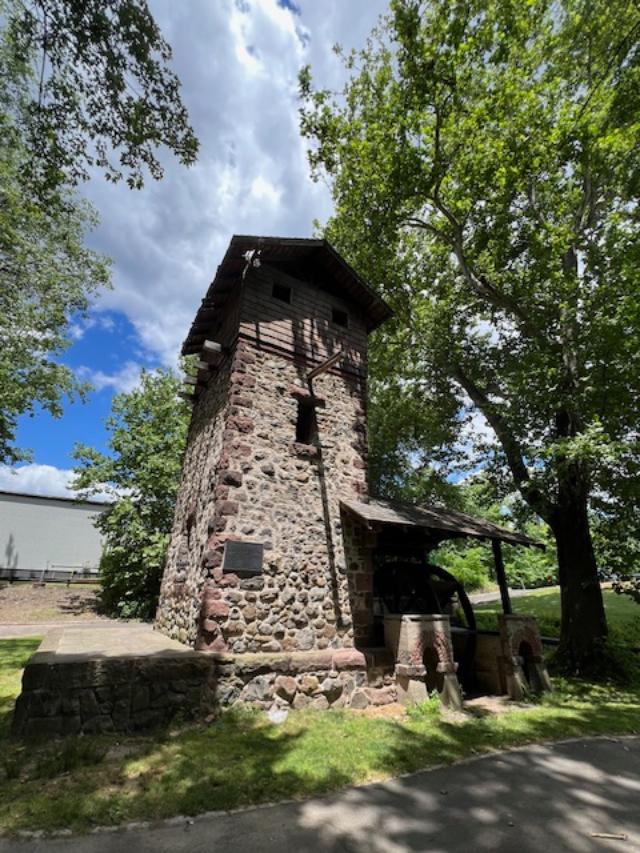
The Easton Tower is a unique historic site in Bergen County, NJ. This stone and wood frame structure was built along the Saddle River in 1900 as part of a private landscaped park in the Arcola area Paramus. Surrounded by busy NJ roadways, it is now adjacent to the County’s Saddle River Bikeway.

The front of the tower on the bike path

The tower sits near the Saddle River in the Saddle River Park

Once used to pump water to irrigate and provide a scenic setting for the estate of Edward Easton, it is a 20 foot rectangular, stone-masonry tower topped with a wood-frame structure and a wood-shingle, gabled roof. On the side is a large wood water wheel, which is under a wood-shingle roof.  The architect Henry Ihnen designed it.

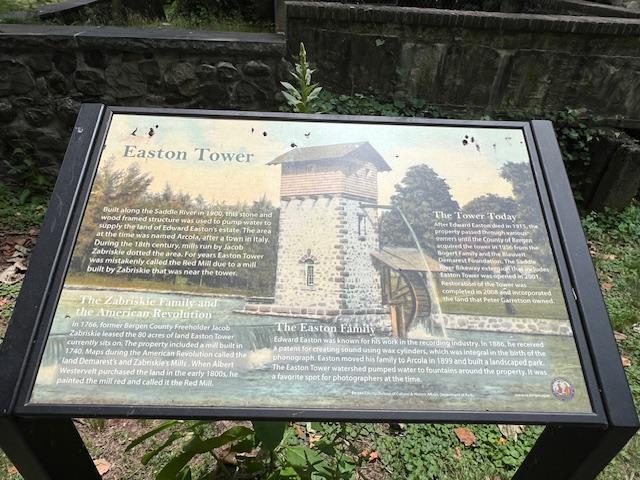
Easton Tower historical information sign

In the 18th century, this area along the Saddle River and near the heavily used Albany Post Road, was the location of many mills. Jacob Zabriskie, a Bergen County Freeholder during the Revolutionary War had leased the 80 acre mill site around 1766 and in 1771 acquired the mill that had been built in the 1740’s. Revolutionary maps identify it as “Demarest’s and Zabriskie’s Mills.”

The Easton Tower in Saddle River Park

Over time it was rebuilt or expanded and in the early 1800’s painted red by its owner Albert Westervelt. It is at this time it  acquired the “Red Mill” name often mistakenly applied to Easton Tower. By the 1800’s, the mill had fallen into disrepair and was demolished circa 1894.

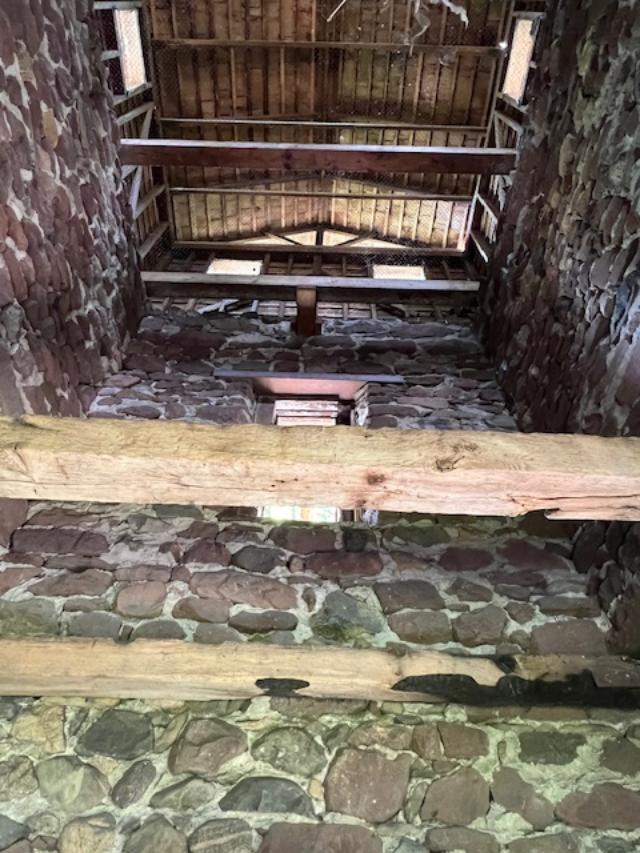
The inside of the tower

The Easton Tower inside

In 1899, Edward D. Easton (1856-1915), bought this almost 48 acre site, which included the mill pond and dam. The area was called “Arcola”. Easton’s father, a teacher, had originally brought his young  family to this area and suggested the name for the new settlement after a town in Italy. Edward Easton was a notable figure in American technological history. He started out as a stenographer, reporter and then a court stenographer In Washington DC, covering many famous trials in the 1880’s. After the 1886 patent was granted for the method of engraving sound by incising wax cylinders, Easton went on to make his fortune in the recording industry. He was a founder and eventually president of the Columbia Phonograph Company, which became one of the three major recording companies at the turn of the twentieth century.

The Easton Tower from the back

After opening an office in New York City, Eaton relocated his family from Washington DC to Arcola. He had a large house built on his property and commissioned the design of a landscaped park. The tower, to be built neat the site of the old Red Mill was a functioning structure pumping water to several fountains. There were also rustic bridges, lakes and expansive lawns. The tower was a favorite of photographers and appears in many contemporary postcards. People came from miles around to this beautiful spot to take boat rides and walks and in the winter, ice skate near the tower. Sources list the Easton home and park as having been used in early silent films.

After Easton’s death in 1915, the property went through various owners. In 1931,  construction of the Route 208 connection with Route 4 at “the Old Mill at Arcola” provided access to the recently opened George Washington Bridge. This destroyed sections of the landscaped park and isolated the tower. In 1940, the 1.26 acres site was sold at a sheriff’s sale to Clyde A. Bogert. The County acquired the tower from the Bogerts and the Blauvelt-Demarest Foundation in 1956. In 1967, the Bergen County Park Commission dedicated the tower. Easton Tower was placed on the State and National Register of Historic Places and in 2008 was completely restored by the County. It can be viewed from the Saddle River Bikeway and visited year round.

Disclaimer: This information is taken from the Bergen County Division of Cultural and Historic Affairs (C) 2015 pamphlet. The Bergen County Division of Cultural & Historic Affairs received an operating support grant from the New Jersey Historical Commission, a division of the Department of State.

Special Note: I visited the site recently and it is hard to get to by car. It is located right off Saddle River Road and it is off on a odd bend in the road. It is a quick turn to the right so pay attention to the directions.


Campbell-Christie House, Historic New Bridge Landing: A Bergen County Historic Site                                                                   1201 Main Street                                                                   River Edge, NJ 07661

Campbell-Christie House, Historic New Bridge Landing: A Bergen County Historic Site 1201 Main Street River Edge, NJ 07661

Campbell-Christie House, Historic New Bridge Landing: A Bergen County Historic Site

1201 Main Street

River Edge, NJ 07661

(201) 343-9492

A County Historic Site

http://www.co.bergen.nj.us

http://bergencountyhistory.org/

Fee: Donations are accepted and there are fees for the special events

Open: Check the website above for special events and times

TripAdvisor Review:

https://www.tripadvisor.com/Attraction_Review-g46776-d7603554-Reviews-Historic_New_Bridge_Landing-River_Edge_New_Jersey.html?m=19905

I recently visited the Steuben House for a Christmas concert which was an evening of Christmas songs, a talk on the history of Christmas before, during and after the Revolutionary War. It was a very lively evening of song and lecture and the ladies who entertained us sang beautifully.

The Campbell-Christie House was used as the ‘pub’ for diners that night

Linda Russell & Company sang Christmas songs of the time and then talked in between about how Christmas was celebrated during the War years. She was a delight in her discussion and her and her daughter and their friend did a wonderful job.

The concert was entertaining, and the talk was interesting in the Van Steuben House

A sample of Linda Russell’s music

It seemed that while the Puritans put a damper on the Christmas holidays in New England the Dutch New Jersey and New York thoroughly enjoyed the holiday season after all their hard work during the Fall harvest months.

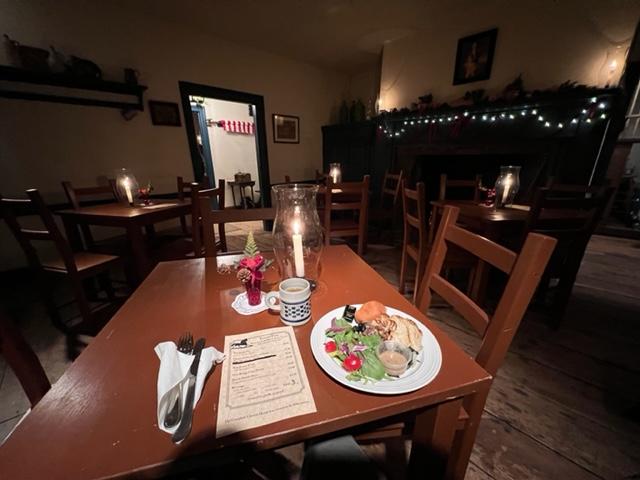
What was really nice was the Campbell-Christie House was open as a pub for dinner and light snacks and you could order things like Shepard Pie, Cheese & Onion Pie and Cake doughnuts and gingerbread for dessert while enjoying conversation by candlelight. It was an interesting and engaging history.

The Van Steuben House for the holidays was where the entertainment was that day

The house is nicely decorated for Christmas circa 1778

BCHS Xmas 2020 VI

The Campbell-Christie House at Christmas 2020 Historical Event

BCHS Xmasw 2020

Singer Linda Russell at the Christmas Tour Event at the BCHS 2020

Don’t miss their historic lectures and reenactments during the year. Check their website above for more activities.

https://revolutionarynj.org/event/sing-we-all-merrily-a-colonial-christmas-at-historic-new-bridge-landing-2/2019-12-15/2/

History of the Site:

BCHS Washington's Birthday X

The historic marker of the Campbell-Christie House

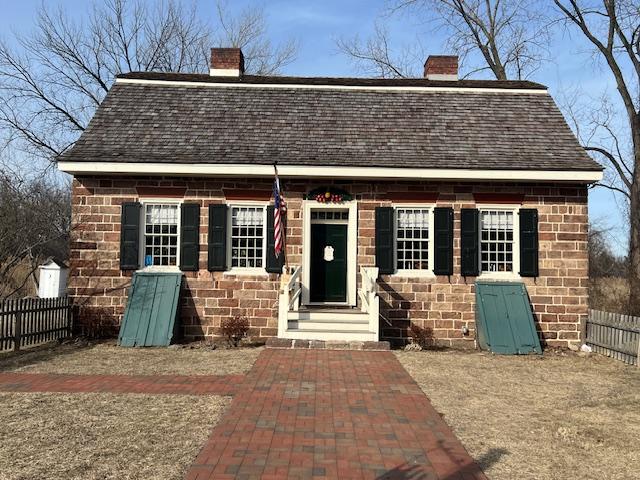
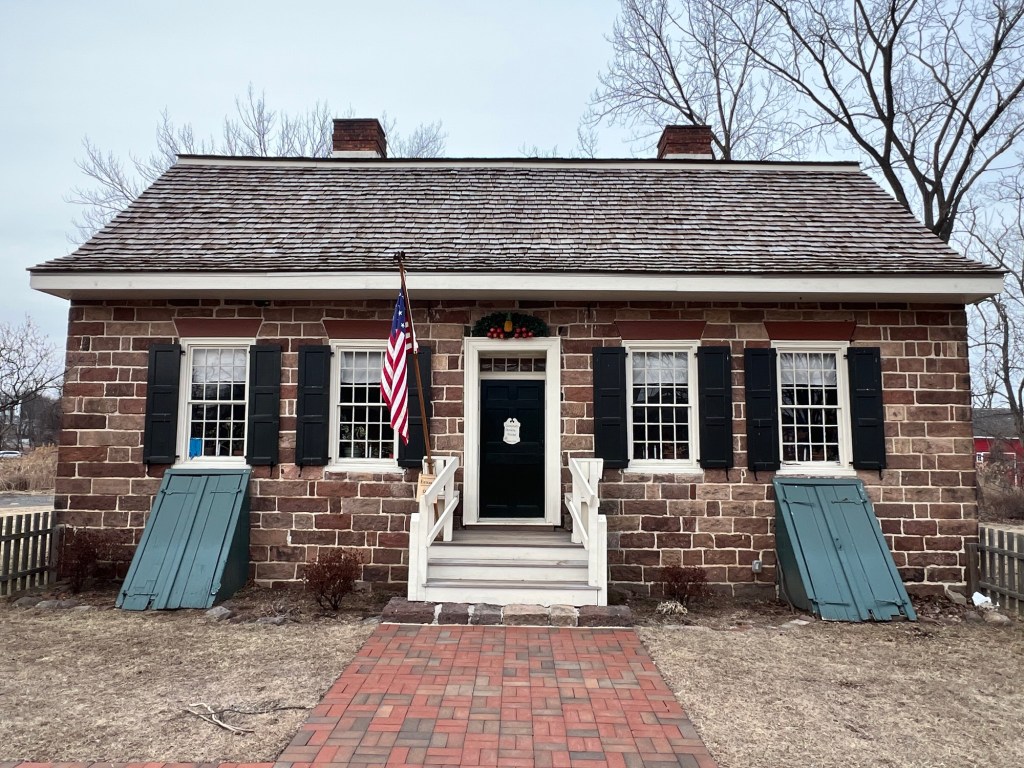
The Campbell-Christie House, an 18th century sandstone structure, is located in Historic New Bridge Landing State Park, River Edge. This historic building originally stood at the intersection of Henley Avenue & River Road, in New Milford, NJ. In 1977, in order to save it from demolition, Bergen County purchased and moved it south to this site next to the Hackensack River.

BCHS Washington's Birthday VIIII

The Christie Family Pub sign

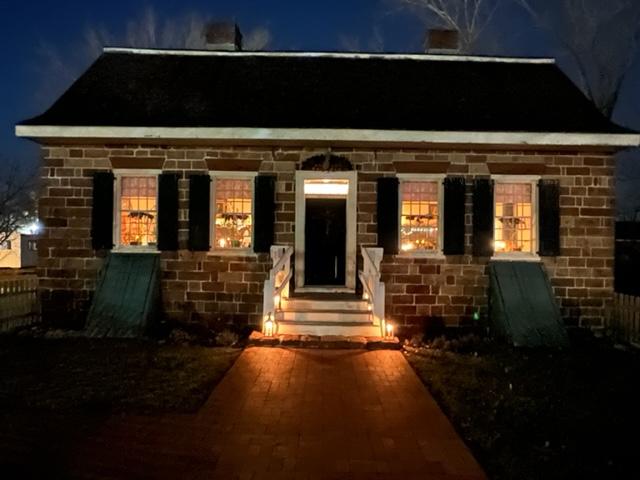
The house was used again for a pub for the Christmas concerts that returned to the site in December 2022. The house was set up as a restaurant with a limited menu before and after the concerts. The light fare was catered in and the menu was similar to what people would have eaten at that time but with a modern twist. The food was really good.

The house was used again for a pub on Christmas 2022 for the concert night

The Campbell-Christie House as the Blackhorse Pub for Christmas dinner

My Shepard’s Pie meal for the Christmas concert at the Blackhorse Pub

The Dutch Sweets dessert plate at the Blackhorse Pub in the Campbell-Christie House Christmas 2022

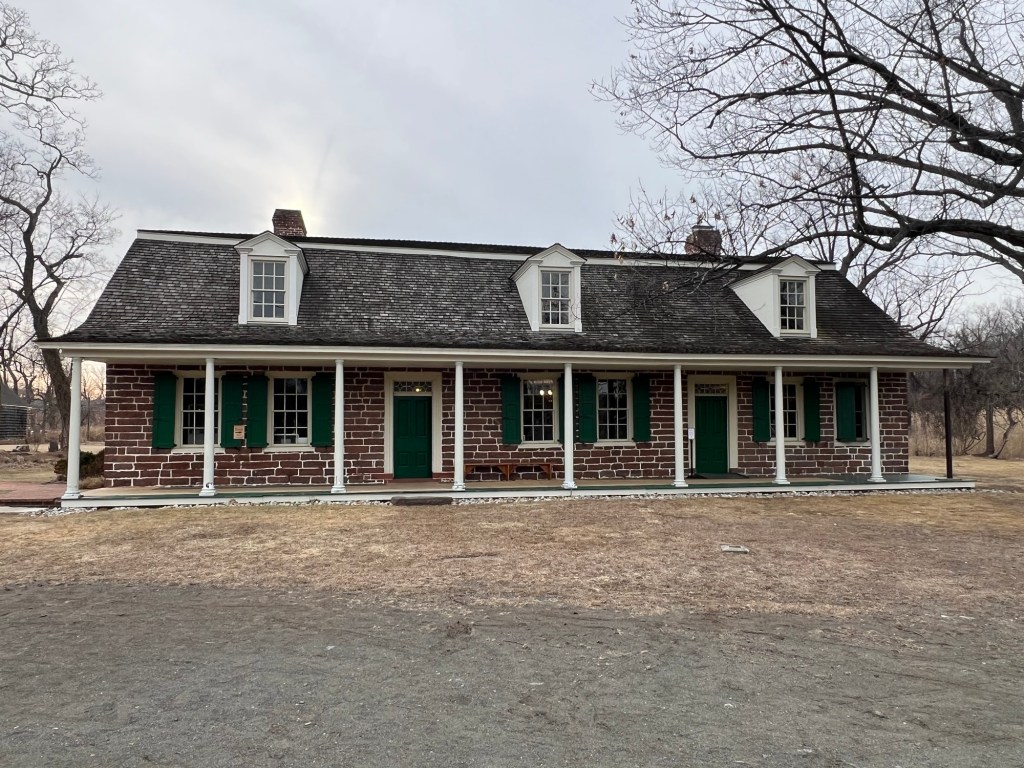
Sandstone houses were built continuously from the Dutch colonization of the 17th century through the founding of the Republic and the early years of the 19th century. The Campbell-Christie House, an outstanding example of this early regional architecture, is a 5 bay, 4 room center all building with two rooms to either side and two interior chimneys. This stone house form seems to have been built mainly after the Revolution and up to the turn of the century. The front wall is built out of well-dressed local sandstone with inset wooden trapezoidal lintels and side composed of roughly coursed sandstone.

BCHS Washington's Birthday VIII

The Campbell-Christie House during Washington’s Birthday Celebration

Historic New Bridge Landing.jpg

The Historic New Bridge Landing Site

Jacob Campbell, at the time of his marriage in 1774 built this house along the road (now Henley Avenue) that led from Old Bridge to the Schraalenburgh Church. Historical evidence records that Campbell, a mason by trade, also ran a tavern in his household. In 1795, the house was sold to John Christie, a blacksmith, who continued as a tavern keeper. Jacob Brinkerhoff-Christie, manager of the Comfort & Lumber Company, eventually inherited this large valuable homestead farm property along the Hackensack River. His son. John Walter, born in the house in 1865, was a famous inventor who built and raced cars (at one time holding the world’s speed record), invented the automotive front-wheel drive and is known as the “father of the modern tank”.

Historic New Bridge Landing Park is located at the narrows of the Hackensack River. Because of its strategic site along a tidal waterway it has been an active area of settlement, trade and commercial activities for thousands of years. The construction of the “New Bridge” in 1744 accelerated development of the area. Because of the nearness to Manhattan, New Bridge Landing was a principal base of operation during the Revolutionary  War and considered an important strategic route, guarded by troops from both sides at different times. General George Washington, who made his headquarters in Zabriske’s house, led his soldiers in retreat across here on November 20, 1776, saving his troops from entrapment by advancing British troops.

On the Hackensack River’s west bank, near the bridge, is the Steuben House. Originally  constructed by Jan Zabriskie in 1753 and doubled in size around 1765, it has been referred to as to as among the five “great houses” of Colonial Bergen County. The third stone house is the 18th century Demarest House, moved to this site in 1956 and owned by the Demarest-Blauvelt Foundation. The Historic New Bridge Landing Park Commission, a partnership of the Bergen County Historical Society, Blauvelt-Demarest Foundation, the County of Bergen, New Jersey Division of Parks & Forestry, New Milford Borough, River Edge Borough and Teaneck Township, operates the New Bridge Landing site.

This site also contains the County-owned 1888-89 Pratt-type, “pony” truss, iron swing bridge, the oldest highway swing bridge in New Jersey. The Campbell-Christie House, along with the other two houses and the bridge, is on the State & National Register of Historical Place. It is the headquarters of the Bergen County Historical Society and furnished with the furniture and collection owned by the Society. Open year round. For the FCHS calendar of event or go to http://www.bergencountyhistory.org.

http://www.co.bergen.nj.us

Kevin Wright’s Lecture on the Site (2015)

(2015 Bergen County Division of Cultural & Historic Affairs)

The Bergen County Division of Cultural & Affairs received an operating support grant from the New Jersey Historical Commission, a division of the Department of the State.

Disclaimer: This information is taken directly form my pamphlet from the Bergen County Division of Cultural & Historic Affairs. The site holds it position in its participation in the Revolutionary War and should not missed. I give them full credit for this information. Please call them for more information.

The reenactment of the Historic Bridge attack during the American Revolution at the Bergen County Historical Society. I give the Historical Society full credit for this information.

The Christie Pub sign

The pub exhibit at the Campbell-Christie House