Tag: Exploring New Jersey

The Friendship School Museum                                       859 South Shore Road (Route 9)                         Palermo, NJ 08223

The Friendship School Museum 859 South Shore Road (Route 9) Palermo, NJ 08223

The Friendship School

859 South Shore Road (Route 9)

Palermo, NJ 08223

(609) 628-3303

http://uppertwphistory.org/Friendship-School.htm

https://hpsout.tripod.com/

https://capemaycountynj.gov/DocumentCenter/View/5497/CMC-Heritage-Brochure

Open: Please call for a appointment and special tour

My review on TripAdvisor:

The front of the schoolhouse

The entrance to the property

The historic marker

The outside sign

The Friendship School was an interesting look at early rural education where students of various ages would be educated together.

The hours would vary with the growing seasons and students would be educated in the basics to educate them to the next level.

During the school day, children would have various chores to do such as gather wood, collect water, mind the fire and watch the day’s lunch. It would be a full day for both the teacher and the students.

My tour guide confirmed that nothing was easy during the school day and children had a lot of responsibility for what went on in their lives.

The tour was an interesting look at the lives of children of that period of time and the education they received.

The history of the Friendship School:

(from the Museum’s website)

This historic property contains the circa 1930 Friendship School, a circa 1900 privy, and a circa 1917 coal storage shed.  The Friendship School was originally donated in 1976 by William Wells, grandson of Enoch Clouting to the Upper Township Bicentennial Committee during a time when Upper Township was particularly interested in its earliest buildings.

The historic plaques

The school’s hand pump

The committee, headed by the late Curtis T. Cordon, evolved to become the nucleus of the Historical Preservation Society of Upper Township (HPSUT) in 1977. Virginia M. Wilson was its’ first President.

 The history of the Friendship School begins when it was incorporated in May of 1831 with Jonathon Corson, Lewis Corson, and Seth Young as trustees. The students’ tuition was paid for by parents in 1830, but by 1869, public funding for schools was established. In the 1862-63 school year, 52 students crowded into this 15’x 20’ structure, and of those students in the teacher’s roll book, 24 were Corsons!

The grounds of the school grounds

The school itself is standing on its fourth known location! It was originally located 6 houses southeast of its present location. It was used for classes until it was replaced with a larger building in the 1860’s.

The abandoned school house later owned by resident, Lot Corson, became known as “Lot’s Temple” because church services were held there. Then, it was moved to Enoch Clouting’s farm where a corn crib was placed on one side. It is Enoch’s grandson who kindly donated the school.

 The barn on the grounds

The school building was in extreme disrepair when it was moved from the Clouting property to the corner of Ocean Ave. and Shore Road.  According to an undated news article, “mere fragments of the (original) building remained” although “some of the heavier corner posts were salvaged.”

The school’s outhouse (pricey)

The historic sign

Nevertheless, restoration of this Friendship School was researched and planned by Kyle Fleetwood of Tuckahoe and James Wilson of Marmora; with assistance from Matt Unsworth, Robert Entirkin, Curtis Corson III, Somers Corson, Marshall “Ted” Behr, Guy Himmelberger, Harry “Hap” Folger and other members of the Bicentennial Committee. It was completed in 1980.

 All replacement wood matched the original in size and material and great care was taken to restore it to its original appearance. Locally sourced materials for the restoration/reconstruction came from the Van Vorst sawmill in Petersburg, the Hess sawmill in South Seaville and the Brewer sawmill in Dennisville. Benches donated by Myra Clouting Biggs, were reproduced by Matt Unsworth.

The inside of the school house

The teacher’s desk is a reproduction also made by Matt Unsworth. Hardware for the building was hand-wrought by Robert Entrikin of Petersburg. Although it does not qualify for the State and National Registers listing because it retains little original historic building fabric, the building is important to the historical time line of Upper Township.

 The schoolbooks and school equipment

Also on this site are two old frame buildings: a circa 1900 privy donated from the property of the Seaville School on Kruk Drive and a circa 1917 coal/storage shed donated from the Palermo School on Route 9.  The coal storage shed, was donated by Wes and Doris Nickerson with Jim and Nancy Siegrist helping with its restoration. It was added to the property in 1993. Three three-seat privy (outhouse) from the old unused Seaville School was donated by Sharon Kruk in honor of her father, and was restored by Lewis Albrecht and Jim Siegrist. It is a work of art (with a French style roof), but is non-functional.

 The school room reproduction

A special item, the cedar flag pole, from which flew a U.S. flag that flew above the capitol in Washington, DC, was donated by former Deauville Inn owners, Walter and Gloria Carpenter in December of 1983. (Since replaced)

 The school bell and flag

The Friendship School was dedicated on September 10, 1983 by Virginia M. Wilson, President of the Historical Preservation Society of Upper Township, Upper Township Mayor Leonard Migliaccio, HPSUT members: Ebbie Unsworth and her son, Matt Unsworth, and guest speaker, New Jersey State Senator, James R. Hurley.

 The children would collect water and fire wood for the class room during the school day

The reproduction of the school

Upper Township continues to own and manage the property and the school, while HPSUT members manage the inside and its activities. Each Upper Township Kindergarten class is invited to the annual Kindergarten Day to learn what a student classroom life is like in a one room school house in the early

The outside of the school

The Bergen County Court House                           10 Main Street                                        Hackensack, New Jersey 07601

The Bergen County Court House 10 Main Street Hackensack, New Jersey 07601

The Bergen County Court House: Hackensack, New Jersey

10 Main Street

Hackensack, NJ 07601

(201) 221-0700

https://www.co.bergen.nj.us/component/rseventspro/location/16-bergen-county-courthouse

Open: Monday-Friday-8:30am-4:30pm

*Call about touring the facility when court is in session.

The Historic Courthouse at 10 Court Street in Hackensack, NJ.

The Bergen County Justice Complex (including the Bergen County Court House) was placed on the New Jersey and National Registers of Historic placed on November 22, 1982 and January 11, 1983 respectively. The Register nomination referred to the building’s significance as “important to the judicial of the Bergen County Justice Complex-the Court House, the Jail (now called the ‘Old Jail’), and the Administration Building-were the work of important architects and all possessed architectural quality and interesting examples of early 20th century technology.

The Historic marker

Designed by James Riely Gordon, in the Beaux Art style reflecting monuments of classical Rome and Italian Renaissance, the Court House incorporated rich materials including marble and bronze. With a dome modeled on the U.S. Capital, it incorporated other art forms including painting, sculpture and stained glass. The exterior contains many sculptures including the female statue of “Enlightenment Giving Power” on the dome’s cupola. The dome’s interior is decorated with Tiffany stained glass panels. Three of the courtrooms have elaborate stained glass skylights fabricated by the famous Lamb Studios. Some of the courtrooms also contain large murals painted in the 1930’s by artists working for the Federal Art Project of the Works Project Administration.

The Hackensack Green, Courthouse and Dutch Reformed Church and Cemetery.

The other side of The Green from the Courthouse.

The symbolic value of the Court House was recognized when it was built in 1910-1912. A local newspaper, The Hackensack Republican, wrote on July 7, 1910 that the courts “stand for the protection of rights, for the redressing of wrongs and for the punishment of crime. There are the great safeguards of the freedom of the people…Hence we build these courthouses as temples of justice-substantial, ornate and commodious as the appropriate form for the great duties which are here to exercised”.

Bergen County Court House 1715-1912 with the historic cemetery in the distance.

First Court House 1715: The Court House was combined jail and courthouse built on the site of three blocks south of the present County Administration  Building. It was located in an area known as Quacksack, later becoming part of the southern portion of Hackensack. It was built of stone laid up by two of the freeholders, John Stagg and Ryer Ryerson.

Second Court House 1734: This Court House, built on “land near the Dutch Church by Hackensack River.” was probably on or adjacent to the Green in Hackensack and closer to the river than the site of the current courthouse. It burned in 1780 during the Revolutionary War in the British raid of Hackensack.

Third Court House 1780: The 1780 Court House was something of a temporary structure built during the Revolutionary War away from Hackensack. It was a log building with the courthouse and jail housed under one roof, erected at “The Ponds” (Present day Oakland) in northwest Bergen County.

Fourth Court House 1786: The fourth Court House was built on a site “about 100 feet east of Main Street,” Hackensack where present day Bridge Street connects with Main Street (southern side of Bridge Street) fronting on the river. It was built on land bought from Peter Zabriskie, who lived in the magnificent Mansion House which faced the Green.

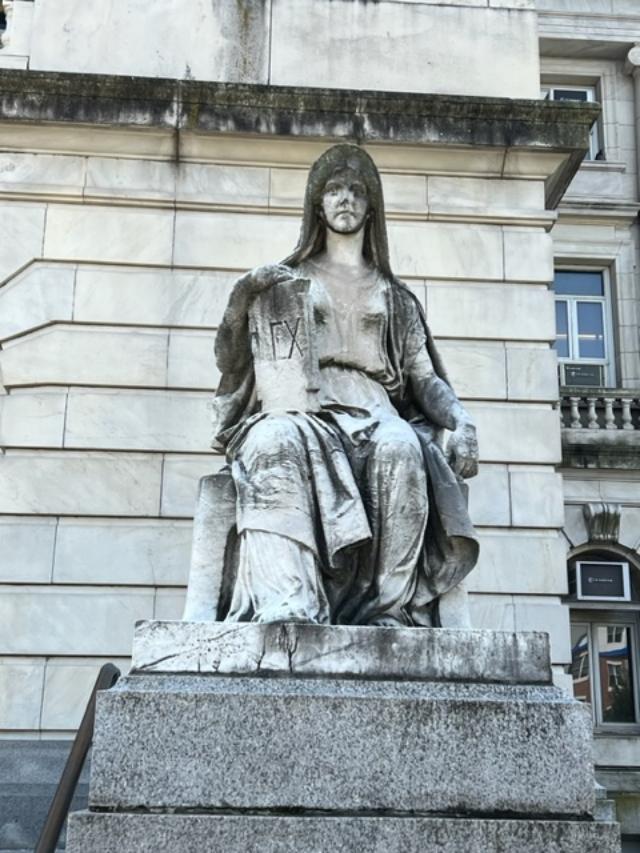
The unique statues that flank the front of the courthouse.

Fifth Court House 1819: The Fifth Court House was a brick structure built on the site of the present courthouse on land deeded to the county by Robert Campbell, a prominent Hackensack attorney and son of Archibald Campbell, whose tavern on the west side of Main Street faced the Green. Campbell specified that the land was deeded for the use of the county. If used for any other purpose, it was to revert to Campbell’s heirs. It was torn down in January 1912 when the present courthouse building had been completed on the side behind it and to its west.

The other statue that flanks the Green.

Sixth Court House 1912: The present Court House was designed by James Riely Gordon (1863-1937), a prominent architect responsible for the design of about 70 courthouses and two state capitals. The cornerstone was laid July 6, 1910 and was built by John T. Brady & Company of New York. Completed in February 1912 at the cost of $1,617,000, it was the subject of considerable investigation and lawsuits due to charges that there was over-payment of funds as well as added costs, which became the basis for political battles.

For Justice Center information: contact http://www.judiciary.state.nj.us/bergen/

http://www.co.bergen.nj.us

2015 Bergen County Division of Cultural and Historic Affairs

The Bergen County Division of Cultural & Historic Affairs received an operating support grant from the New Jersey Historical Commission, a division of the Department of State.

*Disclaimer: This information was taken directly from the Bergen County Division of Cultural & Historical Affairs pamphlet. Please refer to the website for tours and other information on visiting the site as it is a working courthouse. Please check the website and email or call before you visit.

Welcome to ‘VisitingaMuseum.com’, a trip through unique small museums, cultural sites and parks & gardens in NYC and beyond.

Welcome to ‘VisitingaMuseum.com’, a trip through unique small museums, cultural sites and parks & gardens in NYC and beyond.

*Bloggers Note: because of the size, location and time of year these sites are open, the hours and cost to get in can change since the blog was written. Please check with the site’s website or call the site before you visit. Things change over time.

My name is Justin Watrel and welcome to ‘VisitingaMuseum.com’, a trip through cultural sites, small unique museums, historic mansions and homes and pocket parks & community gardens in New York City and beyond its borders. I created this blog site to cross reference all the cultural sites that I came across when I was traveling through Manhattan for my walking blog, “MywalkinManhattan.com”.

Bergen County Historical Society III

Historic New Bridge Landing

I was inspired by all these sites that I had missed over the years and never knew existed in New York City and its suburbs.  Many of these being in Bergen County, NJ where I live. I found that most people feel the same way. The only way you would know that these sites existed is by walking past them.

Schoolhouse Museum Ridgewood.png

School House Museum in Ridgewood, New Jersey

So I created this site to showcase all these smaller, largely unexplored ‘gems’ in Manhattan, the rest of New York City and places outside the greater New York City area. I concentrate on smaller, more off beat cultural sites that you might miss in the tour books or may just find by passing them on the street. This has lead me to  becoming a member of the Bergen County Historical Society in Riveredge, NJ as well as other cultural sites in the area.

Aviation Hall of Fame.jpg

The Aviation Museum in Teterboro, New Jersey

There is so many interesting historical sites, parks, gardens and homes to explore that I want to share it with all of you. They are tucked behind buildings and walls, locked behind gates or hidden behind trees only for you to want to discover them.

Ringwood Manor Christmas 2019

Ringwood Manor in Ringwood, New Jersey at Christmas

I want to give these smaller and unique ‘gems’ more exposure and ‘sing their praises’  to an audience (namely out of town tourists) who might overlook them. It is hard for a lot of these cultural site because of the lack of volunteers or volunteers getting older or the absence of money to properly advertise these sites.

Gallery Bergen Professor Show III

Juan Leon’s work at Gallery Bergen on the Bergen Community College campus in Paramus, NJ

So join me in the extension of “MywalkinManhattan.com” with my new site “VisitingaMuseum.com” and share the adventure with me. Join me also on my sister blog sites, “DiningonaShoeStringinNYC@Wordpress.com” and ‘LittleShoponMainStreet@Wordpress.com’ for restaurants and small shops.

Dyckman Farm House II.jpg

The Dyckman Farm in Washington Heights in Manhattan

These sites featuring all sorts of small restaurants, bodegas and bakeries, where a quality meal can be had for $10.00 and under and unusual stores with unique merchandise that just stand out in their respective neighborhoods. It is important to support small business owners especially in this economy.

Lucy the Elephant

Lucy the Elephant in Margate, NJ

So, join me here as I take “MywalkinManhattan” to some unique and special historical sites and open spaces the New York Metropolitan area and beyond.