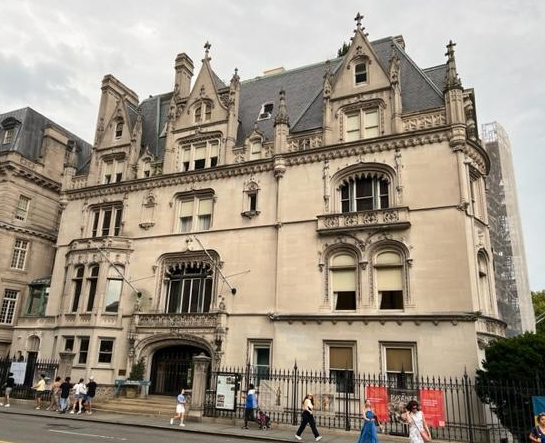
The Ukrainian Institute of America at 2 East 79th Street
I was really impressed by the Ukrainian Institute of America on a recent visit. I must have passed this building a hundred times on my way to the Metropolitan Museum of Art and never thought twice of it. I was sorry I did as you will miss a lot by not walking in. The galleries are really impressive and the main gallery on the bottom gives you an interesting look at the history of the Ukrainian.
The first floor gallery discusses the formation of the country, a bit about its history and its ties to Europe and to Russia, its religious past and the current state of affairs of the country including its recent split of the eastern sections of the country and Crimea to Russia. Its a country in turmoil considering they want to join the European Union. It is a country in flux and on the cusp of entering the 21st Century with some of its past still tugging at it. Like all countries, it will prevail on the will of it’s people. There is a lot of solid history here and a country ready to enter its future.
The artwork of artist Vasyl Diadyniuk
The second and third floor galleries are full of art work from Ukrainian artists that is on sale and each of the galleries is dedicated to certain artists selling their works at somewhat hefty prices. Still you get to see the developments of the artists both here and abroad.
The forth floor is dedicated to special exhibitions. There are two shows going on now. One is by artist Vasyl Diadyniuk and another show is by artist Alexander Archipenko.
The artwork of artist Alexander Archipenko
The Museum has an interesting history.
Ukrainian Institute of America History:
The Ukrainian Institute of America Inc. is a non-profit organization whose primary mission is to showcase and support Ukrainian culture. To that end, the Institute affords the general public an opportunity to learn about Ukraine and how the Ukrainian spirit expresses itself, with special emphasis on the creative arts.
Founded more than fifty years ago by William Dzus, a prominent Ukrainian industrialist and philanthropist, the Institute sponsors:
*Art exhibitions
*Music concerts
*film screenings
*theater presentations
*Poetry readings
*Lectures and symposia
*Educational programs
*Children’s events
*Documentation center
The history of the building:
The building that is home to the Institute, the National Historic Landmark Harry F. Sinclair House is one of the few remaining examples of the splendid mansions that prominent citizens of New York City built in the 19th Century. The mansion was built in 1897 for Isaac D. Fletcher, a wealthy banker and broker, by the architect C.P.H. Gilbert. Executed in Gothic Revival style, the building is richly decorated with intricate crockets, carvings, moldings, pinnacles and other exquisite details. Six stories high, partly surrounded by a dry moat, the Institute features stately rooms that are magnificently proportioned and lavishly finished (Institute History).
The C.P.H. Gilbert house
In 1887, manufacturer, Isaac D. Fletcher, commissioned famed Gilded Age architect, C.P.H. Gilbert to design the mansion. When Mr. Fletcher died, left this mansion and his art collection to the Metropolitan Museum of Art, which sold it to Harry F. Sinclair, founder of Sinclair Oil Company and also famous for his involvement in the Teapot Dome affair. The last private owner was Augustus Van Horne Stuyvesant Jr., the last descendant of Peter Stuyvesant, who was the first governor of New Amsterdam, today’s New York City bought the house in 1930 and lived here with his sister, Anne. The house was sold as part of the estate when Mr. Stuyvesant died in 1953. The Ukrainian Institute of America acquired the mansion in 1955 (Institute History).
A key goal of the Institute is to continue to preserve this extraordinary fragment of the city’s history for the benefit of all citizens of New York. The house still retains its wooden moldings and the house looks as if its residents just moved out.
I recently visited the American Folk Art Museum in New York City for the “Made in New York City” exhibition and it is a very interesting and engaging museum. The artwork for the museum was a combination of painting, sculpture, pottery and metal work created at different periods of the City’s history. It really showed the extent of manufacturing in New York City and the craftsmanship that was once here.
The entrance to the museum
I recently visited the American Folk Art Museum in New York City for the “Nation”exhibition and it is a very interesting and engaging museum.
The main gallery of the museum with early American art
The main gallery with one of the revolving shows
The artwork for the museum was a combination of painting, sculpture, pottery and metal work created at different periods of the City’s and the Country’s history.
Some of the permanent works were made in the Tri-state area. It really showed the extent of manufacturing in New York City and the craftsmanship that was once here.
The ‘Folk Nation’: Crafting Patriotism in the United States’ exhibition
Patriotism in the United States draws from the American Folk Art Museum’s rich collections to explore links between vernacular art and the construction of an American sense of self. Introducing visitors to the concept of “folk” as a category developed in conjunction with the art and antiques markets, this exhibition positions works as multilayered in their meanings, imbued with cultural significance by not only their creators, but also their collectors and subsequent owners. Americans have long preserved objects as a way of telling stories about themselves. Beginning after the Revolutionary War and gathering momentum in the late nineteenth and early twentieth centuries, people turned to early American things to construct a national history and sense of collective identity—an impulse often driven by lingering insecurity about the young nation’s perceived cultural provinciality compared to Europe (Folk Art Museum.com).
One of the painting’s that stood out to me was more contemporary approach to the Statue of Liberty, entitled ‘Miss Liberty reaches out to the persecuted’. A different approach to folk art.
The painting ‘Miss Liberty reaches out to the persecuted’ by Reverend Benjamin Franklin Perkins
The description of the painting
Some of the interesting things you will see are the paintings by artists in both Colonial New York and from the Hudson River School of prominent New Yorkers through its first 200 years of history. You will see how the styles of art have changed over the years.
Also there is a lot of metal work in the ways of signs and rods for the front of doors and for the roofs. The woodwork carvings that once graced the front doors of merchants all over the City is now a lost art. Here you could see the works of German and Russian carvers and the craftsmanship that was put into every piece. It was interesting too to see the racial themes and stereotypes that were used in the art.
Several revolving shows were being featured on a recent trip to the museum such as ‘Nation’ and ‘Self Made’, themed shows for the 250th Anniversary of the Country.
The show ‘Self Made’ A century of inventing artists’
Self-Made: A Century of Inventing Artists takes a critical look at the historical definition of the “self-taught artist” in the United States from the early twentieth century to today. The exhibition examines how artists without academic training have depicted, conceptualized, and identified themselves on their own terms. In doing so, it aims at challenging reductive, long-standing narratives that have cast these artmakers as amateurs or isolated geniuses working out of time, without lineage, influence, or artistic networks (Folk Art Museum.com).
The sixty artists featured here largely worked outside conventional art-school, gallery, museum, and peer-exchange systems. Their practices are rooted in diverse sites of learning, from professional expertise to community-based traditions. Drawn primarily from the American Folk Art Museum’s collection, this selection of artworks brings together outstanding examples of paintings, sculptures, photographs, videos, and artists’ notebooks by key national and international figures—many of them recent or rarely seen acquisitions (Folk Art Museum.com).
The exhibition is organized around three methods of artistic “self-making” and self-fashioning: self-portraits, alter egos, and autobiographies. Each gallery unfolds chronologically, providing grounding for the artists’ intentions. The works function as primary documents: firsthand accounts of the self, authored by the self. Akin to diaries or other personal statements, they call for close attention, asking viewers to “look at me, in this way, that I have chosen.” By centering the makers’ perspectives and aesthetic choices, Self-Made shifts the focus away from the viewer’s role in completing the creative act and places it squarely on the artist’s agency (Folk Art Museum.com).
Some of the paintings that stood out seemed to be self-portraits.
The painting ‘Untitled’
The museum takes different approaches to the way art is portrayed.
Another program that the museum does well is they have afternoon Jazz Wednesdays and Free Concerts on Friday nights.
There are family programs, walking tours, curator talks and lectures as part of the museum programming so there is something for everyone.
The American Folk Art Mission:
(From the Museum website)
Since 1961, the American Folk Art Museum has been shaping the understanding of art by the self-taught through its exhibitions, publications and educational programs. As a center of scholarship and by showcasing the creativity of individuals whose singular talents have been refined through experience rather than formal artistic training, the museum considers the historical, social and artistic context of American culture. Its collection includes more than seven thousand artworks dating from the eighteenth century to the present, from compelling portraits and dazzling quilts to powerful works by living self-taught artists in a variety of mediums (Museum bio).
Self-Taught art, past and present, tells empowering stories of everyday life. The field of American folk art was first defined at the turn of the twentieth century by collectors, professional artists, critics, dealers and curators whose search for an authentic American Art seemed to be finally answered in works that presented a nuanced of national identity, faith, progress, ingenuity, community and individuality. Under the umbrella of “folk art” expanded to also include artists working in the present. For the last twenty years, the term self-taught has more regularly come to address these artists, whose inspiration emerges from unsuspected paths and unconventional places, giving voice to individuals who may be situated outside the social mainstream. Those individuals have been active participants in the shaping of American visual culture, influencing generations of artists and establishing lively artistic traditions (Museum History).
American Folk Art Museum History:
(From the Museum website)
The museum of Early American Folk Arts as it was known initially held its first exhibition in a rented space on 49 West 53rd Street in 1961. The museum’s collection was launched in 1962 with the gift of a gate in the form of an American flag, celebrating the nation’s centennial. The gift reflected the museum’s early focus on eighteenth and nineteenth century vernacular arts from the northeast America.
In 1966, after receiving a permanent charter, the museum expanded its name and mission. As the Museum of American Folk Arts, it looked beyond the traditional definitions of American folk art. Its exhibitions and collection began to reflect “every aspect of the folk arts in America-north, south, east and west.” Founding curator Herbert W. Hemphill Jr. “expanded the notion of folk art beyond traditional, utilitarian and communal expressions.” Under his direction, the museum began to champion idiosyncratic and individualistic artwork from the fields of traditional and contemporary folk art. In doing so, the museum ushered in a new era in the field of twentieth-century folk art (Museum History).
The 1990’s brought new focus to the diversity and multiculturalism of American Folk Art. Offering a more inclusive vision. the museum began to present African American and Latino artworks in their exhibitions and permanent collections. Director Gerard C. Wertikin announced American folk art’s common heritage as “promoting an appreciation of diversity in a way that does not foster ethnic chauvinism or racial division.” (Museum History).
The museum further established its broadened outlook with the 1998 formation of the Contemporary Center, a division of the museum devoted to the work of 20th and 21st century self-taught artists as well as non-American artworks in the tradition of European art brut. In 2001, the museum opened the Henry Darger Center to house 24 self-taught artist’s works as well as a collection of his books, tracings, drawing and source materials (Museum History).
The gift shop
In 2001, the museum chose its current name, American Folk Art Museum. Recognizing that American Fold Art could be fully understood in an international context, the word American functions as an indication of the museum’s location, emphasis and principal patronage rather than as a limitation on the kind of art it collects, interprets or presents. The museum’s current programming reflects this shift in focus. Past exhibits have included folk arts of Latin America, England, Norway, among other countries and continents (Museum history).
Don’t miss this amazing little museum on the Upper West Side of Manhattan.
I recently visited the birthplace of of our 22nd and 24th President of the United States of America and it is an interesting look into one man’s past. The Grover Cleveland Birthplace Museum was originally the pastor’s residence for the First Presbyterian Church in Caldwell, NJ.
What I found interesting about this historical home is that the President’s sister, Susan, saved everything of the family’s past. Things like furniture, home furnishings, cooking utensils, paintings and photos of the family plus personal items of the President such as his clothes, pipes, shaving kits and traveling cases so there is a lot of interesting items to see and well thought up display cases.
The house is broken up into the kitchen area, the living chambers, the former living room area which has most of the displays and then the front hallway where more family displays are located.
President Cleveland and Mrs. Cleveland’s personal clothes
Try to take a tour with the tour guide, Paula, who knows the house backwards and forwards and gives you an interesting take on the family. She will be able to point out all the family objects and personal items that have been donated by family members. Things from formal clothes to a piece of the President’s wedding cake.
A piece of the President’s wedding cake
The whole tour takes about an hour and you will find yourself memorized by the displays and the family history of the children and grandchildren. It is interesting to see how the family grew when they were living in Caldwell, NJ.
History of the Cleveland Birthplace Museum:
Grover Cleveland’s birthplace was built in 1832 as the Manse or pastor’s residence for the First Presbyterian Church of Caldwell. Cleveland’s father, the Reverend Richard Fally Cleveland was the minister here from 1834-1841.
Originally this frame home had a two-story main section with a one-story kitchen to the east and a one-story lean-to at the rear. It was enlarged several times between 1848-1870 to meet the growing needs of the Presbyterian clergy. The house is a good example of local vernacular architecture.
The Birthplace house
The historical significance of the Manse was first noted in 1881 when Cleveland was running for Governor of New York. As his political star ascended, so did the interest in preserving his birthplace as a museum. A group of Cleveland’s friends and admirers began negotiations to purchase the Manse in 1907. Their efforts culminated in the opening of the house to the public on March 18, 1913.
Most of the first floor rooms portray the Manse as it was in 1837, the year Grover Cleveland was born. The decidedly middle-class character of the rooms reflect the day to day life of the Reverend Richard Cleveland and his family. Among the artifacts on display from Cleveland’s early years are his cradle and original family portraits.
Grover Cleveland’s crib where he was born
Contrasting sharply with the humble beginnings portrayed in these rooms, the exhibit gallery features a striking display of artifacts that reflect the financial and political success Cleveland achieved during the last quarter of the 19th Century. Here, the mud-slinging campaign of 1884, the public’s intense interest in his wife and children and America’s political climate throughout his split terms of office are explored.
The Grover Cleveland Birthplace State Historic Site is the only house museum in the country dedicated to the interpretation of President Cleveland’s life. It is the nation’s leading repository of Cleveland artifacts and political memorabilia. The Grover Cleveland Birthplace is listed on the New Jersey and National Registers of Historic Places.
The President’s time in New Jersey:
Stephen Grover Cleveland was born on March 18, 1837 to the Reverend Richard Cleveland and his wife, Ann. Named for the first ordained pastor of the First Presbyterian Church at Caldwell, he would in time become known by his middle name, Grover.
Cleveland was raised in a strict, modest home. As the son of a minister and the fifth of nine children, he had a religious and principled upbringing with few luxuries. When Grover was four, Reverend Cleveland moved his family to Fayetteville, NY.
Admission: $5.00 for Adults/$3.00 for Seniors & Students/Children under 12 are free/General Admission is free on Wednesdays. Guided and group tours are available.
The entrance of the Van Cortlandt House decorated for the Revolutionary era Christmas
I visited the Van Cortlandt House Museum for the their Annual Christmas Decorated House event. The mansion was decorated for Christmas in the 1700’s so it was not overdone as it would during the Victorian times. The front of the house entrance was done with sprays of holly, mistletoe above the door and garlands of pine around the banister and fireplaces. The windows had candles in them and the dining room was set for Christmas luncheon in post-Revolutionary War era.
Van Cortlandt House for Christmas is Post-Revolutionary War in 2019
The entrance hall welcomes you to a Revolutionary era holiday season
While most of the house is represented during the Dutch era with floors with no rugs, vintage furniture and decorations and the second and third floors are set for family entertainment. The first floor is set for entertaining for the holidays with the formal dining room, family parlor and the formal living room for games and dancing. The formal dining room was the only room decorated post-Revolutionary War era.
Van Cortlandt Mansion at Christmas 1800’s
The current entrance to the house from the back of the building
Until the Victorian era, Christmas was a more religious affair with church service in the morning and luncheon in the afternoon. Things were formal and less elaborate. The acts of gift giving, sleigh rides, tree decorating and card giving came during the affluence of Queen Victoria’s reign in the post Civil-War era. This is the reason why the house is decorated so simply and elegantly.
Dining Room set for Christmas lunch circa 1780’s
In 2019, the site celebrated the holidays with a Sinterklaas, a Dutch Christmas celebration, a candlelight tour and a reading from Santa Claus. Please check their website for more information on future events. The house was closed for most of the COVID years and nothing had been planned. The house was open in December of 2022 for touring again for the holidays but was not decorated as much as in the past.
In 2022, when the house reopened after a long period of COVID, the self-guided tours were back and you could tour the house at your own pace ($5.00 donation) and tour the three floors of furnished rooms. You can see how the family lived from the three generations that lived in the residence.
The tour starts at the front hallway where guests would be received for formal affairs and for business meetings with the head of the household.
You would be greeted by servants at the entrance of the home
On either side of the front hallway is the East and West Parlors where you would be directed where the family would receive you. The West Parlor would have been used for business calls and more informal meetings when meeting with the Van Cortlandt family. The family’s wealth would be on display with fine furniture, china and bric-a-brac that would show off the family’s merchant roots and business.
The West Parlor
The West Parlor decorated for Christmas
The East Parlor on the other side of the entranceway would have been used for more formal affairs. The East Parlor is where the family would formally entertain guests with dancing, music and card playing. This is where long evenings of entertaining would take place and the family would enjoy their holiday celebrations.
The East Parlor
The East Parlor decorated for the Christmas holidays
The Dining Room was toward the back of the hallway and was decorated in the Empire Design of the late 1700’s to early 1800’s. The look is very similar to styles used today and the wallpaper is a copy from one of the styles used by the family that was imported in from France. The table was set for Christmas luncheon circa the late 1780’s.
The Dining Room
The Dining Room at the Van Cortlandt House
There are two sets of stairs to the second level of the house where the family bedrooms were located. There was the formal stairs and then there was the stairs that the servants used to go from floor to floor so that they would not be seen.
The steps upstairs to the second floor
On the second floor of the home are the bed chambers of the family. The main bedrooms for the family were located here and then the nursery and servants quarters were located on the Third floor of the home.
The West Chamber:
The bedroom
The ‘Washington Bedroom’ in the Van Cortlandt House
The East Chamber Bedroom:
The Bedroom:
The Landing of the stairs to the third floor lead to the Nursery, an additional guest room and the enslaved servants quarters. These were kept out of site from the other members of the household. It is a reminder of the pecking order of the household and the conditions that people lived under at this time.
The Second Floor Landing leads to the nursery and servants quarters
The Dutch Chamber was formerly a guest room that is used to show life in early Colonial New York City:
The Dutch Chamber:
The Dutch Chamber shows early life in Colonial America
The Second Floor Setup:
The Nursery:
The nursery set up room:
The servants quarters were to the back of the house and were not the most glamorous place to live in the house. There were drafty and not insulated. The amount of time a servant would be here would have been minimal.
The servants quarters:
History of the Van Cortlandt’s:
The Van Cortlandt House Museum, also known as Fredrick Van Cortlandt House or Van Cortlandt House, is the oldest surviving building in New York City’s borough of The Bronx. The Georgian style house, begun in 1748, was build of fieldstone by Fredrick Van Cortlandt (1699-1749) on the plantation that had been owned and farmed by his family since 1691. Fredrick intended the house to be a home for him and his wife, Francis Jay and daughters, Anna Maria, 14 and Eve, 13. His sons, Augustus, 21 and Fredrick, 19, were not intended to be permanent residents of the house.
Sadly, Fredrick died before the new house was completed. In his will written in 1759, Fredrick left the house to his son, James Van Cortlandt (1726-1781) and a lifetime tenancy to his widow, Francis Jay Van Cortlandt (1701-1780).
The Van Cortlandt House gardens in the Summer
The Van Cortlandt’s were a mercantile family prominent in New York affairs. Fredrick’s father, Jacobus, established a thriving wheat growing and processing business on the plantation including a grist mill for processing the wheat into flour and a fleet of shallow draft boats to carry the flour from the south end his lake down Tibbet’s Brook and out to the Harlem and Hudson Rivers to market. During the Revolutionary War, the house was used by Rochambeau, Lafayette and Washington.
(From History of Van Cortlandt House and Museum)
In 1887, after 140 years of occupancy by the Van Cortlandt family and the community of plantation workers, the property was sold to the City of New York and made a public parkland. Before the house became a museum, it saw a variety of uses including as a temporary police precinct house and as a dormitory for ranch hands responsible for taking care of a herd of buffalo.
Van Cortlandt House historic marker
By 1895, The National Society of Colonial Dames in the State of New York expressed their interest in restoring the house as a museum open to the public. There was only one obstacle keeping the Colonial Dames from this important project, there was no provision in the New York State Law allowing the stewardship of a publicly owned building by a private organization. Undaunted, the first Society President, Mrs. Townsend, took the Society’s cause to Albany where on May 22, 1896 in the 199th session of the New York Legislature, Chapter 837 was approved by the governor and passed by a 3/5 majority to become law.
The Van Cortlandt House dollhouse
After nearly a year if repairs and restoration, Van Cortlandt House Museum was opened to great fanfare on May 25th of 1897. The original license agreement grained custody of the house to the National Society of Colonial Dames in the State of New York for a period of 25 years at a ‘peppercorn’ rent of $1.00 per year. Although the Society no longer pays the city rent, they remain, to this day as dedicated to Van Cortlandt House as they were in 1896.
Van Cortlandt Park in the Summer Months
In 1967, Van Cortlandt House was added to the National Register of Historic Places and was designated a National Historic Landmark in 1967. The house was declared a New York City Landmark on March 15, 1966, recognizing the historic and architectural importance of both the exterior and interior.
(From the Van Cortlandt House Museum NSCDNY)
The Van Cortlandt House gardens during the winter of 2022