Category: Walking Around Manhattan

American Academy of Arts Letters                                                    633 West 155th Street                                                                        New York, NY 10032

American Academy of Arts Letters 633 West 155th Street New York, NY 10032

American Academy of Arts & Letters

633 West 155th Street

New York, NY 10032

(212) 368-5900

Academy@Artsandletters.org

https://artsandletters.org/

Hours: Thursday-Sunday-1:00pm-4:00pm/Open During Exhibitions times only or by appointment (Mid-March-Mid-April; Mid-May-Mid-June)

Fee: Free

My review on TripAdvisor:

https://www.tripadvisor.com/ShowUserReviews-g60763-d548512-r682038708-American_Academy_of_Arts_and_Letters-New_York_City_New_York.html?m=19905

The front of the American Museum of Arts & Letters at 633 West 155th Street

I was finally able to visit the American Academy of Arts and Letters on the last day it was open for the year to the public. It was for the ‘Ceremonial Exhibition: Work by New Members and Recipients of Awards’, an exhibition on members art that was chosen specifically for the show. Most of the work was very contemporary and some a little political. It was interesting work by new artists that filled the small gallery rooms.

The front of the American Museum of Arts & Letters

One of the buildings was used for the contemporary art while the one across the courtyard was used for the more architectural pieces. The galleries are small but the art was impressive. What I liked when I talked with one of the women who worked there said to me that after the show, the pieces would be donated to galleries and museums all over the country. The galleries are only open four months out of the year and this was the last day of the exhibition so the work being shown will be gone.

I visited the museum in January 2025 and it had just reopened after a three year renovation after it had been closed since Pre-COVID and it is now fully open with a new exhibitions. All the galleries are brightly lit and displaying new exhibitions.
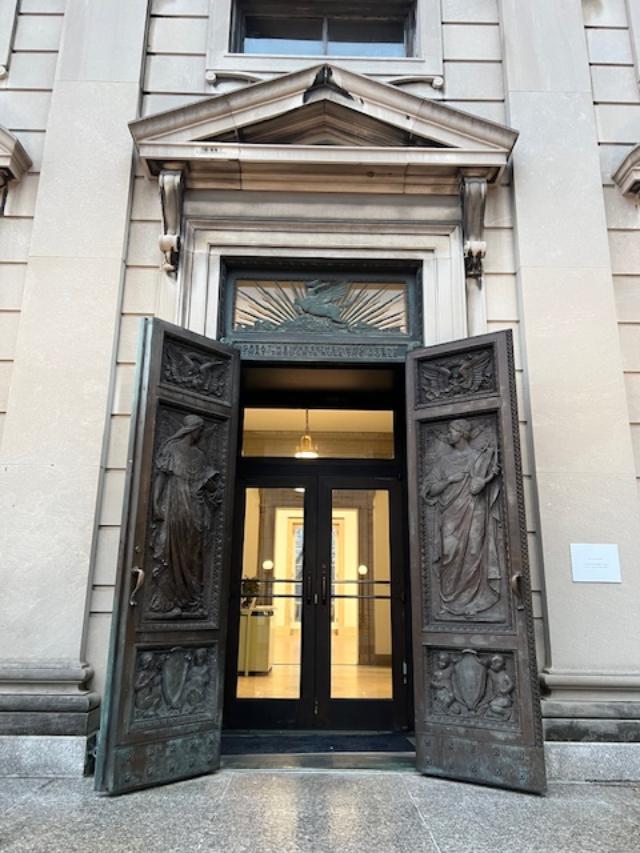
The entrance to the museum from the courtyard

Some of the pieces that really stood out when I visited in 2019 were by Judith Bernstein, a contemporary painter who seems to not like the current administration too much. The themes were on power and money and corruption in the administration. Her work really shows what she personally thinks of  our President. Her ‘Trump Genie” was very clever and I can see this in a major museum in the future.

American Academy of Arts & Letters III

Judith Bernstein’s work

Other work in the main gallery in 2019 were by artists Stephen Westfall with ‘Solid Gone’, Hermine Ford with ‘Paris, France’ and Paul Mogensen with several ‘Untitled’ pieces. The contemporary works I was not sure what the meaning of them were but they were colorful.
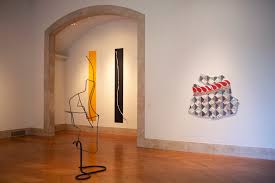
American Academy of Arts & Letters V

The works of the artists of the front gallery

One of the pieces in the front gallery that really stood out was by artist Francesca Dimattio, ‘She-wolf’ which was a classic Greek character made of porcelain, enamel, paint and steel.
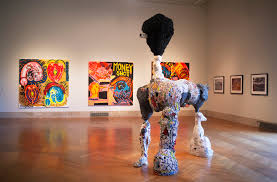
American Academy of Arts & Letters VI

‘She-wolf’ by Francesca Dimattio

There were light installations in 2019 that were very interesting by artist James O. Clark. He had one piece, ‘Wunnerful, Wunnerful’,  which is a work that just keeps being creating itself by bubbles and ink markers moving along a turntable that stops and starts.

There was a permanent exhibition of Charles Ives home in Connecticut that was transported and recreated here. His studio and works are featured here as well as his family life. There are copies of his works in the display cases and his career.

The museum in 2025 was fully open with the exhibition by artist Christine Kozlov, a contemporary Video artist whose works were being featured in the main gallery.

The main gallery of the Kristine Kozlov exhibition

In more than fifty artworks arrayed across four galleries at Arts and Letters, Christine Kozlov shows the breadth of Conceptual artist Christine Kozlov’s practice with a focus on works from the mid-1960s through the late 1970s. Nearly all of the works Kozlov contributed to public exhibitions during this period will be on view, many of which were created for landmark exhibitions of Conceptual art such as: One Month (1969), organized by Seth Siegelaub; Information (1970), curated by Kynaston McShine at the Museum of Modern Art, New York; Arte de Sistemas organized by Jorge Glusberg / CAYC—Centro de Arte y Comunicación at the Museo De Arte Moderno (1971); and the Number Shows, a series of exhibitions curated by Lucy Lippard between 1969 and 1974 (American Museum of Arts & Letters website).

Part of the Kristine Kostov exhibition

Works by artist Christine Kozlov

The next exhibition that I viewed was by artist Wadada Leo Smith, which consisted of an exhibition based on colors and sounds. You could take the headsets around the gallery and tour and admire the work with the sounds of the musical groups.
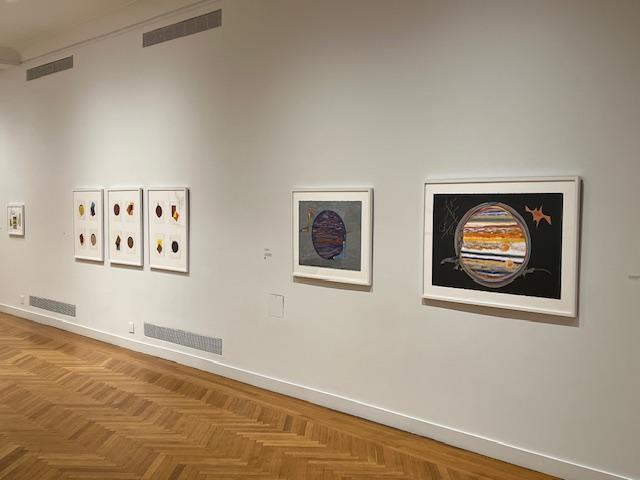
The gallery with works by artist Wadada Leo Smith

Wadada Leo Smith (b. 1941, Leland, MS) is a composer-performer and Arts and Letters member. Formerly an educator at CalArts, he has influenced decades of musicians and artists, including Raven Chacon. In Kosmic Music, Smith’s first solo exhibition in New York, he shares over fifty years of Ankhrasmation (Museum website).

The “Sphere” works by artist Wadada Leo Smith
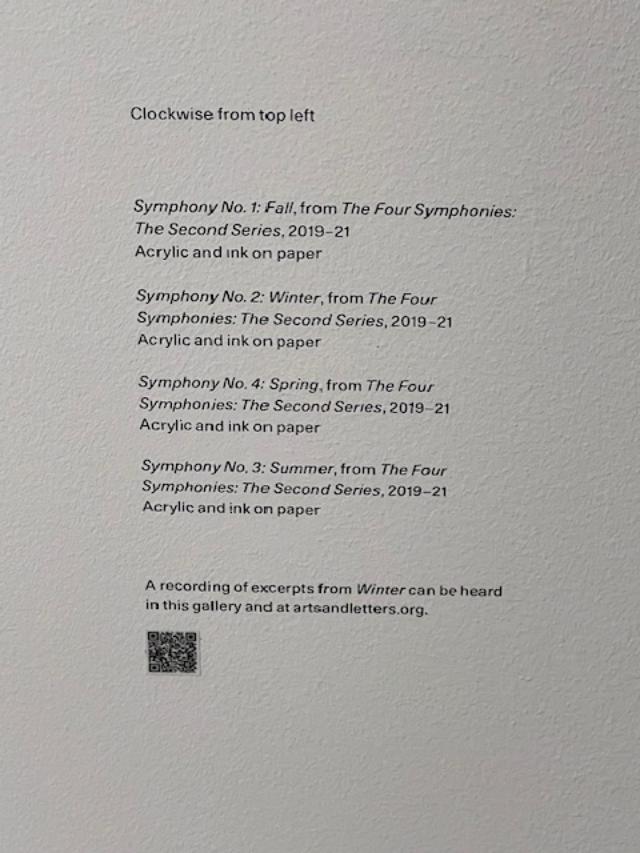
Ankhrasmation is a musical language Smith began exploring in 1965. Smith does not consider Ankhrasmation to be his creation but rather something he discovered. The name derives from Ankh, an ancient Egyptian symbol of life; Ras, an Ethiopian word for leader or father; and Ma, for mother. The distinctive language uses line, color, and shape to designate musical components such as tonal range and intensity of activity. For Smith, performing Ankhrasmation requires focused practice and “having that space in your heart and mind so that you can play from inspiration.” (Museum website).

The last exhibition I saw was in the gallery across the courtyard from the main museum was by artist Raven Chacon. You would walk in the main gallery to the sounds of birds both living and extinct. Just five minutes in the main gallery by myself and I felt like Tippi Hedren in the movie “The Birds”. There were all sorts of bird sounds with no birds around.
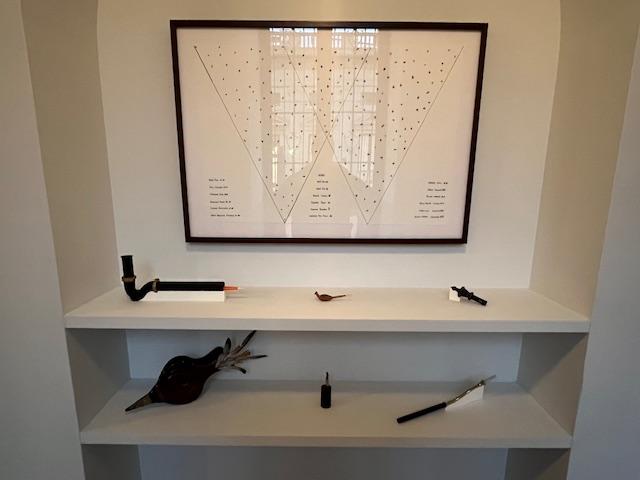
The instruments that the artist uses to achieve the sounds of the birds

When Raven Chacon (b. 1977, Fort Defiance, Navajo Nation) visited Arts and Letters for the first time, he paused in our North Gallery to clap his hands, then counted how long it took for the room to go silent. It took around six seconds—a long rate of decay. Standing in that echoing chamber, Chacon noted the building’s Beaux Arts design by Cass Gilbert, with its imported Spanish tile and cage-like glass ceiling that filters the sky. He became curious to learn the history of the land it sits on, once owned by John James Audubon, who purchased it in 1841 with funds from the sale of his illustrated Birds of America (Museum website).

Chacon is a composer and artist who frequently works with the materials and histories of a given site and who considers, as he puts it, “what has been silenced and what happens when it is not.” For the past year, he has worked on Aviary, his site-specific commission for the North Gallery, creating a soundscape that makes space and time for careful listening (Museum website).

Museum Mission:

(from the museum website)

The American Academy of Arts & Letters was founded in 1898 as an honor society of the country’s leading architects, artists, composers and writers. Charter members include William Merritt Chase, Kenyon Cox, Daniel Chester French, Childe Hassam, Henry James, Theodore Roosevelt, Elihu Vedder and Woodrow Wilson. The Academy’;’s 250 members are elected for life and pay no dues.
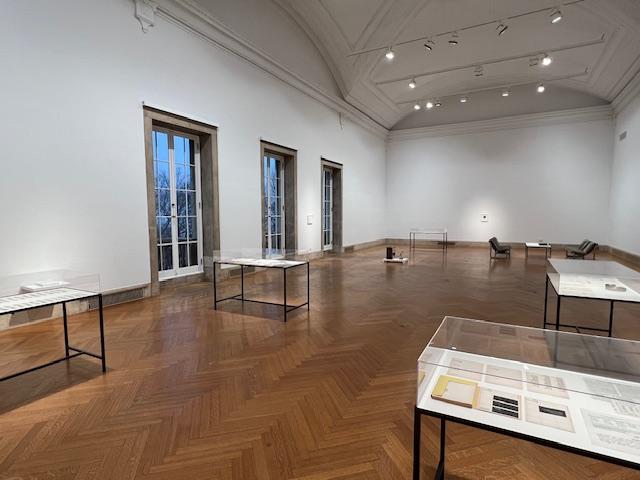
The main gallery of the museum

In addition to electing new members as vacancies occur, the Academy seeks to foster and sustain an interest in Literature, Music and the Fine Arts by administering over 70 awards and prizes, exhibiting art and manuscripts, funding performances of new works of musical theater and purchasing artwork for donation to museums across the country.

Collections:

(from the museum website)

The Academy’s collection, which are open to scholars by appointment, contain portraits and photographs of members, as well as paintings, sculptures, drawings, prints and decorative art objects. The library has more than 25,000 books by or about members. The archives house correspondence with past members, press clippings, institutional records and original manuscripts of musical and literary works.

History:

(from the museum website)

The National Institute of Arts & Letters, the parent body of the Academy, was founded in 1898 for “the advancement of art and literature”. The Institute met for the first time in New York City in February 1899 and began electing members that fall. Architects, artists, writers and composers of notable achievement were eligible and membership was soon capped at 250. In 1913, President Taft signed an act of Congress incorporating the organization in the District of Columbia.

American Academy of Arts & Letters at twilight

In 1904, The Institution created the American Academy of Arts & Letters, a prestigious inner body of its own members that modeled itself on the Academie francaise. The first seven members of the Academy were William Dean Howells, Augustus Saint-Gaudens, Edmund Clarence Stedman, John La Farge, Mark Twain, John Hay and Edward MacDowell. Those seven then chose eight more and so on, until the full complement of 30 and later 50 was reached. Only after being elected to the Institute, was a member eligible for elevation to the Academy. This bicameral system of membership continued until 1993, when the Institute dissolved itself and all 250 members were enrolled in the American Academy of Arts and Letters.

The Academy inaugurated its annual awards program in 1909 with the Gold Medal for Sculpture. Since then, over 70 awards and prizes have been endowed through gifts and bequests or established by the Academy’s board of directors in the fields of architecture, art, literature and music. There are conferred each year at the Ceremonial in May when new members are inducted and a distinguished speaker is invited to deliver the Blashfield Address.

In 2005, the Academy purchased the former headquarters of the American Numismatic Society, the neighboring building on Audubon Terrace. A Glass Link now connects the Academy’s existing galleries to newly renovated ones in the former Numismatic building. These new galleries house the permanently installed Charles Ives Studio.

(The Academy of Arts & Letters Website)
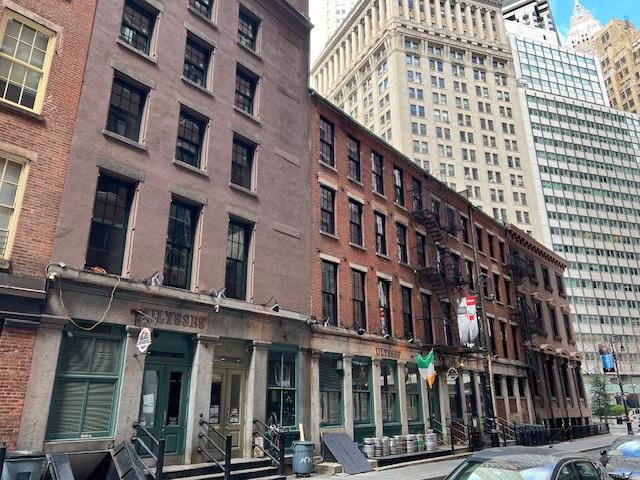
Visiting Stone Street in Lower Manhattan September 2017, November 2019 and April 2024

Visiting Stone Street in Lower Manhattan September 2017, November 2019 and April 2024

Visiting Stone Street in Lower Manhattan:

As part of my tour of Historic Bars and Pubs on Day One Hundred and Thirteen with the Cornell Club on May 9th, 2018, we toured the famous ‘Stone Street’ one of the original paved streets of Manhattan. You will not find architecture or pavings like this left in New York City. Here and there are streets or buildings that represent these times during the early to mid-1800’s but they are few and scattered in remote spots all over the island. Here the street still represents a different era of Manhattan.

Stone Street IV

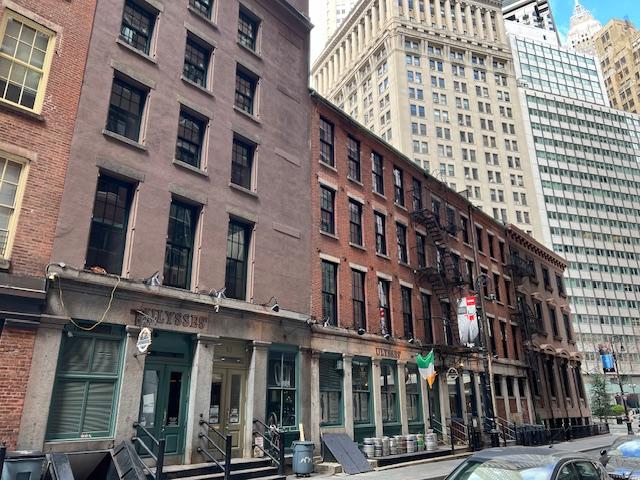
The stores in the 90’s had been either boarded up or were used but in horrible shape. During the business hours not too many people inhabited this area of Lower Manhattan and it was ignored. The neighboring South Street Seaport was being transformed in the mid 80’s into a type of historic theme park and entertainment center by the Rouse Corporation. It put these old neighborhoods back into vogue and people started to return again.

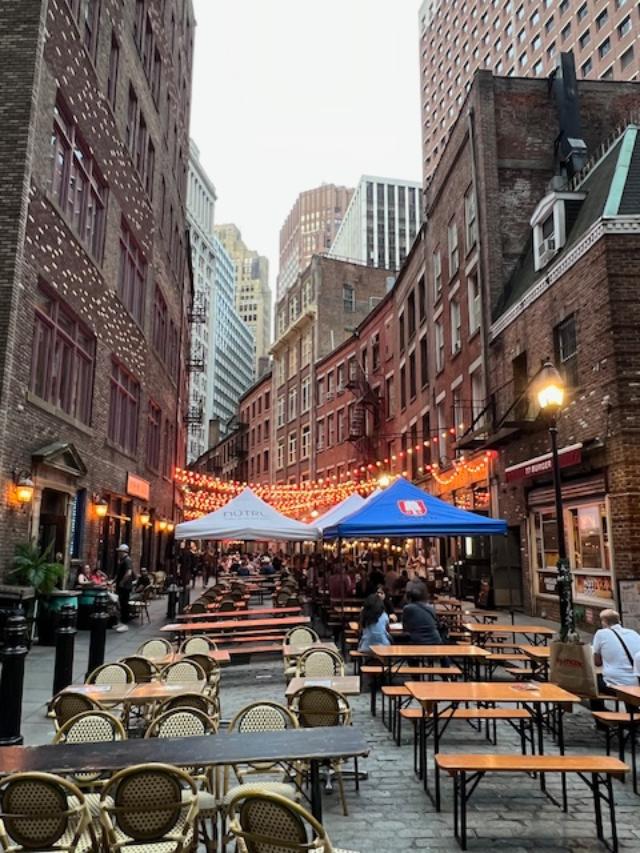
Over time, especially after 9/11 and the changes in downtown Manhattan, the street is now home to many trendy bars and restaurants and a hang out for the downtown business crowd. During the recent walking tour, the place was hopping with people spilling out of restaurants, ordering drinks during happy hour and eating pizza at the local pizzeria.

During ‘Happy Hour’ after work, the place is mobbed with people milling around having a good time. The tables toward the end of the street are filled with tourists taking pictures and at one end of the street is the famous “India House” and at the other is the Frances Tavern where George Washington gave his troops his farewell address.

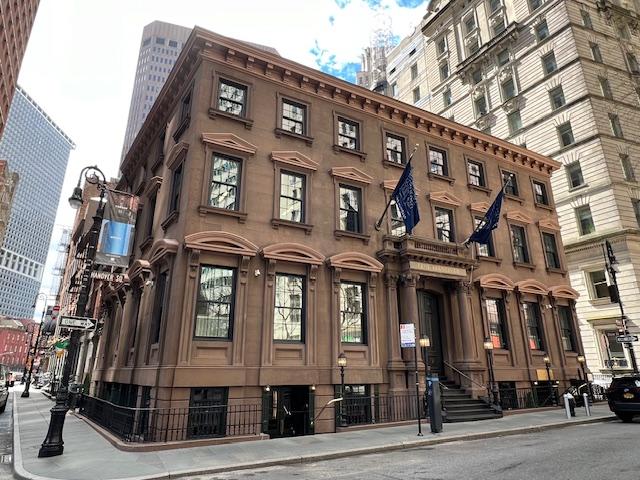
Stone Street’s India House

It is not only a historical neighborhood but loaded with things to see and do. The buildings which were once in horrible shape have been brought back to life and repositioned to use for the meals and entertainment. It is interesting to see how a neighborhood comes back in full circle in a 150 years.

The Stone Street dining area in the warmer months.

History of the area:

Stone Street is a short street in Manhattan’s Financial District. It originally ran from Broad Street to Hanover Square but was divided into two sections by the construction of the Goldman Sachs building at 85 Broad Street in the 1980’s. Today the cluster of historic buildings along Stone, South William, Pearl Streets and Coenties Alley form the Stone Street Historic District.

Fire of 1835 III

The area burned during the Fire of 1835

Stone Street is one of New York’s oldest streets. It was originally known by its Dutch name, Hoogh Staet (High Street). In 1632, the Dutch West India Company built the first commercial brewery in North America there. Around 1656, Hoogh Straet was shifted about twenty to twenty-five feet to align it with Brouwer Street, the extension of Hoogh Straet west of the Gracht and which in 1658 became the first paved street in Nieuw Amsterdam. Following the British conquest of the colony, the name Hoogh Straet was translated to High Street. It was then called Duke Street for the Duke of York during most of the 18th century. Leveled in 1771 and 1790, it was renamed Stone Street in 1794 because of it’s cobblestone paving as New Yorkers abandoned reminders of British Rule.

Fire of 1835

The Fire of 1835

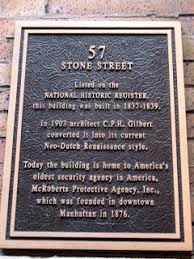
The street’s stores and loft were built for dry-goods merchants and importers, shortly after the Great Fire of 1835, which destroyed many remnants of New Amsterdam. Most buildings were used as storage. The building at 57 Stone Street was rebuilt in 1903 by C.P.H, Gilbert in Dutch Colonial Revivial architecture at the behest of the owner, Amos F. Eno as son of Amos R. Eno. The buildings to the back on South William 13-23 also were reconstructed in the Dutch revival style, evoking New Amsterdam.

Stone Street at night

Today is a busy series of bars and restaurants.

Following many decades of neglect, a joint partnership between the Landmarks Preservation Commission and other city agencies, the Alliance for Downtown New York and Stone Street owners has transformed Stone Street from a derelict back alley into one of Downtown’s liveliest scenes. Restored buildings, granite paving, bluestone sidewalks and period lights set the stage for the half dozen restaurants and cafes, whose outdoor tables are very popular on warm summer nights.

The eastern portion of the street and the surrounding buildings have been protected since 1996 by the New York City Landmarks Preservation Commission as the Stone Street Historic District and is pedestrian only. The historic district is now populated by several restaurants and bars and has a outdoor dining when the weather permits. The India House historic landmark is located at the Hanover Square end of the street.

(This information was taken directly from Wikipedia and I give them full credit)

Fearless Girl Statue                                                                         Bowling Green Park  (now on Wall Street)                                          New York City, NY 10004

Fearless Girl Statue Bowling Green Park (now on Wall Street) New York City, NY 10004

Fearless Girl Statue

Bowling Green Park (Now on Wall Street)

New York City, NY  10004

TripAdvisor Review:

https://www.tripadvisor.com/Attraction_Review-g60763-d13109380-Reviews-Fearless_Girl-New_York_City_New_York.html?m=19905

*The statue has been moved since this blog has been written and it on Broad Street near the New York Stock Exchange.

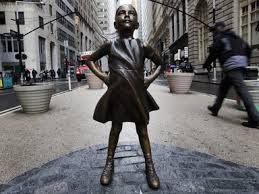
The ‘Fearless Girl’ statue is the latest addition to the street art in lower Manhattan. Placed next to the statue of the ‘Charging Bull’, she portrays a defiance and a look that almost says, “I am standing up to the power and I am standing up to fear’. She has a look of determination on her face that clearly shows that she is standing her ground. She was designed by artist Kristen Visbal.

The statue is located at the northern tip of Bowling Green Park in Lower Manhattan both statues are an easy find on the Broadway side of the park. Be aware that this is a big tourist area for pictures so there will be a crowd.

Kristen Visbal artist

Artist Kristen Visbal

http://www.visbalsculpture.com/

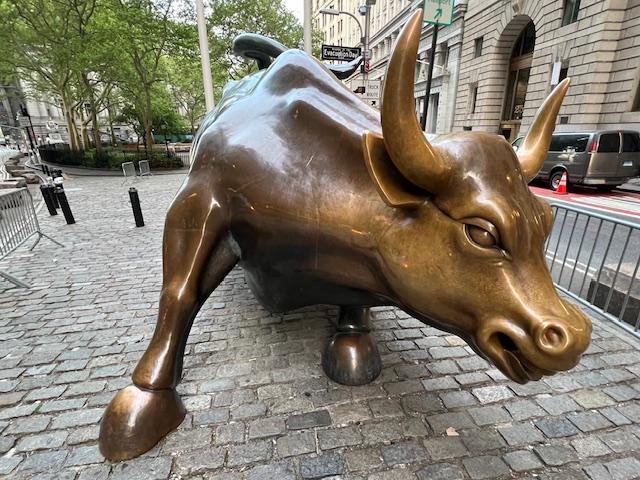
There has been some controversy from Arturo Di Modica the creator of ‘Charging Bull’ who says that it takes away from the meaning of his own work. Di Modica has challenged that the piece exploits his work and distorts the meaning of his own work by turning the ‘Charging Bull’ into a villain instead of the his true meaning for the work which is a ‘symbol of prosperity and for strength’. Both statues are being planned to be moved by the NYC Parks Department in the future (Wiki and the New York Times 2018).

The Charging Bull

History of ‘Fearless Girl’:

The statue was installed on March 7, 2017, the day before International Women’s Day, by State Street Global Advisors, in a campaign developed by advertising agency McCann New York. SSgA was celebrating the first anniversary of its “Gender Diversity Index” fund that “invests in U.S. large-capitalization companies that rank among the highest in their sector in achieving gender diversity across senior leadership. The concept for the statue was developed by Senior Art Director Lizzie Wilson and Senior Copywriter Tali Gumbiner. Wilson and Gumbiner established both the idea for the statue as well as the overall look of the girl using countless mood boards  and imagery, which Visbal referenced (Wiki).

Fearless Girl was originally given a one week City Hall permit that was later extended to 30 days. Later, it was announced that the statue would remain in place through February 2018. Among those advocating for the statue to stay longer was U.S. Representative Carolyn Maloney of New York’s 12th congressional district who stated, “This statue has touched hearts across the world with its symbolism of the resiliency of women. New York City Public Advocate Letitia James wrote a letter that supported keeping the statue, “Fearless Girl stands as a powerful beacon, showing women, young and old, that no dream is too big and no ceiling is too high” (Wiki).

A petition on Change.org asking for the statue to be made permanent gathered 2,500 signatures in the first 48 hours. Efforts to make the statue permanent continued after the statue was granted a one-year permit. In April 2018, after ‘Fearless Girl’ had been in place for thirteen months, New York City Mayor Bill de Blasio announced that both ‘Charging Bull’ and ‘Fearless Girl’ would be moved to a location facing the New York Stock Exchange. The move would occur before the end of 2018 (Wiki).

The plaque below the statue states: “Know the power of women in leadership. SHE makes a difference.” (Wiki)

The statue is available to be seen 24 hours a day.

Disclaimer: The history of the statue was taken from Wikipedia and I give them full credit on the information. The rest is my personal opinions on the statue.

Mount Vernon Hotel Museum & Garden           421 East 61st Street                                            New York, NY 10065

Mount Vernon Hotel Museum & Garden 421 East 61st Street New York, NY 10065

Mount Vernon Hotel Museum & Garden

421 East 61st Street

New York, NY  10065

(212) 838-6878

http://www.mvhm.org

Open: Tuesday-Sunday-11:00am-4:00pm (check the website during each season)

Fee: Adults $15.00/Seniors & Students $12.00/Children 16-12 $5.00/Children under 12 Free

TripAdvisor Review:

https://www.tripadvisor.com/Attraction_Review-g60763-d309468-Reviews-Mount_Vernon_Hotel_Museum_Garden-New_York_City_New_York.html?m=19905

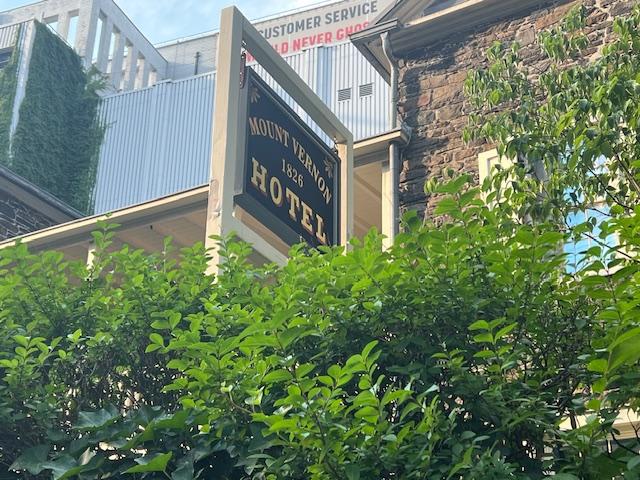
The Mount Vernon Hotel Museum at 421 East 61st Street

Mount Vernon historical sign during the summer months

The history of the building

The model of the building

I had come across the Mount Vernon Hotel Museum when I was walking on East 61st Street for my blog and went to take the tour of the building. It is a one hour (or more as I there for almost two hours but I was by myself) tour of both floors. You start with a film and a quick talk about the history of the building. The hotel building has had several owners and uses over its over hundred years.

I visited the museum during the holiday season in 2025 and I got to see all the decorations around the hotel. There was elegant decorations in most of the rooms and got to see how people ate during the holiday season as well as with visits guests would have indulged in when they came for the day.

Then you start the tour of the upper room where the ladies would gather and talk. This is where they might have tea, musical recitals and read and sew. They would gather with other women for conversation and debate.

The Upstairs foyer gallery

The foyer landing decorated for the holidays with the former traveler, James Taylor, who discussed in his memoir about visiting the hotel

The Ladies Parlor

The upstairs is where the sleeping rooms and the ladies parlors are located, where female guests would enjoy tea, games, music and reading. The main landing was for dancing and for gatherings.

The Ladies Palour with the Chinese writing desk and festive decorations.

The room set for tea with Englishware

The holiday set up afternoon service

The sleeping rooms were kept simple and functional

The Men’s game room

The main floor was the Men’s gaming rooms, where there is a bar and two rooms for male activities such as cards, gambling and reading. Here the men would discuss politics and business over a drink and games of chance.

The main games room

The main entrance was used as the dining room for dinner (our lunch), which was the biggest meal of the day served around 2:00pm.

The bar area where spirits are sold

The afternoon supper was part of the package and couples would join one another for a several course meal, which would serve as the main meal of the day.

Dinner time at the Mount Vernon Hotel Museum

The tour guide went over what would have been served, menu’s and meal times. Dinner would have been served at 2:00pm, tea time would have been around 4:00pm-6:00pm and Supper around 8:00pm.

The multi course meal for everyday on display

The meal would include popular dishes such as turkey and oysters and a specialty, Turtle soup. Fresh vegetables and fancy desserts would be part of the package.

The tour of the kitchen show preparation of foods, recipe books and all kitchen equipment including the stoves and baking materials.

The kitchen for both the hotel and house

The kitchen used to cook afternoon meals

The area used for baking and roasting

If you like the history of “Old New York” and like old homes, hotels and buildings, this is a very interesting tour that deals with the City’s growing middle-class and the new ‘leisure time’ that was coming with the changes in the work week. There are many pieces of period furniture all over the building that show the growth of affluence of the time.

The side board set with holiday desserts

The side board ladened with holiday treats

Don’t miss the formal walled in garden in the back. It is a place of relaxation from the rest of the city. There are stone walk ways and landscaped gardens as well as an herb garden. The building is owned and maintained by the Colonial Dames of America.

The walled gardens during the winter

The walled garden in the winter

I revisited the museum for the holidays and the hotel was decked out in garland and holy based on the decor traditional for the Revolutionary War era Christmas. The archways and tables were lined with greenery and the tables were loaded with oranges plunged with cloves to give the homes at that time a rich citrus smell.

The downstairs dining table was set for a Christmas meal of wild turkey, mock turtle soup, and apple and pumpkin pies. This would have been served in the afternoon as the main meal while it was still light out.

Holiday goodies at the Mount Vernon Hotel Museum getting ready for the holidays

There had been a light snow while we were touring the hotel so when we visited the gardens, it really did have that Christmas feel to it with that light snow all over the pine and the bushes.

How the neighborhood has changed

The old stable area

During the time of the Revolutionary War and afterwards, homes were not as elaborately decorated as they would have been during Victorian times after the Civil War. Homes were lined with greenery that would have given the home the fragrant smell of pine and strings of cranberries and popcorn would have been used to decorate mantles.

The hotel decorated for the holidays

The hotel was getting ready for one of its many special events during the holidays so there was a lot of commotion going on downstairs. It is a very festive looking place for the holidays so try to tour it when it is open in the month of December.

The museum in the 2025 holiday season  

What is the Museum:

Constructed in 1799 as a carriage house and converted into a ‘day hotel’ in 1826, the Museum transports visitors back to Mount Vernon Hotel, a 19th Century country resort for New Yorkers escaping the crowded city below 14th Street.

The model of the original house layout

Recognizing the building as one of the few remaining 18th century sites and the only surviving day hotel in New York City Historic Landmark in 1967, added to the National Register of Historic Places in 1973 and accredited by the American Association of Museums in 1983.

History of the House:

The Mount Vernon Hotel Museum & Garden presents the period of the Mount Vernon Hotel which operated from 1826 until 1833.

Constructed in 1799 as a carriage house for a 23 acre estate and converted into the Mount Vernon in 1826, this stone building sits on land originally owned by Colonel William Stephens Smith and his wife, Abigail Adams Smith, the daughter of John Adams.

This fashionable country resort was popular among New Yorkers who wished to escape the hustle among the bustle of the city, which at that time extended only as far north 14th Street. The Hotel advertised “free from the noise and dust of the public roads and fitted up and intended for only the most gentle respectable” clientele. In those days, one could take the stagecoach or steamboat up to 61st Street spend the day at the hotel sipping lemonade in the ladies parlor or playing cards in the gentlemen’s.

In 1833, the house became the home for three generations of a New York City family. In 1905, as the area became more industrialized, the building was purchased by Standard Gas Light Company (today’s Con-Edison). The Colonial Dames of America, a woman’s patriotic society purchased the building in 1924 and did an extensive restoration to the structure, the Colonial Dames opened the site to the public in 1939. The building endures as a rare reminder of an important era in New York City’s history.

What the organization does:

*Welcome 5000 school children annually in grades-pre-K through high school for field trips.

*Summer History Weeks for children ages 6-12

*A Summer High School Internship for 15 students to support college readiness skills and career exploration.

*Two summer Hearst Fellowships for undergraduates or graduate students.

*40+public programs each year, including:

-monthly free Story time

-monthly Lunchtimes lectures

-holiday programs, garden concerts, hands on craft and cooking workshops.

*Temporary exhibitions on facets of life in early 19th century NYC, some promoting local contemporary artists.

*Special programs for individuals with Alzheimer’s and their caregivers.

*Outreach programs to schools, senior centers and homeless shelters.

*Themed group tours focused on 19th century food, decorative arts or literature.

*Three options for team building events.

*Two free admission days: Smithsonian Museum Day and Open House New York.

Programs are made possible in part by the support of the New York City Department of Cultural Affairs in partnership with the City Council and Council Member Ben Kallos, the New York State Council on the Arts with the support of Governor Andrew Cuomo and the New York State Legislature, the Manhattan Borough President Gale Brewer, the Institute of Museum and Library Services, the Rosenthal Foundation and the Michael Tuch Foundation.

(Mount Vernon Hotel Pamphlet)

The Colonial Dames of America:

With these words, spoken in April 1890, Maria Denning “May” Van Rensselaer imitated what was to become the oldest colonial lineage society for women in the United States. The Colonial Dames of America. Its mission is to preserve historic sites and objects, award scholarships, educate the public about American history, inspire patriotism and promote fellowship among its members.

(The Colonial Dames of America information).

The backyard gardens in the Winter time

Video on the museum