Category: Exploring the Upper East Side

Asia Society and Museum                                    725 Park Avenue at 70th Street                         New York, NY 10021

Asia Society and Museum 725 Park Avenue at 70th Street New York, NY 10021

Asia Society & Museum

725 Park Avenue At 70th Street

New York, NY 10021

(212) 288-6400

AsiaSociety.org/NY

https://asiasociety.org/new-york

Open:

Museum: Tuesday-Sunday-11:00am-6:00pm, Friday-11:00am-9:00pm

Asia Store: Monday-Sunday-11:00am-6:00pm, Friday-11:00am-9:00pm

Garden Court Cafe: Tuesday-Sunday, 11:30am-3:00pm; Reservations: (212) 570-5202

Asia Society is closed on major holidays. Please check AsiaSociety.org/NY for updates on museum, store and cafe hours.

Fee: $12.00 Adults/$10.00 Seniors/$7.00 Students with ID/Free to members and children under 16/Free Admission Fridays, 6:00pm-9:00pm

Adult, Student and Teacher tours:

For information or to schedule a tour, call (212) 327-9237

*Wheelchair accessible/available for use during visits/Complimentary cell phone audio tour available/Assistive listening devices and headsets available for many programs. 

TripAdvisor Review:

https://www.tripadvisor.com/Restaurant_Review-g60763-d531995-Reviews-Asia_Society_and_Museum_Garden_Court_Cafe-New_York_City_New_York.html?m=19905


History of the Museum:

Asia Society II

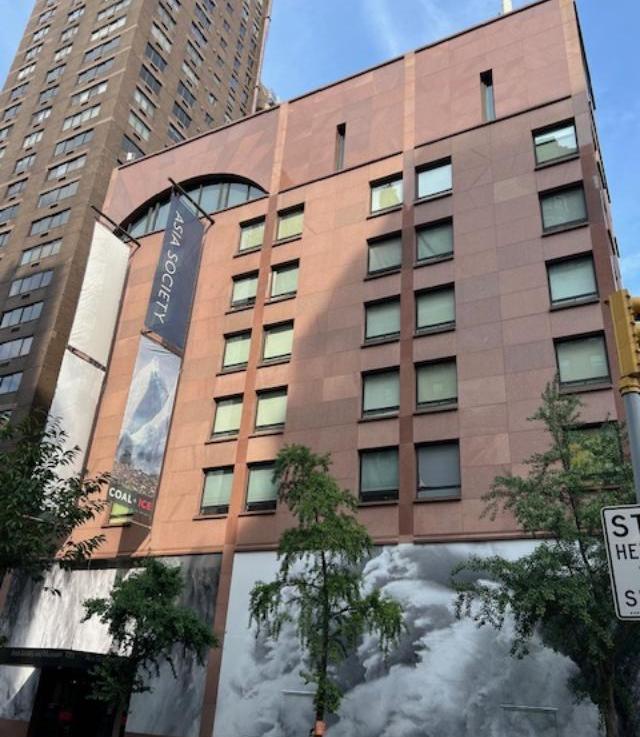
The entrance to the Asian Society Museum
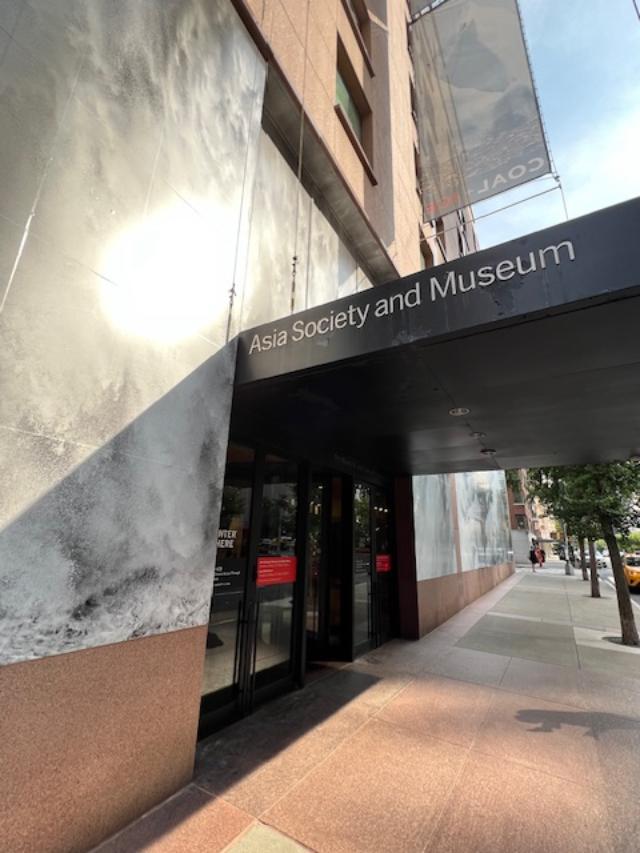
John D. Rockefeller 3rd (1906-1978) , who established Asia Society in 1956, firmly believed that art was an indispensable tool for understanding societies. From 1963 to 1978, he and his wife, Blanchette Hooker Rockefeller (1909-1992), worked with art historian Sherman E. Lee (1918-2008) as an advisor to build the Mr. and Mrs. John D. Rockefeller 3rd Collection, which was later bequeathed to Asia Society.

Asian Society Museum

The Rockefeller Collection

The group of spectacular historical objects they assembled-including sculpture, painting and decorative arts-became the core of the Asia Society Museum Collection and is world renowned. The Collection, now consisting of approximately 300 pieces, is distinguished by the high proportion of acclaimed masterpieces, to which additional high-quality gifts and acquisitions have been added since the original bequest to Asia Society. The Collection has particular strengths in Chinese ceramics of the Song and Ming periods, Chola-period Indian bronzes and Southeast Asian sculptures.

Extraordinary examples of decorative art in the acclaimed Asia Society Museum collection include a number of superior East Asian ceramics, which make up more than one-third of the Collection. A luminous pair of twelfth-century Korean bowl and saucer sets, covered with the celebrated celadon glaze of the Goryeo period and an extraordinary tea leaf jar, decorated with mynah birds and accented with silver by Japanese ceramic artist Nonomura Ninsei (active ca. 1646-1677) are among the ceramic highlights.

Asia Society III

Walking around the museum

An exquisite solid silver Chinese stem up that dates to the late seventh or early eighth century also stands out as an exceptional masterpiece of decorative art within the Collection. The skill of the craftsman is evident in the fine embossing, chasing and engraving of the birds, flowers and scrolling vines on the exterior of the cup.

Two other great strengths of the Collection are Hindu and Buddhist sculpture from South and Southeast Asia. An eleventh-century processional sculpture of the elephant-headed Hindu deity Ganesha is an endearing example produced by the South Indian master bronze casters at that time and one of the fifteen important Chola-period bronzes in the Collection.

Another great treasure is a rare eighth-century inscribed and dated inlaid-brass crowned Buddha seated on a lotus rising from water inhabited by serpent deities (nagas) from Kashmir or northern Pakistan. A sculpture of the serene and slender Buddhist Bodhisattva Maitrya stands just over an impressive three-feet tall and represents the pinnacle of Thai metal casting during the eighth-century.

These objects and the Asia Society Museum Collection as a whole continue to be an important means for sharing the talent, imagination, and deep history of the peoples of Asia with audiences all over the world.

(From: Masterpieces from the Asia Society Museum Collection)

We are …Policy

With top-level experts and advisors-including former heads of state and cabinet officials, CEOs, civil society leaders and scholars-the Asia Society Policy Institute creates solutions that advance Asia’s prosperity, security and sustainability. Its projects include working to strengthen regional security institutions and mechanisms in Asia, assessing the impact of China’s rise and tracking its economic reform program, recommending pathways to an inclusive and high-standard Asian trade architecture, charting a path for India’s admission to APEC and designing strategies for Northeast Asian economics to link carbon markets and reduce greenhouse gas emissions.

The Asia Society Center on U.S. China Relations seeks to build mutual understanding between the two countries through projects and events on policy, culture, business, media, economics, energy and the environment.

We are…Arts

Transforming Americans understanding of Asia through exhibitions and performing arts was at the heart of our founder’s vision. The bequest of the Mr. & Mrs. John D. Rockefeller 3rd Collection of traditional Asian art in 1979 spurred the building of our New York headquarters. Today, our ground-breaking exhibitions of traditional, modern and contemporary art-as well as performing arts, film and author programs-are presented to the highest acclaim at our centers in New York, Hong Kong and Houston and at venues all over the world. Global initiatives such as the Arts & Museum Summit bring together museum and cultural leaders from across Asia, the United States and Europe further appreciation of Asian arts.

Asia Society I

The gift shop at the Asia Society

We are …Education

A rising Asia requires a rising generation of students to understand its cultures and complexities. The Center for Global Education at Asia Society has developed an internationally recognized approach to foster the global competence of students, aiming to improve the capacity of 100,000 educators to instill global competence in 4 million youth by 2030. We partner with leaders and institutions from around the world to transform teaching and develop global-ready students. We also lead a major effort to bring Mandarin language instruction and the study of China and Chinese culture to children in the United States and to bring global learning to American after school programs, in pursuit of best practices in global education.

(From Asia Society pamphlet)

Asia Society is a non-profit, nonpartisan organization offering dynamic public programming at our cultural centers in New York, Hong Kong and Houston and at our other global locations in the United States, Asia and Europe.

Asia Society appreciates the support of its members, who aid our vital mission of preparing Asians and Americans for a shared future. For more information, AsiaSociety.org.

Disclaimer: This information was taken directly from the pamphlets from the Asia Society in New York City. I give them full credit for all the information. Please see the above hours and programs and call the above numbers for more information.
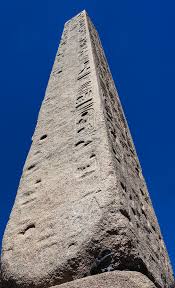
Cleopatra’s Needle Central Park @ East 81st Street New York, NY 10028

Cleopatra’s Needle

Central Park at East 81st Street (behind the Metropolitan Museum of Art)

New York, NY  10028

https://www.centralparknyc.org/attractions/obelisk

https://en.wikipedia.org/wiki/Cleopatra%27s_Needle_(New_York_City)

Open: When Central Park is open from dawn to dusk depending on the season

TripAdvisor Review:

https://www.tripadvisor.com/Attraction_Review-g60763-d1959031-Reviews-Cleopatra_s_Needle-New_York_City_New_York.html?m=1990

Cleopatra's Needle III

Cleopatra’s Needle

https://www.centralparknyc.org/locations/obelisk

https://en.wikipedia.org/wiki/Cleopatra%27s_Needle_(New_York_City)

I always admire Cleopatra’s Needle whenever I am touring Central Park West after an afternoon at the Metropolitan Museum of Art. The obelisk sits in back of the Metropolitan Museum of Art on Fifth Avenue and the pathways behind the museum lead to the site.

It is one of the few place where you can see hieroglyphics up close unless you are in Egypt and the sad part is that the natural surroundings are wearing them out. Still it is one of the most interesting outside artifacts that Manhattan and New York City has on display. Take time to observe all four sides of the obelisk and observe the writings.

Sometimes I think the tourists miss this interesting artifact and how it got here from Egypt.

The History of Cleopatra’s Needle:

(From Wiki)

Cleopatra’s Needle (obelisk) was erected in Central Park, just west of the Metropolitan Museum of Art on February 22, 1881. It was secured in May 1877 by Judge Elbert E. Farnam, the then United State Consul General of Cairo as a gift from the Khedive for the United States remaining friendly neutral as the European powers, France and Britain, maneuvered to secure political control of the Egyptian government.

The obelisk is a twin of the obelisk given to London at the same time and come from the ancient city of Alexandria. The name is a misnomer as they have no relationship with the Ptolemaic Queen Cleopatra VII of Egypt and were already over a thousand years old in her lifetime (please see the Wiki link attached to the blog for more information on the obelisk).

Cleopatra's Needle II

The obelisk is free to the public and can be seen by taking the path behind the Metropolitan Museum of Art. It is open all day.

Central Park Conservatory Garden Located between 104th and 106th Streets by Fifth Avenue                                            New York, NY 10029

Central Park Conservatory Garden Located between 104th and 106th Streets by Fifth Avenue New York, NY 10029

The Central Park Conservatory Garden

Located between 104th and 106th Streets off Fifth Avenue

New York, NY 10029

https://www.centralparknyc.org/

https://www.centralpark.com/visitor-info/central-park-conservancy/

Hours: Depends on the season and the Dawn to Dusk rule

Hours of Operation:

November-February (8:00am-5:00pm)

March (8:00am-6:00pm)

April (8:00am-7:00pm)

May (August 14th 8:00am-8:00pm)

August 15-31 (8:00am-7:30pm)

September (8:00am-7:30pm)

http://www.centralparknyc.org/things-to-see-and-do/#what_lawns-and-landscapes

Fee: Free

TripAdvisor Review:

https://www.tripadvisor.com/Attraction_Review-g60763-d272517-Reviews-Conservatory_Garden-New_York_City_New_York.html?m=19905

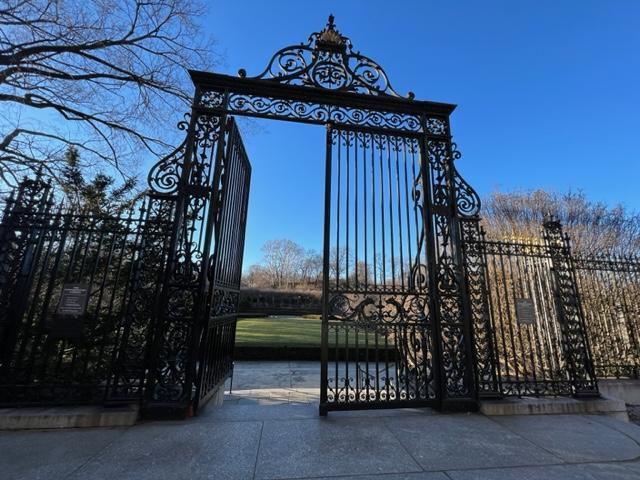
The entrance to the Central Park Conservatory Garden in Winter 2023 (The Vanderbilt Gates)

The map of the gardens

This time of the year (Spring) the Central Park Conservatory is in full bloom and its magnificence is at its finest in the Spring and Summer months. In May, the tulips and daffodils are just finishing their flowering and the lilacs are just finishing their blooming and still fragrant the garden. The lawns are all a deep green and the dogwood trees are just starting to bloom around the rings of the gardens.

The newly renovated pathways

Don’t miss walking around the Gardens off to the side closest to the Harlem Meir as they are open through the renovation. You will see beds of flowers along the fountain’s edge and can admire all the sculpture. What is most impressive is that in-between the Gardens is a vast green lawn surrounded by trees. The lawn of the Conservatory is nice to just admire with the trees lining it on all sides.

Central Park Conservatory Garden Spring 2025

The best time to come to the Conservatory Gardens is in early to late Spring and the early Summer when everything is in full bloom. This is when Mother Nature shows us her great magic.

The Central Park Conservatory in the Spring of 2025

The beauty of the Central Park Conservatory is that it blooms all year around except the winter and even then, there is a quiet elegance to the garden.

The gardens in full bloom in Summer 2025

History of The Central Park Conservatory:

The Central Park Conservatory Garden is the only formal garden in Central Park, New York City and is located approximately between 104th and 106th Street on Fifth Avenue in NYC. The Garden consists of about six acres of formal landscaping of trees, shrubs and flowers. The formal garden is divided into three smaller gardens each with a distinct style: Italian, French and English. The Central Conservatory Garden is an officially designated Quiet Zone and offers a calm and colorful setting for a leisurely stroll and intimate wedding.

The Central Park Conservatory in the Spring 2025

It takes its name from a conservatory that stood  on the site from 1898 to 1934. The park’s head gardener used the glasshouses to harden hardwood cuttings for the park’s plantings. After the conservatory was torn down, the garden was designed by Gilmore D. Clarke, landscape architect for Robert Moses, with planting plans by M. Betty Sprout and constructed and planted by WPA workers, it was opened to the public in 1937.

The Garden is composed of three distinct parts, skillfully restored since the 1980’s and is accessible through the Vanderbilt Gate at Fifth Avenue and 105th Street, a quarter south of the park’s northeast corner.

The Vanderbilt Gate at the Central Park Conservatory

The Vanderbilt Gate once gave access to the forecourt of Cornelius Vanderbilt II’s chateau designed by George Browne Post, the grandest of the Fifth Avenue mansions of the Gilded Age, at 58th Street and Fifth Avenue, sharing the Plaza with Plaza Hotel. The wrought iron gates with cast iron and repousse details, were designed by Post and executed in an iron foundry in Paris.

The fountain at the Central Park Conservatory


The fountain statuary in the main gardens.

Below the steps flanked by Cornelian cherry, the central section of the Conservatory Garden is a symmetrical lawn outlined in clipped yew, with a single central fountain jet at the rear. It is flanked by twin aisles of crabapples and backed by a curved wisteria pergola against the steep natural slope, that is dominated at its skyline by a giant American Sycamore.

Otherwise there is no flower color; instead on any fine Saturday afternoon in June, it is a scene of photography sessions for colorful wedding parties for which limousines pull up in rows on Fifth Avenue.

The Cherry Trees at the gardens in 2019

To the left of the south side is the garden of mixed herbaceous borders in wide concentric bands around The Secret Garden water lily pool, dedicated in 1936 to the memory of Frances Hodgson Burnett with sculpture by Bessie Potter Vonnoh.

Some large shrubs, like tree lilac, magnolias, buddleias and Cornus alba ‘elegantissima’ provide vertical structure and offer light shade to offset the sunny locations, planted by Lynden Miller with a wide range of hardy perennials and decorative grasses, intermixed with annuals planted to seem naturalized. This  garden has seasonal features to draw visitors from April through October.

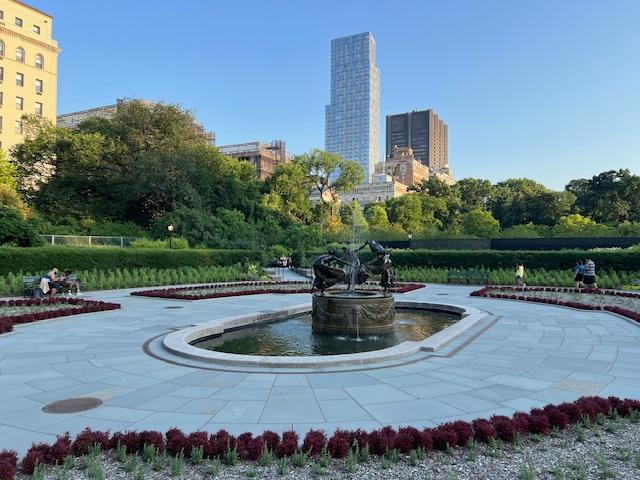
To the right of the central formal plat is a garden also in concentric circles, round the Untermyer Fountain, which was donated by the family of Samuel Untermyer in 1947. The bronze figures, Three Dancing Maidens by Walter Schott (1861-1938) were executed in Germany about 1910 and formed a fountain at Utermyer’s estate “Greystone” in Yonkers, New York.

The Untermyer Fountain

https://www.centralparknyc.org/locations/untermyer-fountain

https://en.wikipedia.org/wiki/Untermyer_Fountain

This section of the Conservatory Garden has two dramatic seasons of massed display of tulips in the spring and Korean chrysanthemums in the fall. Beds of satolina clipped in knotted designs with contrasting bronze-leaved bedding begonias surround the fountain and four rose arbor gates are planted with reblooming ‘Silver Moon’ and ‘Betty Prior’ roses.

The French Gardens at the Central Park Conservatory in Summer 2025

After the Second World War the garden had become neglected and by the 1970’s became a wasteland. It was restored and partially replanted under the direction of horticulturist and urban landscape designer Lyden Miller to reopen in June 1987. The overgrown, top-heavy crabapples were freed of water shoots and pruned up to a higher scaffold for better form. The high-style mixed planting was the first to bring estate garden style to urban parks, part of the general of Central Park under Elizabeth Barlow Rogers of the Central Park Conservancy.

The Conservatory in the early Spring of 2025

(This information directly from Wikipedia and has many sources)