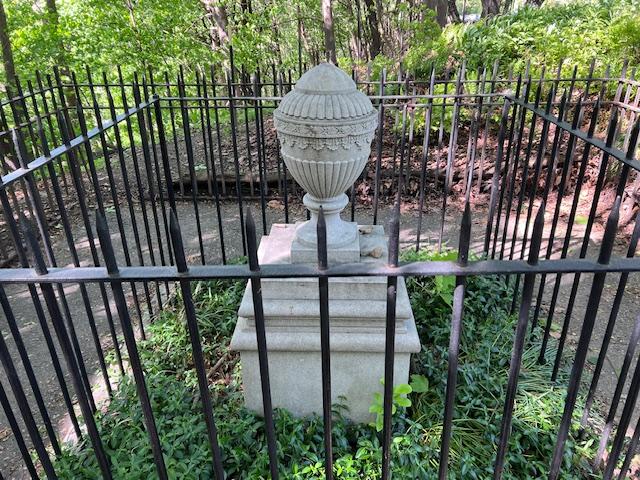
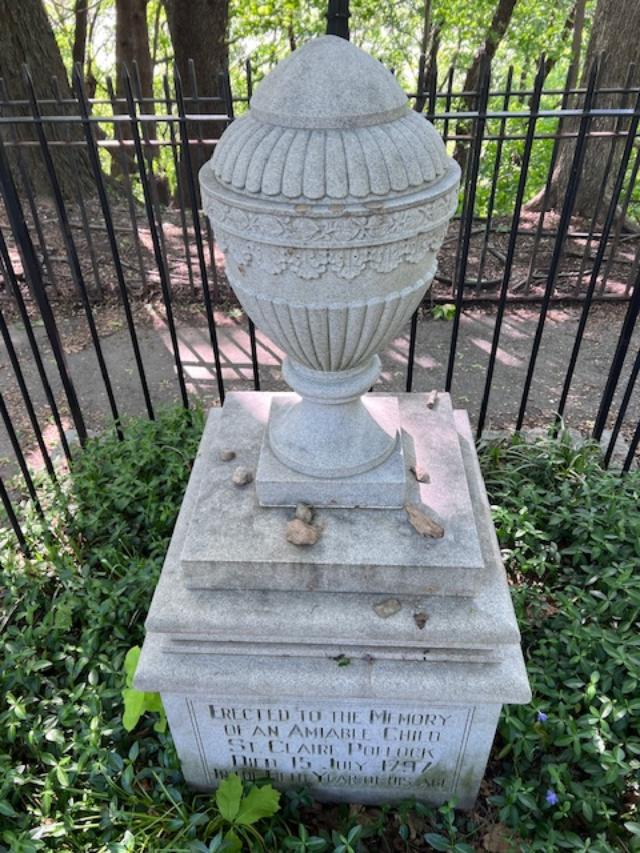
I stumbled across the Amiable Child Memorial over the summer when I was walking Riverside Drive for “MywalkinManhattan” project (see walking 155th Street) and came across this small memorial when I was passing Grant’s Tomb. It is off to the side on the path by the woods. It is a small monument and very humbling in its look. It is a small urn on a pedestal marking a grave of a small child surrounded by a fence. I got the following information from the NYC Parks Department website when I wanted to know more about the site:
The historic sign for the Tomb
This unique New York City monument marks the site of one of the few private graves on public land within the five boroughs. It belongs to St. Claire Pollock (the namesake of nearby St. Claire Place), a child who died on July 15, 1797 in the fifth year of his life, probably from a fall from the cliffs of the parkland onto the rocks near the Hudson River.
The tomb up close
In the two centuries that have passed since the tragedy of the “Amiable Child” as he was described on his headstone-different accounts of St. Claire origins and family have persisted. George Pollock, the owner of the property on which the boy was buried, was either his father or his uncle. He was a linen merchant of Scots-Irish or possibly English descent, who lived in a mansion on Strawberry Hill (later called Claremont) in the 1790’s. He had sold his property to Mrs. Cornelia Verplanck, his former neighbor, by January 18, 1800 when he wrote as follows:
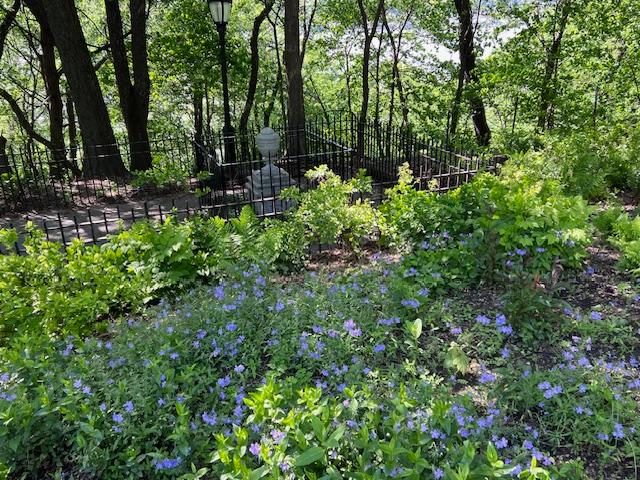
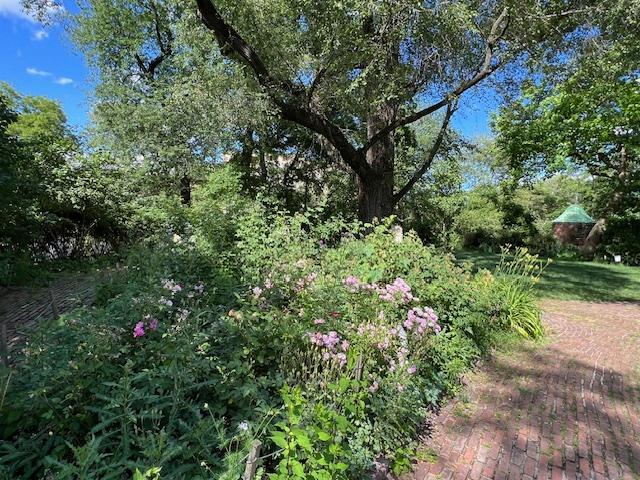
The Tomb of the Amiable Child park and flowers
“There is a small enclosure near your boundary fence within which lie the remains of a favorite child, covered by a marble monument. You will confer a peculiar and interesting favor upon me by allowing me to convey the enclosure to you so that you will consider its part of your own estate, keeping it however always enclosed and sacred.”
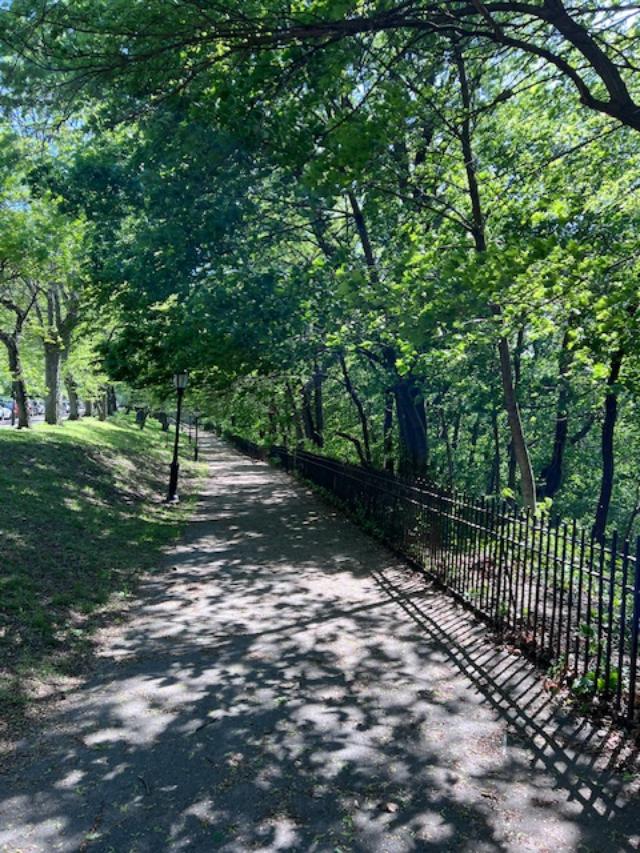
The park in the Spring of 2025
Claremont Hill was the site of the Battle of Harlem Heights, fought during the Revolutionary War on September 16, 1776. By 1806, it had been acquired by Michael Hogan, a former British Consul in Havana, who built Claremont Mansion (for which Claremont Avenue was named). Possible sources for the name are Hogan’s birthplace of County Clare, Ireland and his friend Prince William, Duke of Clarence, who would ascend the English throne as King William IV in 1830. Known as the site of a popular roadside inn by 1860, Claremont was acquired by the City from the heirs of Joel Post in 1873 for the development of Riverside Park.
The Park and the Tomb in the Spring 2025
In the 1890’s, Claremont Inn was host to numerous politicians, socialites and entertainers including the Morgan’s, Vanderbilt’s and Whitney’s, Lillian Russell and Admiral George Dewey. By 1907, the Inn had been transformed into a restaurant, serving the likes of Cole Porter and James J. Walker. It was destroyed by fire in 1950. The playground which now stands on the site was built shortly afterwards.
A century after the Tomb of the Amiable Child was laid, New York’s most famous monumental grave-Grant’s Tomb-was completed. The domed structure across Riverside Drive, designed by architect John Duncan and sculptor John Massey Rhind, was dedicated on April 27, 1897. The later structure is as grand a testimony to the accomplishments of national leader as the monument to the amiable child is a modest and touching tribute to a young boy who never had the opportunity to grow into adulthood. This monument was dedicated on May 3, 1967 (www.nycgovparks.org/parks/riverside-park/mounments/1206).
*You really have to look off the beaten path to see this unique little memorial but it is very touching and soulful. Take the time when visiting the neighborhood to visit this very touching site. You will find it by the path behind Grant’s Tomb.
This quirky little museum is located in the ‘A’ Building on the Fashion Institute of Technology campus and is a little ‘gem’ if there was ever one and I am not just saying that because I am a proud Alumnus of the college (Class of ’93). This museum is dedicated to the world of fashion and has had several revolving shows themed of fashion from the colleges extensive collection. The school really does know how to mount a show.
Please watch this video on the Museum at FIT.
About the Museum at FIT:
The Museum at FIT (MFIT) is the only museum in New York City dedicated solely to the art of fashion. Best known for its innovative and award-winning exhibitions, the museum has a permanent collection of more than 50,000 garments and accessories dating from the eighteenth century to the present, MFIT is a member of the American Alliance of Museums. Its mission is to educate and inspire diverse audiences with innovative exhibitions and programs that advance knowledge of fashion.
For more information about The Museum at FIT, please visit fitnyc.edu/museum.
The museum is part of the Fashion Institute of Technology (FIT), a college of art and design, business and technology. FIT is part of the State University of New York (SUNY) and offers nearly 50 programs leading to AAS, BFA, BS, MA, MFA, and MPS degrees.
I have been to many shows at the museum over the years and the curators do a nice job mounting show from the College’s collection and from items that they borrow from other museums.
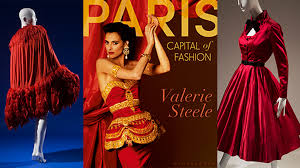
“Paris Refashioned, 1957-1968” examined the combined influence haute couture, ready-to-wear and popular culture, highlighting how changes that took place during this time period helped to shape the fashion industry as we know it today. Exhibitions and books about this era tend to focus on London as the center of innovative, youth-oriented design but this perspective overlooks the significant role that Paris continued to play in the fashion industry.
Like England, France had a large population of young people-more than eleven million of its citizens in 1958 were under 15 years old. This generation came of age during the 1960’s, listening to their own music, watching films featuring their own movie stars and frequenting their own boutiques. Paris’s creative output was singularly dynamic, far-reaching and innovative.
“Paris Refashioned” exhibition
Although the French ready-to-wear revolution did not truly begin until the 1960’s, the concept of lively, youth-oriented design had been set in motion during the previous decade. By the late 1950’s, a few young, talented couturiers-including Pierre Cardin, Hubert de Givenchy and Yves Saint Laurent-had made names for themselves. In 1957, the House of Christian Dior promoted 21 year old Saint Laurent to creative director.
While fashion insiders questioned the decision to place an unknown, seemingly naïve designer at the helm of such a prestigious institution, Saint Laurent’s first solo collection for Dior quickly silenced his detractors. His line of short, swinging A-line dresses-known as “Trapeze” dresses-was a critical and commercial success, ushering in an unmistakable shift toward more relaxed and ultimately, more youthful designers.
Another exhibition that I had seen in the past was “Pink: The History of Punk, Pretty and Powerful Color” running until January 5, 2019 and “Fashion Unraveled”, a guideline to ‘Behind the Seams’, ‘Repurposed Clothes’ and ‘Distressed and Deconstructed’ that ran through November 17, 2018.
The History of Pink video
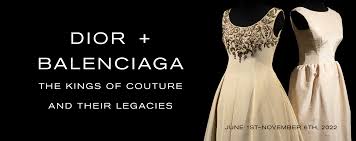
I recently visited the museum for the “Dior + Balenciaga: The Kings of Couture and their Legacies” exhibition and it was an interesting approach to fashion after WWII. Both designers brought back a very feminine and wearable look to women that accented their bodies. What I thought was interesting is that the undergarment was stitched right into the garment and was a way to fit the garment to the woman.
“Dior + Balenciaga: The kings of Couture and their Legacies”
The exhibit showed a comparison of both designers and how they approached items such as dresses, coats and evening wear. Each had a way to form fit a woman. What I thought was interesting is that Dior just designed his garments and never worked on the construction whereas Balenciaga do all the draping of garments himself.
The exhibition continued with the new designers that took up the mantles of the houses when the founders died. It was a different take on the founders ideas but with a more modern twist. I think the classics still were the best and looked more professional on a woman.
Video on “Dior + Balenciaga” exhibition
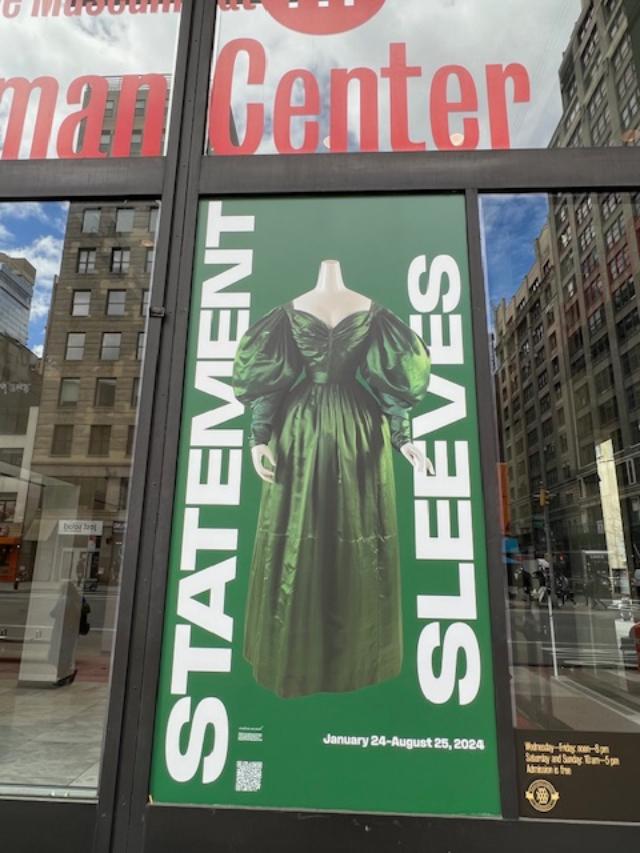
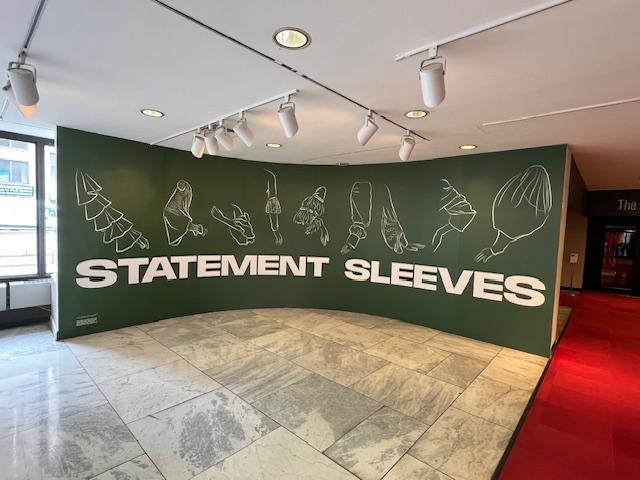
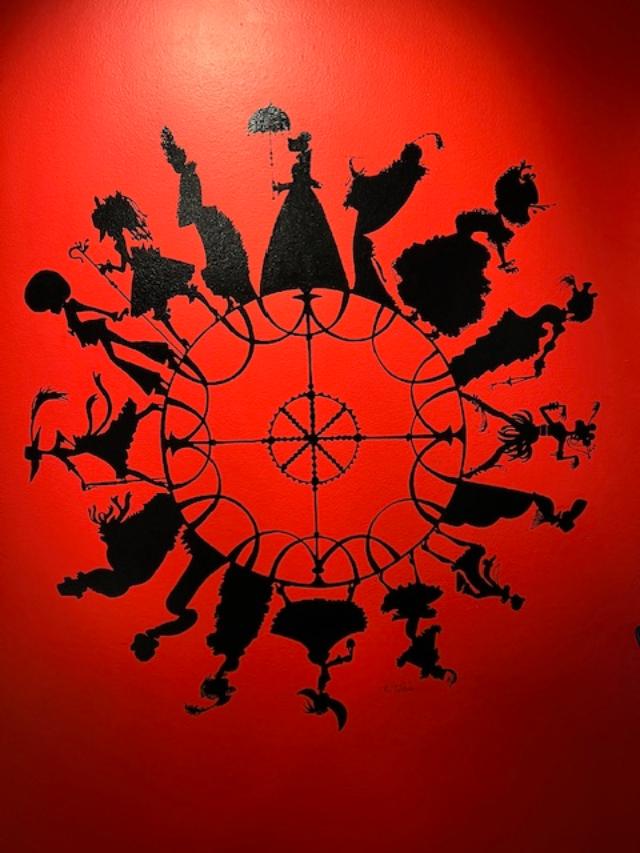
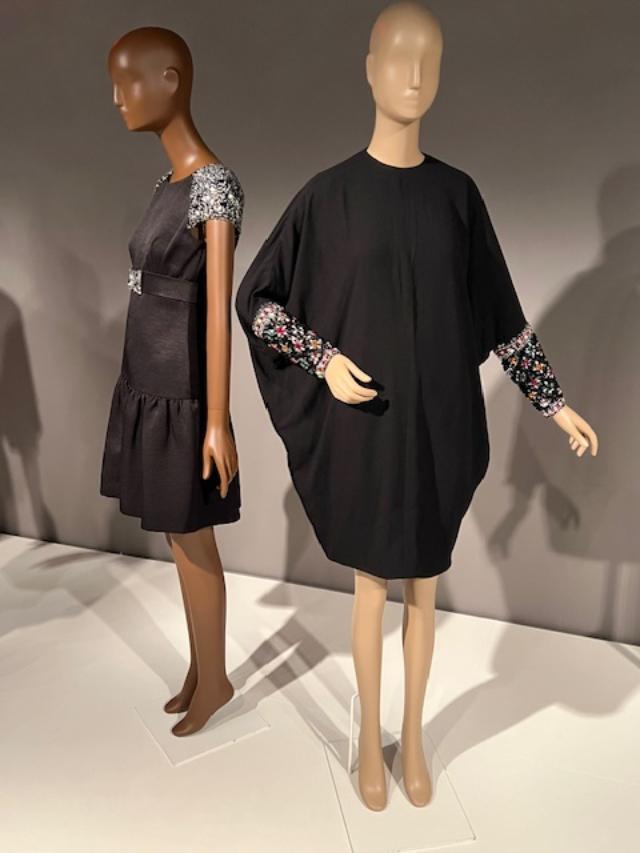
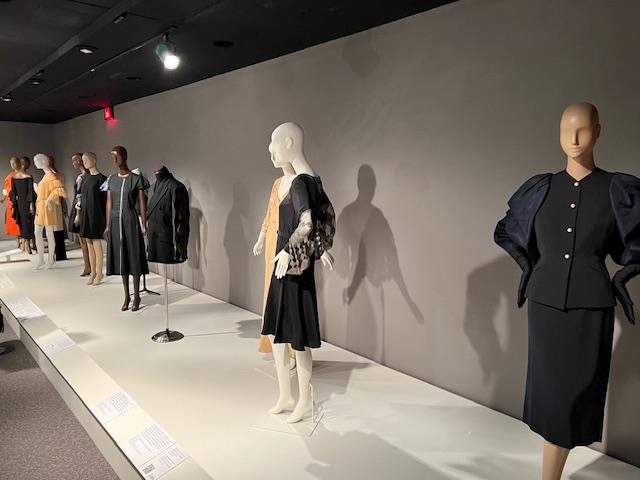
The recent exhibition “Statement Sleeves” is a retrospect on the evolution on the pattern of sleeves in a woman’s dress. These statements of fashion on the sleeve is “a sleeve, style that is exaggerated, embellished, elaborately constructed or otherwise eye-catching to the extent that it defines a garment.” (show description).
“Statement Sleeves” sign
The start of the exhibition.
The front of the gallery.
The diagram on the evolution of sleeves.
The changes in Sleeves design.
The changes in Sleeves design.
The different ways at looking at formal design.
The unique designs from the 1980’s and 1960’s.
The changes of Sleeve designs over the years.
The “Power Suit” of the 1980’s.
The colorful trends in women’s wear over the years with the changes in design of the sleeves.
The exhibition of “Statement Sleeves” runs through August of 2024.
Information and History of the Museum at FIT:
(From the Museum’s website):
For further information about the Fashion Institute of Technology, please visit fitnyc.edu.
Couture Council:
An elite membership group, the Couture Council helps to support the exhibitions and programs of The Museum at FIT. Members receive invitation to exclusive events and private viewings. Annual membership is $1,000 for an individual or couple and $350 for a young associate( under the age of 35).
For more information, write to couturecouncil@fitnyc.edu or call (212) 217-4532.
Tours and donations
Every six months, a changing selection of garments, accessories and textiles from the museum’s permanent collection is put on display in the Fashion and Textile History Gallery, on the museum’s ground floor. Tours of the Fashion and Textile History Gallery and of the Special Exhibition Gallery may be arranged for a sliding fee of approximately $350. Donations of museum quality fashions, accessories and textiles are welcome.
For more information about tours, call (212) 217-4550. For information about donations, call (212) 217-4570.
All MFIT exhibitions and public programs are supported bin part by the couture council of The Museum at FIT.
The shows are continuously changing so please check the website for more detail on the current show. Below is a sampling of one of the shows earlier last year when I visited the museum.
The Morris-Jumel Mansion at 65 Jumel Place in the summer months
I came across the Morris-Jumel Mansion on my walk around Manhattan and noted it on my blog site “MywalkinManhattan.com”. This is the only remaining Colonial residence left on the island of Manhattan and is worth the time to take the tour of the house for its significance in the American Revolutionary War and in it’s later history.
The mansion is now going through a restoration
The Mansion and the historical district and grounds in the background
The historic plaque
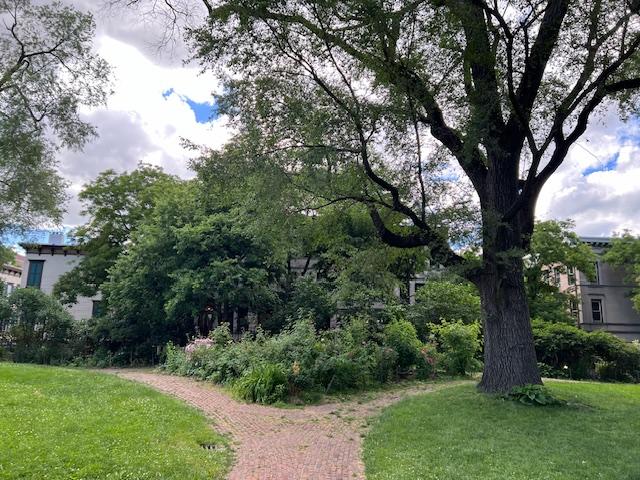
The historic district outside the estate.
When touring the house, you get to see most of the rooms furnished with period furniture and some with the family belongings. The house had other uses over the years and the curators are trying bringing it back to the period of time when Madame Jumel lived there. The tour guides have some interesting stories on the colorful history of the house.
The Gardens in the early Spring months.
The crocuses and daffodils were just coming up
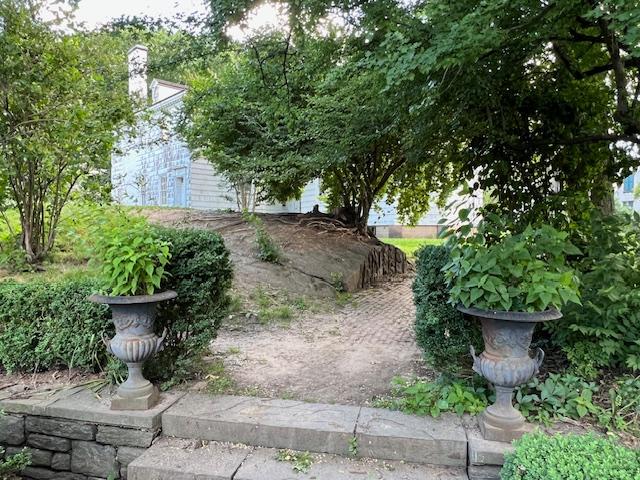
In the summer months, don’t miss the beautiful if somewhat rustic gardens that surround the house. It is very beautiful during the summer months. Check out their website for special events.
The Morris Jumel Gardens by the front gate.
The History of the Morris-Jumel Mansion:
The Morris-Jumel Mansion, Manhattan’s only remaining Colonial era residence is unique in its combination of architectural and historical significance. Built as a summer ‘villa’ in 1765 by the British Colonel Roger Morris and his American wife, Mary Philipse.
It originally commanded extensive views in all directions: of New York harbor and Staten Island to the south; of the Hudson and Harlem Rivers to the west and east and of Westchester county to the north. The estate named “Mount Morris” stretched over 130 acres from the Harlem to Hudson Rivers and the working farm grew fruit trees, and raised cows and sheep.
Colonel Morris was the son of the famous architect Roger Morris, a fact which may explain the extremely innovative features of the Mansion such as the gigantic portico, unprecedented in American architecture and the rear wing which was the first octagon built in the Colonies.
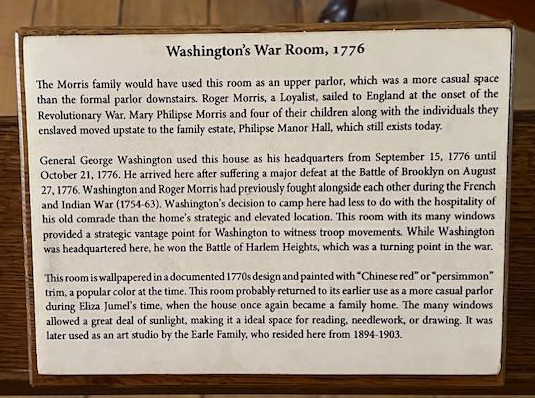
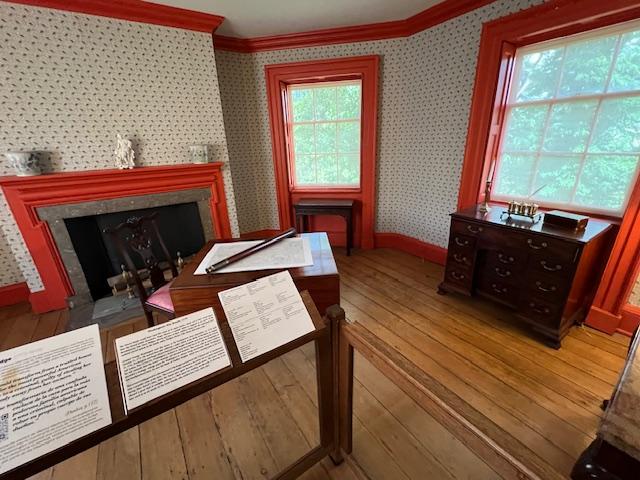
The house’s situation and large size made it ideal as military headquarters during the Revolution and it was occupied successively by Washington, General Henry Clinton and the Hessian General Baron von Knyphausen. As the Morris’s were loyal to Britain during the Revolution, so their property was seized and sold after its conclusion. In 1790, Washington returned for a cabinet dinner at which he entertained Jefferson, Adams, Madison, Hamilton and Colonel Knox among others.
George Washington’s War Room on the second floor of the mansion
The later history of the house centers on the Jumel’s. Stephen Jumel was a wealthy French émigré, who married in 1804, his beautiful and brilliant mistress, Eliza Bowen. They bought the mansion in 1810. In 1815, they sailed to France and offered Napoleon safe passage to New York after Waterloo. Although he eventually declined the offer, they did acquire from his family many important Napoleonic relics-some of which can be seen in the blue bedroom on the second floor.
Favorable tariffs and faster sailing technology made Atlantic trade in raw materials and luxury goods and luxury products highly lucrative. Stephen made his fortune as a merchant. Later as his business floundered, Eliza applied herself to the real estate trade, buying and selling land and renting properties downtown.
Morris-Jumel Mansion Entrance Hall with the portrait of King George’s brother
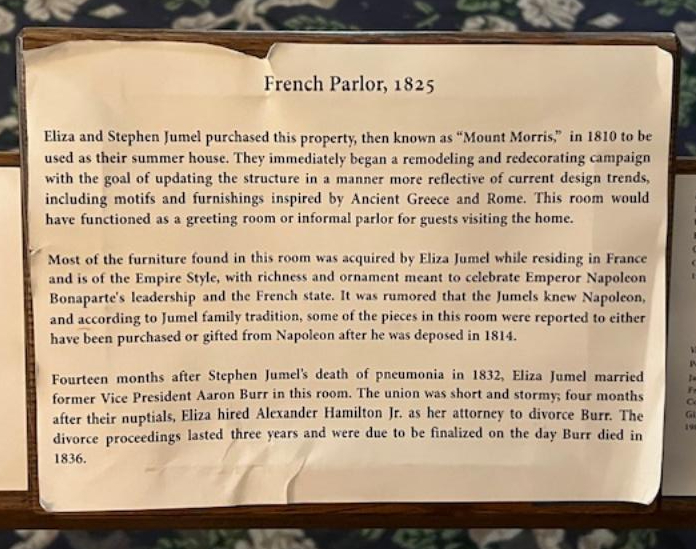
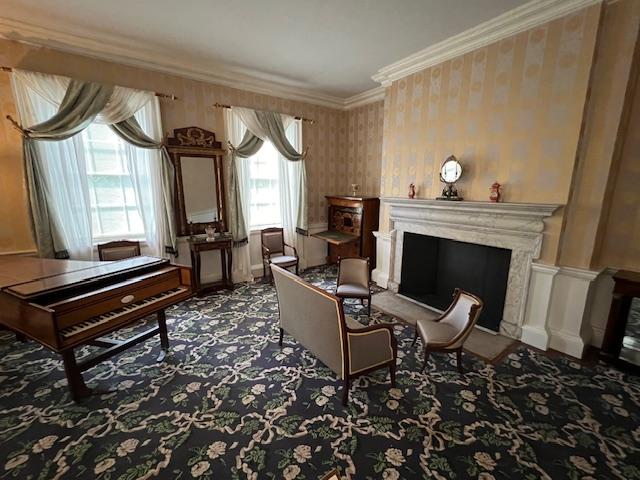
The sign for the French Parlor
The French Parlor
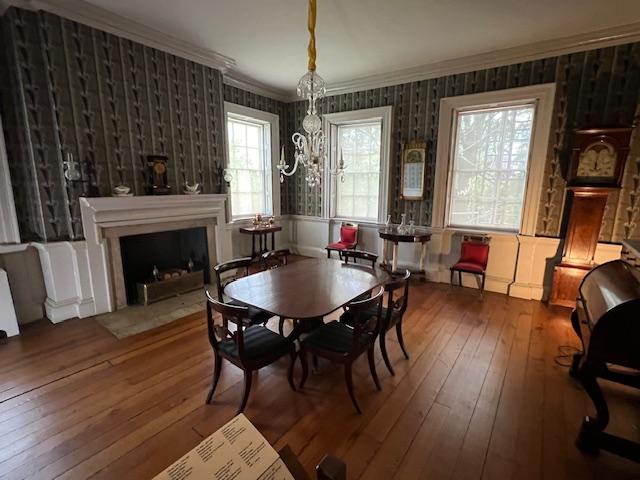
The historic sign for the Dining Room
The formal Dining Room
Her success made large profits for her husband and herself at a time when it was very unusual for a woman to be so active in business. Stephen died in 1832 and Eliza married the ex-Vice-President Aaron Burr in the front parlor one year later.
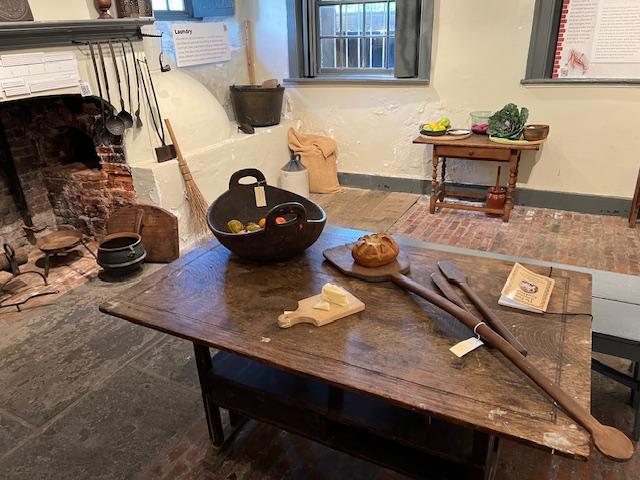
The Kitchen of the Morris Jumel Mansion is in the basement
Eliza filed for divorce in 1833, a lengthy process which was not finalized until 1836 at the time of Burr’s death. Eliza lived in the house until her death at age 90 in 1865, exactly 100 years after the mansion was built. On her death , she was considered one of the wealthiest women in America. In 1904, the city of New York purchased the house and turned it into a museum.
The historic sign for Aaron Burr’s Bedroom
Aaron Burr’s Bedroom on the second floor.
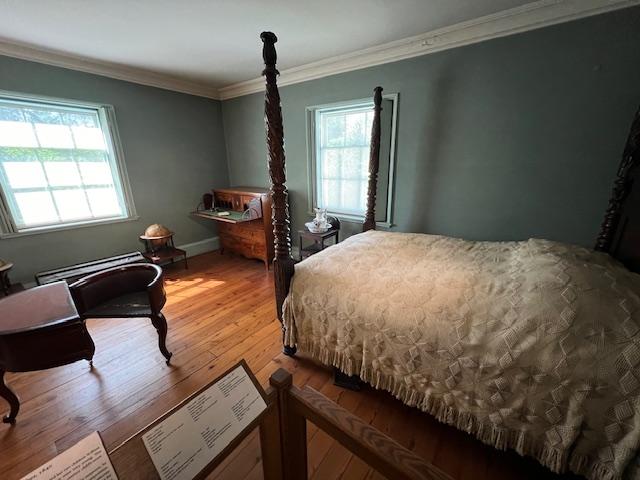
Eliza Jumel’s Bedroom on the second floor
Eliza Jumel’s Bedroom
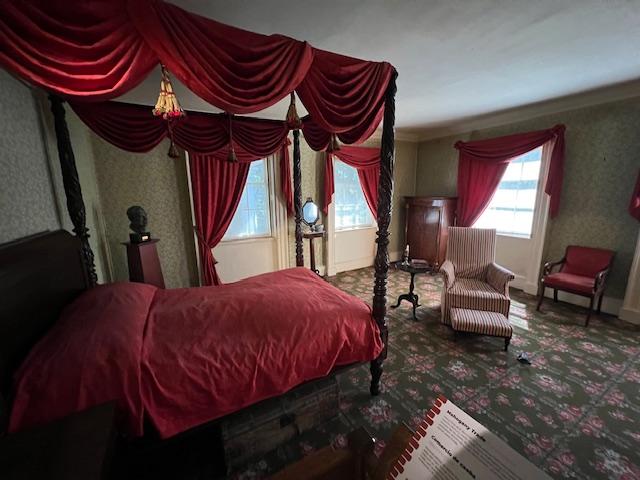
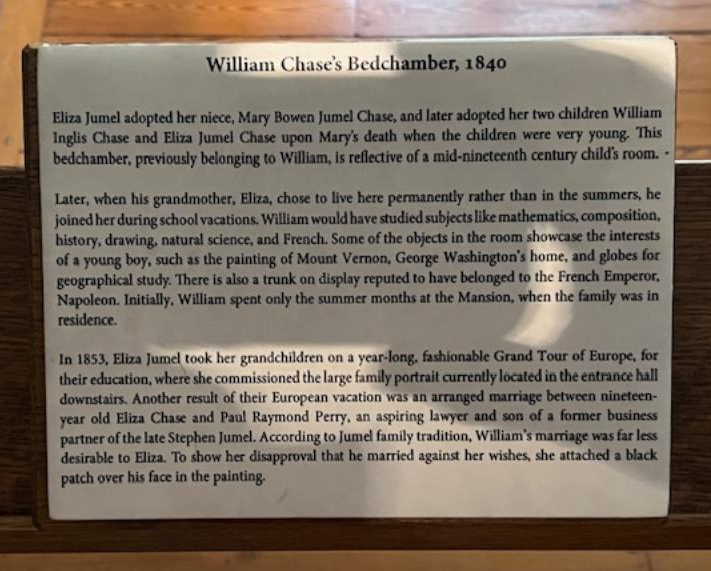
Mrs. Jumel’s grandson’s Bedroom is down the hall from the other bedrooms
William Chase, Mrs. Jumel’s grandson’s Bedroom
The upstairs Hallway and Gallery
Examples of the Mansion’s wallpaper that has been reproduced for the home.
Today, the mansion is the oldest remaining house in Manhattan and is a museum highlighting over 200 years of New York history, art and culture. The neighborhood surrounding the mansion is known as the Jumel Terrace Historic District.
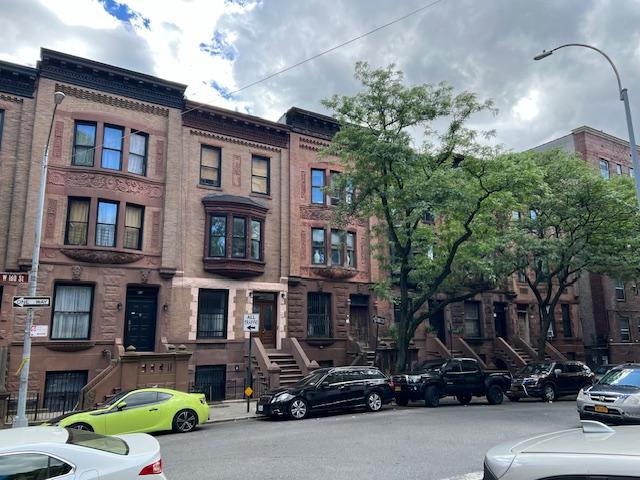
The Morris-Jumel Historic District
The Morris-Jumel Historic District
Faces stare at you from some of the brownstones
The Morris-Jumel Historical District
The hill that Roger Morris once called “Mount Morris” in the 18th century became better known as “Sugar Hill” during the Harlem Renaissance of the 1920’s.
The Gardens were just starting to bloom late Spring in 2024
*The buildings in this district are protected by the New York Landmarks Commission and must be maintained as if they were new, so this is why the area has changed little over time. The Morris-Jumel Mansion is a proud member of the Historic House Trust of New York City and partner of the New York City Department of Parks & Recreation.
The Morris-Jumel Gardens in bloom in the Spring of 2024.
*This information is taken from the Morris-Jumel Mansion press release and pamphlet and from the New York City Parks Department. Please call or email the mansion in case times have changed or events planned.
The Gardens of the Morris-Jumel Estate by the historic district.
The Morris Jumel Community Garden at 455 West 162nd Street
The Morris-Jumel Community Garden is to the north of the estate and is independent of the property. The garden is open for twelve hours a week to the outside community. It is very impressive and the residents do a good job in the planting and care of the gardens.
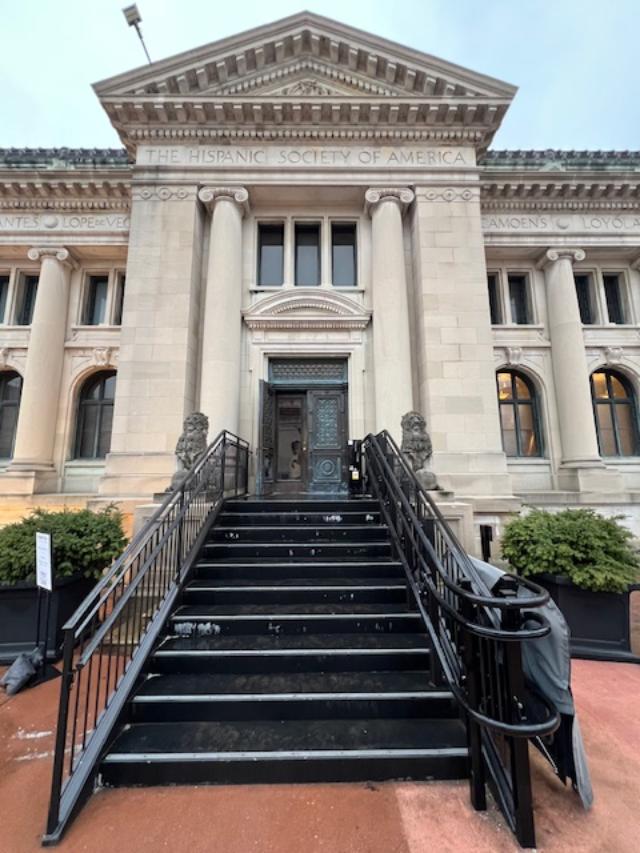
The front of the Hispanic Society of America at 613 West 155th Street
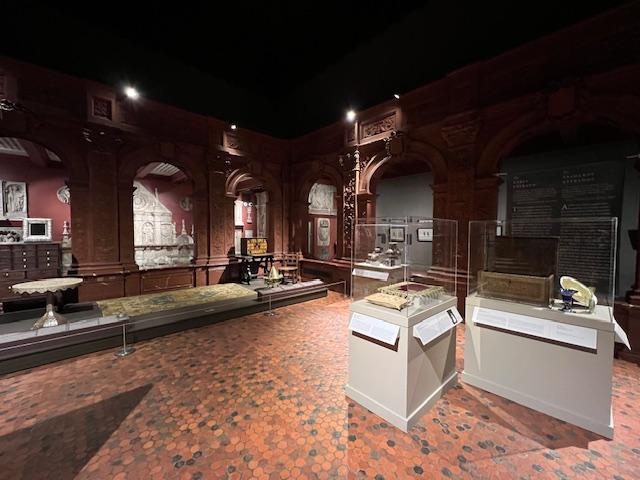
I visited the Hispanic Society of America in 2025 to see the new exhibition “A Room of Her Own”, where I saw where women made their homes their domain. In the exhibition, I saw how women made rooms in their homes their place of business, rest and socialization. They bought and designed these rooms with the most beautiful, tasteful and costly items that they could afford to show their taste and design. It showed how female Hispanic Society carved a place for themselves in a male dominated society. The elaborate objects showed the taste and the creativity of the artists themselves. It was a very unique exhibition.
The exhibition explores the rich history of the estrado—a woman’s private drawing room found in early modern Spain and the Spanish Americas—and illuminates the estrado’s long-overlooked role in female agency, social practices, and intercultural exchange. A Room of Her Own features decorative objects, paintings, textiles, rare books, and engravings from the Hispanic Society’s unrivaled collection, with many works on view for the first time (museum website).
The items from “A Room of Her Own” that would have decorated their homes
This landmark exhibition traces the evolution of the sala de estrado from Islamic al-Andalus to the Americas, where it flourished until the collapse of the Spanish Empire. Described in the Diccionario de Autoridades (Madrid, 1732) as the “set of furniture used to cover and decorate the place or room where the ladies sit to receive visitors,” the estrado was a room or designated area where women engaged in elaborate social practices and displayed their collections of valuable objects from the Americas, Asia, and Europe (Museum website).
Some of the beautiful decorative items from the exhibition
The well-appointed estrado has long been a focal point of opulence and intrigue in traveler accounts, inventories, legal records and works of fiction. Designed for upper-class interiors and inhabited by elite women of European, Indigenous American and West African descent, the estrado paradoxically becomes a locus of female agency and subversion within a place of confinement. The exhibition engages a comprehensive array of archival sources and objects to question the values historically imposed on gender stereotypes and behaviors and highlights the estrado’s importance as a symbol of power, wealth, and virtue (Museum website).
The history of the Museum:
(From the Museum website)
The Hispanic Society of America was founded as a free museum and research library in 1904 by the American Scholar and philanthropist Archer Milton Huntington (1870-1955). Over the past century, the Hispanic Society has promoted the study of the rich artistic and cultural traditions of Spain and Portugal and their areas of influence in the Americas and throughout the world. The Museum and Library constitute the most extensive collection of Hispanic art and literature outside of Spain and Latin America.
The main gallery of the Hispanic Society of America
Archer Huntington’s fascination with Spanish culture started at the age of twelve; by fourteen he had begun to study the Spanish language and by nineteen he revealed his aspiration to found a “Spanish Museum”. As Huntington’s enthusiasm grew he became increasingly committed to the creation of an institution that would encompass all facets of Hispanic culture. Working toward this goal, Huntington began his collection with Spanish rare books and manuscripts; then decorative arts; followed by paintings and sculpture-all of which now fill the galleries of The Hispanic Society of America.
The Catholic symbols and artifacts and artwork of the Hispanic Society of America
Today the Hispanic Society Museum and Library builds upon the legacy of Huntington through an active acquisitions program as well as public programs that reach out to new audiences through collaborative exhibitions, educations, and publications.
Portrait of the Dutchess of Alba by Goya
The Hispanic Society is especially rich in paintings, drawings and prints by Francisco de Goya (1746-1828), one of the most inventive artists of his time. Goya’s iconic 1797 Portrait of the Duchess of Alba dressed in black as a Spanish maja, is the most renowned painting in the collection.
Paintings:
(from the Museum website)
The Museum offers a panoramic survey of Spanish painting and drawing dating from the Middle Ages up to the early 20th century with particular strengths in the Golden Age (1550-1700) and the 19th century. Notable among 16th century paintings are the Portrait of the Duke of Alba by Antonis Mor (1516/19-1576) and the Holy Family by El Greco (Domenikos Theotokopoulos, 1541-1614).
Three portraits by Spain’s preeminent master, Diego Vaelazquez (1599-1660), represent the heights of Spanish painting in the 17th century: Gaspar de Guzman, Conde-Duque de Olivares; Portrait of a Little Girl and Camillo Astalli, Cardinal Pamphili. The collection also includes works by other acknowledged masters of the period, such as Jusepe de Ribera (1591-1652), Francisco de Zurbaran (1598-1664) and Bartolome Esteban Murillo (1617-1682).
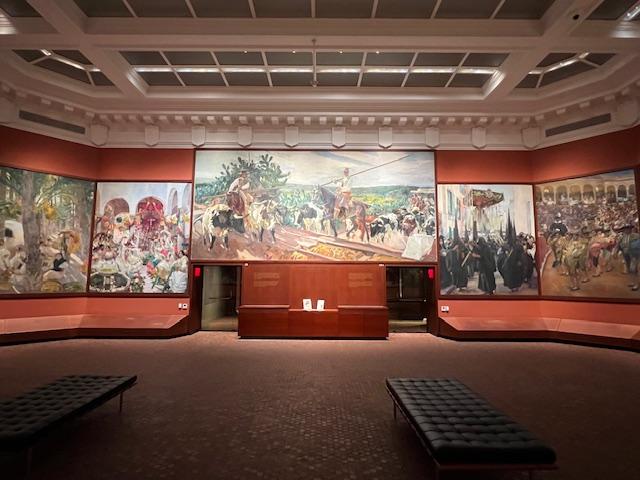
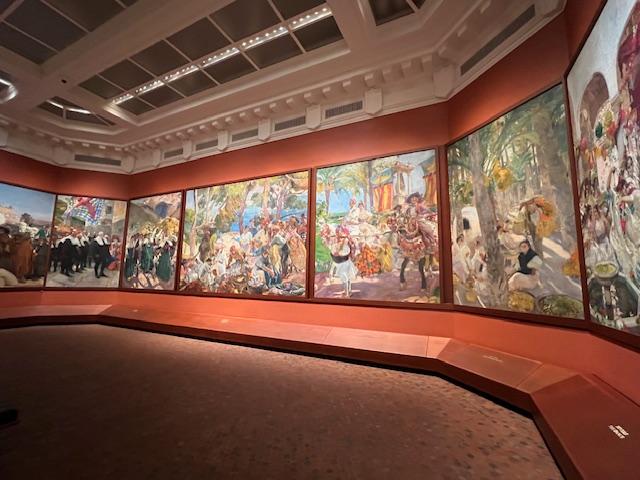
The gallery of Joaquin Sorolla y Bastida’s “Vision of Spain”
“The Vision of Spain” gallery painting
The “Vision of Spain” painting
The sign explaining the artwork
The “Festival of Bread” painting as part of the display
Among the most popular works at the Hispanic Society are those by Spain’s “painter of light” Joaquin Sorolla y Bastida (1863-1919), present a celebration of regional costumes and cultures that surround the visitor with the artist’s “vision of Spain”. The Museum also possesses an outstanding selection of works by late 19th and early 20th century artists.
The painting a “Day in Seville” as part of the display
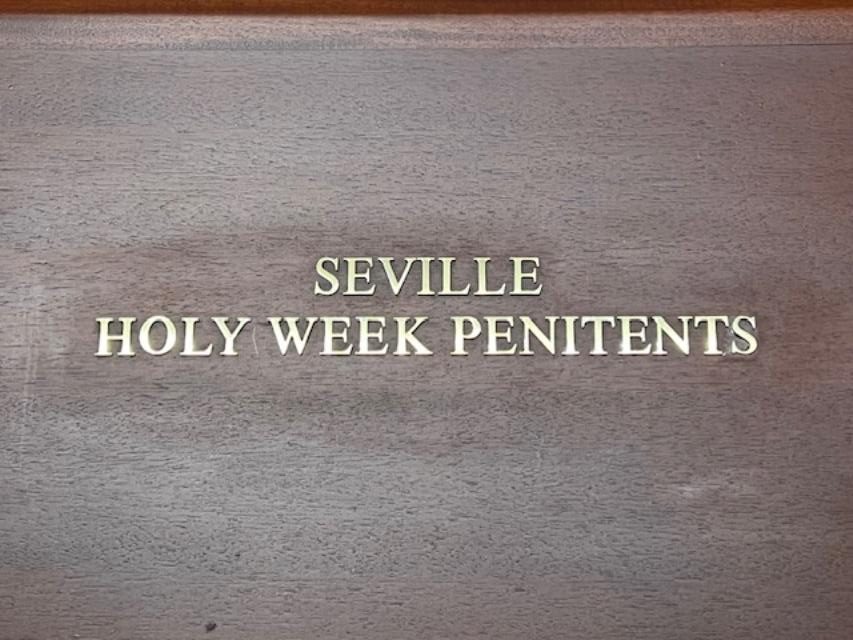
The “Holy Week Penitents” in the display
The sign for “Holy Week Penitents”, people who admit to their sins and wrongdoings
Decorative Arts:
(from the Museum website)
The Hispanic Society is renowned for its decorative arts from Spain, Portugal, Latin America, the Philippines and Portuguese India. Ceramics represent one of the most significant facets of the collection, ranging from three-thousand-year old Bell-Beaker pottery to contemporary works. The collection of Spanish lusterware, numbering over 150 pieces, is considered the finest in the United States. This distinctly Spanish style of ceramics flourished between the 15th and 17th centuries as artisans combined Islamic and Western traditions to produce objects of incomparable beauty. Important examples of decorative and utilitarian earthenware and soft-paste porcelain from various workshops complete the collection-including works from Talavera de la Reina, Alcora and Buen Retiro in Spain and Puebla de lost Angeles and Tonala in Mexico.
The decorative items in the collection
Other decorative arts include silver, glassware, secular and ecclesiastical furniture, decorative ironwork and textiles dating from between the 15th and 19thy centuries. The processional custodia by Cristobal Beceril (1533-1585) is one of the highlights of the magnificent collection of Spanish and Latin American gold and silver ars sacra and jewelry. Textiles in the collection range from luxurious silks of medieval Islamic Spain to domestic needlework of the early 20th century. Hispano-Muslim textiles include fine gold, silk, and satin brocades from the 13th through the 15th century. An exquisite ‘Alhambra silk” (ca. 1400) from Granada recalls the repeating geometrical pattern and Kufic inscriptions which decorate the famous Alhambra palace.
Archaeology:
(from the Museum website)
Huntington’s fascination with the ancient past of the Hispanic world led him to sponsor significant archaeological expeditions and excavations in Spain and the Americas. He conducted excavations in 1898 near Seville at the site of the Roman City of Italica, birthplace of the emperors Hadrian and Trajan. Through these excavations and subsequent acquisitions, the Hispanic Society has been able to assemble the most important collection of Spanish antiquities outside Spain. This wealth of objects from Spain’s Bronze Age to the period of Roman rule features works from Ibero-Phoenician, Greek and Celtiberian cultures in addition to the extensive collection of Roman ceramics, glass, metalwork, mosaics and statuary.
Sculpture:
(from the Museum website)
In addition to Ancient and Classical sculpture, the Hispanic Society collection contains extraordinary Islamic and Christian works dating from the Middle Ages to the early 20th century. A cylindrical ivory box signed by the Islamic master Khalaf (ca. 966) at the Umayyad court at Madinat al-Zahra stands out for the beauty of its intricate carving. Supreme examples of the heights which Spanish sculpture reached in the 16th century are found in the Gothic and Renaissance tombs of the Bishop of Palencia and the Duchess of Albuquerque from the monastery of San Francisco de Cuellar, along with the two magnificent effigies of Suero de Quinones and Elvria de Zuniga by Leone and Pompeo Leoni.
The Hispanic Society of America has some interesting pieces of art
Pedro de Mena’s haunting representation of the young Saint Acisclus, patron saint of Cordoba, stands out as one of the finest examples of 17th century Spanish polychrome sculpture of her era, are rich in exquisite detail. An impressive ensemble of monumental sculpture also graces Audubon Terrace with the iconic equestrian statute of El Cid and limestone reliefs of Don Quixote and Boabdil, all by noted American sculptor, Anna Hyatt Huntington (1876-1973).
Library:
(from the Museum website)
With more than 600,000 books, manuscripts, documents and letters dating from the 10th century to the present day, the Library of the Hispanic Society offers unparalleled resources for researchers interested in the history and culture of the Spanish and Portuguese speaking worlds. The manuscripts and rare books section comprises over 15,000 books printed before 1701 including some 250 incunabula (books printed before 1500) as well as first editions of the most significant literary works in the Spanish language such as Tirant lo Blanc, Celestina and Don Quixote.
The collection of Hispanic manuscripts, extraordinary rich in material and scope is the most extensive outside Spain. It encompasses medieval charters, holograph royal letters, sailing charts, illuminated bibles and books of hours as well as historical and literary manuscripts from the 10th to the 20th century.
The library’s invaluable holdings from the America’s include some of the earliest books printed in Mexico, Peru, Guatemala and Puerto Rico. First editions of works by many of Latin America’s greatest writers, such as Sor Juana Ines de la Cruz, form an integral part of the collection. The library also conserves one of the largest and most important collections in the United States of historical manuscripts and documents pertaining to Latin America and the Philippines from the 16th through 19th century.
Prints & Photographs:
(from the Museum website)
Over 15,000 prints afford a unique glimpse of the graphic arts in Spain. The collection contains incomparable engravings by 17th-century artists such as Ribera, yet its greatest strengths are in the 18th and 19th centuries including almost all of Goya’s prints, many in multiple editions. The department also has an extraordinary assemblage of illustrations of Don Quixote, totaling more than 4000 engravings, etchings and lithographs.
The section of photographs holds over 176,000 black and white images documenting life and customs in the Hispanic world. Many of these images now preserve a way of life irrevocably lost. Among the most notable and rarest are those from the 19th century but the department also features more than 15,000 photographs made by Hispanic Society curators and staff who traveled throughout Spain and Latin America in the 1920’s.
Publications, Group Visits & Education:
(from the museum website)
For over a century, the Hispanic Society has maintained an active publication program. Books and other publications relating to the collections as well as postcards, note cards and posters are available from the Museum bookstore.
The Hispanic Society is dedicated to educational programs for students of all ages. The education department provides gallery talks, group tours and activities and materials for educators.
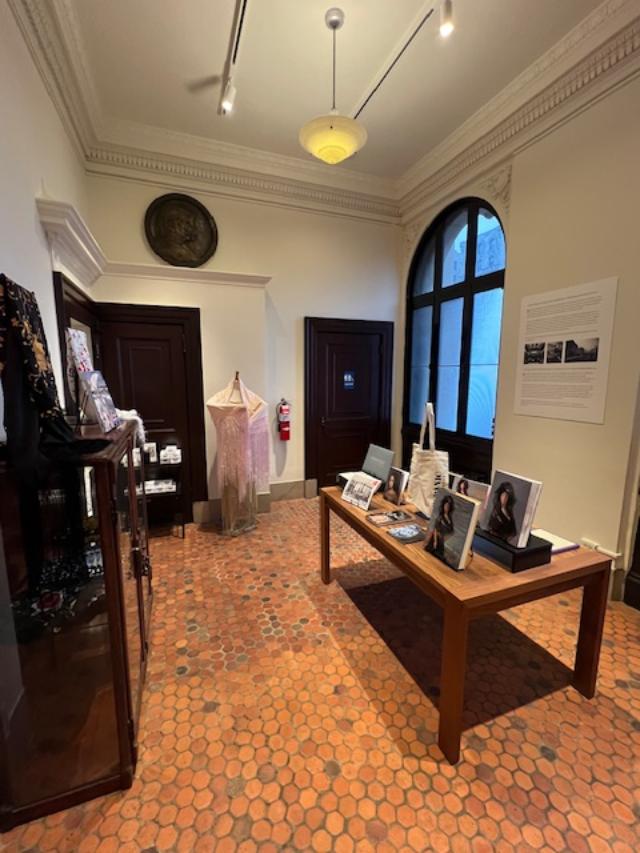
The Hispanic Society gift shop
For further information on current programs, group tours, special events and on becoming a member of The Friends of the Hispanic Society visit our website, hispanicsociety.org or call (212) 926-2234.
(This information is taken from the Hispanic Society of America’ brochure)









































 Visiting a Museum: The Unique, Unusual, Obscure and Historical