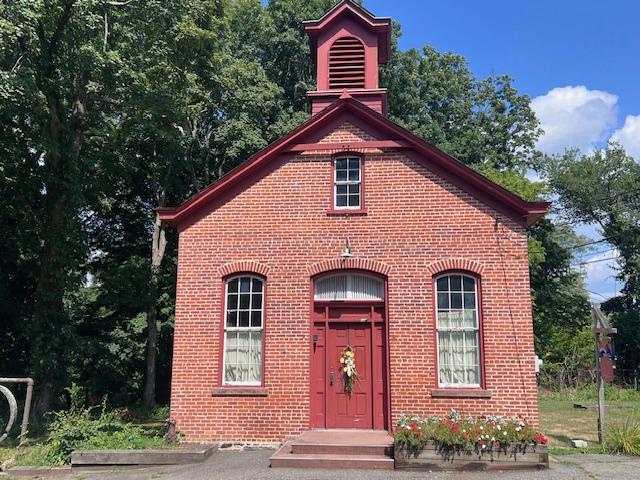
The front of the Sam Azeez Museum of Woodbine Heritage
The entrance sign that welcomes you
The History of the Sam Azzez Woodbine Museum:
(from the museum’s website):
The Sam Azeez Museum of Woodbine Heritage is an independent non-profit charitable organization preserving the unique history of Woodbine, NJ.
Established in the 1890’s through Baron de Hirsch’s philanthropy, Woodbine began as an agricultural colony for Russian Jewish immigrants seeking freedom denied in their homeland. As poor soil conditions limited farming, Woodbine evolved into Cape May County’s manufacturing center while maintaining founding values of education, religion and inclusion.
The museum occupies the historic Woodbine Brotherhood Synagogue, listed on the Natural Register of Historic Places. The restored sanctuary hosts special services, while the Brotherhood Hall houses exhibitions including the community-contributed Collective Memory Wall.
The historical significance of of the Town of Woodbine
The entrance to the museum
The museum is another interesting look at New Jersey history and the development of the immigrant story of assimilation into American society.
I was given a personal tour by the Assistant Curator and she explained the resettlement of Russian Jewish immigrants by a wealthy patron into this South Jersey community.
The main gallery of the museum
The panels tell the story of how these community came into being and how these people built a community through agricultural and eventually manufacturing and small businesses that supported the community around it. It established a town that was self sustaining and grew to the community center.
The panels show the growth of Woodbine as a community
The residents established their own sports teams, community organizations and civic groups like the councils and fire and police departments.
The records of the many town organizations of Woodbine
Display of one of the first families to settle in Woodbine
Display of the religious faith of the community
One of the most touching displays is of survivors of the concentration camps during the holocaust. These pictures represent these women as children and them today.
The display of the women who survived the camps
The history of the community and the growth of diverse businesses in Woodbine
Creating and building the Synagogue in the community
On the second floor of the building is the old synagogue of the community which is only used during the high holidays. This is used by descendants of the community and family members of theirs.
The inside of the synagogue on the second floor of the building
The front of the temple
The chandelier is original to the temple
The space was being prepared for the Jewish New Year and the crowd of people who would be attending.
The Memorial Wall
The traditions of the religion being practiced in the community
The self-government of the community
Still the younger generation was all American and wanted to assimilate into society with an all American past time of things like baseball.
The Woodbine youth baseball team
The uniform of the old baseball team for youths in the town
The last display is of the famous alumni who once lived in the community. These are the men and women who once lived here and went on after all odds to do great things and make our country better.
The Hall of Fame
The museum I thought had a bit of an identity crisis as I really did not know what the museum was about.
I was pleasantly surprised to find an interesting part of New Jersey history I had never known. It just goes to show you how a museum can educate you with just one visit. The Assistant curator said there will be more to come in the future.
The Van Allen House in 2023 during the next History Coalition
I visited the Van Allen House on my first trip on the Northwest Bergen History Coalition 6th Annual History Day tour of Upper Bergen County in 2016 and in 2019. It is mentioned on ‘Day Forty-Three’ of my blog, ‘MywalkinManhattan.com’. It had been my last stop of the day. The historic home is currently closed due to renovations on the house and will open in the Fall of 2019.
The Van Allen House during the renovation in 2023 with the added dormers
Of all my stops that day, I found that the Van Allen House was in need of a renovation. From the outside, it is very quaint. On the inside, the house needed a lot of fixing up and restoration work. The upstairs had water marks all over the ceilings. The gardens also needed some serious weeding and planting. IN 2023, the renovations of the upstairs had been completed and the home was replastered and painted. Most of the artifacts were stored in a few rooms that were being finished.
The kitchen is as you enter the home
During the renovation, a lot of the artifacts were being stored in the addition to the house that took place in the early 1800’s. Many of the things that had been donated were showcased in this room off the kitchen and shows the wide variety of the society’s collection. There were all sorts of items from the home, decorative pieces and a variety of things that would have been used at the house as it being a working farm. There were also many Native American artifacts.
Some of the artifacts in the downstairs room
Artifacts in the room downstairs
Household items donated to the society
More household items of the Van Allen House
More artifacts of the Van Allen House Collection
The vast array of items in the downstairs addition of the house will be used all over the house once the renovation is completed sometime in the next two years. There was still a lot to do around the house. There had been so much damage to the house over the years that it needed a major renovation.
The upstairs had been finished with the addition of the domers which a few of the society members had said that these were not part of the original house. They can debate about it but the house looks really nice with them and makes the house look realistic. Still from what the people said that they were not part of the original design.
You could see the vast improvement in the house over the last three years and the extent of the work that had been done already. All the outstairs rooms had been plastered and painted. The rooms looked very modern,
The upstairs has been nicely restored
The upstairs rooms now house many of the home furnishings of the collection along with clothes and personal items of families that have donated them over the years. The upstairs is just finishing the renovation so things will have to be organized in the future but at least you can see the things that the Historical Society has in the collection.
Household items in the collection upstairs
Clothing and bedding items at the Van Allen House
The smaller bedroom of the Van Allen House
One of the best things of the house is its gift shop. It has some of the most unusual handmade gifts that it was worth the trip out to the house. One of the members makes handmade cloth dolls for $5.00 that are just quaint and make a beautiful gift.
The Oakland Historical Society, who operates the house, was putting a lot of time and effort in the renovations of the house and their volunteers I was told would be working on the gardens. Either way, it is an interesting house to visit and it is steeped in history.
The upstairs beams leading to the bedrooms
The toy collection at the top of the stairs
The History of the Van Allen House:
The Van Allen House was built around 1740 as the home of farmer Hendrik Van Allen. During the Revolutionary War, it served as the headquarters for George Washington on July 14, 1777. At the time, he moving his troops from Morristown, NJ to New York (Wiki).
In 1778 and 1779, Bergen County used the house as a court. Edward Day Page, a dairy farmer, businessman and Oakland’s second mayor, owned the house as well as the northern fourth of Oakland in the late nineteenth and early twentieth century (Wiki).
Household items at the Van Allen House
It was saved from demolition by the Oakland Historical Society with aid from the Woman’s Club of Oakland. It is now maintained as a museum displaying colonial Dutch life. The house was added to the National Register of Historic Places on July 24, 1973. There were several branches of the family in the Paterson, Passaic and Bergen Counties in New Jersey (Wiki).
Items in the family collection
The Oakland Historical Society:
The mission of the Oakland Historical Society (Oakland, NJ) is to bring to life and help maintain the history of the Borough of Oakland by activating and preserving especially the Van Allen House site, with the Vygeberg Farm Office Building and by keeping a museum there showing living displays and memories of Oakland’s past. We support living displays and memories of Oakland’s past. We support the Borough’s efforts to continue and complete the renovations of both buildings with the help of the Bergen County Office of Historic Preservation (OHS).
The Children’s bedroom at the Van Allen House
During the year we offer opportunities from people to visit the Van Allen House and experience local life as it was in the 18th and 19th Centuries on a farm settlement in northern New Jersey. The Lenni-Lenape Indians are known to have used the path which followed the Ramapo River Valley north and south and has now become an interstate roadway, Route 202, which goes from Maine south into Maryland and beyond. Copies of letters George Washington wrote at the House are available there during open-houses, usually the 3rd or 4th Sunday afternoon many months during the year. Please check our events page to see when the house will be open (OHS).
The Van Allen House on that gloomy Saturday morning
The site also has a building from 1902, built by Edward Page, one of the industrialists who settled along Route 202 to develop agricultural for the growing cities of Northern New Jersey, such as Paterson or Newark (OHS).
The Van Allen House Marker
The house was really interesting to visit during the Northwest Bergen Historical Coalition. The docents were really nice and they gave some interesting insights about the family and the house itself.
The Christmas holiday eventcelebrating Sinterklaas and the Dutch Christmas:
The outside of the house decorated for Christmas
The front door wreath
The wreath
In December of 2025, I visited the historical site for the Sinterklaas celebration for the Christmas season. It was a nice festival with making in the hearth and gingerbread man decorating for the kids. These were delicious.
Baking in the hearth
Decorating gingerbreadmen
Indulging in freshly baked gingerbreamen
There was a woman playing Christmas songs on the harpsichord to the group of patrons in the main room of the house and an old fashioned Christmas tree decorated for the holidays.
The colonial woman playing the harpsichord
The performance
Sinterklaas, the Dutch version of Santa Claus was on hand to talk to the children and give out well wishes to everyone.
Sinterklaas talking to the guests
The jolly man greeting all of us
The house both inside and out was decorated for the Christmas holidays and had that early colonial look about it. Back then things were not as elaborate as the Victorian era and were simple pines, green and berries.
The simple table tree
The pines and greens decorating the mantle
The wonderful artifacts that are part of the collection
In the gift shop area there were very reasonably priced handmade dolls and ornaments made by one of the members. These one of a kind pieces are a perfect gift for the holidays. These are a very special gift for a lucky child.
The handmade items in the gift shop area
The grounds of the house and outside doors were decorated with wreaths and greens as well.
The wreath outside the Dutch doors
It was a nice event and the perfect way to start the holiday season. These Oakland Historical Society did a nice job with popular family event. It was a nice way to start the holiday season. The house was beautifully decorated for the season and the Society was planning all sorts of events for the Spring.