Tag: NYC Historical Sites

Van Cortlandt House Museum in Van Cortlandt Park at Broadway & West 246 Street                                              Bronx, NY 10471

Van Cortlandt House Museum in Van Cortlandt Park at Broadway & West 246 Street Bronx, NY 10471

Van Cortlandt House Museum

Van Cortlandt Park at Broadway & West 246 Street

Bronx, NY  10471

(718) 543-3344

infor@vchm.org

Open: Tuesday-Friday 10:00am-4:00pm/Saturday & Sunday 11:00am-4:00pm

Admission: $5.00 for Adults/$3.00 for Seniors & Students/Children under 12 are free/General Admission is free on Wednesdays. Guided and group tours are available.

Review on TripAdvisor:

https://www.tripadvisor.com/Attraction_Review-g47369-d103501-Reviews-Van_Cortlandt_House-Bronx_New_York.html?m=19905

The Van Cortlandt House:

Welcome:

Van Cortlandt House during Christmas time

The entrance of the Van Cortlandt House decorated for the Revolutionary era Christmas

I visited the Van Cortlandt House Museum for the their Annual Christmas Decorated House event. The mansion was decorated for Christmas in the 1700’s so it was not overdone as it would during the Victorian times. The front of the house entrance was done with sprays of holly, mistletoe above the door and garlands of pine around the banister and fireplaces. The windows had candles in them and the dining room was set for Christmas luncheon in post-Revolutionary War era.

Van Cortlandt House VI.jpg

Van Cortlandt House for Christmas is Post-Revolutionary War in 2019

The entrance hall welcomes you to a Revolutionary era holiday season

While most of the house is represented during the Dutch era with floors with no rugs, vintage furniture and decorations and the second and third floors are set for family entertainment. The first floor is set for entertaining for the holidays with the formal dining room, family parlor and the formal living room for games and dancing. The formal dining room was the only room decorated post-Revolutionary War era.
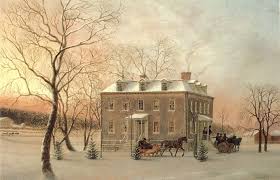
van cortlandt mansion xmas ii

Van Cortlandt Mansion at Christmas 1800’s

The current entrance to the house from the back of the building

Until the Victorian era, Christmas was a more religious affair with church service in the morning and luncheon in the afternoon. Things were formal and less elaborate. The acts of gift giving, sleigh rides, tree decorating and card giving came during the affluence of Queen Victoria’s reign in the post Civil-War era. This is the reason why the house is decorated so simply and elegantly.

Dining Room set for Christmas lunch circa 1780’s

In 2019, the site celebrated the holidays with a Sinterklaas, a Dutch Christmas celebration, a candlelight tour and a reading from Santa Claus. Please check their website for more information on future events. The house was closed for most of the COVID years and nothing had been planned. The house was open in December of 2022 for touring again for the holidays but was not decorated as much as in the past.

In 2022, when the house reopened after a long period of COVID, the self-guided tours were back and you could tour the house at your own pace ($5.00 donation) and tour the three floors of furnished rooms. You can see how the family lived from the three generations that lived in the residence.

The tour starts at the front hallway where guests would be received for formal affairs and for business meetings with the head of the household.

You would be greeted by servants at the entrance of the home

On either side of the front hallway is the East and West Parlors where you would be directed where the family would receive you. The West Parlor would have been used for business calls and more informal meetings when meeting with the Van Cortlandt family. The family’s wealth would be on display with fine furniture, china and bric-a-brac that would show off the family’s merchant roots and business.

The West Parlor
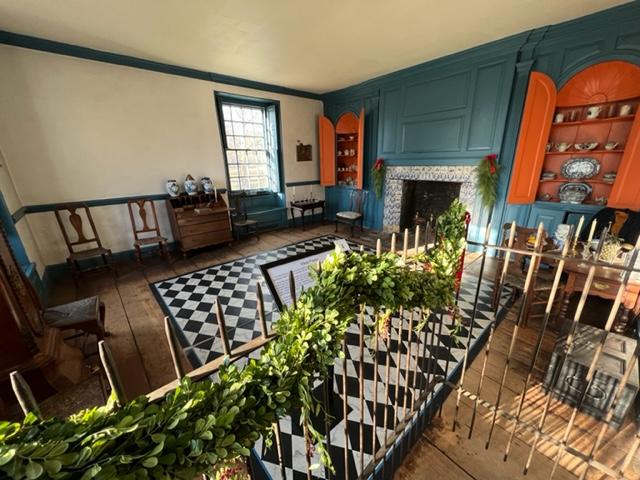
The West Parlor decorated for Christmas

The East Parlor on the other side of the entranceway would have been used for more formal affairs. The East Parlor is where the family would formally entertain guests with dancing, music and card playing. This is where long evenings of entertaining would take place and the family would enjoy their holiday celebrations.

The East Parlor
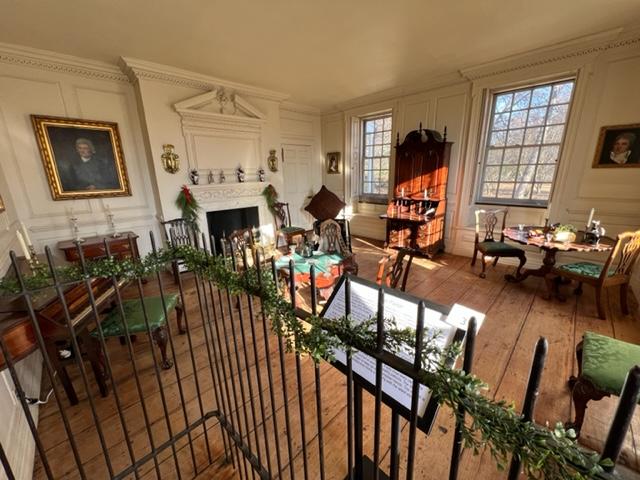
The East Parlor decorated for the Christmas holidays

The Dining Room was toward the back of the hallway and was decorated in the Empire Design of the late 1700’s to early 1800’s. The look is very similar to styles used today and the wallpaper is a copy from one of the styles used by the family that was imported in from France. The table was set for Christmas luncheon circa the late 1780’s.

The Dining Room

The Dining Room at the Van Cortlandt House

There are two sets of stairs to the second level of the house where the family bedrooms were located. There was the formal stairs and then there was the stairs that the servants used to go from floor to floor so that they would not be seen.
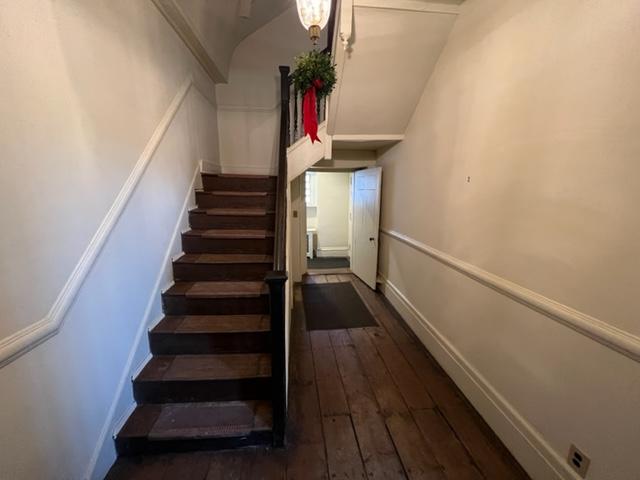
The steps upstairs to the second floor

On the second floor of the home are the bed chambers of the family. The main bedrooms for the family were located here and then the nursery and servants quarters were located on the Third floor of the home.

The West Chamber:
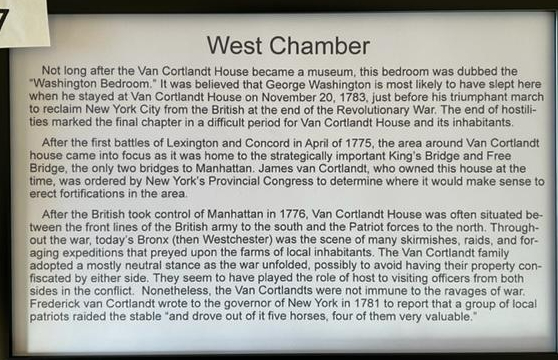
The bedroom

The ‘Washington Bedroom’ in the Van Cortlandt House

The East Chamber Bedroom:

The Bedroom:

The Landing of the stairs to the third floor lead to the Nursery, an additional guest room and the enslaved servants quarters. These were kept out of site from the other members of the household. It is a reminder of the pecking order of the household and the conditions that people lived under at this time.
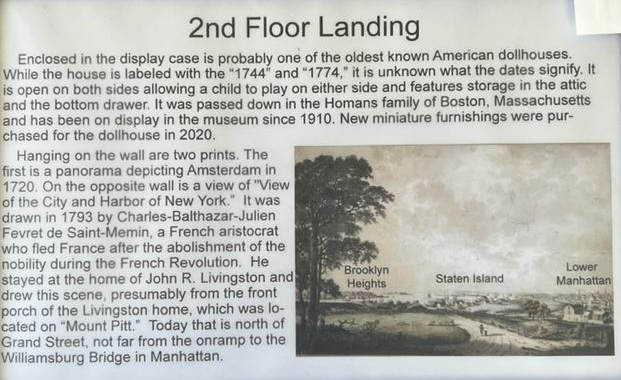
The Second Floor Landing leads to the nursery and servants quarters

The Dutch Chamber was formerly a guest room that is used to show life in early Colonial New York City:

The Dutch Chamber:

The Dutch Chamber shows early life in Colonial America

The Second Floor Setup:

The Nursery:
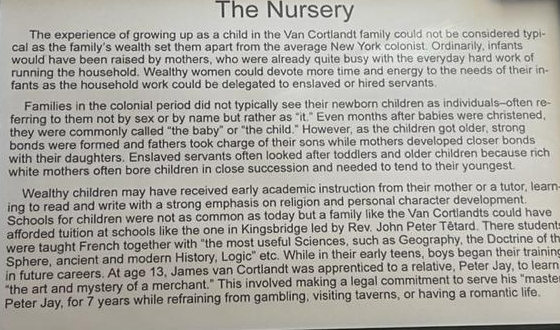
The nursery set up room:

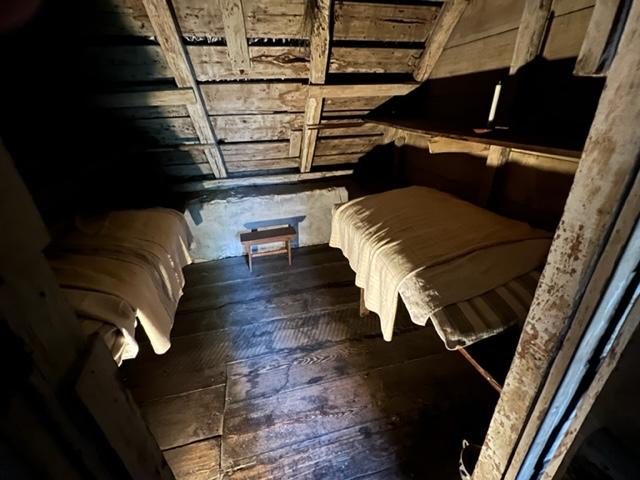
The servants quarters were to the back of the house and were not the most glamorous place to live in the house. There were drafty and not insulated. The amount of time a servant would be here would have been minimal.
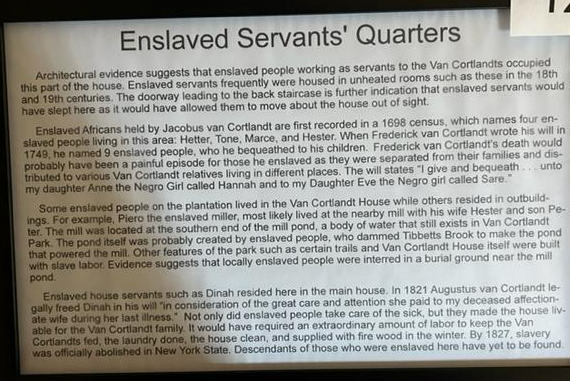
The servants quarters:

The servants quarters:
History of the Van Cortlandt’s:

The Van Cortlandt House Museum, also known as Fredrick Van Cortlandt House or Van Cortlandt House, is the oldest surviving building in New York City’s borough of The Bronx. The Georgian style house, begun in 1748, was build of fieldstone by Fredrick Van Cortlandt (1699-1749) on the plantation that had been owned and farmed by his family since 1691. Fredrick intended the house to be a home for him and his wife, Francis Jay and daughters, Anna Maria, 14 and Eve, 13. His sons, Augustus, 21 and Fredrick, 19, were not intended to be permanent residents of the house.

Sadly, Fredrick died before the new house was completed. In his will written in 1759, Fredrick left the house to his son, James Van Cortlandt (1726-1781) and a lifetime tenancy to his widow, Francis Jay Van Cortlandt (1701-1780).

Van Cortlandt House IV.jpg

The Van Cortlandt House gardens in the Summer

The Van Cortlandt’s were a mercantile family prominent in New York affairs. Fredrick’s father, Jacobus, established a thriving wheat growing and processing business on the plantation including a grist mill for processing the wheat into flour and a fleet of shallow draft boats to carry the flour from the south end his lake down Tibbet’s Brook and out to the Harlem and Hudson Rivers to market. During the Revolutionary War, the house was used by Rochambeau, Lafayette and Washington.

(From History of Van Cortlandt House and Museum)

In 1887, after 140 years of occupancy by the Van Cortlandt family and the community of plantation workers, the property was sold to the City of New York and made a public parkland. Before the house became a museum, it saw a variety of uses including as a temporary police precinct house and as a dormitory for ranch hands responsible for taking care of a herd of buffalo.

Van Cortlandt House historic marker

By 1895, The National Society of Colonial Dames in the State of New York expressed their interest in restoring the house as a museum open to the public. There was only one obstacle keeping the Colonial Dames from this important project, there was no provision in the New York State Law allowing the stewardship of a publicly owned building by a private organization. Undaunted, the first Society President, Mrs. Townsend, took the Society’s cause to Albany where on May 22, 1896 in the 199th session of the New York Legislature, Chapter 837 was approved by the governor and passed by a 3/5 majority to become law.

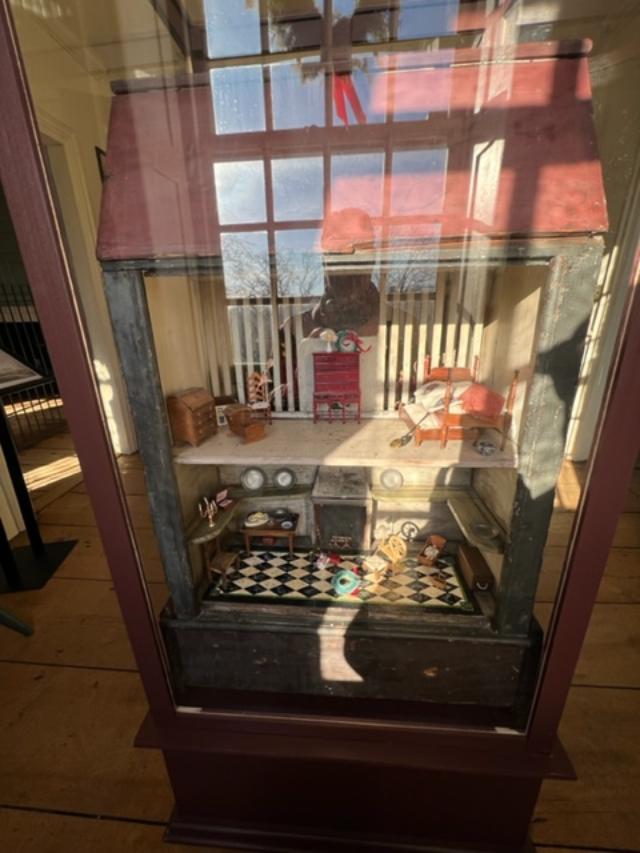
The Van Cortlandt House dollhouse
After nearly a year if repairs and restoration, Van Cortlandt House Museum was opened to great fanfare on May 25th of 1897. The original license agreement grained custody of the house to the National Society of Colonial Dames in the State of New York for a period of 25 years at a ‘peppercorn’ rent of $1.00 per year. Although the Society no longer pays the city rent, they remain, to this day as dedicated to Van Cortlandt House as they were in 1896.

Van Cortland Park.jpg

Van Cortlandt Park in the Summer Months

In 1967, Van Cortlandt House was added to the National Register of Historic Places and was designated a National Historic Landmark in 1967. The house was declared a New York City Landmark on March 15, 1966, recognizing the historic and architectural importance of both the exterior and interior.

(From the Van Cortlandt House Museum NSCDNY)

The Van Cortlandt House gardens during the winter of 2022
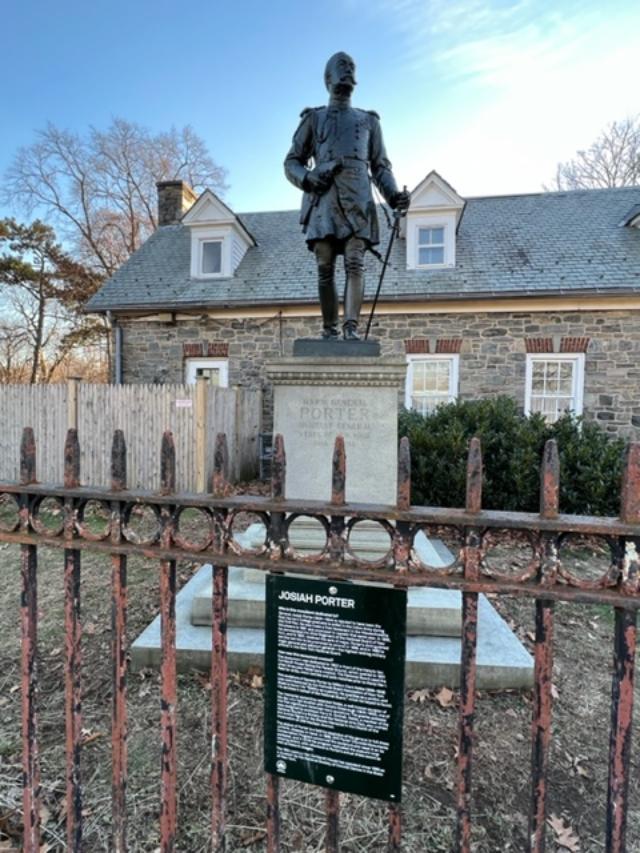
The General Porter Statute in front of the house
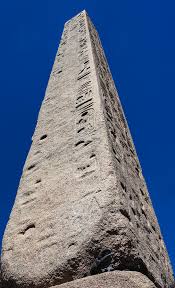
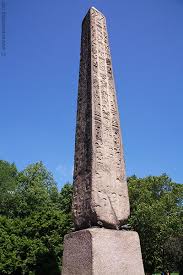
Cleopatra’s Needle                                                                           Central Park @ East 81st Street                                                                  New York, NY 10028

Cleopatra’s Needle Central Park @ East 81st Street New York, NY 10028

Cleopatra’s Needle

Central Park at East 81st Street (behind the Metropolitan Museum of Art)

New York, NY  10028

https://www.centralparknyc.org/attractions/obelisk

https://en.wikipedia.org/wiki/Cleopatra%27s_Needle_(New_York_City)

Open: When Central Park is open from dawn to dusk depending on the season

TripAdvisor Review:

https://www.tripadvisor.com/Attraction_Review-g60763-d1959031-Reviews-Cleopatra_s_Needle-New_York_City_New_York.html?m=1990

Cleopatra’s Needle

https://www.centralparknyc.org/locations/obelisk

https://en.wikipedia.org/wiki/Cleopatra%27s_Needle_(New_York_City)

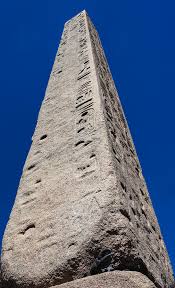
I always admire Cleopatra’s Needle whenever I am touring Central Park West after an afternoon at the Metropolitan Museum of Art. The obelisk sits in back of the Metropolitan Museum of Art on Fifth Avenue and the pathways behind the museum lead to the site.

It is one of the few place where you can see hieroglyphics up close unless you are in Egypt and the sad part is that the natural surroundings are wearing them out. Still it is one of the most interesting outside artifacts that Manhattan and New York City has on display. Take time to observe all four sides of the obelisk and observe the writings.

Sometimes I think the tourists miss this interesting artifact and how it got here from Egypt.

The History of Cleopatra’s Needle:

(From Wiki)

Cleopatra’s Needle (obelisk) was erected in Central Park, just west of the Metropolitan Museum of Art on February 22, 1881. It was secured in May 1877 by Judge Elbert E. Farnam, the then United State Consul General of Cairo as a gift from the Khedive for the United States remaining friendly neutral as the European powers, France and Britain, maneuvered to secure political control of the Egyptian government.

The obelisk is a twin of the obelisk given to London at the same time and come from the ancient city of Alexandria. The name is a misnomer as they have no relationship with the Ptolemaic Queen Cleopatra VII of Egypt and were already over a thousand years old in her lifetime (please see the Wiki link attached to the blog for more information on the obelisk).

The obelisk is free to the public and can be seen by taking the path behind the Metropolitan Museum of Art. It is open all day.

Franklin D. Roosevelt Four Freedoms Park             1 Four Freedoms Park                                Roosevelt Island, NYC 10044

Franklin D. Roosevelt Four Freedoms Park 1 Four Freedoms Park Roosevelt Island, NYC 10044

Franklin D. Roosevelt  Four Freedoms Park

1 Four Freedoms Park

Roosevelt Island, NYC, NY 10044

(212) 204-8831

Open: Sunday-Monday 9:00am-5:00pm/Tuesday Closed/Wednesday-Saturday 9:00am-5:00pm

Fee: Free

TripAdvisor Review:

https://www.tripadvisor.com/Attraction_Review-g60763-d3595273-Reviews-Franklin_D_Roosevelt_Four_Freedoms_Park-New_York_City_New_York.html?m=19905

The park on a sunny July day

Franklin D. Roosevelt Four Freedoms Park is the first memorial dedicated to the president in his home state of New York. Located on the southern tip of Roosevelt Island in New York City, it is the last work of Louis I. Kahn, an iconic architect of the 20th Century.

The interior of the park facing Roosevelt Island

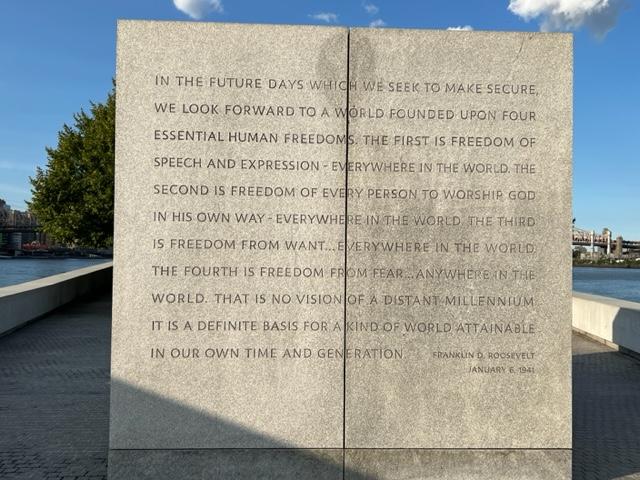
The memorial, which opened to the public in October 2012, celebrates the four freedoms, as pronounced in President Roosevelt’s famous January 6, 1941 State of the Union address: freedom of speech and expression, freedom of worship, freedom of want and freedom from fear. This has been prominently etched on the memorial.

FDR Four Freedoms Park

FDR Four Freedoms Park from a view

Our Mission:

As steward of this civic space, Four Freedoms Park Conservancy advances President Roosevelt’s legacy and inspires; educates and engages the public in the ideals of the four freedoms. The Conservancy does this by:

*Safeguarding the memorial as a space for inspired use.

*Fostering community and understanding.

*Igniting conversation about human rights and freedoms today.

The Four Freedoms that were the goals of the President

On January 6, 1941, President Franklin D. Roosevelt delivered his eighth State of the Union address, now known as the Four Freedoms speech. In his address, Roosevelt presented his vision for the world, “a world attainable in our own time and generation,” and founded upon four essential human freedoms: freedom of speech and expression, freedom of worship, freedom from want and freedom from fear.

Roosevelt’s call for human rights has created a lasting legacy worldwide, forming the basis for the Universal Declaration of Human Rights adopted by the United Nations in 1948.

For a richer of FDR, his legacy and the four freedoms, visit fdr4freedoms.org.

The view from Roosevelt Island of the Upper East Side

Franklin D. Roosevelt Island: A History

Originally called Minnahannock by Native Americans and Varkins Island  by the Dutch settlers, the island was acquired by the Blackwell family in the 1600’s, who renamed the land Blackwell Island. The Blackwells lived on and farmed it before selling it to the City of New York in 1828 for $30,000.

In the 19th Century, the island was used by the City for institutional facilities, including the Workhouse, Penitentiary, Lunatic Asylum, City Hospital and City Home and given the name Welfare Island in 1921. These institutions served the City until the 1930’s., before gradually being relocated to areas more easily accessible to public transportation.

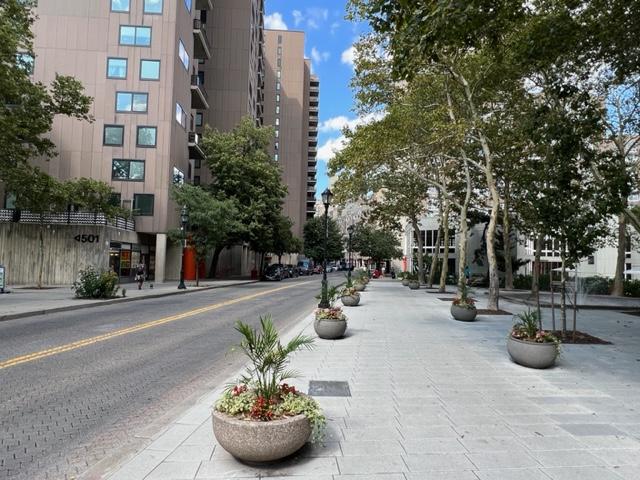
The Roosevelt Island Main Street

In 1969, this two-mile island was lease to the State of New York for 99 years. Under New York State’s Urban Development Corporation, Welfare Island  became a beacon for the affordable housing movement within the City. Construction of the Island community was completed in 1975 with four housing developments. In 1973, the island was renamed Franklin D. Roosevelt Island.

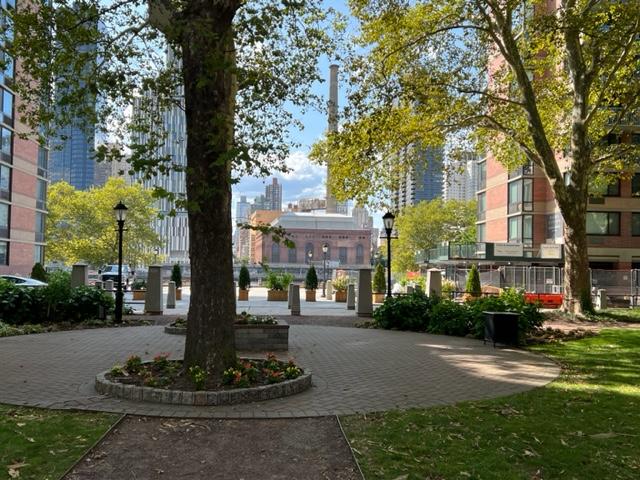
The Gardens in the Main Street of Roosevelt Island

Today, Roosevelt Island has a small town feel with approximately 20 buildings and 14,00 residents. The island is home to six landmarked structures and proudly houses Four Freedoms Park, one of the original visions for the Island. To learn more, visit the Roosevelt Island Visitor Center at the Tram Plaza.

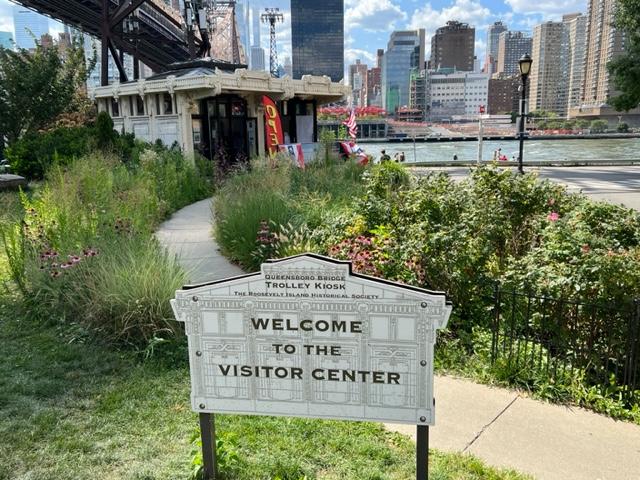
The Visitors Center at Roosevelt Island

(Judith Berdy, President, The Roosevelt Island Visitor Center)

A Memorial to Franklin D. Roosevelt

Nearly 40 years before the Park opened its gates to the public, Louis I. Kahn presented his vision for what would become Franklin D. Roosevelt Four Freedoms Park. It was a simple idea. “I had this thought,” Kahn said. “that a memorial should be a room and a garden.”

The FDR Hope Memorial

This was 1973. Less than a year later, Khan had died; Governor Nelson Rockefeller, who had announced the project with Mayor John  Lindsay, became Vice President of the country and the City of New York neared bankruptcy.

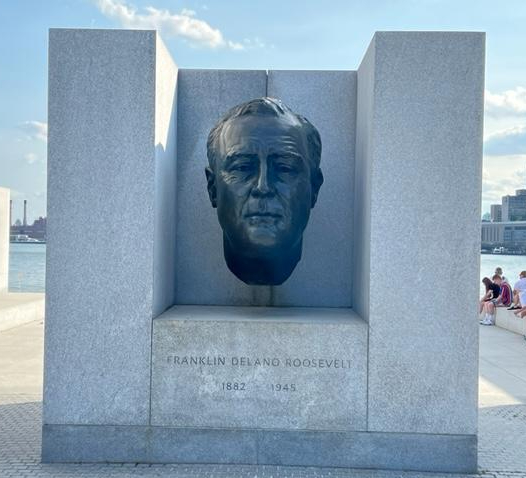
The bust of President Roosevelt

The future of the memorial seemed a fragile and tenuous dream. Yet, through the power and determination of a small but dedicated group, nearly four decades after Kahn completed his architectural design, Four Freedoms Park became the place he envisioned. In 2012, following 30 months of construction, the Park opened to the public. The Park is operated and maintained by Four Freedoms Park Conservancy in partnership with New York State Parks.

(Part of the New York State of Opportunity: Parks, Recreation and Historic Preservation)

I admired the FDR Hope Memorial in which the statue of the President reaches to a young girl with a disability herself. The statue offers encouragement to those with a disability and the power to persevere.

http://www.fdrhopememorial.org/

FDR faces the young girl

the young girl facing FDR

The statue was designed by artist and sculptor Meredith Bergmann, who herself was inspired by the photos and stories of the President (FDR Hope Memorial).

Artist Meredith Bergmann (Cooper Union Alumni Picture)

https://meredithbergmann.com/

Ms. Bergmann is an American born artist with BFA from The Cooper Union School of Art and attended Parsons School of Design and Wesleyan University. Her public works explore history, social justice, human rights and disabilities (Author’s bio).

Franklin D. Roosevelt Four Points Freedom Park is the first memorial dedicated to the president in his home state of New York. Located at the southern tip of Roosevelt Island in New York City. It is the last work of Louis I. Kahn, an iconic architect of the 20th century.

FDR Four Freedoms Park

The memorial, which opened to the public in October 2012, celebrates the four freedoms, as pronounced in President Roosevelt’s famous January 6, 1941, State of the Union address: freedom of speech and expression, freedom of worship, freedom from want and freedom from fear.

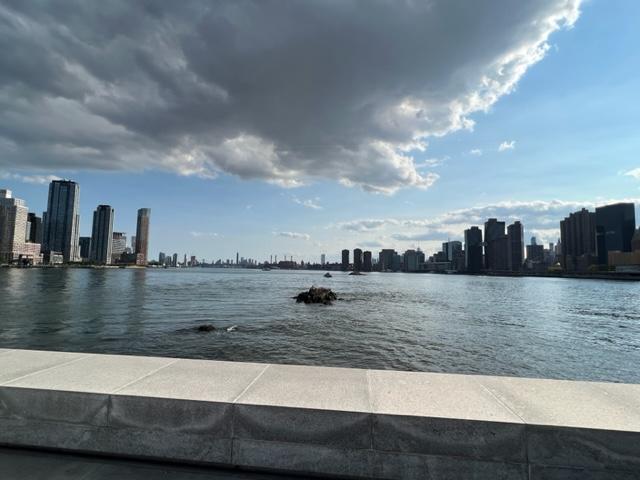
The skyline from the southern part of the park.

Disclaimer: this information was taken from the NYS Parks, Recreation and Historic Preservation pamphlet. Please call the park or email to check on opening times when in season.

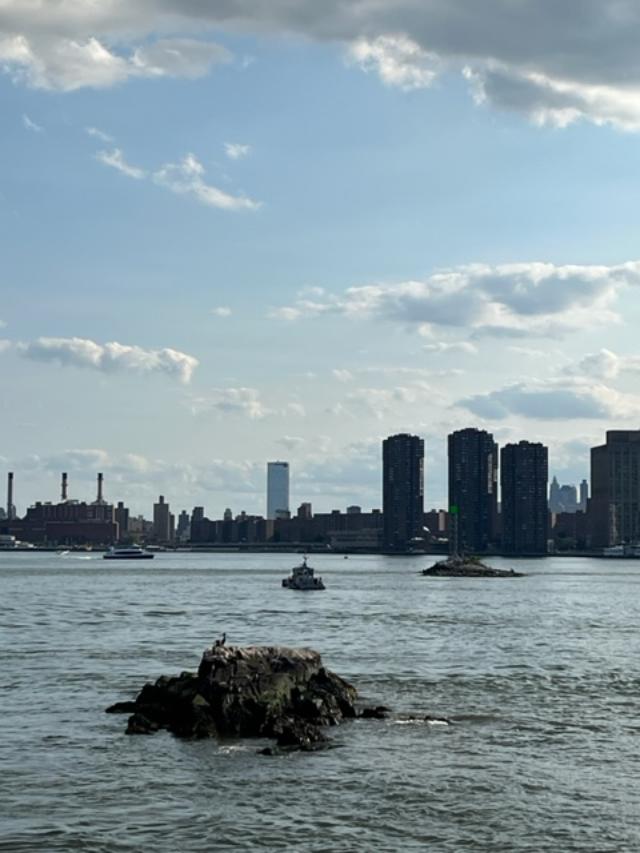
The islands just south of the park.

El Museo del Barrio                                                                             1230 Fifth Avenue, Museum Mile                                                        New York, NY 10029

El Museo del Barrio 1230 Fifth Avenue, Museum Mile New York, NY 10029

El Museo del Barrio

1230 Fifth Avenue

Museum Mile,

New York, NY  10029

(212) 831-7272

https://www.elmuseo.org

info@elmuseo.org

Hours: Wednesday-Saturday 11:00am-6:00pm/Sunday-12:00pm-5:00pm/Closed: Tuesday

Fee: $9.00 for Adults/$5.00 Children & Seniors/Free: Members and children under 12/Seniors on Wednesdays

 TripAdvisor Review:

https://www.tripadvisor.com/Attraction_Review-g60763-d116228-Reviews-El_Museo_del_Barrio-New_York_City_New_York.html?m=1990

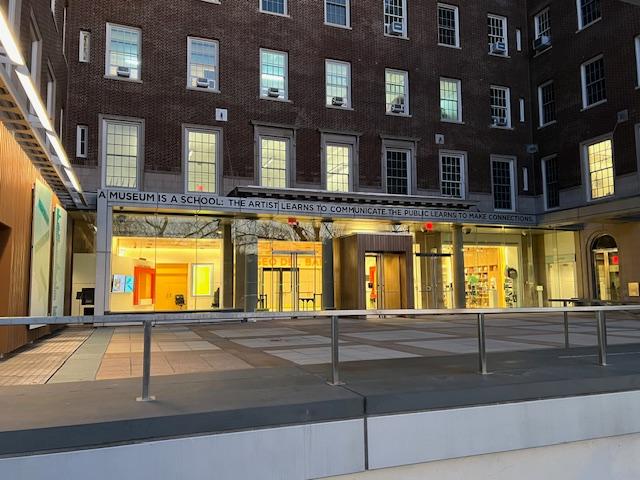
The El Museo del Barrio at 1239 Fifth Avenue

Museum de Barrio during the day

The Mission:

The mission of El Museo del Barrio is to present and preserve the art and culture of Puerto Ricans and all Latin Americans in the United States. Through its extensive collections, varied exhibitions and publications, bilingual public programs, educational activates, festivals and special events, El Museo educates its diverse public in the richness of Caribbean and Latin American arts and cultural history.

The sign in front of the building

By introducing young people to this cultural heritage, El Museo is creating the next generation of museum-goers while satisfying the growing interest in Caribbean and Latin American art of a broad national and international audience.

The History of the Museum:

El Museo was founded 45 years ago by artist and educator Raphael Montanez Ortiz and a coalition of parents, educators, artists and activists who not that mainstream museums largely ignored Latino artists. Since its inception, El Museo has been committed to celebrating and promoting Latino culture, thus becoming a cornerstone of El Barrio and a valuable resource for New York City.

El Museo del Barrio

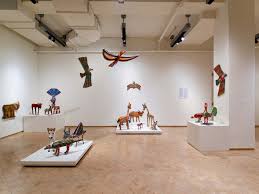
The exhibitions in the Main Gallery

El Museo’s varied permanent collection of over 6,500 objects, spans more than 800 years of Latin American, Caribbean and Latino art, includes pre-Columbian Taino artifacts, traditional arts, twentieth-century drawings, painting, sculptures and installations as well as prints, photography, documentary films and video. For a brief overview of our  history and to explore the institutional chronology and exhibition history year by year.

EL Museo del Barrio II

The Galleries of  El Museo del Barrio

Our Purpose:

El Museo del Barrio’s purpose is to collect, preserve, exhibit and interpret the art and artifacts of Caribbean and Latin American cultures for posterity.

To enhance the sense of identify, self-esteem and self-knowledge of the Caribbean and Latin American peoples by educating them in their artistic heritage and bringing art and artists into their communities.

To provide an educational forum that promotes an appreciation and understanding of Caribbean and Latin American art and culture and its rich contribution to North America.

To offer Caribbean and Latin American artists greater access to institutional support in the national and international art world.

To convert young people of Caribbean and Latin American descent into the next generation of museum-goers, stakeholders in the institution created for them.

To fulfill our special responsibility as a center of learning and training ground for the growing numbers of artists, educators, art historians and museum professionals interested in Caribbean and Latin American Art.

The mission reaffirms the vision of Raphael Montanez Ortiz, who founded El Museo del Barrio in 1969 and of the Puerto Rican educators, artists and community activities who worked in support of this goal.

(El Museo del Barrio pamphlet online)

The Collection:

The museum features an extensive collection of around 8,500 pieces composed of pre-Columbian and traditional artifacts, particularly a large permanent Taino exhibit as well as 20th century arts and crafts, graphics and popular media, Mexican masks, textiles from Chile and photographs and traditional art from Puerto Rico. There are often temporary exhibits on Puerto Rican and Latino modern art. The museum also sponsors numerous festivals and educational programs throughout the year including the annual Three Kings Day parade.  Due to a lack of space prior to their 2009-2010 expansion, the museum began to place some of their permanent collection online. This also served as a means of audience development. (Wikipedia)