Tag: Exploring Manhattan

Day Three Hundred and Seventy-Nine Exploring The Met at ‘Met After Hours’                                                                        February 12th, 2026

Day Three Hundred and Seventy-Nine Exploring The Met at ‘Met After Hours’ February 12th, 2026

One of the things I love about being a member the Metropolitan Museum of Art is the private Member’s Night ‘Met After Hours’ they hold about four times a year. The museum is open after the closing hours and it is a night of wondering the museum galleries, great music and entertainment and wonderful tours and talks in the galleries. You really experience the museum at its best and it does shine.

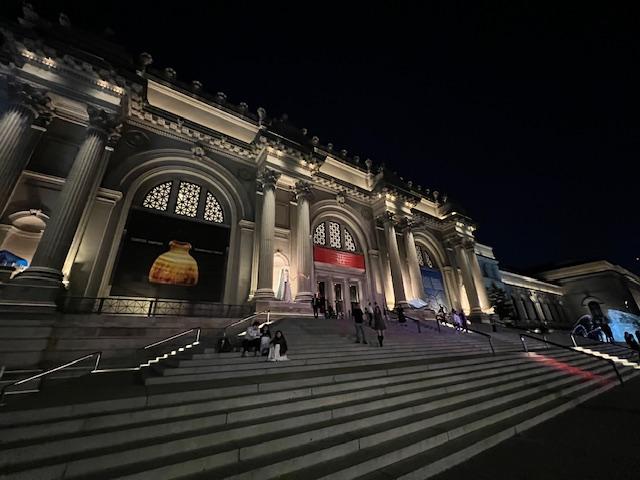
The outside of The Met at night

https://www.metmuseum.org/

My review on TripAdvisor:

My ‘Met After Hours’ reviews on MywalkinManhattan.com:

https://mywalkinmanhattan.com/category/met-after-hours-event/

The lines move very quickly to get into the museum and with traffic getting into the City that night, I arrived about twenty minutes after opening and there were no crowds to face and I got right in. There’s always a sense of excitement on these nights.

The Grand Hall in the front of the museum decorated with Spring flowers

The beautiful Spring flowers lined all the urns around the Great Hall

The museum welcoming all the members of the museum at ‘The Met After Hours’

I started my walk around the galleries in the Greek Wing touring the main hallway. It still boggles my mind how old these statues are and I am looking at something almost two thousand years old.

The Greek Gallery wing

https://www.metmuseum.org/departments/greek-and-roman-art

(From the Metropolitan Museum of Art website):

The Museum’s collection of Greek and Roman art comprises more than thirty thousand works ranging in date from the Neolithic period (ca. 4500 BCE) to the time of the Roman emperor Constantine’s conversion to Christianity in 312 CE. It includes the art of many cultures and is among the most comprehensive in North America. The geographic regions represented are Greece and Italy, but not as delimited by modern political frontiers: Greek colonies were established around the Mediterranean basin and on the shores of the Black Sea, and Cyprus became increasingly Hellenized. For Roman art, the geographical limits coincide with the expansion of the Roman Empire. The department also exhibits the art of prehistoric Greece (Helladic, Cycladic, and Minoan) and pre-Roman art of Italic peoples, notably the Etruscans (Metropolitan Museum of Art website).

One of the statues that stood out that evening

I spent some time admiring the statues and the craftsmanship of the works along the hallway. The only problem is that most of the Greek and Roman Galleries were closed for the evening so I headed off to the Renaissance Wing. I love the luxury objects in the collection of silver and gold and again their craftsmanship is still unrivaled today. To make these objects takes intensive work and talent.

The historic collection of luxury items

The time pieces of the Renaissance period

https://www.metmuseum.org/learn/educators/curriculum-resources/the-art-of-renaissance-europe

The timepieces show how advanced science had become and the importance of it in not just measurements but in beauty.

The lobby of the American Wing with the facade of what was a former bank and a Wall Street private mansion. I love the quiet elegance of this building and to think they moved it here piece by piece. The American Wing Cafe was open for the evening and the area was busy throughout the evening. It is nice to just sit and enjoy the views by the fountain. The artwork is beautiful.

https://www.metmuseum.org/departments/the-american-wing

(From the Metropolitan Museum of Art website):

Visitors to the American Wing will experience in more than 75 galleries on three floors varied art, design, and culture from the mid-seventeenth to the mid-twentieth century, with some contemporary expressions, by a diverse array of artists from across North America. Since our founding in 1924, this curatorial department has evolved its collecting to include some 20,000 artworks in many mediums by African American, Asian American, Euro-American, Latin American, and Native American makers, affirming ever more inclusive definitions of American art and identity. These dynamic holdings include painting, sculpture, drawing, furniture, textiles, regalia, ceramics, basketry, glass, silver, metalwork, jewelry, as well as historic interiors and architectural fragments, produced by highly trained and self-taught artists, both identified and unrecorded (Metropolitan Museum of Art website).

The evening then moved to the Egyptian Wing and the Temple of Dendur, where the entertainment and the cocktail bar was located.

The Temple of Dendur is the hub of activity on Members Nights

https://www.metmuseum.org/art/collection/search/547802

(From the Metropolitan Museum of Art website):

This small temple, built about 15 B.C., honored the goddess Isis and, beside her, Pedesi and Pihor, deified sons of a local Nubian ruler. On the outer walls between earth and sky are carved scenes of the king making offerings to deities who hold scepters and the ankh, the symbol of life. The figures are carved in sunk relief. In the brilliant Egyptian sunlight, shadows cast along the figures’ edges would have emphasized their outlines. Isis, Osiris, their son Horus, and the other deities are identified by their crowns and the inscriptions beside their figures (Metropolitan Museum of Art).

These scenes are repeated in two horizontal registers. The king is identified by his regalia and by his names, which appear close to his head in elongated oval shapes called cartouches; many of the cartouches simply read “pharaoh.” This king was actually Caesar Augustus of Rome, who, as ruler of Egypt, had himself depicted in the traditional regalia of the pharaoh. Augustus had many temples erected in Egyptian style, honoring Egyptian deities (Metropolitan Museum of Art). 

The area was packed with patrons enjoying music and talking by the bars. The crowds were so large at the beginning of the evening that I waited until after 9:00pm for the second performance of the group playing. So I headed into the section of the Egyptian Wing to look at the galleries that were open. I love walking around the Egyptian Wing of the Met. It is one of the most extensive collections outside of Egypt and the most fascinating Mummy exhibition.

Admiring one of the Mummy exhibits in the Egyptian Wing

https://www.metmuseum.org/departments/egyptian-art

(From the Metropolitan Museum of Art website):

The Department of Egyptian Art was established in 1906 to oversee the Museum’s already sizable collection of art from ancient Egypt. In the same year, the Museum’s Board of Trustees voted to establish an Egyptian Expedition to conduct archaeological excavations in Egypt. Between 1906 and 1935, The Met’s Egyptian Expedition worked at a number of important sites, including Lisht in the north and Thebes in the south, and the objects gifted to The Met by the Egyptian antiquities service form the core of our collection. Over the years, the Department of Egyptian Art has also been able to acquire, through purchase and bequest, several important private collections (Metropolitan Museum of Art website).

The ancient tablets outside of the Mummy Exhibition

The Egyptian artwork outside the Mummy Room

The tablets outside the Mummy Room

When the whole gallery is open, it is a treasure trove of objects and information from each Dynasty. I have been mind-boggled by these galleries since I first visited the museum in the third grade for a class field trip. I remember sketching artifacts for a class project and am still fascinated about how old some of these objects are and condition they are still in after thousands of years. It is my favorite part of the museum.

By 9:00pm, the entertainment was starting again, so I joined other members for a cocktail and enjoyed the music in the Temple of Dendur Gallery.

The Temple of Dendur fully lit for the evening before the start of the entertainment

The signature cocktail of the evening, the Starlight Spritz

Enjoying a Starlight Spritz while listening to the music

The bartenders can mix a drink

After a long week at work, it was nice to relax and enjoy the music. The music that night was performed by artist Jasim Perales and Friends, an Afro-Latin Jazz performance. The music was relaxing and soulful and the crowd had a wonderful time.

The start of the music again at 9:00pm

The trio performing

A clip from the entertainment that night

The Master of Ceremonies that night, Jasim Perales

https://www.instagram.com/jasimperales/?hl=en

All good things come to an end and it was time leave. The night was dark and the winter air was crisp creating the perfect Winter evening to set out into for the walk back to Port Authority. The Upper East is so beautiful at night.

The front of the Met that night

The artwork is always so impressive outside the Met

It was in the low 40’s that evening and the perfect night for a walk around the Upper East Side and Midtown. It still surprises me after all these years of walking around Manhattan how beautiful the City really is at night.

The beauty of Carnegie Hall in the evening

https://www.carnegiehall.org/

Passing the front of a quiet Carnegie Hall that evening

Looking up Fifth Avenue at night

Looking up Sixth Avenue and West 35th Street by Herald Square

The New York Public Library on Fifth Avenue at night

https://www.nypl.org/

It was another spectacular evening at the Metropolitan Museum of Art. Thank you to the Membership and Special Events Departments for hosting another wonderful evening.
Day Three Hundred and Sixty-Five Artist Party-Ruth Asawa-Member’s Night at the MoMA November 22nd, 2025

Day Three Hundred and Sixty-Five Artist Party-Ruth Asawa-Member’s Night at the MoMA November 22nd, 2025

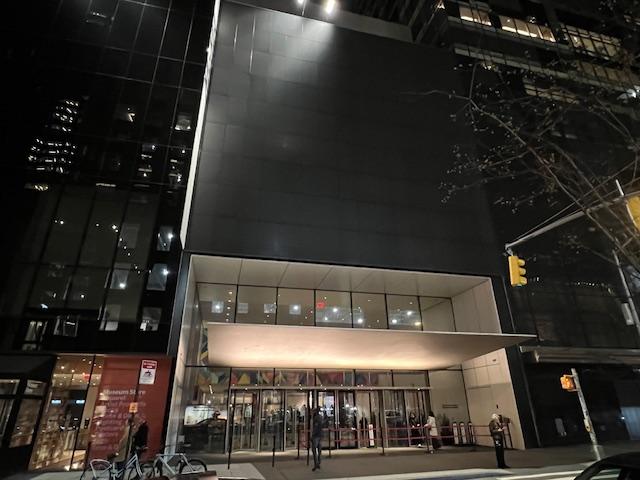
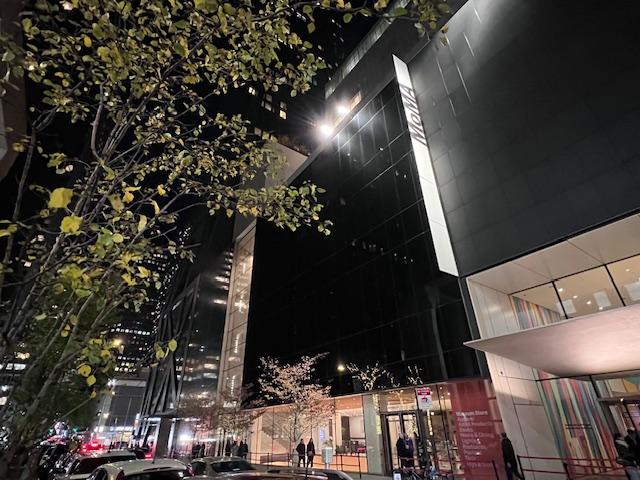
The front of the Museum of Modern Art on 11West 53rd Street

https://www.moma.org/

My review on TripAdvisor:

https://www.tripadvisor.com/ShowUserReviews-g60763-d105126-r1040038069-The_Museum_of_Modern_Art_MoMA-New_York_City_New_York.html?m=19905

There is always a lot of excitement when a new art exhibition is ready to open. It is even better when the museum opens it to its members first before the public gets a glimpse. It gives a chance to see the exhibitions before it opens to the public.

The long line of MoMA members waiting to get into the museum for the opening night of Artist Ruth Asawa’s exhibition

I noticed this year especially and right before Thanksgiving, all the museums are throwing open their doors for Member’s Nights. I have been invited to five Members Nights at museums all over the City. You can’t attend them all.

The excitement the museum creates for these evenings

Video of entering the museum at the start of the opening with 80’s Japanese Pop Music

I think in an economy like this, these Members Nights are one of the best ways to engage with the membership for both donations and renewals of memberships especially before the holiday season. Plus it gives the members a wonderful night out to see the exhibitions ahead of time and enjoy the evening after a long week at work.

The opening of the Ruth Asawa Retrospect

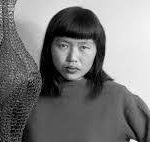
Artist Ruth Asawa

https://en.wikipedia.org/wiki/Ruth_Asawa

The biography of the artist and her works

https://www.moma.org/artists/21-ruth-asawa

Biography of Artist Ruth Asawa:

(from the Museum of Modern Art website)

Born on a farm in Southern California, Asawa began her arts education when she was a teenager and she and her family were among the thousands of persons of Japanese descent who were forcibly incarcerated by the US government during World War II. It was at the internment camp that Asawa began taking classes in painting and drawing. After her release, Asawa studied to be a teacher but was unable to get a license because of her Japanese heritage, so she enrolled at Black Mountain College, an experimental art school in North Carolina. Asawa took classes from and worked alongside fellow artists Josef AlbersRobert RauschenbergMerce Cunningham, and R. Buckminster Fuller. Black Mountain was also where she met her husband, the architect Albert Lanier.

I loved her wire woven sculptures.

The wire woven sculptures were the standouts of the exhibition

I thought these were a unique design

I liked here colorful paintings, these are of her child’s footprints. I loved the idea that her children were involved with the art

The patrons enjoying the art

The display of the wire art

The displays were impressive and graceful

The colorful faces looked tired

The look of nature in the wire art in the form of trees

I loved her works of food

At the end of the exhibition and the evening, I joined everyone on the main floor where the bar and gift shop were located. The main floor was the busiest part of the museum. I wondered if some of these people even went upstairs to see the exhibition or just stayed downstairs to socialize.

The main floor of the museum is always packed with people

Share in the excitement of the Membership opening

These evenings always get my mind off the stress of life. It is nice to just be in Midtown Manhattan and be in the moment. It is nice to see art, hear music and walk through the museum.

Third Shearith Israel Cemetery                                             98-110 West 21st Street                                            New York, NY 10011

Third Shearith Israel Cemetery 98-110 West 21st Street New York, NY 10011

Third Shearith Israel Cemetery

98-110 West 21st Street

New York, NY 10011

https://www.findagrave.com/cemetery/2260432/third-cemetery-of-congregation-shearith-israel

Open: Closed to the Public but you can see it from outside the fence.

My review on TripAdvisor:

Closed to the public

The cemetery sits behind the former ‘Ladies Shopping District’ department stores

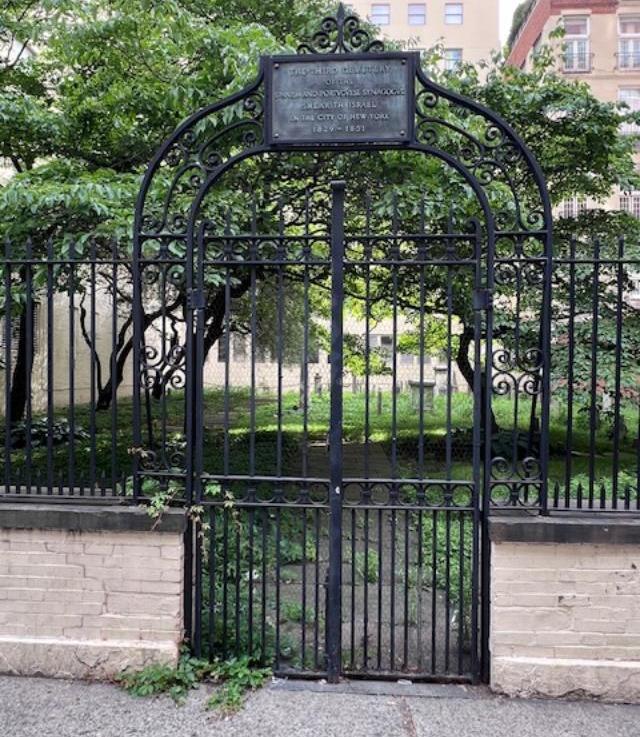
The front of the cemetery

When I was finishing my walk of the streets of Lower Chelsea, I came across this quiet and respectful cemetery in the middle of a busy neighborhood. This small graveyard was the third of series of moves that Shearith Israel made to bury their dead since the original cemetery open on the edge of what is today Chinatown.

Like its earlier counterparts, the cemetery is locked to visitors. So you can only admire it from a far. The graves date back to the early 1800’s.

The History of the cemetery:

(From the New York City Cemetery Project and Find a Grave)

This cemetery is located on 21st Street between 6th and 7th Avenues, in use 1829-1851. Shearith Israel, the first Jewish congregation in North America, was formed in 1654 by Spanish and Portuguese Jews who journeyed from Recife, Brazil, seeking refuge from the Inquisition.

The entrance to the cemetery is always locked

The sign for the cemetery

While New Amsterdam’s city fathers did not recognize freedom of worship, they respected the Jews’ right to their own consecrated burial ground. Shearith Israel purchased the cemetery plot on West 21st Street in 1829 for $2,750. It, too, was on the outskirts of the expanding city, which for sanitary reasons had prohibited interment below Grand Street after the yellow fever epidemic of 1822.

The view of the cemetery from the fence

In 1832 the congregation bought land extending the cemetery east to Sixth Avenue and south to 20th Street. Fifty years later the land was sold to Hugh O’Neal, who built a dry goods store there. Shearith Israel used the cemetery for burials until 1851.

The graves are from the early 1800’s

That year, New York City prohibited burials south of 86th Street and the establishment of any new cemeteries within city limits (Find a grave.com).

The side section of the cemetery and pathway

The view of the cemetery and its quiet respect to those buried there

The history of the Cemetery from the Congregation of Shearith Israel The Spanish & Portuguese Synagoge website:

According to rules of ritual purity, Cohanim are prohibited from coming into contact with the deceased (except for their immediate family.)  This means that ordinarily Cohanim cannot participate in any of the mitzvoth related to burial.  One particularly commendable priest, Mr. Lewis I. Cohen, realized that the consecration of a new and unused cemetery afforded him an opportunity to participate in a mitzvah usually off limits to Cohanim.  So it was Mr. Cohen who volunteered to dig the first grave for the first burial of the new cemetery in November 1829.

Some of the notable persons laid to rest in the 21st Street cemetery were Moses Levy Maduro Peixoto and Isaac Seixas, ministers of our congregation, and Harmon Hendricks, founder of one of America’s first great industrial companies and whose descendants are still members of our congregation today. Perhaps the most influential person to be buried in the 21st Street cemetery was the great Jewish diplomat and proto-Zionist, Mordecai Manual Noah.

In 1851, the city prohibited burial in Manhattan below 86th Street.  Rather than continue to look north (as Trinity Church did), the Congregation searched outside of Manhattan for its next burial ground.  Together with Bnai Jeshurun and Shaarei Tefila, the congregation purchased a large plot of land in Ridgewood, Queens.

Day Three Hundred and Fifty-Five Private Members Morning ‘Oasis in the City’ tour at the MoMA                                                                          August 9th, 2025

Day Three Hundred and Fifty-Five Private Members Morning ‘Oasis in the City’ tour at the MoMA August 9th, 2025

The entrance to the Museum of Modern Art 11West 53rd Street in New York City

https://www.moma.org/

My review on TripAdvisor:

https://www.tripadvisor.com/Attraction_Review-g60763-d105126-Reviews-The_Museum_of_Modern_Art_MoMA-New_York_City_New_York.html

The sign for the gardens

What I love about being a member of the museums in New York City is that there is an opportunity to see the museum in the early hours for private events. This morning I got up early to experience Manhattan on a spectacular sunny morning for the event ‘Oasis in the Garden’, a talk on the design, purpose and art in the MoMA outdoor garden.

We met inside the museum before the tour

Since the museum opened at 9:30am and there was no one at the museum at that hour, we had the outdoor garden to ourselves for almost an hour and a half.

The outdoor garden at the MoMA at 10:00am in the morning

Our tour guide led about fifteen of us through a history of the creation of the gardens, the purpose in the museum, its renovation in 2004 when I joined and the sculpture in the garden.

She also talked about taking her students here and that some of them wanted specific answers to what the art meant rather than forming their own opinion. It is funny how I see this in my own students.

What I liked about our tour group was that it was an older, very educated crowd of people who brought different opinions on how the art we were seeing should be thought about. From the time the artist created it to it modern interpretation by the ‘politically correct police’, I was amazed by the other members take on each piece of art.

The gardens are a refuge from the noise and crowds of the museum and the City

Video of the fountain

The Albert Giacometti ‘Talk Figure III’

Each piece of sculpture we touch upon was chosen specifically for the gardens and we talked about its place from when it was made to the modern interpretation and how they differ. Our first discussion was about the Albert Giacometti sculpture ‘Tall Figure III’. Some people talked about hunger and the stance on poverty. I asked if her students had different thoughts of the statue when it was made versus today.

She explained everything is seen differently through the artist’s eyes versus the modern I perception. It was hard to compare the two opinions without a debate. I thought today’s students needed to lighten up a little and stop taking art at face value and just enjoy it. The context of work over a hundred years ago is very different from how it can be looked at today.

We had time to talk and relax between art pieces and I swear the sound of the fountains relaxed me so much I almost feel asleep.

The fountains were so calming that morning

Video of the Japanese fountain

The August’s Rodin ‘St. John the Baptist Preaching’

We talked about the religious standpoint of the sculpture versus its place in modern society. I thought it was a naked guy hitchhiking. It’s funny how you see art.

The Jacques Lipchitz ‘Figure 1926-30’

With the ‘Figure’ many of the member talked about their interpretation of the modern take of Cubism and some members asked about whether these were arms and legs or something else.

The back of the gardens

The back of the gardens were so peaceful. I stood back from the tour so I could just hear the water rumble.

The Henry Moore sculpture ‘ The Family Group 1948-49

We discussed the modern family unit of today versus when the sculpture was created.

The back of the gardens

The Henri Matisse ‘The Back (III) 1913-16

The Aristide Maillol ‘The River’

We talked about the fall from God. One person said it looked like someone was tripping into the fountain. I thought that was clever.

The Jean Dubuffet ‘Study for Tower with Figures’

This was the last figure we discussed and we were asked as a group what was the first thing that came to our minds when we saw this. I said ‘Juxtaposed’. So much going on and a lot being said. We talked about children and their make up in the family unit. How they change things.

I have to say that I saw the art in a different light this morning. It was interesting to hear the artist’s interpretation versus what members thoughts were on what the art meant. I thought it was a good take away when we finished the tour. There were so many interesting opinions on the art. What I liked was the weather was so amazing, and it was so nice to be outside.

The garden as the public entered later that morning

I know I got a lot out of the tour. It’s always nice to see different points of view of what the art means and how we interpret it. This is why it is fun to be a member of the MoMA. It’s nice to see the museum when it is quiet and you can just take your time.

The gardens really are an “Oasis in the City”.