I recently visited the birthplace of of our 22nd and 24th President of the United States of America and it is an interesting look into one man’s past. The Grover Cleveland Birthplace Museum was originally the pastor’s residence for the First Presbyterian Church in Caldwell, NJ.
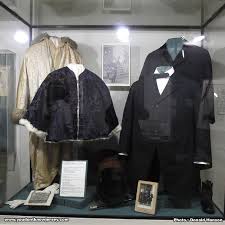
What I found interesting about this historical home is that the President’s sister, Susan, saved everything of the family’s past. Things like furniture, home furnishings, cooking utensils, paintings and photos of the family plus personal items of the President such as his clothes, pipes, shaving kits and traveling cases so there is a lot of interesting items to see and well thought up display cases.
The house is broken up into the kitchen area, the living chambers, the former living room area which has most of the displays and then the front hallway where more family displays are located.
President Cleveland and Mrs. Cleveland’s personal clothes
Try to take a tour with the tour guide, Paula, who knows the house backwards and forwards and gives you an interesting take on the family. She will be able to point out all the family objects and personal items that have been donated by family members. Things from formal clothes to a piece of the President’s wedding cake.
A piece of the President’s wedding cake
The whole tour takes about an hour and you will find yourself memorized by the displays and the family history of the children and grandchildren. It is interesting to see how the family grew when they were living in Caldwell, NJ.
History of the Cleveland Birthplace Museum:
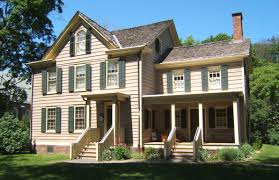
Grover Cleveland’s birthplace was built in 1832 as the Manse or pastor’s residence for the First Presbyterian Church of Caldwell. Cleveland’s father, the Reverend Richard Fally Cleveland was the minister here from 1834-1841.
Originally this frame home had a two-story main section with a one-story kitchen to the east and a one-story lean-to at the rear. It was enlarged several times between 1848-1870 to meet the growing needs of the Presbyterian clergy. The house is a good example of local vernacular architecture.
The Birthplace house
The historical significance of the Manse was first noted in 1881 when Cleveland was running for Governor of New York. As his political star ascended, so did the interest in preserving his birthplace as a museum. A group of Cleveland’s friends and admirers began negotiations to purchase the Manse in 1907. Their efforts culminated in the opening of the house to the public on March 18, 1913.
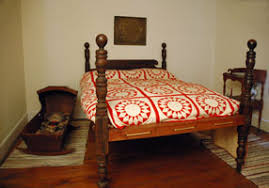
Most of the first floor rooms portray the Manse as it was in 1837, the year Grover Cleveland was born. The decidedly middle-class character of the rooms reflect the day to day life of the Reverend Richard Cleveland and his family. Among the artifacts on display from Cleveland’s early years are his cradle and original family portraits.
Grover Cleveland’s crib where he was born
Contrasting sharply with the humble beginnings portrayed in these rooms, the exhibit gallery features a striking display of artifacts that reflect the financial and political success Cleveland achieved during the last quarter of the 19th Century. Here, the mud-slinging campaign of 1884, the public’s intense interest in his wife and children and America’s political climate throughout his split terms of office are explored.
The Grover Cleveland Birthplace State Historic Site is the only house museum in the country dedicated to the interpretation of President Cleveland’s life. It is the nation’s leading repository of Cleveland artifacts and political memorabilia. The Grover Cleveland Birthplace is listed on the New Jersey and National Registers of Historic Places.
The President’s time in New Jersey:
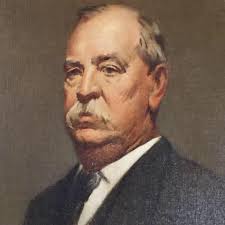
Stephen Grover Cleveland was born on March 18, 1837 to the Reverend Richard Cleveland and his wife, Ann. Named for the first ordained pastor of the First Presbyterian Church at Caldwell, he would in time become known by his middle name, Grover.
Cleveland was raised in a strict, modest home. As the son of a minister and the fifth of nine children, he had a religious and principled upbringing with few luxuries. When Grover was four, Reverend Cleveland moved his family to Fayetteville, NY.
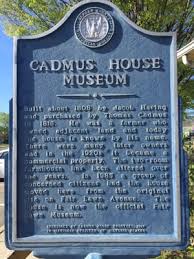
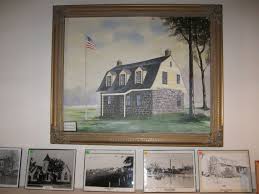
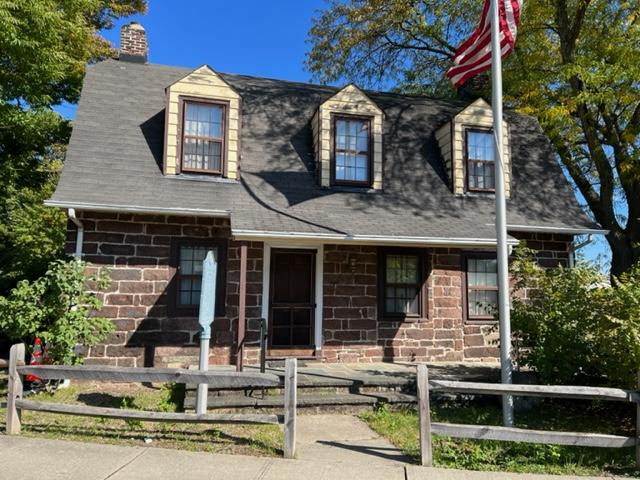
The Cadmus House was built in 1808 by landowner Jacob Haring and his wife, Margarat. It was originally a two room farmhouse when it was built on their extensive farm land. The Harings’ sold the house to Abraham and Harmones Van Derbeek in 1815 and they turned around and sold the house to Thomas Cadmus and his wife, Margaret in 1816 and the name stuck from there.
The Haring house originally and then it had a gable and second floor built in the late 19th century
More information on the Haring Family from the novel “A Dutch Family for the Middle Colonies” by author Firth Haring:
Over the years, the house had had many owners and many uses. Before the house was moved in 1985 to its current location, it served as a real estate office at that time. When they were building new construction on the spot, the house was saved by a group of concerned Fair Lawn residents to preserved the town’s past and it was turned into the Cadmus House-Fair Lawn Museum.
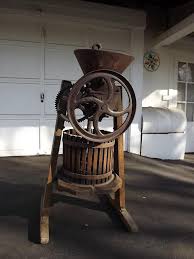
The house is broken down into different themed rooms. The downstairs rooms are devoted to the Fair Lawn’s past with pictures of old homes that used to line the streets of the neighborhood. There are pictures of old farms and farm houses, relics from town such as arrowheads, farming equipment and old farm house decor such as ice boxes and apple presses for cider.
Pictures of Fair Lawn’s past
In the room that once served as a dining room, there are period Dutch items that would be needed to run a household or a business.
The apple press which was a big part of the farming community in Bergen County
The upstairs rooms have different displays. One room is devoted to Victorian living with furniture and bedroom decors along with dolls and cribs. The other room is dedicated to the history of the Fair Lawn Fire and Police Departments as well as memorabilia from Fair Lawn High School such as trophies, yearbooks and old films of football games.
There is plenty of parking in the front of the house and the parking lot is shared with the railroad station next door. The house is only open the third Sunday of each month and it is closed for the months of July and August.
If you want to take a glimpse of Bergen County’s past Colonial, Victorian, Motor Age or current, the Cadmus House will give you a perspective on living in Bergen County in the past into current times.
The house now sits by the train station in Fairlawn, NJ
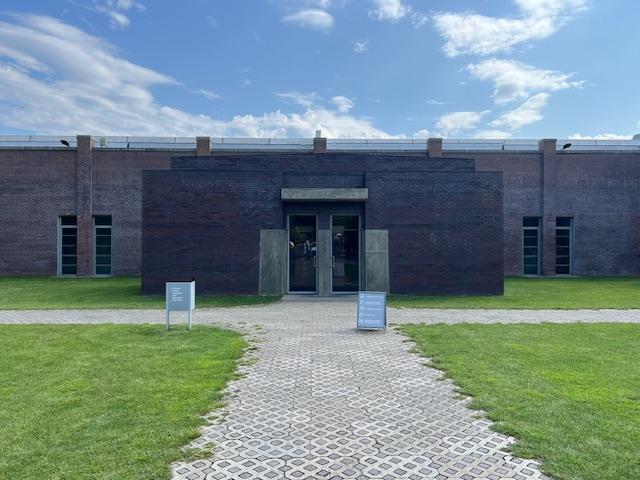
I visited the Dia: Beacon in Beacon, NY many times and I have to say that is an interesting space to display art and the pieces themselves make a statement. The museum is sited on thirty-one acres on the banks of the Hudson River and is adjacent to ninety acres of riverfront parkland. The museum is located in a former printing plant built in 1929 by Nabisco (National Biscuit Company) (Wiki). The space square footage gives the museum the opportunity to display larger statement pieces of well known artists.
The history of the Dia: Beacon:
(from the museum website)
The Dia: Beacon presents Dia Art Foundation’s collection of art from the 1960’s to the present as well as special exhibitions, performances and public programs. The Dia invited artist Robert Irwin to conceive the master plan for a twenty-century museum that retained the original character of the factory’s interior spaces, Irwin also designed seasonally changing garden throughout the surrounding landscape. Following the renovation, the Dia: Beacon was added to the National Register of Historic Places (Dia: Beacon Museum).
Dia Art Foundation:
(from the museum website)
Founded in 1974, Dia Art Foundation is committed to advancing, realizing and preserving the vision of artists. In addition to Dia: Beacon, Dia maintains a constellation of iconic, permanent artworks and installations in New York City, the American West and Germany (Dia Museum).
Each of the galleries are devoted one artist’s work and these galleries make their own statements. There is also a really nice bookstore and gift shop on the extension of the museum and small restaurant.
It is nice to just walk around in your own time and visit each of the galleries. Plan about two hours to see the whole museum. It is an interesting place to see contemporary art in a gallery that is devoted to one artist at a time. The outside grounds of the museum and the parking lot makes it own statement. There is not much parking so plan on getting there early or later in the afternoon.
The museum has clean lines and big halls and a minimalist landscaping
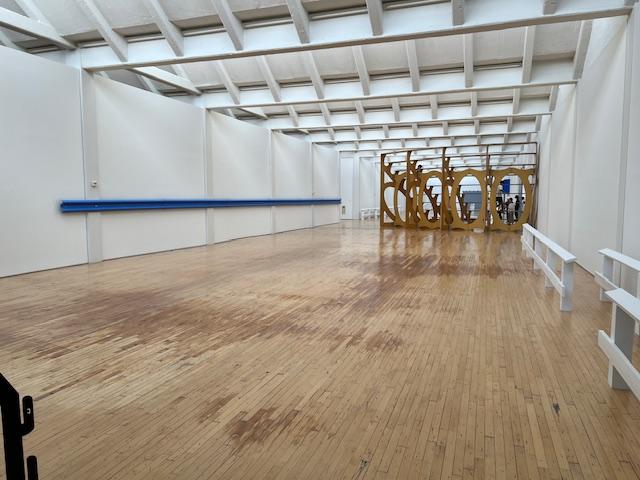
The one thing about the Dia is that the works are quite large and pack a bold statement. The museum uses a combination of both American and Foreign artists and their works make a bold statement. The museums galleries are large and airy and can show larger works of art. The museum shows many of the artists largest pieces of work.
The inside of the Dia: Beacon’s large galleries
These larger pieces were interactive
Inside the museum, many contemporary artists are featured each season. Many of their larger works were featured in their galleries. While the shows rotate collections of many artists, these were the pieces that stood out to me on my visits to the museum over the years.
The Artists I most admired and their works that most stood out to me:
Artist Louise Bourgeois has displayed some interesting sculptures that dominate the upper floors. One of the most fascinating pieces was that of a large spider that dominates the corner of the floor.
This Louise Bourgeois work is a rather creepy piece of art like something out of the movie “It”.
In Bourgeois’s works on view in these galleries, organic formations fuse with the inorganic materiality of the media in which they are rendered, be it marble, wood, or bronze. The artist’s repertoire of materials spans traditional media and new textures, such as latex and synthetic resin. In her work, representation often entails the creation of a surrogate for the body and its suffering organs (Dia: Beacon museum website).
Artist Dan Flavin has some interesting light sculptures on display along the walls and floors of the gallery. Things are made of long fluorescent lights of various colors.
After 1963 Flavin’s work was composed almost entirely of light, in the form of commercially available fluorescent tubes in ten colors (blue, green, pink, red, yellow, ultraviolet, and four whites) and five shapes (one circular and four straight fixtures of different lengths). Initially arranging these fixtures in varying autonomous configurations, Flavin increasingly made work in relation to architecture, such as his monumental barriers that physically block a passageway or segment of a space with light (The Dia: Beacon museum website).
In the main gallery as you walk in are the large geometric shapes of artist Charlotte Posenenske who created these pieces in various colors and shapes. These pieces line the floors and walls.
The geometric shapes of Artist Charlotte Posenenske
Embracing reductive geometry, repetition, and industrial fabrication, she developed a form of mass-produced sculptural Minimalism that addressed the pressing socioeconomic concerns of the decade by circumventing the art market and rejecting established formal and cultural hierarchies. Posenenske employed playful conceptual devices to oppose compositional hierarchy and invite the collaborative engagement of the public in the continual reconfiguration of her variable sculptures (The Dia: Beacon website).
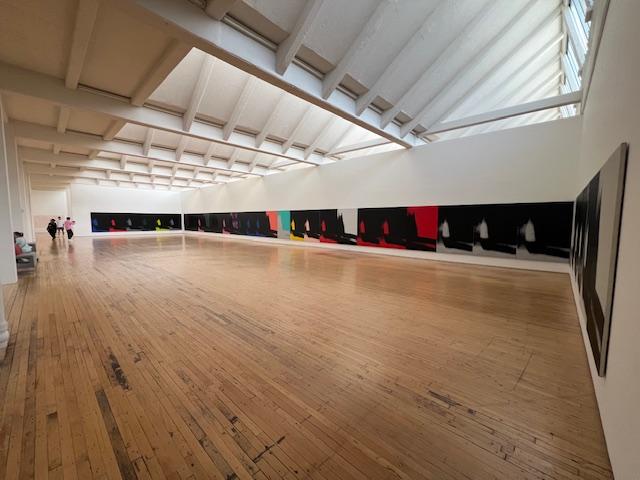
Artist Andy Warhol has one of his largest works displayed in the main gallery on the first floor.
What I loved about the work by Warhol was the continuous colorful pattern of the work and the way it wrapped around the room. The pattern took form in many colors and showed consistency and balance.
A single painting in multiple parts, Shadows is one of Warhol’s most abstract works, yet one that cohesively synthesizes key elements of his practice, including film, painting, photography, and screen-printing. Originally commissioned by Dia and acquired in 1979 for a solo exhibition at 393 West Broadway in New York, Shadows includes a total of 102 canvases; the final number of canvases on view in each installation is determined by the dimensions of an existing exhibition space (The Dia: Beacon museum website).
American artist Senga Nengudi had a some interesting works on display, one resembling melted ‘freeze pops’, which I thought was rather clever. Her large works took liquid forms and were colorful and spontaneous. These large works had lots of color and looked whimsical and fun.
One of Artist Senga Nengudi works
I thought this was a large ‘freeze pop’
One of her non-liquid works
Made of everyday materials such as vinyl, water, nylon, sand, dry-cleaning bags, lint, paper, and tape, Nengudi’s installations are at once proxies for bodies and sites for performance. The works accommodate a variety of cultural references from African, Japanese, and South Asian rites to Western avant-garde art. Characteristic of her openness to multiplicity, the artist, born Sue Ellen Irons, has assumed pseudonyms that inflect her creative identities as sculptor (Senga Nengudi), painter (Harriet Chin), photographer (Propecia Leigh), and writer (Lily Bea Moor) (The Dia: Beacon museum website).
Some of the other works that I liked as I walked around the museum:
Displayed on the first floor of the Dia: Beacon
Another interesting work on the first floor
The large galleries and open air space give patrons a chance to walk around the works and really get a feel for what the artists are trying to express. You really get to see the art up close and that is why I like the way they display their art. We can engage with each piece and develop our own meaning from it.
The grounds and the proximity to the river gives the museum a picturesque spot. It is nice to walk around the lawn on a warm day and enjoy the paths around the museum. The museum also has a very interesting gift shop featuring many books and gifts. The small restaurant can be pricey but offers a place for a light lunch or a quick snack.
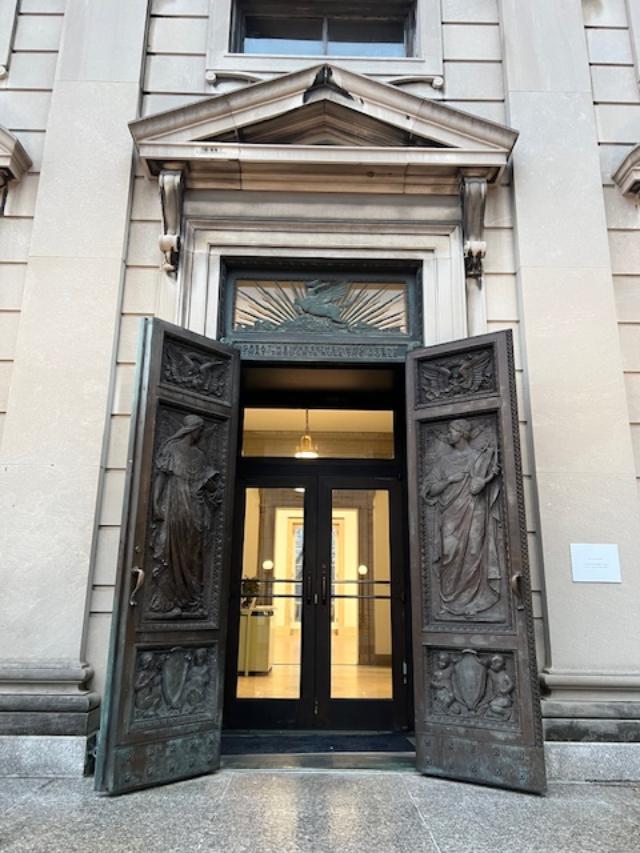
The front of the American Museum of Arts & Letters at 633 West 155th Street
I was finally able to visit the American Academy of Arts and Letters on the last day it was open for the year to the public. It was for the ‘Ceremonial Exhibition: Work by New Members and Recipients of Awards’, an exhibition on members art that was chosen specifically for the show. Most of the work was very contemporary and some a little political. It was interesting work by new artists that filled the small gallery rooms.
The front of the American Museum of Arts & Letters
One of the buildings was used for the contemporary art while the one across the courtyard was used for the more architectural pieces. The galleries are small but the art was impressive. What I liked when I talked with one of the women who worked there said to me that after the show, the pieces would be donated to galleries and museums all over the country. The galleries are only open four months out of the year and this was the last day of the exhibition so the work being shown will be gone.
I visited the museum in January 2025 and it had just reopened after a three year renovation after it had been closed since Pre-COVID and it is now fully open with a new exhibitions. All the galleries are brightly lit and displaying new exhibitions.
The entrance to the museum from the courtyard
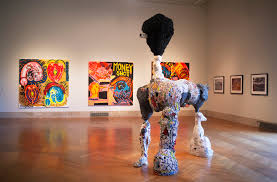
Some of the pieces that really stood out when I visited in 2019 were by Judith Bernstein, a contemporary painter who seems to not like the current administration too much. The themes were on power and money and corruption in the administration. Her work really shows what she personally thinks of our President. Her ‘Trump Genie” was very clever and I can see this in a major museum in the future.
Judith Bernstein’s work
Other work in the main gallery in 2019 were by artists Stephen Westfall with ‘Solid Gone’, Hermine Ford with ‘Paris, France’ and Paul Mogensen with several ‘Untitled’ pieces. The contemporary works I was not sure what the meaning of them were but they were colorful.
The works of the artists of the front gallery
One of the pieces in the front gallery that really stood out was by artist Francesca Dimattio, ‘She-wolf’ which was a classic Greek character made of porcelain, enamel, paint and steel.
‘She-wolf’ by Francesca Dimattio
There were light installations in 2019 that were very interesting by artist James O. Clark. He had one piece, ‘Wunnerful, Wunnerful’, which is a work that just keeps being creating itself by bubbles and ink markers moving along a turntable that stops and starts.
There was a permanent exhibition of Charles Ives home in Connecticut that was transported and recreated here. His studio and works are featured here as well as his family life. There are copies of his works in the display cases and his career.
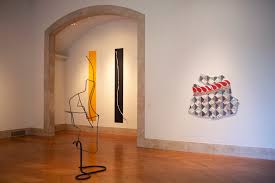
The museum in 2025 was fully open with the exhibition by artist Christine Kozlov, a contemporary Video artist whose works were being featured in the main gallery.
The main gallery of the Kristine Kozlov exhibition
In more than fifty artworks arrayed across four galleries at Arts and Letters, Christine Kozlov shows the breadth of Conceptual artist Christine Kozlov’s practice with a focus on works from the mid-1960s through the late 1970s. Nearly all of the works Kozlov contributed to public exhibitions during this period will be on view, many of which were created for landmark exhibitions of Conceptual art such as: One Month (1969), organized by Seth Siegelaub; Information (1970), curated by Kynaston McShine at the Museum of Modern Art, New York; Arte de Sistemas organized by Jorge Glusberg / CAYC—Centro de Arte y Comunicación at the Museo De Arte Moderno (1971); and the Number Shows, a series of exhibitions curated by Lucy Lippard between 1969 and 1974 (American Museum of Arts & Letters website).
Part of the Kristine Kostov exhibition
Works by artist Christine Kozlov
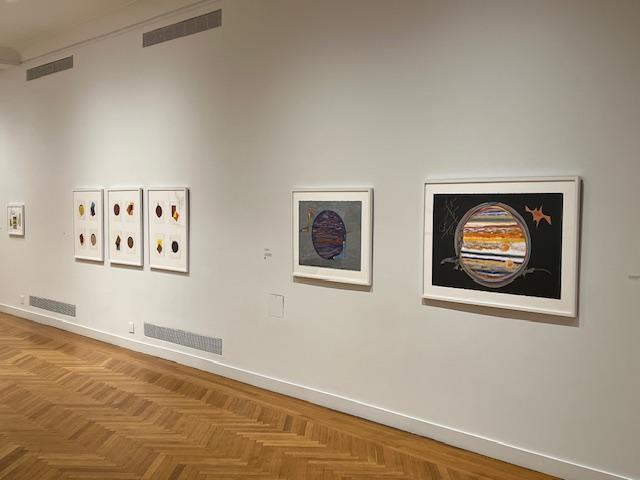
The next exhibition that I viewed was by artist Wadada Leo Smith, which consisted of an exhibition based on colors and sounds. You could take the headsets around the gallery and tour and admire the work with the sounds of the musical groups.
The gallery with works by artist Wadada Leo Smith
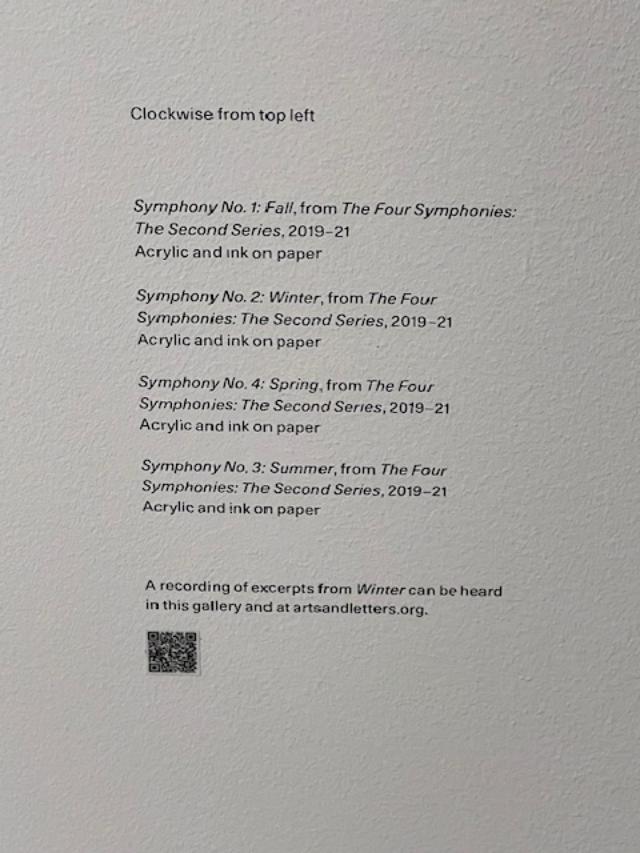
Wadada Leo Smith (b. 1941, Leland, MS) is a composer-performer and Arts and Letters member. Formerly an educator at CalArts, he has influenced decades of musicians and artists, including Raven Chacon. In Kosmic Music, Smith’s first solo exhibition in New York, he shares over fifty years of Ankhrasmation (Museum website).
The “Sphere” works by artist Wadada Leo Smith
Ankhrasmation is a musical language Smith began exploring in 1965. Smith does not consider Ankhrasmation to be his creation but rather something he discovered. The name derives from Ankh,anancient Egyptian symbol of life; Ras,an Ethiopian word for leader or father; and Ma, for mother. The distinctive language uses line, color, and shape to designate musical components such as tonal range and intensity of activity. For Smith, performing Ankhrasmation requires focused practice and “having that space in your heart and mind so that you can play from inspiration.” (Museum website).
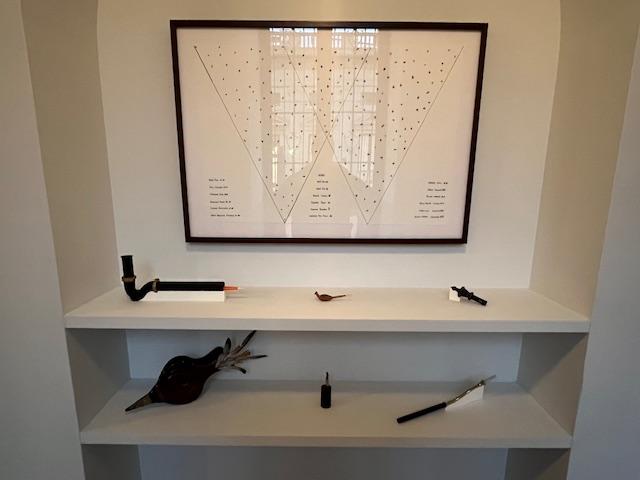
The last exhibition I saw was in the gallery across the courtyard from the main museum was by artist Raven Chacon. You would walk in the main gallery to the sounds of birds both living and extinct. Just five minutes in the main gallery by myself and I felt like Tippi Hedren in the movie “The Birds”. There were all sorts of bird sounds with no birds around.
The instruments that the artist uses to achieve the sounds of the birds
When Raven Chacon (b. 1977, Fort Defiance, Navajo Nation) visited Arts and Letters for the first time, he paused in our North Gallery to clap his hands, then counted how long it took for the room to go silent. It took around six seconds—a long rate of decay. Standing in that echoing chamber, Chacon noted the building’s Beaux Arts design by Cass Gilbert, with its imported Spanish tile and cage-like glass ceiling that filters the sky. He became curious to learn the history of the land it sits on, once owned by John James Audubon, who purchased it in 1841 with funds from the sale of his illustrated Birds of America (Museum website).
Chacon is a composer and artist who frequently works with the materials and histories of a given site and who considers, as he puts it, “what has been silenced and what happens when it is not.” For the past year, he has worked on Aviary, his site-specific commission for the North Gallery, creating a soundscape that makes space and time for careful listening (Museum website).
Museum Mission:
(from the museum website)
The American Academy of Arts & Letters was founded in 1898 as an honor society of the country’s leading architects, artists, composers and writers. Charter members include William Merritt Chase, Kenyon Cox, Daniel Chester French, Childe Hassam, Henry James, Theodore Roosevelt, Elihu Vedder and Woodrow Wilson. The Academy’;’s 250 members are elected for life and pay no dues.
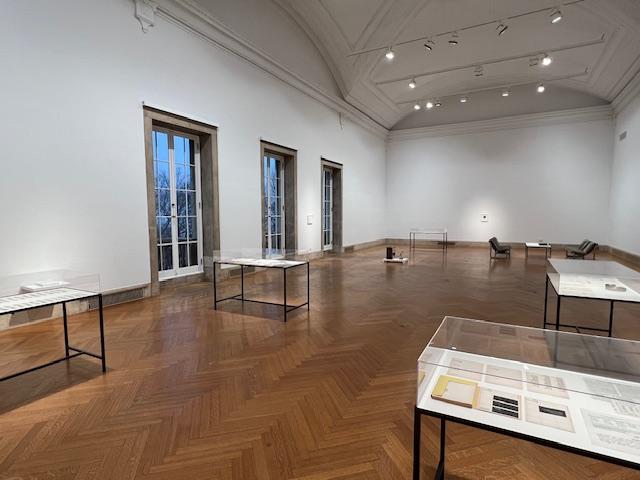
The main gallery of the museum
In addition to electing new members as vacancies occur, the Academy seeks to foster and sustain an interest in Literature, Music and the Fine Arts by administering over 70 awards and prizes, exhibiting art and manuscripts, funding performances of new works of musical theater and purchasing artwork for donation to museums across the country.
Collections:
(from the museum website)
The Academy’s collection, which are open to scholars by appointment, contain portraits and photographs of members, as well as paintings, sculptures, drawings, prints and decorative art objects. The library has more than 25,000 books by or about members. The archives house correspondence with past members, press clippings, institutional records and original manuscripts of musical and literary works.
History:
(from the museum website)
The National Institute of Arts & Letters, the parent body of the Academy, was founded in 1898 for “the advancement of art and literature”. The Institute met for the first time in New York City in February 1899 and began electing members that fall. Architects, artists, writers and composers of notable achievement were eligible and membership was soon capped at 250. In 1913, President Taft signed an act of Congress incorporating the organization in the District of Columbia.
American Academy of Arts & Letters at twilight
In 1904, The Institution created the American Academy of Arts & Letters, a prestigious inner body of its own members that modeled itself on the Academie francaise. The first seven members of the Academy were William Dean Howells, Augustus Saint-Gaudens, Edmund Clarence Stedman, John La Farge, Mark Twain, John Hay and Edward MacDowell. Those seven then chose eight more and so on, until the full complement of 30 and later 50 was reached. Only after being elected to the Institute, was a member eligible for elevation to the Academy. This bicameral system of membership continued until 1993, when the Institute dissolved itself and all 250 members were enrolled in the American Academy of Arts and Letters.
The Academy inaugurated its annual awards program in 1909 with the Gold Medal for Sculpture. Since then, over 70 awards and prizes have been endowed through gifts and bequests or established by the Academy’s board of directors in the fields of architecture, art, literature and music. There are conferred each year at the Ceremonial in May when new members are inducted and a distinguished speaker is invited to deliver the Blashfield Address.
In 2005, the Academy purchased the former headquarters of the American Numismatic Society, the neighboring building on Audubon Terrace. A Glass Link now connects the Academy’s existing galleries to newly renovated ones in the former Numismatic building. These new galleries house the permanently installed Charles Ives Studio.


















 Visiting a Museum: The Unique, Unusual, Obscure and Historical