Category: Statues and Monuments

The Big Duck                                                      1012 Flanders Road                                     Flanders, New York 11901

The Big Duck 1012 Flanders Road Flanders, New York 11901

The Big Duck

1012 Flanders Road

Flanders, New York  11901

(631)852-3377

http://bigduck.org/

Open: Sunday-Saturday 10:00am-5:00pm

Fee: Free donations accepted

TripAdvisor Review:

https://www.tripadvisor.com/Attraction_Review-g754554-d3292234-Reviews-The_Big_Duck-Flanders_Long_Island_New_York.html?m=19905

The History of the Big Duck

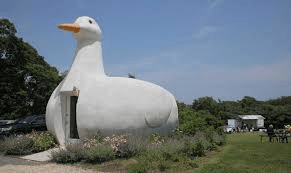
IN 1931, Riverhead duck farmer, Martin Maurer and his wife, Jeule, decided to construct a giant duck-shaped poultry shop. They hoped to sell the Pekin ducks they raised to passing motorists, who would surely be drawn to the striking form of the ‘big duck’ along Riverhead’s West Main Street. The Maurers envisioned this plan while vacationing in California where they are known to have visited a roadside coffee shop shaped like a giant coffee pot.

The Big Duck III

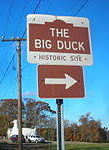
The historic sign

Seeking local assistance, the Maurers hired carpenter George Reeve and two eccentric stage show set designers, brothers William and Samuel Collins. A live duck tied with a string to their porch served as a model for the Collins’ design. Reeve studied the carcass of a cooked chicken in order to create a sturdy, bird-accurate, frame work for the building. Construction of The Big Duck had begun.

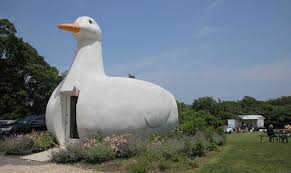
After The Big Duck’s wooden frame had been pieced together, wire mesh was attached. Cement was applied to the wire mesh with the assistance of Smith and Yeager Builders. The Big Duck was painted a lovely bright white, save the beak, of course, which was given its street-line orange color. The finishing touch was the placement of two Model-T taillights in The Big Duck’s head for eyes that would glow red at night. The Big Duck in its entirety measures 30 feet from beak to peaky tail, 15 feet from folded wing to folded wing and 20 feet from its base to the top of its head. As duck farms in the 1930’s were commonly known as duck ranches, Martin Maurer had his giant duck shop and business trademarked as The Big Duck Ranch.

The Big Duck II

The Big Duck roosted at The Big Duck Ranch on West Main Street till 1936. The Maurers’ had sold quite a few ducks from their unique shop and decided to relocate, Big Duck and all, to Route 24 in Flanders. The Flanders community welcomed The Big Duck with open arms and have cherished it since.

The Big Duck’s popularity grew and continues to grow steadily. When the land where The Big Duck rested was slated for development in 1987, Big Duck fans from all over joined Suffolk County in an effort to preserve The Big Duck. The Big Duck’s then current owners, Kia and Pouran Eshghi, generously donated The Big Duck to Suffolk County in December of 1987. The Big Duck was relocated to a nearby County Park. In 2007, since the former site had not been developed after all, the Big Duck was returned to the heart of Flanders.

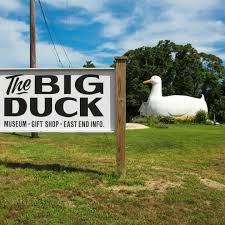
The Big Duck is open to the public as a gift shop and museum. Visitors can browse historic photographs, antique postcards and published articles as well as photos of roadside architecture on display. Unusual duck merchandise or ‘duck-a-billia’ as well as other Long Island  gifts and handcrafted items are available for sale.

The Bid Duck

World Famous Duck Architecture

While The Big Duck is a well-known Long Island landmark, it has also lent its name to a specific style of roadside architecture. The architectural term, “duck” was coined by architects Robert Venturi and Denise Scott Brown in 1968. Duck buildings are highly sculptural forms which represent products or services available within as opposed to the more common ‘decorated sheds’ which are plain buildings whose functions are revealed by added signage.

Within Suffolk County’s Big Duck as with other architectural ducks, the building itself is the signage, a colossal, three dimensional, representational advertisement. Designed to mesmerize passing motorists and entice them ultimately to a purchase, ducks are fantastical while retaining their purely practical intentions. The Big Duck has become the most famous example of roadside architecture.

Another well-known architect named James Wines has proposed the Duck Design Theory, D.D.T., part of which states: ‘Form follows fantasy not function for architecture that cannot offer fantasy fails man’s need to dream.’

Long Island Duck Farms and its history:

How did the Pekin duck get to Long Island? According to legend, in 1870, a Long Island sailor traveled to China and returned with nine of the snowy-white, orange-beaked Pekin ducks. These ducks thrived on Long Island’s splendid waterways when shelter was provided them for the cold winters.

As Pekin duck meat was especially succulent, it marketing potential soon became evident to potential soon became evident to Long Islanders. Duck farms, sometimes known as duck ranches, sprang up all over Suffolk County, producing 60% of the nation’s ducks by 1969. Today that figure has dropped to below 15% due to escalating land values, increased production costs and environmental concerns.

Long Island duckling can still be found as a menu offering at the finest restaurants around the world.

The Big Duck Museum Store features many duck-inspired souvenirs. Find Big Duck t-shirts, caps, magnets, key chains, mugs, note cards, holiday ornaments and children’s items as well as other Duck-a-bilia. Also find many local products: Books on local history, Long Island seaside photography and artwork, hand-crafted items. calendars, post cards and much more.

Directions:

From Western Long Island:

From the LIE, exit 71 take Route 24 south through the Riverhead traffic circle. Cross Route 105 and continue 1 mile on Route 24 to The Big Duck on the left, right after Huntington Lane.

From the Sunrise Highway, take exit 64N (Riverhead), make a right onto Pleasure Drive, Flanders. At a right onto Pleasure Drive, Flanders. At the end, make a left onto Route 24. The Big Duck is on the right, after the access road to the Flanders Men’s Club.

From Eastern Long Island:

From the Sunrise Highway, take exit 65N, Riverhead and travel 5 miles on Route 24 to The Big Duck on the right after the access to the Flanders men’s Club.

Disclaimer: This information was taken directly from the Suffolk County Department of Parks, Recreation and Conservation Division of Historic Services pamphlet. The Big Duck is very unusual to visit and has bathroom facilities.


Franklin D. Roosevelt Four Freedoms Park             1 Four Freedoms Park                                Roosevelt Island, NYC 10044

Franklin D. Roosevelt Four Freedoms Park 1 Four Freedoms Park Roosevelt Island, NYC 10044

Franklin D. Roosevelt  Four Freedoms Park

1 Four Freedoms Park

Roosevelt Island, NYC, NY 10044

(212) 204-8831

Open: Sunday-Monday 9:00am-5:00pm/Tuesday Closed/Wednesday-Saturday 9:00am-5:00pm

Fee: Free

TripAdvisor Review:

https://www.tripadvisor.com/Attraction_Review-g60763-d3595273-Reviews-Franklin_D_Roosevelt_Four_Freedoms_Park-New_York_City_New_York.html?m=19905

The park on a sunny July day

Franklin D. Roosevelt Four Freedoms Park is the first memorial dedicated to the president in his home state of New York. Located on the southern tip of Roosevelt Island in New York City, it is the last work of Louis I. Kahn, an iconic architect of the 20th Century.

The interior of the park facing Roosevelt Island

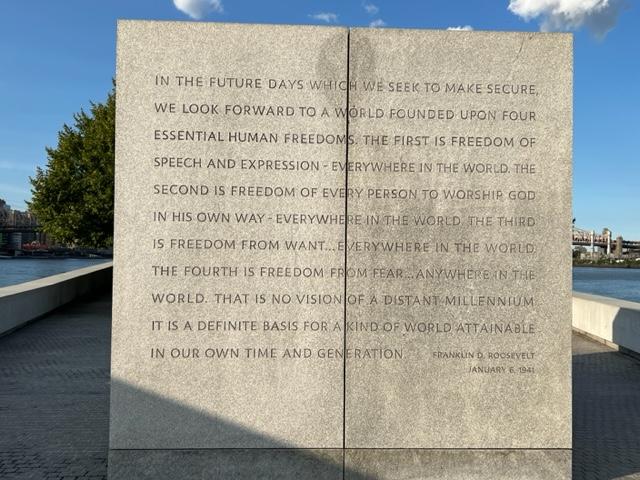
The memorial, which opened to the public in October 2012, celebrates the four freedoms, as pronounced in President Roosevelt’s famous January 6, 1941 State of the Union address: freedom of speech and expression, freedom of worship, freedom of want and freedom from fear. This has been prominently etched on the memorial.

FDR Four Freedoms Park

FDR Four Freedoms Park from a view

Our Mission:

As steward of this civic space, Four Freedoms Park Conservancy advances President Roosevelt’s legacy and inspires; educates and engages the public in the ideals of the four freedoms. The Conservancy does this by:

*Safeguarding the memorial as a space for inspired use.

*Fostering community and understanding.

*Igniting conversation about human rights and freedoms today.

The Four Freedoms that were the goals of the President

On January 6, 1941, President Franklin D. Roosevelt delivered his eighth State of the Union address, now known as the Four Freedoms speech. In his address, Roosevelt presented his vision for the world, “a world attainable in our own time and generation,” and founded upon four essential human freedoms: freedom of speech and expression, freedom of worship, freedom from want and freedom from fear.

Roosevelt’s call for human rights has created a lasting legacy worldwide, forming the basis for the Universal Declaration of Human Rights adopted by the United Nations in 1948.

For a richer of FDR, his legacy and the four freedoms, visit fdr4freedoms.org.

The view from Roosevelt Island of the Upper East Side

Franklin D. Roosevelt Island: A History

Originally called Minnahannock by Native Americans and Varkins Island  by the Dutch settlers, the island was acquired by the Blackwell family in the 1600’s, who renamed the land Blackwell Island. The Blackwells lived on and farmed it before selling it to the City of New York in 1828 for $30,000.

In the 19th Century, the island was used by the City for institutional facilities, including the Workhouse, Penitentiary, Lunatic Asylum, City Hospital and City Home and given the name Welfare Island in 1921. These institutions served the City until the 1930’s., before gradually being relocated to areas more easily accessible to public transportation.

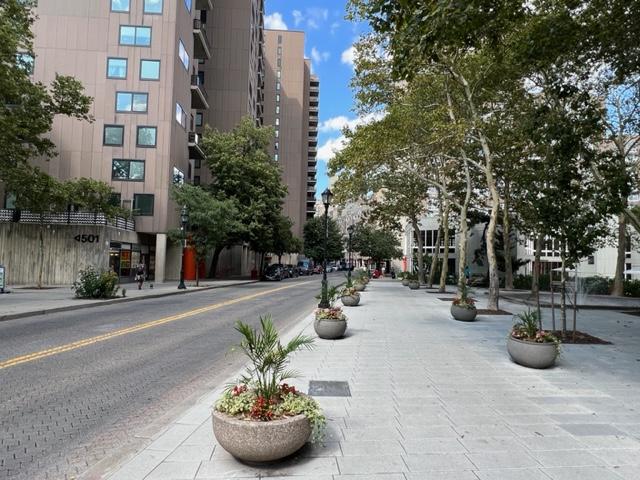
The Roosevelt Island Main Street

In 1969, this two-mile island was lease to the State of New York for 99 years. Under New York State’s Urban Development Corporation, Welfare Island  became a beacon for the affordable housing movement within the City. Construction of the Island community was completed in 1975 with four housing developments. In 1973, the island was renamed Franklin D. Roosevelt Island.

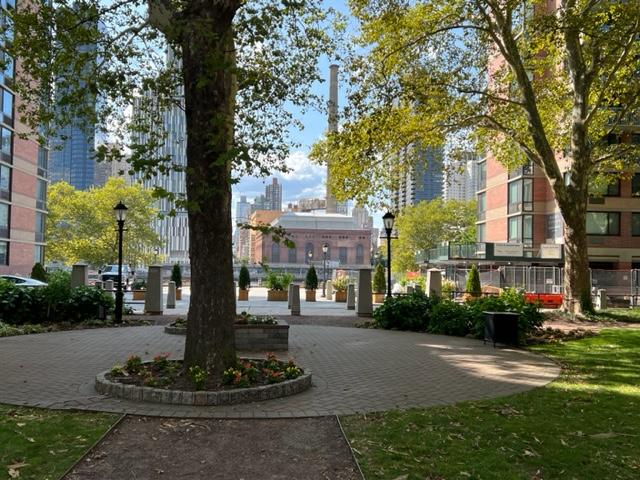
The Gardens in the Main Street of Roosevelt Island

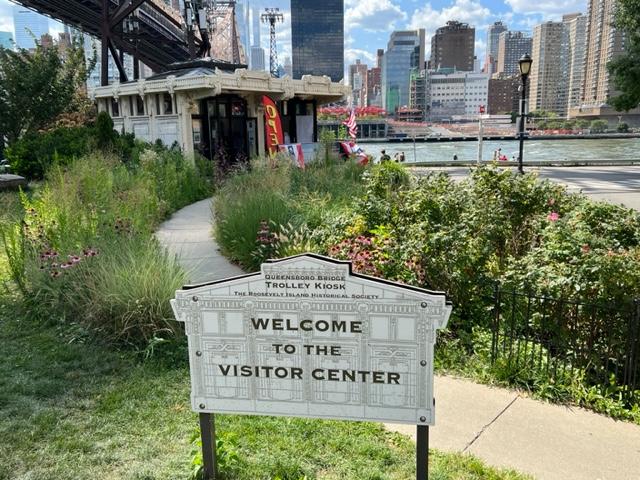
Today, Roosevelt Island has a small town feel with approximately 20 buildings and 14,00 residents. The island is home to six landmarked structures and proudly houses Four Freedoms Park, one of the original visions for the Island. To learn more, visit the Roosevelt Island Visitor Center at the Tram Plaza.

The Visitors Center at Roosevelt Island

(Judith Berdy, President, The Roosevelt Island Visitor Center)

A Memorial to Franklin D. Roosevelt

Nearly 40 years before the Park opened its gates to the public, Louis I. Kahn presented his vision for what would become Franklin D. Roosevelt Four Freedoms Park. It was a simple idea. “I had this thought,” Kahn said. “that a memorial should be a room and a garden.”

The FDR Hope Memorial

This was 1973. Less than a year later, Khan had died; Governor Nelson Rockefeller, who had announced the project with Mayor John  Lindsay, became Vice President of the country and the City of New York neared bankruptcy.

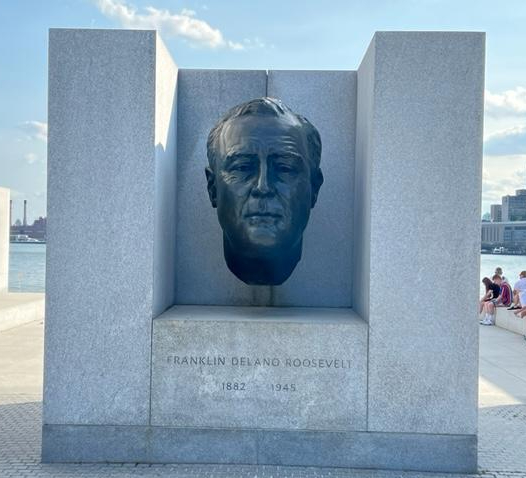
The bust of President Roosevelt

The future of the memorial seemed a fragile and tenuous dream. Yet, through the power and determination of a small but dedicated group, nearly four decades after Kahn completed his architectural design, Four Freedoms Park became the place he envisioned. In 2012, following 30 months of construction, the Park opened to the public. The Park is operated and maintained by Four Freedoms Park Conservancy in partnership with New York State Parks.

(Part of the New York State of Opportunity: Parks, Recreation and Historic Preservation)

I admired the FDR Hope Memorial in which the statue of the President reaches to a young girl with a disability herself. The statue offers encouragement to those with a disability and the power to persevere.

http://www.fdrhopememorial.org/

FDR faces the young girl

the young girl facing FDR

The statue was designed by artist and sculptor Meredith Bergmann, who herself was inspired by the photos and stories of the President (FDR Hope Memorial).

Artist Meredith Bergmann (Cooper Union Alumni Picture)

https://meredithbergmann.com/

Ms. Bergmann is an American born artist with BFA from The Cooper Union School of Art and attended Parsons School of Design and Wesleyan University. Her public works explore history, social justice, human rights and disabilities (Author’s bio).

Franklin D. Roosevelt Four Points Freedom Park is the first memorial dedicated to the president in his home state of New York. Located at the southern tip of Roosevelt Island in New York City. It is the last work of Louis I. Kahn, an iconic architect of the 20th century.

FDR Four Freedoms Park

The memorial, which opened to the public in October 2012, celebrates the four freedoms, as pronounced in President Roosevelt’s famous January 6, 1941, State of the Union address: freedom of speech and expression, freedom of worship, freedom from want and freedom from fear.

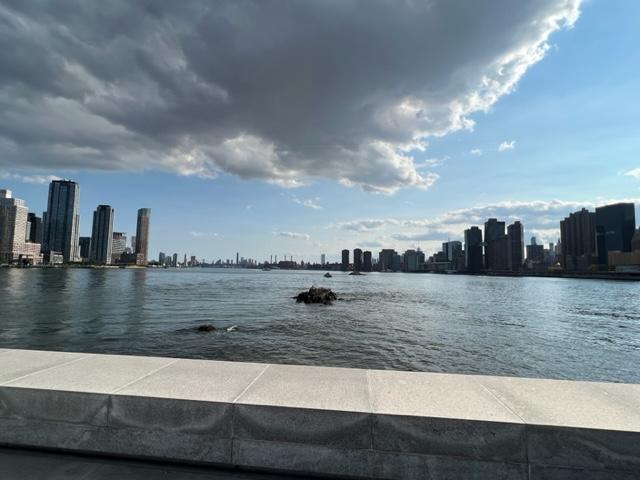
The skyline from the southern part of the park.

Disclaimer: this information was taken from the NYS Parks, Recreation and Historic Preservation pamphlet. Please call the park or email to check on opening times when in season.

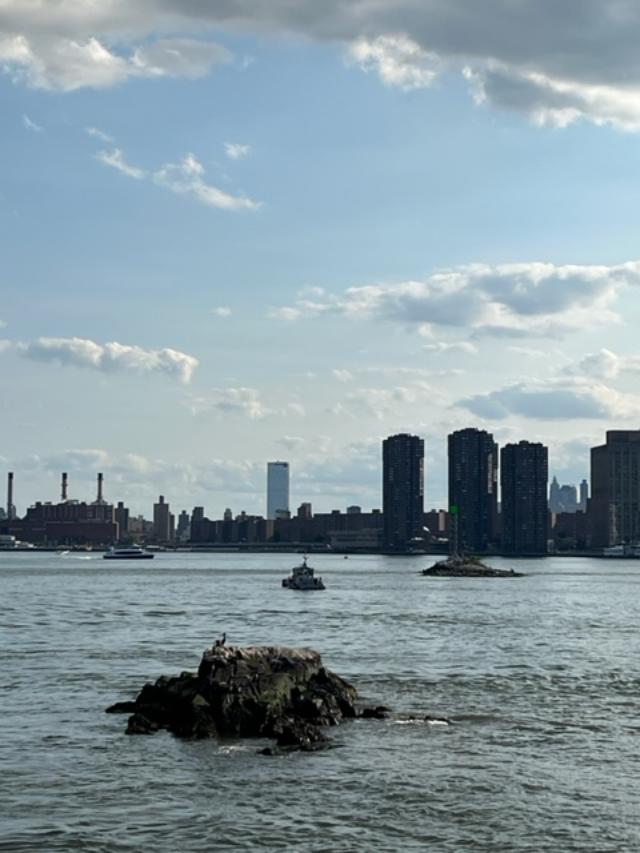
The islands just south of the park.

The ‘Rock’ on Rock Road off Downtown                             Glen Rock, NJ 07452

The ‘Rock’ on Rock Road off Downtown Glen Rock, NJ 07452

The “Rock”

Rock Road

Glen Rock, NJ 07452

https://www.glenrockhistory.org/photography

TripAdvisor Review:

https://www.tripadvisor.com/Attraction_Review-g46466-d2549392-Reviews-The_Rock-Glen_Rock_New_Jersey.html?m=19905

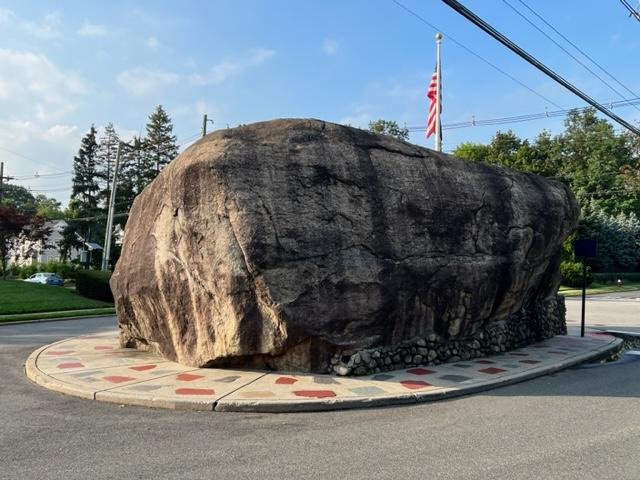
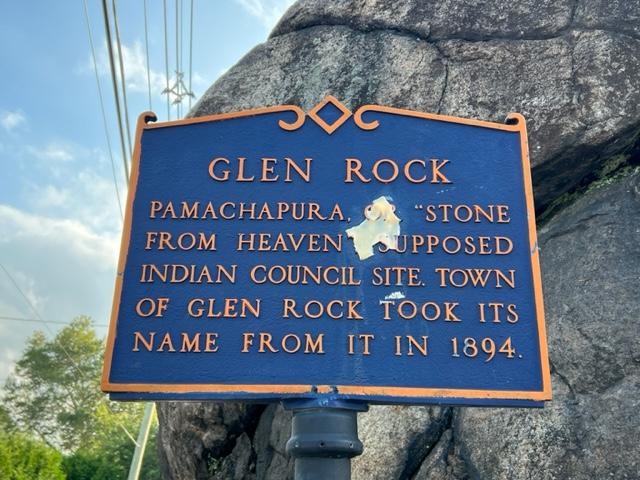
The Rock in Glen Rock, NJ.

The ‘Rock’ where the town of Glen Rock, NJ gets its name from is more than just a rock in the middle of road off the downtown. It has a rich history that is part of the history of Bergen County itself.

Glen Rock was settled around a large boulder in a small valley (glen) from which it gets its name. The boulder, a glacial erratic weighing in at 570 short tons (520t) and located where Doremus Avenue meets Rock Road is believed to have been carried to the site by a glacier that picked up the rock 15,000 years ago near Peekskill, New York and carried it for 20 miles (32km) to its present location.

The Lenape Native Americans called the boulder “Pamachapuka” (meaning ‘stone from heaven’ or ‘stone from the sky’) and used it for signal fires and as a trail marker (Wikipedia).

The Glen Rock Rock

This is an interesting part of Bergen County’s early Native American history and is located right off the downtown area of the town on Rock Road.

General Grant National Memorial 122nd Street and Riverside Drive New York, NY 10027

The General Grant National Memorial

122nd Street and Riverside Drive

New York, NY 10027

(212) 666-1640

https://www.nps.gov/gegr/index.htm

http://www.nps.gov/gegr

Hours: Wednesday-Sunday: 9:00am-5:00pm/Closed Monday-Tuesday/Check for tour times on site.

Admission: Free but donations accepted

TripAdvisor Review:

https://www.tripadvisor.com/Attraction_Review-g60763-d105812-Reviews-General_Grant_National_Memorial-New_York_City_New_York.html?m=19905

A Grateful Nation:

The Grant Memorial was designed by architect John Duncan. Rising to an imposing 150 feet from the bluff overlooking the Hudson River, it took 12 years to build and remains the largest mausoleum in North America. Its  great size was meant to express the profound admiration Americans felt for the Civil War commander and was propelled to the forefront of America’s pantheon of heroes and declared the equal of George Washington and Abraham Lincoln.

Spearheaded by the Grant Monument Association, some 90,000 people from around the United States and the world donated over $600,000 to construct the memorial, the largest public fundraising effort up to that time.

The statuary in front of the building

Initial fundraising was led by Richard T. Greener, first black graduate of Harvard and a Grant supporter who credited the general with his advancement. Many African Americans contributed to the building fund.

The eagles that flank the front of the tomb

The memorial is open from 9:00am-5:00pm daily. For information or to arrange for group visits call (212) 666-1640.

The entrance to the Mausoleum

Among the most Revered of Men:

This large classically proportioned mausoleum honors the Civil War general who saved the nation from dissolution and the president who worked to usher in a new era of peace and equality for all Americans.

The Civil War era flag being displayed inside

Sign for the flag display in the Western trophy case

The flags in the Western trophy case

The sign for the flags in the Eastern Case

The flags in the Eastern case display

Ulysses S. Grant, a plain-spoken unassuming man who studiously avoided pomp and ceremony had volunteered his services for the Union effort when the Civil War erupted in 1861.

The details inside the rotunda

In doing what he considered simply his duty, he emerged after four years of fighting as one of the great military leaders in history. Aggressiveness, speed, tenacity and the ability to adjust his plans in the face of unexpected impediments all helped to bring him victory.

General Ulysses S. Grant

General U. Grant

As great as he was in war, Grant showed magnanimity and compassion in peace. He granted humane and generous terms when General Robert E. Lee surrendered to him on April 9, 1865 at Appomattox Court House. As president he pardoned many former Confederate leaders at the same time insisting on protecting the full political equality of former slaves.

The friezes of General Grant with General Lee

The General leading his troops

The General leading his troops

He was also concerned that American Indian tribes be treated with dignity  and respect. His fundamental desire for peace was reflected in his efforts to solve international disputes by arbitration rather than by threat of war. At the time of his death in 1885. Grant was universally respected by northerners and southerners alike.

The main floor of the tomb

The main floor of the tomb

Because of Grant’s status as a national hero, most Americans assumed he would be buried in Washington DC but his family preferred New York City. Grant himself had no strong preference; his only desire was for his wife, Julia to be buried next to him.

The funeral on August 8, 1885 was one of the most spectacular events New York had ever seen. Buildings all over the city were draped in black. An estimated one million people crowded sidewalks, filled windows, stood on rooftops and climbed trees and telephone poles for a view of the procession, which stretched seven miles and took  five hours to pass.

The resting place for General Grant and his wife

Grant’s remains were placed in a temporary vault until an appropriate memorial could be funded and built. On April 27, 1897, the 75th anniversary of Grant’s birth, thousands of people, including diplomats from 26 countries, attended the dedication ceremony for the completed memorial.

The President’s tomb is surrounded by the busts of his contemporaries:

The bust of General Sheridan

The bust of General McPherson

The bust of General Sherman

The bust of General Ord

The bust of General Thomas

The dedication parade, led by President William McKinley, was almost as large as Grant’s funeral parade. Julia Grant reviewed the ceremony sitting next to President McKinley. She was laid by her husband’s side after her death in 1902.

The Tomb of General Grant and his wife

The tomb is located in Riverside Park near Columbia University and across the street from Sakura Park, where Japanese Cherry trees are in bloom every Spring.

The park outside the Memorial

The Memorial with a park view

The Memorial from the park

The Memorial from Claremont Park

Claremont Park behind the tomb is beautiful in the Spring

The artwork surrounding the tomb

The artwork surrounding the tomb

The artwork surrounding the tomb

Near the tomb is the memorial to the ‘Amicable Child’ and that should not be missed as well.

The Tomb of the Amiable Child right down the path

The little park the tomb sits in

Disclaimer: This information was taken directly from the National Park Service pamphlet. This is a very interesting National Memorial and should not be missed.

The gift shop is across the street

The theater is in the next room where you can watch the film

It is opened at certain times of the week, so please look for the posted hours. (The memorial is open from 9:00am to 5:00pm daily. For more information or to arrange for groups visits, please call (212) 666-1640).