Tag: Walking the Upper East Side

Gracie Mansion Carl Schurz Park East 88th Street and East End Avenue New York, NY 10128

Gracie Mansion

Carl Schurz Park

East 88th and East End Avenue

New York, NY  10128

(212) 570-4773

Hours: Mondays only-10:30am. 12:00pm and 1:30pm. See their website at www1.nyc.gov/site/Gracie/visit/visit page or gracieinfo@cityhall.nyc.gov

http://www.historichousetrust.org

https://www.nycgo.com/events/gracie-mansion-tours

https://www.graciemansion.org/

Admission: $10.00

TripAdvisor Review:

https://www.tripadvisor.com/Attraction_Review-g60763-d136688-Reviews-Gracie_Mansion-New_York_City_New_York.html?m=19905

Hours: There are free house tours at 10:30am, 12:00pm and 1:30pm on Mondays only. Check their website for availability. This is one of the few rare treats of New York if you can snare one of the tours of Gracie Mansion. It is a really interesting tour of the first floor rooms and entrance to the gardens of this historic home and the Mayor of New York City’s residence.

This was really a wonderful tour of the mansion given by a woman who has been a docent for twenty years and has seen the changes of the administrations. We went room by room and discussed how the Gracie’s then the Wheaton’s and the other families who lived here use the house until Robert Moses, the great City Planner, decided this should become the Mayor’s residence.

The front of the mansion at the start of the tour in the Summer of 2025

The formal gardens in front of the house in full bloom

The formal gardens to the side of the house near the parking lot

We started the tour on the front porch of the old Gracie Mansion

The tour consists of the first floor only and you can not take pictures inside with the exception of the Wagner Ballroom. We saw the formal entrance, the Living Room, Library, Dining Room and then the hallway leading to the front of the house to the Susan Wagner Ballroom, the newest extension of the house (the front section is the original section of the home built during the Gracie period).

The front rooms you are not allowed to take pictures so as you tour the Living Room, the Dining Room and Parlor rooms, you can not take pictures. When we left the older section of the home and entered the hallway to the Susan Wagner Ballroom added in the Wagner Administration, then you could take pictures in this room only (outside the gardens).

The inside of the Susan Wagner Ballroom

The Chandelier in the ballroom was from an old mansion downtown

The Bayard Fireplace from the Bayard Mansion once located in lower Manhattan

The Wagner Ballroom details

History of the Mansion and Gracie Family:

Gracie Mansion, built in 1799 by shipping merchant Archibald Gracie, is the last of the elegant county estates that once lined Manhattan’s East River shore. Gracie hosted elegant dinner parties at his country estate for visitors including Alexander Hamilton, Rufus King, Joseph Bonaparte and Washington Irving.

Archiebald Gracie

Archibald Gracie

https://en.wikipedia.org/wiki/Archibald_Gracie

Major losses during the years after the War of 1812 forced Gracie to sell his estate in 1823 to Joseph Foulke. In 1857, the Mansion was bought by Noah Wheaton. After Wheaton’s death in 1896, the City of New York appropriated the estate, incorporating ts 11 acres of grounds into the surrounding park that was renamed Carl Schurz Park in 1910.

After years as a comfort station and ice cream stand, Gracie Mansion became the first home of the Museum of the City of New York. When the museum moved to a larger building, Parks Commissioner Robert Moses convinced  City Authorities to designate the Mansion as the official residence of the Mayor. In 1942, Fiorello H. La Guardia moved into Gracie Mansion.

In 1966, the Mansion was enlarged with the construction of the Susan E. Wagner Wing, which includes a ballroom and two additional rooms. Under the guidance of the Gracie Mansion Conservatory, major restorations to the Mansion were undertaken between 1981 and 1984 and in 2002.

The 2002 restoration transformed Gracie Mansion into the “People’s House” and increased accessibility to the public and City agencies. First Lady Rosalyn Carter and South African President Nelson Mandela are among the many notable visitors.

Gracie Mansion II.jpg

Gracie Mansion at the turn of the last century

Gracie Mansion is owned by the New York City Department of Parks & Recreation, operated by the Gracie Mansion Conservatory and is a member of the Historic House Trust.

(Gracie Mansion Pamphlet)

Gracie Mansion Conservatory:

After years of neglect and continual erosion of any trace of history, Mayor Edward I. Koch and founding Chair Joan K. Davison, established the Gracie Mansion Conservatory in 1981. as a public./private partnership.. Under its guidance, the first major restoration of the house was undertaken between 1981 and 1984. Besides creating a connection between  the original house  and the Wagner Wing, this effort included the display of art, furniture and decorative objects either  purchased or more often, lent by the City’s many cultural institutions. The Charter mandate of the Conservatory was not to seal the residence in the past (especially as there is no record of how it originally appeared inside) but to protect its history while accommodating change and progress by successive generations of New Yorkers.

The Gracie Mansion Conservatory continues to operate as a charitable organization dedicated to enhancing and enlivening its namesake. Its mission is to preserve and honor Gracie Mansion’s Federal Period origins while also making sure it remains as forward-looking and welcoming as the city it serves. An increasing  share of this work focuses on exploring the many different people and cultures whose contributions to Gracie Mansion and the New York at large gone unrecognized for far too long. The Conservatory also works to improve the surrounding landscape and gardens and provide public programming and educational services, including publications and tours for local school students, especially those studying in New York State’s 7th grade social studies curriculum.

(Gracie Mansion Conservatory pamphlet)

Disclaimer: This information was taken from the Gracie Mansion Conservatory pamphlet press kit given on my tour and I give the Conservatory full credit for it. Please check the website for tour information or call them to find out about group tours.

It really is a great tour!

Gallery of New York School of Interior Design:   NYSID Gallery                                                        170 East 70th Street                                                             New York, NY 10021

Gallery of New York School of Interior Design: NYSID Gallery 170 East 70th Street New York, NY 10021

Gallery of the New York School of Design; NYSID Gallery

170 East 70th Street

New York, NY 10021

(212) 472-1500

https://www.nysid.edu/exhibitions

https://www.nysid.edu/

Hours: Tuesday-Saturday: 11:00am-6:00pm/Closed on Sunday and Monday

Admission: Free

My review on TripAdvisor:

 New York School of Interior Design at 170 East 70th Street

I came across the Gallery of the New York School of design when walking the Upper East Side for my project, ‘MywalkinManhattan.com’ when covering the lower part of the Upper East Side.

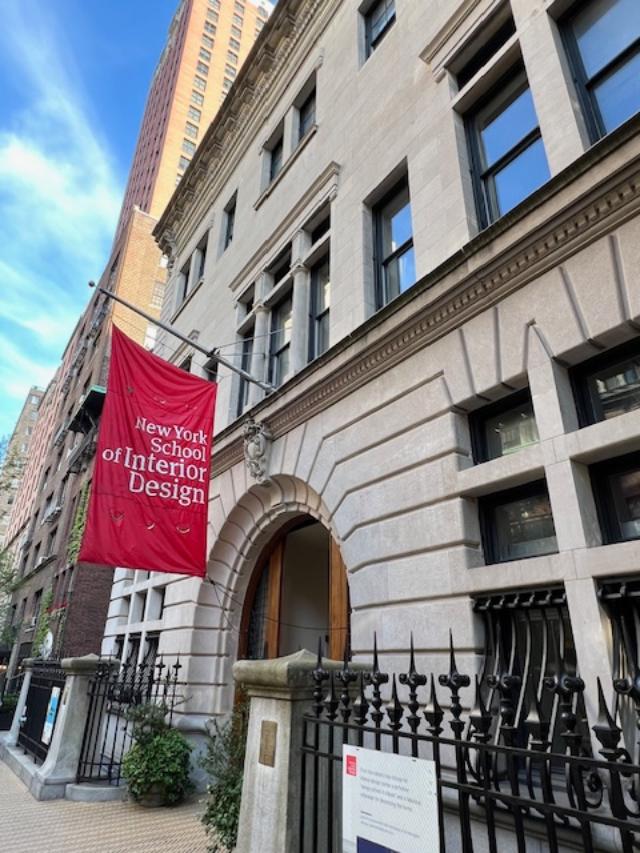
The entrance to the Gallery

The New York School of Interior Design was displaying their Senior projects as most the college galleries I visited were doing at this time (this takes place between May and June around graduation time). It was interesting to see how the seniors at the college reused space in old buildings for new purposes. The seniors use their creativity to recreate these spaces. It is the student’s project to take a space and redesign it for a new purpose.

The entrance sign to the gallery

We had done similar projects in college but did not have the computer technology that students do today and they really went above and beyond the things we did back then. You can take this project into 3-D if you want and how real it looks. These kids are so talented that their creativity reminds me of us when we were in school. If only we had what they have today.

The Student Projects line the walls

Take time to look at the detail work and space design of each project. Some of the students even include samples of fabrics and stone/wood work that will be used for the surfaces.

The Gallery is located on the Upper East Side in the back of the school’s building on the first floor. The admission is free and the Gallery is open when the school is open. There are only two shows a year. You just have to show your ID to get into the galleries.

The student project along the walls

The student project along the walls

What I like about the museum is that you get to see the student creativity and how they imagine the space will be designed. The use of color and shape play a roll in all the designs. It looks like the students get to choose their own space to design.

The best part is the you get to go in for free with you ID and just enjoy the show and see the students creativity.

History of the Gallery/Museum at the College:

The New York School of Design’s gallery presents two public exhibits yearly on design and architecture. Exhibitions have included ‘Paris in the Belle Epoque’, rare photographs from the years 1880-1914; Perspective on Perspective, an exploration of artistic technique; ‘The Great Age of Fairs; London, Chicago, Paris, St. Louis’, selective coverage from the first World’s Fair in 1851 to the last in 1904; ‘Venice’s Great Canal’, architectural drawings of the buildings along the famous thoroughfare; ‘Stanford White’s New York’, a survey of that classicist’s many metropolitan buildings and ‘Vanishing Irish Country Houses’, a look into the preservation crisis facing these not infrequently grand structures.

The gallery’s Thursday-evening lectures have included ‘Palladio’s Villas’; ‘Beaux-Arts New York’ and a survey of the Grands Projects undertaken in Paris during the tenure of French President Francois Mitterrand.

(New York School of Interior Design Website)

Americas Society Museum                                   680 Park Avenue                                                 New York, NY 10021

Americas Society Museum 680 Park Avenue New York, NY 10021

Americas Society Museum

680 Park Avenue

New York, NY 10021

(212)628-3200

https://www.as-coa.org/visual-arts/arts_americas_circle

https://www.as-coa.org/arts-culture-americas-society

Open: Wednesday-Saturday: 12:00pm-6:00pm/Closed Sunday-Tuesday
Varies with exhibitions

Admission: Free

http://www.as-coa.org/visual arts

My review on TripAdvisor:

https://www.tripadvisor.com/Attraction_Review-g60763-d548518-Reviews-Americas_Society-New_York_City_New_York.html

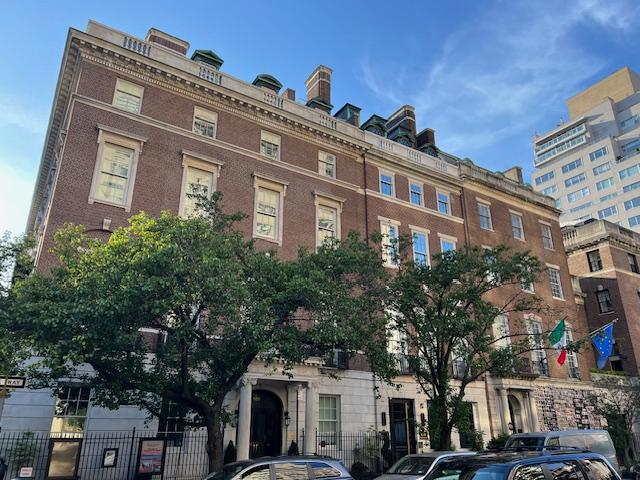
 The Americas Society Museum at 680 Park Avenue

I came across the Americas Society Museum when walking on Park Avenue on the Upper East Side for my walking project, “MywalkinManhattan.com”. I noticed the sign for the exhibition, “The Metropolis in Latin America 1830-1930”. The exhibition was on the transformation of cities in Latin America from their traditional path starting with Spanish colonization to a more European layout that was developed between the Revolutionary and Civil Wars with the ‘Gilded Age’ thrown in as the third generation of settlers became long time citizens and became more wealthy.

They wanted to live like they were still in Europe. It showed how the cities developed over time with planning and then with extended, unintended growth that lead to the outlaying slums. Very interesting exhibition (now closed).

Americas Society Museum II

A exhibition at the Americas Society Museum

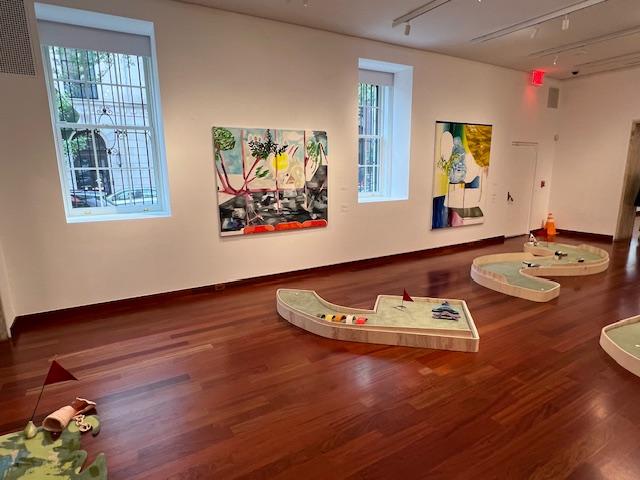
In the summer of 2024, the museum had an interesting exhibition on artist Alejandra Seeber. Her colorful interactive works had some of the patrons playing golf inside of the galleries. I thought her work was vibrant and exciting. She draws you in with the bright invigorating colors and on the floor pieces of carpet whose colors lead your golf balls from hole to hole as you travel the exhibition.

The museum press release on the Alejandra Seeber exhibition:

The description of the show:

(from the museum’s website):

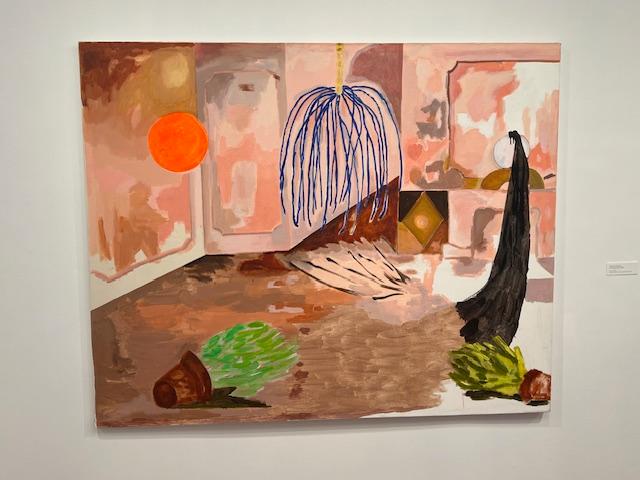
Americas Society presents the first solo exhibition and career survey of the Argentine artist Alejandra Seeber in New York, starting June 5. Seeber (b. 1969, Buenos Aires, Argentina) is a painter who centers representations of various spaces to explore the tension between representation and abstraction in painting. Seeber utilizes bold color and gesture to examine liminal spaces within built and domestic environments. Later work veers further into abstraction, implementing visual devices like Rorschach drawings or knit grids to structure the composition. 

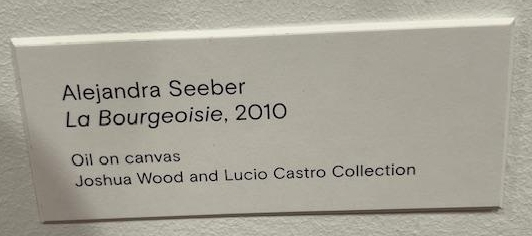
My favorite painting in the show by Alejandra Seeber “La Bourgeoisie”

The sign of the painting

The exhibition  pairs these paintings with Seeber’s contemporary explorations of the built landscape with an installation. This survey of her work is organized around a playable golf course installed inside the gallery space in which visitors will be invited to play golf as they walk through the show. The golf obstacles become active sculptures in the exhibition, creating porous boundaries between artwork and audience. This playful environment manifests the explorations of edges, doorways, windows, and borders in the artist’s painting. As they play, visitors will be able to trace Seeber’s artistic trajectory and see how her interventions in the form and practice of painting continue to this day. 

The vibrance of the art with its colorful details

The interactive art in the gallery

The art golf course

History:

The Americas Society is an organization dedicated to education, debate and dialogue on the Americas and is located at 680 Park Avenue on the Upper East Side of Manhattan. The Americas Society was established by David Rockefeller in 1965. The Americas Society promotes the understanding of the economic, political and social issues confronting Latin America, the Caribbean and Canada; its mission is “to increase public awareness and appreciation of the diverse cultural heritage of the Americas and the importance of the inter-American relationship.

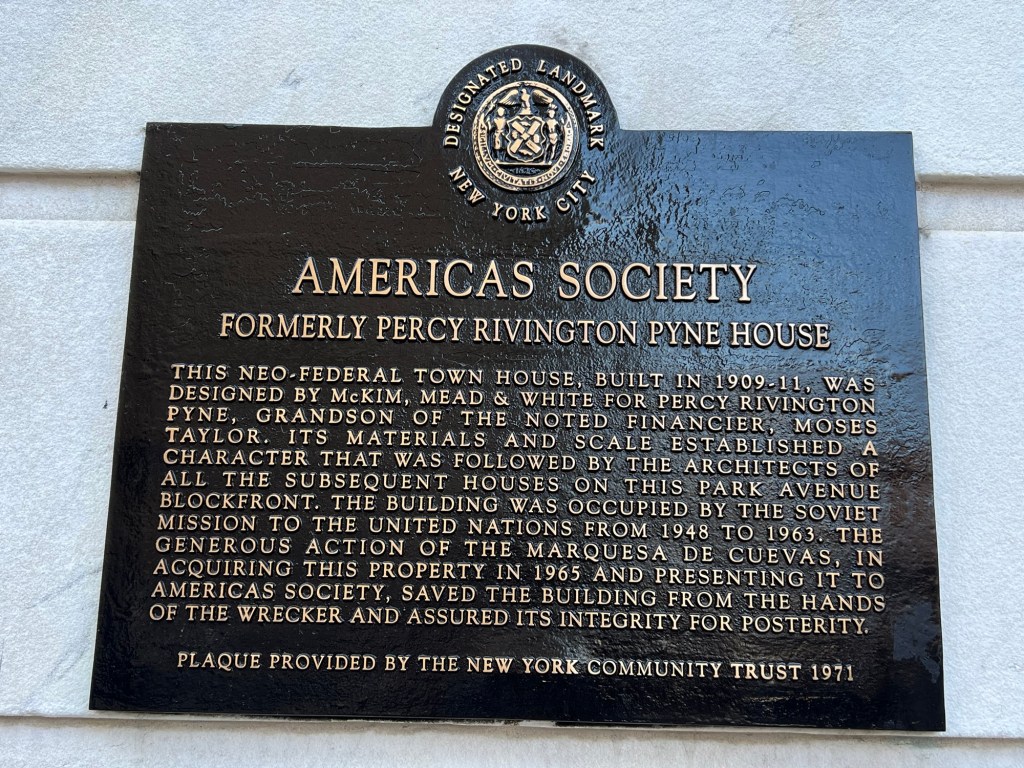
The buildings historical past as the Percy Rivington Pyne House

https://en.wikipedia.org/wiki/Percy_Rivington_Pyne_I

The Americas Society Building is listed in the National Register of Historic Places. The building was previously the Percy Rivington Pyne House before serving as the Soviet Mission to the United Nations until its current usage. along with the neighboring buildings of the Queen Sofia Spanish Institute and the Italian Consulate General, the house constitutes one of the few remaining unified architectural ensembles on Park Avenue. The Center for Inter-American Relations was later to be absorbed into Americas Society 1985.

Activities:

The Americas Society organizes interviews, speeches, podcasts, exhibitions, readings and musical performances at its headquarters and reports on Congressional updates and local events. Many events are held at the Salon Simon Bolivar, an expansive room in the building’s Neo-Federal style with wide windows, a 15 foot ceiling and wood-paneled and silk fabric walls.

Americas Society Museum III

An Exhibition at the museum:

The Americas Society produces the MetLife Music of the Americas (concert series) to showcase the diversity of styles and genres of music in the Americas. The concert series is held at the Society’s headquarters.

The Americas Society, together with Council of the Americas, produces the publication ‘Americas Quarterly’, a policy journal for the Western Hemisphere. The Americas Society also publishes ‘Review Magazine’, which was first founded in 1968. ‘Review Magazine’ is an English language journal for literature from Latin America, the Caribbean and Canada. ‘Review Magazine’ also helped support the first English translation of “One Hundred Years of Solitude” by Gabriel Garcia Marquez as well as other translations.

The Americas Society has also organized working groups on the topics of women’s empowerment and leadership. Cuba, energy policy, immigration, trade facilitation and Venezuela.

Americas Society Museum

Council of the Americas (COA)

Is the premier international business organization whose members share a common commitment to economic and social development, open markets, the rule of law and democracy throughout the Western Hemisphere. The Council’s membership consists of leading international companies representing a broad spectrum of sectors, including banking and finance, consulting services, consumer products, energy and mining, manufacturing, media, technology and transportation.

(This information was taken directly from Wiki and Americas Society publications)

Asia Society and Museum                                    725 Park Avenue at 70th Street                         New York, NY 10021

Asia Society and Museum 725 Park Avenue at 70th Street New York, NY 10021

Asia Society & Museum

725 Park Avenue At 70th Street

New York, NY 10021

(212) 288-6400

AsiaSociety.org/NY

https://asiasociety.org/new-york

Open:

Museum: Tuesday-Sunday-11:00am-6:00pm, Friday-11:00am-9:00pm

Asia Store: Monday-Sunday-11:00am-6:00pm, Friday-11:00am-9:00pm

Garden Court Cafe: Tuesday-Sunday, 11:30am-3:00pm; Reservations: (212) 570-5202

Asia Society is closed on major holidays. Please check AsiaSociety.org/NY for updates on museum, store and cafe hours.

Fee: $12.00 Adults/$10.00 Seniors/$7.00 Students with ID/Free to members and children under 16/Free Admission Fridays, 6:00pm-9:00pm

Adult, Student and Teacher tours:

For information or to schedule a tour, call (212) 327-9237

*Wheelchair accessible/available for use during visits/Complimentary cell phone audio tour available/Assistive listening devices and headsets available for many programs. 

TripAdvisor Review:

https://www.tripadvisor.com/Restaurant_Review-g60763-d531995-Reviews-Asia_Society_and_Museum_Garden_Court_Cafe-New_York_City_New_York.html?m=19905


History of the Museum:

Asia Society II

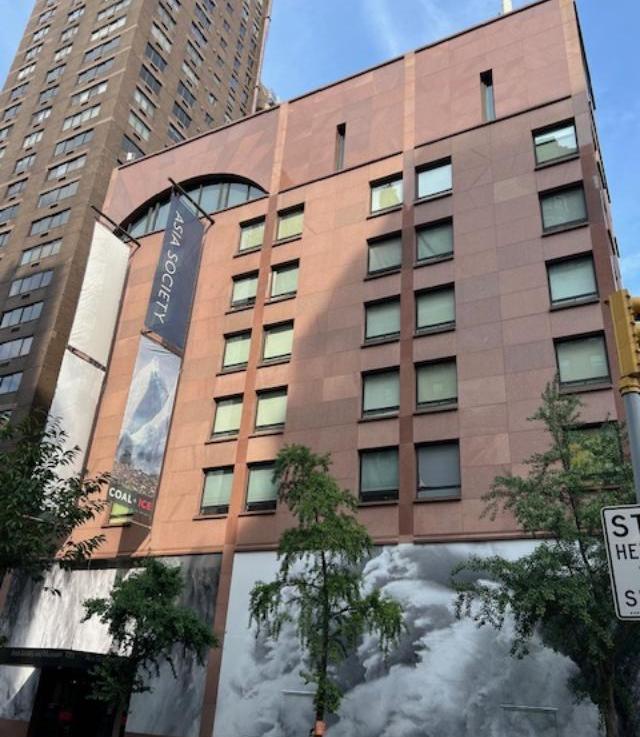
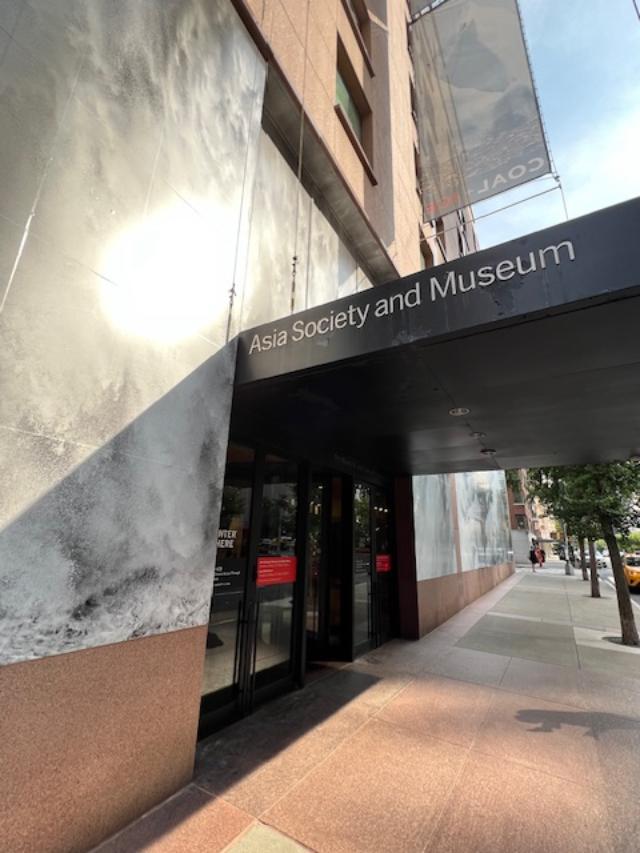
The entrance to the Asian Society Museum

John D. Rockefeller 3rd (1906-1978) , who established Asia Society in 1956, firmly believed that art was an indispensable tool for understanding societies. From 1963 to 1978, he and his wife, Blanchette Hooker Rockefeller (1909-1992), worked with art historian Sherman E. Lee (1918-2008) as an advisor to build the Mr. and Mrs. John D. Rockefeller 3rd Collection, which was later bequeathed to Asia Society.

Asian Society Museum

The Rockefeller Collection

The group of spectacular historical objects they assembled-including sculpture, painting and decorative arts-became the core of the Asia Society Museum Collection and is world renowned. The Collection, now consisting of approximately 300 pieces, is distinguished by the high proportion of acclaimed masterpieces, to which additional high-quality gifts and acquisitions have been added since the original bequest to Asia Society. The Collection has particular strengths in Chinese ceramics of the Song and Ming periods, Chola-period Indian bronzes and Southeast Asian sculptures.

Extraordinary examples of decorative art in the acclaimed Asia Society Museum collection include a number of superior East Asian ceramics, which make up more than one-third of the Collection. A luminous pair of twelfth-century Korean bowl and saucer sets, covered with the celebrated celadon glaze of the Goryeo period and an extraordinary tea leaf jar, decorated with mynah birds and accented with silver by Japanese ceramic artist Nonomura Ninsei (active ca. 1646-1677) are among the ceramic highlights.

Asia Society III

Walking around the museum

An exquisite solid silver Chinese stem up that dates to the late seventh or early eighth century also stands out as an exceptional masterpiece of decorative art within the Collection. The skill of the craftsman is evident in the fine embossing, chasing and engraving of the birds, flowers and scrolling vines on the exterior of the cup.

Two other great strengths of the Collection are Hindu and Buddhist sculpture from South and Southeast Asia. An eleventh-century processional sculpture of the elephant-headed Hindu deity Ganesha is an endearing example produced by the South Indian master bronze casters at that time and one of the fifteen important Chola-period bronzes in the Collection.

Another great treasure is a rare eighth-century inscribed and dated inlaid-brass crowned Buddha seated on a lotus rising from water inhabited by serpent deities (nagas) from Kashmir or northern Pakistan. A sculpture of the serene and slender Buddhist Bodhisattva Maitrya stands just over an impressive three-feet tall and represents the pinnacle of Thai metal casting during the eighth-century.

These objects and the Asia Society Museum Collection as a whole continue to be an important means for sharing the talent, imagination, and deep history of the peoples of Asia with audiences all over the world.

(From: Masterpieces from the Asia Society Museum Collection)

We are …Policy

With top-level experts and advisors-including former heads of state and cabinet officials, CEOs, civil society leaders and scholars-the Asia Society Policy Institute creates solutions that advance Asia’s prosperity, security and sustainability. Its projects include working to strengthen regional security institutions and mechanisms in Asia, assessing the impact of China’s rise and tracking its economic reform program, recommending pathways to an inclusive and high-standard Asian trade architecture, charting a path for India’s admission to APEC and designing strategies for Northeast Asian economics to link carbon markets and reduce greenhouse gas emissions.

The Asia Society Center on U.S. China Relations seeks to build mutual understanding between the two countries through projects and events on policy, culture, business, media, economics, energy and the environment.

We are…Arts

Transforming Americans understanding of Asia through exhibitions and performing arts was at the heart of our founder’s vision. The bequest of the Mr. & Mrs. John D. Rockefeller 3rd Collection of traditional Asian art in 1979 spurred the building of our New York headquarters. Today, our ground-breaking exhibitions of traditional, modern and contemporary art-as well as performing arts, film and author programs-are presented to the highest acclaim at our centers in New York, Hong Kong and Houston and at venues all over the world. Global initiatives such as the Arts & Museum Summit bring together museum and cultural leaders from across Asia, the United States and Europe further appreciation of Asian arts.

Asia Society I

The gift shop at the Asia Society

We are …Education

A rising Asia requires a rising generation of students to understand its cultures and complexities. The Center for Global Education at Asia Society has developed an internationally recognized approach to foster the global competence of students, aiming to improve the capacity of 100,000 educators to instill global competence in 4 million youth by 2030. We partner with leaders and institutions from around the world to transform teaching and develop global-ready students. We also lead a major effort to bring Mandarin language instruction and the study of China and Chinese culture to children in the United States and to bring global learning to American after school programs, in pursuit of best practices in global education.

(From Asia Society pamphlet)

Asia Society is a non-profit, nonpartisan organization offering dynamic public programming at our cultural centers in New York, Hong Kong and Houston and at our other global locations in the United States, Asia and Europe.

Asia Society appreciates the support of its members, who aid our vital mission of preparing Asians and Americans for a shared future. For more information, AsiaSociety.org.

Disclaimer: This information was taken directly from the pamphlets from the Asia Society in New York City. I give them full credit for all the information. Please see the above hours and programs and call the above numbers for more information.