Tag: Small Museums in NYC

Poster House                                                         119 West 23rd Street                                          New York, NY 10011

Poster House 119 West 23rd Street New York, NY 10011

Poster House

119 West 23rd Street

New York, NY 10011

(917) 722-2439

https://www.facebook.com/posterhousenyc/

Open: Sunday 10:00am-6:00pm/Monday-Wednesday Closed/ Thursday-Saturday 10:00am-6:00pm

Admission: Adults $12.00/Children Over 18/People with Disabilities/Students & Educators/Veterans $8.00. Children under 18 and Members are free (please check website for changes)

My review on TripAdvisor:
https://www.tripadvisor.com/Attraction_Review-g60763-d17794247-Reviews-Poster_House-New_York_City_New_York.html

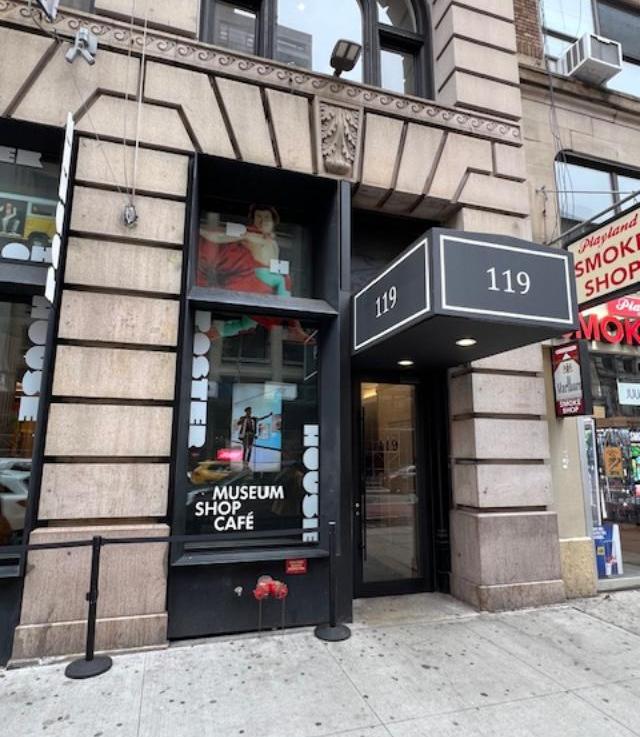
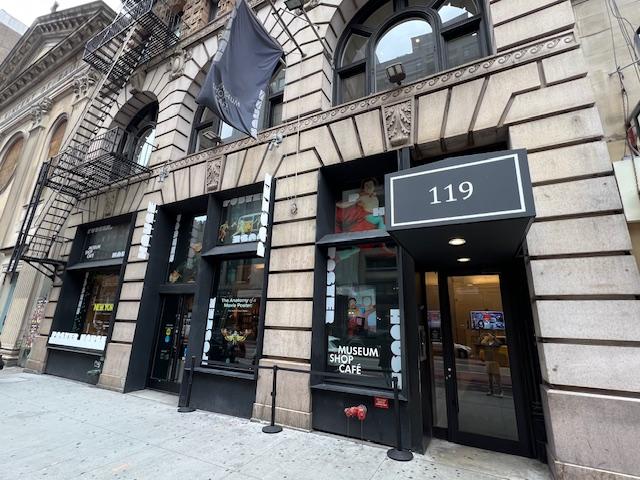
The Poster House Museum at 119 West 23rd Street.

The Poster House is a little gem of a museum that I must have passed many times and never knew it was a museum. I had never heard of this museum before. The Poster House is dedicated to the history and art of posters and how they impact our lives as a way of communication. I got a chance to see the whole museum in about two hours.

The first exhibition on the first floor of the museum was “Utopian Avant-Guard: Soviet Film Posters of the 1920’s”, a retrospect on the film industry during the Silent Era. It was a time with the fall of the Czar and the coming of Communism where artists tried to shape the new face of Communism before the rigidity of the party controlled the whole film industry from the end of Silents until the Fall of Communism in the early 1990’s.
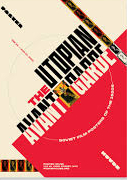
“The Utopian Avant-Guard: Soviet Film Posters of the 1920’s” exhibition

During the early years of the Communism, the country was going through radical changes that were not facing the rigid standards of the future Communist Party. Artists and film makers were getting their creativity from the West from countries in Europe and the United States. The creative class got to experiment with film and adapted what they saw to their own markets. This did not last long as Communism took hold and then started to control the content that was shown in the country. This continued from the Silent Era until the mid 1990’s when Communism fell.

Movie Poster from the 1920’s: ‘Six Girls Seeking Shelter’ from 1928

There were two interesting exhibitions on the lower level on artist and poster maker Ethel Reed. The exhibition was a collection of her work for magazines, books and film. She handled all sorts of mediums and was prominent for many years in the industry until her work fell out of fashion and her behavior became erratic with addiction.

“Ethel Reed: I am my own Woman”

The last exhibition that I toured was “Experimental Marriage: Women in Early Hollywood”, women whose role in in the film industry included writers, directors and producers. It showed how the influential women were in the industry before it became corporate. It also showed how actors had a lot of say in their films and the themes of the films were more female based. As things got concentrated in California and became more unionized, it became more of ‘Good Old Boys’ network as the industry became more streamlined.

“Experimental Marriage: Women in Early Hollywood” exhibition

What I liked about the museum is that it showed the politics from all angles and explained its progression and future in these industries.

The museum also has a nice gift shop and bookstore and a small restaurant, Café des Affiches.

History & Mission of the Poster House:

(From the Museum website)

The Poster House is dedicated to presenting the impact, culture and design of posters, both as historical documents and contemporary visual communication.

Through temporary exhibitions, a growing permanent collection and educational events, Poster House explores the enormous impact of posters on society and culture and how they have been adapted to contemporary use. As the first poster museum in the United States, The Poster House provides a space for inquiry for all those interested in design, advertising and public interventions with an aim to improve design literacy among the general public.

Posters explore:

*Mass communication and persuasion

*the intersection of art and commerce

*control of the public domain

Poster House was founded in 2015 with an eye towards filling a long-acknowledged gap in the New York cultural landscape for accessible art and design. After several years of planning and construction, Poster House opened its doors on June 20th, 2019.

Poster House is proud to receive support from the New York State Council of the Arts. Poster House is an affiliate member of the International Vintage Poster Dealers Association.

New York Transit Museum Gallery                                           89 East 42nd Street                                                                  New York, NY 10001

New York Transit Museum Gallery 89 East 42nd Street New York, NY 10001

New York Transit Museum Gallery

89 East 42nd Street

New York, NY 10001

(212) 878-0106

https://en.wikipedia.org/wiki/New_York_Transit_Museum

My review on TripAdvisor:

https://www.tripadvisor.com/Attraction_Review-g60763-d9873833-Reviews-New_York_Transit_Museum-New_York_City_New_York.html

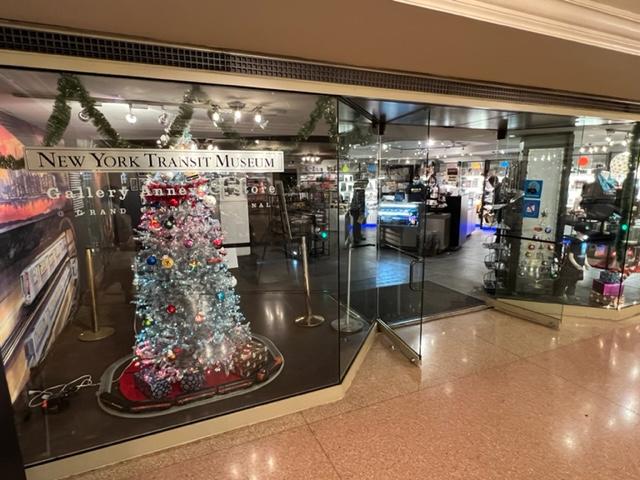
The NY Transit Museum Gallery inside Grand Central Station on the first floor

It is amazing to be in a building a record number of times and miss a small gallery that makes an impact on a visitor. This is how I felt when I entered Grand Central Station recently and discovered the New York Transit Museum Gallery. This little gem is tucked into a corner away from the ticket booths and Grand Hall and is free to the public.

The Gallery is a branch of the larger New York Transit Museum in downtown Brooklyn. This smaller space can be toured in about an hour which is perfect in case you need to spend some time in the terminal before your train.

The Gallery was showing an exhibition entitled “Transit Sketches” by six artists who were based in New York City over the last 100 years. It was nice to see different perspectives of the artist though the overall theme was still the same.

“Transit Sketches” at the New York Transit Gallery

Video by Burning Hammer Productions

Tired people going to and from work. Works featured were from artists Ebony Bolt, Marvin Franklin, Naomi Grossman, Joseph Solman, Amy Tenenouser and Hank Virgona. Each artist represented a different time in the subway system, and it was nice to see that nothing really has changed over the years with the exception of the iPhone has replaced the newspaper as a place to do your work on the subway.

Each artist had their own mini gallery show in each section of the museum gallery and all the works showed people after either getting to work in the morning or after a long day at work. It showed the human side of riding the subway and just wanting to get to our destination.
Artist Ebony Bolt created a series entitled “The Bolt Dairies”, where she drew sketches of people either reading or sleeping on the subways and most of the faces were looking down. I took this that she was secretly drawing them while they were content being distracted by whatever means possible from the other riders and the books were full of overlapping faces.

Artist Ebony Bolt on her work on the inspiration of the people on the subway

https://www.theboltdiaries.com/

Artist Naomi Grossman show her works with an interesting approach of capturing the moods of the passengers as they spent their time on the train almost wishing to get off at the next stop. It was a way of looking at the patrons and capturing them after a long day at work.

Artist Naomi Grossman

https://www.naomigrossman.com/

MTA worker and Artist Marvin Franklin’s work

Artist Marvin Franklin

http://thejadesphinx.blogspot.com/2015/06/sketches-of-marvin-franklin.html

Artist Marvin Franklin was an MTA worker who worked the lines as a track worker who died on the job in 2007. He was on the job with another worker picking up a non-working dolly on the track whose lights were out and the train operator who hit them did not see them (NY Times.com). His vision to see the people who disappeared after work and became part of the fabric of the City. He showed their stories in his art.

Joseph Solman Artist

https://en.wikipedia.org/wiki/Joseph_Solman

Joseph Solman work on riders on the subway

Joseph Solman used to sketch people when they were involved in just trying to ignore what was going on around them. He caught people in a part of time of just trying to keep their space on the subway.

Artist Amy Tenenouser

https://amytenenouser.com/home.html

https://www.facebook.com/people/Amy-Tenenouser/646628208/

Artist Amy Tenenouser’s work also gives the patron a Birdseye view of average people living their lives and capturing them in a moment in time. She has a good view of the riders on the subway and a whimsical approach.

Artist Amy Tenenouser captures the everyday person.

Artist Hank Virgona

https://www.hankvirgonaart.com/

https://www.facebook.com/HankVirgona/

Hank Virgona’s work shows people in a state of mind

Hank Virgona’s career goes back to the Great Depression, and he captures like many of the artists in the exhibition the everyday person on the subway. Being a native New Yorker, he looks at the riders keeping an uncomfortable position keeping their space. I liked his work on the written word.

The newest exhibition is on the tunnel extension from Grand Central Terminal called the “Grand New Connection”:

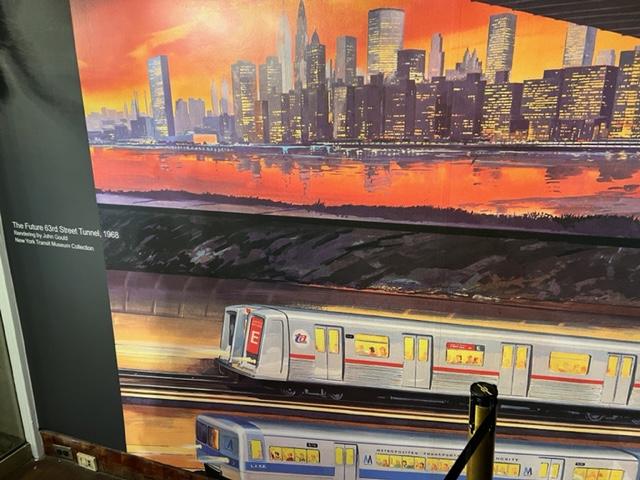
The plans for the new tunnel in 1968

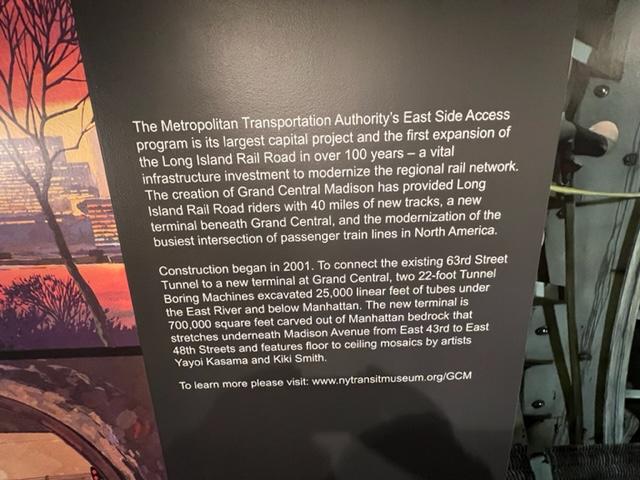
The East Side Access program

The new plans for the tunnel

The updates and pictures of what the tunnels are going to look like when finished

The exhibition was interesting at looking what progress in transportation can be in the modern age of New York City. The new boring machines can do a lot more that manmade labor was able to accomplish at the same time. It was interesting to see all these pictures.

In the corner of the gallery there is a very extensive gift shop that features hats with subway numbers and letters representing the routes they take, games, puzzles and books that are all railroad themed catering to both children and adults. It has a nice selection of products to choose from.

The best part of the New York Transit Gallery is that it is free and a nice way to spend the afternoon while waiting to get on your train.

The gift shop at the NY Transit Museum Gallery

The History of the Transit Museum:

(From the museum’s website)

Founded in 1976, the New York Transit Museum is dedicated to telling and preserving the stories of mass transportation-extraordinary engineering feats, workers who labored in the tunnels over 100 years ago, communities that were drastically transformed and the ever-evolving technology, design and ridership of a system that runs 24 hours a day, every day of the year.

Housed underground in a authentic 1936 subway station in Downtown Brooklyn, the Transit Museum’s working platform level spans a full city block and is home to a rotating selection of twenty vintage subway and elevated cars dating back to 1907.

Visitors can board the vintage cars, sit at the wheel of a city bus, step through a time tunnel of turnstiles and explore changing exhibits that highlight the cultural, social and technology history and future of mass transit.

The New York Transit Museum is a self-supporting division of the Metropolitan Transportation Authority, Friends of the New York Transit Museum, a 501c3 not-for-profit organization was established in 1995 to promote and raise funds for the Museum’s operations and programs.

The National Museum of Mathematics                                     225 Fifth Avenue                                                                   New York, NY 10010

The National Museum of Mathematics 225 Fifth Avenue New York, NY 10010

The National Museum of Mathematics

225 Fifth Avenue

New York, NY 10010

(212) 542-0566

https://momath.org/

https://www.facebook.com/MoMath1/

Open: Sunday-Saturday 10:00am-5:00pm

Fee: Adults $25.00/Seniors-Children-Students $20.00/Members are Free

My review on TripAdvisor:

https://www.tripadvisor.com/Attraction_Review-g60763-d3726207-Reviews-National_Museum_of_Mathematics-New_York_City_New_York.html?m=19905

The Museum of Mathematics at 225 Fifth Avenue

https://momath.org/

In 2020, COVID had closed this unique little family orientated museum when I visited the NoMAD neighborhood earlier last year and it finally reopened for business right before the holidays. I could see the reasons why in that the museum is very interactive and there are a lot of activities and displays that warrant families touching objects and getting involved with the exhibitions.

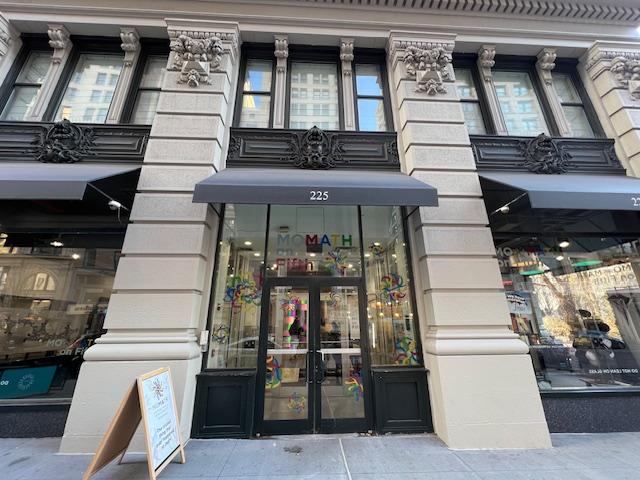
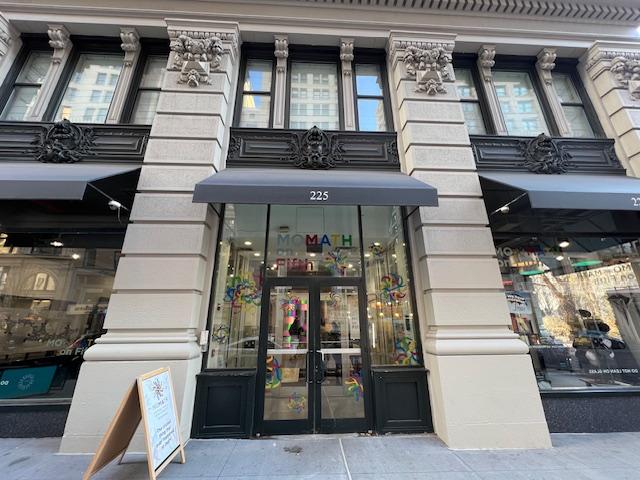
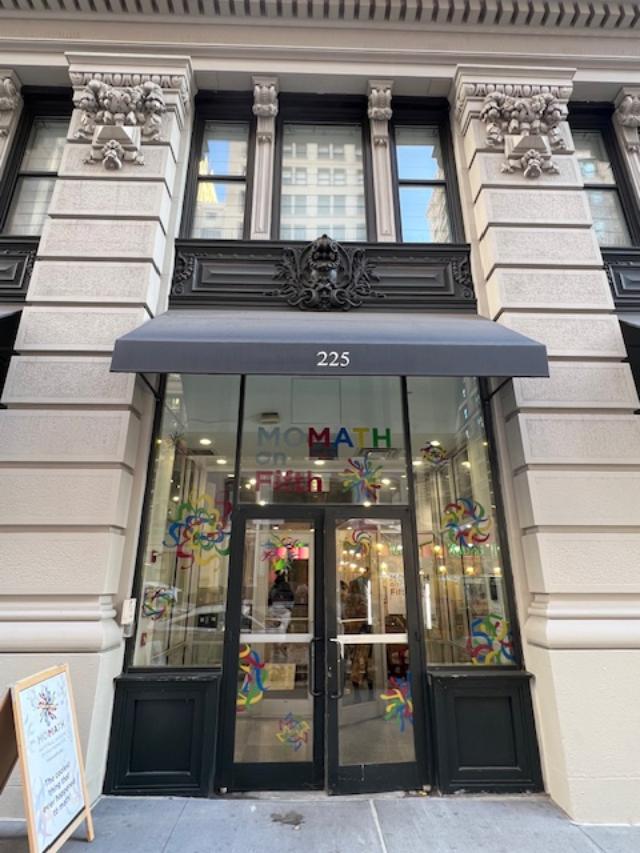
The entrance to the new museum at 225 Fifth Avenue

Like most museums in Manhattan, the MoMATH or the Museum of Mathematics is quite pricey at $25.00 ($26.00) for an adult and for students, children over 12 and seniors over 60 it is $20.00. While it may be lot for an average family, a trip there is an eye-opening experience at least to me it was that day.

The sign welcoming you on Fifth Avenue

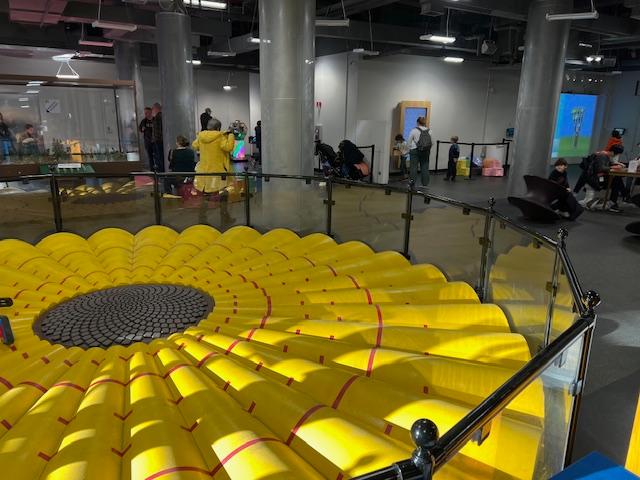
In 2021 when it reopened, the museum was two full floors of exhibitions with a spiral staircase separating the floors and a gift shop at the entrance. On the main floor there are interesting interactive exhibitions such as the Shapes of Space that show how different shapes fit together on a curved surface. I was not too sure what the point of it was, but the kids seemed to enjoy it and it was interesting to see how they connected. The Square wheeled Trike was interesting as you rode a square wheeled type of bike on a bumpy surface to check velocity. The kids and young parents really liked this.

The “Shapes of Space” exhibition

In 2024, the museum was moved around the corner until the permanent location could be finished. The museum was on one floor with a art gallery in the front of the museum and the back of the museum was all the interactive activities.

The Math “Fractorals” Gallery Exhibit at the Museum of Math

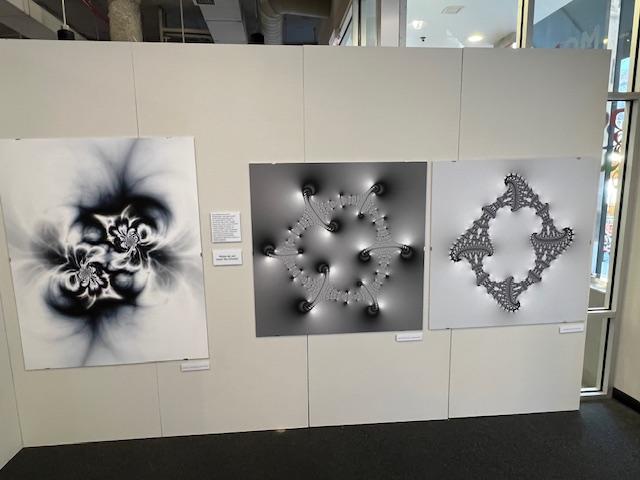
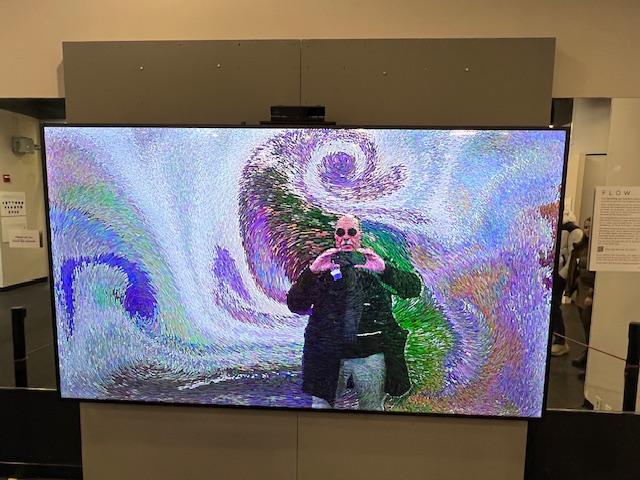
The “Fluids and Fractals” exhibition of artist Karl Sims

The Art Gallery exhibition

The art in the Gallery

The art gallery at the Museum of Mathematics

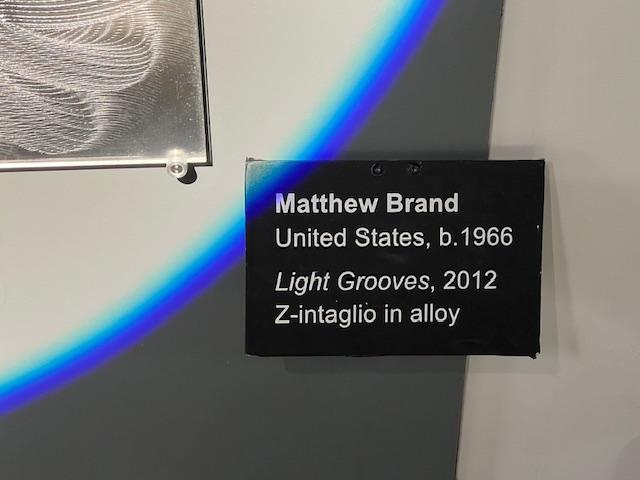
‘Light Grooves’ by artist Matthew Brandt

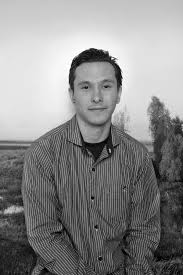
Artist Matthew Brandt

https://matthewbrandt.com/

Matthew Brandt is an American born artist. Matthew Brandt received his BFA from Cooper Union and MFA from UCLA. Brandt has been the subject of institutional solo shows at the Newark Museum, the Columbus Museum of Art, Virginia Museum of Contemporary Art and SCAD Museum of Art, Savannah (Artist bio).

“Light Grooves”

The interactive display

The interactive display

The displays I enjoyed in the old museum were Motionscape, where you had to walk as fast as you could on the track to check the relationship between velocity, your position and acceleration. It was interesting to see how your body movements when walking affects the way you react. The other display that was really popular was Hoop Curves which was always busy. The exhibit used statistics and a robot arm to shoot the basketball. The kids got a real kick out of this when trying to make a basket.
In 2021, the museum was two stories but in 2024, the museum moved to the new Fifth Avenue location and all the interactive displays were on the first floor, along with an explanation of the math along with the creators of the theory. I found that interesting because you could see who all the mathematicians were who the projects were based on or who had contributed to them.

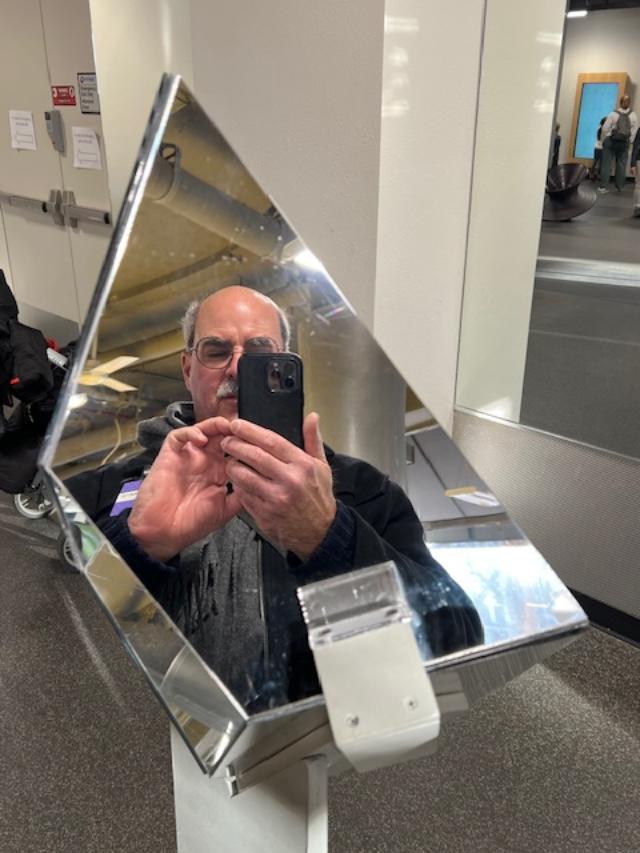
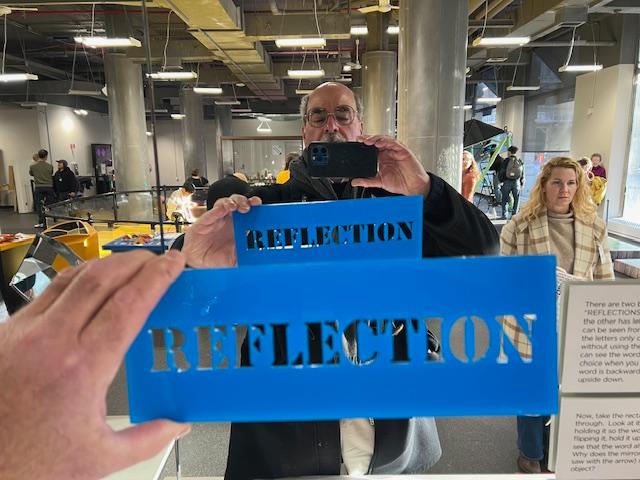
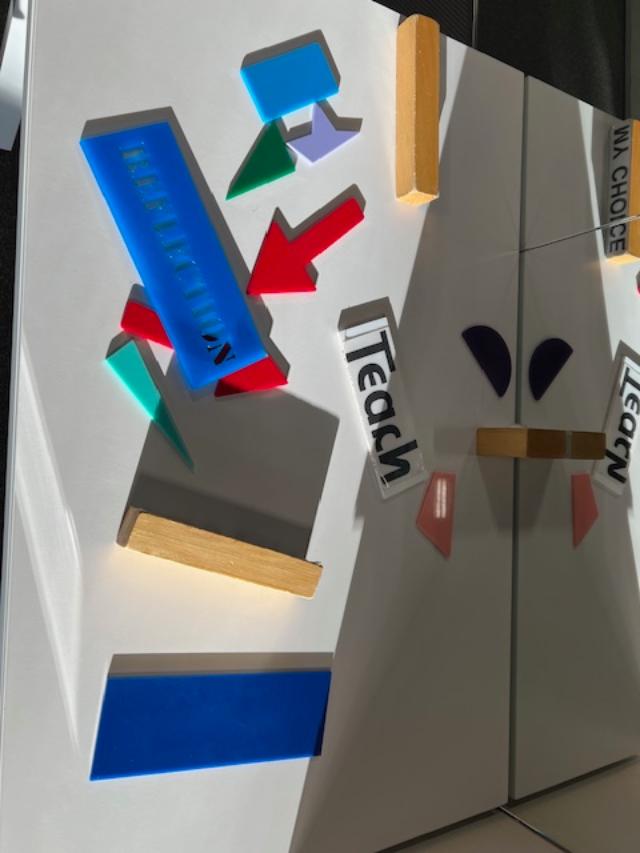
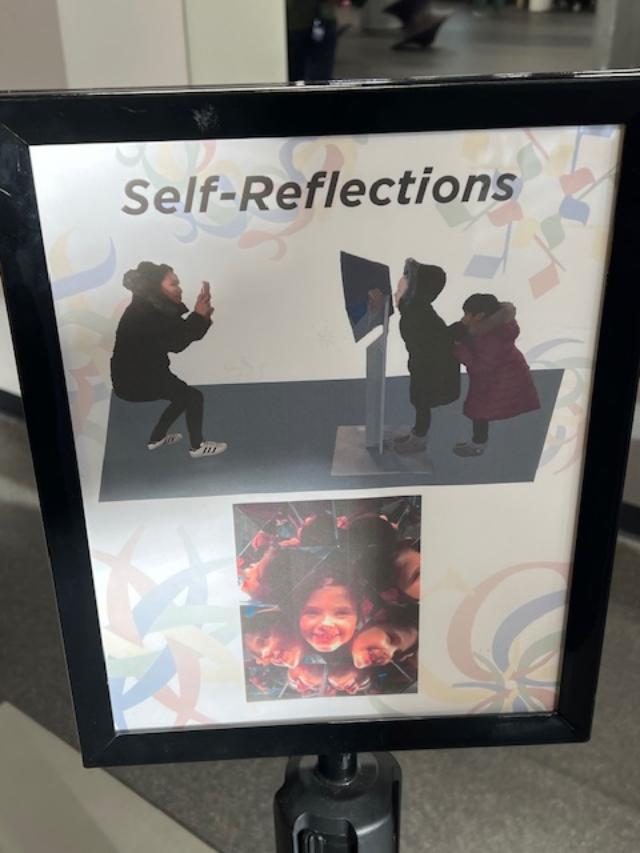
I started with the “Self-Reflections” exhibit where shapes and sizes mattered, and the use of symmetrical patterns shaped our faces and observations. I got to see how the shapes altered my reflection in the mirrors.

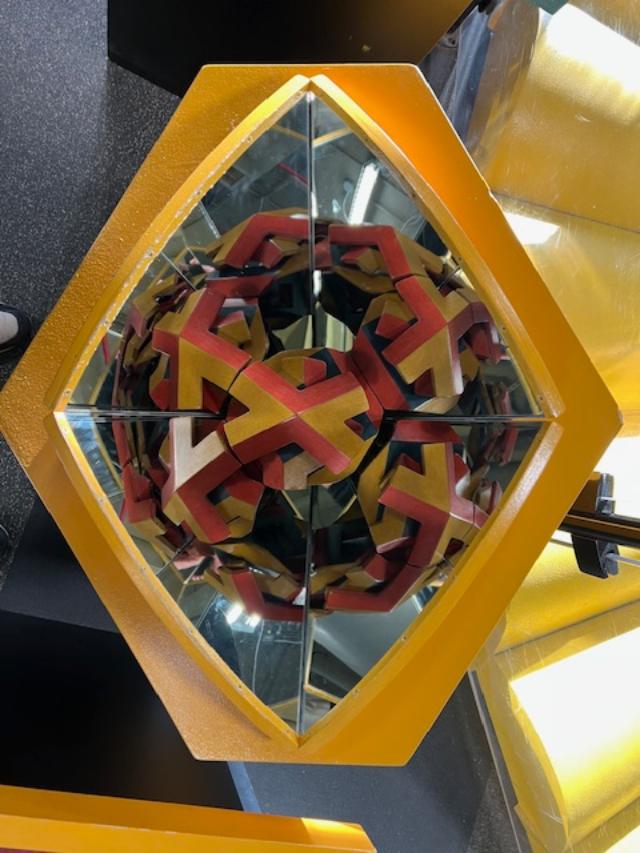
The use of mirrors and shapes

The use of shapes and colors in the experiment

The signage

How we look at ourselves in the mirror

Taking pictures in the ‘mirror’

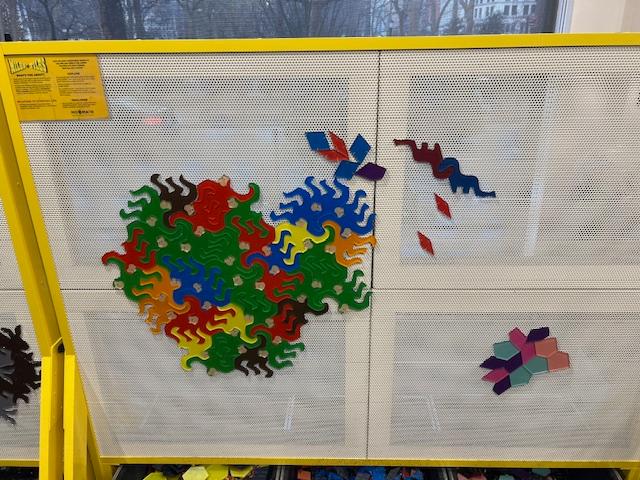
One of the first interactive displays that I enjoyed was the Tessellation Station, where you could create displays with magnetic tiles on a large board. Later I learned about Tessellation as a form of making shapes fit together in a pattern and then the theory behind that. It was a fun way to use your creativity. This exhibition was very popular in the old museum as well but had been a much bigger interactive display.

The “Tessellation Station” exhibition is a lot of fun

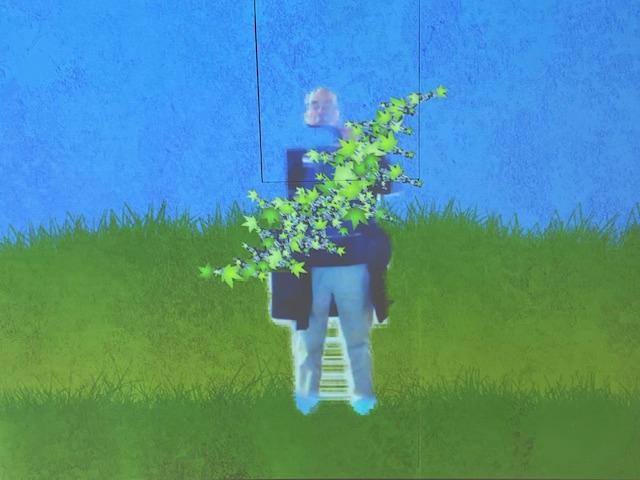
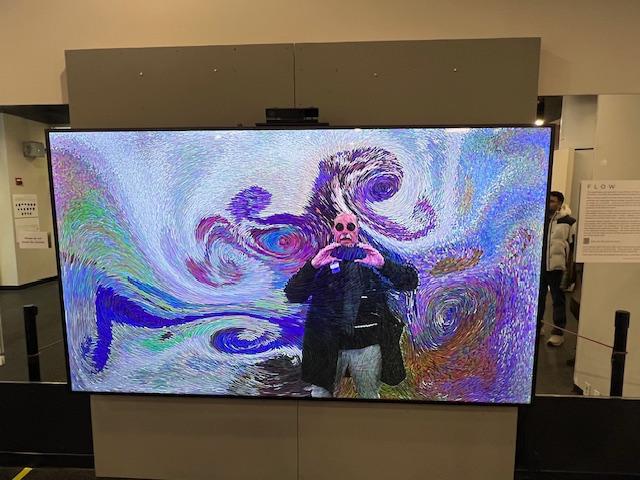
Another was the Tree of Life, where the computer copied the movements of myself and then used them to show the how I moved my arms and legs in a pattern. It was funny to see myself repeated over and over again like a tree with branches. It really did measure the movement of my body. This was a lot of fun because you got to see smaller versions of yourself attached to you.

Me playing with the Tree of Life

Me having fun by the Tree of Life exhibition

The Twist and Roll display showed how to put different shapes and sizes together and show their movement on the board.

The Twist and Roll hands on display

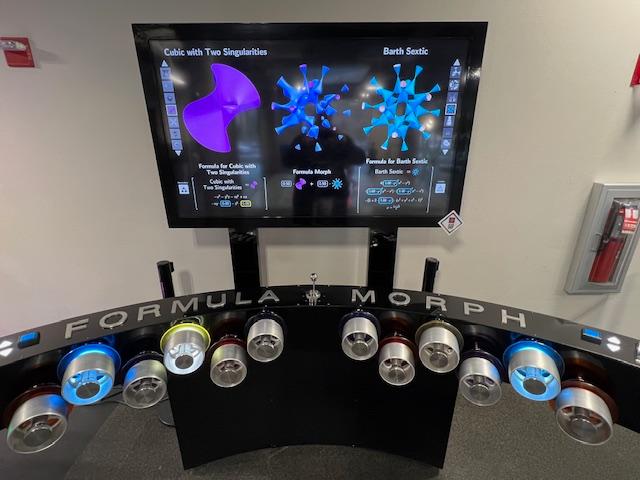
The one display that all the kids got a kick out of was the Math Board, where the colors and shapes of the section of the floor lit up when you walked on them and was controlled by the way you walked on them.

The “Math Morphing-Formula Morph” replaced the “Math Board”

The Museum of Mathematics is a great museum for younger children who want to get physical and have a good time and like the interaction. I learned a few things too about the fundamentals of math and some of its background theories.
The geometrics of the Museum of Mathematics

Still, it is a great museum for kids under the age of twelve and their younger parents. I think anything over that age would warrant a trip to the American Museum of Natural History or the Liberty Science Center with more exhibits that are age appropriate. It is a museum you should visit once or twice with small children who are at the learning stage and just want to have fun.

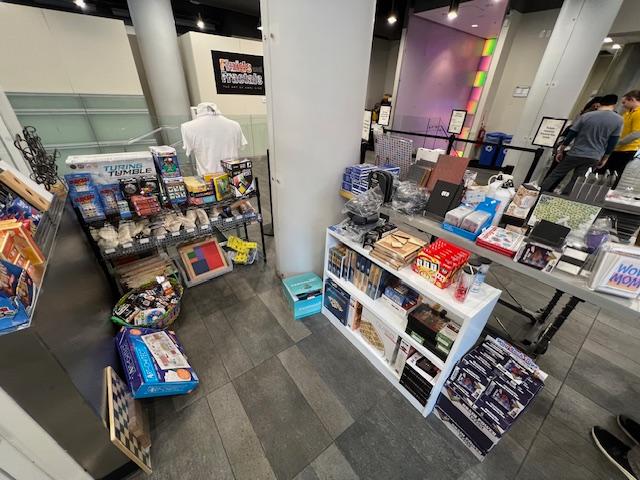
The Gift Shop

The Museum Gift Shop

The History of the National Museum of Mathematics:

(From the museum website)

The National Museum of Mathematics began in response to the closing of a small museum of mathematics on Long Island, the Goudreau Museum. A group of interested parties (the “working group”) met in August 2008 to explore the creation of a new museum of mathematics-one that would go well beyond the Goudreau in both its scope and methodology. The group quickly discovered that there was no museum of mathematics in the United States, and yet there was a incredible demand for hands0n math programming.

Interactive objects at the Museum of Mathematics

Accomplishments to date include: opening Manhattan’s only hands-on science center, welcoming more than one million visitors; creating the popular Math Midway exhibition, which has delighted millions of visitors at museums throughout the United States and internationally; leading math tours in various U.S. cities; running dozens of Math Encounters and Family Fridays events; delivering a broad array of diverse and engaging programs for students, teachers, and the public to increase appreciation of mathematics and creating the largest public outdoor demonstration of the Pythagorean Theorem ever.

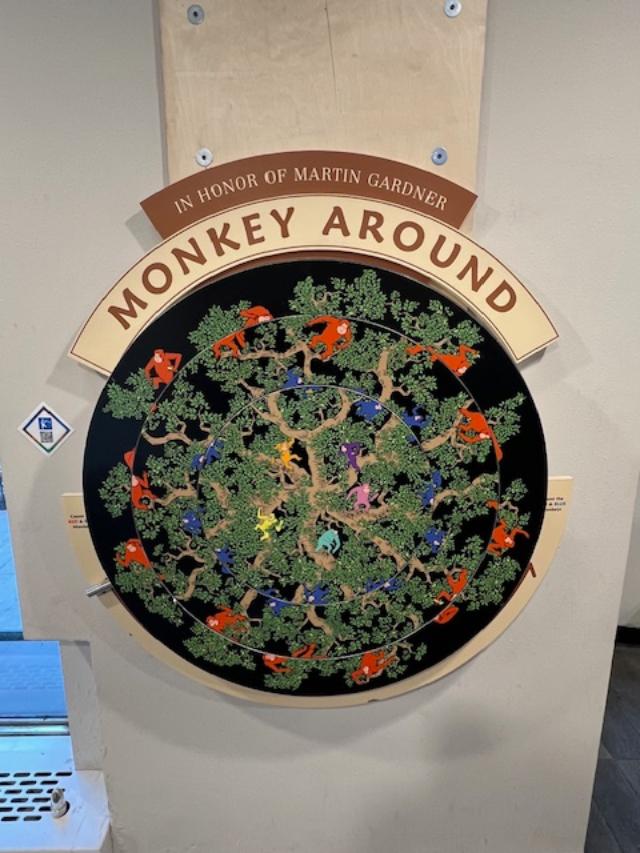
The “Monkeying Around” exhibition at the museum

The Museum Mission:

(From the Museum website)

Mathematics illuminates the patterns that abound in our world. The National Museum of Mathematics strives to enhance public understanding and perception of mathematics. Its dynamic exhibits and programs stimulate inquiry, spark curiosity and reveal the wonders of mathematics. The Museum’s activities lead a broad and diverse audience to understand the evolving, creative, human and aesthetic nature of mathematics.

The “Weights and Balances” exhibition at the museum

Math Geographics

Video on the displays

The displays are so interesting

The American Kennel Club Museum of the Dog              101 Park Avenue                                                 New York, NY 10178

The American Kennel Club Museum of the Dog 101 Park Avenue New York, NY 10178

The American Kennel Club Museum of the Dog

101 Park Avenue

New York, NY 10178

(212) 696-8360

Home

https://www.facebook.com/akcmuseumofthedog/

Open: Sunday 10:00am-5:00pm/Monday-Thursday Closed/Friday-Saturday 10:00am-5:00pm

Fee: Adults $15.00/Seniors (65+), Students (13-24) & Active Military/Veterans $10.00/Children under 12 $5.00/Members Free

My review on TripAdvisor:

https://www.tripadvisor.com/Attraction_Review-g60763-d15941897-Reviews-The_American_Kennel_Club_Museum_of_the_Dog-New_York_City_New_York.html?m=19905

The American Kennel Club Museum of the Dog at 101 Park Avenue

When I was walking the neighborhood of Murray Hill for my blog, “MywalkinManhattan.com, I came across on one of the side streets tucked into a new office building on Park Avenue, The American Kennel Club Museum of the Dog at 101 Park Avenue. This unique little museum is two floors of art dedicated to the story of the dog.

The first floor features small fossils that show the early domestication of dogs during prehistoric times with humans. They may have used them for hunting and companionship. You could see this in the burials and in the wall paintings found all over the world that they partnered with early man and helped shape their world.

The American Kennel Club Museum of the Dog collection

Most of the paintings were from the Victorian Age (post Civil War to WWI) where the romanticized view of nature and of pet companions was emphasized. One both the first and second floor there were all sorts of paintings of various breeds of dog in all sorts of playful and working environments. There were dogs for hunting and sport, dogs as pets and dogs in playful position reacting with their masters and each other.

The Victorian approach to pets

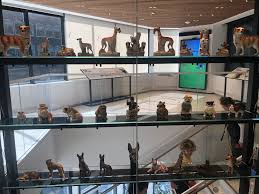
The was also porcelain figurines of dogs, statuary and trophies from various Canine Clubs all over the country. It shows the history of the dog as show with breeding and disposition counting of the way the animal was raised and trained.

The second floor had another series of paintings, a lot from the same time period and some contemporary artist’s take on modern dog owners and their relationship with their pets.

Canine Porcelains line the staircase

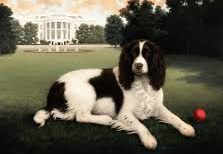
Also on the second floor was exhibition on ‘Presidential Dogs”, with the first families relationship with their dogs (and cats too) and the role that they played in White House politics. Truthfully outside of “Socks”, the Clinton’s cat, I never knew of any of the White House pets. I knew the both the Roosevelts and Kennedy’s had lots of pets in the White House, I never heard of their names or seen their pictures. So that was an eye opener.

White House pets tell their own story

Also in a special case was small fancy dog houses and dog holders for travel which was interesting to see how small dogs could travel with their masters and the expense to create a way for them to travel. These were very elaborate. I thought of some of the items I used to see at Bergdorf-Goodman when I worked there with the Ralph Lauren tote bags and fur lined sweaters and thinking this was a little much.

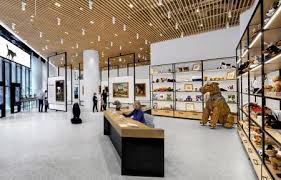
The museum also has a small gift shop on the first floor near the entrance that you should check out. There is all sorts of books and art work to look through and knick-knacks to buy with a dog them. The staff is also very nice and very welcoming.

The entrance to the museum and gift shop has a nice contemporary feel to it

History of the American Kennel Club Museum of the Dog:

The American Kennel Club Museum of the Dog preserves, interprets and celebrates the role of the dogs in society and educates the public about the human-canine bond through its collection of art and exhibits that inspire engagement with dogs.

The Museum logo

Founded in 1982, the AKC Museum of the Dog was originally located in the New York Life Building at 51 Madison Avenue as a part of the AKC headquarters. In 1987, the Museum of the Dog was moved to a new location in Queeny Park, West St. Louis County, Missouri. After over 30 great years at Queeny Park, the decision was made to bring the Museum back to its original home and reunite it with the AKC headquarters and collection.

Combining fine art with high-tech interpretive displays, the Museum of the Dog’s new home at 101 Park Avenue hopes to capture the hearts and minds of visitors. Located in the iconic Kalikow Building, the Museum will offer rotating exhibits featuring objects from its 1,700 piece collection and 4,000 volume library.

We hope to see you soon.
(From the AKC Museum of Dog website)