Tag: Contemporary Art Galleries

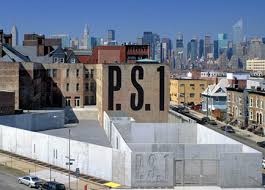
MoMA PS 1                                                            22-25 Jackson Avenue                                        Long Island City, New York, NY 11101

MoMA PS 1 22-25 Jackson Avenue Long Island City, New York, NY 11101

MoMA PS 1

22-25 Jackson Avenue

Long Island City, NY  11101

(718) 784-2084

https://momaps1.org/

Open: Sunday-Monday 12:00pm-6:00pm/Monday & Tuesday Closed/Wednesday-Saturday 12:00pm-6:00pm

Fee: Adults $10.00/Seniors & Students $5.00/Children Under 16 Free/Free to NYC Residents & MoMA members

My review on TripAdvisor:

https://www.tripadvisor.com/Attraction_Review-g48080-d107822-Reviews-MoMA_PS1-Long_Island_City_Queens_New_York.html?m=19905

I recently visited the MoMa PS 1 in Long Island City for a private members night and was really blown away by the exhibitions that I saw there. It is all contemporary art but really edgy, probably more innovative than some of the things in the main branch of the museum. Even the clientele was different. I was one of the oldest people there and I am in my early 50’s. There must have been three people older than me.

The museum is built into an old elementary school and with the rooms there some have been merged together for bigger exhibitions and others were smaller and showcased a newer artist or an individual work. The works from current artists are very unusual and I guess you have to like very contemporary art.
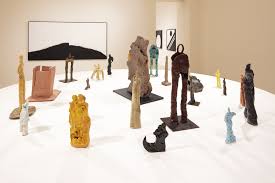
MoMA PS 1 exhibition

Some of the pottery from artist Simone Fattal “Works and Days”

I saw the work from artist Simone Fattal who is from Lebanon. I have to admit her works are eclectic. Her pottery looks like a third grader did it. I was not very impressed even though everyone oohhed and aahhed. It was very unusual.

I also saw the work of artist Gina Beavers whose works have someone always looking at you. Her eye portraits were different but they reminded me of some of Salvatore Dali works of the 50’s. Her works look at you from every direction with a look of judgement.

MoMA PS 1 Exhibition II

Artist Gina Beavers works “The Life I Deserve”

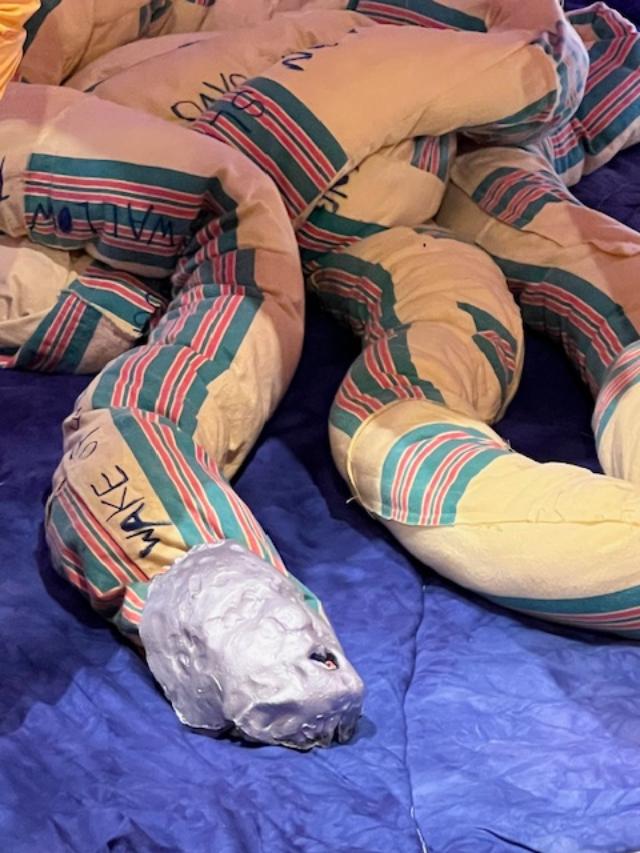
One exhibition which was loosely based on the movie “The Shining” by artist Julie Becker. The whole exhibition is made of works that looked like someone just left the room. There were creepy office set ups and hallways. The work was almost surreal itself by trying to confuse you and throw you off balance with her art.

MoMa PS 1 Exhibition III.jpg

Artist Jule Becker “I must Create a Masterpiece to pay the Rent”

I was able to quickly tour the whole museum which is not as big as its counterpart in Manhattan. It just has a different feel and direction to it.

What was nice about the evening was there was music outside for people to enjoy and there were hammocks that were art of a display at the entrance of the museum. It is a smaller museum that showcases the newer artists and gives them a voice. I have to say one thing is that the museum does fit into the neighborhood as Long Island City is going through a huge building boom and renovation/gentrification of the surrounding area. There is a lot of street art in the area and a lot of residents who look ‘bohemian’ to say the least. It was enlightening night of music and art.

History of MoMA PS 1:

MoMA PS 1 is one of the oldest and largest non-profit contemporary art institutions in the United States. An exhibition space rather than a collecting institution, MoMA PS 1 devotes its energy and resources to displaying the most experimental art in the world. A catalyst and an advocate for new ideas, discourses and trends in contemporary art, MoMA PS 1 actively pursues emerging artists, new genres and adventurous new work by recognized artists in an effort to support innovation in contemporary art. MoMA PS 1 achieves this mission by presenting its diverse program to a broad audience in a unique and welcoming environment in which visitors can discover and explore the work of contemporary artists. Exhibitions at MoMa PS 1 include artist’s retrospectives, site-specific installations, historically surveys, arts from across the United States and the world and a full schedule of music and performance programming.

MoMA PS 1 was founded by Alanna Heiss as the Institute for Art and Urban Resources Inc., an organization devoted to organizing exhibitions in underutilized and abandoned spaces across New York City. In 1976, it opened the first major exhibition in its permanent location in Long Island City, Queens with the seminal Rooms exhibition. An invitation for artists to transform the building’s unique spaces. Rooms established the MoMA PS 1 tradition of transforming the building’s spaces into site-specific art that continues today with long term installation by James Turrell, William Kentridge, Pipilotti Rist, Lawrence Weiner and others.

For the next twenty years, the building was used as studio, performance and exhibition spaces in support of artists from around the world. After a building-wide renovation, PS 1 Contemporary Art Center (now MoMA PS 1) reopened in 1997, confirming its position as the leading contemporary art center in New York. True to the building’s history and form, the renovation preserved much of the original architecture as well as most of its unique classroom-sized galleries.

In 2000, P.S. 1 Contemporary Art Center became an affiliate of The Museum of Modern Art to extend the reach of both institutions and combine MoMA PS 1’s contemporary mission with MoMa’s strength as one of the greatest collecting museums of modern art.

A true artistic laboratory, MoMa PS 1 aspires to maintain its diverse and innovative activities to continue to bring contemporary art to international audiences.

(This information was taken from the MoMA PS 1 website and I give them full credit for the information. Please see the web link above for more information).

Ford Foundation Gallery at the Ford Foundation Center for Social Justice                                      320 East 43rd Street                                           New York, NY 10017

Ford Foundation Gallery at the Ford Foundation Center for Social Justice 320 East 43rd Street New York, NY 10017

Ford Foundation Gallery at the Ford Foundation Center for Social Justice

320 East 43rd Street

New York, NY  10017

(212) 573-5000

https://www.fordfoundation.org/about/the-ford-foundation-center-for-social-justice/ford-foundation-gallery/

Open:  Sunday Closed/Monday-Saturday 11:00am-6:00pm

Fee: Free to the public

My review on TripAdvisor:

https://www.tripadvisor.com/Attraction_Review-g60763-d615514-Reviews-Ford_Foundation_Building-New_York_City_New_York.html

The Ford Foundation at 320 East 43rd Street

https://www.fordfoundation.org/about/the-ford-foundation-center-for-social-justice/visitor-information/

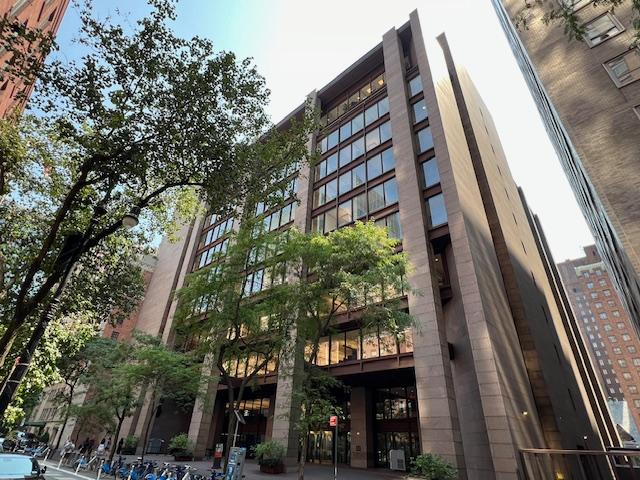
The Ford Foundation Building

The Ford Foundation Building at 320 East 43rd Street in the Turtle Bay neighborhood. Take time after visiting the gallery to tour the gardens in the lobby.

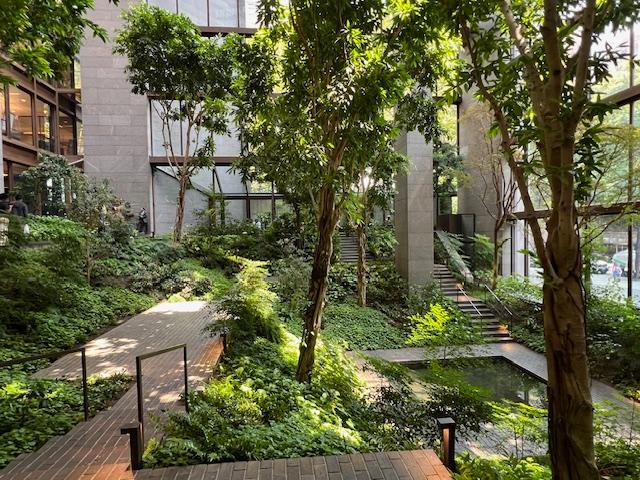
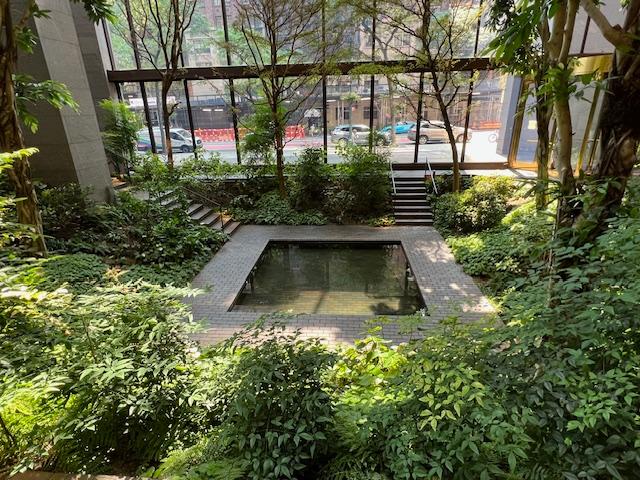
When I was touring the Turtle Bay neighborhood for my blog, “MywalkinManhattan.com”, I toured the Ford Foundation Building on East 43rd Street and wondered through the lobby area gardens I came across the Ford Foundation Gallery, which is just off the main lobby. The small gallery delves into some deep material on social commentaries about life and the artists featured have some pretty interesting perspectives on their work.

The Ford Gallery gardens inside the building

The pool of the Ford Foundation Garden

The beauty of the Ford Foundation gardens

The Ford Foundation Gallery entrance

The first exhibition I saw there was “Radical Love”, a theme is dealing with ‘love as the answer to a world in peril’. This interesting exhibition offers multidisciplinary art dealing with human nature and society. How different cultures show their respect and love to one another. It is an interesting mix of paintings, photos and video art from all over the world with each other showing their interpretation of dealing with the issues in life. You really have to read between the lines with this exhibition.

Ford Foundation Gallery II

The ‘Radical Love’ exhibition at the new Ford Foundation Gallery

(from the museum website on the exhibition)

Through the theme of Utopian Imagination, the trilogy of exhibitions in the gallery’s inaugural year create a trajectory toward a more just future. The first exhibition, Perilous Bodies (March 4 – May 11, 2019), examined injustice through the intersecting lens of violence, race, gender, ethnicity, and class. Radical Love responds to the first show by offering love as the answer to a world in peril.

Love, in the context of this exhibition, is defined by a commitment to the spiritual growth and interconnectedness of the individual, their community, and stewardship of the planet. Guided by the powerful words of bell hooks, “Were we all seeing more images of loving human interaction, it would undoubtedly have a positive impact on our lives.” The works in Radical Love are grounded in ideas of devotion, abundance, and beauty; here, otherness and marginality is celebrated, adorned, and revered. The Utopian Imagination exhibition trilogy concept was developed by Jaishri Abichandani.

In 2024, I saw the new show “Cantando Bajito Incantations“:

The sign from the exhibition:

(from the website)

The Gallery

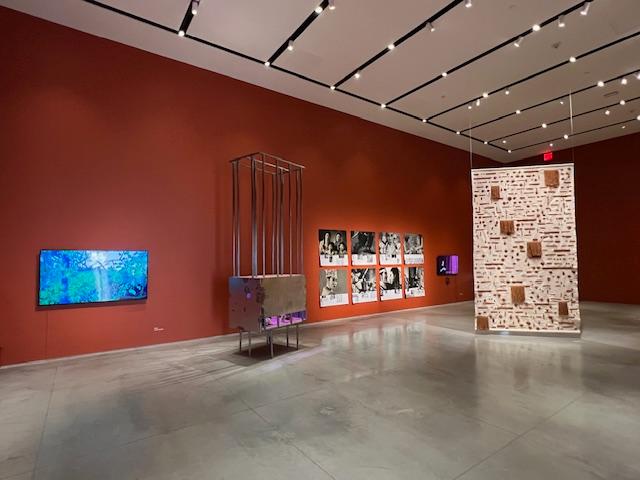
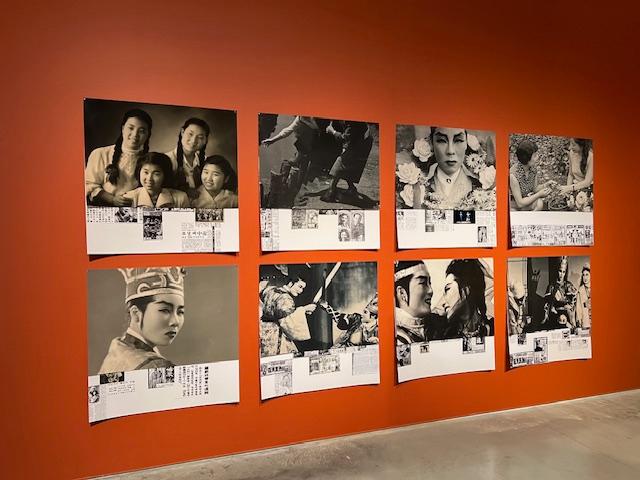
Work from the exhibition

Translated into English as “singing softly,” the exhibition series title is drawn from a phrase used by Dora María Téllez Argüello, a now-liberated Nicaraguan political prisoner, to describe the singing exercises she did while she was incarcerated in isolation. Helping her to conserve her voice and defeat the political terror she endured, Téllez’s quiet singing became a powerful strategy for survival and resistance. Conceived in three movements, Cantando Bajito features artists who explore similar forms of creative resistance in the wake of widespread gender-based violence. The second chapter, Cantando Bajito: Incantations, brings together artists who consider ancestral, contemporary, and future-facing networks of support and care that safeguard feminized bodies through forms of knowledge transmission. 

Work from the exhibition

Such networks—symbolic systems, subversive spaces, or covert forms of language—are as varied as the communities that develop them. They include Nüshu, a form of script passed from mother to daughter in China; the use of henna as an agent of protection; and forms of therapeutic communication that have been deemed “gossip.” All have long existed, whether in the shadows or in plain sight. Preserved not in written history but in the body, these channels prepare feminized bodies for potential violence while giving them tools to resist it. 

Works from the show

Works from the show

From inside the tent

The History of the Ford Foundation Gallery and it’s recent opening:

(From the museum website)

This new 1,900 square foot gallery space opened in February of 2019 after a two-year renovation of the Ford Foundation Building. The Ford Foundation Gallery will be an innovative exhibition space dedicated to presenting multidisciplinary art, performance and public programming by artists committed to exploring issues of justice and injustice. In creating a space for artists whose work addresses pressing social issues, the foundation continues its decades long history of investing in the arts to advance human welfare (Ford Foundation Press Release).

Ford FOundation Gallery V

Athi-Patra Ruga’s ‘Umesiyakazi in Waiting’

With a mission focused on addressing inequality in all its forms and providing more than $600 million annually in grant support to organizations on four continents, the Ford Foundation is a natural home for art that challenges viewers to grapple with fundamental questions of fairness and dignity. Three exhibitions in this inaugural year offer varied interpretations on the theme of Utopian Imagination (Ford Foundation Press Release).

The gallery is small and you can see these exhibitions in under an hour.

American Academy of Arts Letters                                     633 West 155th Street                                        New York, NY 10032

American Academy of Arts Letters 633 West 155th Street New York, NY 10032

American Academy of Arts & Letters

633 West 155th Street

New York, NY 10032

(212) 368-5900

Academy@Artsandletters.org

https://artsandletters.org/

Hours: Thursday-Sunday-1:00pm-4:00pm/Open During Exhibitions times only or by appointment (Mid-March-Mid-April; Mid-May-Mid-June)

Fee: Free

My review on TripAdvisor:

https://www.tripadvisor.com/ShowUserReviews-g60763-d548512-r682038708-American_Academy_of_Arts_and_Letters-New_York_City_New_York.html?m=19905

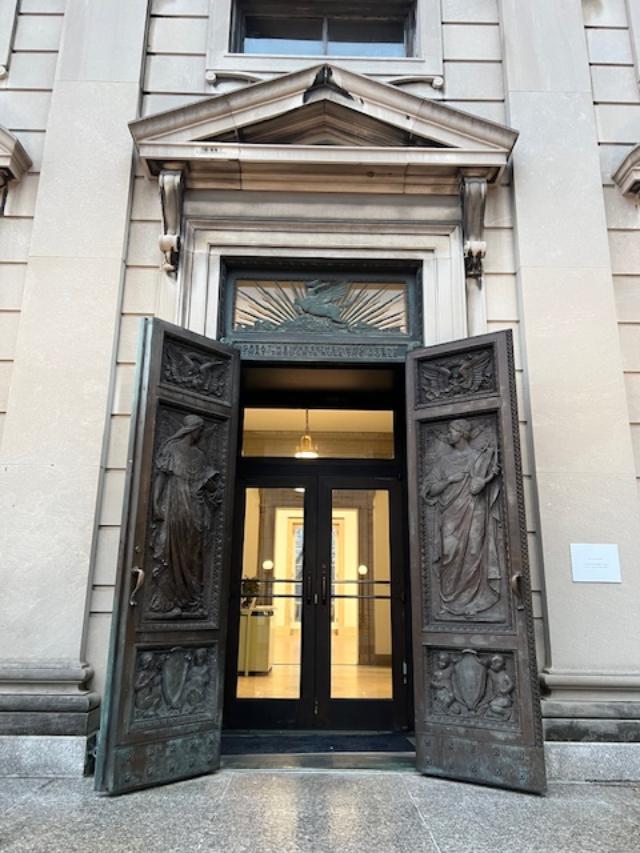
The front of the American Museum of Arts & Letters at 633 West 155th Street

I was finally able to visit the American Academy of Arts and Letters on the last day it was open for the year to the public. It was for the ‘Ceremonial Exhibition: Work by New Members and Recipients of Awards’, an exhibition on members art that was chosen specifically for the show. Most of the work was very contemporary and some a little political. It was interesting work by new artists that filled the small gallery rooms.

The front of the American Museum of Arts & Letters

One of the buildings was used for the contemporary art while the one across the courtyard was used for the more architectural pieces. The galleries are small but the art was impressive. What I liked when I talked with one of the women who worked there said to me that after the show, the pieces would be donated to galleries and museums all over the country. The galleries are only open four months out of the year and this was the last day of the exhibition so the work being shown will be gone.

I visited the museum in January 2025 and it had just reopened after a three year renovation after it had been closed since Pre-COVID and it is now fully open with a new exhibitions. All the galleries are brightly lit and displaying new exhibitions.

The entrance to the museum from the courtyard

Some of the pieces that really stood out when I visited in 2019 were by Judith Bernstein, a contemporary painter who seems to not like the current administration too much. The themes were on power and money and corruption in the administration. Her work really shows what she personally thinks of  our President. Her ‘Trump Genie” was very clever and I can see this in a major museum in the future.

American Academy of Arts & Letters III

Judith Bernstein’s work

Other work in the main gallery in 2019 were by artists Stephen Westfall with ‘Solid Gone’, Hermine Ford with ‘Paris, France’ and Paul Mogensen with several ‘Untitled’ pieces. The contemporary works I was not sure what the meaning of them were but they were colorful.

American Academy of Arts & Letters V

The works of the artists of the front gallery

One of the pieces in the front gallery that really stood out was by artist Francesca Dimattio, ‘She-wolf’ which was a classic Greek character made of porcelain, enamel, paint and steel.

American Academy of Arts & Letters VI

‘She-wolf’ by Francesca Dimattio

There were light installations in 2019 that were very interesting by artist James O. Clark. He had one piece, ‘Wunnerful, Wunnerful’,  which is a work that just keeps being creating itself by bubbles and ink markers moving along a turntable that stops and starts.

There was a permanent exhibition of Charles Ives home in Connecticut that was transported and recreated here. His studio and works are featured here as well as his family life. There are copies of his works in the display cases and his career.

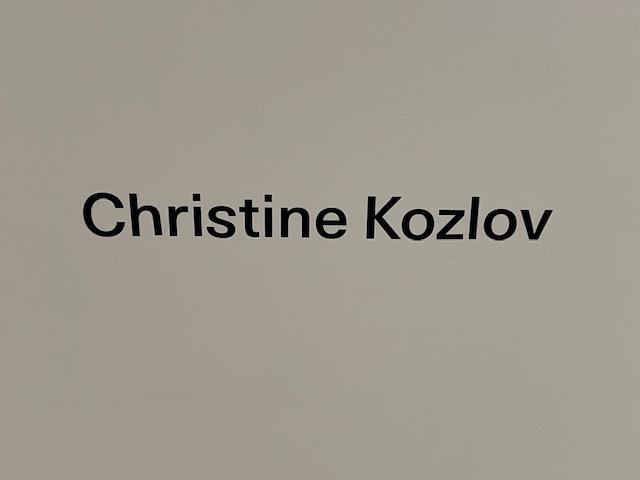
The museum in 2025 was fully open with the exhibition by artist Christine Kozlov, a contemporary Video artist whose works were being featured in the main gallery.

The main gallery of the Kristine Kozlov exhibition

In more than fifty artworks arrayed across four galleries at Arts and Letters, Christine Kozlov shows the breadth of Conceptual artist Christine Kozlov’s practice with a focus on works from the mid-1960s through the late 1970s. Nearly all of the works Kozlov contributed to public exhibitions during this period will be on view, many of which were created for landmark exhibitions of Conceptual art such as: One Month (1969), organized by Seth Siegelaub; Information (1970), curated by Kynaston McShine at the Museum of Modern Art, New York; Arte de Sistemas organized by Jorge Glusberg / CAYC—Centro de Arte y Comunicación at the Museo De Arte Moderno (1971); and the Number Shows, a series of exhibitions curated by Lucy Lippard between 1969 and 1974 (American Museum of Arts & Letters website).

Part of the Kristine Kostov exhibition

Works by artist Christine Kozlov

The next exhibition that I viewed was by artist Wadada Leo Smith, which consisted of an exhibition based on colors and sounds. You could take the headsets around the gallery and tour and admire the work with the sounds of the musical groups.

The gallery with works by artist Wadada Leo Smith

Wadada Leo Smith (b. 1941, Leland, MS) is a composer-performer and Arts and Letters member. Formerly an educator at CalArts, he has influenced decades of musicians and artists, including Raven Chacon. In Kosmic Music, Smith’s first solo exhibition in New York, he shares over fifty years of Ankhrasmation (Museum website).

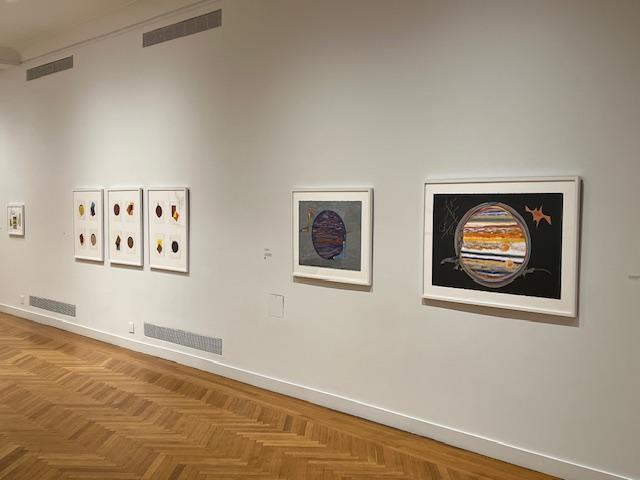
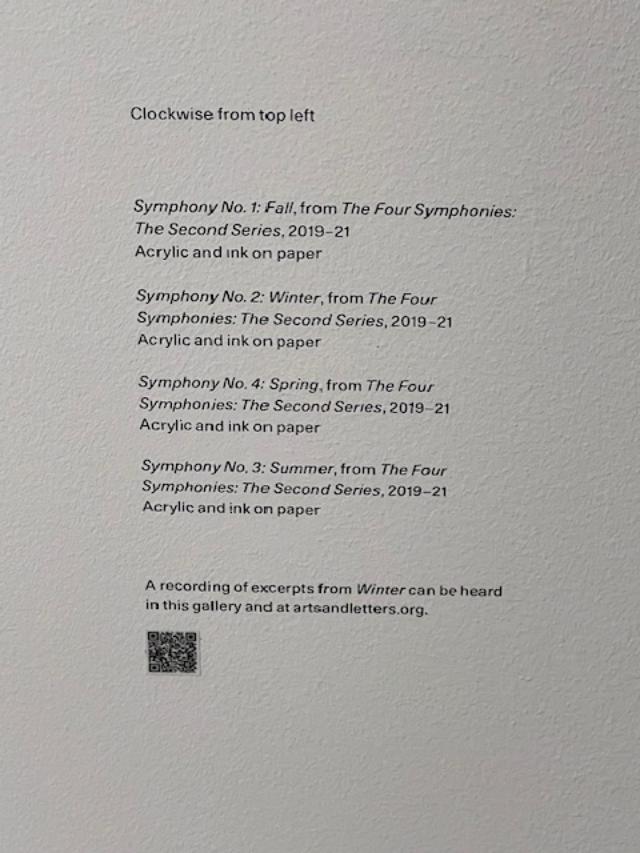
The “Sphere” works by artist Wadada Leo Smith

Ankhrasmation is a musical language Smith began exploring in 1965. Smith does not consider Ankhrasmation to be his creation but rather something he discovered. The name derives from Ankh, an ancient Egyptian symbol of life; Ras, an Ethiopian word for leader or father; and Ma, for mother. The distinctive language uses line, color, and shape to designate musical components such as tonal range and intensity of activity. For Smith, performing Ankhrasmation requires focused practice and “having that space in your heart and mind so that you can play from inspiration.” (Museum website).

The last exhibition I saw was in the gallery across the courtyard from the main museum was by artist Raven Chacon. You would walk in the main gallery to the sounds of birds both living and extinct. Just five minutes in the main gallery by myself and I felt like Tippi Hedren in the movie “The Birds”. There were all sorts of bird sounds with no birds around.

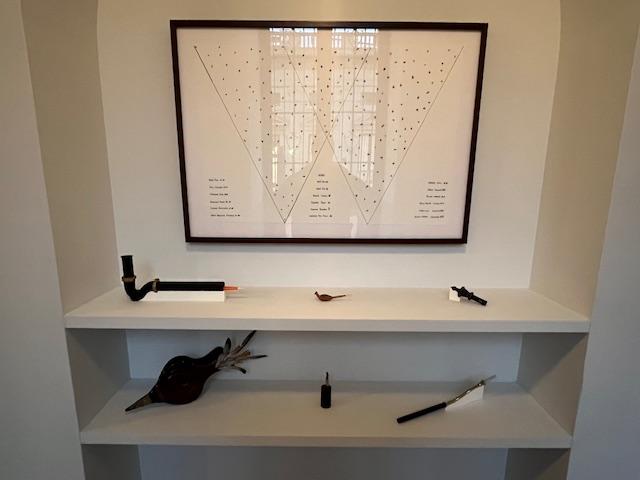
The instruments that the artist uses to achieve the sounds of the birds

When Raven Chacon (b. 1977, Fort Defiance, Navajo Nation) visited Arts and Letters for the first time, he paused in our North Gallery to clap his hands, then counted how long it took for the room to go silent. It took around six seconds—a long rate of decay. Standing in that echoing chamber, Chacon noted the building’s Beaux Arts design by Cass Gilbert, with its imported Spanish tile and cage-like glass ceiling that filters the sky. He became curious to learn the history of the land it sits on, once owned by John James Audubon, who purchased it in 1841 with funds from the sale of his illustrated Birds of America (Museum website).

Chacon is a composer and artist who frequently works with the materials and histories of a given site and who considers, as he puts it, “what has been silenced and what happens when it is not.” For the past year, he has worked on Aviary, his site-specific commission for the North Gallery, creating a soundscape that makes space and time for careful listening (Museum website).

Museum Mission:

(from the museum website)

The American Academy of Arts & Letters was founded in 1898 as an honor society of the country’s leading architects, artists, composers and writers. Charter members include William Merritt Chase, Kenyon Cox, Daniel Chester French, Childe Hassam, Henry James, Theodore Roosevelt, Elihu Vedder and Woodrow Wilson. The Academy’;’s 250 members are elected for life and pay no dues.

The main gallery of the museum

In addition to electing new members as vacancies occur, the Academy seeks to foster and sustain an interest in Literature, Music and the Fine Arts by administering over 70 awards and prizes, exhibiting art and manuscripts, funding performances of new works of musical theater and purchasing artwork for donation to museums across the country.

Collections:

(from the museum website)

The Academy’s collection, which are open to scholars by appointment, contain portraits and photographs of members, as well as paintings, sculptures, drawings, prints and decorative art objects. The library has more than 25,000 books by or about members. The archives house correspondence with past members, press clippings, institutional records and original manuscripts of musical and literary works.

History:

(from the museum website)

The National Institute of Arts & Letters, the parent body of the Academy, was founded in 1898 for “the advancement of art and literature”. The Institute met for the first time in New York City in February 1899 and began electing members that fall. Architects, artists, writers and composers of notable achievement were eligible and membership was soon capped at 250. In 1913, President Taft signed an act of Congress incorporating the organization in the District of Columbia.

American Academy of Arts & Letters at twilight

In 1904, The Institution created the American Academy of Arts & Letters, a prestigious inner body of its own members that modeled itself on the Academie francaise. The first seven members of the Academy were William Dean Howells, Augustus Saint-Gaudens, Edmund Clarence Stedman, John La Farge, Mark Twain, John Hay and Edward MacDowell. Those seven then chose eight more and so on, until the full complement of 30 and later 50 was reached. Only after being elected to the Institute, was a member eligible for elevation to the Academy. This bicameral system of membership continued until 1993, when the Institute dissolved itself and all 250 members were enrolled in the American Academy of Arts and Letters.

The Academy inaugurated its annual awards program in 1909 with the Gold Medal for Sculpture. Since then, over 70 awards and prizes have been endowed through gifts and bequests or established by the Academy’s board of directors in the fields of architecture, art, literature and music. There are conferred each year at the Ceremonial in May when new members are inducted and a distinguished speaker is invited to deliver the Blashfield Address.

In 2005, the Academy purchased the former headquarters of the American Numismatic Society, the neighboring building on Audubon Terrace. A Glass Link now connects the Academy’s existing galleries to newly renovated ones in the former Numismatic building. These new galleries house the permanently installed Charles Ives Studio.

(The Academy of Arts & Letters Website)