Category: Historic Sites in NYC

Volunteer Firemen’s Hall & Museum of Kingston 265 Fair Street Kingston, NY 12402

Volunteer Firemen’s Hall & Museum of Kingston

265 Fair Street

Kingston, NY  12402

(831) 331-0866

https://kingstonvolunteerfiremensmuseum.weebly.com/

Open:  The hours vary by the season so please look to the website for the openings. School groups please call for an appointment.

Fee: Free but donations accepted

My review on TripAdvisor:

The Kingston Volunteer Museum during the ‘Kingston Snowflake Festival’

https://www.tripadvisor.com/Attraction_Review-g48003-d3367598-Reviews-Volunteer_Fireman_s_Hall_Museum_of_Kingston-Kingston_New_York.html?m=19905

The antique fire truck outside the firehouse during the Kingston “Snowflake Festival”

I was recently visiting Kingston, NY for an event and while walking around the downtown the doors of the Volunteer Firemen’s Hall & Museum of Kingston was open for visitors. Even if you are not a fire fighter it is such an interesting museum on the history of fire fighting and the role the Kingston Fire Department had in the formation of the City of Kingston.

Kingston Firemen's Museum II.jpg

The early horse drawn fire equipment

The museum welcoming people to the Kingston “Snowflake Festival” in 2022

On the main floor is four pieces of equipment from various stages of the department. The engines are from the turn of the last century featuring horse drawn ladders and steam engines and then the latest equipment from the early teens and twenties from the automotive stage. Each piece of equipment has been carefully maintained and is in pristine shape.
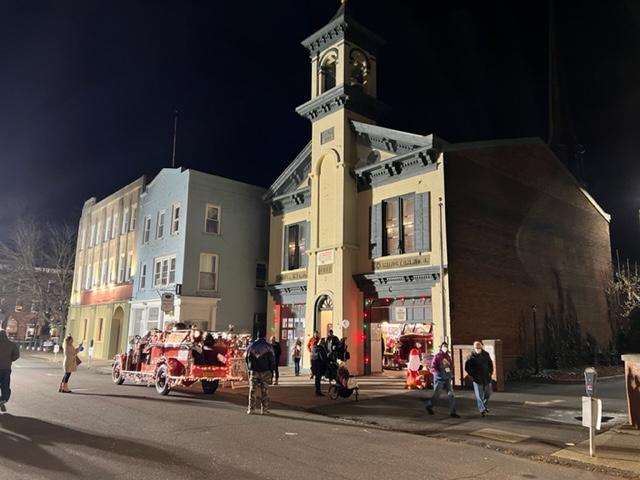
The museum decorated for Christmas for the recent “Kingston Snowflake Festival”

It is interesting to see how different each rig is at that stage of its history but how much has not really changed with the use of the equipment when fighting a fire.

The bay area of the old firehouse with the antique equipment

One of the more interesting pieces in the collection is the beautifully detailed Parade piece from the late 1800’s (circa around 1890’s) which has gorgeous details and intricate craftsmanship work to it. This interesting piece of equipment was the pride of the department on parade day and is one of the few of its type in the country.

The Fire Department Parade Piece

Along the walls is all sorts of pictures of old fires, men who were once members of the department, ribbons and awards, old systems for calling for firemen from the horns that used to sound the alarms to the more modern telegraph equipment to the current paging systems.

The roster upstairs
Kingston Firemen's Museum III.jpg

The fire department equipment pieces

Upstairs you can visit the furnished headquarters of a firehouse circa 1890’s to 1920 with vintage furniture, decorations and composites of firemen long ago. There is even a mannequin of a fire fighter sliding down a pole that leads to the first floor. Here and there are more decorative equipment pieces, furnishings and awards.

The upstairs of the Kingston Volunteer Museum

The museum has a little something for everyone and if you are interesting in knowing more of the history of the fire service and want to hear the stories by members current and retired from the Kingston Fire Department, then the Volunteer Firemen’s Hall & Museum is the place to visit.

Kingston Firemen's Museum IV.jpg

Old decorations from fire equipment at the Volunteer Firemen’s Hall & Museum

History of the Museum and Fire Fighting in Kingston, NY:

Ulster County has a remarkable over 350 year history of noble fire fighting. See it up-close and personal at the Volunteer Firemen’s Hall & Museum of Kingston.

The award case upstairs at the firehouse

When Kingston City Hall burned on June 4th, 1927, the third alarm was sounded from the building’s own bell tower before it crashed to the ground. Fire calls in Kingston today are answered through the 911 system with a three minute response time. Ever watched a TV show about firemen and their firehouse? The ‘squawk’ to a call is unmistakable.

The upstairs in the firehouse

Seven volunteer fire companies and the Exempt Association of Kingston recognized the importance of preserving and protecting firematic artifacts as well as establishing a meeting hall for volunteer fire organizations in Kingston and Ulster County. They were charged with finding a permanent home and signed a lease with the City of Kingston for Fair Street’s historic circa 1850 Wiltwyck Fire Station and the rest is history.

The Ladies Auxiliary and rosters

Walk through the large wooden doors to the home away from home of the 19th century firefighters.
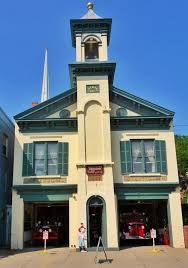
Kingston Firemen's Museum.jpg

The old Kingston, NY firehouse that now houses the museum

Disclaimer: this information was taken directly from the Volunteer Firemen’s Hall & Museum of Kingston pamphlet and I give them full credit for it. Please check out their website for more information.

The living area upstairs in the firehouse decorated for Christmas

Jewish Museum                                                  1109 Fifth Avenue                                              New York, NY 10128

Jewish Museum 1109 Fifth Avenue New York, NY 10128

Jewish Museum

1109 Fifth Avenue

New York, NY   10128

(212) 423-3200

https://thejewishmuseum.org/

Open: Monday-Tuesday 11:00am-5:45pm/Wednesday Closed/Thursday 11:00am-8:00pm/Saturday & Sunday 10:00am-5:45pm

Fee: Adults $18.00/Seniors (over 65) $12.00/Students $8.00/Children under 18 Free

My review on TripAdvisor:

https://www.tripadvisor.com/Attraction_Review-g60763-d106187-Reviews-The_Jewish_Museum-New_York_City_New_York.html?m=19905


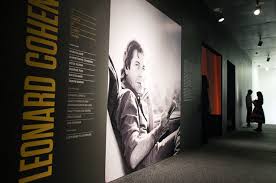
I visited the Jewish Museum for the first time this week to see the Leonard Cohen exhibition which had gotten good review online ( I had never heard of him before). It was a combination of video and pictures. The videos were on concerts, interviews, poetry readings and documentaries on his life.

Jewish Museum III.jpg

The Leonard Cohen exhibition

After seeing his videos on each floor, which was nice because there were bean bags all over the galleries, I visited the other galleries. There was an gallery dedicated to Jewish religious symbols, Contemporary Jewish Artists and items by Jewish craftsman.

The one gallery that I thought was quite amusing was the depictions of Jews on TV and how stereotypes play a role in comedy. It had everyone in the gallery laughing their heads off. It is good when you can laugh at yourself.

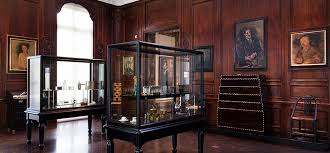
There is some interesting silver works from the Eighteen century on exhibition and the contemporary works were very lively. The museum is not that big so you can visit all the galleries in one afternoon. There is also a branch of Russ & Daughters in the basement level that is very popular with visitors.

Jewish Museum IV.jpg

The music gallery of the Leonard Cohen exhibition


History of the Jewish Museum:

The Collection that seeded the museum began with a gift of Jewish ceremonial art objects from Judge Mayer Sulzberger to the Jewish Theological Seminary of America on January 20, 1904, where it was housed in the seminary’s library. The collection was moved in 1931, with the Seminary to 122nd Street and Broadway. The Jewish Theological received over 400 Jewish ceremonial items and created. The Museum of Jewish Ceremonial Objects’, previously the Jacob Schiff Library. The collection was subsequently expanded by major donation from Hadji Ephrain Benquiat and Harry G. Friedman. In 1939, in light of WWII, Poland sent about 350 objects to New York City from homes and synagogues in order to preserve them.

Following Felix Warburg’s death in 1937, in January 1944 his widow Frieda donated the family mansion to the seminary as a permanent home for the museum and the site opened to the public as “The Jewish Museum” in May 1947. Frieda Warburg said at the opening that the museum would not be a somber memorial but rather a celebration of the Jewish faith and traditions. The first expansive of the museum was the addition of a sculpture garden in 1959 by Adam List. The building was expanded in 1963 and further by architect Kevin Roche in 1993.

In the 1960’s, the museum took a more active role in the general world of contemporary art with exhibitions such as Primary Structures, which helped to launch the Minimalist art movement. In the decades since, the museum has had a renewed focus on Jewish culture and Jewish artists. From 1990 through 1993, director Joan Rosenbaum led the project to renovate and expand the building and carry out the museum’s first major capital campaign of sixty million. The project designed by architect Kevin Roche, doubled the side of the museum, providing it with a seven story addition. In 1992, the Jewish Museum and the Film Society of Lincoln Center teamed up to create the New York Jewish Film Festival, which presents narrative features, short films and documentaries.

Jewish Museum II.jpg

Contemporary art galleries

Today, the museum also provides educational programs for adults and families organizing concerts, films, symposiums and lectures related to its exhibitions. In 2011, the museum named Claudia Gould as its new director.

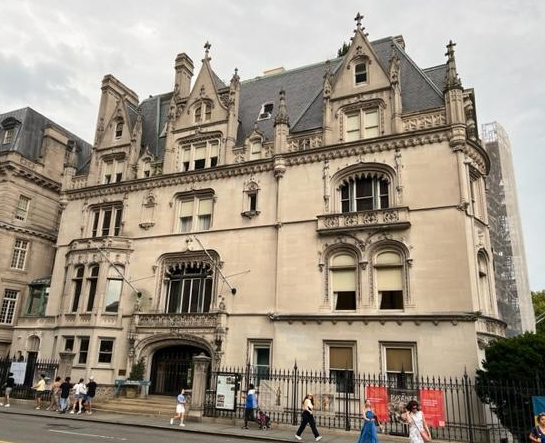
Jewish Museum

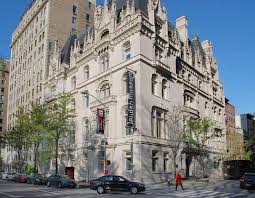
The Warburg Mansion

Architecture:

Felix M. Warburg House  was constructed in Francois I style in 1906-1908 for Felix and Frieda Warburg, designed by C.P.H. Gilbert. Francois I style was originally found in New York City in the late 19th century through the works of Richard Morris Hunt. Hunt was a renowned architect throughout the Northeast, particularly in New England and was one of the first American architects to study at the elite Ecole des Beaux-Arts in Paris.

The original house is built in limestone with mansard roofs, dripping moldings and gables. This architectural style was based on French revivalism and exuded wealth, a point which Felix Warburg wanted to make to his neighbors. It featured a green yard in front of the house, which was later converted into the museum’s entrance.

Disclaimer: This information was taken from the Wiki story on The Jewish Museum and I give the site full credit for it.)


Neue Galerie New York                                      1048 Fifth Avenue                                               New York, NY 10028

Neue Galerie New York 1048 Fifth Avenue New York, NY 10028

Neue Galerie New York

1048 Fifth Avenue

New York, NY  10028

(212) 628-6200

neuegalerie.org

@neugalerieny

Open: Sunday 11:00am-5:00pm/Monday 11:00am-6:00pm/ Tuesday and Wednesday Closed/Thursday-Saturday 11:00am-6:00pm

Café and Shops have various hours. Please check the website for these.

Fee: General $22.00/Seniors (65 and Older) $16.00/Students and Educators $12.00/Children under 12 are not admitted and Children under 16 years old must be accompanied by an adult. The museum is open on First Fridays from 6:00pm-9:00pm. Please visit the website for more information.

My review on TripAdvisor:

https://www.tripadvisor.com/Attraction_Review-g60763-d258699-Reviews-Neue_Galerie-New_York_City_New_York.html?m=19905


I visited the Neue Galerie for the first time after passing the building on the way to the Metropolitan Museum of Art. This interesting little gallery space has some interesting pieces to see and many decorative objects in the cases.

The gallery space for special exhibitions on the third floor was closed when I visited and being an educator, I got a half price discount off the educator rate was a nice deal.

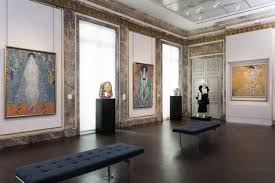
It was a thrill to finally see the famous Gustav Klimt painting of the “Woman in Gold” that had been such a controversial piece during the Nazi occupation in Germany. It’s beautiful detail work was very innovative then. After all the fighting over the painting it is nice to see that the family sold it to the museum to share it with the world. The gallery where the painting hangs has more works by Gustav Klimt and you can see the extent of his work along the walls of the gallery.

Neue Gallery II

The ‘Woman in Gold’

The side galleries are full of all sorts of objects of art for the home such as chairs, silverware, dishware, clocks and decorative objects. There was a lot of items that still are contemporary in their fashion. The back gallery on the second floor is full of paintings by various German artists.

neue Gallery IV.jpg

The Decorative Objects Gallery

The whole museum you can see in about an hour when the special galleries are closed. There is also Cafe Sabarsky on the main floor, a Viennese cafe the serves German food like sausages, salads and pastries. The restaurant is a little over-priced for what it is.


History of the Neue Galerie New York:

Neue Galerie New York is a museum devoted to early twentieth-century German and Austrian art and design. Located in a landmark mansion built in 1914 by the architectural firm of Carrere & Hastings, the museum offers a diverse program of exhibitions, lectures, films, concerts and other events. The second floor galleries are dedicated to a rotating selection of fine and decorative art from Vienna circa 1900, including work by fine artists Gustav Klimt, Egon Schiele and Oskar Kokoschka and decorative artists Josef Hoffmann, Koloman Moser and Adolf Loos. The third-floor galleries present German fine and decorative art of early twentieth century, including work by Max Beckmann, Ernest Ludwig Kirchner, Paul Klee and Marcel Breuer. The third floor is also the site for special exhibitions that focus on key individuals and movements, articulating a more complete vision of twentieth-century German and Austrian art (Neue Galerie New York History).

The Gustav Klimt Gallery

Neue Gallery III


Neue Galerie New York was conceived by two men who enjoyed a close friendship over a period of nearly thirty years: art dealer and museum exhibition organizer Sege Sabarsky and businessman, philanthropist and art collector Ronald S. Lauder. Sabarsky and Lauder shared a passionate commitment to Modern German and Austrian art and dreamed of opening a museum to showcase the finest examples of this work. After Sabarsky died in 1996, Lauder carried on the vision of creating Neue Galerie New York as a tribute to his friend (Neue Galerie New York History).

The German art collection represents various movements of the early twentieth century: the Blaue Reiter and its circle (Vasily Kandinsky, Paul Klee, August Macke, Franz Marc, Gabriele Munter) the Brucke (Erich Heckel, Ernest Ludwig Kirchner, Hermann Max Pechstein, Karl Schmidt-Rottluff), the Bauhaus (Lyonel Feininger, Paul Klee, Laszio Moholy-Nagy, Oskar Schlemmer), the Neue Schlichkeit (Otto Dix, George Grosz, Christian Schad) as well as applied arts from the German Werkbund (Peter Behrens) and the Bauhaus (Marianne Brandt, Marcel Breuer, Ludwig Mies van der Rohe, Wilheim Wagenfeld) (Neue Galerie New York History).

Cafe Sabarsky located in a spectacular wood-paneled room on the ground floor has become a favorite spot for New Yorkers. Operated by acclaimed chef Kurt Gutenbrunner, it evokes the great fin-de-siecle cafes of Vienna. The Book Store fills the former library of the mansion and specializes in publications on fine art and architecture from Germany and Austria. The Design Store features objects based on original works by Marianne Brandt, Josef Hoffman, Adolf Loos and other major designers of the era (Neue Galerie New York).


Ukrainian Institute of America                                2 East 79th Street                                                New York, NY 10021

Ukrainian Institute of America 2 East 79th Street New York, NY 10021

Ukrainian Institute of America

2 East 79th Street

New York, NY  10021

(212) 288-8660

Open: Sunday 12:00pm-6:00pm/Monday Closed/ Tuesday-Saturday 12:00pm-6:00pm

Fee: Adults $8.00/ Seniors $6.00/ Students with current ID $4.00/Children under 12 Free/ Members Free

My review on TripAdvisor:

https://www.tripadvisor.com/Attraction_Review-g60763-d5953575-Reviews-Ukrainian_Institute_of_America-New_York_City_New_York.html?m=19905

The Ukrainian Institute of America at 2 East 79th Street

I was really impressed by the Ukrainian Institute of America on a recent visit. I must have passed this building a hundred times on my way to the Metropolitan Museum of Art and never thought twice of it. I was sorry  I did as you will miss a lot by not walking in. The galleries are really impressive and the main gallery on the bottom gives you an interesting look at the history of the Ukrainian.

The first floor gallery discusses the formation of the country, a bit about its history and its ties to Europe and to Russia, its religious past and the current state of affairs of the country including its recent split of the eastern sections of the country and Crimea to Russia. Its a country in turmoil considering they want to join the European Union. It is a country in flux and on the cusp of entering the 21st Century with some of its past still tugging at it. Like all countries, it will prevail on the will of it’s people. There is a lot of solid history here and a country ready to enter its future.

Ukrainian Institute II

The artwork of artist Vasyl Diadyniuk

The second and third floor galleries are full of art work from Ukrainian artists that is on sale and each of the galleries is dedicated to certain artists selling their works at somewhat hefty prices. Still you get to see the developments of the artists both here and abroad.

The forth floor is dedicated to special exhibitions. There are two shows going on now. One is by artist Vasyl Diadyniuk and another show is by artist Alexander Archipenko.

Ukrainian Institute III

The artwork of artist Alexander Archipenko

The Museum has an interesting history.

Ukrainian Institute of America History:

The Ukrainian Institute of America Inc. is a non-profit organization whose primary mission is to showcase and support Ukrainian culture. To that end, the Institute affords the general public an opportunity to learn about Ukraine and how the Ukrainian spirit expresses itself, with special emphasis on the creative arts.

Founded more than fifty years ago by William Dzus, a prominent Ukrainian industrialist and philanthropist, the Institute sponsors:

*Art exhibitions

*Music concerts

*film screenings

*theater presentations

*Poetry readings

*Lectures and symposia

*Educational programs

*Children’s events

*Documentation center

The history of the building:

The building that is home to the Institute, the National Historic Landmark Harry F. Sinclair House is one of the few remaining examples of the splendid mansions that prominent citizens of New York City built in the 19th Century. The mansion was built in 1897 for Isaac D. Fletcher, a wealthy banker and broker, by the architect C.P.H. Gilbert. Executed in Gothic Revival style, the building is richly decorated with intricate crockets, carvings, moldings, pinnacles and other exquisite details. Six stories high, partly surrounded by a dry moat, the Institute features stately rooms that are magnificently proportioned and lavishly finished (Institute History).

Ukranian Institute of America

The C.P.H. Gilbert house

In 1887, manufacturer, Isaac D. Fletcher, commissioned famed Gilded Age architect, C.P.H. Gilbert to design the mansion. When Mr. Fletcher died,  left this mansion and his art collection to the Metropolitan Museum of Art, which sold it to Harry F. Sinclair, founder of Sinclair Oil Company and also famous for his involvement in the Teapot Dome affair. The last private owner was Augustus Van Horne Stuyvesant Jr., the last descendant of Peter Stuyvesant, who was the first governor of New Amsterdam, today’s New York City bought the house in 1930 and lived here with his sister, Anne. The house was sold as part of the estate when Mr. Stuyvesant died in 1953. The Ukrainian Institute of America acquired the mansion in 1955 (Institute History).

A key goal of the Institute is to continue to preserve this extraordinary fragment of the city’s history for the benefit of all citizens of New York. The house still retains its wooden moldings and the house looks as if its residents just moved out.