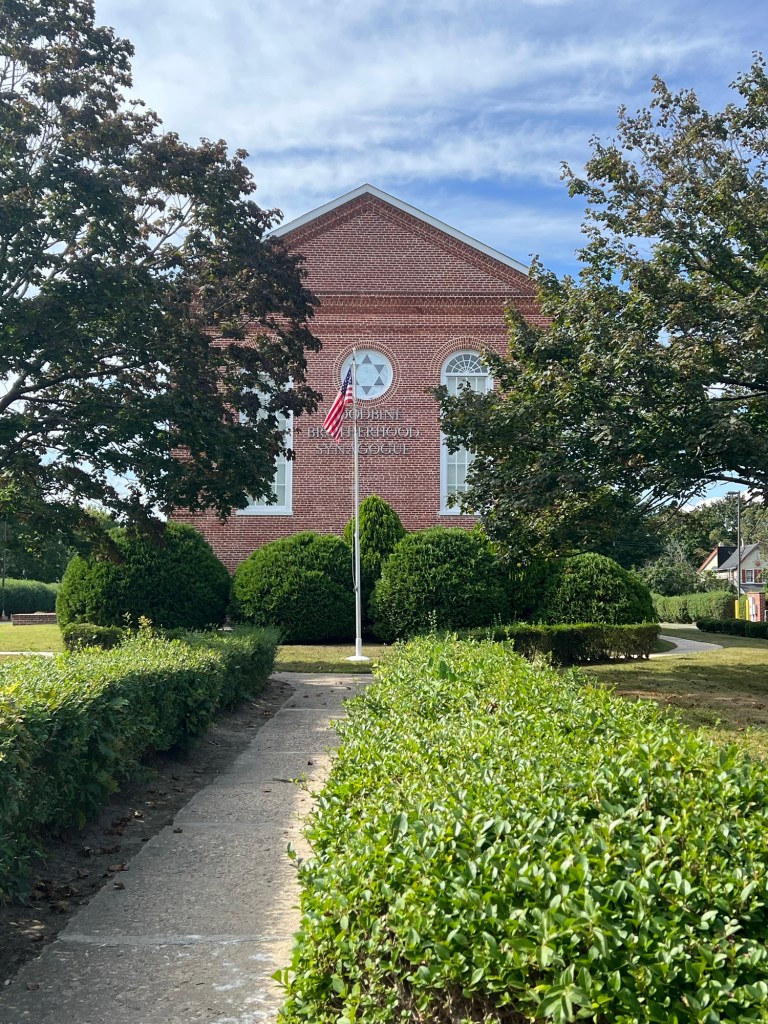
The front of the Sam Azeez Museum of Woodbine Heritage
The entrance sign that welcomes you
The History of the Sam Azzez Woodbine Museum:
(from the museum’s website):
The Sam Azeez Museum of Woodbine Heritage is an independent non-profit charitable organization preserving the unique history of Woodbine, NJ.
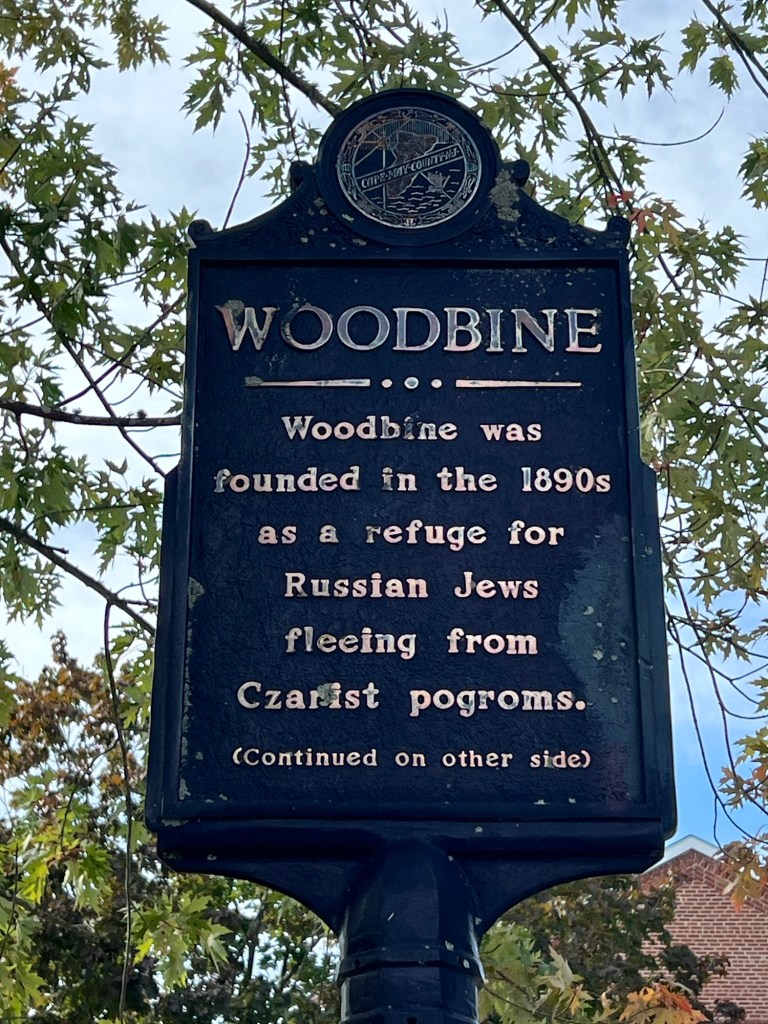
Established in the 1890’s through Baron de Hirsch’s philanthropy, Woodbine began as an agricultural colony for Russian Jewish immigrants seeking freedom denied in their homeland. As poor soil conditions limited farming, Woodbine evolved into Cape May County’s manufacturing center while maintaining founding values of education, religion and inclusion.
The museum occupies the historic Woodbine Brotherhood Synagogue, listed on the Natural Register of Historic Places. The restored sanctuary hosts special services, while the Brotherhood Hall houses exhibitions including the community-contributed Collective Memory Wall.
The historical significance of of the Town of Woodbine
The entrance to the museum
The museum is another interesting look at New Jersey history and the development of the immigrant story of assimilation into American society.
I was given a personal tour by the Assistant Curator and she explained the resettlement of Russian Jewish immigrants by a wealthy patron into this South Jersey community.
The main gallery of the museum
The panels tell the story of how these community came into being and how these people built a community through agricultural and eventually manufacturing and small businesses that supported the community around it. It established a town that was self sustaining and grew to the community center.
The panels show the growth of Woodbine as a community
The residents established their own sports teams, community organizations and civic groups like the councils and fire and police departments.
The records of the many town organizations of Woodbine
Display of one of the first families to settle in Woodbine
Display of the religious faith of the community
One of the most touching displays is of survivors of the concentration camps during the holocaust. These pictures represent these women as children and them today.
The display of the women who survived the camps
The history of the community and the growth of diverse businesses in Woodbine
Creating and building the Synagogue in the community
On the second floor of the building is the old synagogue of the community which is only used during the high holidays. This is used by descendants of the community and family members of theirs.
The inside of the synagogue on the second floor of the building
The front of the temple
The chandelier is original to the temple
The space was being prepared for the Jewish New Year and the crowd of people who would be attending.
The Memorial Wall
The traditions of the religion being practiced in the community
The self-government of the community
Still the younger generation was all American and wanted to assimilate into society with an all American past time of things like baseball.
The Woodbine youth baseball team
The uniform of the old baseball team for youths in the town
The last display is of the famous alumni who once lived in the community. These are the men and women who once lived here and went on after all odds to do great things and make our country better.
The Hall of Fame
The museum I thought had a bit of an identity crisis as I really did not know what the museum was about.
I was pleasantly surprised to find an interesting part of New Jersey history I had never known. It just goes to show you how a museum can educate you with just one visit. The Assistant curator said there will be more to come in the future.
The John DuBois Maritime Museum at 949 Ye Greate Street in Greenwich, NJ.
I visited the John DuBois Maritime Museum when I was visiting the Gibbon House and the Carman Prehistoric Museum when I was visiting Greenwich, NJ. What a nice little museum explaining the maritime history of not just New Jersey but the local area as well.
The museum is one large gallery broken down into sections of the history of the area. The main gallery is well organized by section to explain the shipping history of the region.
The decoys and rafts that are part of the collection.
The nautical instruments to guide your way through the stars. These were part of the long voyage.
The Shipping display
The sign for the Oyster Dredge display
The Oyster Dredge display
The Oyster Dredge display explores the important of the oyster industry in the area’s waters and what an important source of food they were to the local population. It also showed their role in keeping the waterways clean and the water well circulated.
The Ship Building display
Ship building and the creation of the shipping industry’s planning on future boat was another important part of the economy before the Civil War.
The Ship’s Mascot greets all of her guests at the front of the museum.
The History of the Museum:
The John DuBois Maritime Museum houses a large collection of Southern New Jersey Maritime related items from the 19th and early 20th centuries. A large and unique collection of builders models of local craft, show the plans used to build a new ship from the model itself.
The anchor outside the museum
Exhibited are tools used to carve ribs, planking, masts and booms. Also displayed are many blocks, ‘deadlines’ and ‘rigging’. The museum is proud to have one of the largest collections on the East Coast of caulking tools. Videos are available to view by the New Jersey network on oyster schooners including an interview with John DuBois who donated most of the artifacts in the museum.
Also exhibited are early maritime engine parts, most from the Hettinger’s of Bridgeton, one of the first manufacturers in America of marine motors.
The Shipping displays in the heart of the collection.
$12.50 Seniors/Students/Children/$17.50 for Adults and Combination tickets
The History of the Reher Center:
(From the museum website)
I recently went to the Roundout section of Kingston to tour the Reher Center and what an interesting tour not just of the exhibit, I recently went to the Roundout section of Kingston to tour the Reher Center and what an interesting tour not just of the exhibit, “Taking Root: Immigrant stories of the Hudson River Valley” but also the historic baking tour. The tour guides really explained how the Reher Bakery, which closed its doors in 1980 was not just a bakery. It was a staple in the community where people got to together not just over bread but community affairs and interaction with other immigrant groups of people.
‘Taking Root: Immigrant stories from the Hudson River Valley’
Our first part of the tour started in the bakery on the first floor of the museum. when Hymie Reher closed the doors of the bakery for good in 1980, he shut the door and created a time capsule that would become the museum. It seemed that the family did not want another business in the space so it just stayed empty all those years. This led to the creation of the museum dedicated to a family whose roots were in Kingston for several generations (it seemed that family members still lived upstairs until the early 2000’s).
The start of the Bakery tour
The tour starts in the front of the bakery where the family would have standing orders ready for customers and this is where the community would come together. Over their orders. Some of the shelves are still stocked with supplies that would have been on the shelves in the 1950’s. The tour guide said that it was not just a bakery but a small grocer as well.
The Grocery display
The Grocery display
The bakery display section
The tour continued in the bakery section where the oven was located and where all the magic took place to produce all the breads, rolls and challah was made. The oven, which is still functional today but can not be used, takes up most of the room. It was a coal and wood burning oven that was used from the turn of the last century until the bakery closed in 1980. The oven was impressive not just for the amount of bread items that needed to be produced each week but the fact that people would come with their food for the sader to cook in the cooling oven.
The oven in the kitchen where the breads and rolls were made
On the other side of the kitchen is the flour bins and the dough mixer where the dough was produced and all the product was portion sized. The storage areas where supplies came in and were held each week to produce what needed to be made for the customers were off to the side. On the tour, you will hear talks from former employees and customers about what life was like in the bakery.
The shared oven where meals were cooked in the cooling oven
The tour would end with a few more conversations with former customers and a quick wrap up in the grocery area. Then each of us got a fresh roll in a bag that was baked by a restaurant in the neighborhood. That was really good. The roll was chewy on the outside and soft on the inside.
The dough mixing machine is to the right and the supply area to the left.
The dough machine
The kitchen storage area
Baking sheets from years and years of making rolls
The last part of the tour was in the new upstairs gallery where the “Taking Root: Immigrant stories of the Hudson River Valley” is on view. This is where immigrants from the United States from the World Wars until today tell their stories in video recording and you can hear how they came to this country. Their lives before they arrived and after they settled in the region. Some of the stories I heard were fascinating.
The timeline of the stories told
The pictures of the immigrant stories told
Pictures and stories from the exhibition
Brief History of the Reher Center:
2002-2007: The idea for the Reher Center was hatched in 2002 when Geoffrey Miller peered into the window of 101 Broadway and observed a time capsule: the space was left untouched since Hymie Reher closed his family’s bakery in the early 1980’s. Geoff describes it as “Falling down a rabbit hole,” as he envisioned preserving and opening the site as a museum. Through a conversation with his friend, Barbara Blas in 2004. Geoff learned that the Rehers and the Blases were long time members of Kingston’s Orthodox synagogue. Agudas Achim and old family friends. Hymie was pleased with Geoff’s vision (Barbara remembers him singing “Happy Days are Here”) and arranged to deed the Reher’s property at 99-101 Broadway to the Jewish Federation of Ulster County.
The front of the bakery
A core committee quickly formed to develop plans to preserve the buildings and expand on Geoff’s initial vision for the site as a museum and cultural center that would honor the Reher family’s legacy and the broader immigrant history of Rondout neighborhood. Its tagline became “Building community by celebrating multiculturalism and our immigrant past.”
2008-2016: Geoff led the all-volunteer Reher Center Committee to restore the storefront and raise $750,000 in funding to stabilize the property under the guidance of preservation architect Marilyn Kaplan. Working with a variety of local organizations and partners, the Reher Center also spearheaded a series of popular programs including an annual Kingston Multicultural Festival, Deli Dinner and Immigrant Gifts to America series.
2016-2018: The Reher Center Committee expanded its Steering Committee and hired its first professional staff to leverage a range of new expertise and develop an interpretive plan for the site. In 2017, Sarah Litvin, Interpretive Planner, and Samantha Gomez-Ferrer, archivist, were hired to inventory, catalog, preserve, research, and digitize the Reher Center’s collection and expand it through conducting oral histories.
The outside displays of the Reher Center
In 2018, thanks to a generous matching donation from the Norman I. Krug family and our committed funders, the Reher Center was able to hire our first Director, Sarah Litvin, to open the site for public programming during summer, 2018. From May to August, the Reher Center was abuzz of activity as we created a new window display featuring historic photos from our collection; created a gallery and mounted our first exhibit, “The Story Continues” and shared the site and our vision for its future on Preview Tours of our historic bakery. Our July 7th “Open House” marked the first time the Reher Center was open for regular on-site programs.
The “Big Night” event in 2025:
In February 2025, I was invited to a very successful special event sponsored by both the Kingston Film Foundation and the Reher Center, a screening of the film, ‘Big Night’ and a sampling of Italian food. Needless to say the event far exceeded what the planners thought and they were completely full and sold out by 6:00pm. The organizer said they were turning people away. They had never seen anything like this. When you mix free Italian food, free wine and an excellent movie, you have a recipe for an excellent event. It was so much fun.
The organizer from the Kingston Film Foundation was explaining the success of the evening to the crowd
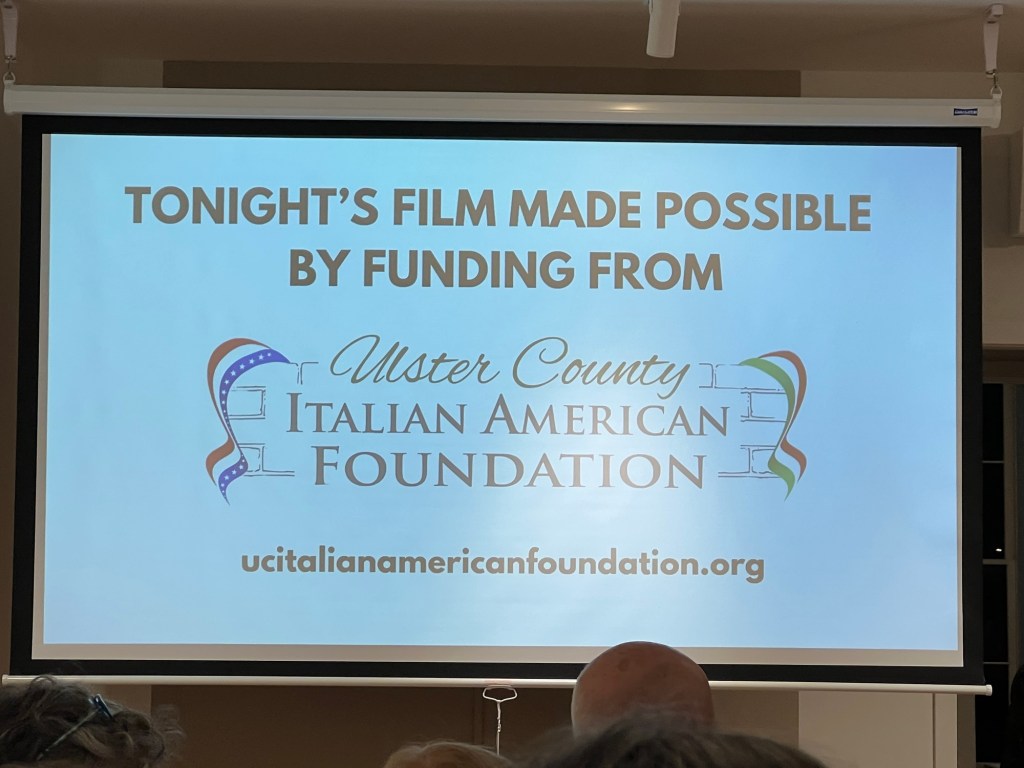
The event was funded by the Ulster County Italian American Foundation
I am convinced that it was the food that brought the people in coupled with a very popular film. The caterer who was there that night from Mass Midtown made two versions of the Tripoli, the noodle and meat dish in the film. Trust me when I say, the lines never stopped for that.
The two versions of the Timpano, the Vegetarian and the Meat versions, which were delicious was donated by Masa Midtown in Kingston, NY and the wines were donated by Kingston Wine Company.
Trust me they were very generous with the slices of Timpano
God, it was delicious
The screening room was beyond packed that evening. Put free Italian food and a popular film in front of people and you will get a crowd
This very popular event people in the area will be talking about for a long time. This is what gets you a lot of attention. It really was an excellent event and I had a lot of fun that night. I love the movie ‘Big Night’.
The Timpano in the “Big Night”
The Trailer for the “Big Night”:
The evening was night of good food, wonderful conversation and an excellent movie.
Open: When the library is open. Please check the website.
Admission: Free
The Donald & Barbara Tober Exhibit Room plaque inside the Conrad N. Hilton Library hallway
The Donald and Barbara Tober Exhibit Room is on the main floor of the Conrad N. Hilton Library. The exhibit room is open to the CIA community and to the public. The exhibition room has ongoing displays of culinary themed exhibits that cover topics involving the culinary world and food service. This is run by both the college and by students. It is not quite a museum but more of a display room of artifacts that are held by the Conrad N. Hilton Library and its archives.
The Hallway exhibition
The two display cases are in the main entrance of the Conrad N. Hilton Library and hold more of the exhibition. These are displays of industry pamphlets and flyers plus menus and equipment.
The library exhibition of China pieces
The Menu Collection:
The Tober Room Exhibition space
The CIA’s menu collection began in the small library at the New Haven campus and was used as a reference tool by the culinary students. By 1978, then in Hyde Park, the library had amassed a file of over 3,000 menus which were openly available to students and used regularly in their studies. These menus still remain in the collection and are known as the “Original CIA Menu Collection.” They provided the foundation for the growing menu collection that was later added to by many prominent menu collectors and friends of the CIA.
This collection of nearly 800 menus, acquired by the CIA in 1984, were collected by the culinary writer and critic, Baron Roy Andries de Groot (1910-1983), during the course of editing his column, “A Moveable Feast,” for Esquire Magazine. The menus date primarily from the 1960s and 1970s and are from major U.S. cities (many from New York City), as well as Canada, France, Belgium, Spain, Puerto Rico, Hong Kong, and Thailand. Some menus include supplemental materials, as well as annotations by de Groot or his staff noting the date of visit, names of other guests, the chef’s name, and his evaluations and/or ratings.
In 1987, Herbert Ernest donated to the CIA over 300 menus collected by his father, Semy Ernest. The menus date from 1889-1977 and include menus from restaurants and clubs in New York City, Boston, Indianapolis, Los Angeles, and San Francisco; international menus from France and Germany; and several menus from on board the Santa Magdalena ocean liner. This collection is rich in pre-1920 menus.
The Greenebaum Menu Collection was donated to the CIA by Henry Greenebaum in 1989. Greenebaum’s father, Michael H. Greenebaum, started the collection and it was continued by his two sons, Henry and Richard. It includes menus from 1905-1988, many international and many from railroads and ships. Several menus are signed by the chef or proprietor.
Bruce P. Jeffer donated his collection of 2,500 menus to the CIA in 2013. Jeffer, a California lawyer and wine connoisseur, began collecting menus during his travels as a child. The menus date from 1950s-1990s. Much of the collection is international menus from over 70 countries on 6 continents. A selection of these were featured in an exhibit in the Conrad N. Hilton Library in August 2013.
George Lang, restaurateur and author, donated his personal collection of over 3,000 menus to the CIA in 1989. Many of these menus are international, including often under-represented countries such as Australia, Cuba, Hong Kong, Hungary and the Philippines. Although most menus date from 1950s-1970s, the earliest two menus are from Hotel Knickerbocker in New York City, 1907.
Vinnie Oakes Menu Collection
In 2000, Vinne Oakes donated his collection of over 200 menus to the CIA. The collection is strong in menus from restaurants in Nevada, as well as ship menus from the 1960s.
The Chapman S. Root Menu Collection of nearly 10,000 menus was donated by The Root Company in 2000. The largest collection recieved so far, it includes menus from almost every state (strongest in California, Florida and Nevada), and several foreign countries. The bulk of the menus date from 1960s-1980s, although the earliest are from 1878. Over 3,000 U.S. Railroad menus are an important highlight of the collection.
Chapman S. Root’s grandfather, Chapman J. Root, designed the classic green, ridged Coca-Cola bottle in 1915. At his grandfather’s death in 1945, Chapman S. Root inherited Associated Coca-Cola Bottling Plants, Inc. He traveled a great deal, mostly by car or train, and amassed an enormous menu collection. Friends, knowing of his interest, also contributed to his collection.
Jacob Rosenthal, former president of the Culinary Institute of America, donated nearly 500 menus to the CIA menu collection. The bulk of these menus are from food and wine societies in the 1960s-1970s, including Confrerie des Chevaliers du Tastevin, Confrerie de la Chaine des Rotisseurs, and the International Food & Wine Society. Also of note are several international menus from the 1930s-1950s.
The Smiley Family Menu Collection was donated to the CIA in 1982 and 1993, a gift of Mohonk Mountain House. (The Smiley family are the founders and proprieters of the Mohonk Mountain House in upstate New York.) Three generations of Smileys traveled the world, by land and by sea, and collected menus along the way. This collection is rich in pre-1920 menus; menus from historically world-renowned resorts including Laurel-in-the-Pines (Lakewood, N.J.), Haverford Court (Pennsylvania) and Hotel Colonial and Royal Vicotoria Hotel (Nassau, Bahamas); beautifully-illustrated ship menus; and a selection of early menus from Mohonk Mountain House.
The display case in the main library showcases the collection of China and Silverware and decorative objects that are in the collection.
The Tober Room exhibition on “Fat” at the Conrad N. Hilton Library on the CIA campus
The exhibition that they were showing when I came up to visit was “Clarifying Butter: A Cultural History of Fat”. There were a lot of recipes, objects and equipment to make butter, understand the use of fats in cooking, recipes, menus and corporate information.
The description of the exhibition:
FAT. The very word, fat, conjures images of unctuous oils, crispy fried foods and flavorsome pools of golden richness (indeed, medieval European foods that were described as “rich” meant both fatty and foods of the privileged). Conversely, the idea of fat can also make people frown with scorn, concerned over blocked arteries or a perceived moral laxity of a diner.
Fat. as an substance found in animals and oil, as a plant based ingredient, appear across time and place and reveal cultural attitudes and historical changes. At a culinary school, we use fats and oils daily and as eaters, they literally become part of us. While ubiquitous they are never without deep meaning. This exhibit explores but some of the aspects of a food group that is simultaneously present and polarizing.
Both the two display cases and the middle display case were set with all sorts of information through the ages of the subject of fat, fried foods and items used to produce and make them.
The Display Cases in the Tober Room
The exhibitions here are very detailed and display over a hundred years of culinary arts research. The displays are revolving every quarter. The room is off to the right of the entrance to the library and is open for free to the public. It is a wonderful way to learn the aspects of food than in one of the best culinary libraries in the world.