The cemetery sits behind the former ‘Ladies Shopping District’ department stores
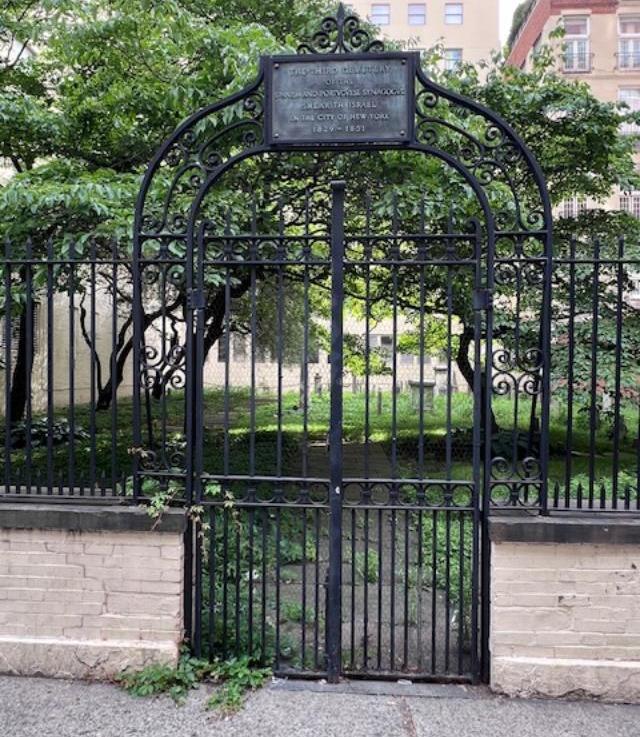
The front of the cemetery
When I was finishing my walk of the streets of Lower Chelsea, I came across this quiet and respectful cemetery in the middle of a busy neighborhood. This small graveyard was the third of series of moves that Shearith Israel made to bury their dead since the original cemetery open on the edge of what is today Chinatown.
Like its earlier counterparts, the cemetery is locked to visitors. So you can only admire it from a far. The graves date back to the early 1800’s.
The History of the cemetery:
(From the New York City Cemetery Project and Find a Grave)
This cemetery is located on 21st Street between 6th and 7th Avenues, in use 1829-1851. Shearith Israel, the first Jewish congregation in North America, was formed in 1654 by Spanish and Portuguese Jews who journeyed from Recife, Brazil, seeking refuge from the Inquisition.
The entrance to the cemetery is always locked
The sign for the cemetery
While New Amsterdam’s city fathers did not recognize freedom of worship, they respected the Jews’ right to their own consecrated burial ground. Shearith Israel purchased the cemetery plot on West 21st Street in 1829 for $2,750. It, too, was on the outskirts of the expanding city, which for sanitary reasons had prohibited interment below Grand Street after the yellow fever epidemic of 1822.
The view of the cemetery from the fence
In 1832 the congregation bought land extending the cemetery east to Sixth Avenue and south to 20th Street. Fifty years later the land was sold to Hugh O’Neal, who built a dry goods store there. Shearith Israel used the cemetery for burials until 1851.
The graves are from the early 1800’s
That year, New York City prohibited burials south of 86th Street and the establishment of any new cemeteries within city limits (Find a grave.com).
The side section of the cemetery and pathway
The view of the cemetery and its quiet respect to those buried there
The history of the Cemetery from the Congregation of Shearith Israel The Spanish & Portuguese Synagoge website:
According to rules of ritual purity, Cohanim are prohibited from coming into contact with the deceased (except for their immediate family.) This means that ordinarily Cohanim cannot participate in any of the mitzvoth related to burial. One particularly commendable priest, Mr. Lewis I. Cohen, realized that the consecration of a new and unused cemetery afforded him an opportunity to participate in a mitzvah usually off limits to Cohanim. So it was Mr. Cohen who volunteered to dig the first grave for the first burial of the new cemetery in November 1829.
Some of the notable persons laid to rest in the 21st Street cemetery were Moses Levy Maduro Peixoto and Isaac Seixas, ministers of our congregation, and Harmon Hendricks, founder of one of America’s first great industrial companies and whose descendants are still members of our congregation today. Perhaps the most influential person to be buried in the 21st Street cemetery was the great Jewish diplomat and proto-Zionist, Mordecai Manual Noah.
In 1851, the city prohibited burial in Manhattan below 86th Street. Rather than continue to look north (as Trinity Church did), the Congregation searched outside of Manhattan for its next burial ground. Together with Bnai Jeshurun and Shaarei Tefila, the congregation purchased a large plot of land in Ridgewood, Queens.
Open: Sunday 9:00am-12:00pm/Monday-Saturday Be Appointment
My review on TripAdvisor:
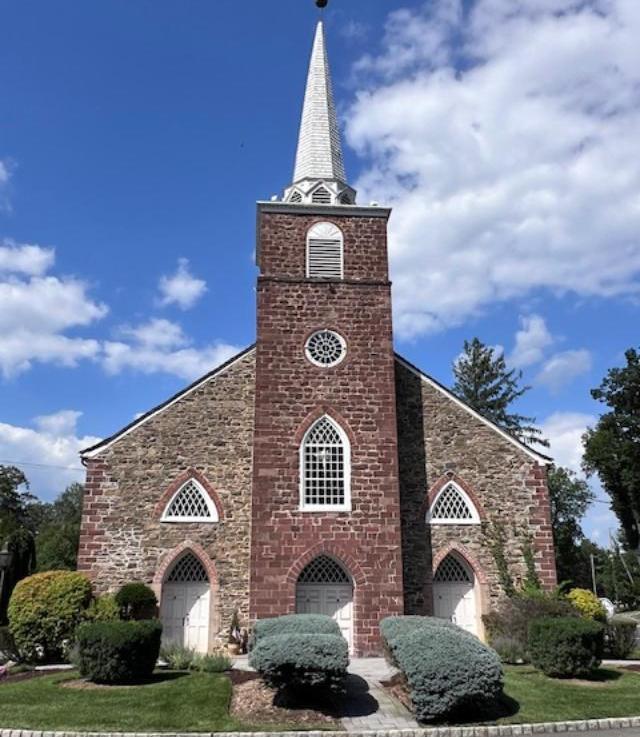
The Saddle River Reformed Church at 481 East Saddle River Road in Saddle River, NJ is also known as the “Old Stone Church”
The Saddle River Reformed Church in Saddle River, NJ is one of the nicest church’s in Bergen County for Sunday services. The Pastor is very inspirational in her speaking, the service is well planned out and enjoyable to follow, the congregation is very nice and very welcoming to new people attending church and they have nice refreshments in which they ask you to enjoy after service is over. I found the whole experience very engaging and enjoyable.
Inside the Old Stone Church during Sunday service there is still a sense that you are revisiting the time of the Revolutionary War and the period around it. The pews still have the same details they have had for three hundred years. You are no just going for Sunday service you are experiencing part of history.
The inside of the Old Stone Church
The inside of the Old Stone Church for Sunday Mass
The podium at the Old Stone Church
The Chandelier inside the Old Stone Church
The refreshment table after mass. It is a nice way to gather with other parishioners.
I thought it was very nice of the congregation to invite me to join them for pastries after the service was over. I had a nice time talking to everyone.
The historic marker of the church
I visited the ‘Old Stone Church’ in Saddle River, one of the oldest churches in the state and was taken not just by the beauty of the church but by the respect the church has for the people who are buried here. There is much recognition for the contributions of the soldiers and the armed forces not just for the Revolutionary War soldiers but current ones as well.
The oldest part of the cemetery is the closest to the church
The oldest part of the cemetery contains names like Demarest, Haring, Hopper, DeBraun, Eckerson, Terhune and Zabriskie. These are the first settlers of the area whose families owned farms in Saddle River. Many of the families have family plots in the cemetery.
The Hopper family plot
The Hopper family plot
The Hopper family plot
The Zabriskie family plot
The Gilderston family plot
The DeBaum family plot
The DeBaun family plot
The DeBaun family plot
The Hopper family plot
The Hopper family plot
The oldest part of the cemetery holds so much history of the founding members of the Saddle River and Bergen County community.
The History of the Church:
(from the Saddle River Reformed Church website)
Our church, known to many as the Old Stone Church, was organized in 1784 as a daughter church of the Old Paramus Church. It is a part of the Reformed Church in America, a denomination which traces its roots to the Dutch colonists.
While there is evidence that the original church building was erected in 1789, our present sanctuary was built in 1819. An extensive renovation in 1971 – 1972 recreated the appearance of the original structure.
The Old Stone Church and the historic Revolutionary War Cemetery that is located behind it.
The History of the Cemetery:
(From the Saddle River Reformed Church website):
Our cemetery is the resting place of numerous American Revolution and Civil War Veterans. Church records indicate that the following veterans have been buried at our historic site.
The Saddle River Reformed Church Cemetery is one of the most historic in this part of the country. Our cemetery is over 230 years old and is the burial ground of nine known Veterans of the American Revolution. Tracing back to the founding of this nation, these resting places designate the cemetery as an historic spot of great significance, with a special interest to historians and antiquarians. Surrounded by mature and lush foliage, its peaceful setting by the banks of the Saddle River make for an esteemed and hallowed resting place for your loved ones.
Some of the most fascinating part of the cemetery is its historical section
My International Marketing class at Bergen Community College recently did a complete study and marketing plan for the “Bergen250” on the Revolutionary War veterans buried at graveyards and cemeteries all over Bergen County, NJ:
For a Mapping of all the historic graveyards and cemeteries, I had the students visit all the sites that the Daughters of the American Revolution had researched and I had the students find all the locations, photo the tombstones and create a bio on each of the veterans. I enclosed a copy of their work above.
My blog on the historic graveyards and cemeteries of Bergen County:
David DeBaun was born in Schraalenburg (Bergenfield) in 1759 to Abraham DeBaun and Bridget Ackerman. About 1770 the family moved to Hempstead in New York. David served as a private in the Second Regiment of Hay’s Militia, Captain Garret Ackerson’s Company. He married Hannah Forshay, b. 1868, d. 1836. David died in New Hempstead, NY in 1820. He was tax officer of Hempstead in 1811 and 1812; supervisor of Haverstraw 1811-1814. An enclosed plot in the Upper Saddle River Cemetery is the resting place of his entire family.
John Tallman
(from the church website)
John Tallman was a Sergeant in Hays Regiment of Militia, Orange County, NY Militia, Company of Captain Hogenkamp, William Sickles, and Aurie Smith, and is listed on the Revolutionary War pension records. He was born in Tappan, the son of Jan Tallman and Helena Gerritse Blauvelt. He married Margrietje Forseur (Forshay). He died in New Hempstead, NY in 1839.
David Eckerson
(from the church website)
David Thomas Eckerson, was born in Schraalenburgh (Bergenfield) in 1738. He married Angenetye Vanderbeek and they had a sons Thomas, Paul, Jon, David and Aurie and daughters Hannah, Mary and Angenetye. He is on the Revolutionary War rolls in Rockland County. Revolutionary War veteran Peter van Orden was an executor to his will.
Thomas Eckerson
(from the church website)
Thomas Eckerson, 1745-1818, was married to Cornelia Eckerson. They had children, Thomas Eckerson, Edward T. Eckerson, Maria Eckerson Crouter, and Jacob Eckerson. He is listed as a Private, New Jersey Regiment. He also served in the War of 1812.
Abraham Haring
(from the church website)
Abraham G. Haring was born in 1755 in Tappan, Orange, NY to Garret J. Haring and Cornelia Lent. He married Elizabeth Blauvelt. He died in 1832 in Hempstead, Rockland, NY. He served in the Revolutionary War 1775-1783, Coopers Regiment, NY Militia.
John Terhune
(from the church website)
John A. Terhune, 1753-1805, was the son of Albert A. Terhune and Elizabeth Doremus. He inherited the stone house on the sw corner of Lake Street and West Saddle River Road, known as the Terhune-Hopper house. He married Catherine Lutkins, daughter of Harman Lutkins of Paramus. He is on the SAR list.
Jacob Zabriskie
In the modern day, I wanted to point out a hero to the Bergen Country Firefighting Community and former Saddle River Fire Chief Larry Rauch and his wife, Sherry who both contributed so much to the firefighting community.
Many members of the Revolutionary, Civil, war of 1812 to WWI and II to Desert Storm are buried here. These church treats our veterans with great respect.
The cemetery sign
Bergecco-Parc Consulting Inc. Team Project Spring Semester 2026:
As part of our historic cemeteries and graveyard project we are working on for the Bergen 250 project for the 250th Anniversary of the Revolutionary War, my class and I toured the historic graveyard and the family plots. This is one of the oldest churches in Bergen County and in New Jersey. We came to
The Old Stone Church at 481 East Saddle River Road in Saddle River
Touring the oldest part of the graveyard
This church has the most complete set of tombstones of Revolutionary War veterans and the church website has some of the most complete information on their veterans.
Our group picture at the Old Stone Church
My class and I toured the Old Stone Church first through some of the family plots that the students were writing about and then I took them on a tour of the section of the graveyard that held most of the veterans noted above. I walked them through the many family plots around this section of the church through the class period.
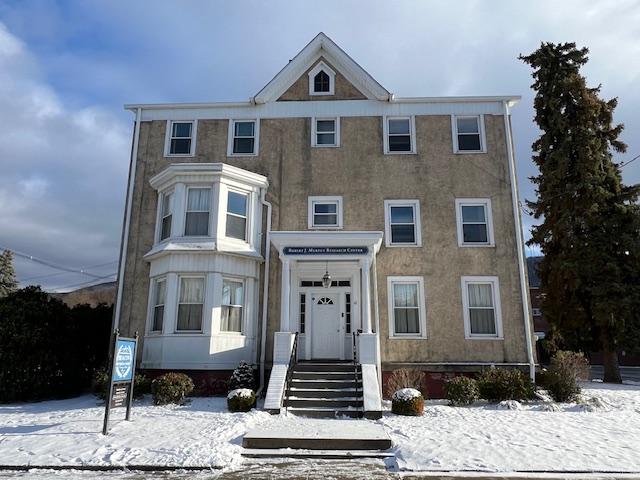
The Beacon Historical Society at 61 Leonard Street at Christmas time
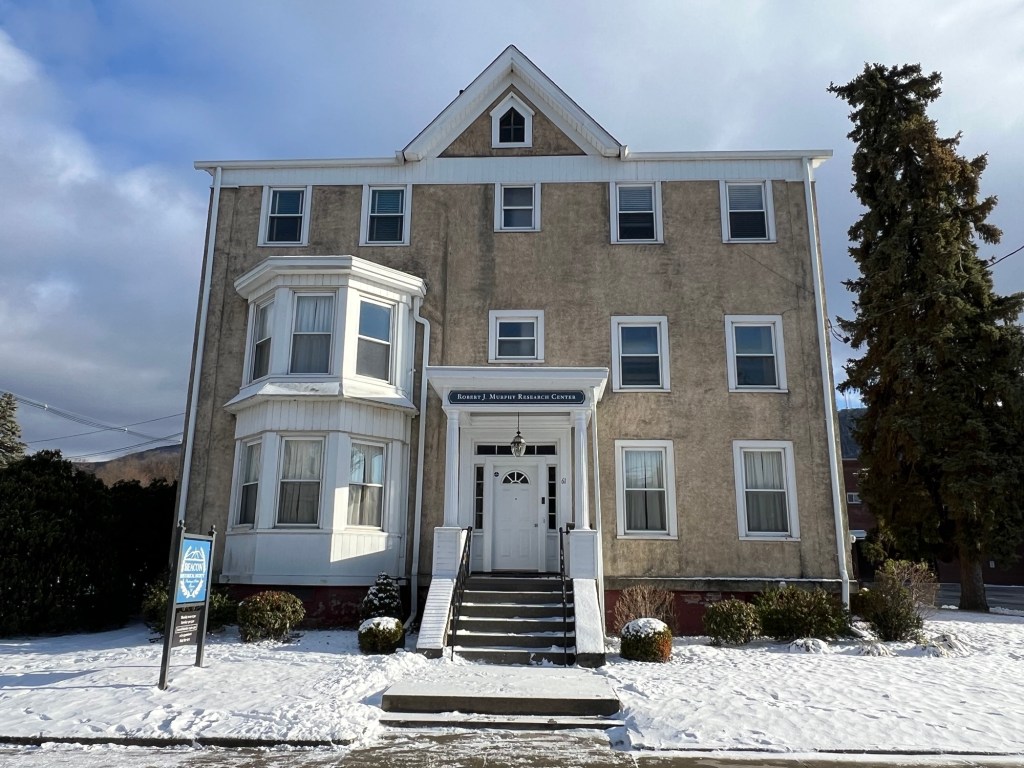
The outside of the building in the Summer
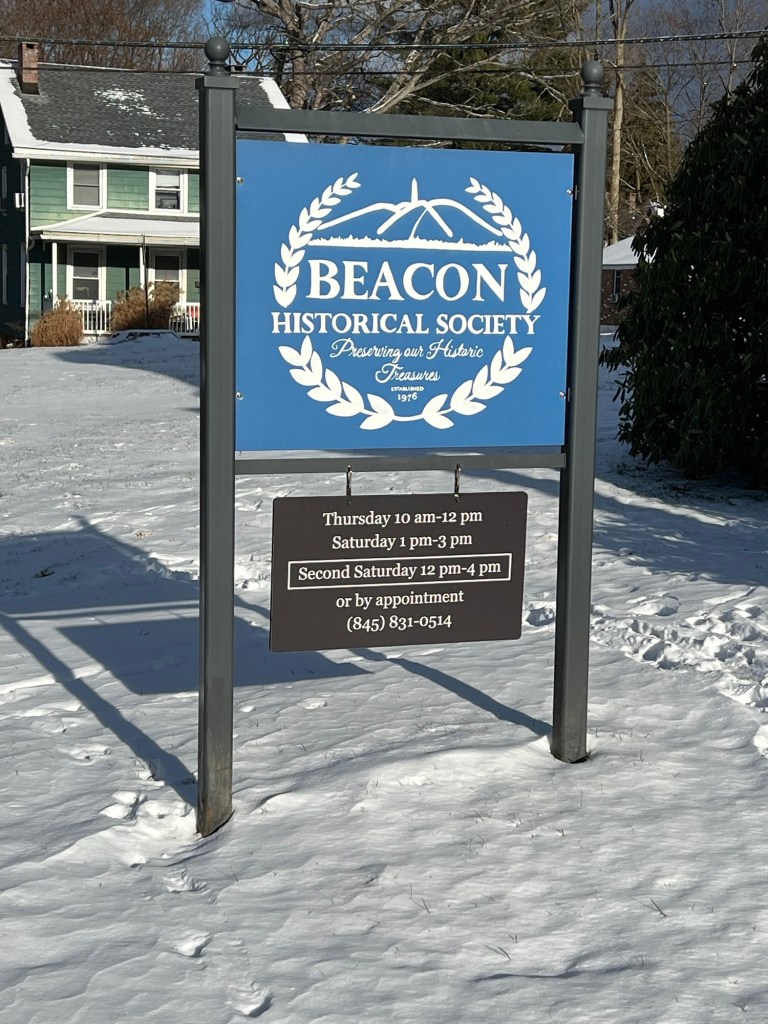
The sign for the Beacon Historical Society at Christmas time
The outside sign in the Summer
The Mission of the Society:
(From the Society pamphlet
The Beacon Historical Society was founded in 1976 to preserve, collect and interpret the rich history of the City of Beacon and its predecessor Villages of Fishkill Landing and Matteawan.
History of the Society:
(From the Museum website)
Established in 1976, the Beacon Historical Society showcases Beacon’s history through exhibitions, collections, programs, books and an informative monthly newsletter. The Beacon Historical Society is proud to serve as Beacon’s repository of rare photographs, paintings and prints, Hudson River ship models, objects and ephemera from local factories and Main Street businesses, records of local cemeteries and Civil War veterans, maps of Beacon, Fishkill Landing and Matteawan.
I recently did a walking tour of Downtown Beacon, NY and was impressed by the numbers of restaurants, bars and stores in the downtown area. It is an impressive downtown with very few empty stores and impressive and lively street life. On my first trip to the Beacon Historical Society I learned this was not always the case.
I recently visited this small historical society packed with information on the history not just of the City of Beacon but the surrounding Hudson River area. The museum gives an in depth view of the industrial history of the area and the highs and lows of many of the river communities. These small communities have seen a renaissance over the last decade especially during COVID and many of the older towns have seen new life being breathed into them.
The first exhibition I looked at was the Photographer Patrick Prosser exhibition (being shared with the Howland Cultural Center) ‘Work in Decay: The City of Beacon NY’.
Photographer Patrick Prossner was born and raised in Beacon and a graduate of Beacon High School and SUNY New Paltz with BFA. His work on this project started in 1982 photographing the decay of his home town (Author’s Bio on BHS website).
The photographer moved to the area in the early 1980’s during a time when Beacon’s mills and factories were closing and the downtown was boarded up. It shows what the downtown business district looked like and the changes that were made to shape it today.
The sign for the exhibition
Pictures of the former industrial zone
The pictures showed a once vibrant industrial community and the changes once these factories closed.
The changes in the surrounding area
The exhibition really shows the transformation of these towns from the once industrial hubs to the artsy communities filled with galleries and bars that many of them have become.
Downtown Beacon today filled with art galleries, shops and small restaurants
The former mill is now a luxury hotel and restaurant overlooking the same waterfall that used to power the mill
These small communities factories have now become hotels, lofts and in some cases new cottage industries have moved in. Time transforms areas and what is old becomes new again.
The first floor gallery
The second exhibition that I walked through was the ‘From Haverstraw to Beacon: Inside the Brickyards the built New York City’, an extensive look at the brickyards and the clay deposits that once lined the Hudson River that build most buildings in the City in the end of the Eighteenth, Nineteenth and early Twentieth centuries.
The exhibition sign
The map of the location of the brickyards along the Hudson River. This depended on the location of the clay deposits.
Transportation of freight and people for both recreation and business was described in this display of different boats down the Hudson River.
The display of understanding the brick business
Display of the different companies and processes of making bricks
The display of people that make up the industry
The process of mining, making, drying and creating the bricks that would end up in New York City
Some of the bricks and the companies from the New York market that were created in the region
Another display on the companies
More of the companies and processes to making bricks
The exhibition was a very interesting look at what was once a dominant industry in the area but like any industry as the clay ran out and building materials changed, the industry diminished in the area and that way of life changed. With it as well was the transformation of the area.
The former brick factories
The Brockway Brick Company that built Macy’s original building in Manhattan
There were smaller exhibitions as well all over the two floors of displays. First there was a handmade dollhouse on the first floor that is a favorite of the elementary school students.
The handmade dollhouse on the first floor
On the seconded floor is a display is the socially prominent Van Nydeck family. The family donated their family tree and many family heirlooms and portraits.
Part of the Schenck Van Nydeck family tree
The Van Nydeck family heirlooms
There was also artwork and artifacts from the surrounding community on display all over the museum.
The painting is by a local artist and the pottery is locally made
The window is a Tiffany window from a local church that the Historical Society saved for the museum
The first floor gallery
The docent told me after I toured the exhibition that there are more exhibitions being planned for the future.
Touring Downtown Beacon, NY:
After the trip through the Historical Society, I ventured and walked Downtown Beacon. The neighborhood has certainly changed since the early eighties.
Downtown Beacon today
Downtown Beacon today with Mount Beacon in the distance
The beautiful floral arrangements in the downtown today
The Sautjes Tave Begraven Ground Cemetery is an example of an early Dutch Cemetery of some of the first Colonists in Bergen County with some families arriving in the early 1600’s .
The entrance to the Sautjes Tave Begraven Ground Cemetery in Demarest, NJ
The historic sign at the entrance placed by the David Demarest Chapter of the Daughters of the American Revolution
The inside of the historic cemetery
These early families once owned farms under royal patents of hundreds of acres and these would be passed down from generation to generation. These small family cemeteries were once located on the edge of family land that have since been replaced by modern suburbs. This is now in the middle of a traffic circle surrounded by homes. The cemetery is a wonderful shape and is nicely landscaped.
The cemetery from the south side
Generations of a Bogarts, Blauvelts, Haring, Demarest, Du Bois, Van Scivan and other prominent families all inter married into each family were buried here.
The Bogart-Bauvelt family plot
The Bogart-Blauvelt family plot
The Demarest family plot
The Demarest-Haring family plot
The Ann Marie Demarest grave
My International Marketing class at Bergen Community College recently did a complete study and marketing plan for the “Bergen250” on the Revolutionary War veterans buried at graveyards and cemeteries all over Bergen County, NJ:
For a Mapping of all the historic graveyards and cemeteries, I had the students visit all the sites that the Daughters of the American Revolution had researched and I had the students find all the locations, photo the tombstones and create a bio on each of the veterans. I enclosed a copy of their work above.
My blog on the historic graveyards and cemeteries of Bergen County:
The Cornelius Demarest grave site, a Revolutionary War veteran
Patriot Douwe Talema, who was killed by the Tories during the Revolutionary War
The Daniel Van Scivan grave, another Revolutionary War veteran
The Haring Family plot
The Haring family plot
The James Haring grave
The Sophia Haring grave
The Du Bois family plot
The Cemetery view from the southern corner
My video of Touring the Cemetery and its historic roots:
My tour of the cemetery
Leaving the cemetery you can see the landscaping offers these families privacy in both life and death.
After the tour of the cemetery, I explored Downtown Demarest, NJ and discovered a beautiful little town with small local stores and a beautiful set of parks surround the streams and the train station just off the downtown.
The town of Demarest Veteran’s display
The town of Demarest has its own rich beauty and you can see this by visiting its Downtown area and its parks.
The breathtaking Duck Pond Park attracted a lot of painters who set their easels by the banks of the streams.
The Duck Pond is really beautiful
They also have a really nice railroad terminal that is now a senior center
The historic Demarest Railroad Station
This wonderful community has so many wonderful attributes.