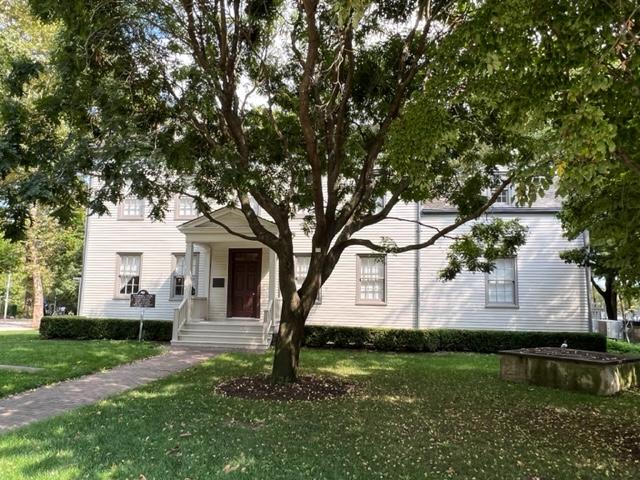
The Blackwell House on Roosevelt Island finally opened for tours after a major renovation of the house. When I had visited Roosevelt Island the last time in 2017, the house was corded off and was not open for touring. It had looked like it was falling apart from the inside out.
Historical Landmark sign
The home has now gone through a major renovation. The grounds outside were beautifully landscaped and gave the house a very warm and welcoming entrance to the property. In the middle of the summer, the flowers and trees were all in bloom and it was a nice view from the street. The house is conveniently located in the middle of the island, so it is not far from the tram and the subway.
The historical plaque in front of the house
I have to say that I was a little disappointed with the tour of the house what there was of it. The house had gone through a renovation but not a historic restoration, so the house is not a period piece with historic displays of furniture and art objects. It was like touring a modern home. I felt like I was walking through a 1980’s McMansion.
The new Living Room at the Blackwell House is not very historical.
When you enter the front hall, there is a reproduction of a portrait of Captain Blackwell, who was a Captain in the Revolutionary War. The house was built in 1796 for James Blackwell and added to in 1804, when the family fortunes had improved after the war.
The portrait of General Blackwell
The island had been ‘patented’ to Captain John Manning by British Governor Nicolls in 1668. Before the Dutch had arrived, the island had been used by the Native Americans for hunting and fishing. The island had been inherited by the captain’s stepdaughter, Mary Manningham Blackwell and her husband, Jacob Blackwell, thus named Blackwell’s Island, upon his death. The island passed to her children, James and Jacob. The island was sold to the City of New York in 1823 (Roosevelt Island history).
The historical pictures in the hallway of Roosevelt Island
All around the first floor, which is the only floor you can visit, there are all sorts of reproductions of historical maps and pictures of the island. The tour guide who had lived on the island his whole life, told me that the house had always been in disrepair and the local kids had thought it was haunted.
Now you can walk the grounds around the house and admire the beauty of the home from the outside. The only thing historical that I saw inside is when the tour guide opened the door to the cellar and showed me the stones that made up the foundation of the home. They had been quarried locally and still had the look of that time period.
The grounds of the Blackwell House
The home is nice for a quick tour but do not expect much from the history side of the house.
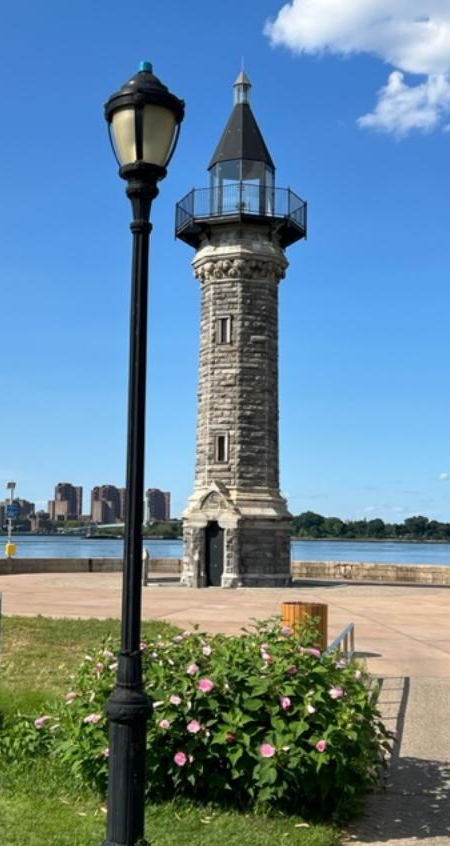
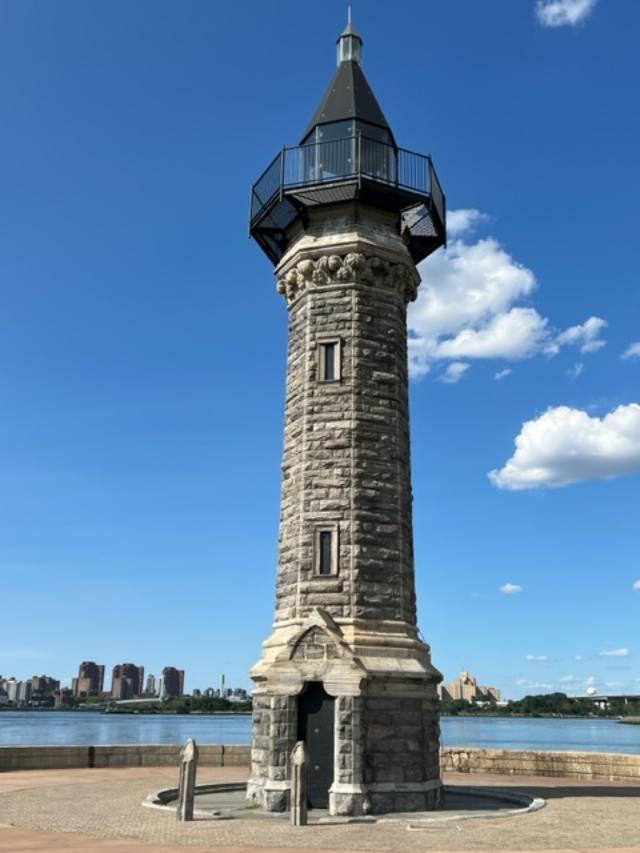
The Roosevelt Island Lighthouse is a stone lighthouse built by New York City in 1872. It is at the northeast tip of Roosevelt Island in the East River in Lighthouse Park. It was named to the National Register of Historic Places on March 16th, 1972, and was designated a New York City Landmark on March 23rd, 1976 (Wiki).
Blackwell Island, which was called Welfare Island from 1921 to 1973 and is now known as Roosevelt Island was purchased by New York City in 1828. Various facilities on the island were built including a penitentiary, almshouse, city hospital, the New York Lunatic Asylum and the Smallpox Hospital (some of these buildings still exist).
In 1872, the City of New York built a lighthouse. The supervising architect was James Renwick Jr., who also designed several other buildings on the island for the Charities and Correction Board as well as more famous works such has St. Patrick’s Cathedral. (Wiki)
Legends abound about the construction of the lighthouse. Two names, John McCarthy and Thomas Maxey, are associated with the various legends. The 1870 report of the warden of the lunatic asylum that an industrious patient had built a seawall near the asylum that had reclaimed the land. The legends indicate that he had incorporated Civil War cannons.
The park in the distance on Roosevelt Island
The legend indicates that the builder was bribed with bogus money to demolish the fort for the construction of the lighthouse. For many years, a saying was inscribed on a stone near the lighthouse:
This is the work
Was done by
John McCarthy
Who built the Light
House from the bottom to the
Top All ye who do pass by may
Pray for his soul when he dies.
Lighthouse Park from Carl Schulz Park on Manhattan Island
The lighthouse was operated by the City instead of the U.S. Lighthouse Board. In its 1893 annual report, the Lighthouse Board generally praised the operations of Blackwell Island Lighthouse but indicated that the Board has unfairly criticized because of the City’s occasional failure to keep the light in operation. The Board advocated banning private lights. The 1917 U.S. Coast Pilot indicated that there was a private light at the north end of the island. (Wiki)
The light was operated until about 1940. In the 1970’s, the lighthouse was partially restored. The restoration was completed in 1998. (Wiki)
The lighthouse is approximately 50 feet (15m) tall. It is constructed of gray gneiss, rough ashlar that was quarried on the island by inmates from the penitentiary. It has an octagonal base and an octagonal shaft. There is an entrance on the south side under a projecting gable and a pointed Gothic arch. Two south-facing slit windows in the shaft light the interior. At the top of the shaft there is a band of ornamented corbels below the gallery, which is surrounded by an iron railing. The lantern is octagonal with a shallow conical roof. An 1893 photograph and a 1903 movie show that it probably had a much taller, steeper conical cap when it was built. The optics were provided by the U.S. Lighthouse Board (Wiki).
Lighthouse Park in the winter months
Lighthouse Park is located on the northernmost section of Roosevelt Island and can be seen from Carl Schurz Park. On a beautiful sunny day, it is a very picturesque view from the park.
Lighthouse Park from Carl Schulz Park
The sculpture “The Girl Puzzle”:
Next to the lighthouse is a monument of faces dedicated to Nellie Bly and to women who have faced hardship entitled “The Girl Puzzle”. The sculpture was dedicated to journalist Elizabeth Cochrane Seaman, pen name Nellie Bly, who wrote about the abuses in the mental asylum on what was known as Mental Island at the time. She wrote the full report “Ten Days in the Mad House” on the abuses of patients.
“Girl Puzzle” by artist Amanda Matthews (Artist Bio)
The piece was created by American born artist Amanda Matthews. Ms. Matthews graduated with a BA in Studio Art from the University of Louisville and had studied abroad in Europe. She is known for her work that honors women and celebrates diversity and inclusion (Wiki).
The history sign on Nellie Bly
Each sculpture is a interpretation on Nellie Bly. It really is an interesting sculpture.
The Girl Puzzle One:
The Girl Puzzle Two:
The Girl Puzzle Three:
The Girl Puzzle Four:
The Girl Puzzle Five:
Disclaimer: this information was taken from Wikipedia site and the Roosevelt Island Historical Society. This little ‘gem’ of a park can be seen by walking to the most northern part of Roosevelt Island by way of the Main Street which runs through the island.
Franklin D. Roosevelt Four Freedoms Park is the first memorial dedicated to the president in his home state of New York. Located on the southern tip of Roosevelt Island in New York City, it is the last work of Louis I. Kahn, an iconic architect of the 20th Century.
The interior of the park facing Roosevelt Island
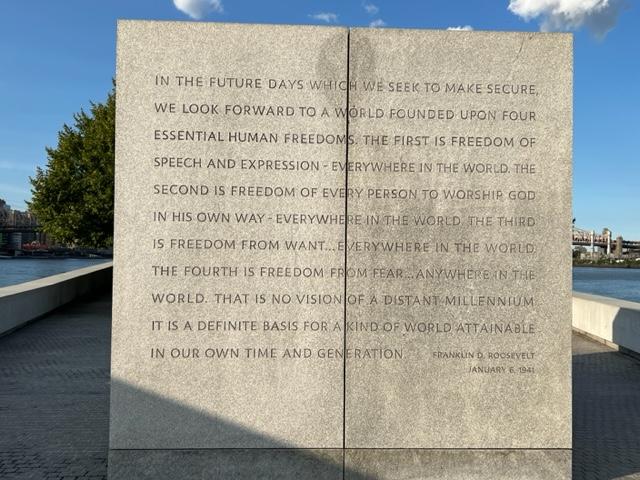
The memorial, which opened to the public in October 2012, celebrates the four freedoms, as pronounced in President Roosevelt’s famous January 6, 1941 State of the Union address: freedom of speech and expression, freedom of worship, freedom of want and freedom from fear. This has been prominently etched on the memorial.
FDR Four Freedoms Park from a view
Our Mission:
As steward of this civic space, Four Freedoms Park Conservancy advances President Roosevelt’s legacy and inspires; educates and engages the public in the ideals of the four freedoms. The Conservancy does this by:
*Safeguarding the memorial as a space for inspired use.
*Fostering community and understanding.
*Igniting conversation about human rights and freedoms today.
The Four Freedoms that were the goals of the President
On January 6, 1941, President Franklin D. Roosevelt delivered his eighth State of the Union address, now known as the Four Freedoms speech. In his address, Roosevelt presented his vision for the world, “a world attainable in our own time and generation,” and founded upon four essential human freedoms: freedom of speech and expression, freedom of worship, freedom from want and freedom from fear.
Roosevelt’s call for human rights has created a lasting legacy worldwide, forming the basis for the Universal Declaration of Human Rights adopted by the United Nations in 1948.
For a richer of FDR, his legacy and the four freedoms, visit fdr4freedoms.org.
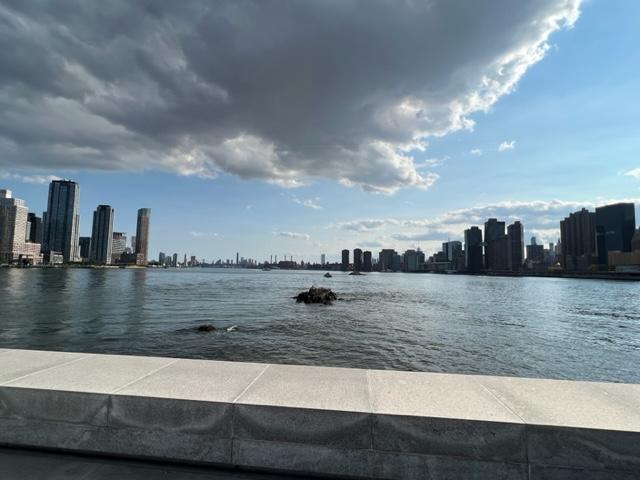
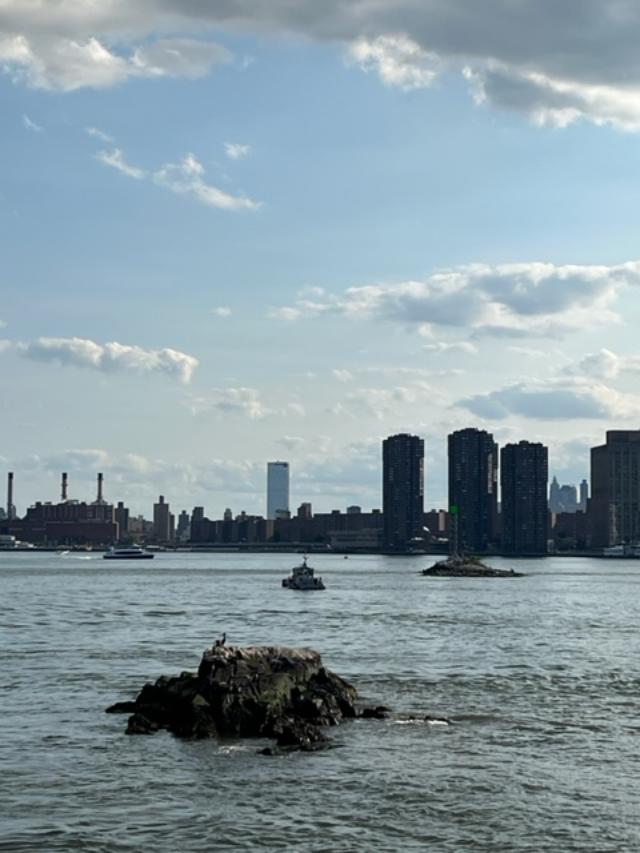
The view from Roosevelt Island of the Upper East Side
Franklin D. Roosevelt Island: A History
Originally called Minnahannock by Native Americans and Varkins Island by the Dutch settlers, the island was acquired by the Blackwell family in the 1600’s, who renamed the land Blackwell Island. The Blackwells lived on and farmed it before selling it to the City of New York in 1828 for $30,000.
In the 19th Century, the island was used by the City for institutional facilities, including the Workhouse, Penitentiary, Lunatic Asylum, City Hospital and City Home and given the name Welfare Island in 1921. These institutions served the City until the 1930’s., before gradually being relocated to areas more easily accessible to public transportation.
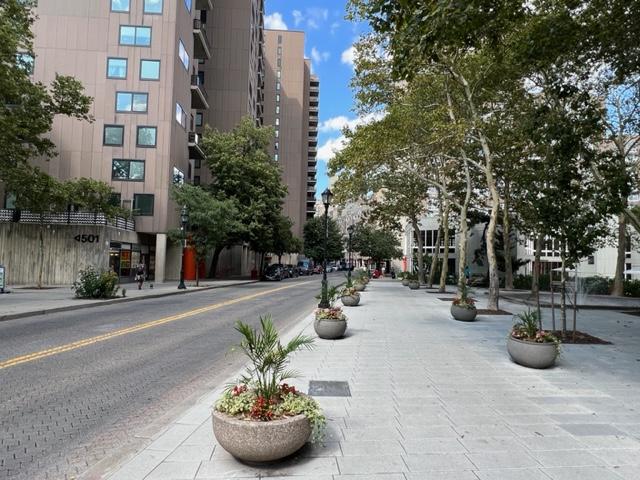
The Roosevelt Island Main Street
In 1969, this two-mile island was lease to the State of New York for 99 years. Under New York State’s Urban Development Corporation, Welfare Island became a beacon for the affordable housing movement within the City. Construction of the Island community was completed in 1975 with four housing developments. In 1973, the island was renamed Franklin D. Roosevelt Island.
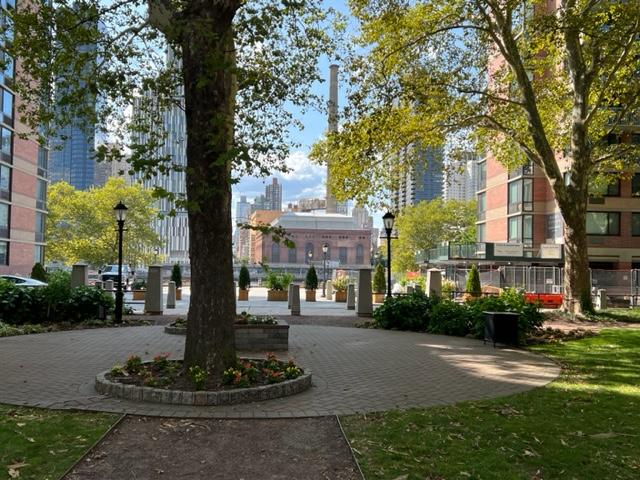
The Gardens in the Main Street of Roosevelt Island
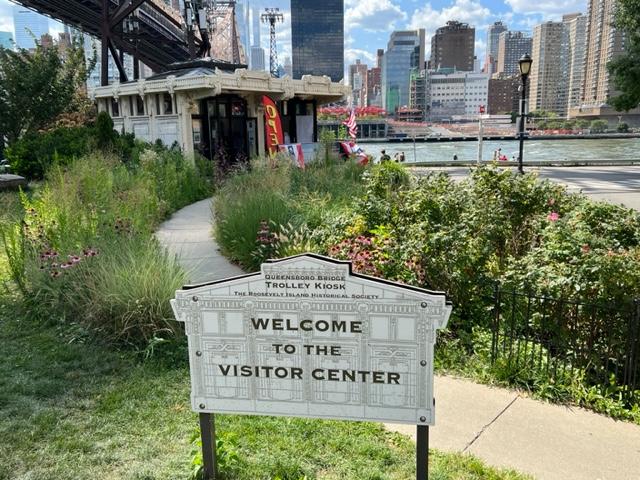
Today, Roosevelt Island has a small town feel with approximately 20 buildings and 14,00 residents. The island is home to six landmarked structures and proudly houses Four Freedoms Park, one of the original visions for the Island. To learn more, visit the Roosevelt Island Visitor Center at the Tram Plaza.
The Visitors Center at Roosevelt Island
(Judith Berdy, President, The Roosevelt Island Visitor Center)
A Memorial to Franklin D. Roosevelt
Nearly 40 years before the Park opened its gates to the public, Louis I. Kahn presented his vision for what would become Franklin D. Roosevelt Four Freedoms Park. It was a simple idea. “I had this thought,” Kahn said. “that a memorial should be a room and a garden.”
The FDR Hope Memorial
This was 1973. Less than a year later, Khan had died; Governor Nelson Rockefeller, who had announced the project with Mayor John Lindsay, became Vice President of the country and the City of New York neared bankruptcy.
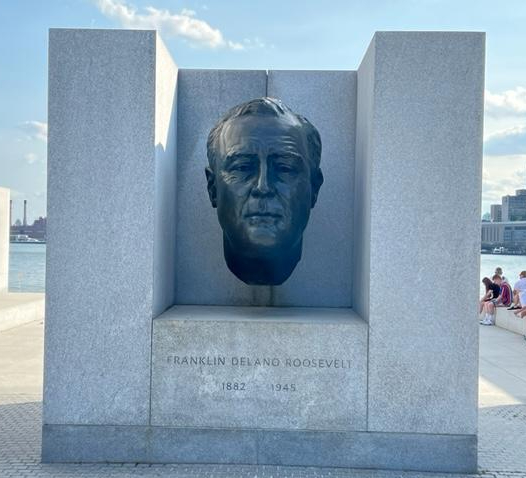
The bust of President Roosevelt
The future of the memorial seemed a fragile and tenuous dream. Yet, through the power and determination of a small but dedicated group, nearly four decades after Kahn completed his architectural design, Four Freedoms Park became the place he envisioned. In 2012, following 30 months of construction, the Park opened to the public. The Park is operated and maintained by Four Freedoms Park Conservancy in partnership with New York State Parks.
(Part of the New York State of Opportunity: Parks, Recreation and Historic Preservation)
I admired the FDR Hope Memorial in which the statue of the President reaches to a young girl with a disability herself. The statue offers encouragement to those with a disability and the power to persevere.
The statue was designed by artist and sculptor Meredith Bergmann, who herself was inspired by the photos and stories of the President (FDR Hope Memorial).
Artist Meredith Bergmann (Cooper Union Alumni Picture)
Ms. Bergmann is an American born artist with BFA from The Cooper Union School of Art and attended Parsons School of Design and Wesleyan University. Her public works explore history, social justice, human rights and disabilities (Author’s bio).
Franklin D. Roosevelt Four Points Freedom Park is the first memorial dedicated to the president in his home state of New York. Located at the southern tip of Roosevelt Island in New York City. It is the last work of Louis I. Kahn, an iconic architect of the 20th century.
FDR Four Freedoms Park
The memorial, which opened to the public in October 2012, celebrates the four freedoms, as pronounced in President Roosevelt’s famous January 6, 1941, State of the Union address: freedom of speech and expression, freedom of worship, freedom from want and freedom from fear.
The skyline from the southern part of the park.
Disclaimer: this information was taken from the NYS Parks, Recreation and Historic Preservation pamphlet. Please call the park or email to check on opening times when in season.










 Visiting a Museum: The Unique, Unusual, Obscure and Historical