Tag: addthistoyourgrocerycart@Wordpress.com

The New Jersey Firemen’s Museum at the New Jersey Firemen’s Home 565 Lathrop Avenue Boonton, NJ 07005

The New Jersey Firemen’s Museum at the New Jersey Firemen’s Home

565 Lathrop Avenue

Boonton, NJ  07005

(973) 334-0024

http://www.NJFH.org

Open: Sunday-Saturday 8:00am-4:00pm

Admission: Free

http://www.njfh.org/njfh-museum.php

My review on TripAdvisor:

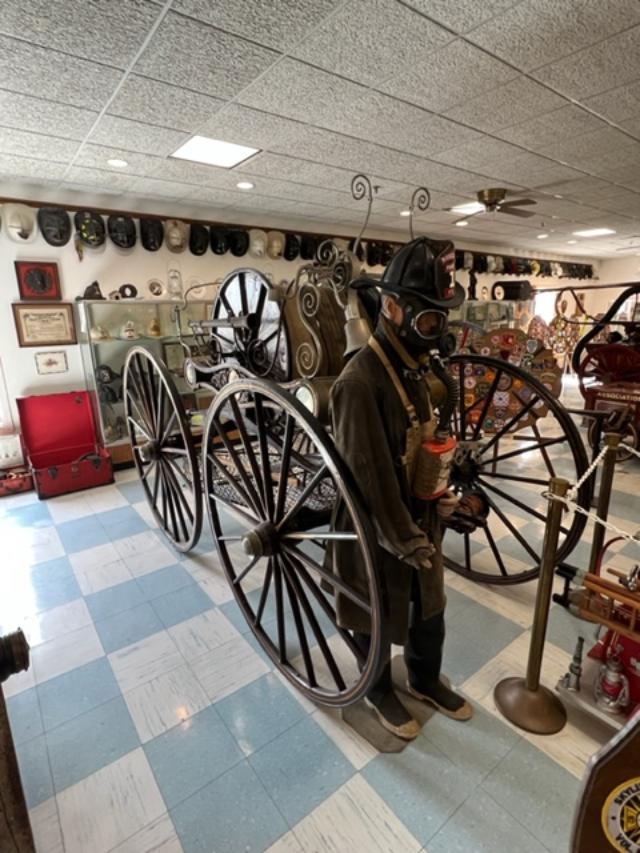
Located inside the Boonton New Jersey Firemen’s Home, The New Jersey Firemen’s Museum is an 8000 square feet, two story museum that houses steamers, ornate hose carts and antique fire trucks from all eras.

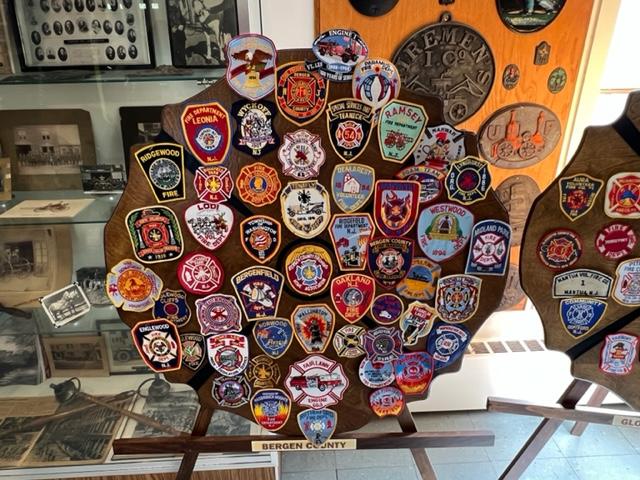
The museum was established in May of 1985 and is home to many fire department in New Jersey’s memorabilia. It seems like everyone fire department in the State of New Jersey is represented here with old fire department pictures, patches from the fire companies, fire trucks from all eras and pictures of department fires from all over the state.

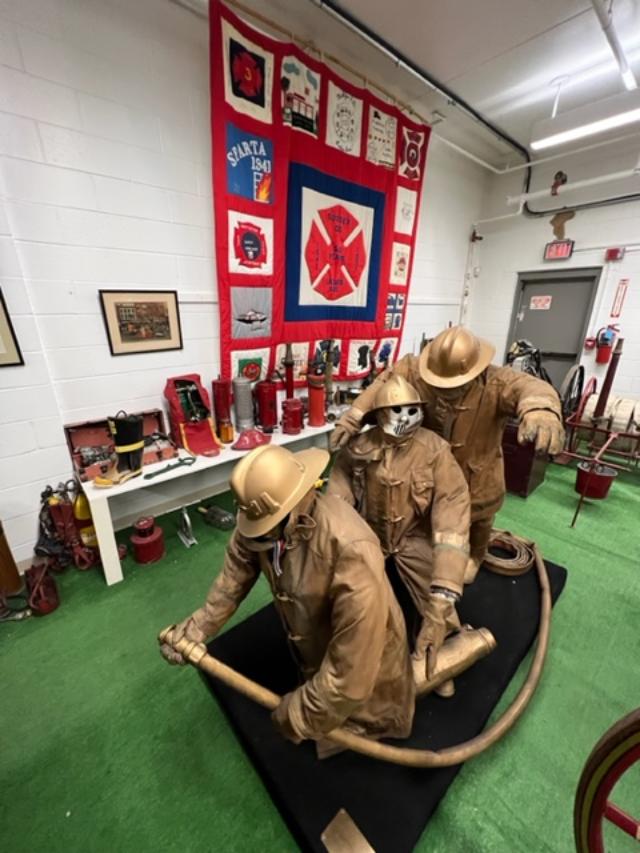
Filling the cases is antique fire equipment, badges from officers in many departments, figurines of fire equipment and ribbons from conventions of the past. There are old fire buckets from the beginnings of the fire service, horns to sound the alarms from the turn of the last century and helmets that retired chiefs from many departments donated with much honor.

Many companies donated their department pictures from fires of their past that were fought with much bravery. People forget that this job is very dangerous and we have to watch ourselves in every step.

The fire trucks are from every era from the carts that were dragged by hand to horse drawn engines to the original steam engines that were introduced with the advent of technology. All of the equipment has been carefully restored and shined to almost new. Much care has been taken to show the transition of the fire service over the years.

The tours are on your own and the admission is free. You don’t have to be a fire fighter or visiting a resident here to visit the museum. If you are a serious fire buff or have children that are really into fire fighting or being a fireman, this museum will give you all sorts of perspectives on the fire service and its development not just in New Jersey but all over the county as well.

Don’t miss the memorial to the victims of 9/11 off to the side. It is very touching and shows the support of the fire service to the members of the FDNY and their families.

9/11 is still fresh in all our minds

It is a nice afternoon out. The museum is free to the public. These pictures are just a glimpse of the collection of the NJ Firemen’s Home Museum. It is two floors of donated equipment, memorabilia, awards, dedications and department antiques that are so well preserved. If you love the history of firefighting, this is the museum for you.

Fire equipment from the past and present

Sound the Alarm

The Patch Board is extensive

The Convention Wall of attending as a delegate

Preparing for rescue

Don’t miss all the antique equipment

Fearless Girl Statue                                         Bowling Green Park  (now on Wall Street)                                          New York City, NY 10004

Fearless Girl Statue Bowling Green Park (now on Wall Street) New York City, NY 10004

Fearless Girl Statue

Bowling Green Park (Now on Wall Street)

New York City, NY  10004

TripAdvisor Review:

https://www.tripadvisor.com/Attraction_Review-g60763-d13109380-Reviews-Fearless_Girl-New_York_City_New_York.html?m=19905

*The statue has been moved since this blog has been written and it on Broad Street near the New York Stock Exchange.

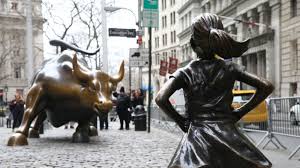
The ‘Fearless Girl’ statue is the latest addition to the street art in lower Manhattan. Placed next to the statue of the ‘Charging Bull’, she portrays a defiance and a look that almost says, “I am standing up to the power and I am standing up to fear’. She has a look of determination on her face that clearly shows that she is standing her ground. She was designed by artist Kristen Visbal.

Fearless Girl

The statue is located at the northern tip of Bowling Green Park in Lower Manhattan both statues are an easy find on the Broadway side of the park. Be aware that this is a big tourist area for pictures so there will be a crowd.

Kristen Visbal artist

Artist Kristen Visbal

http://www.visbalsculpture.com/

There has been some controversy from Arturo Di Modica the creator of ‘Charging Bull’ who says that it takes away from the meaning of his own work. Di Modica has challenged that the piece exploits his work and distorts the meaning of his own work by turning the ‘Charging Bull’ into a villain instead of the his true meaning for the work which is a ‘symbol of prosperity and for strength’. Both statues are being planned to be moved by the NYC Parks Department in the future (Wiki and the New York Times 2018).

Charging Bull II

History of ‘Fearless Girl’:

The statue was installed on March 7, 2017, the day before International Women’s Day, by State Street Global Advisors, in a campaign developed by advertising agency McCann New York. SSgA was celebrating the first anniversary of its “Gender Diversity Index” fund that “invests in U.S. large-capitalization companies that rank among the highest in their sector in achieving gender diversity across senior leadership. The concept for the statue was developed by Senior Art Director Lizzie Wilson and Senior Copywriter Tali Gumbiner. Wilson and Gumbiner established both the idea for the statue as well as the overall look of the girl using countless mood boards  and imagery, which Visbal referenced (Wiki).

Fearless Girl Statue II

This is where the statue was originally placed and now it is located near the New York Stock Exchange

Fearless Girl was originally given a one week City Hall permit that was later extended to 30 days. Later, it was announced that the statue would remain in place through February 2018. Among those advocating for the statue to stay longer was U.S. Representative Carolyn Maloney of New York’s 12th congressional district who stated, “This statue has touched hearts across the world with its symbolism of the resiliency of women. New York City Public Advocate Letitia James wrote a letter that supported keeping the statue, “Fearless Girl stands as a powerful beacon, showing women, young and old, that no dream is too big and no ceiling is too high” (Wiki).

A petition on Change.org asking for the statue to be made permanent gathered 2,500 signatures in the first 48 hours. Efforts to make the statue permanent continued after the statue was granted a one-year permit. In April 2018, after ‘Fearless Girl’ had been in place for thirteen months, New York City Mayor Bill de Blasio announced that both ‘Charging Bull’ and ‘Fearless Girl’ would be moved to a location facing the New York Stock Exchange. The move would occur before the end of 2018 (Wiki).

The plaque below the statue states: “Know the power of women in leadership. SHE makes a difference.” (Wiki)

The statue is available to be seen 24 hours a day.

Disclaimer: The history of the statue was taken from Wikipedia and I give them full credit on the information. The rest is my personal opinions on the statue.

Bowling Green Park                                    Broadway & Whitehall Street                            New York, NY 10004

Bowling Green Park Broadway & Whitehall Street New York, NY 10004

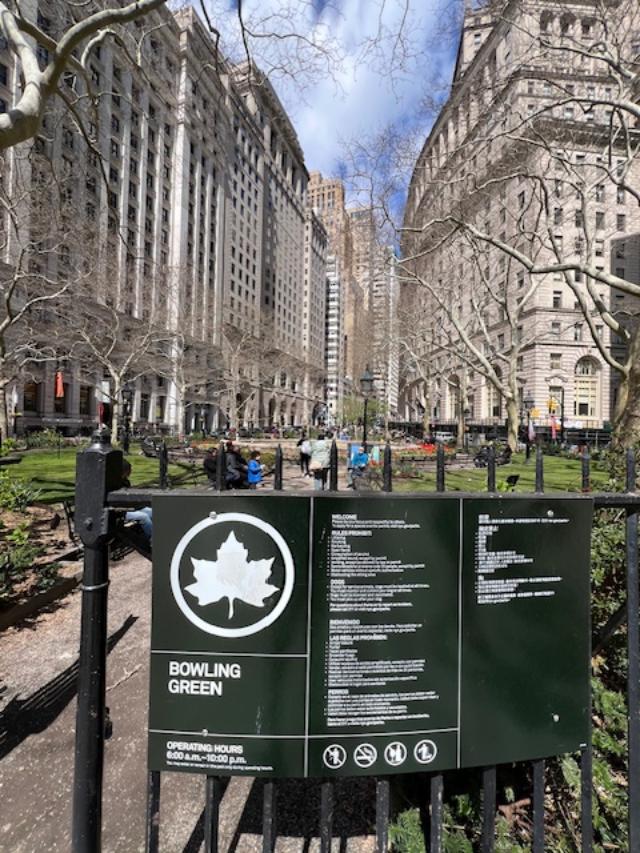
Bowling Green Park

Broadway & Whitehall Street

New York, NY  10004

https://www.nycgovparks.org/parks/bowling-green

https://www.nycgovparks.org/parks/bowling-green/history

TripAdvisor Review:

https://www.tripadvisor.com/Attraction_Review-g60763-d136413-Reviews-Bowling_Green-New_York_City_New_York.html?m=19905

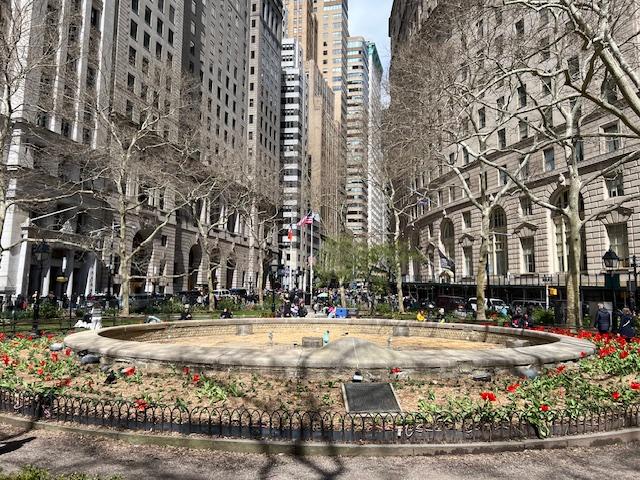
Bowling Green Park in Spring 2024

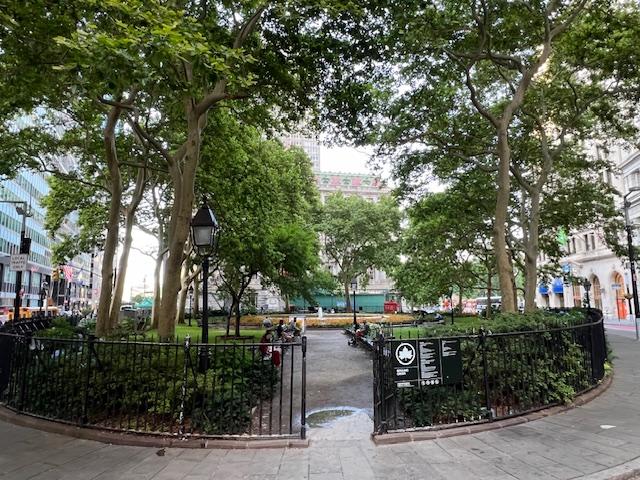
Bowling Green Park on the first day of summer 2024

I visited this wonderful park for my walking project, ‘MywalkinManhattan.com-Day 113-Walking the Historical Bars & Pubs of New York City’.

The entrance to the park.

This is one of the most fascinating parks in New York City and probably one the most historical in the shaping of the United States. Located on the grounds of the original Dutch settlement, this tiny park placed an important role in the confrontation of the Loyalist versus the Patriots when deciding who to support during the Revolutionary War.

The toppling of the King George Statue was the beginning of a new Republic. Along the historic fence which has been standing in the park since the late 1700’s are the markings where the tiny crowns were sawed off by the Patriots in defiance to the Crown.

Bowling Green Park III

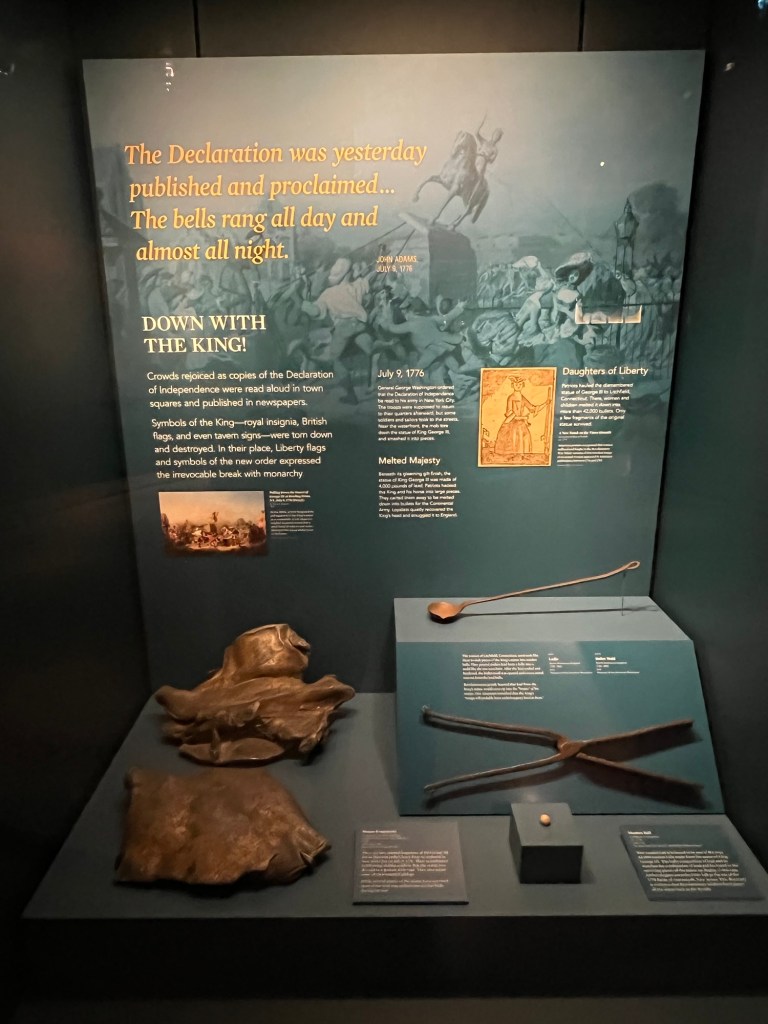
The toppling of the statute of King George (parts of the statue are at the Museum of the American Revolution in Philadelphia, PA-read my blog on this.)

The exhibit at the Museum of the American Revolution in Philadelphia on the King George Statue

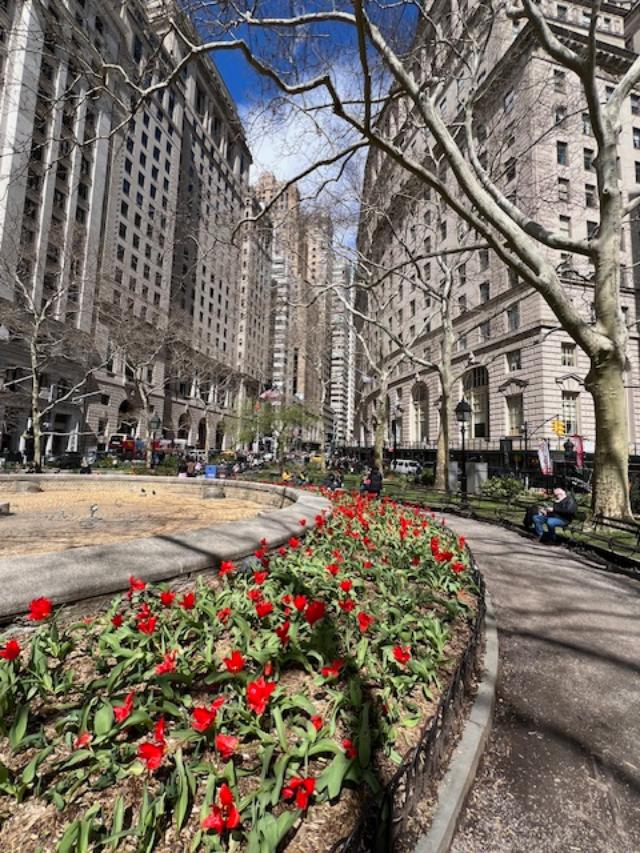
Now it is a resting spot for tired tourists off the boats from Ellis and Liberty Islands and for Wall Street workers who need a nice place to eat their lunch. It is still a relaxing little park with tree lined paths and a beautifully landscaped fountain area. In the later summer, the flowers are still in bloom and the colorful highlights of the trees accent all sides of the park and keep it private. Even in this secrete setting it is mind boggling of the fact that people put their lives on the line to establish this country right from this tiny park.

Bowling Green Park IV

Map of Lower Manhattan

Take time to walk through the cool paths of trees to the edges of the park, which are lines with historic buildings with decorative stone work and look at the beautiful statuary work on the old U.S. Custom House that now serves as the Museum of the American Indian. Take a quick tour of Stone Street just a few blocks away and see the development of the New York City after the Great Fire of 1823, which destroyed most of lower Manhattan.
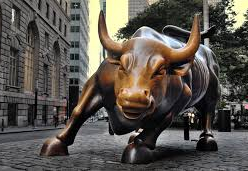
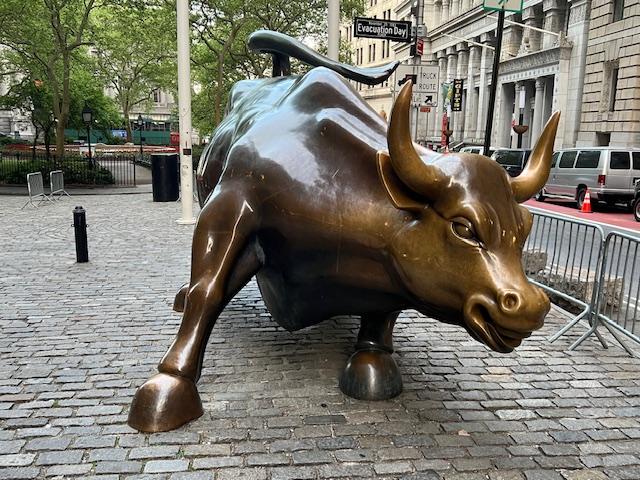
Just at the tip of the norther part of the park is the famous statue of ‘Charging Bull’ a gift to the City by artist Arturo Di Modica to show the ‘strength of the American people’ and the now becoming famous statue of “Fearless Girl” by artist Kristen Visbal which was erected for International Women’s Day. Both statues have created quite the debate since they were both placed here in 1989 and 2017 and their fate is up to the City.

Take time to really see what all these symbols mean to the Bowling Green.

History of the Park:

The beauty of Bowling Green Park in the early morning hours.

The Bowling Green is New York City’s oldest park. According to tradition, this spot served as the council ground for Native American tribes and was the site of the legendary sale of Manhattan to Peter Minuit in 1626. The  Dutch called the area “the Plain” and used it for several purposes including a parade ground, meeting place and cattle market. It marked the beginning of Heere Staat (High Street, now Broadway), a trade route which extended north through Manhattan and the Bronx. In 1686, the site was designated as public property, when the City Charter put all ‘waste, vacant, unpatented and unappropriated lands’ under municipal domain (NYC Parks.org).

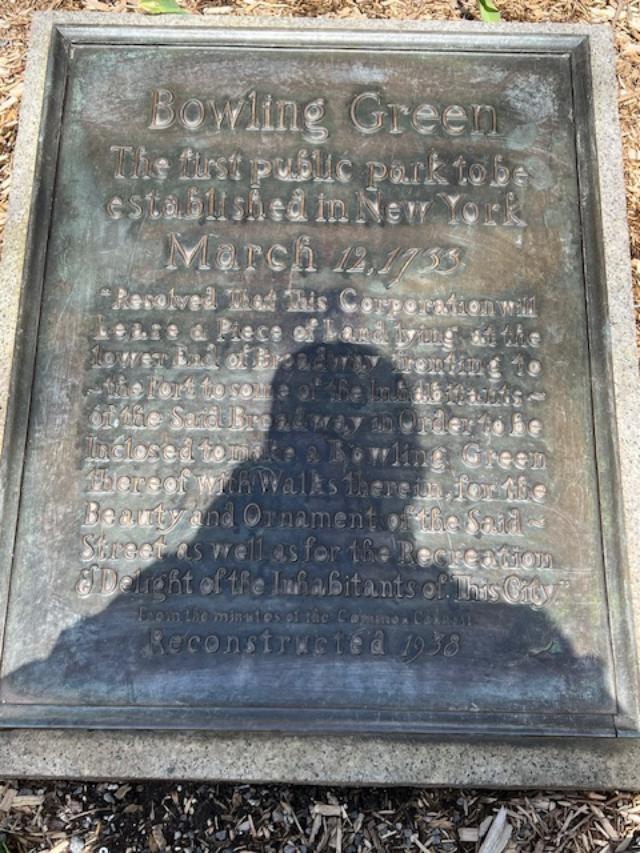
The historic marker for the park.

Bowling Green was first designated as a park in 1733, when it was offered for rent at the cost of one peppercorn per year. Lessees John Chambers, Peter Bayard and Peter Jay were responsible for improving the site with grass, trees and a wood fence “for the Beauty & Ornament of the Said Street as well as for the Recreation & delight of the Inhabitants of this City.”

A gilded lead statue of King George III was erected here in 1770 and the iron fence (now a New York City landmark) was installed in 1771. On July 9, 1776, after the first public reading in New York State of the Declaration of Independence, this monument was toppled by angry citizens who dragged it up Broadway, sent it Connecticut, melted it down and recast it as ammunition.

The exhibit at the Museum of the American Revolution in Philadelphia:

My review on TripAdvisor:

https://www.tripadvisor.com/Attraction_Review-g60795-d12163505-Reviews-Museum_of_the_American_Revolution-Philadelphia_Pennsylvania.html

My review on VisitingaMuseum.com:

The pieces of the statue are on display at the Museum of the American Revolution in Philadelphia

The pieces of the statue

Portions of the statue are held by the Museum of the City of New York and the New York Historical Society (which also possesses musket balls made from the statue’s head) (NYC Parks.org).

The park with the buildings in the background.

By the late 18th Century, Bowling Green was the center of New York’s most fashionable residential district, surrounded by rows of Federal-style townhouses. In 1819, the Common Council that neighbors could plant and tend the area in return for the exclusive use of the park by their families. By mid-century, shipping offices inhabited the old townhouses and the park was returned to more public use. Monuments installed in the park in the 19th century include two fountains (now gone) and a statue of New York’s early Mayor and later colonial Supreme Court Judge Abraham DePeyster (1896, by artist George Bissell). DePeyster was moved to nearby Hanover Square in 1976 and finally to Thomas Paine Park in 2014 (NYC Parks.org).
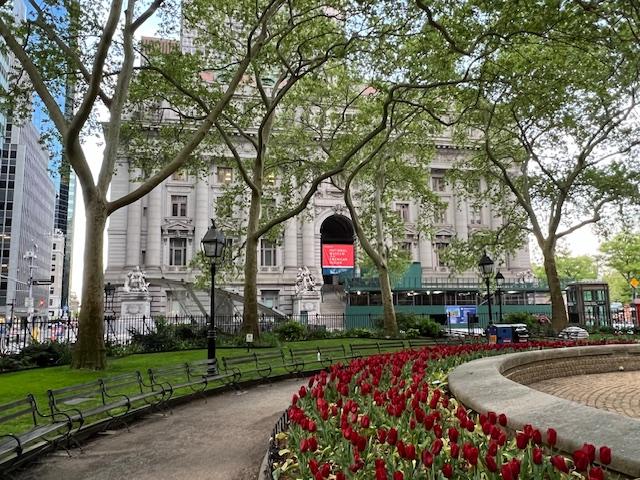
Bowling Green Park Spring 2024

Bowling Green Park Spring 2024.

In the first decade of the 20th Century, Bowling Green was disrupted by the construction of the IRT subway. The park was rebuilt as  part of citywide improvements made in preparation for visitors to the 1939 World’s Fair. Renovations to Bowling Green included removing the fountain basin, relocating the interior walkways, installing new benches and providing new plantings. Mayor Fiorello LaGuardia, Parks Commissioner Robert Moses, members of the Board of Estimate and local businessmen participated in the rededication ceremony held on April 6, 1939. Despite unseasonable late snow, the ceremony included a demonstration of colonial era lawn bowling (NYC Parks.org).

The tulips at Bowling Green Park in Spring 2024.

A 1976-77 capital investment restored Bowling Green to its 18th century appearance. Improvements included the redistribution of subway entrances, the installation of new lampposts and benches and landscaping. Publisher and philanthropist George Delacourte (best known for the Alice in Wonderland statue in Central Park) donated the park’s central fountain (NYC Parks.org).

The Spring time flowers at the Bowling Green Park.

Since December of 1989, the statue of Charging Bull (1987-89) has been on display at the north end of the park. Its sculptor, Arturo Di Modica, says the three ton and a half bronze statue represents “the strength, power and hope of the American people for the future.” It has been linked to the property enjoyed by Wall Street in the past decade.

The park in the Summer of 2025

In 2004, the reconstruction of the park included new perimeter bluestones sidewalks and interior paths, landscaping, plantings and the re-sodding of the lawn. Antique-style gas lamps and hoof benches were also placed in the park with the addition of a new irrigation system for the parks fountain (New York Parks.org).

The “Charging Bull” sculpture.

Disclaimer: This information was taken directly from the New York City Parks.org site and I given them full credit for it. This is one of the special parks of the City so take some time to visit it while on your way to one of the other tourist sites or to Liberty Island or Ellis Island.

Westwood Heritage Society Museum/Westwood Train Station Broadway and Westwood Avenue                                Westwood, NJ 07675

Westwood Heritage Society Museum/Westwood Train Station Broadway and Westwood Avenue Westwood, NJ 07675

Westwood Heritage Society Museum

Westwood Train Station

Broadway & Westwood Avenue

Westwood, NJ 07675

(201) 666-9682

http://www.westwoodheritage.org

https://www.facebook.com/hfwhalen/

Hours: The Second Saturday of every month; 10:00am-2:00 pm

Admission: Free

TripAdvisor Review:

I had visited the Westwood Heritage Society Museum during its one day opening in the month and no one was there to greet me. It seems that they closed at noon. I was able to walk around the train station’s main room and look around at all the old pictures of town, its history and the interesting facts of how the town grew

Westwood NJ Rail Station where the museum is located

The Westwood NJ Train Station is the home for the Westwood Heritage Society Museum

Many prestigious families of Bergen County, NJ have helped shape the town including members of the Demerest, Blauvelt, Wortendyke and Haring families. These early members of Bergen County Society have left their mark on the politics and construction of the current town. These names are part of the founding families of the town.

The sign in Veterans Park

There are displays of family life in town, life on the railroads, the history of how the railroad came to town, the growth of the town, residents of the town and a display on railroad conductor, Mr. Blauvelt himself.

There are many sets of pictures in the display cases and there is an on-going slide show of pictures on the main wall of the terminal showing the past and present of the town.

They let us tour the bomb shelter that is beneath the train station. This is interesting.

I recently toured the museum with my students on the second Saturday in November of 2022 and met with the members of the Westwood Heritage Society. They put all their displays out when the museum was open from 10:00am-12:00pm. There were some interesting things to see. There was the history of the businesses, schools, the fire and police department and town government. They had some interesting artifacts from Veterans of the Wars as well.

Displays of memorabilia at the museum

If you like the history of railroads into the new suburbs or are from Westwood and are interested in its history, this museum is worth coming to for the afternoon. Take time to walk along the tables and view all the artifacts. There are some interesting things to see.

The glassworks of Westwood

Some of the items from the veterans of foreign wars.

Artifacts from the railroad

The main building of the train station is always open during business hours, so you will have plenty of time to look at all the displays. If you get there on the second Saturday of the month, you might get to talk with a member of the Heritage Society. It only takes about an hour to see all the displays.

The history of the town is in all these notebooks

History:

The Westwood Museum, which is housed in the Westwood Train Station building, was established and held its ‘Grand Opening’ on Memorial Day of 2002.

The Museum serves as an exhibit gallery for the numerous artifacts of Westwood’s past and records of its history that have been acquired or compiled by the Society.

Westwood Heritage Society Museum III

Historic Westwood, NJ

The Historic Displays that line the walls on the history of the town:

Historic homes and businesses of prominent members of the Westwood community

Historic Homes of Westwood

Historic businesses in Westwood

Prominent residents of Westwood, NJ

Historic Downtown Westwood NJ

The commercial we created for the Downtown Westwood, NJ for Bergecco-Parc Consulting Inc.

The Project for “It’s Wonderful in Westwood, NJ-Be a Tourist in your Own Town”:

https://mywalkinmanhattan.com/tag/exploring-downtown-westwood-nj