Category: Parks and Historical Sites

Perry Cemetery-Harrington Park Historical Society                                                                            Old Hook Road                                                                      Harrington Park, NJ 07640

Perry Cemetery-Harrington Park Historical Society Old Hook Road Harrington Park, NJ 07640

Perry Cemetery-Harrington Park Historical Society

Old Hook Road

Harrington Park, NJ 07640

(201)768-2615

http://www.harringtonparkhistoricalsociety.com/

https://www.hmdb.org/m.asp?m=241777

Open: Dusk to Dawn

Admission: Free

My review on TripAdvisor:

https://www.tripadvisor.com/Attraction_Review-g46493-d33215615-Reviews-Perry_Cemetery-Harrington_Park_New_Jersey.html

The historical significance of for the cemetery

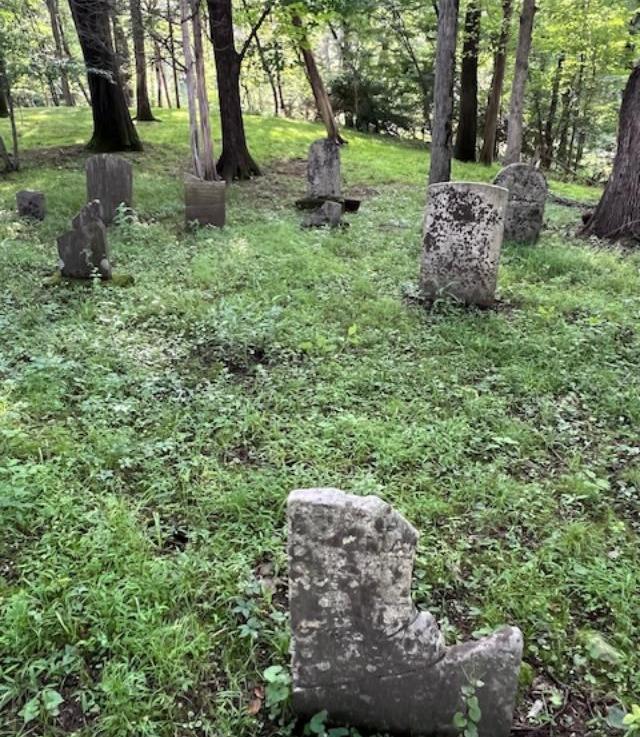
The Perry family cemetery is a small family plot in Harrington Park, NJ and example of a time when families still buried their loved ones on property that family’s thought would be there for generations. Many generations of the family are buried here showing the family’s love of this land but like too many tiny cemeteries throughout Bergen County have been lost in time by the family buried there.

Today it sits quiet and respectful and somewhat over grown. Nature now surrounds it.

The Perry Cemetery History:

(From the Harrington Park Historical Society)

The Perry Cemetery is a small family burial ground located on what was the farm of David Perry (1809-1871). The Old Burying Ground cemetery is part of the land apportioned to Garret Huybertsen Blauvelt, son of one of the original sixteen grantees of the Tappan Patent approved by the Governor of New York in 1686. Although there are believed to be earlier ones, the first known burial was in 1722 and the last in 1905.

The Perry Family Cemetery sits quietly on a stretch of Old Hook Road

(From the Harrington Park Historical Society)

The Perry Cemetery is situated in the Borough of Harrington Park on Old Hook Road, east of Bogert’s Mill Road opposite the United Water Company building. David Perry had devised by his will, signed on July 18,1868 that: “the burying ground where the same now is, westerly of my dwelling house, of the use of 40’ square, I give unto all my children to be kept by them and their posterity as a place of burial forever.”

The Perry family tree of loved ones buried at the cemetery

(From the Historical Marker Database)

When David wrote his will, his great-grandson Perry Cole (1866-1867) already had been buried in the small plot. By the end of 1871, six members of the Perry Family had been laid to rest within yards of the family house. The last burial at the cemetery was that of David’s great-grandson, Claude Yeomans (1887-1940). There are a total of twelve people interred at the Perry Cemetery.

The untimely death of many members of David’s family is a reminder of the struggles and uncertainties that people of that period routinely endured. The property remained in the Perry Family until the 1920s when it was purchased by the Hackensack Water Company to become part of the Oradell Reservoir. The graves are laid out in four even rows facing East and the markers are either marble or granite.

The Perry Family tree starting with the marriage of David Perry to Catherine Blauvelt

Son Henry and Daughter Rachel’s tombstones

Patriarchs David Perry and his wife, Catherine Blauvelt Perry

The last David Perry to be buried in the family plot

The family plot facing the stream

The Patriarchs of the family stand in the middle

The newest graves in the cemetery

The latest burials in the family plot

Video on the Perry Cemetery from the Harrington Park Historical Society

Old Burying Ground-Blauvelt Cemetery-Harrington Park Historical Society                                                                              Tappan Road                                                                              Harrington Park, NJ 07640

Old Burying Ground-Blauvelt Cemetery-Harrington Park Historical Society Tappan Road Harrington Park, NJ 07640

Old Burying Ground/Blauvelt Cemetery-Harrington Park Historical Society

Tappan Road

Harrington Park, NJ 07640

(201). 768-2615

https://www.findagrave.com/cemetery/1653309/harrington-park-old-burial-ground

http://www.harringtonparkhistoricalsociety.com/

Open: Dawn to Dusk

Admission: Free

My review on TripAdvisor:

https://www.tripadvisor.com/Attraction_Review-g46493-d33215617-Reviews-Old_Burying_Ground-Harrington_Park_New_Jersey.html

The historical marker for the Old Burying Ground

The wall outside the cemetery

The Old Burying Ground known also as the Blauvelt Cemetery, is an interesting look at the burial rights of prominent farming families of early Bergen County and their forgotten legacy of their contributions to building not just the County to our Country as well.

Many of these families intermarried over time combining properties and farms that over time since the turn of that last century, have become lost corners of our county’s history due to growth after WWII of suburban communities.

It is interesting to see who the movers and shakers of these communities of the past whose descendants were still live in Bergen County. The sad part is that these distant family members may not know their own family history enough to visit these tiny pieces of history that hold members who fought in the Revolutionary War and contributions to the growth of businesses with names that have been reduced to well known street addresses. A lot of history lies in these tiny plots that dot Bergen County. Here you can see the ‘ghosts’ of the past and walk past their graves to hear their stories.

The entrance to the cemetery

The History of Burying Ground:

(from the Harrington Park Historical Society)

In use for nearly two hundred years, largely by the Blauvelt family, the earliest known burial was in 1722. The cemetery contains the graves of members of other early Bergen County families, veterans of the American Revolution and slaves. Some of the tombstones are inscribed in Dutch.

The description of the family plots

The grave of Patriarch Justin Demarest

The Blauvelt family plot of Patriarch Daniel Blauvelt

The graves of members of the Blauvelt and DeGraw families

The graves of David and Helen Blauvelt

The middle of the Blauvelt family plot

The cemetery from the other side of the Blauvelt family plot

The Blauvelt and Demarest family plots (damaged tombstones)

(From the Harrington Park Historical Society)

Abraham Quackenbush (1768-1854) and his wife, Elizabeth Myers (1770-1807)) are part of the Abraham Myers family burial plot at the Old Burying Ground. In the middle of the 18th century, Abraham Myers received a royal charter from King George III to build a grist mill on the Hackensack River which his grandson John Bogert later operated, and it thereby became known as “Bogert’s Mill.”

The Myers family members interred in the plot are Abraham Myers, his wife Cathrena Nederman, daughter Cathrena, daughter Elizabeth and Abraham Quackenbush, son John Myers and wife Rebecca Durie. 

The Blauvelt-Eckerson-DeGraw family graves

Patriarchs David and Helen Blauvelt family plot

Video on the Cemetery from the Harrington Park Historical Society

The 1740 Miller-Kingsland House-Boonton Historical Society                                                         445 Vreeland Avenue                                               Boonton, NJ 07005

The 1740 Miller-Kingsland House-Boonton Historical Society 445 Vreeland Avenue Boonton, NJ 07005

The 1740 Miller-Kingsland House-Boonton Historical Society

445 Vreeland Avenue

Boonton, NJ 07005

Open: For special events and the Pathways Tours-Contact Boonton Historical Society

My review on TripAdvisor:

The Miller-Kingsland Homestead at 445 Vreeland Avenue

I went to visit the Miller-Kingsland Homestead, which is part of the Boonton Historical Society, during the Morris County’s Pathway’s tour and discovered a beautiful little historical home situated on picturesque piece of property. I saw by the signs that the grounds were maintained by the local Garden Club, who did a wonderful job landscaping the grounds.

The Living Room in the extension on the house

The portraits of Mr. & Mrs. Kingsland

The Dining Room in the old section of the home

The historic home is filled with period furnishings and decorations, none it seems local to the home. Still you can see how the home has changed over the years with additions and renovations. The older part of the home is now part of the Dining Room.

The Pewter ware collection on the Dining Room table

The fireplace in the original house kitchen now in the Dining Room

The formal Dining Room in the extension of the house

The formal Dining Room in the newer section of the home

The antique China Closet with Teapots

The outside of the house

The grounds of the home

The house sits on a quiet bend in the road and the properties landscaping was just beautiful. Even on this gloomy, rainy day, it was nice to walk around quickly and admire the flower beds and the lawn.

The grounds of the home

The outside gardens of the home in the Spring

The History of the home:

(From the Boonton Historical Society Pathways Tour Book and Wiki):

When Isaac Kingsland purchased the property on Vreeland Avenue from Jacob Miller c 1798, he began a dynasty that would include four New York City lawyers, a comptroller of the City of New York, a Civil War aide to General Benjamin Butler, a college president, three nuns, and a troupe of nationally known marionettes. Similarly, the property itself went from small to large to small again, from the home of farmers, a carpenter and a blacksmith, to a boarding home for horses and the headquarters and studio premises for a company of touring entertainers (Boonton Historical Society).

The Miller-Kingsland House is the oldest recorded home in Boonton. The original Dutch house was one-room with a sleeping attic, built by Johannes Miller around 1740. This room, which is complete with a large cooking fireplace and beehive oven, makes up the west wing of the current structure. The property was sold to Isaac Kingsland in 1798. He added the two and one-half story main section in 1808. It features Dutch style and a gambrel roof (Wiki).

The Miller-Kingsland house sits on a beautiful wooded landscape with a stream flowing through it. The property today comprises some 2.5 acres including the historic frame house and a barn. It is the oldest recorded house in Boonton and is listed on the NJ and National Registers of Historic Places (Boonton Historical Society).

Molly Maguire Historical Park                                    West Centre Street                                             Mahanoy City, PA 17948

Molly Maguire Historical Park West Centre Street Mahanoy City, PA 17948

Molly Maguire Historical Park

West Centre Street

Mahanoy City, PA. 17948

(No phone at the park)

https://www.hmdb.org/m.asp?m=236538

https://mahanoyhistory.org/mollymaguires.html

Open: Sunday-Saturday 24 hours

Admission: Free

My review on TripAdvisor:

https://www.tripadvisor.com/Profile/R4960NKjustinw/mediabatch/13493199?m=19905

The Molly Maguire Historical Park at West Centre Street

The historical sign

The inside of the park

The History of the Molly Maguires in Mahanoy City:

(from the Mahanoy Area Historical Society website: (Terry Rang/Paul Coombe):


The Mahanoy City area’s first anthracite mine opened in 1861. As mining flourished in the area, so did the population, as many Irish families and other immigrants came to find work. Mahanoy City was incorporated as a borough in 1863, and by 1870, its population had grown to 5,500. The borough’s population hit its peak of about 16,000 in 1910. While the burgeoning anthracite industry made the coal barons rich, the workers toiled for low wages and in dangerous conditions. In the 1870s, tensions mounted between mine bosses and the labor force. Violence erupted between the Irish Catholics and the Protestant English. Mahanoy City became one of Schuylkill County’s sites of alleged Molly Maguire activity.


The Molly Maguires were considered an off-shoot of violent Irish secret societies, such as the Ribbonmen, who rebelled against landlords who treated them harshly and kept them in poverty. In Schuylkill County, Irish miners faced similar hardships. They eventually joined the Workingmen’s Benevolent Association, which had some success in winning better wages and working conditions.


But Franklin B. Gowen, president of Philadelphia & Reading Railroad and its coal land subsidiary, feared the power the union held and believed the Irish controlled it through the secret Molly Maguire society. Determined to break the union, he began accusing Irish miners, who he claimed were Molly Maguires, of murdering mine bosses and other violence.


In 1873, Gowen, a former Schuylkill County district attorney, hired Pinkerton undercover detective James McParlan, using the alias James McKenna, to destroy the Ancient Order of Hibernians. Gowen claimed the AOH was a cover for the Molly Maguires. In 1875, Gowen cut county miners’ wages by 20 percent, triggering “The Long Strike” that lasted five months, devastating the miners and their families. Gowen won that battle as he did his war against the AOH. Gowen and McParlan’s efforts sent 20 men accused of murder as Mollies to the gallows in Schuylkill and Carbon counties. Many of the convictions came on little evidence and McParlan’s testimony.


Alleged Molly events in Mahanoy City included the assassination of Chief Burgess George Major, a St. Patrick’s Day parade led by Kehoe against the Catholic Church’s orders, and the alleged plotting to kill “Bully Bill” Thomas and the Major brothers at Mickey Clarke’s saloon. A monument memorializing the tragic era stands at Centre and Catawissa streets. More than 150 years later, the debate continues whether the men considered Mollies were murderers or martyred heroes. While an incomplete history of the Molly Maguire era in Schuylkill County, this presentation highlights the people, places and events in the Mahanoy City area. We extend a special thank you to Mark T. Major, who granted the Mahanoy Area Historical Society permission to use content from “A Guide to the Molly Maguires,” which he co-wrote with H.T. Crown.

The inside of this quiet park tells the timeline of happenings in Mahanoy City at the time.

The historic plaques tell the story of who the Molly Maguire were and their lasting effects on the changing of mining conditions.

The park story

Who they were

The story and time line

The fate of these men in the end

The park is a reminder for the freedoms that were fought to make things better for future generations and for the stop of oppression in society. There will be different ways to interpret the story in the future but this is a reminder of a better way of life that we now enjoy.