Category: Botanical Gardens and Parks

Day Three Hundred and Seventy-Six Touring the Met-Cloisters at Christmas time ‘The Yule Tide Tour’-The Walking tour of the Museum                                          January 4th, 2026

Day Three Hundred and Seventy-Six Touring the Met-Cloisters at Christmas time ‘The Yule Tide Tour’-The Walking tour of the Museum January 4th, 2026

I love the holidays in New York City. There are so many Christmas themed events to go to and decorated homes to visit. One of my favorite tours is at the Met Cloisters for their Christmas themed walking tours that take place from December through early January.
The Cloisters Museum & Gardens: A Branch of The Metropolitan Museum of Art

99 Margaret Corbin Drive

Fort Tryon Park

New York, NY  10040

(212) 923-3700

Open: March-October 10:00am-5:15pm/November-February-10:00am-4:45pm

http://www.metmuseum.org

https://www.metmuseum.org/visit/plan-your-visit/met-cloisters

Fee: Adults $30.00/Seniors $17.00/Children $12.00/Members & Patrons and Children under 12 are free (prices do fluctuate).

Museum Hours:

Hours: Open 7 days a week

March-October 10:00am-5:15pm

November-February 10:00am- 4:45pm

Closed Thanksgiving Day, December 25th and January 1st.

*Some galleries may be closed for construction or maintenance.

TripAdvisor Review:

https://www.tripadvisor.com/Attraction_Review-g60763-d106609-Reviews-The_Met_Cloisters-New_York_City_New_York.html?m=19905

My review on VisitingaMuseum.com:

To finish my weekend of holiday festivities before the Epiphany, I took the annual Christmas walking tour of the Met Cloisters. The museum hosts an interesting walking tour of the history of the holidays during the Medieval era. Each tour has a different theme to it. There is the history of Christmas in that era, the use of plants and flowers in the decorating of the religious sites and the historic significance of the visit of the Three Kings.

Each tour guide incorporates the artwork, architecture and plants into the discussion. On average you will have about forty people on the tour.
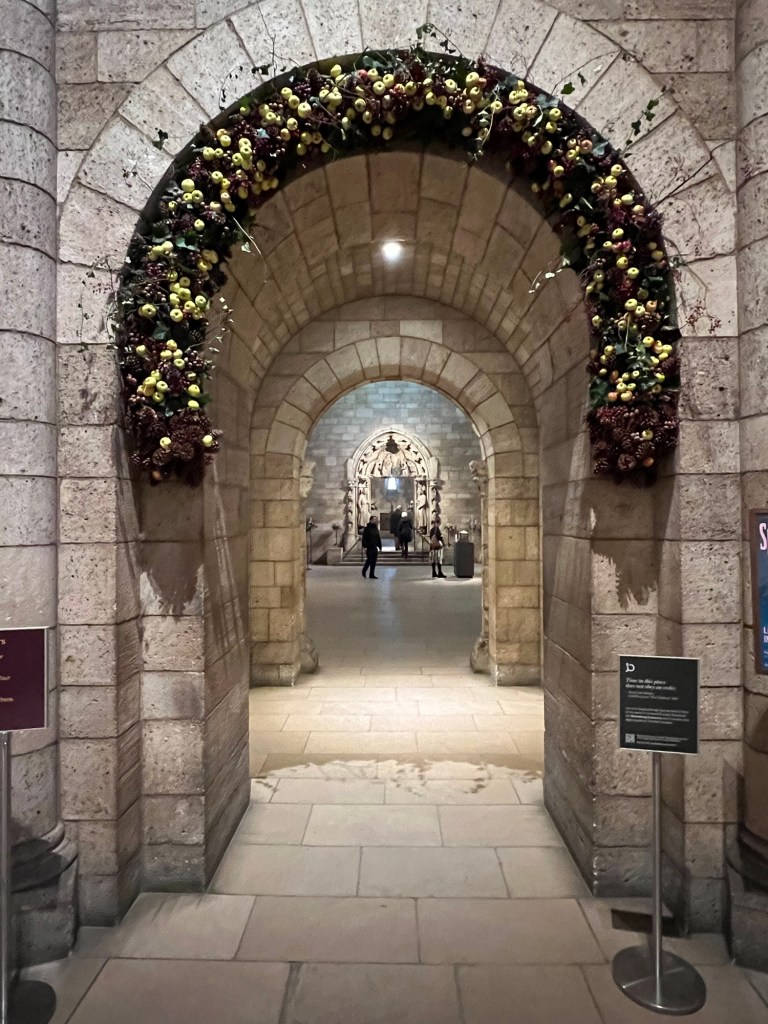
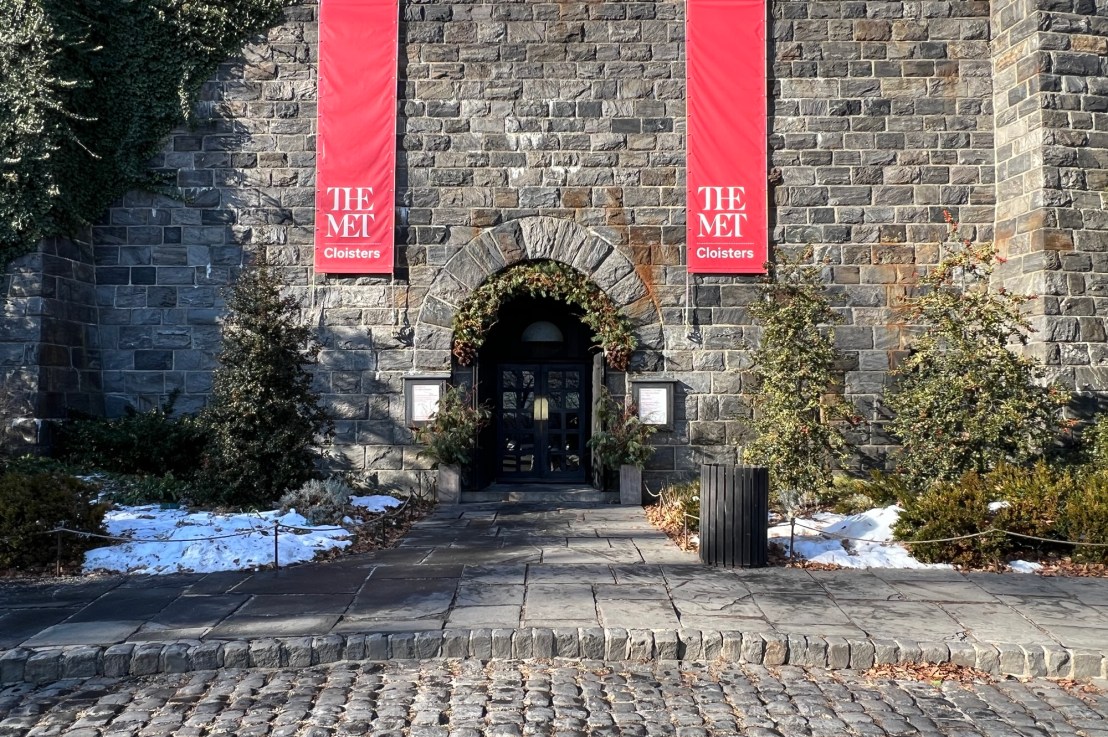
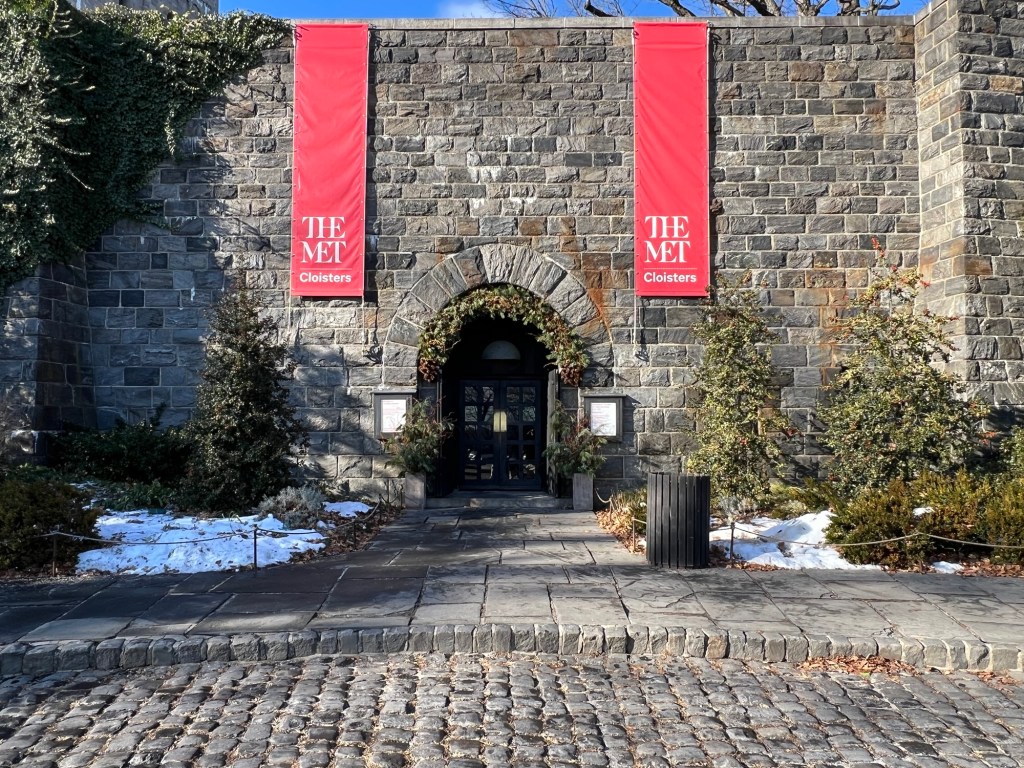
The entrance of the Cloisters decorated for the holidays

The Christmas Tide Tour:

https://www.metmuseum.org/perspectives/christmastide-deck-the-halls
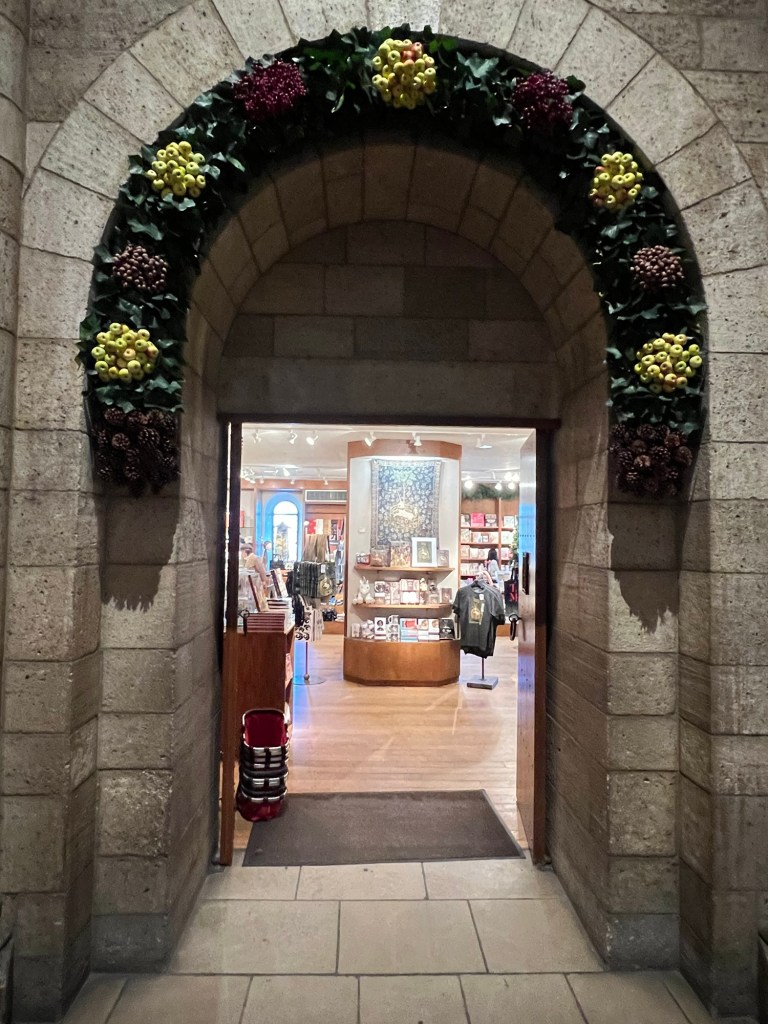
The entrance of the gift shop decorated for the holidays

The archways were decorated with seasonal plants and fruits. I read online that the volunteers went into Fort Tyron Park and collected ivy from the wild to decorate the museum. Every day the museum is open during the holidays these are replaced on a daily basis.
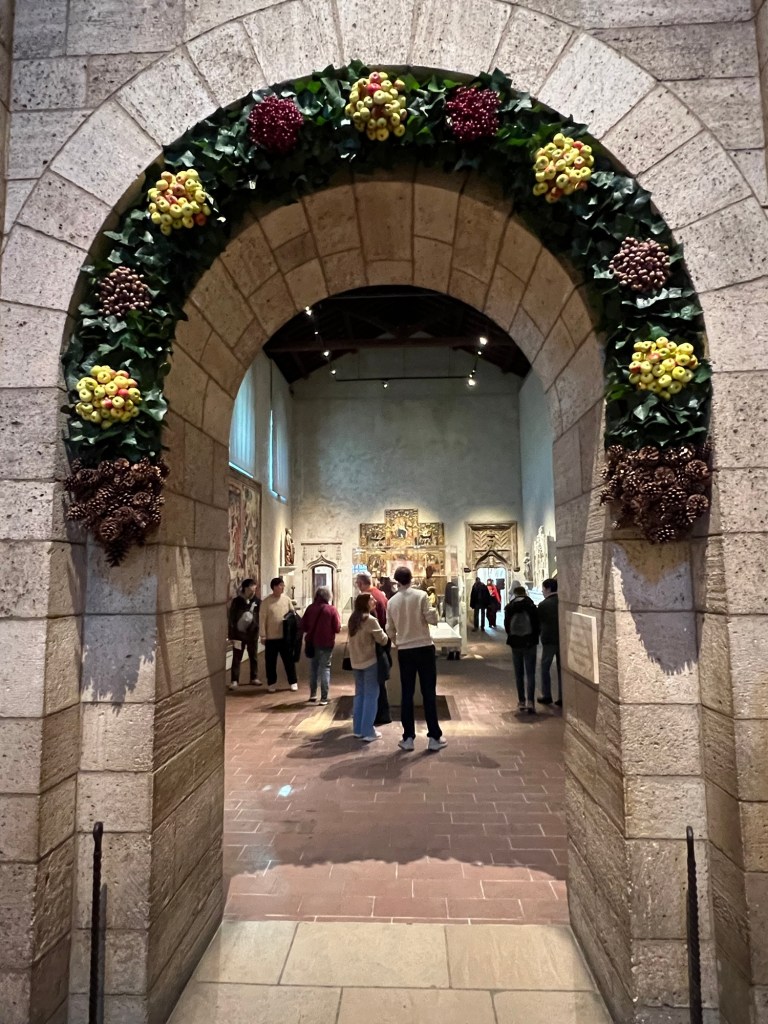
The entrance to the galleries decorated for the holidays
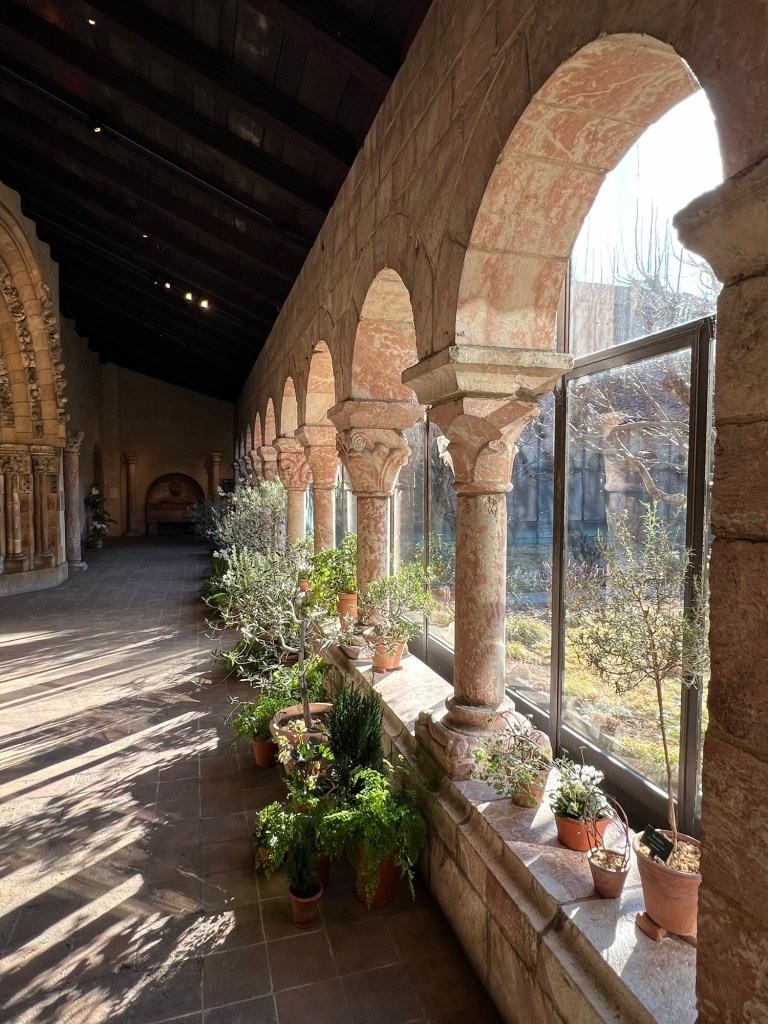
We started the tour with a discussion of plants that once decorated churches and ministries

With the change in attitude towards the Christmas holidays during the Middle Ages and its incorporation into church traditions, decorating for the holidays came back into style. The use of holly, evergreen and mistletoe became part of the Christmas tradition and to justify the decorating, they were related to Christian symbols.
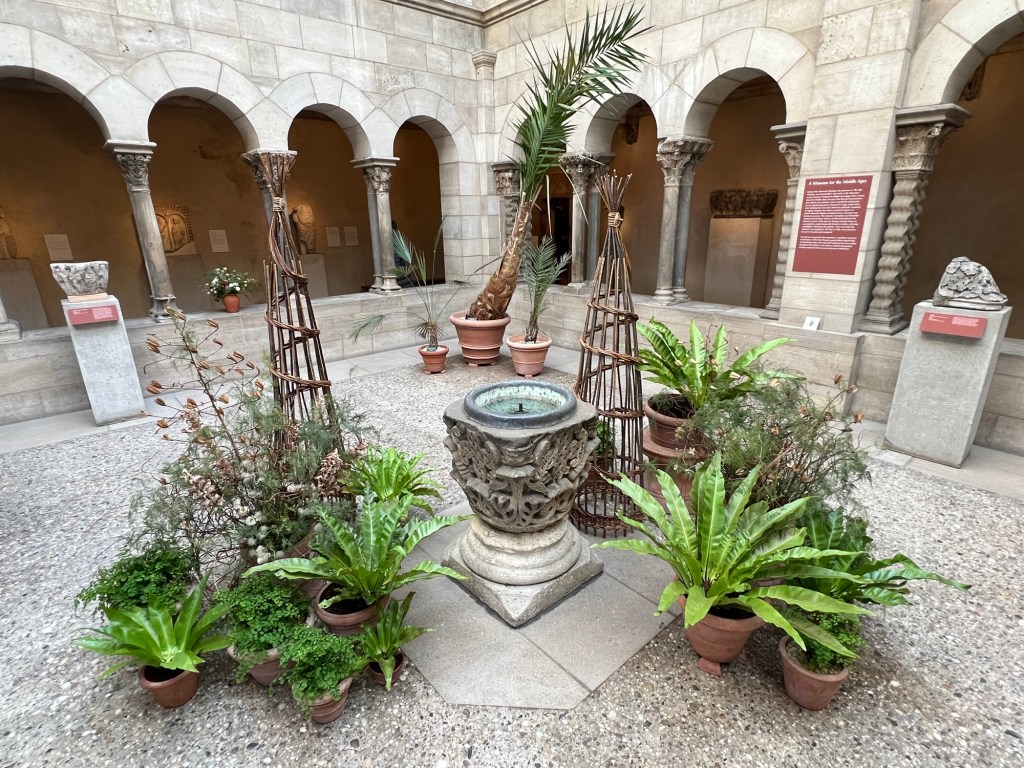
The beauty of the life plants in winter

Each of the Cloisters were lined with fresh greens and potted plants giving each of the Cloisters its own special mood.
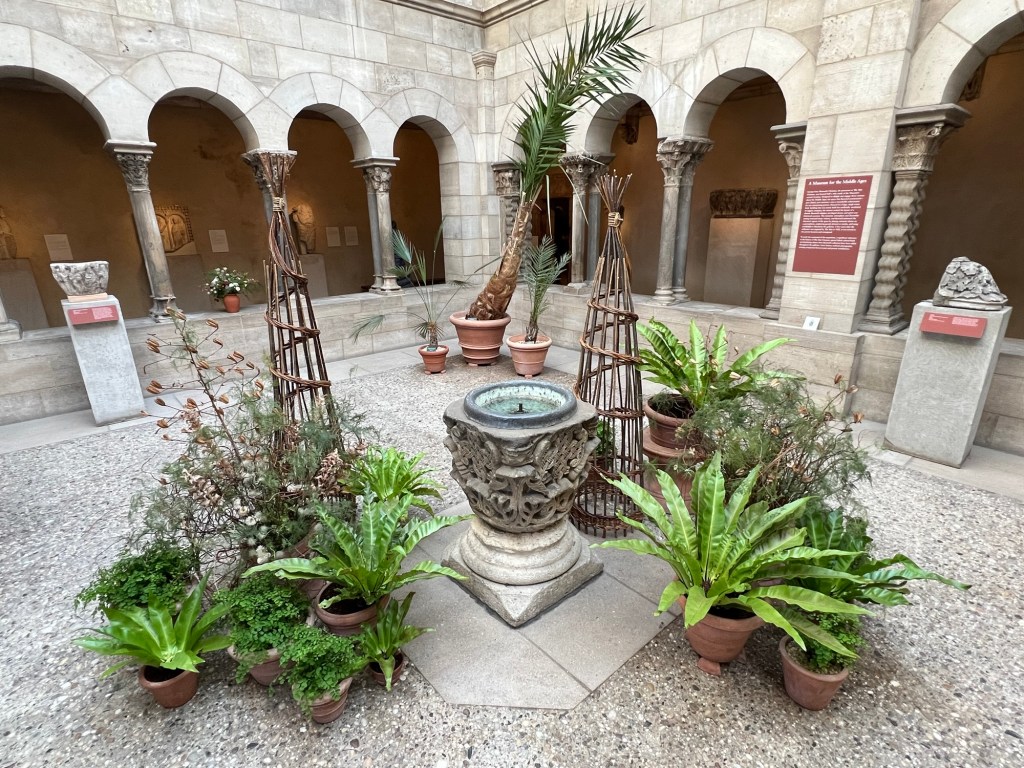
One of the Cloisters bright with plants
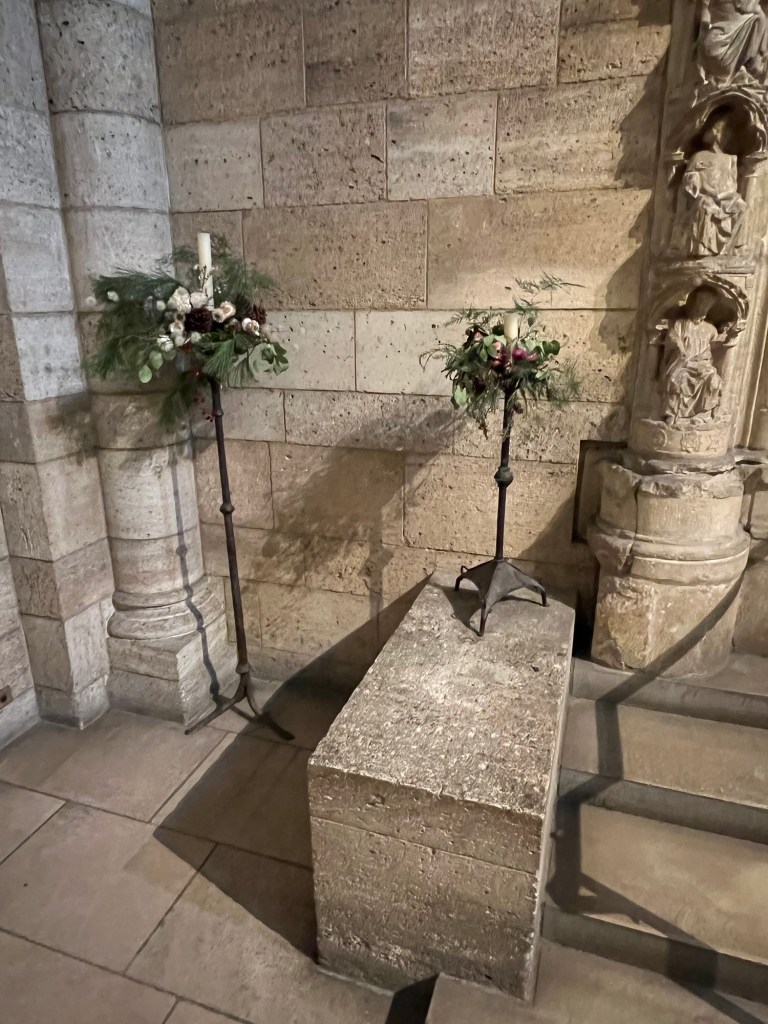
The stairs leading into the chapel decorated for the holidays
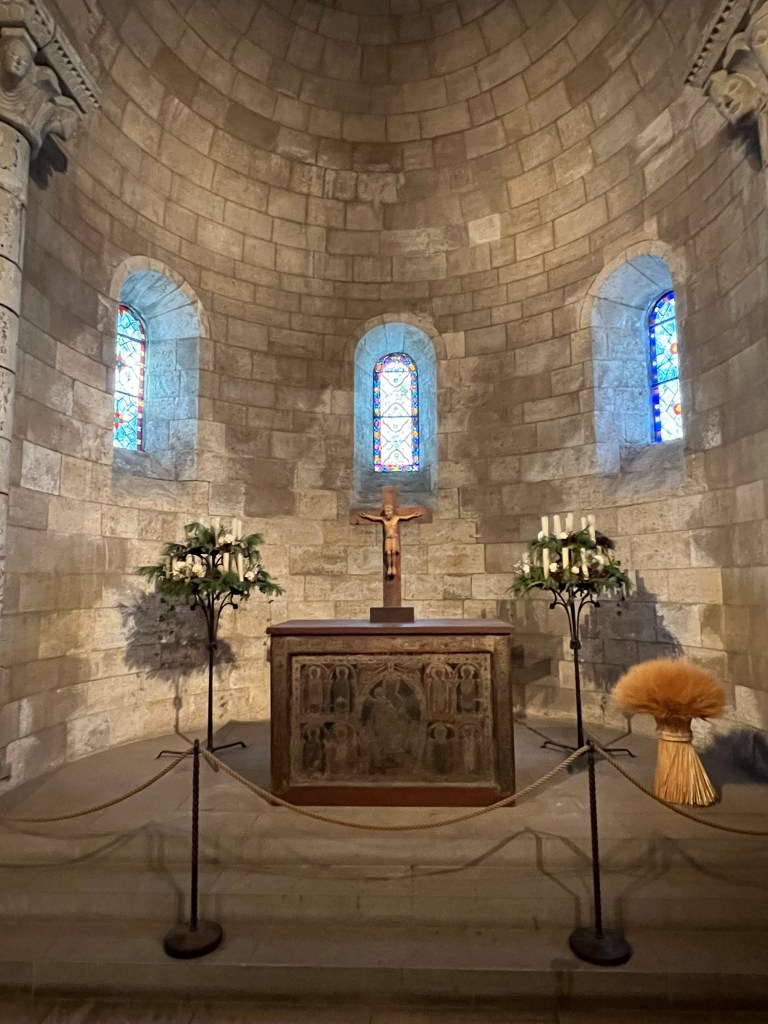
The chapel on the main floor decorated for the holidays
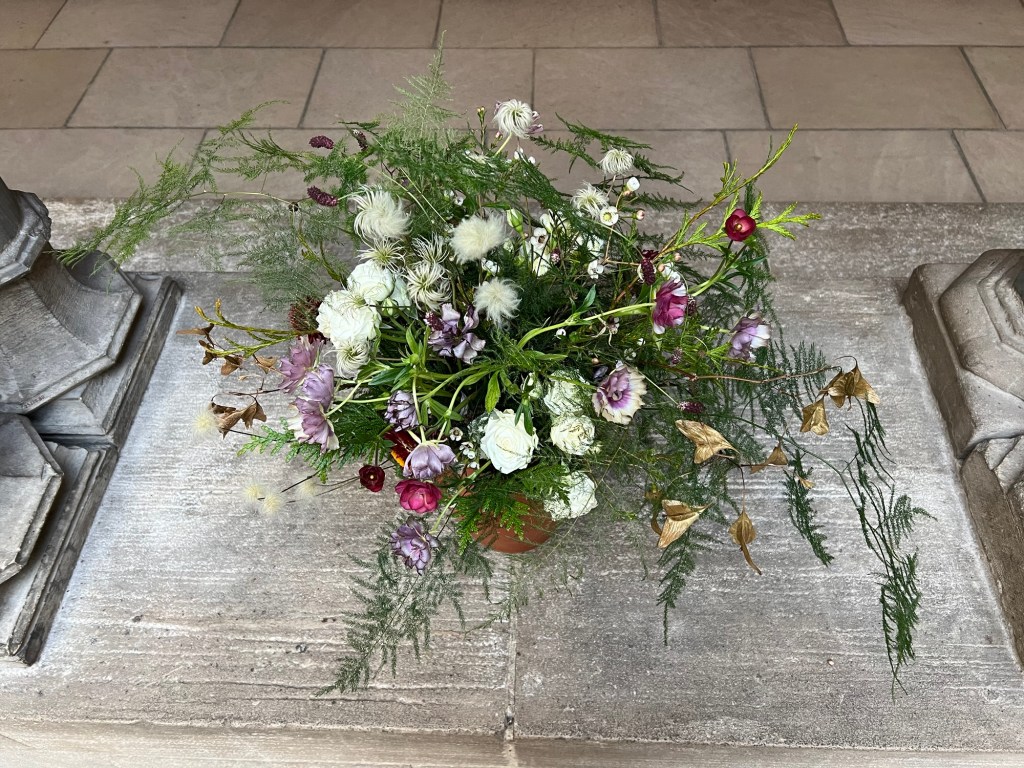
The colorful floral displays lining the window sills of the chapel

This led to a discussion about what each plant, flower and fruit meant in the Christian tradition, a clever way to justify decorating and celebrating during the holidays. Ivies, pine, winter flowers and even late season apples not only lined places of worship but gave a festive look and district smell to these buildings. A symbol of life in the cold winter months while they waited for the arrival of Spring.
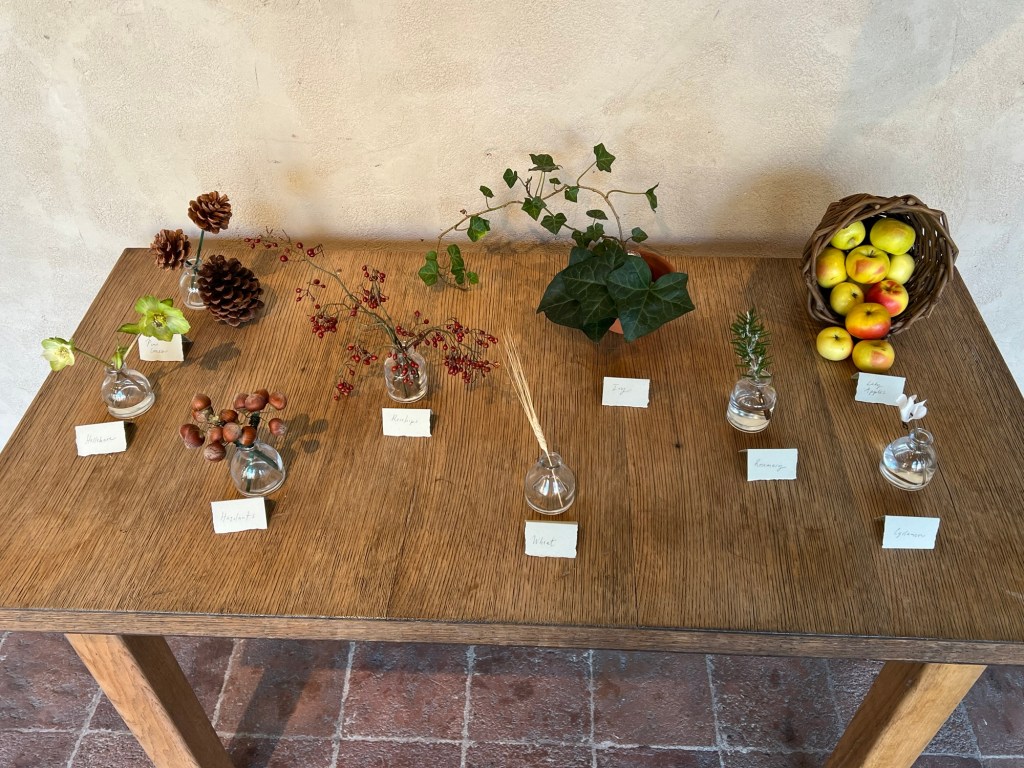
The plant types that decorated the houses of worship
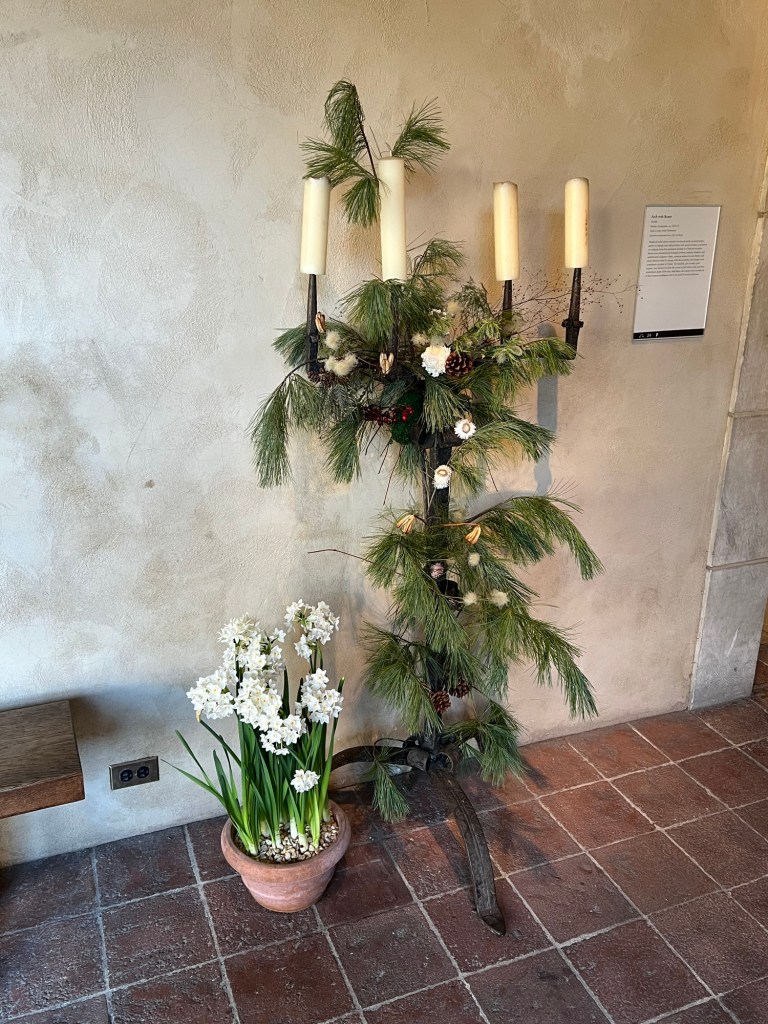
The flowers and plants lining the chapel
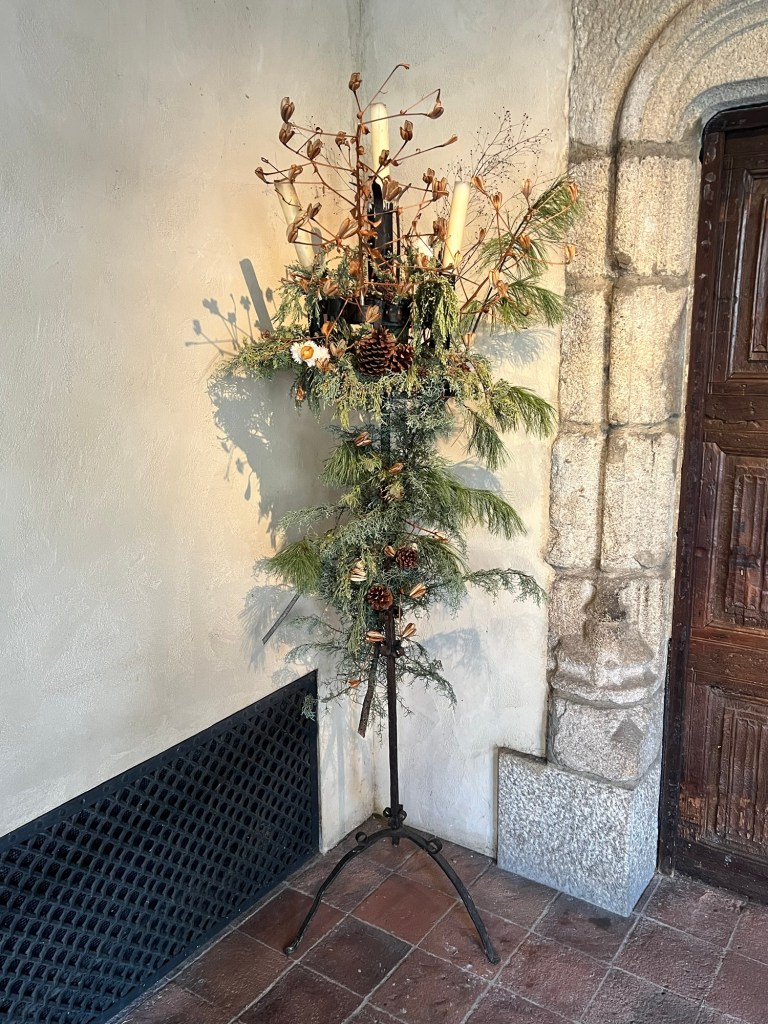
The decorative candle stands lining the walls of the chapel

We then toured the main Cloister, closed for the Winter but was lined with plants, flowers and greens brighting every corner of the building. These were examples of plants and flowers that would have decorated these halls at the holidays.
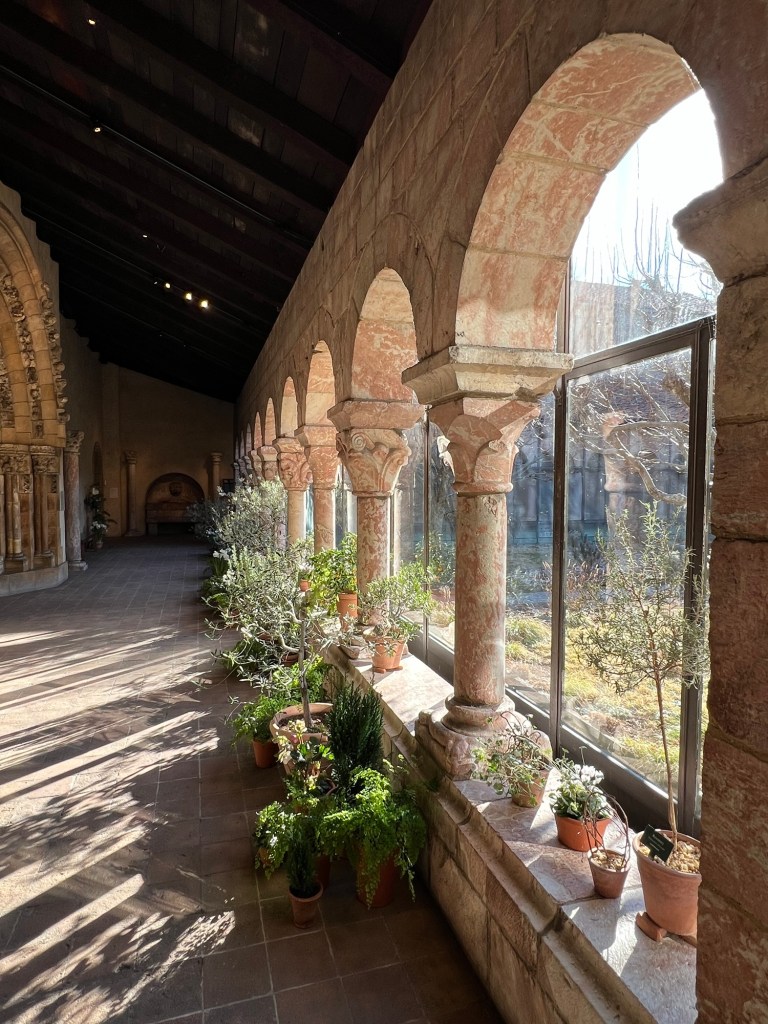
Walking the halls of the Cloisters
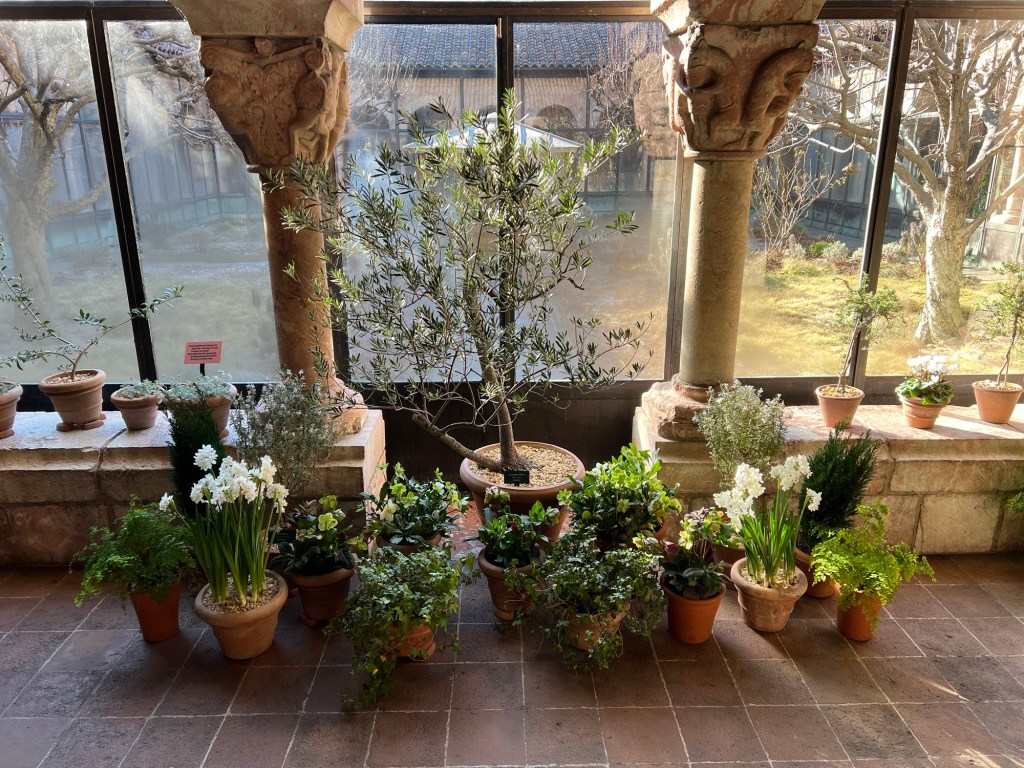
Touring the halls of the Cloisters with flowers and plants to celebrate the season
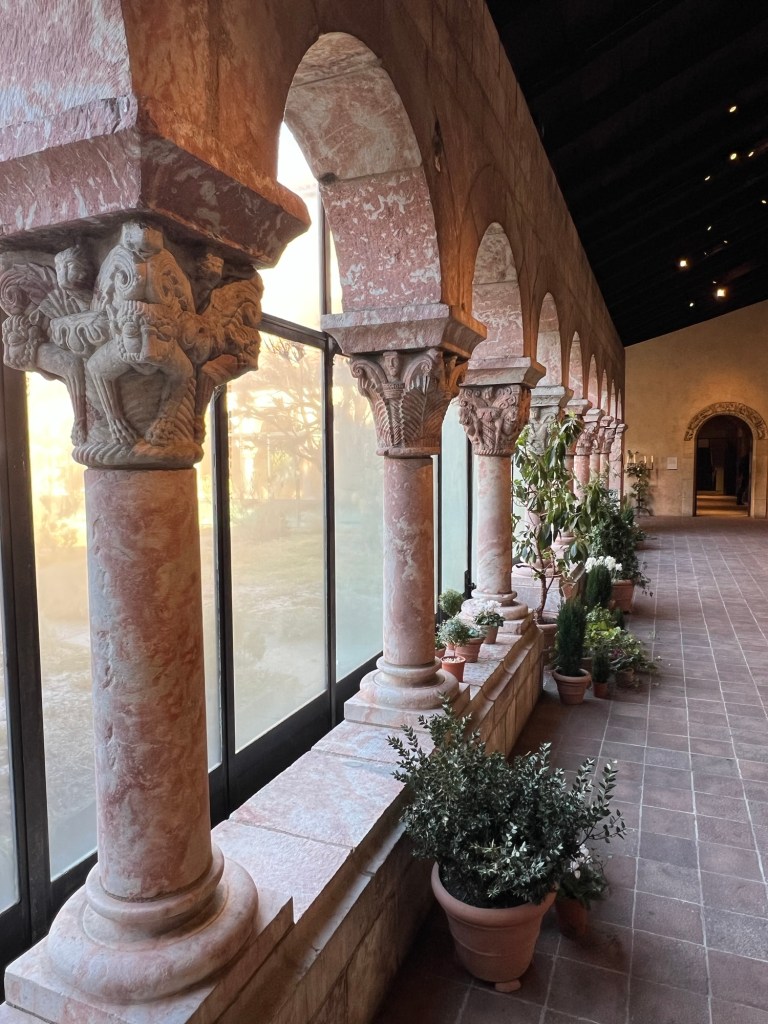
Walking the halls of the Cloisters
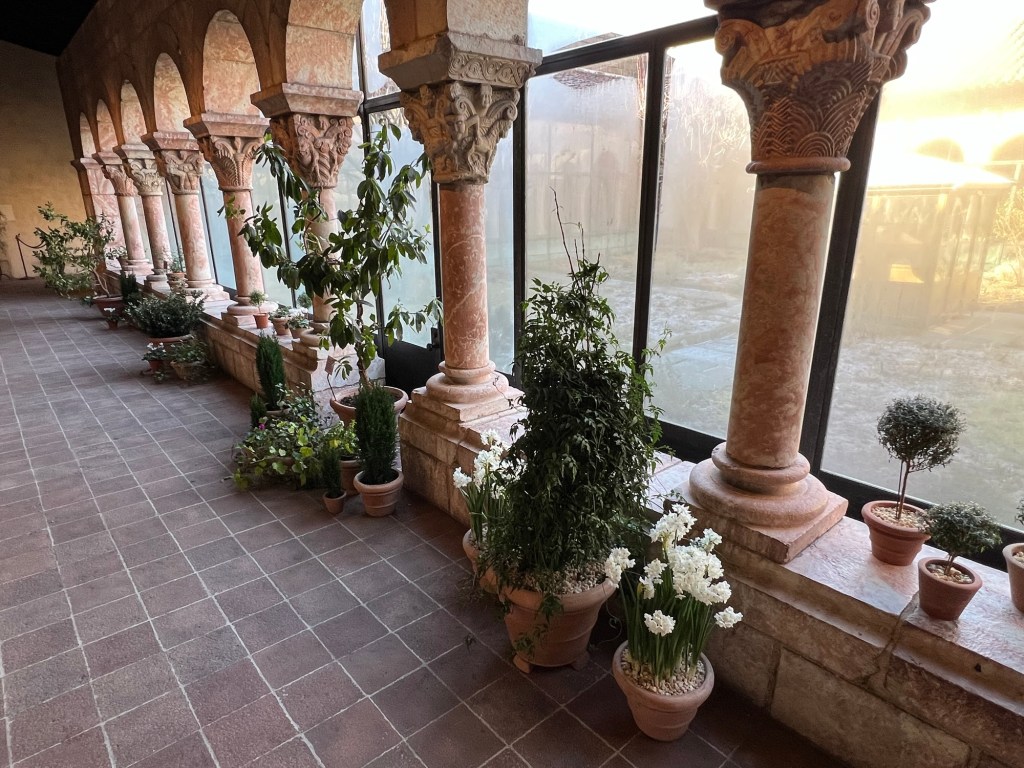
The flowering plants of the Cloisters
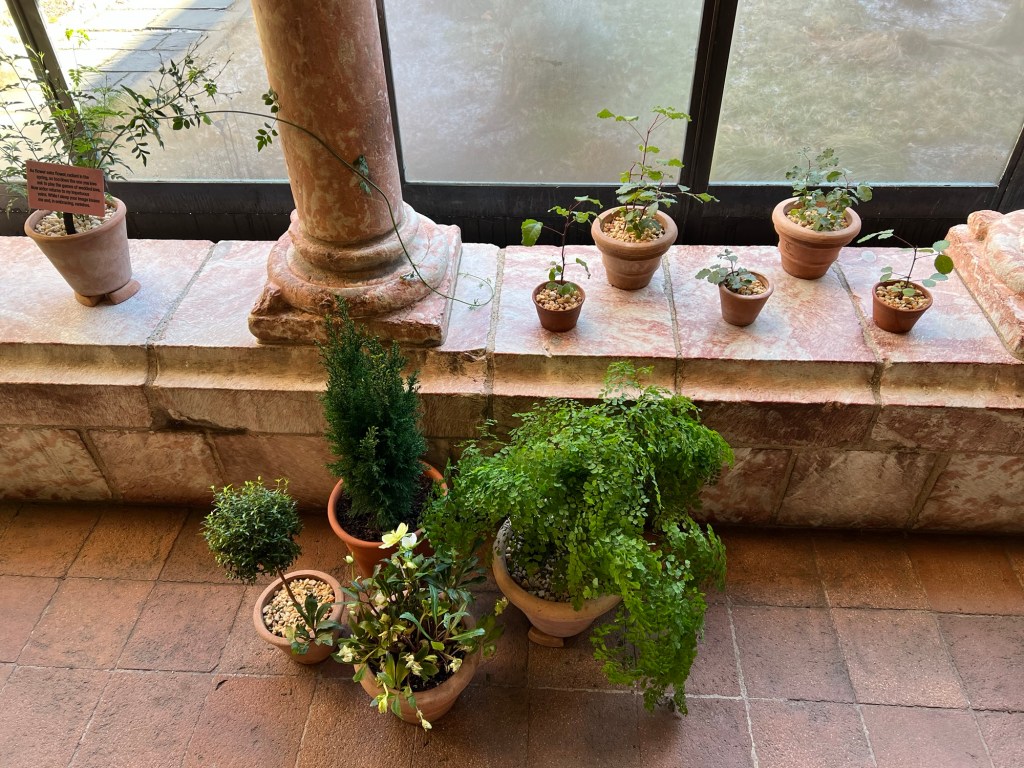
The flowering plants and vines that would have decorated churches in Medieval times

We then toured the Tapestry Room and discussed the use of plants in art form and the use of the detail as symbolism in art. These tapestries were meant to cover the drafty walls of palaces and bring in color and decoration to the stone walls.
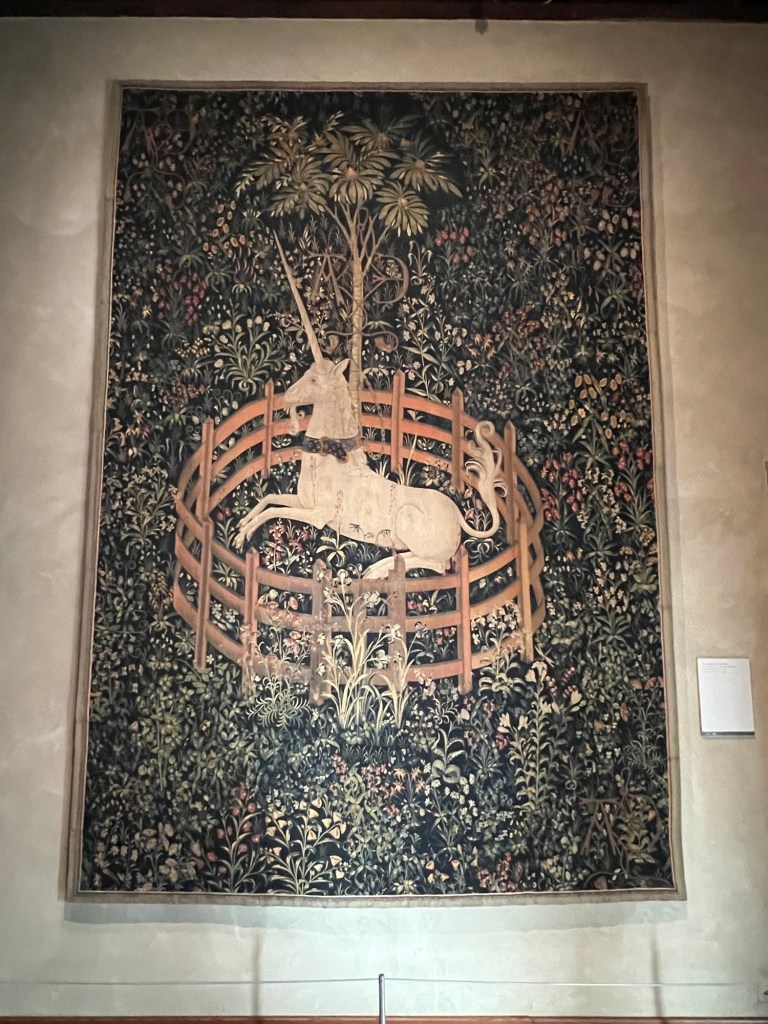
The famous ‘Hunt of the Unicorn’ tapestry

We then took a detour to the outside gardens that are enjoying their winter slumber. These gardens were used by the cloisters for food, medicines and decorative use. They will start coming to life in a few months.
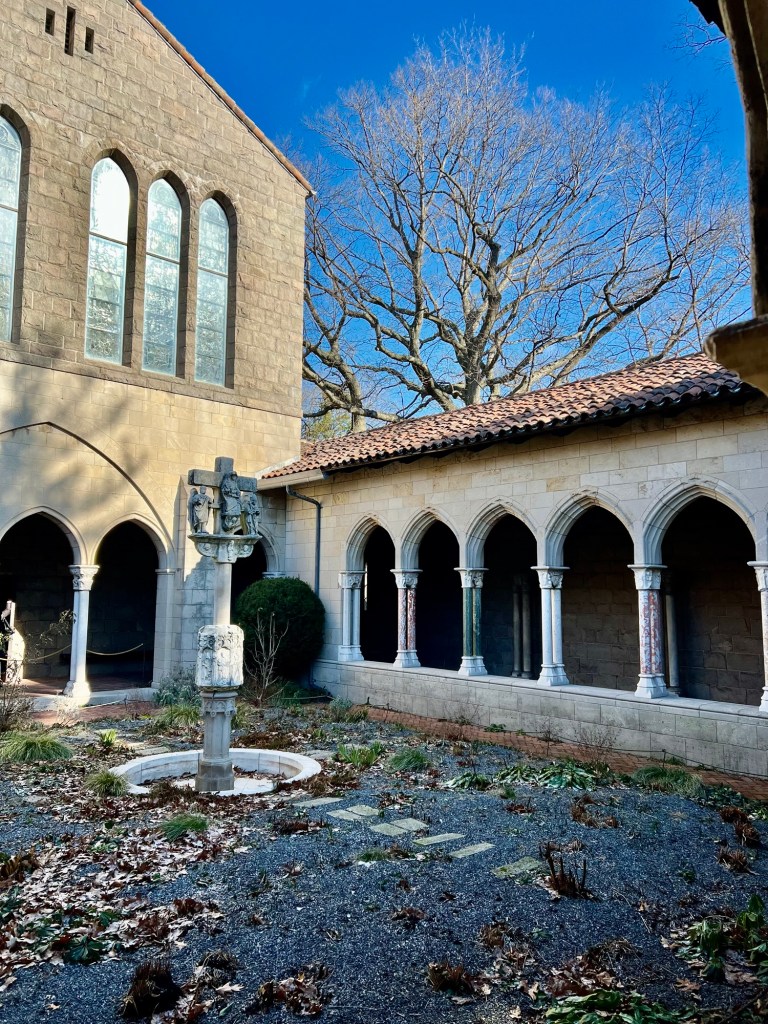
The Cloisters Gardens
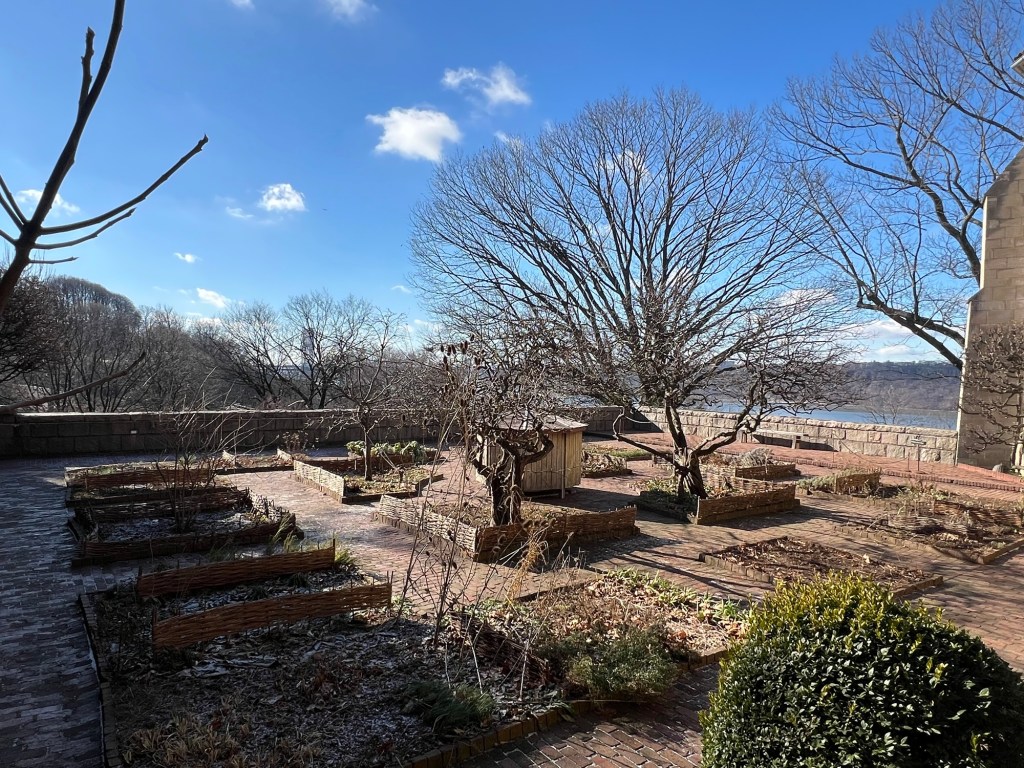
The garden terrace over looking the Hudson River
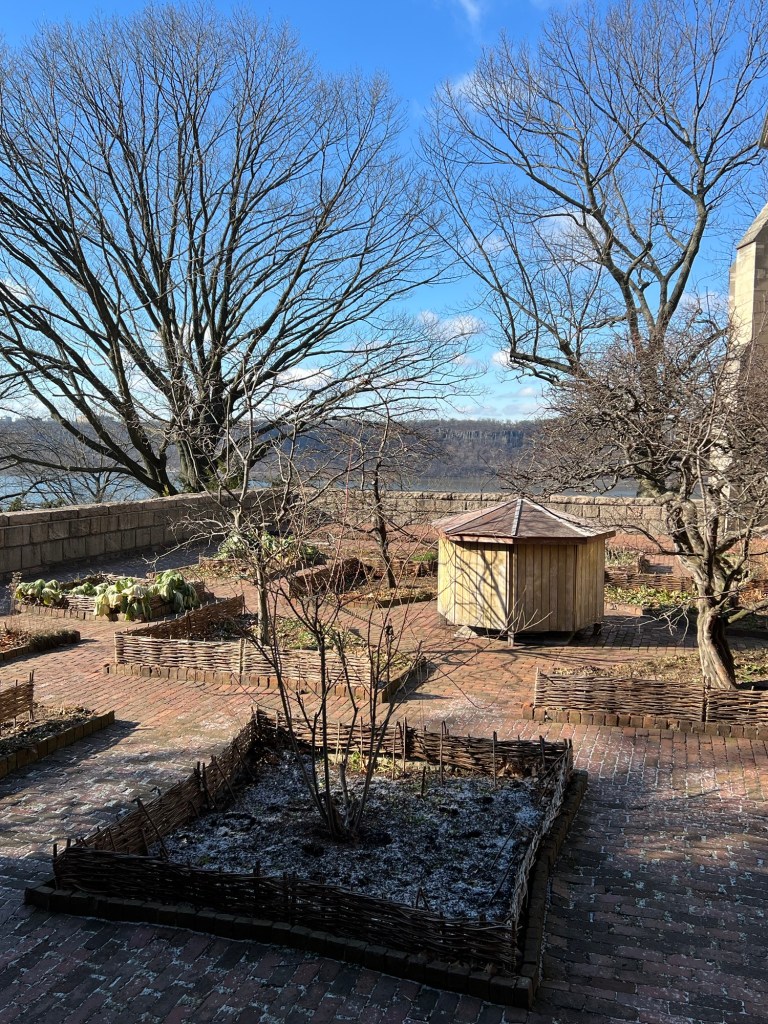
The terrace gardens in the winter waiting to come to life

Then we went back inside for a discussion of the Three Kings and the Epiphany and its symbolism in art at the Cloisters. These are some of the works featured on the ‘Christmas Tide’ tour to symbolize that visit.
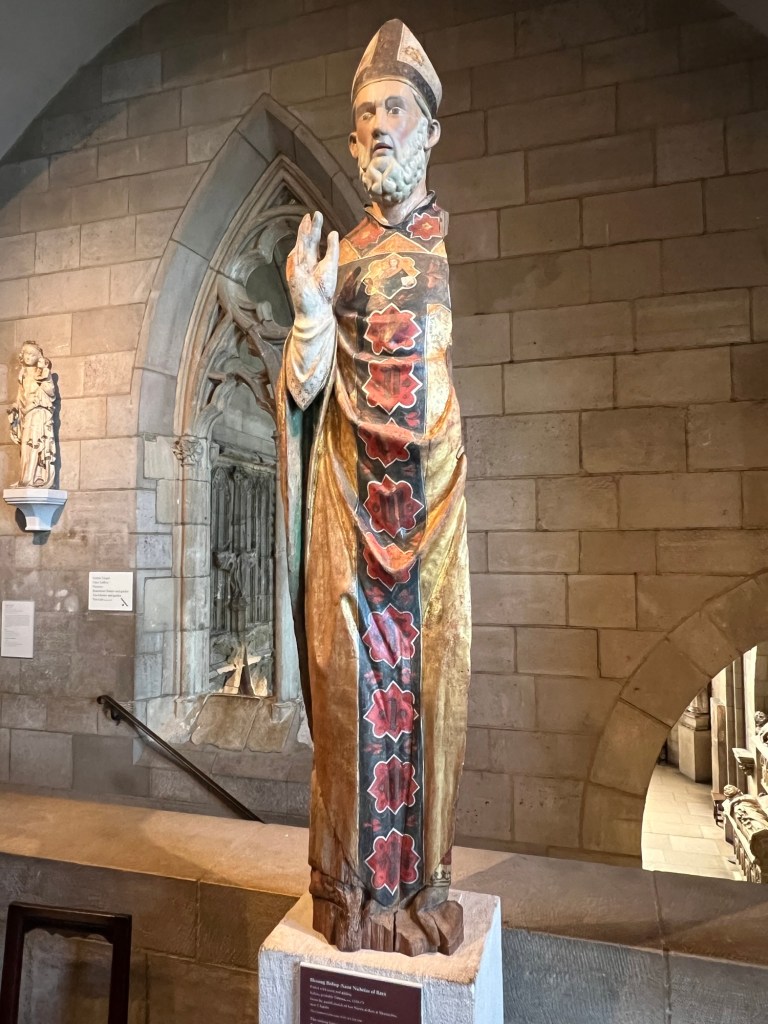
Some of the woodwork from that era
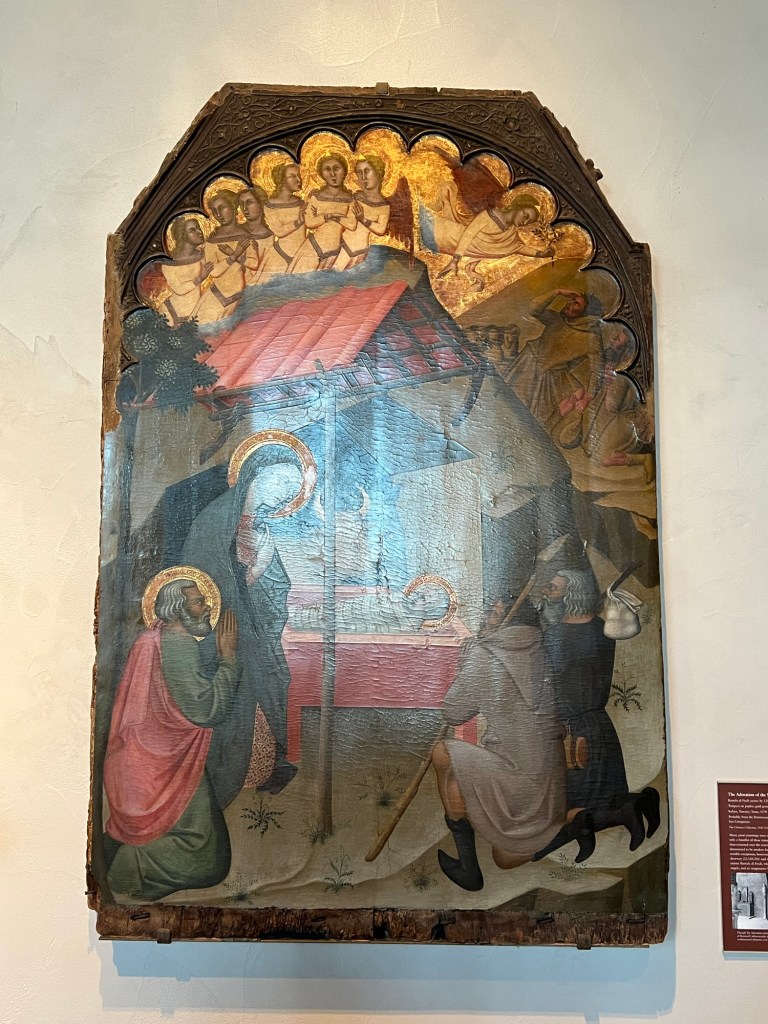
The Visitation of the Three Kings
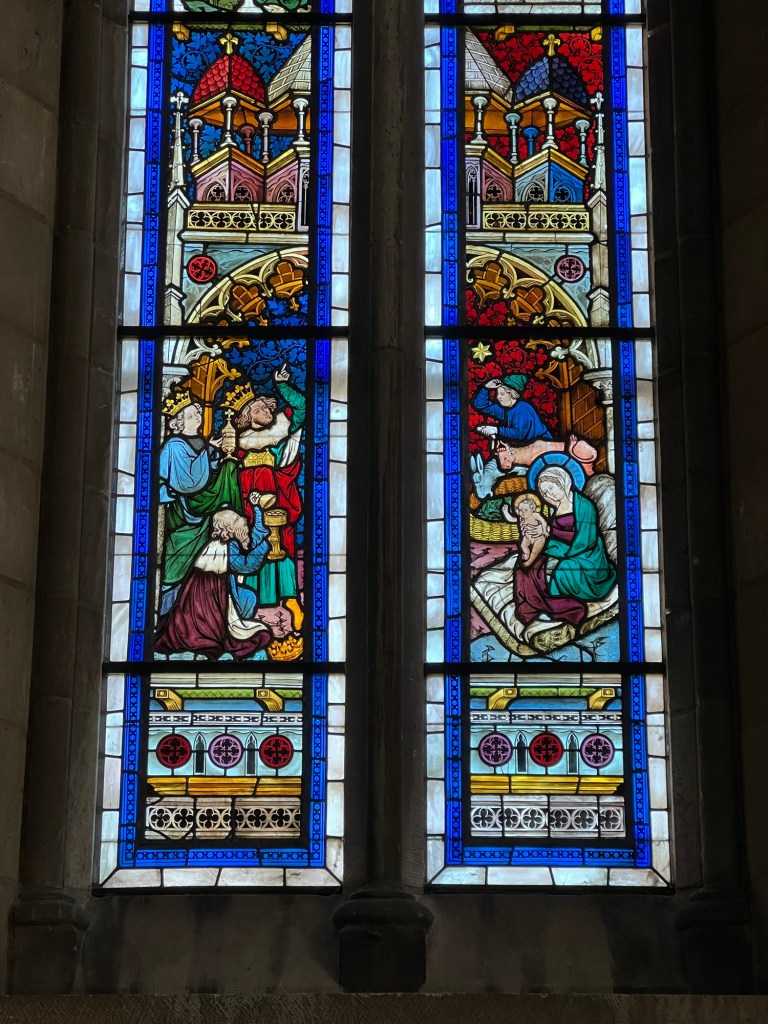
The Visitation of the Three Kings depicted in stained glass
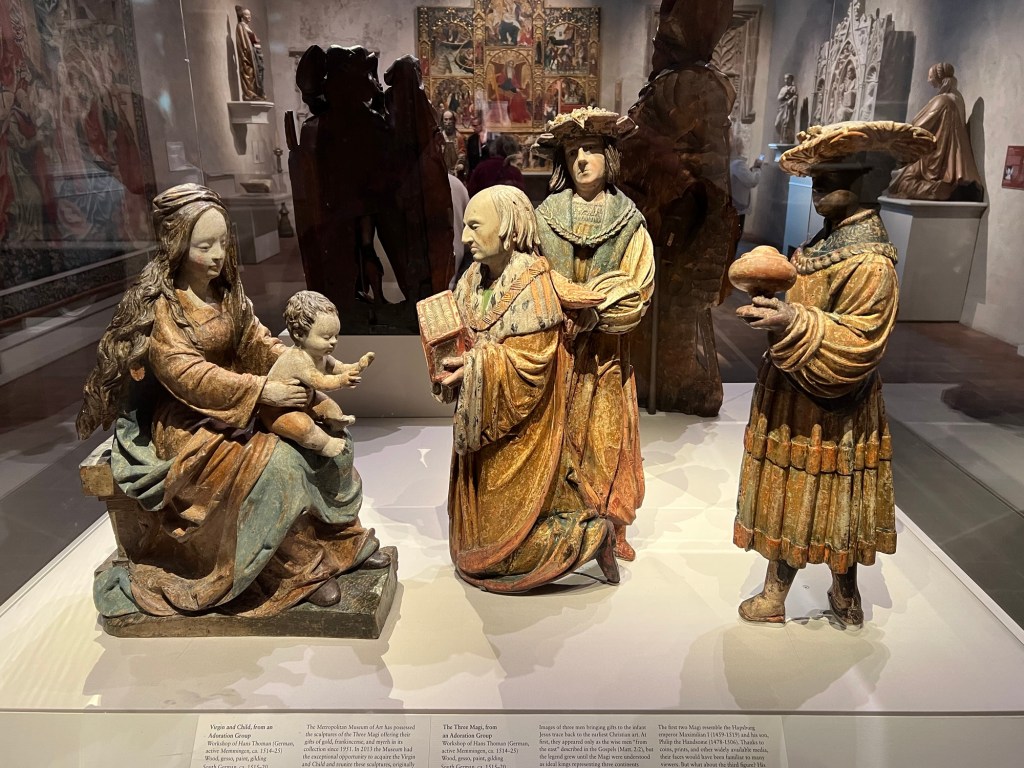
The Visitation of the Three Kings depicted in statuary
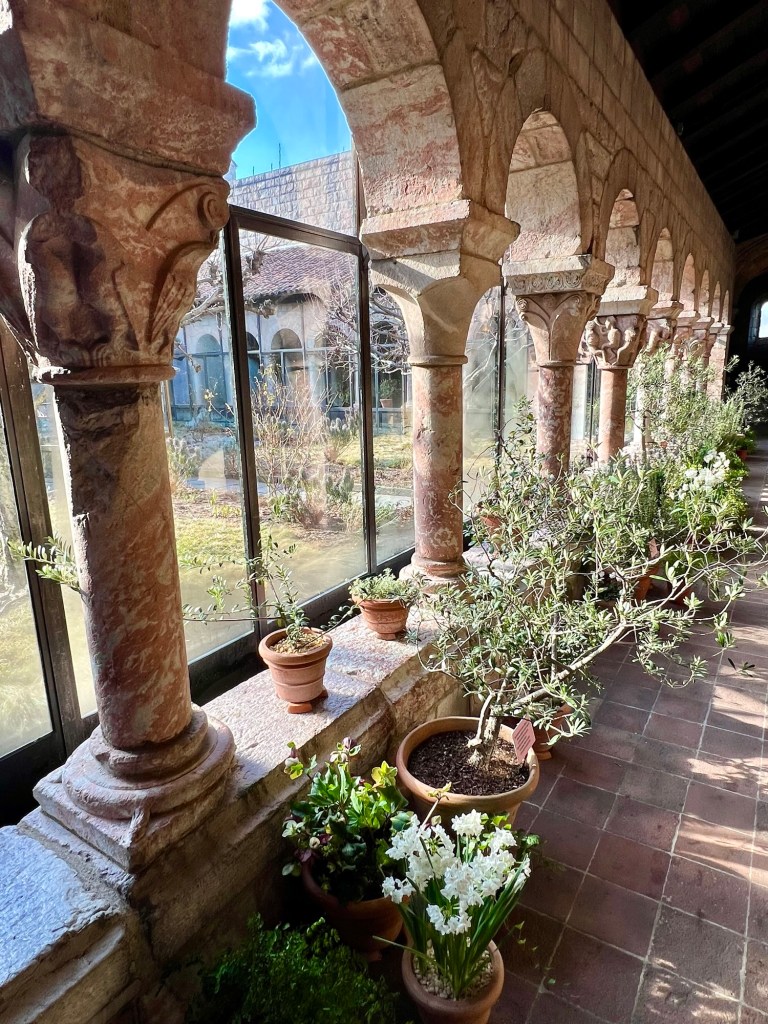
We visited the last of the Cloisters and discussed some of the plants in the collection
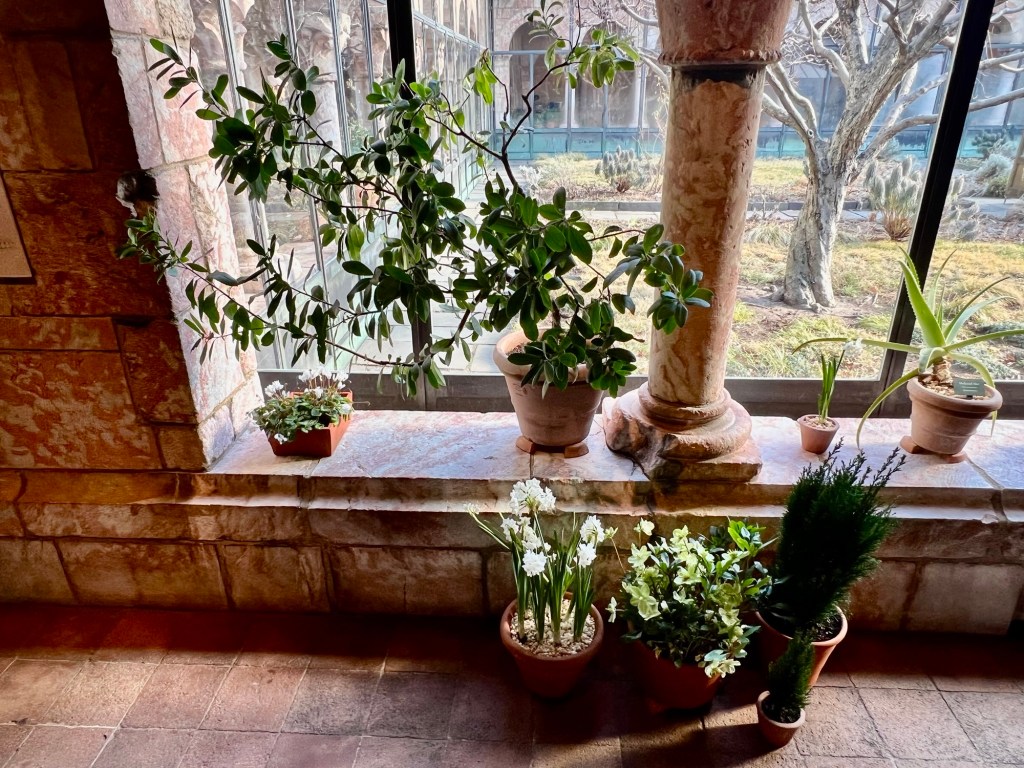
We were admiring the plants and flowers
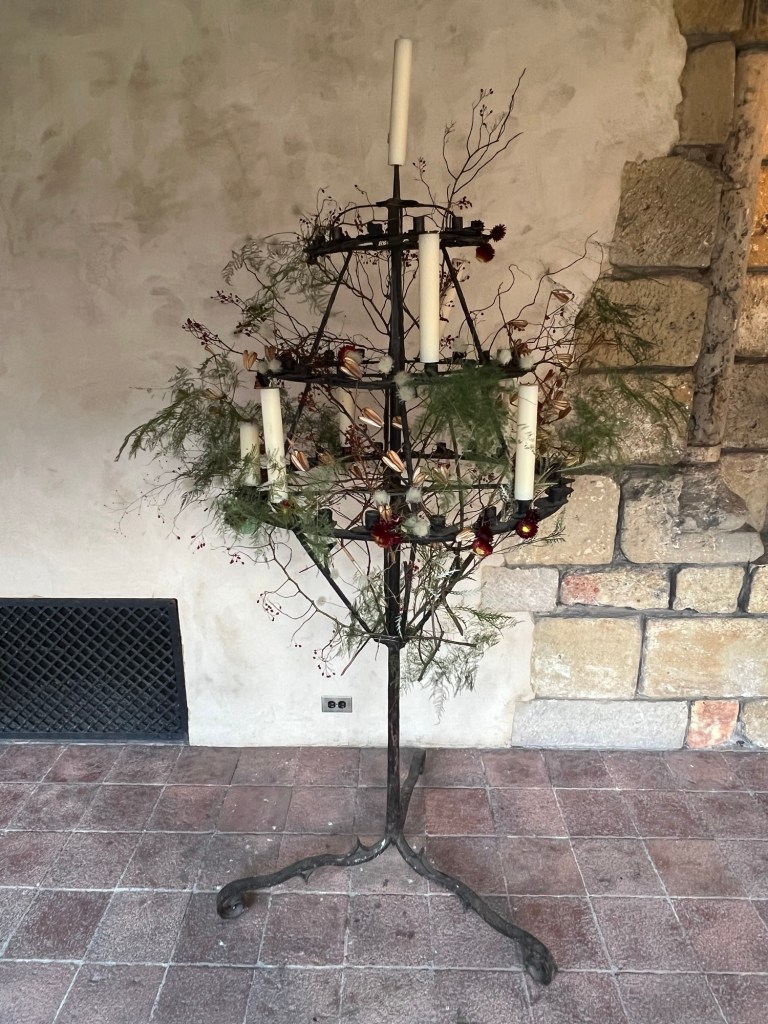
A candelabra in the hallway of the Cloisters

As I exited the building that afternoon, there were potted plants at the entrance of the Cloisters. It was a real treat to walk around the building at the holidays.
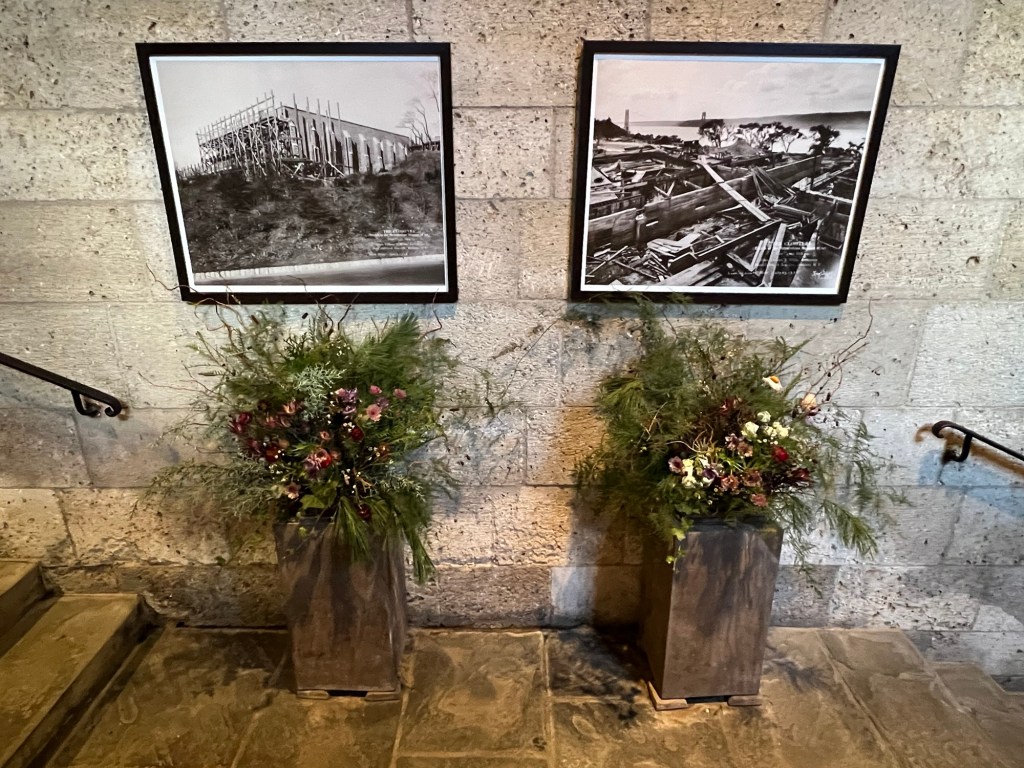
The potted plants outside the entrance of the museum

On my way down the stairs and out the door to Fort Tryon Park, I took another walk down the stone steps and walked through Ann Loftus Park. This popular playground was quiet this time of year, awaiting the Spring and the wonderful warm afternoons ahead.
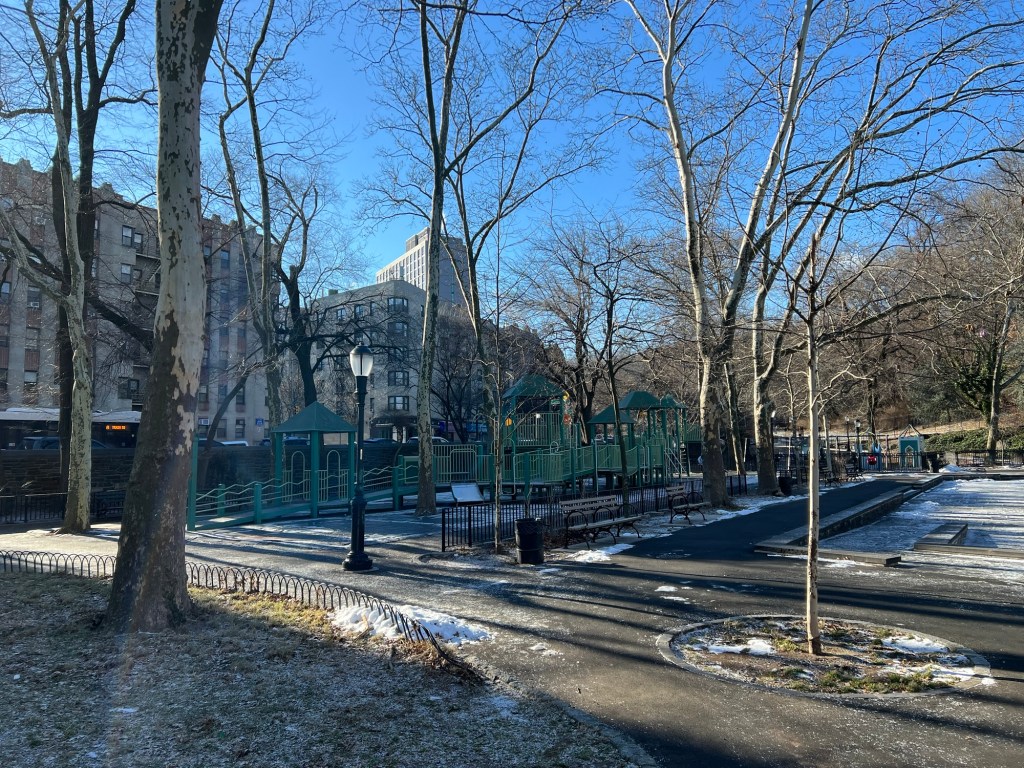
Walking through Fort Tryon Park

Fort Tyron Park

Riverside Drive to Broadway

New York, NY  10040

https://www.nycgovparks.org/parks/fort-tryon-park

https://www.nycgovparks.org/parks/fort-tryon-park/history

Open: Sunday-Saturday 6:00am-1:00am

My review on TripAdvisor:

https://www.tripadvisor.com/Attraction_Review-g60763-d2305249-Reviews-Fort_Tryon_Park-New_York_City_New_York.html?m=19905

My review on VisitingaMuseum.com:

https://visitingamuseum.com/tag/fort-tyron-park/
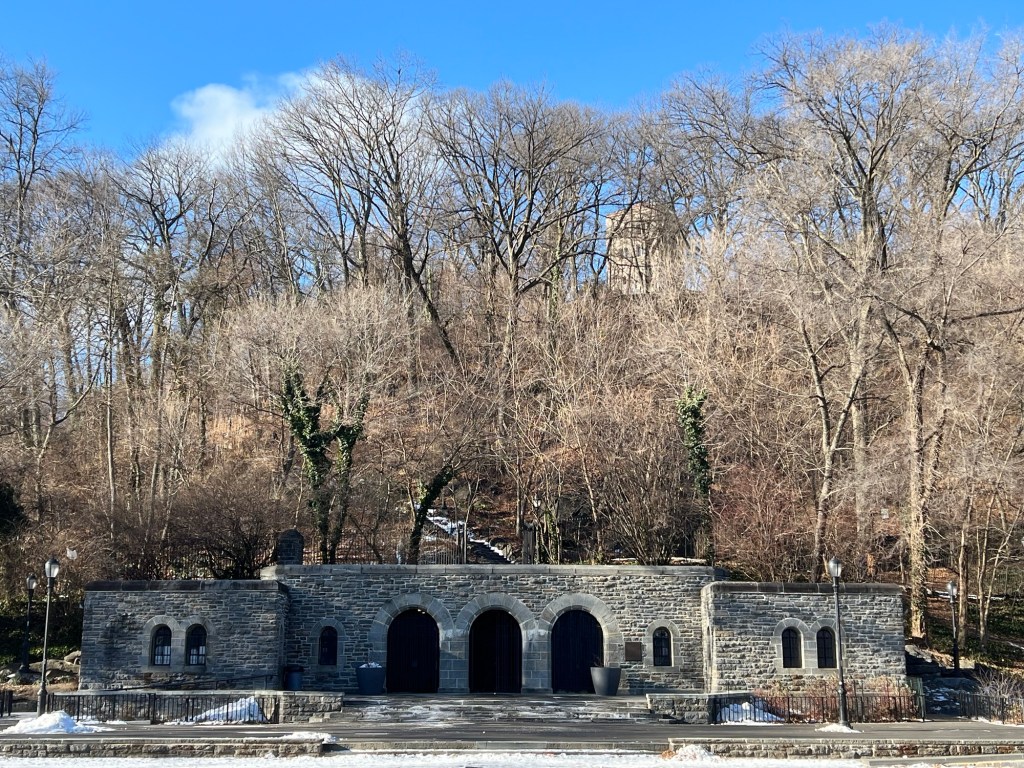
Ann Loftus Park in the winter time
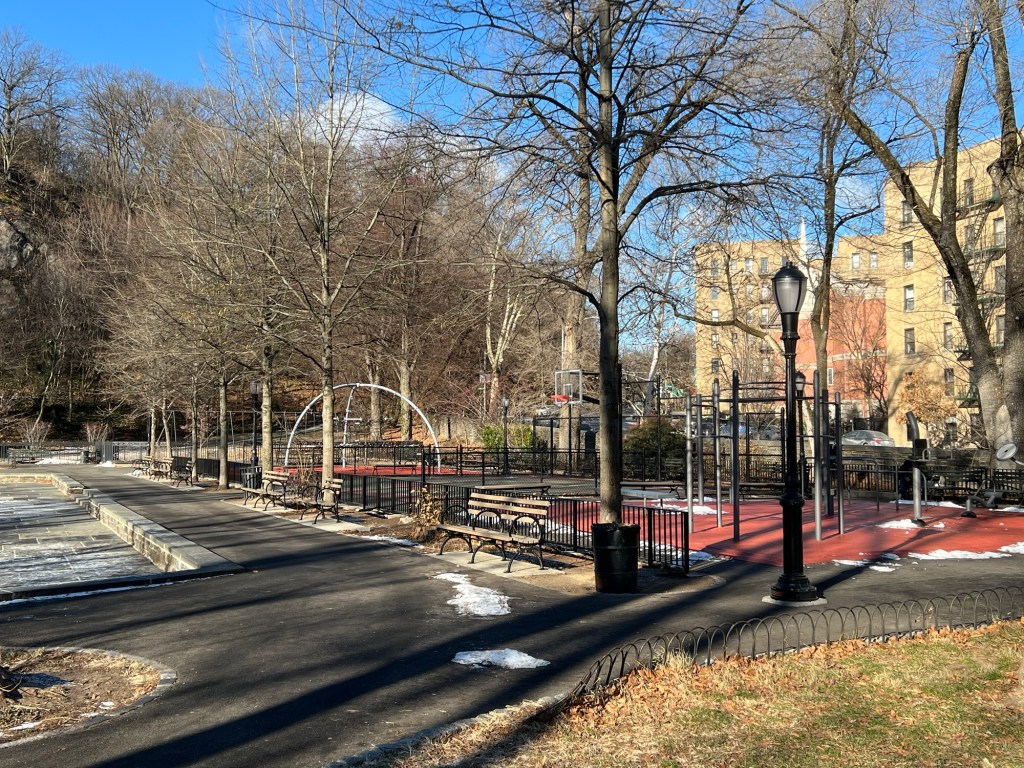
Ann Loftus Park quiet in the winter
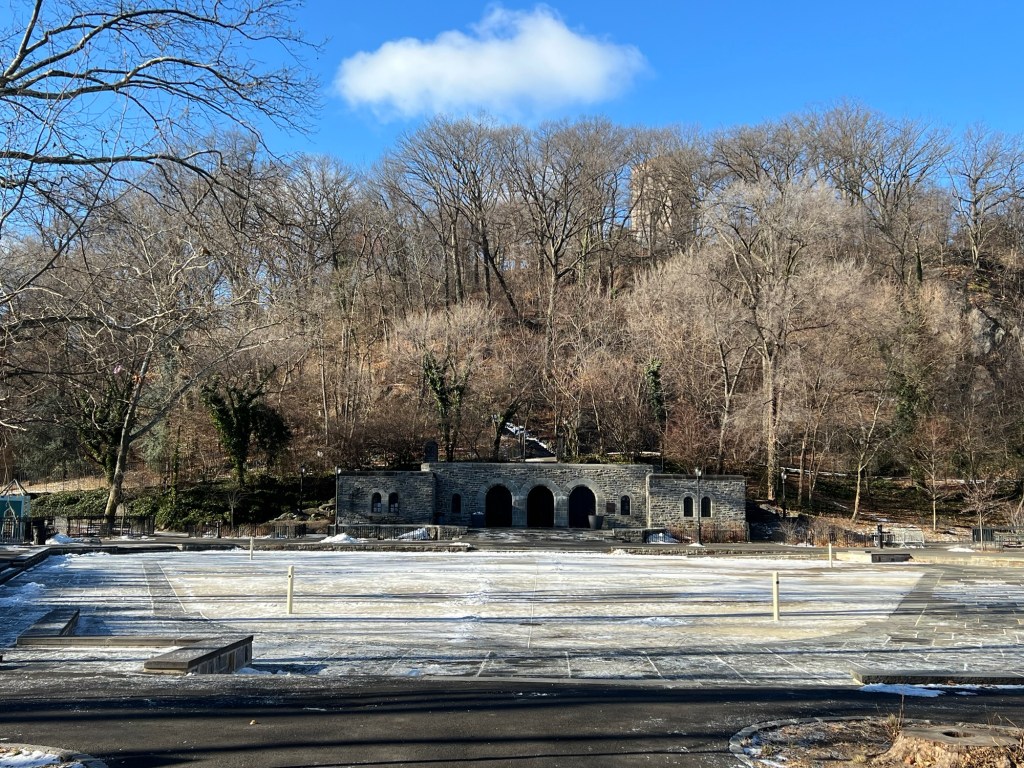
Ann Loftus Park upon leaving the park that afternoon. The quiet beauty of the Winter.

https://www.nycgovparks.org/parks/fort-tryon-park/highlights/11234

https://www.nycgovparks.org/facilities/playgrounds/325

After the tour was over, I went to G’s Coffee Shop for second breakfast that morning.
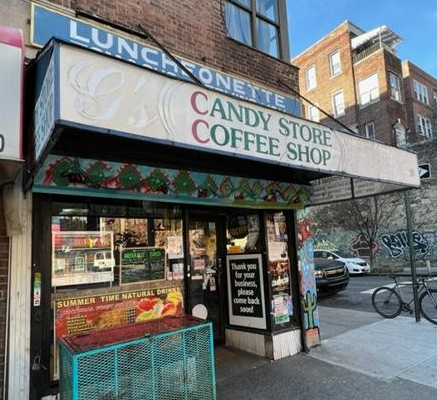
G’s Coffee Shop at 634 West 207th Street

G’s Coffee Shop

634 West 207th Street

New York, NY  10034

(212) 942-0679

Free Delivery

Open: Sunday-Saturday 7:00am-9:00pm

https://www.facebook.com/pages/category/Breakfast—Brunch-Restaurant/Gs-Coffee-Shop-205601462950934/

My review on TripAdvisor:

https://www.tripadvisor.com/Restaurant_Review-g60763-d17445018-Reviews-G_s_Coffee_SHop-New_York_City_New_York.html?m=19905

My review on DiningonaShoeStringinNYC@Wordpress.com:

My breakfast at G’s Coffee Shop

I love coming for breakfast at G’s Coffee Shop after a tour of The Cloisters. The food and service of this small ‘hole in the wall’ diner is wonderful. The meals are so reasonable and when you dine at the counter, you can watch the food cooked right in front of you. I had a wonderful Bacon, Egg and Cheese sandwich with a side of golden pancakes. What a great meal on a cold winter morning.

The Bacon, Egg and Cheese sandwich

The breakfast sandwiches here are so good

The pancakes were wonderful. The perfect comfort food on a winter day.

It was a really great tour and it was fun to walk around the neighborhood through the parks and seeing all the post Christmas decorations. Inwood is a really beautiful section of Manhattan with lots to do and see. It is the perfect place to spend the Christmas break.

Day Three-Hundred and Seventy-Three Walking through the Light show at the Brooklyn Botanic Garden                                                                         January 4th, 2026

Day Three-Hundred and Seventy-Three Walking through the Light show at the Brooklyn Botanic Garden January 4th, 2026

I promised myself I would cut back on holiday activities last year. Since almost all of my older blogs have been revamped and updated to reflect the work on my newer visits and walks of neighborhoods and towns, I took a step back and revisited one last holiday activity I enjoyed last year, The Light Show at the Brooklyn Botanic Garden.

The Gardens have been running this show for several years to increase traffic in the Gardens during the winter months to great success. These type of lightshows are gaining popularity in botanical gardens all over the country similar to the drive through holiday light shows. They are becoming a new tradition for families in usually quiet parks during the holiday season. The Brooklyn Botanic Garden has been an impressive show over the last four years that I have attended.

The directory of the ‘Lightscape Show’ at the Brooklyn Botanic Garden

https://www.bbg.org/lightscape

The brilliance of the “The Tree of Stars” display at the entrance of the show

I love how they illuminated the trees to the music

The Christmas music illuminated the trees in the “Shadow Play” and created a festive beginning to the light shows

One of the best parts of the light shows is displayed in the Japanese Garden “Let the Magic Begin”. The water show keeps people dazzled for almost five minutes. I find myself every year having to watch it three times. Once to check it out, once to film it and then the last time to be dazzled by it myself. It is one of the reasons why I put up with 35-degree weather.

The beautiful lights illuminate the gardens at its start

Then the water show “Let the Magic Begin” begins

The video of the water show is so impressive every year (excuse my coughing)

The end of the water show was spectacular

I walked down the pathway toward Daffodil Hill and could not wait until the sea of yellow flowers returned in four months. In its place was a sea of lights and sounds in the display “Papillion’s”.

I next walked through a sea of butterflies and the skies were full of color in the ‘Papillion’s’ display

The trees were full of colorful butterflies in ‘Papillion’s’

I then walked through the Shakespeare Garden and came across the ‘Threshold’ display which was a sea of lights that flipped and sparkled around.

The ‘Threahold’ display in the Shakespeare Garden

‘Threshold’ in full color

‘Threshold’ changing colors

I walked around the spiral of spinning lights s and admired all the beautiful colors as it moved around. I walked around the Shakespeare Garden and looked at where the colorful flowers and plantings are placed in the Spring and Summer.

As I walked to the lawns of the Watershed, I passed the ‘Sway’ exhibition with its layers of colorful lights on the trees.

The colorful lights of ‘Sway’ as the music plays on CD

The video of the ‘Sway’ lights against the trees

The illumination of the trees in the gardens during the light show

The next display on the lawn of the Watershed was ‘Fluxit’, which looked like outside fire. It clicked and sparkled as the music played.

The ‘Fluxit’ display as it lit and moved

The video of the ‘Fluxit’ display

Once I left the Watershed lawns, I walked into the ‘Winter Terrace’, where in the warmer months are the Lotus Pools and seasonal plants and flowers are displayed. It was now decorated with topiary women guiding in the pools, the fountains were decorated with blinking lights and where the bar and restaurant were located. The area is really crowded with people milling around and taking a break from the walk.

The ‘Winter Terrace’ in full illumination

The Lotus Pools with the illuminated women

The ‘Illuminated’ women in the pool

One of the ‘Illuminated’ women

The fountain was shimmering with lights in the “Winter Terrace”

While I was walking around the frozen pools admiring the lights, many of the patrons were in the glassed-in banquet room having snacks and drinks. The building was packed with people eating and drinking.

I walked through the next series of displays ‘Flock’ and ‘Shadow Lantern’s on the edge of the Water Basin lawn. “Flock” looks like illuminated pigeons flying around the trees.

The display ‘Flock’ on the lawn’s edge

The ‘Shadow Lantern’s’ were quite brilliant

The ‘Shadow Lantern’s’ cast their brilliant lights all over the sidewalks with a sea of snowflakes and could hear the music in the background.

One of my favorite displays in the show was walking through the giant ‘Lilly’s of the Valley’ display to what sounded like a 1970’s folk singer. It was like a surreal trip through ‘Wonderland’ and I felt like Alice when she was shrunk walking through the gardens.

The ‘Lilly’s of the Valley’ display

Walking by the floral displays illuminated with brilliant lights

My video of walking through the giant patch of Lillie’s and watching the plants and trees change colors. It was a lot of fun to walk around.

The next display was another favorite of mine, the colorful and interactive ‘Winter Walk’ with lights and music to the song ‘Sleigh Ride’ that sounded like the New York Pops. The colors popped and popped with the music.

The ‘Winter Walk’ in full color as the music played

My pictures and videos don’t give the display justice as I filmed everything from the side view of the display.

The festive lights dancing to the song ‘Sleigh Ride’

Talk about putting you in the Christmas spirit even after the holidays were over. “Sleigh Ride” is still one of my favorite songs at the holidays.

I loved walking past the lines of trees that were illuminated

I followed the path down to where in the Spring, the Bluebell flowers bloom brightly and the whole area is a sea of purples and blues. Now it was ‘Bluebonnets’, a sea of purple lights. It was just picturesque and brought the gardens back even in the dead of winter.

‘Bluebonnets’ light display

The light flowers replacing the Spring flowers

The ‘Robin’s Trail’ display at the end of the ‘Bluebonnets’ display

As I entered the Cherry Blossom lawn, which is a sea of pinks in various hues, there was now the ‘Leaf on the Light’ display on all the trees.

The ‘Leaf on the Light’ display

Towards the end of the light display for the spectacular finish of the display in the Cherry Blossom lawn, you had to walk through the lines of Cherry Blossoms that line the pathways on both sides of the lawn. Only this side of the pathway was open and lit for the display.

I walked through ‘Pulse’ , where the trunks of the trees kept changing colors. It was an interesting walk down the pathway.

The lighting of ‘Pulse’ as I walked down the pathway

‘Pulse’ as it changed colors

All this led to the best part of the show, ‘The Sea of Light’, where the whole Cherry Blossom lawn became a dazzling sea of lights, sounds and music. I love the creation of the lawn light display every year I visit the show.

The ‘Sea of Light’ as it started

The ‘Sea of Light’ as it changed colors

The dazzling ‘Sea of Light’ performance and the lively music that accompanied it.

This was the best way to cap off the evening with its dazzling lights and music. Even as it got colder, I stayed longer to see watch it at least three times. I wanted to get the perfect video to share with everyone. If there was part of the show I enjoyed most, it was this part of the display.

As I left the gardens that evening, I exited through the ‘Winter Cathedral’, an archway of an illumination of lights that is the one place that foot traffic stops as people always want to take pictures here. While this display has moved around the gardens over the years, it is still the one display that has been been consistent every year.

The ‘Cathedral of Lights’

Couples were stopping here asking everyone to take their pictures. It was a popular spot to take pictures.

The ‘Cathedral of Lights’

The last display I walked through to exit that night was the ‘Firefly Field’ at the old main entrance of the Gardens.

The ‘Firefly Field’ blazing with Tony lights

It was a nice way to wrap up the show. The “Lightscape” light display at the Brooklyn Botanic Garden was spectacular this year and always different. As cold as it was, it was still an amazing night of sights and sounds.

It was a nice way to rest and relax as the holiday season ended. Until next year!

Brooklyn Botanic Garden

990 Washington Avenue

Brooklyn, NY  11225

(718) 623-7210

http://www.bbg.org

Open:  Sunday and Saturday 10:00am-6:00pm/Monday Closed/Tuesday-Friday 8:00am-6:00pm

Admission: Depending on the time of year/please check the website

My review on TripAdvisor:

https://www.tripadvisor.com/Attraction_Review-g60827-d103900-Reviews-Brooklyn_Botanic_Garden-Brooklyn_New_York.html?m=19905

My review on VisitingaMuseum.com:

https://visitingamuseum.com/tag/brooklyn-botanical-garden/

The Garrett Family Preserve at Cape Island Creek 801 Wilson Avenue                                                       Cape May, NJ 07204

The Garrett Family Preserve at Cape Island Creek 801 Wilson Avenue Cape May, NJ 07204

The Garrett Family Preserve at Cape Island Creek

801 Wilson Avenue

Cape May, NJ 07204

(908) 879-7262

https://www.nature.org/en-us/get-involved/how-to-help/places-we-protect/garrett-family-preserve-at-cape-island-creek/

My review on TripAdvisor:

https://www.tripadvisor.com/Attraction_Review-g46341-d7190574-Reviews-Garrett_Family_Preserve-Cape_May_Cape_May_County_New_Jersey.html

While I was searching for the Cape May Maritime Museum, I made a detour into a parking lot and came across the Garrett Family Preserve

The sign that welcomes you to the park

Visiting the Preserve:

(from the Cape May Visitor website)

The Nature Conservancy protects the 180-acre Garrett Family Preserve situated between Seashore Road and Cape Island Creek, offering a tranquil setting for walking, picnics, painting, biking, and observing nature.

The preserve offers six trails ranging from 0.2-0.5 miles in length, and a two-mile perimeter loop along the forested edge–four miles in total. Explore year-round on foot or by bicycle. Sights vary by season, with bird migration peaking in the spring and fall, and the wildflower field blooming from May through July. Beginning in late August into the fall, Monarch butterflies stop here to feed before their journey south.

Preserve amenities include a mobile bird blind, welcome kiosk, shaded pavilion with picnic tables, benches and picnic tables along the trails, and three adjustable art easels. From November 1st to March 1st, leashed dogs are welcome. Because this is a preserve, the Nature Conservancy does not provide trash receptacles. Be sure to take anything you’ve brought with you.

The size of the preserve

The history of the Garrett Family

History of the Preserve:

(From the Nature Conservatory website)

Originally slated for development, TNC acquired the property in 2000, as the preserve offered an unusual opportunity to manage a significant piece of land for migratory songbirds, whose stopover habitat, especially at the southern tip of the peninsula, has been all but wiped out.

In 2013, the generosity of the Garrett family enabled TNC to further protect Cape Island Creek for future generations by acquiring crucial land, improving and stewarding habitat, performing coastal research and installing enhanced visitor amenities.  

After reading some of the history of the preserve, I decided to take a walk down the paths. I ended up walking down several paths that took me through woods and many natural gardens. I could see by how dry everything was how the lack of rain was affecting the preserve.

The pathways leading to different parts of the preserve

Following the pathways through the preserve

My first stop was the picnic area and rest stop

The Insect Hotel

The Insect Hotel

The description of the insect hotel

I thought this was an interesting concept of creating a place for insects to have a breather. It is a place of reproduction and in helping pollinate the preserve.

The fields of plants and wildflowers that make up the preserve

The flowering plants and wildflowers in the fields

Each of the paths took me through different parts of the preserve that were wooded or with meadows or an array of wildflowers that attracted birds, butterflies and bees.

The batches of wildflowers in the meadow

The Salt Marsh part of the Preserve was filled with more wildflowers that had bees and butterflies swarming them.

The Salt Marsh Habitat

The sign for the Salt Marsh Habitat

The the pathways though the meadows

The fields of flowers and plants in the marsh area

Th e next section of the preserve I visited was the Wildflower Meadows

The Wildflower Meadows in the late summer

The Wildflower Meadows paths

As I left this part of the preserve, I took many paths around the park lands. There are all sorts of fields of flowers and woods to shade the way during touring the preserve.

Going on the different trails throughout the preserve

I walked down the paths to the Bird Habitat area

The golden rod flowers attract all sorts of bees and butterflies

Flowering Honey Suckle

Beautiful flowering plants in the woods area

The colorful paths of flowers that lined the Bird Sanctuary

This all led to the end of the trails and a wrap up of how the pollinators work. How the plants, insects and birds play a role in nature.

The last thing I saw at the preserve was this butterfly sculpture by the parking lot

The history of the Garrett family

The park changes its complexity with each season. What I noticed at the end of the summer with no rain is how dry the fields were and the trees were changing colors early because the lack of moisture.

It will be interesting to see the preserve in the Spring and early Summer in the future. It was a nice walk through the preserve.

Stone Harbor Bird Sanctuary                                         11400 3rd Avenue                                                                Stone Harbor, NJ 08247

Stone Harbor Bird Sanctuary 11400 3rd Avenue Stone Harbor, NJ 08247

Stone Harbor Bird Sanctuary

11400 3rd Avenue

Stone Harbor, NJ 08247

(609) 368-5102

https://www.facebook.com/p/Stone-Harbor-Bird-Sanctuary-100064916130839/

Open:Sunday-Saturday 24 Hours

Admission: Free

My review on TripAdvisor:

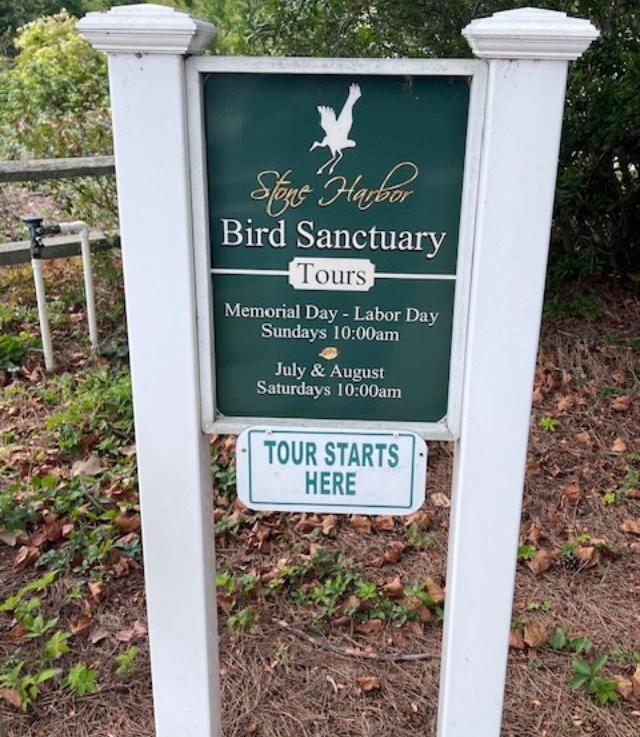
The sign welcoming you

The History of the Stone Harbor Bird Sanctuary:

(from the park’s website)

The Stone Harbor Bird Sanctuary is a wonderfully preserved microcosm of what the barrier islands of New Jersey looked like hundreds of years ago.  As you walk along Sanctuary paths, it is easy to imagine the Lenni-Lenape Indians wandering through the maritime forest, crossing wind swept sand dunes, past groves of white cedar, birch, pine, holly and sassafras trees, taking time to drink water from a spring fed freshwater pond and then, fishing in the salt water meadows surrounded by herons and songbirds.

As early as the 1870’s and 1880’s, the Sanctuary area was recognized as a “veritable paradise of birds” for ornithologists.  The primary attractions were Little Blue Herons, Black-crowned Night Herons, Green Herons and egrets.  Once the 96th Street Bridge opened in 1911, those who wanted to study, hunt or collect the eggs of birds no longer had to walk across four miles of marsh.  Easy access to the heronry was a boon to birders but also a threat to birds whose plumes and eggs were valued.

In 1941, the Stone Harbor Bird Club was organized in the home of Lillian R. Leuallen.  The Bird Club was renamed in 1946 as the Witmer Stone Club to honor Witmer Stone, one of the first ornithologists to document birds in the Sanctuary area.  With considerable foresight, the Witmer Stone Club proposed early in 1947 that the Borough of Stone Harbor establish a “sanctuary”.  In October of 1947, the Borough Council passed Ordinance #208 which preserved 31 acres of land as a wildlife sanctuary.  Subsequent to expert study in 1961 which demonstrated that no birds were nesting on the beach side sanctuary acreage, the Stone Harbor Borough Council sold ten acres to the east of Second Avenue.  The remaining 21 acres bounded by Second Avenue to the East, Third Avenue to the West, 111th Street to the North and area between 116th and 117th on the South represents the Sanctuary as we know it today.  The Sanctuary remains one of the few bird sanctuaries in the world that are completely within municipal boundaries.

One can’t overstate the foresight and commitment of the residents and Borough officials to conservation as well as the preservation of open space and wildlife in 1947, 1961 and every year since.  This commitment was reinforced by the United States Park Service in 1965 when it designated the Sanctuary as a National Natural Landmark.

Over the years, the Sanctuary has been home to thousands of birds and visited by more than a million people representing all fifty states and most countries in the world.  It has been estimated that Sanctuary visitors spend more than $5 million each year, locally. Although some like the New York Times in 1960 glorify the Sanctuary, referring to it as “The Everglades of New Jersey”, Stone Harbor residents think of the Sanctuary as a symbol of the character of this quiet, single family town which respects the nature and wildlife that surrounds them while placing a premium on livability, aesthetics and serenity.

The front of the sanctuary from 3rd Avenue

I took a walk when I was in Stone Harbor through the town’s Bird Sanctuary to hopefully view some rare birds. While I did not see much, I heard a lot of singing and scrawling as I walked the path through the trees.

The front gardens in the sanctuary

The gardens were still in bloom in the late Summer and many colorful wildflowers attracted all sorts of butterflies and other insects.

The sign greeting you about the experience

The front path of the sanctuary

You head over the bridge to the paths that take you into the woods

Walking down the pathways through the woods

The path takes you into a deep wooded area in the middle of the town and by the time you get to the middle of the path, you can hear the mating calls of many birds. It’s funny to note that we are a couple of blocks from the shore.

Walking through the pathways

Reaching the middle of the beach woods

The middle of the bird sanctuary noisy with bird calls

Walking back through the pathways through the roads

Touring through the Bird Sanctuary does not take a long time, but offers relief from a busy shore town.

Video on the park: