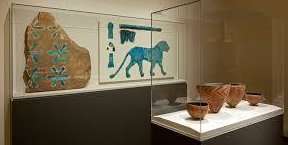
I just happened to stumble across this museum on the way back from the Metropolitan Museum of Art and saw that they were having an exhibition entitled “A Wonder to Behold: Craftsmanship and the Creation of Babylon’s Ishtar Gate”. The exhibition is on the craftsman who created the ‘Ishtar Gate’ and the ‘Processional Way’ in the Ancient City of Babylon.
Glazed brick art from the ‘Processional Way’
The small exhibition contains many examples of clay bricks that were used to build the decorative walls and pathways, artwork from the ‘Processional Way’ were displayed as well as smaller decorative art pieces from the time period.
Some of the works in the exhibition
The exhibition also showed tablets from the time period, information on the digs on the site of Babylon and some of the recorded history of the civilization.
There are interesting tablets on display
For two small rooms of gallery space, the Institute for the Study of the Ancient World covers a lot of information on the time period. One nice thing about the museum is that you can see the whole exhibit in less than an hour and they do have a very nice gift shop.
The History of the Museum:
The Institute for the Study of the Ancient World is a center for advanced scholarly research and graduate education, which aims to encourage particularly the study of the economic, religious, political and cultural connections between ancient civilizations. It offers both doctoral and postdoctoral programs with the aim of training a new generation of scholars who will enter the global academic community and become intellectual leaders.
In effort to embrace a truly inclusive geographical scope while maintaining continuity and coherence, the Institute focuses on the shared and overlapping periods in the development of cultures and civilizations around the Mediterranean basin and across central Asia to the Pacific Ocean. The approaches of anthropology, archaeology, geography, geology, history, economics, sociology, art history, digital humanities and the history of science and technology are as integral to the enterprise as the study of texts, philosophy and the analysis of artifacts. The Institute’s Director and permanent faculty determine particular directions of research but both historical connections and patterns as well as socially illuminating comparisons will always be central to its mission.
The public presence matches its vision, engaging both the public and scholars worldwide in the work and findings of its scholarly community. Exhibitions, public lectures, publications, digital resources and other programs reflect the Institute’s ideal of study that bridges disciplines and ancient peoples.
The creation of the Institute for the Study of the Ancient World at New York University has its roots in the passion that Shelby White and Leon Levy had for the art and history of the ancient world, which led them to envision an Institute that would offer an unshuttered view of antiquity across vast stretches of time and place. It was founded in 2006 with funding from the Leon Levy Foundation.
Areas of specialty among the museum’s faculty include the Greco-Roman world, the Ancient Near East, Egypt, Central Asia and the Silk Road, East Asian art and archaeology, Late Antiquity and the early Middle Ages, ancient science and digital humanities.
Disclaimer: This information was taken from the museum’s website and I give them full credit for it.
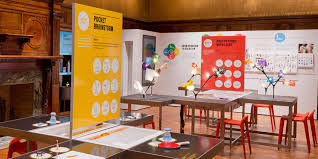
I recently visited the Cooper-Hewitt Smithsonian Design Museum for the first time. I can’t believe that all those years visiting the Met just down the road I had never stopped in the museum to take a peak. I went into see the “Nature-Cooper Hewitt Design Triennial” exhibition that was showing on all three floors of the museum. It was an interesting look on how nature plays a role in design and there is a beauty in the unusual shapes and colors that nature provides us.
Third Floor studio
The first floor was composed of design found in nature. You will see blood samples that move and shiver, electric movements and the role of it in nature and how plants and animals can be shown in simplest terms. On the second floor, you will see the prints in clothing and in home décor and see how color and design enhance beauty in an every day environment. The third floor will show more home décor and design objects.
The First Floor Elements
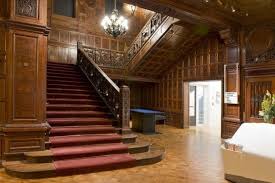
What is unique about the museum is how the mansion was converted into display areas and the use of the interior was blended into fabric of the museum. Take time to look at the areas around the staircases to admire the ceiling and the walls. It must have been a very grand home in its day.
The stairs of the mansion
Purpose of the Museum:
The Cooper Hewitt Smithsonian Design Museum is a design museum located in the Upper East side’s Museum Mile in Manhattan. It is the only museum in the United States devoted to historical and contemporary design. Its collections and exhibitions explore approximately 240 years of design aesthetic and creativity. In June 2014, the museum changed its name from Cooper-Hewitt, National Design Museum to Cooper Hewitt, Smithsonian Design Museum and reopened to the public that December (Wiki).
History of the Museum: (Provided by Wiki)
The Cooper-Hewitt Museum was founded in 1896. It was originally named Cooper Union Museum for the Arts of Decoration and it fell under the wing of the Cooper Union for the Advancement of Science and Art. In 1895, the granddaughters of Peter Cooper, Sarah Cooper Hewitt, Eleanor Garnier Hewitt and Amy Hewitt Green, asked the Cooper Union for a space to create a Museum for the Arts of Decoration. The museum would take its inspiration from the Musee des Arts Decoratifs, Paris. The museum would serve as a place for Cooper Union students and professional designers to study decorative arts collections. Cooper Union trustees provided the fourth floor of the Foundation Building. It opened in 1897. It was free and open three days a week (Wiki).
The museum and the art school started to distance themselves from on another in regards to programming. Other departments of the Cooper Union were making financial demands and the Cooper Union announced that they would close the museum. This led to the museum being closed on July 3, 1963. Public outcry was strong against the closing. A committee to Save the Cooper Union Museum was formed by Henry Francis Du Pont (Wiki).
The American Association of Museums developed a case study about the future of the museum. Negotiations then began between the Cooper Union and the Smithsonian Institution. On October 9, 1967, Smithsonian Secretary S. Dillon Ripley and Daniel Maggin, the chair of the Board of Trustees signed an agreement turning over the collection and library of the museum to the Smithsonian. On May 14, 1968, the New York Supreme Court transferred to the Smithsonian and the museum was renamed the Cooper-Hewitt Museum of Design. The following year, 1969, it was renamed as the Cooper-Hewitt Museum of Decorative Arts and Design. In October of that year, Lisa Taylor became the Director (Wiki).
The museum, which was the first Smithsonian museum outside of Washington DC, moved to its home at the Andrew Carnegie Mansion in 1970. The Mansion was renovated and the museum opened to the public on October 7, 1976 with the exhibition “Man transFORMs”. A conservation laboratory was opened in July 1978. The Samuel H. Kress Foundation funded the lab and it focuses on textile and paper conversation. Lisa Taylor retired in 1987 and in 1988 Dianne H. Pilgrim took her place as Director. In 1994, the museum’s name was changed again to Cooper-Hewitt, National Design Museum. Pilgrim retired from the museum in 2000. In 2000, Paul W. Thompson became Director. On June 17, 2014, the museum’s name was changed again to Cooper Hewitt, Smithsonian Design Museum. A new graphic identity, wordmark and new website was launched on this day. This identity was designed by Eddie Opara (Wiki).
The building is located in the Andrew Carnegie Mansion. The Georgian style mansion was built over the course of years 1899 to 1902 and has sixty rooms. The home served as not only the home for Andrew Carnegie, his wife and daughter but also as his office for his philanthropic work after his retirement. The mansion was designed by Babb, Cook & Willard. It was the first private residence in the United States to have a structural steel frame. It was the first home in New York to have an Otis elevator (Wiki).
I visited the Jewish Museum for the first time this week to see the Leonard Cohen exhibition which had gotten good review online ( I had never heard of him before). It was a combination of video and pictures. The videos were on concerts, interviews, poetry readings and documentaries on his life.
The Leonard Cohen exhibition
After seeing his videos on each floor, which was nice because there were bean bags all over the galleries, I visited the other galleries. There was an gallery dedicated to Jewish religious symbols, Contemporary Jewish Artists and items by Jewish craftsman.
The one gallery that I thought was quite amusing was the depictions of Jews on TV and how stereotypes play a role in comedy. It had everyone in the gallery laughing their heads off. It is good when you can laugh at yourself.
There is some interesting silver works from the Eighteen century on exhibition and the contemporary works were very lively. The museum is not that big so you can visit all the galleries in one afternoon. There is also a branch of Russ & Daughters in the basement level that is very popular with visitors.
The music gallery of the Leonard Cohen exhibition
History of the Jewish Museum:
The Collection that seeded the museum began with a gift of Jewish ceremonial art objects from Judge Mayer Sulzberger to the Jewish Theological Seminary of America on January 20, 1904, where it was housed in the seminary’s library. The collection was moved in 1931, with the Seminary to 122nd Street and Broadway. The Jewish Theological received over 400 Jewish ceremonial items and created. The Museum of Jewish Ceremonial Objects’, previously the Jacob Schiff Library. The collection was subsequently expanded by major donation from Hadji Ephrain Benquiat and Harry G. Friedman. In 1939, in light of WWII, Poland sent about 350 objects to New York City from homes and synagogues in order to preserve them.
Following Felix Warburg’s death in 1937, in January 1944 his widow Frieda donated the family mansion to the seminary as a permanent home for the museum and the site opened to the public as “The Jewish Museum” in May 1947. Frieda Warburg said at the opening that the museum would not be a somber memorial but rather a celebration of the Jewish faith and traditions. The first expansive of the museum was the addition of a sculpture garden in 1959 by Adam List. The building was expanded in 1963 and further by architect Kevin Roche in 1993.
In the 1960’s, the museum took a more active role in the general world of contemporary art with exhibitions such as Primary Structures, which helped to launch the Minimalist art movement. In the decades since, the museum has had a renewed focus on Jewish culture and Jewish artists. From 1990 through 1993, director Joan Rosenbaum led the project to renovate and expand the building and carry out the museum’s first major capital campaign of sixty million. The project designed by architect Kevin Roche, doubled the side of the museum, providing it with a seven story addition. In 1992, the Jewish Museum and the Film Society of Lincoln Center teamed up to create the New York Jewish Film Festival, which presents narrative features, short films and documentaries.
Contemporary art galleries
Today, the museum also provides educational programs for adults and families organizing concerts, films, symposiums and lectures related to its exhibitions. In 2011, the museum named Claudia Gould as its new director.
The Warburg Mansion
Architecture:
Felix M. Warburg House was constructed in Francois I style in 1906-1908 for Felix and Frieda Warburg, designed by C.P.H. Gilbert. Francois I style was originally found in New York City in the late 19th century through the works of Richard Morris Hunt. Hunt was a renowned architect throughout the Northeast, particularly in New England and was one of the first American architects to study at the elite Ecole des Beaux-Arts in Paris.
The original house is built in limestone with mansard roofs, dripping moldings and gables. This architectural style was based on French revivalism and exuded wealth, a point which Felix Warburg wanted to make to his neighbors. It featured a green yard in front of the house, which was later converted into the museum’s entrance.
Disclaimer: This information was taken from the Wiki story on The Jewish Museum and I give the site full credit for it.)
The front of the Japan Society on 333 West 47th Street.
I recently visited the Japan Society for the ‘Japan Cuts’ film festival 2019 to see four films as part of the festival. I had visited the Society years ago for a ‘Monsters’ exhibition which coincided with the dropping of the Atom Bomb. It was told to me during the tour of the exhibition that the Godzilla movies were the Japanese reaction to the dropping of the bombs and the effects of nuclear was on nature.
The inside lobby of the Japan Society
This time around it was a little more upbeat. I went to see new films by Japanese directors who are looking at contemporary culture a little more differently that film makers of the past. I was most impressed with “Dance with Me”, a light weight musical that reminded me of 1960’s musicals that came out in the United States and “Whole” about Japanese who come from mixed backgrounds and their role in society. It was nice to sit back and watch the films and participate in the Q & A’s.
My favorite scene from “Dance with Me” “Happy Valley”
It was also nice to walk around the building to see the indoor gardens and pools that are located in the lobby area of the building. The building does have a feeling of Ying and Yang. There will be more exhibitions in the Fall.
The inside of the lobby of the Japan Society
The opening film “Dance with Me”
The Q & A at Japan Cuts for “Dance with Me”:
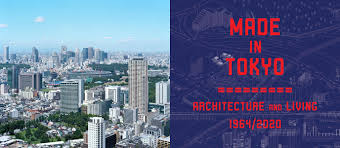
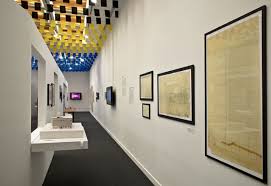
I recently visited the Japan Society for the “Made in Tokyo” exhibition on the development of architecture in the City of Tokyo between the 1962 and the 2020 Olympic Games. The exhibition showed the development and progress of the City since the bombings in WWII and how the City has rethought the building and rebuilding of the City since.
“Made in Tokyo”
Just like in the United States old department stores and office buildings are finding new use and older buildings in fringe and outside rural areas are becoming tech hubs. It was interesting so see how they were reworking old turn of the last century buildings and homes as incubators for the ‘computer age’.
The “Made in Japan” exhibition is closing at the Japan Society on January 26th, 2020. If you like the history of architecture this is an exhibition not to be missed.
The “Made in Tokyo” exhibition at the Japan Society
I recently went to the Japan Society for the screening of the famous movie, “Ringu” which is the original version of the American film, “The Ring”. It is rarely shown, and you can’t find it on YouTube or in the local libraries, so it was a treat to see this film. It was also the first time I had been in the museum since COVID closed everything down and it was nice to visit again.
Guess what I found on YouTube the next morning: “Ringu” the comparison:
Still, it was nice to go to the museum again and just relax for the evening.
The Trailer of “Ringu”
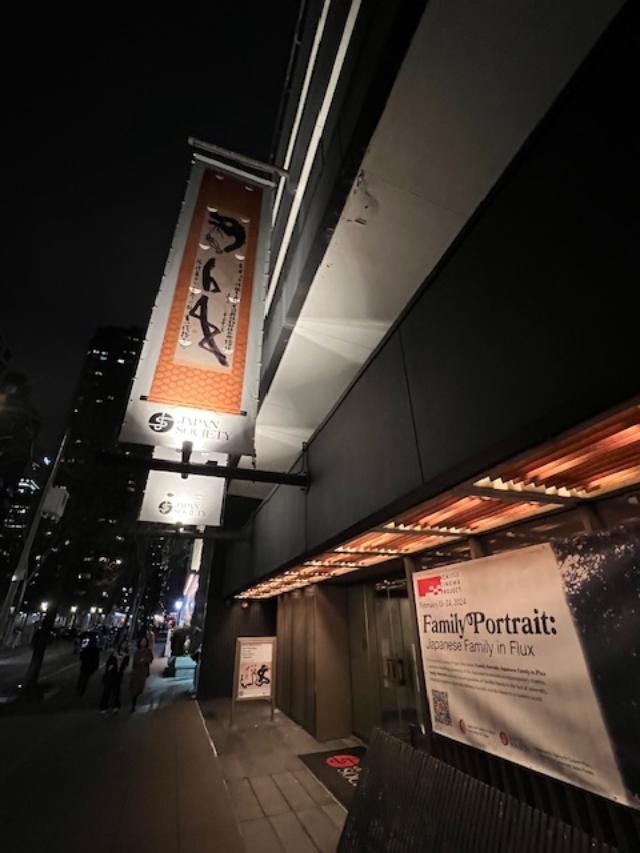
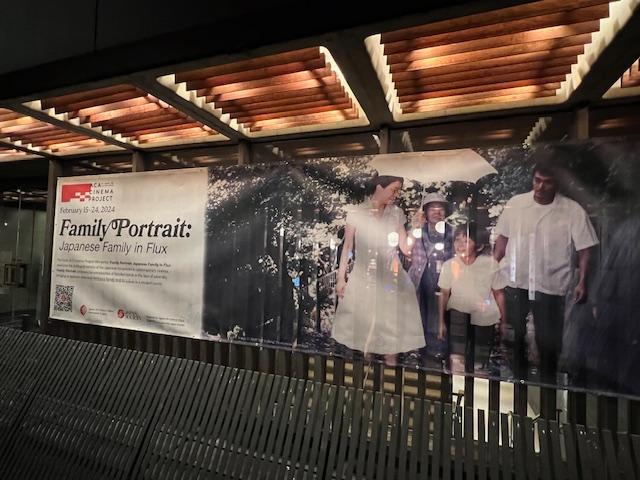
I recently went to see the “Family Portrait: Japanese family in Flux Series” in 2024 on some of the more contemporary films of Japan from the 1980’s and 90’s that are outside the studio system. These films dealt with real issues that most studio films don’t want to touch. I saw a film about a woman with terminal cancer and all the secrets of her past came out and the problems she had to face when the end was coming. Many twists and turns. The films dealt with these issues in a mature way and the series was very successful.
The sign for this amazing series of films.
The Japan Society mission:
The Japan Society is a non-profit organization formed in 1907 to promote friendly relations between the United States and Japan. Its headquarters, the youngest landmark building in New York was designed by Junzo Yoshimura and opened in 1971 at 333 East 47th Street near the United Nations. With a focus on promoting “arts and culture, public policy, business, language and education,” the organization has regularly held events in its many facilities including a library, art gallery and theater since its opening. After suspending all activities during World War II, Japan Society expanded under the leadership of John D. Rockefeller III (Wiki).
History:
In 1907, Tamemoto Kuroki and Goro Ijuin were chosen to represent Japan at the Jamestown Exposition. They attended a welcome dinner in New York with Japanese ambassador to the United States, Shuzo Aoki, where there was talk of forming an organization to promote US-Japan relations in the city. Two days later at a luncheon held by Kuroki, Japan Society was born. The organization would be run by Aoki, then Honorary President of the Japan Society of the UK and John Huston Findley.
Japan Society spent the next forty years hosting events in honor of Japanese royalty, giving annual lectures on a wide range of topics and presenting art exhibits that drew in thousands of New Yorkers. In 1911, Lindsay Russell, another founding member of the society and later president, met with Emperor Meiji and spent his visit to Japan encouraging more societies to form there and throughout the United States.
Japan Society was soon incorporated under New York law and finally found a home near one of Russell’s work offices, though it continued to relocate throughout its history before its current headquarters was opened in 1971. At this time, Japan Society and its members began to express interest in improving teaching about Japan in the United States. The organization began sponsoring trips to the country, publishing books and sent a report to the Department of Education about the portrayal of Japan in American textbooks.
It remained active during World War I, operating as it had for the last seven years but the organization became more political when it began associating with the Anti-Alien Legislative Committee, an advocacy group that spoke out against yellow peril. Russell and Hamilton Holt, another founding member used the organization’s publication to defend all of Japan’s actions at the time. Unbeknownst to anyone at the time, even one of Japan Society’s writers secretly worked for the Japanese government with the task of improving Japan’s imagine in the United States. The organization eventually realized the dangers of taking sides and by 1924 stopped publishing any political commentary.
By the 1930’s, membership had dropped significantly due to financial difficulties and the Second Sino-Japanese War. Following the attack on Pearl Harbor in 1941, Henry Waters Taft immediately resigned as president after serving from 1922 to 1929 and again from 1934. Russell also stepped down as one of Japan Society’s directors. All activities were suspended and would not resume until the Treaty of San Francisco was signed in 1951.
John D. Rockefeller III served as president from 1952 to 1969 and then as Chairman of the Board until his death in 1978. He accompanied John Foster Dulles on his trip to Japan that eventually led to the signing of the 1951 treaty. Rockefeller, a supporter of the Institute of Pacific Relations, who visited Japan in 1929 during one of its conferences, wanted to contribute to bettering US-Japan relations after the war and believed there needed to be non-governmental organizations like Japan Society in each country in order for such friendly relations to exist.
Under Rockefeller’s leadership, Japan Society expanded and talk began to find a permanent headquarters for it. It shared offices with another Rockefeller-led organization, Asia Society but as the two organizations continued to grow during the 1960’s, it became increasingly clear that Japan Society needed its own building. After receiving donations from Rockefeller and other members, construction began on “Japan House” in 1967. Designed by Junzo Yoshimura, whose work also includes Asia Society’s headquarter, it became the first building in New York of contemporary Japanese architecture. On September 13, 1971, it was finally opened to the public after a ceremony attended by Prince Hitachi. He echoed Russell’s first words about Japan Society, calling for “closer people-to-people” contact between countries.
Japan Society building
(This information was taken from Wiki and I give them full credit for the information. I also included information of Japan Society).










 Visiting a Museum: The Unique, Unusual, Obscure and Historical