Category: Educational Museums

Fort Jay                                                       Governors Island                                                 New York City, NY 10004

Fort Jay Governors Island New York City, NY 10004

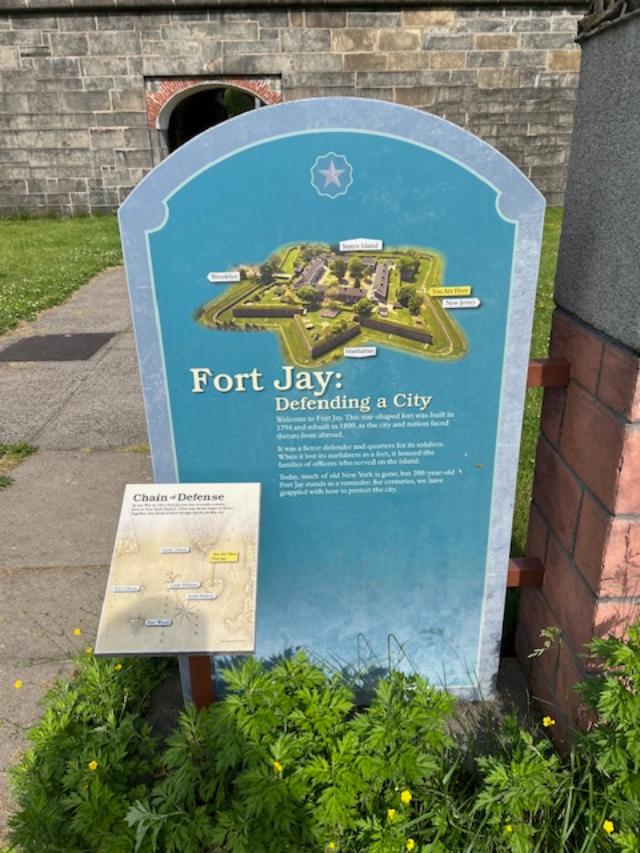
Fort Jay

Governors Island

New York, NY 10004

My review on TripAdvisor:

https://www.tripadvisor.com/Attraction_Review-g60763-d136072-Reviews-Governors_Island_National_Monument-New_York_City_New_York.html?m=19905

My review on MywalkinManhattan.com in 2018 and 2024:

https://wordpress.com/post/mywalkinmanhattan.com/7658

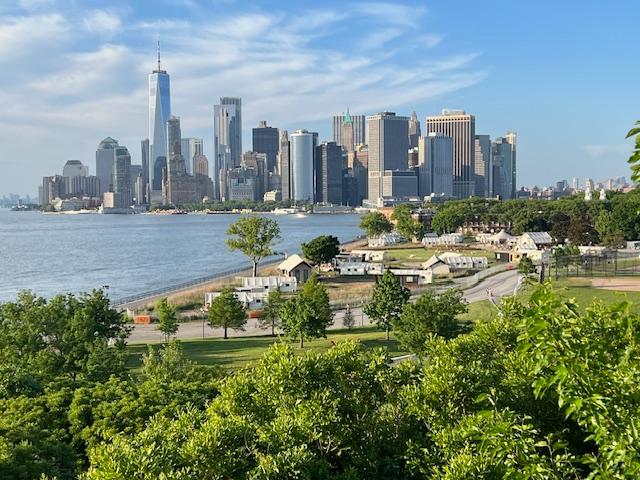
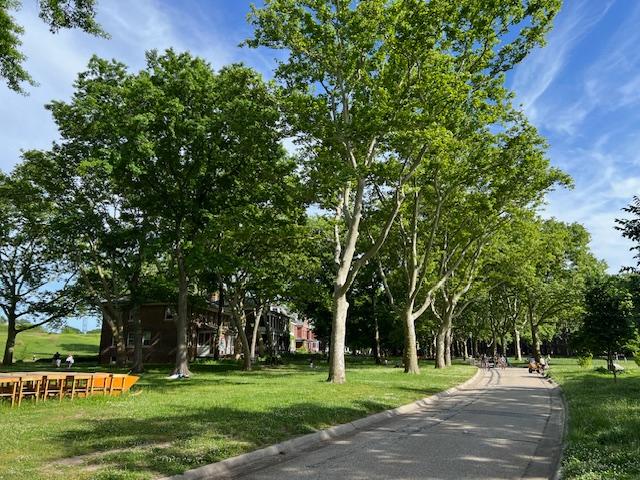
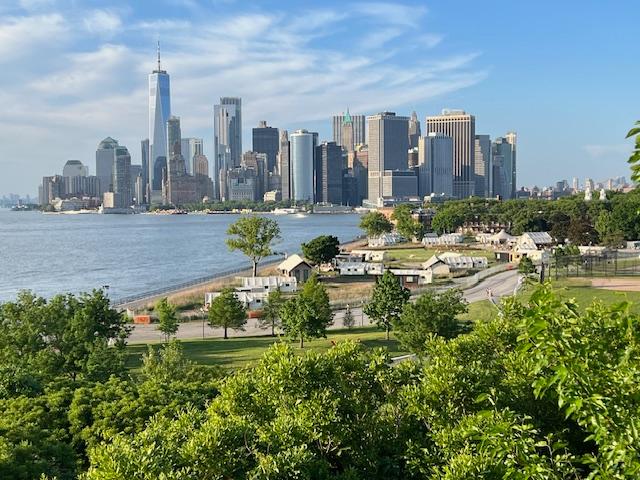
The view from the top of the hill on Governor’s Island.

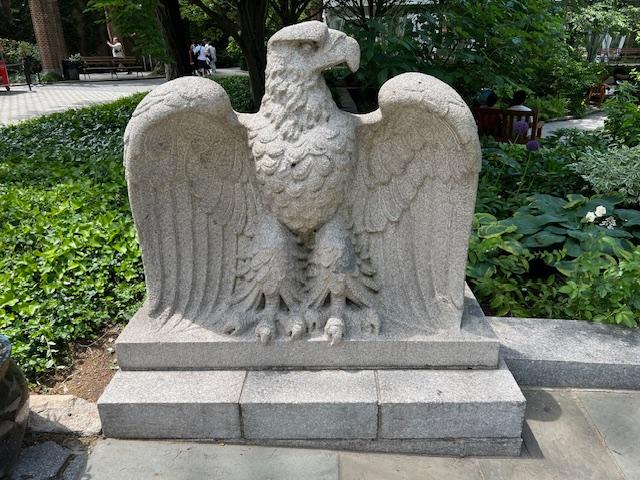
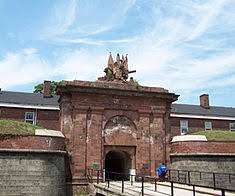
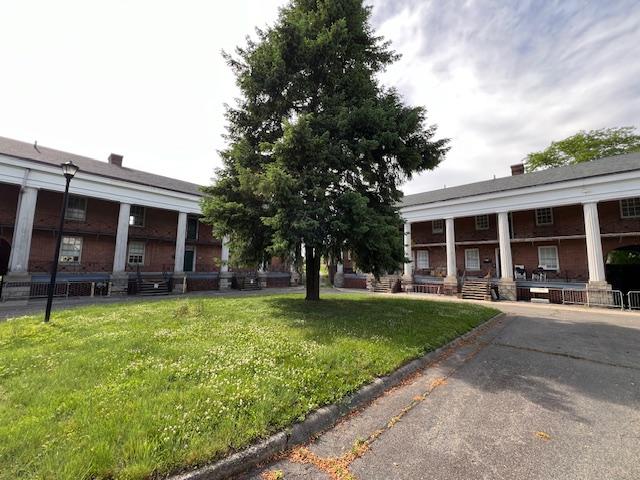
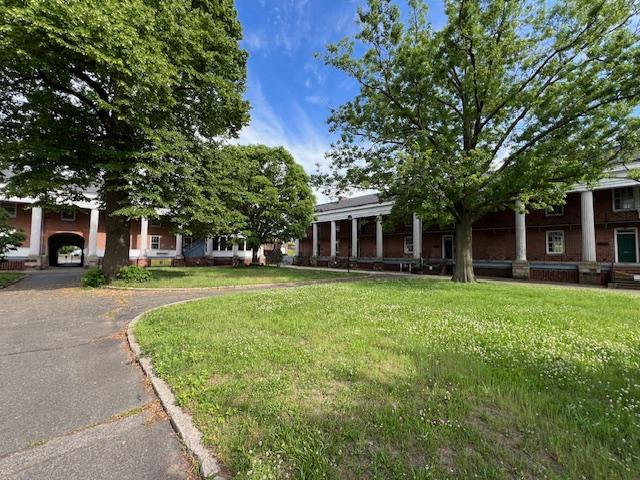
When I was touring Governors Island for my blog, “MywalkinManhattan.com”, I explored the Fort Jay complex which is located on the northern end of the island just past Castle Williams. This fort is mostly in a state of ruin and is currently being restored at various stages all around the complex. The decorative entrance with its statuary is being cleaned and the entrance fixed on one side of the fort and the walls and some of the interior space is being repaired inside the fort.

The main entrance to Fort Jay (currently under restoration)

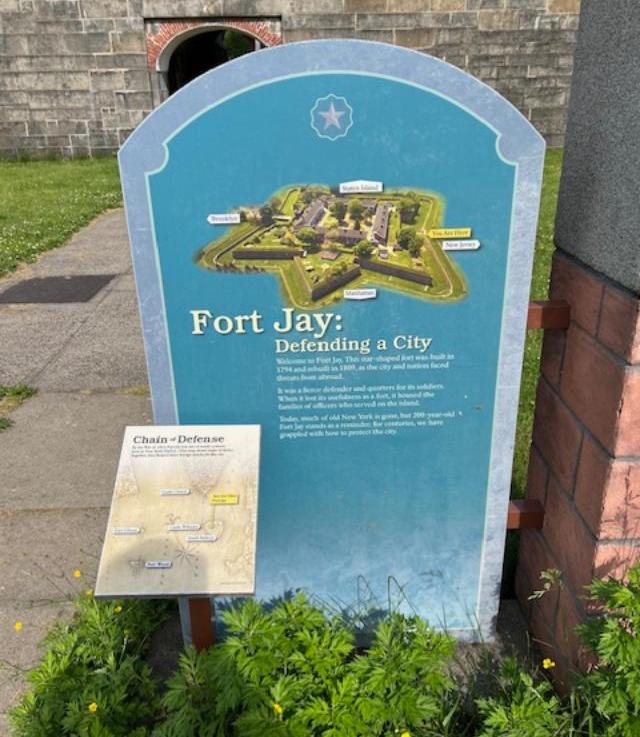
This fort and Castle Williams were built to protect the City of New York between the Revolutionary War and the War of 1812. After that these forts fell out of use as the times and technology changed .

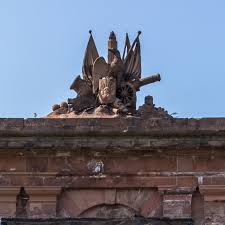
The decorative statuary is being repaired on the fort (currently under restoration)

Now the fort is used for art exhibitions in some of the interior hallways and grass has grown over most of the walkways. Still it is interesting to walk along the pathways near the walls of the fort and see how they were once used. It is interesting to see how far we have progressed in warfare.

The entrance to Fort Jay

The History of Fort Jay:

Fort Jay is located on Governors Island in New York Harbor, one half-mile from the southern tip of Manhattan. No defensive works are known to have been erected on the island during its early history. Defensive earthen works were first erected on the highest point of Governors Island by Continental troops in 1775-76. The island and its fort were occupied by the British during the American Revolution until 1783, when it surrendered, along with several buildings to the Governor of New York.

More than ten years passed before renewed tensions with Great Britain resulted in funding from both the New York Legislature and the United States Congress in 1794 to reconstruct the works on Governors Island. This part of a larger national effort to fortify ports that later became known as the First American System of coastal fortifications.

Design of the New York Harbor defenses was assigned to French engineer Charles Vincent. The works on Governors Island had been completed by 1796, described in January of that year by the Secretary of War as “a fort made of earth and two batteries under its protection, partly lined with brick masonry, two air furnaces, a large powder magazine and a barrack for the garrison.”

The inside of Fort Jay.

Fears of a French invasion in 1797 resulted in a second phase effort funded by additional appropriations to complete and enhance the coastal fortifications, including those on Governors Island. The fort is said to have acquired the name “Fort Jay” in 1798 for John Jay, then the Governor of New York State. Governors Island and its fort were conveyed to the federal government two years later in 1800, by an Act of the New York State Legislature.

The inside of Fort Jay

A plan of the fort as it existed that year shows it as a four-bastioned form surrounded by a ditch with a parapet having 51 embrasures, a gate and bridge on the east side and a large magazine in the northeast bastion. The fort was still incomplete and incapable of defense in 1802 according to a written report, although it was then equipped with a “handsome Gateway with a Corps de Garde” or guardhouse, that survives today.

Fort Jay had fallen into ruinous condition by 1806 when a second national campaign to strengthen the coastal defenses of the country, now known as the Second American System of fortifications, was implemented. This effort differed from the first by employing American engineers and using more durable masonry construction.

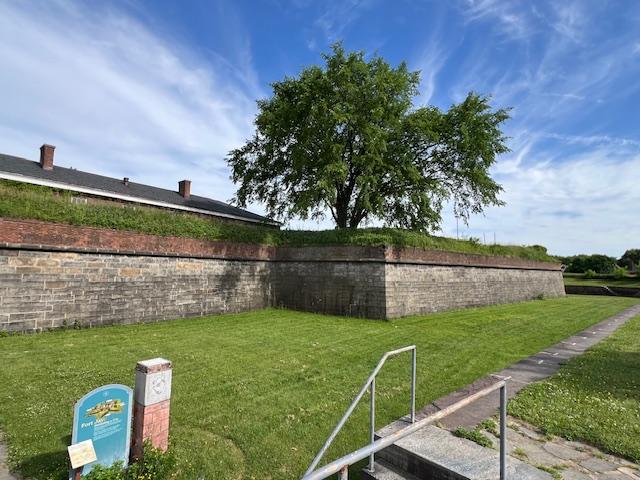
The outside wall of the fort.

The engineer chosen to design and oversee the defenses of New York Harbor was Colonel Jonathan Williams, Chief Engineer of the Corps of Engineers and first Superintendent of the Military Academy at West Point. Reconstruction of Fort Jay, renamed Fort Columbus about this time, began in July 1806 and was completed by December 1809. The only components of the old fort judged worth saving were “the walled Counterscarp, the Gate, the Magazine and the Barracks,” according to Colonel Williams in a report dated November 1808.

The completed fort was described in a later report to Congress as “an enclosed pentagonal work, with four bastions of masonry, calculated for one hundred guns, fifty-five mounted with brick barracks for two hundred and thirty men, including officers. The earliest known plan of the completed fort is a plan by Joseph Mangin drawn in 1813.

The walkway between the forts.

The first significant repairs and alterations were made to Fort Columbus in the 1830’s, resulting in the overall appearance of the fort as it exists today. The stone retaining walls were extensively rebuilt at this time, including the scarp that was faced with granite and topped with a new brickwork parapet. The old magazine in the northeast bastion was demolished and replaced by four new magazines erected in the north ravelin. Finally, the four existing brick were replaced by four new barracks with flanking triangular structures and outdoor courtyards.

Later changes have been made to the barracks by the U.S. Army over the years, including interior remodeling and replacement of the flat roofs with hipped roofs in 1855-57, incorporated of five of the triangular buildings as additions in the 1860’s and 1898-99 and reconfiguration of the buildings as officers’ apartments in 1921-22 and again in the 1930’s. Paint was stripped from the exterior brick buildings in the 1930’s, the sodded glacis of the fort was converted to recreational use as a golf course by 1940 and the flagstaff was moved from the northwest bastion to the north ravelin by 1953.

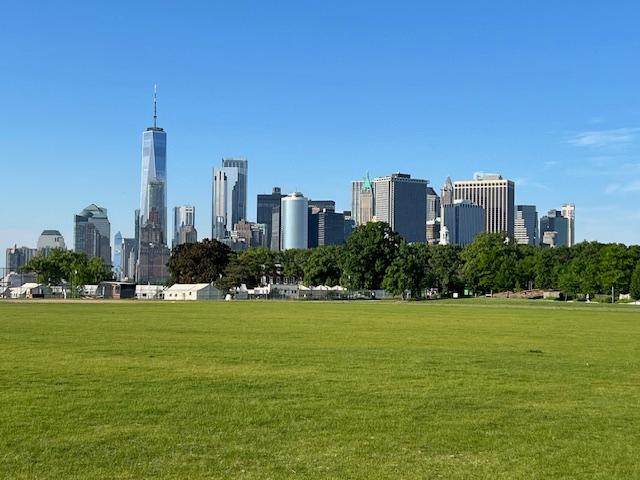
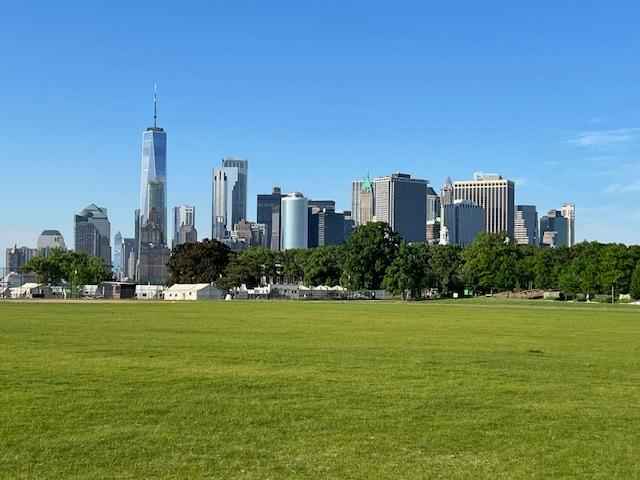
The lawn on Governor’s Island overlooking Lower Manhattan.

Jurisdiction of Governors Island passed from the U.S. Army to the U.S. Coastguard in 1966. Improvements made by the Coast Guard to Fort Jay, whose name was officially reinstated in 1904, included expansion of the golf course; remodeling of the barracks with new kitchens, bathrooms, heating and electrical systems and storm windows and doors and erection of chain-link fencing on the glacis. Fort Jay sat vacant with minimal upkeep since the closure of the Coast Guard in 1997.

Fort Jay was recorded by the Historic American Buildings survey in 1934 and in 1982-83. The fort was individually listed in the National Register of Historic Places in 1974. It was included in a National Historic Landmark District designated in 1985 and a New York Historic District designated in 1996. The fort is also located within the boundaries of the Governors Island National Monument, established by Presidential Proclamations in 2001 and 2003.

(This information I credit to the National Park System-Division of Culture website)

Castle Williams                                           Governors Island                                                 New York, NY 10004

Castle Williams Governors Island New York, NY 10004

Castle Williams

Governors Island

New York, NY 10004

(212) 825-3054

Open: Check the website. It varies by season

https://www.nps.gov/gois/learn/historyculture/castle-williams.htm

https://www.nps.gov/gois/planyourvisit/explore-castle-williams.htm

My review on TripAdvisor:

https://www.tripadvisor.com/Attraction_Review-g60763-d6952984-Reviews-Castle_Williams-New_York_City_New_York.html?m=19905

My trip to Governors Island on MywalkinManhattan.com in 2018 and 2024:

https://wordpress.com/post/mywalkinmanhattan.com/7658

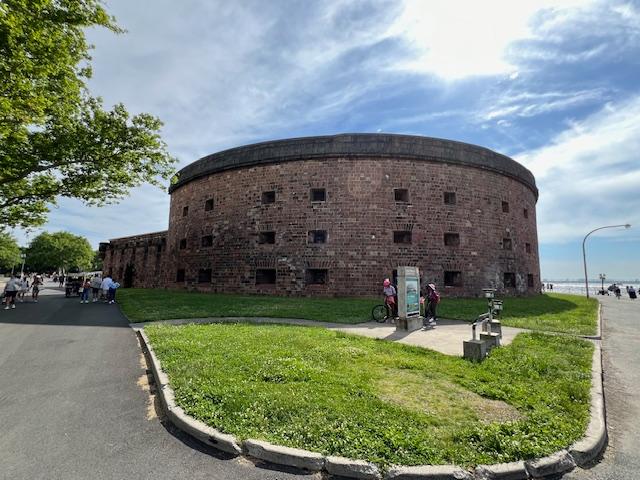
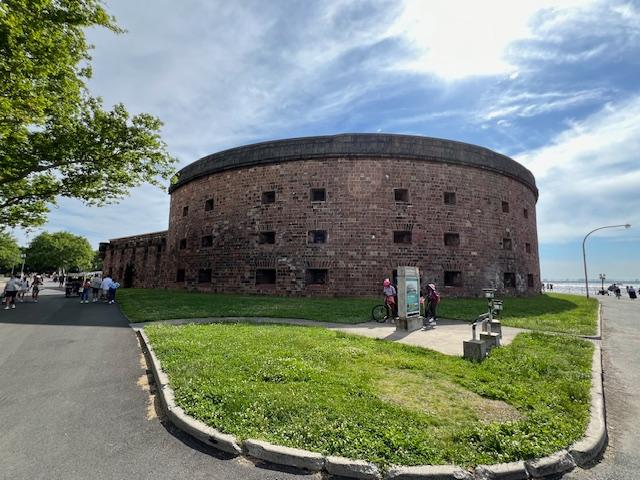
Castle Williams Fort as you enter from the main walkway

I have toured Castle Williams several times when visiting Governors Island over the last two years. The fort sits at a strategic site on the island facing Manhattan. The fort was originally built to protect New York City from the British during the War of 1812. The British knowing that the City had been fortified for battle never attacked New York.

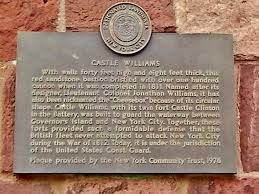
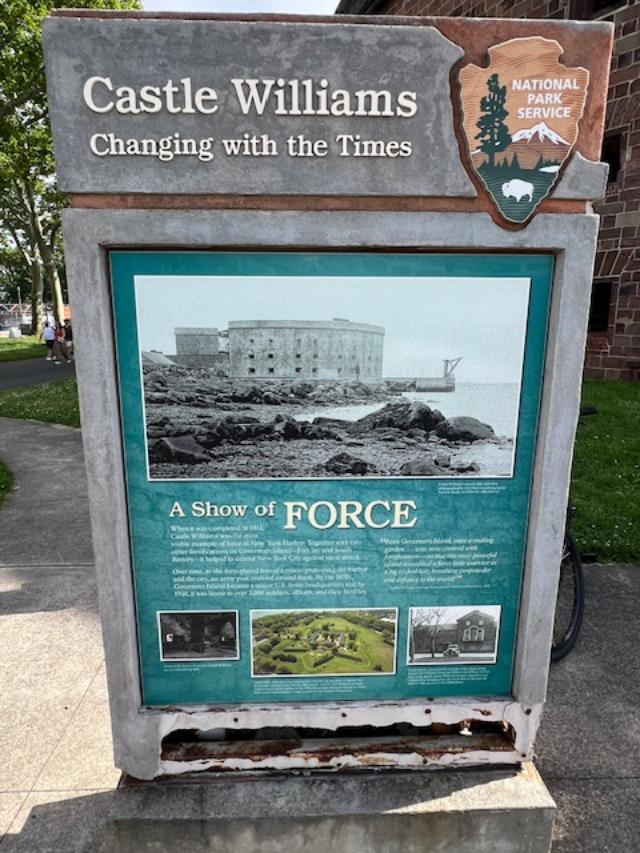
The historic plaque

The tour takes place twice a day for about an hour and you tour the first two levels of the fort. There are all sorts of signs around to show the history of the fort and its uses over the years. The one thing they don’t like is you touching the walls as the fort is still pretty fragile.

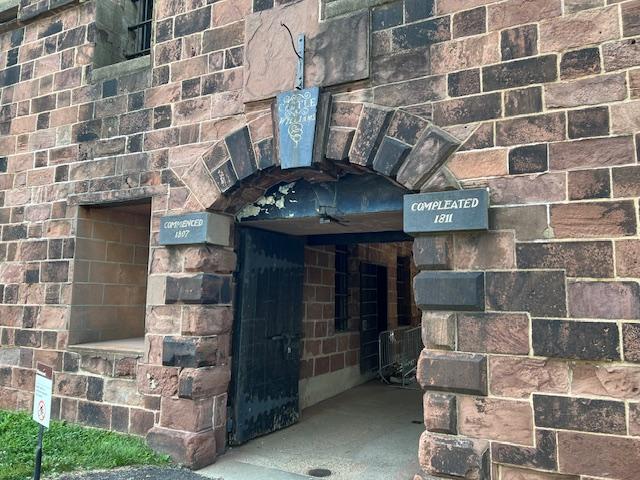
The entrance to this historic fort.

The nicest part of the tour is the observation deck at the top of the fort and the views of the Lower Manhattan skyline. It is a spectacular view of the harbor. You can see by the view why the fort was built where it was built and for its purpose before the War of 1812.

The sign welcoming you to the fort.

It really is a treat to see how fortifications mattered for cities in this time of history in this country.

The History of Castle Williams:

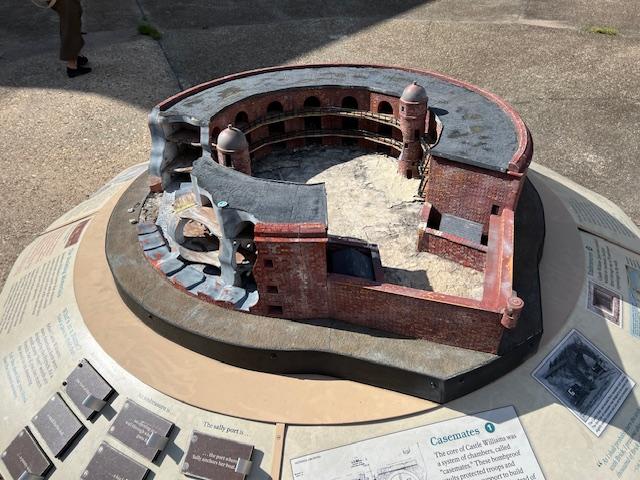
The model of Castle Williams inside the fort.

Castle Williams is a circular defensive work of red sandstone on the west point of Governors Island in New York Harbor. It was designed and erected between 1807 and 1811. It was designed by the Chief Engineer of the U.S. Army Corps of Engineers, Lieutenant Colonial Jonathan Williams for whom the fort was named after. It was considered a prototype for new forms of coastal fortification.

The fort from the outside

The castle was one component of a larger defensive system for the inner harbor that included Fort Jay and the South Battery on Governors Island, Castle Clinton at the tip of Manhattan, Fort Gibson at Ellis Island and Fort Wood, which is now the base of the Statue of Liberty on Liberty Island. This system of forts came to be known as the Second American System of coastal defense and existed to protect harbors like the one in New York from British interference with American Shipping.

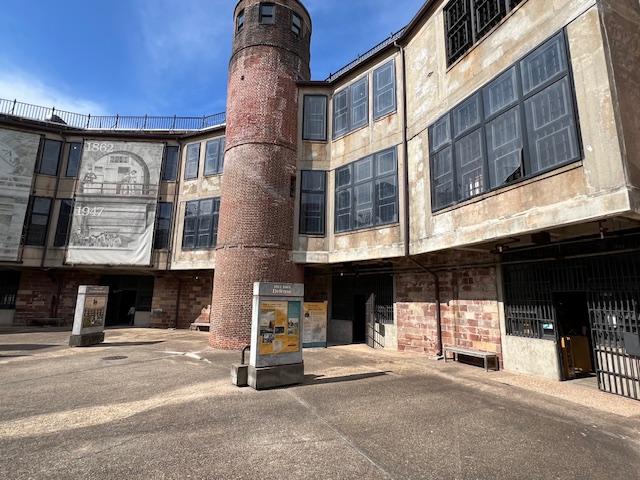
The inside courtyard of the fort.

Its usefulness as a fort began to end in the 1830’s, so Castle Williams subsequently served as barracks for the island’s garrison and new and transient troops. The castle was then remodeled by the U.S. Army for use as a prison in various forms during the Civil War and through the first half of the 20th Century.

In 1901, Secretary of War Elihu Root, who worked hard to modernize the Army, made a commitment to preserve the castle and overruled army leaders who wanted to demolish both it and Fort Jay. By 1903, the castle was fitted up as a model, state of art prison facility. In 1947, extensive renovations were carried out with the wooden catwalks replaced by concrete enclosed walk ways, hiding the beautiful stone arches on the third level and resulting in the industrial appearance of the courtyard today. Castle Williams ceased operations as a military prison in 1965 just before the U.S. Army left Governors Island.

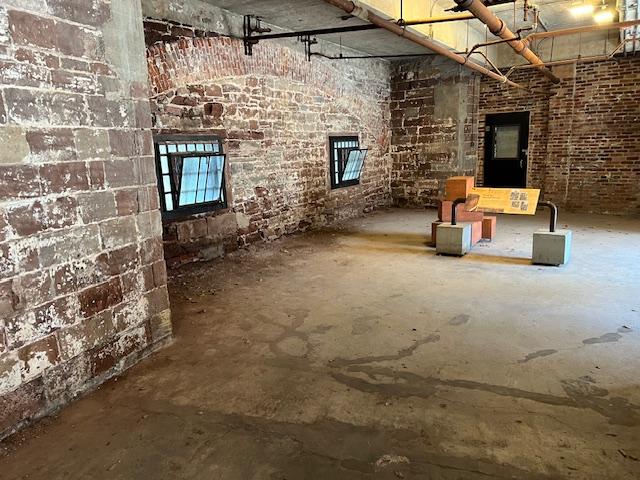
The inside of the prison cell.

The Castle again faced a demolition challenge as Coast Guard officials in Washington DC, who took control of Governors Island in 1966, wanted to demolish it. Instead, the castle was remodeled as a youth community center with a nursery, meeting rooms for Scouts and clubs, a woodworking shop, art studios, a photography laboratory and a museum. By the late 1970’s, the community center moved to another location and the fort became the grounds-keeping shop for the Coast Guard base.

Over time, the roof failed and broken windows allowed serious water damage to occur inside the castle. In the mid-1990s, the roof was replaced and new windows stopped further water damage to the structure but the interior remains closed until it can be made safe for public access. The National Park Service proposes to stabilize and restore the castle and eventually provide access to the roof, allowing the public to admire the harbor and the modern skyline of the great city (this has since opened on my last visit).

The view from the top of the hill on Governor’s Island.

Castle Williams was individually listed in the National Register of Historic Placed on July 31, 1972. It was recorded by the Historical American Buildings Survey in 1983. It was designated a National Historic Landmark in 1985 and the New York City Landmarks Historic District in 1996. It has been part of the Governors Island National Monument by Presidential Proclamations signed in 2001 and 2003.

(This information was provided by the National Park System Division of Cultural Affairs).

The lawn of Governor’s Island overlooking Lower Manhattan.

Sara Delano Roosevelt Memorial House             47-49 East 65th Street                                        New York, NY 10065

Sara Delano Roosevelt Memorial House 47-49 East 65th Street New York, NY 10065

Sara Delano Roosevelt Memorial House

47-49 East 65th Street

New York, NY  10065

(212) 650-3174

Roosevelt House History

Sara Delano Roosevelt Library

Open: To Groups on Fridays and Saturdays and to individuals on Saturdays 10:00am/12:00pm/2:00pm

Fee: Free to Individuals/Donations welcome-Groups tours are $100.00 for up to five people with an additional $15.00 fee per person. There is also an administration fee of $25.00 for groups over 20 people.

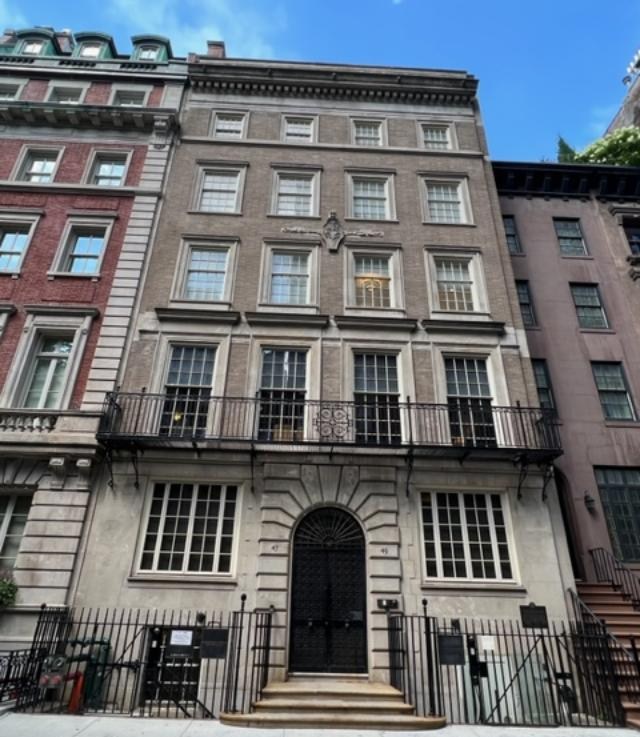
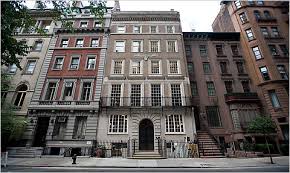
The Sara Delano Roosevelt Home at 47-49 East 65th Street

It is amazing what you discover when you are walking around the Upper East Side of Manhattan. I was exploring the Streets of the Upper East Side for my blog, ‘MywalkinManhattan’ and when walking around the Hunter College Campus came across the Sara Delano Roosevelt Memorial House at 47-49 East 65th Street.

This beautiful brownstone was built as a wedding present to Franklin Delano Roosevelt and his wife, Eleanor and their future family by his mother Sara Delano Roosevelt. It was their New York City residence until they moved to the White House. His mother continued to use the house until her death in 1941 when the home was sold to Hunter College.

Tours are available when the building is open (Hunter College is currently closed) and you can tour the whole house. The home was listed on the National Register of Historic Places in 1980.

History of the Sara Delano Roosevelt Memorial House:

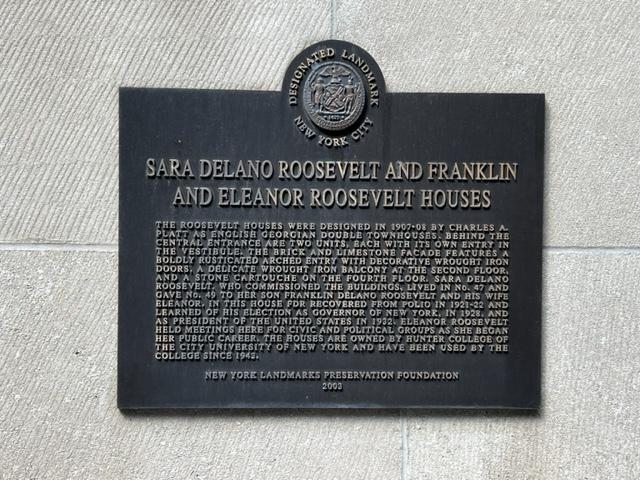
The Neo-Georgian townhouse was designed by architect Charles A. Platt for Sara Ann Delano Roosevelt in 1907. It originally held “two mirror-image residences with a single facade and entrance. Each floor had its own front reception room with a welcoming fireplace. Rear parlous could be combined through sliding doors

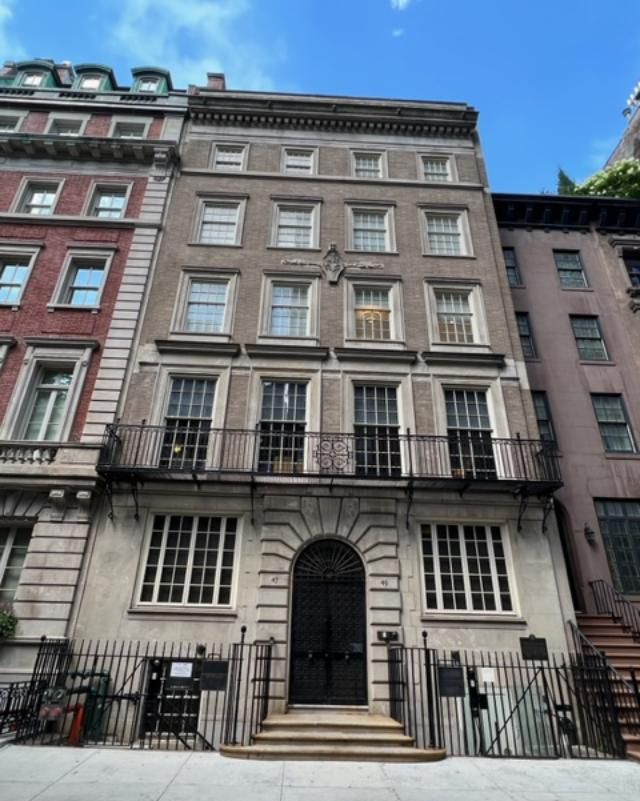
The mansion at 47-49 East 65th Street on the Upper East Side

The house was given to the Roosevelt’s by Franklin’s mother as a wedding gift for them. The house originally two homes and Franklin’s mother had doors put in place so she could enter their part of the home whenever she wanted. The house was used by Sara Ann Delano Roosevelt from its completion in 1908 to her death in 1941 and intermittently by the Roosevelts until the sale to Hunter College in 1943.

The house historical marker

After his mother’s death in 1941, President Roosevelt and his wife placed the house up for sale and a non-profit consortium was organized to purchase the house on behalf of Hunter College.

Sara Delano Roosevelt House IV

The Extended Roosevelt family

The house was closed in 1992 and reopened in 2010 after an $18 million renovation. Leslie E Robertson Associates was the structural engineers on this renovation. The building is currently used by Hunter College as the Roosevelt House Public Policy Institute at Hunter College or just known as the Roosevelt House.

Sara Delano Roosevelt House

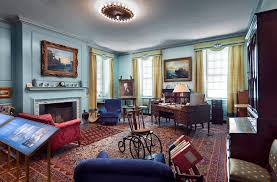
The inside of the house’s museum

(Disclaimer: This information was from Wiki and I give them full credit for the History of the Roosevelt House).

Video’s Related to the House on YouTube:

Visiting the Roosevelt House:

The History of the House:

High School of Art & Design-John B. Kenny Gallery                                                                   245 East 54th Street                                           New York, NY 10022

High School of Art & Design-John B. Kenny Gallery 245 East 54th Street New York, NY 10022

High School of Art & Design-John B. Kenny Gallery

245 East 54th  Street

New York, NY  10022

(212) 752-4340

http://www.artanddesignhs.org/

https://insideschools.org/school/02M630

https://en.wikipedia.org/wiki/High_School_of_Art_and_Design

Open: Seasonal when school is open and only at certain times of the year

Fee: Free-check in with the security guard

 The High School of Art & Design at 245 East 54th Street

I passed the High School of Art & Design when I was touring the Turtle Bay neighborhood in Manhattan for my blog, MywalkinManhattan.com. The school was open during the Spring Break and some of the kids were in the school were taking classes. The security guard let me walk around and then he asked me would I like the see the art gallery. I said sure and I was able to explore the John B. Kenny Gallery.

John B. Kenny was Ceramist and an administrator who saved the school and created the school with three other artists in 1936. He founded the school with artists Henry Cordes, Mildred Harston and Jerod Magon.

High School of Art & Design V

The School History:

https://www.biblio.com/the-complete-book-of-pottery-by-kenny-john-b/work/59670

https://muse.jhu.edu/article/598110/pdf


The School Mission Statement:

The Mission of the High School of Art & Design is to inspire, educate and fully prepare our gifted students to become exceptional artists. Through a unified curriculum that incorporates a broad spectrum of disciplines integrating art, technology and academics, our students are prepared to go on to college and careers with industry-standard mastery in the major of their choice.

With a commitment to promoting strong ethical values and professional demeanor, we strive to foster a sense of community among our students, staff and parents. We are dedicated to engendering student’s productive, creative and innovative participation in the world of visual arts as concerned and caring citizens of the global community (School Mission Statement).

John B. Kenny artist

John B. Kenny artist

https://www.goodreads.com/author/show/242318.John_B_Kenny

The Gallery is full with Alumni and student art and it revolves at various times of the year. It is a nice size gallery full of interesting art. There was a combination of sculpture, painting and paper sculpture in the gallery.

High School of Art and Design Gallery Show

The John B. Kenny Gallery is very interesting

I was only able to spend a short time in the gallery but it is a hidden gem tucked in the side of the main entrance and just talk to the security guards at the front of the school and they will let you tour on your own.

Check it out when the school reopens in the Fall.