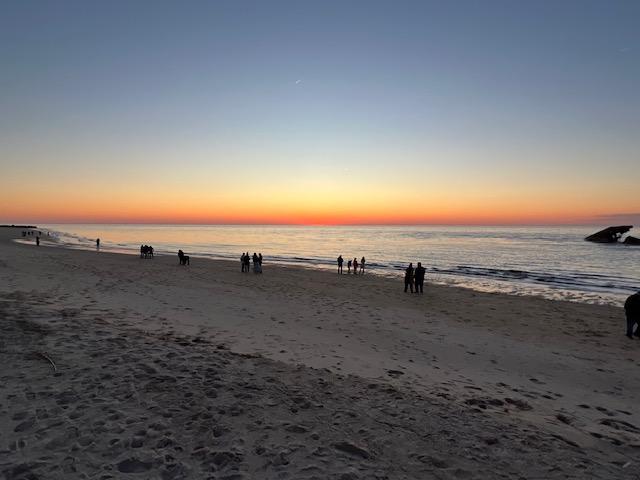
Sunset Beach in all its glory in the summer of 2023.
Sunset Beach is a marvelous place to visit for sunset
Sunset Beach in Cape May, NJ is one of the most beautiful beaches in American and is ranked 24# on TripAdvisor as one of the breathtaking beaches to visit. The beach site in Lower Township in Cape May and is at the very end of Sunset Boulevard which is a direct run from downtown Cape May.
One both sides of the parking lot, there are gift shops and a small café grill. These have limited hours after Labor Day Weekend. The grill is closed after the holiday weekend but sometimes stays open depending on the weather after the Labor Day weekend.
The beach is amazing as you can see the pleasure boats in the distance coming in and out of the small harbor just north of the beach.
The Sunset Beach is really beautiful in the off season when not a lot of people are there
The Start of the Sunset in December 2022
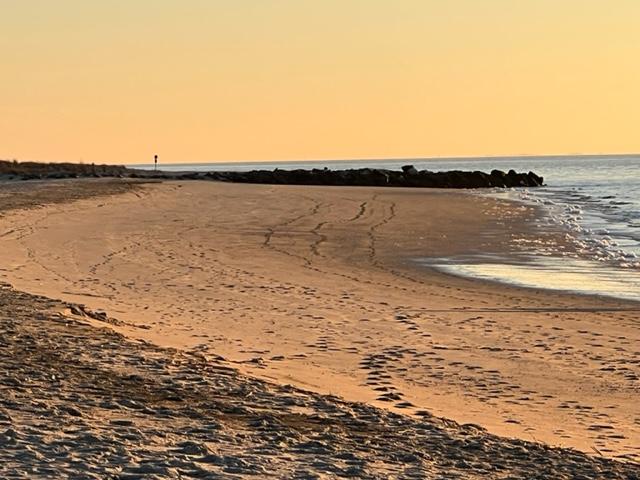
Looking out into Delaware Bay is quite spectacular with its moving waves and the way it glitters in the sun. In the warmer months, it is just nice to walk along the shore and watch the birds. In the winter months, the breezes get to be too much and a short visit is nicer.
The beginning of the sunset
Any time of the year though, make sure to be here for sunset and that is when the beach works it beautiful natural magic.
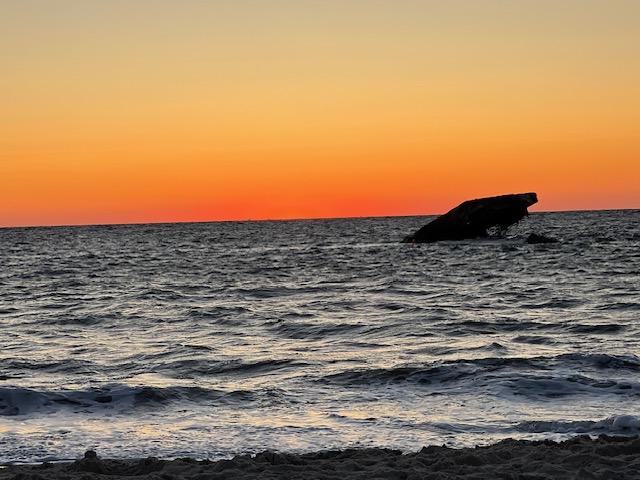
The setting of the sun
The sun disappearing in the horizon
The sun disappearing
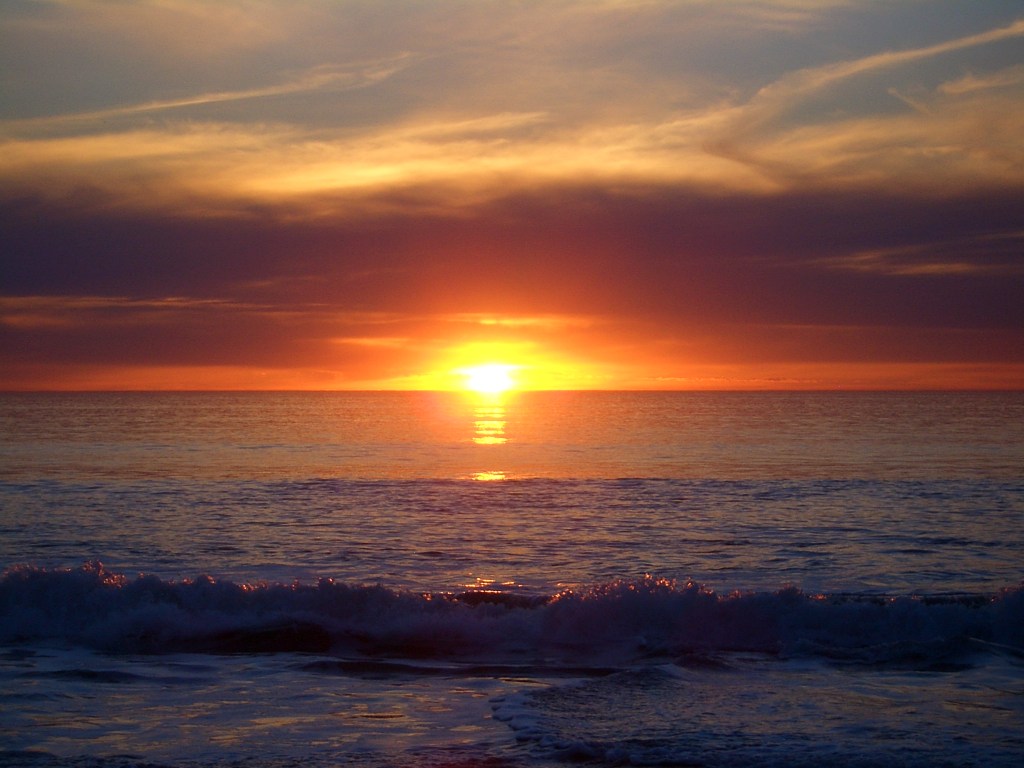
At sunset you will see an array of colors with the sun setting in the distance. The last time I visited the beach in September, it was a combination of oranges, purples and blues as the sun set. The lower the sun the more brilliant the colors. They become more complex as the sun gets lower.
The final sunset
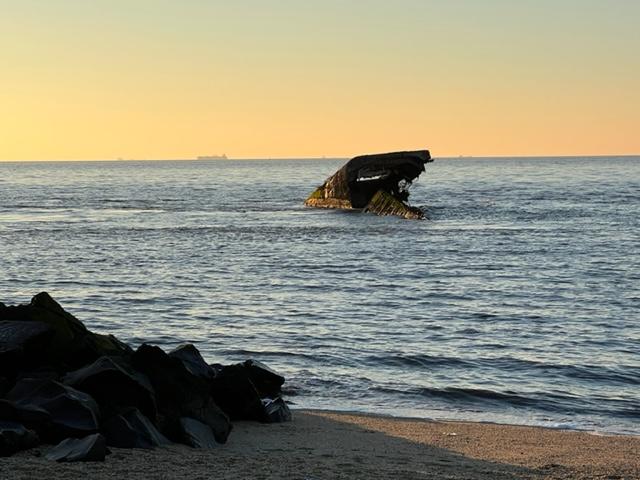
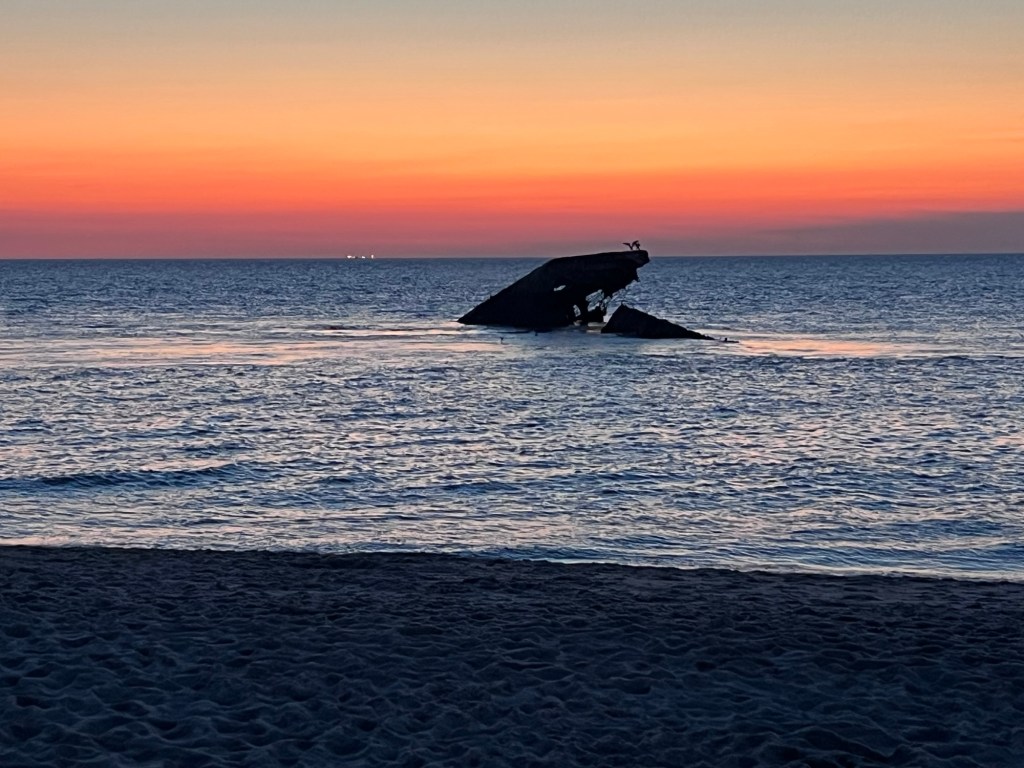
The best part of the view is that it is played out on the large stage. It covers the whole sky and it looks like the sun is going to sleep in the bay. You can almost touch it. Each night when the sun sets its a different color in the rainbow in the sky. The backdrop of the small stone formations and the SS Atlantus Concrete Ship make it more dramatic.
SS Atlantus Concrete Ship
Whenever you are in Cape May, try to finish your dinner early and then watch Mother Nature work her magic by the shoreline. It is an experience that should not be missed. Please try to arrive about an hour before sunset to get a space in the parking lot.
It is the most spectacular site at anytime of the year.
The SS Atlantus Concrete Ship:
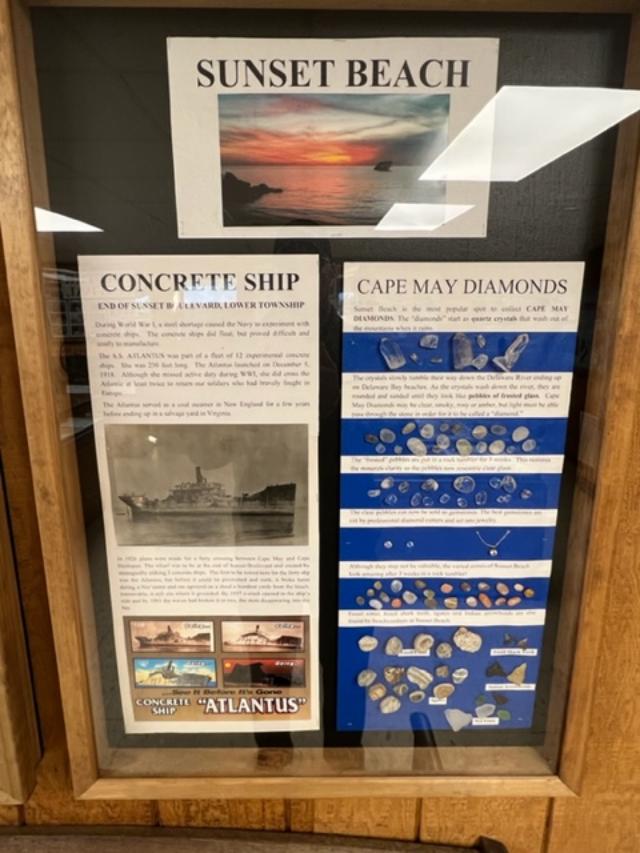
The SS Atlantus Concrete Ship was built and launched in 1918, just after World War I had ended as a trans-Atlantic steamer to return troops from Europe to home. After being decommissioned in 1926, she was purchased along with two other ships to create a ferry dock for ferries from Cape May to Delaware. The plans were later shelved as she ran aground in a storm along Sunset Beach and could not be freed.
Flag Lowering Ceremony:
The Evening Flag Ceremony held every night at sunset between Memorial Day and Labor Day. The lowering of the American flag at sunset is a 40-year-old tradition. All of the flags that are flown at the flag ceremony are veteran’s caskets flags that families being with them from their loved one’s funeral. The ceremony includes the Pledge of Allegiance, the ‘Stat-Spangled Banner’ and a recording of Kate Smith’s ‘God Bless America”.
The beautiful summer sunset in 2023.
Cape May Diamonds:
While taking a stroll along the beach, look out for Cape May ‘Diamonds’. These are small pieces of quartz crystal found in the sand that are washed from the bay. You can find Cape May diamond jewelry in the gift stores at the beach.
(NJ Leisure Guide)
Sunset Beach during the day
Visiting again in 2025:
When I came in the Summer of 2025, for the Firemen’s Convention, that Saturday evening I came on the most spectacular sunny evening and the beach was packed.
Sunset Beach in the summer of 2025
I loved the sailboat in the distance
The beach was crowded with people
Then the sun started to set and the magic began. It was such a clear night it was perfect to see the sun set with no cloud interference.
The setting of the sun at 7:00pm
People getting the birds-eye view of the setting sun
While I was at Sunset Beach, I took a series of videos when the sun was setting to share with all the readers. You really must visit Sunset Beach to experience the beauty and the gracefulness of Mother Nature at her best. Until then, I hope everyone enjoys these videos of the setting of the sun in Delaware Bay.
The pictures and videos of the setting of the sun at Sunset Beach:
A video of the beauty of the beginning of the sunset
The sun in the horizon
A video of the sun setting
A video of the colors were brilliant that night
All the colors of three rainbow
The crowds that stared to thin out
Rainbow of cololr
The old snack shop here is now a fine dining restaurant
I saw this in the sand
This beach has some of the most beautiful sunsets in the world and I have seen a lot of them. Try not to miss seeing this when you visit Cape May.
Disclaimer: This information was taken from the NJ Leisure Guide and I give their writer full credit for it. The beach is open all year around but it is the best in the warmer months. Don’t miss this spectacular view at sunset.
I have visited the Ringwood Manor during the Christmas holidays over the last four years and it keeps getting better. Each room in the house is tastefully decorated for the holidays. The West Milford Garden Club does an excellent job decorating every year and in the post-COVID environment, it is nice to see such a beautiful and well thought out display for Christmas.
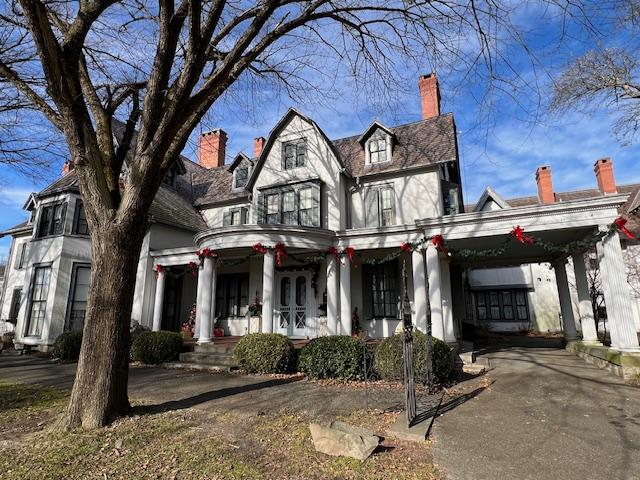
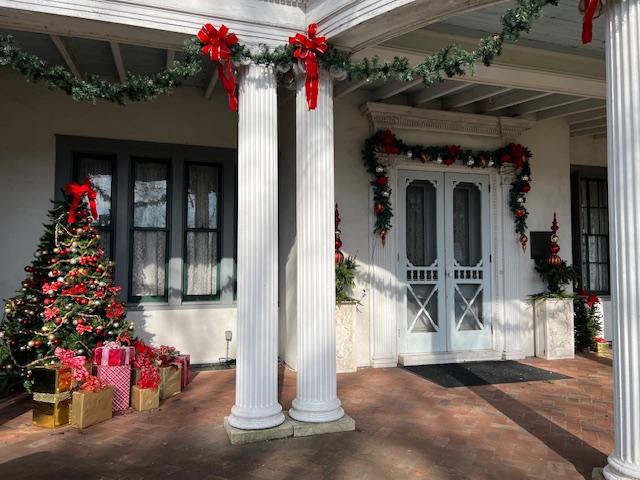
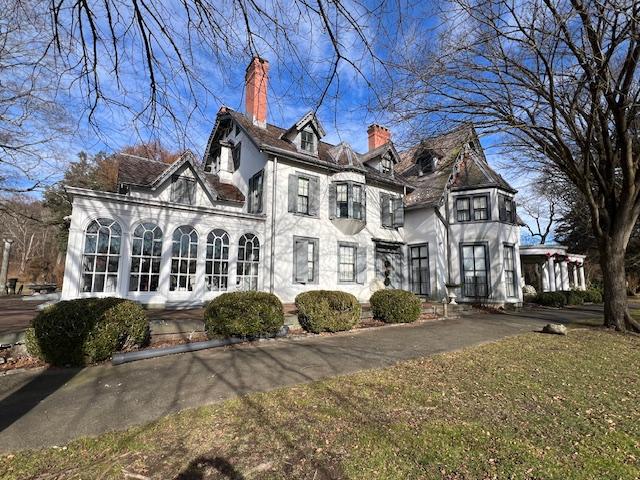
The outside of the house was decorated with garland and ribbons and welcomed visitors with Christmas cheer.
The entrance of Ringwood Manor.
The entrance to the estate.
The patio of Ringwood Manor.
The outside of the house was tastefully decorated in garland and bows.
The decorated front door on the Ryerson side of Ringwood Manor.
The decorated carriage house.
When you walk into the home, the first rooms is decorated tastefully around a collection of antique guns and hunting equipment. The Great Hall was decorated with garland and ornaments with a large tree in the corner.
The Great Hall of the Ringwood Manor when you enter for Christmas.
The Great Hall upon entering.
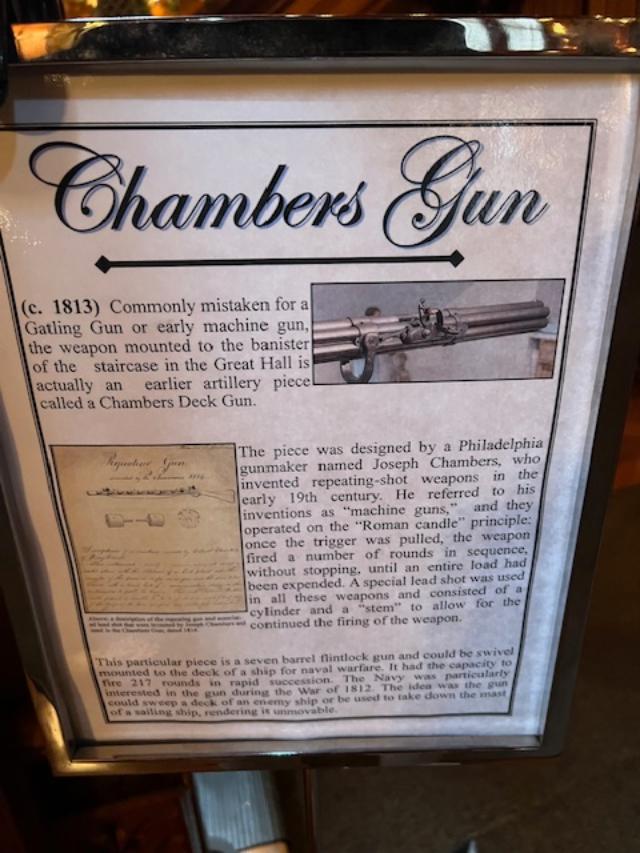
The Chamber Gun display.
The Chamber Gun display in the Great Hall of Ringwood Manor.
The Great Hall fireplace decorated for the holidays.
The formal dining room was set for Christmas dinner for the family after church. The elegant china was set on the table with poppers and small Christmas gifts for the guests. The side boards were set with the dinner entrees and sides for the family meal. There was a little discussion of how the Hewitt family would entertain during the holidays and in 2019 and in 2023, they opened up the kitchen and Butler’s pantry for touring.
The Hallway leading to the formal Dining Room.
The decorated staircase in the Great Hall
The Great Hall hallway
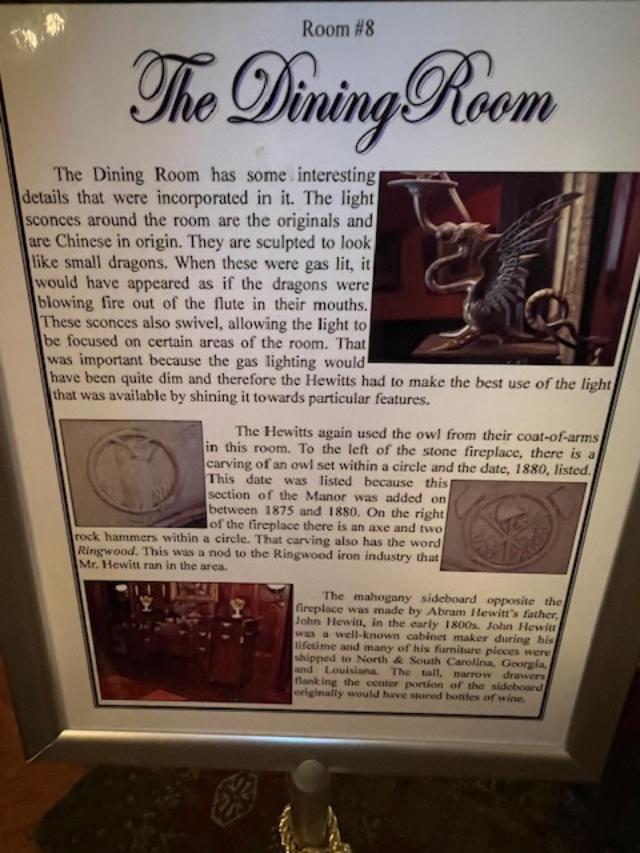
The Dining Room sign
The Dining Room at the Ringwood Manor.
The Dining Room set for Christmas dinner.
Dining Room set for Christmas dinner beautifully.
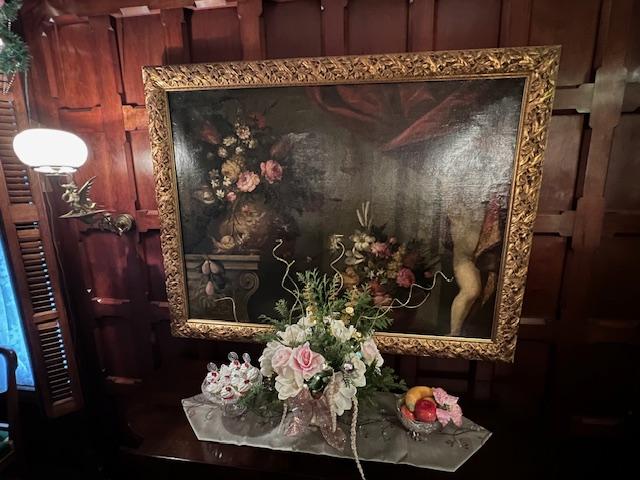
The details of the Dining Room
The Dining Room paintings and details.
Preparing for the holidays in the Dining Room
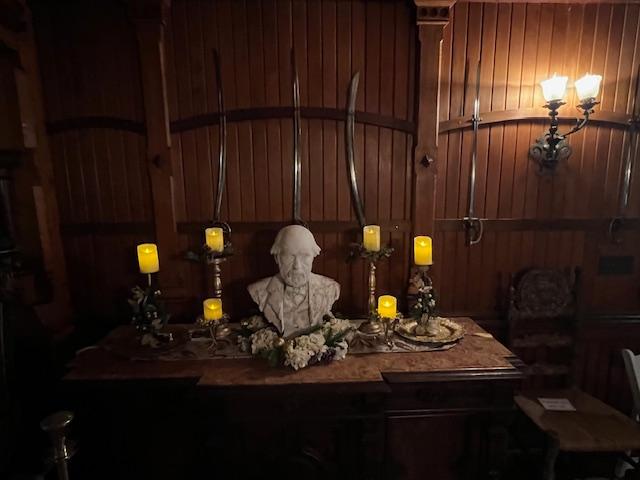
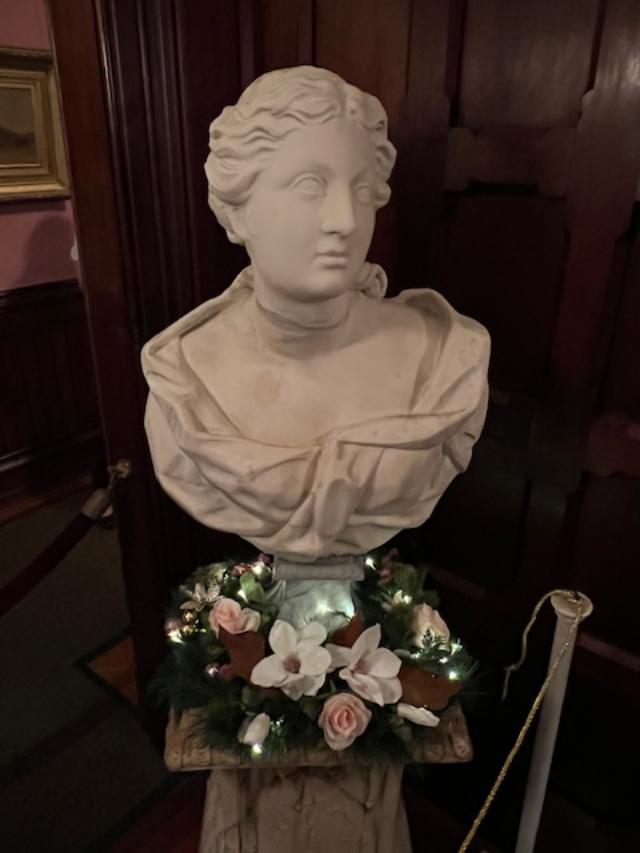
The statuary of the Dining Room
The lighting fixtures of the Dining Room.
Each room was set for the holidays with garlands, trees and decorations. As it was explained to me on another house tour during the holidays, the Victorians would normally only decorate one or two rooms for the holidays and not the whole house. The whole house might be decorated based on the wealth of the family and the amount of servants to take care of the home. Needles would have to cleaned up and the trees would have to be attended to on a daily basis.
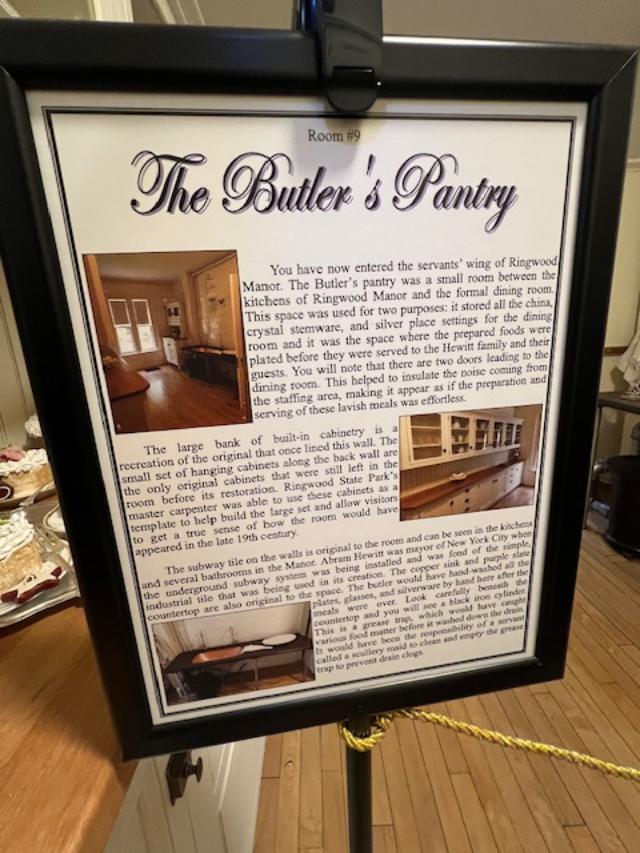
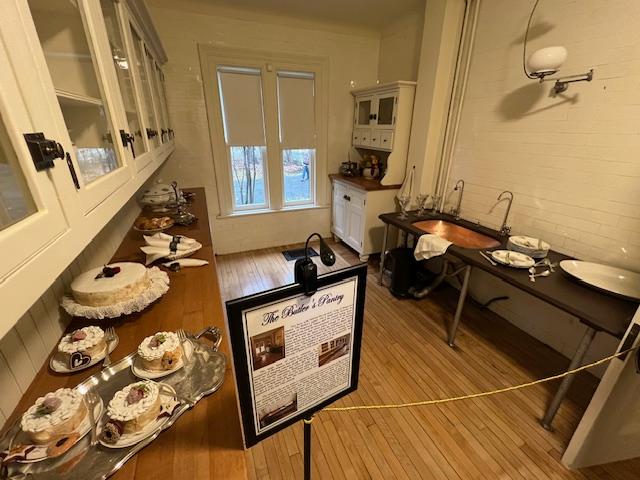
the Butler’s Pantry just off the Dining Room
The Butler’s Pantry in preparation for Christmas dinner
The Christmas treats in the Butler’s Pantry.
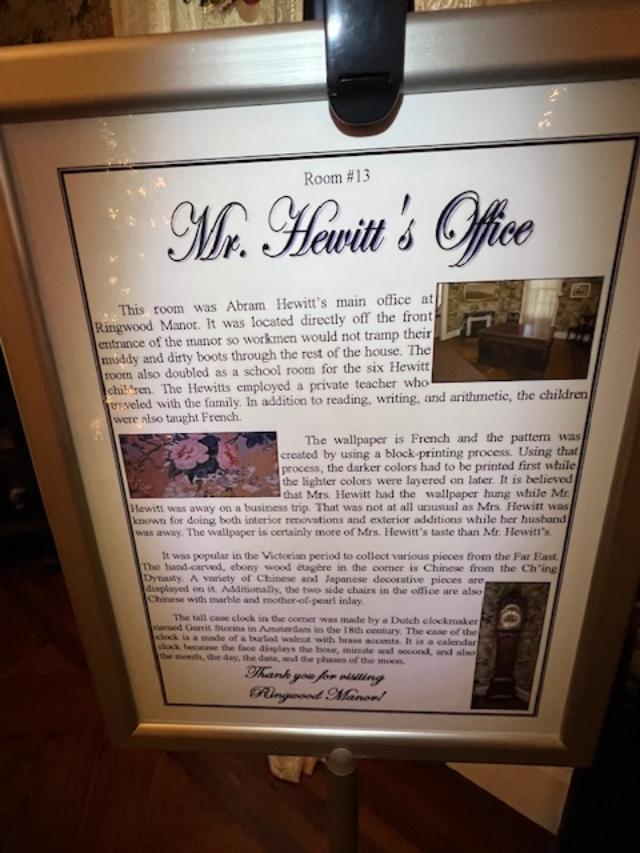
I then walked back through the house and passed by the Office on my way to the social rooms of the first floor. The office is where business was taken care by Mr. Hewitt when he was in residence.
Mr. Hewitt’s Office decorated for Christmas
Mr. Hewitt’s office at Christmas time.
The Christmas tree in Mr. Hewitt’s office.
Before I left this part of the house, I passed the Breakfast Room which is just off the Dining Room. It had beautifully decorated for a Christmas breakfast.
The Breakfast Room sign
The Breakfast Room was decorated with desserts and sweets for the Christmas holidays.
The Breakfast Room beautifully decorated for the holidays.
The Breakfast Room for a Christmas feast.
The Christmas tree in the Breakfast Room.
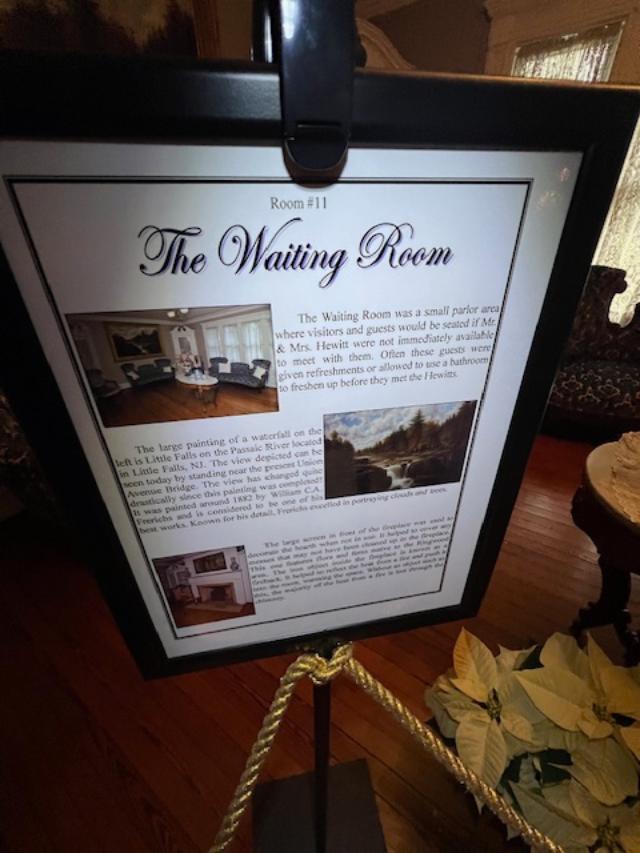
Before entering the Great Hall, I visited the Receiving Room, where guests waited until dinner was served.
The Waiting Room
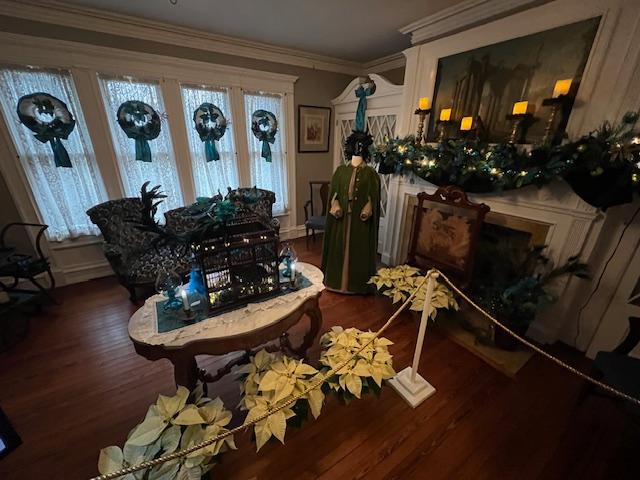
The Waiting Room was for guests to relax and wait for Mr. & Mrs. Hewitt.
The Waiting Room fireplace is nicely decorated.
The ‘Birdcage’ in the Waiting Room
Passing through the Great Hall again, I entered what had once been the original Ryerson House built in the early 1800’s. The first room on the tour of this side of the house was the French Drawing Room decked out for the holidays. This room was used by the ladies after dinner was over to converse and get away from their husbands, who would have still been in the dining room.
French Drawing Room, the “Withdrawing” room.
The French Drawing Room
The French Drawing Room in all its Christmas glory.
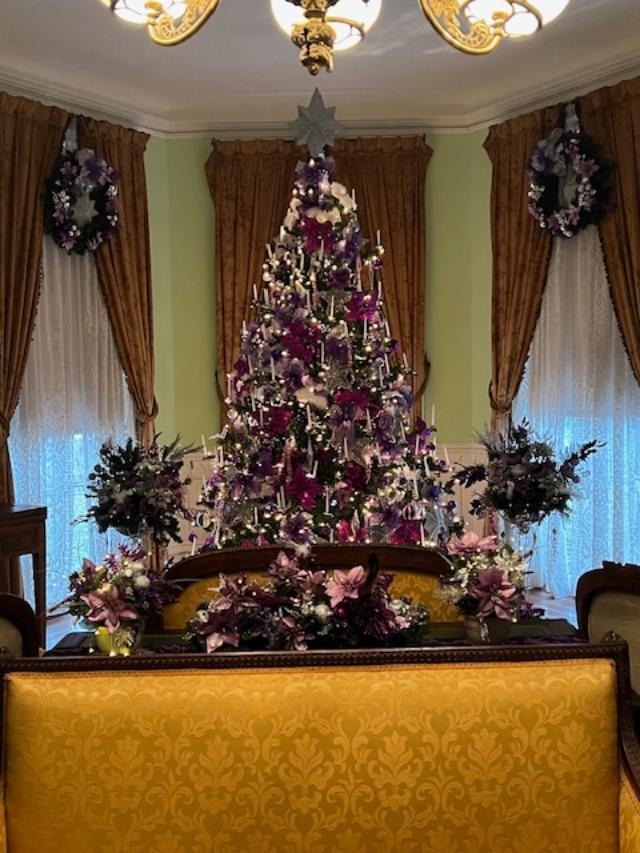
The Christmas tree in the French Drawing Room
The fireplace in the French Drawing Room.
On the other side of the house is the original Ryerson mansion that was added on by the Hewitt’s when they bought the house. The older house had the original moldings and windows from the early 1800’s and that side of the house had a different feel to it starting with the original entrance and staircase.
The Ryerson Staircase and foyer sign
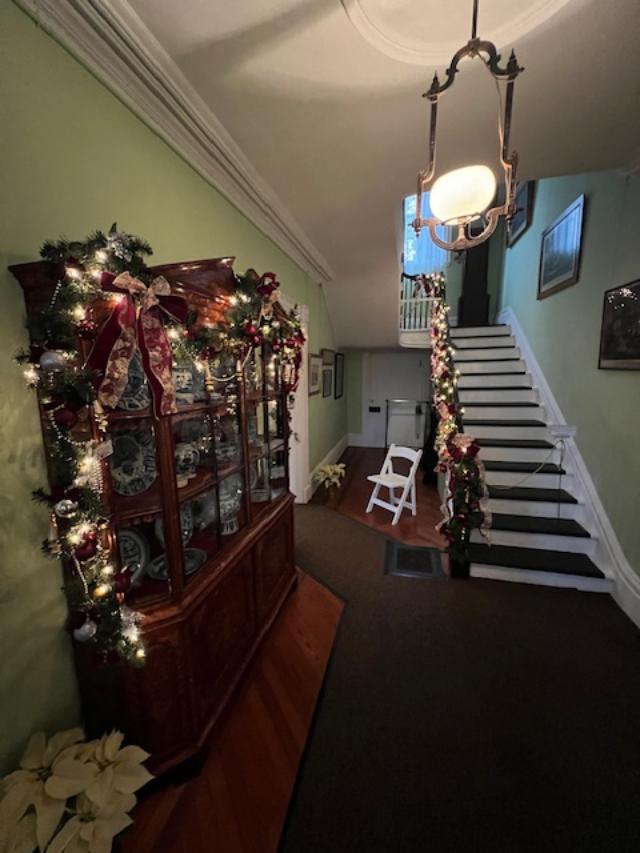
The Ryerson Staircase and foyer
The decorated Ryerson staircase.
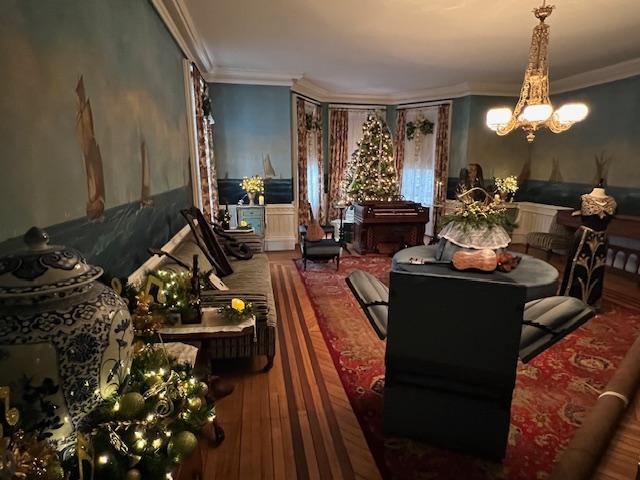
One of the nicest rooms that was decorated was the screened in porch. Here there was a tree set with presents, hot house flowers and garland lining the room. The sunlight shined throughout the room and the decorations sparkled.
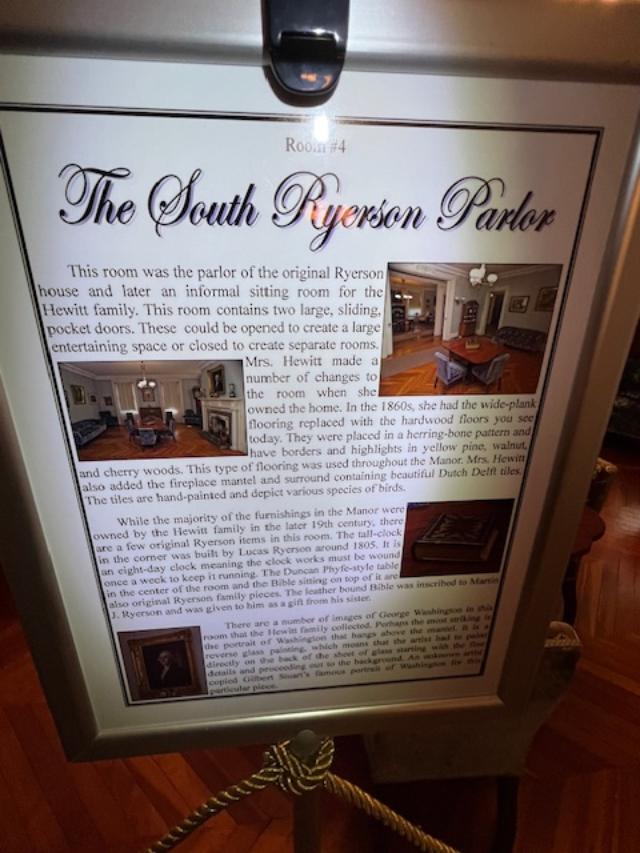
The South Ryerson Parlor
The South Ryerson South Parlor
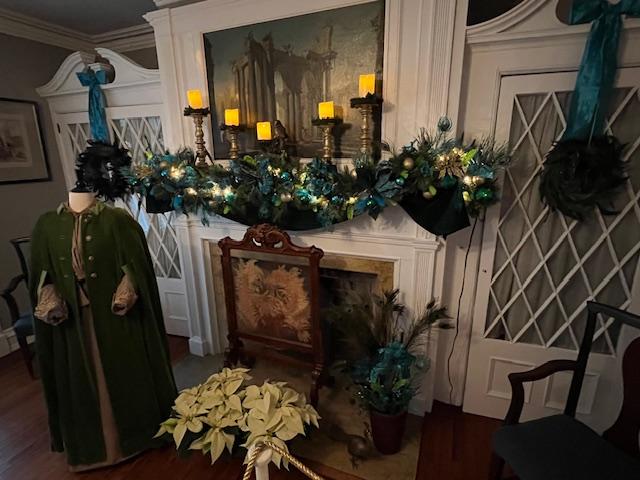
The fireplace in the South Parlor.
The latest addition to the house was the screened in porch, The Glass Piazza, of the house which was used in the summer months for rest and relaxation. The screen in porch was beautifully decorated for the holidays with all sorts of Christmas trees and decorations.
The Glass Piazza, the screened in porch of the main house.
The Glass Piazza decked out at Christmas time.
The doll mini tea service in the Glass Piazza.
The Glass Piazza set for tea at the holidays.
The Glass Piazza at Christmas time.
The beautiful Christmas tree in the Glass Piazza in 2023.
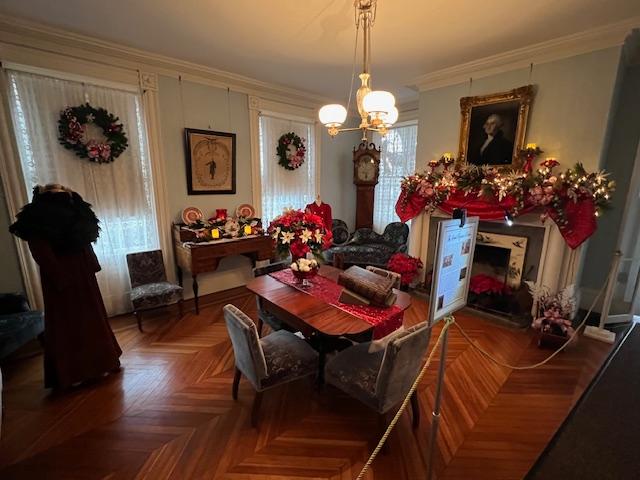
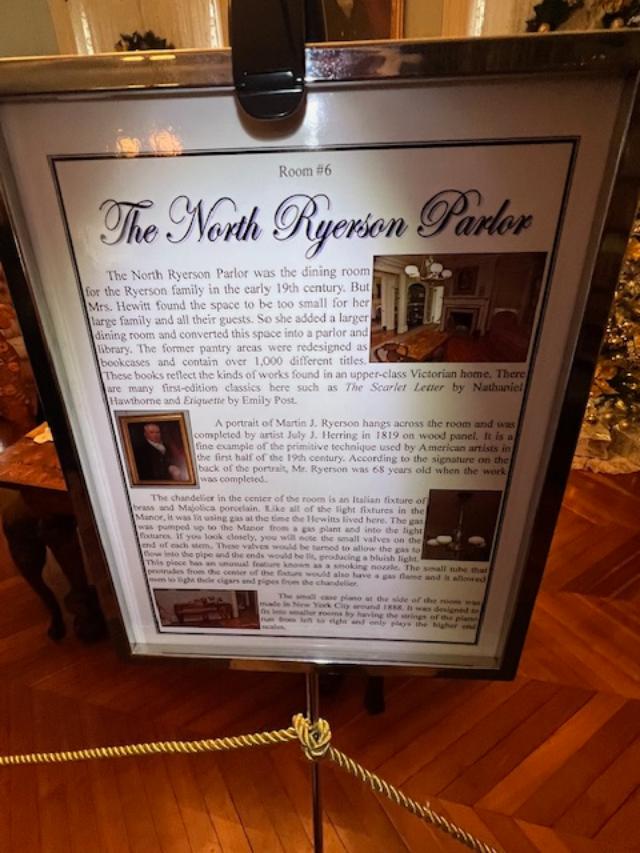
When you leave the Glass Piazza, you enter the original part of the house again with the North Ryerson Parlor. This room was used by the family for less formal affairs but it was still decked out of the holidays.
The North Ryerson Parlor
The Ryerson North Parlor decorated for tea.
The Ryerson North Parlor fireplace decorated for Christmas time.
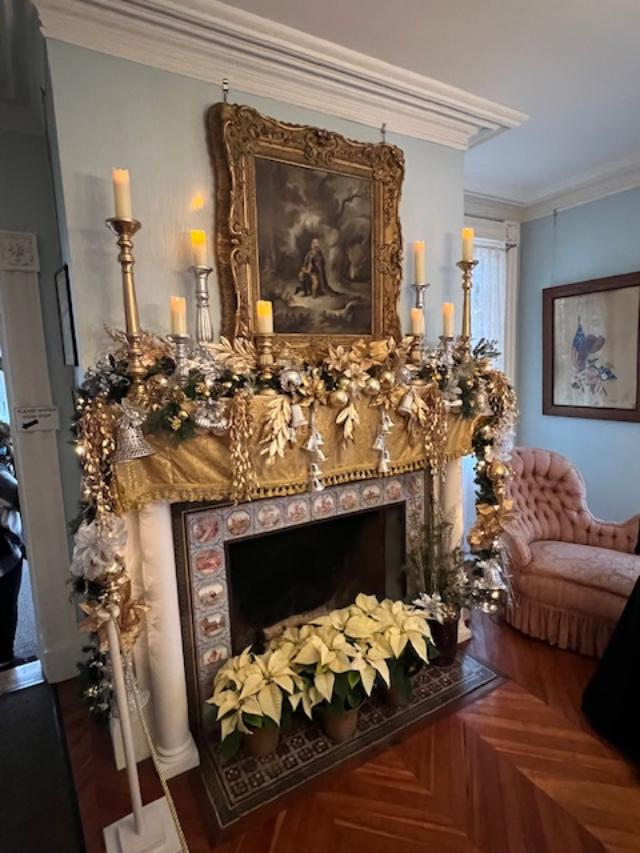
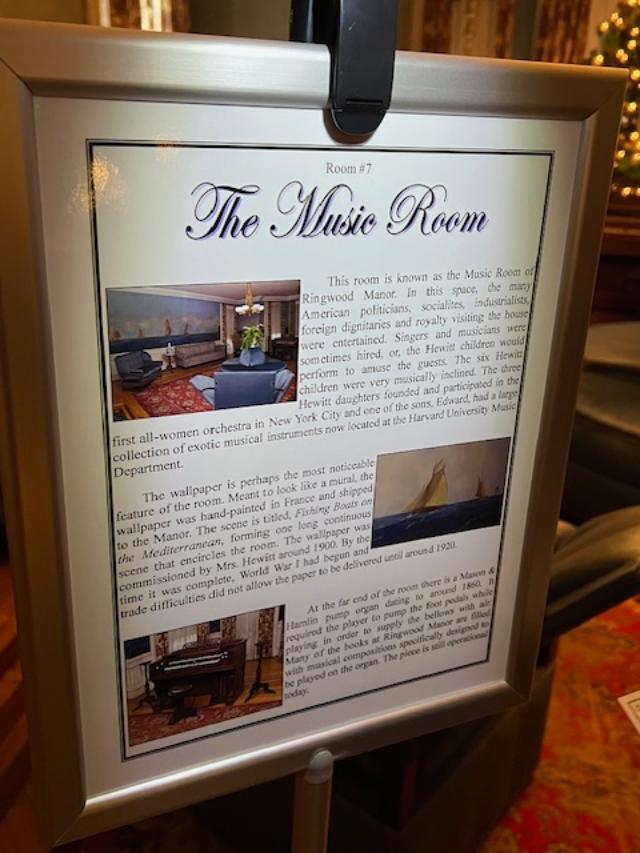
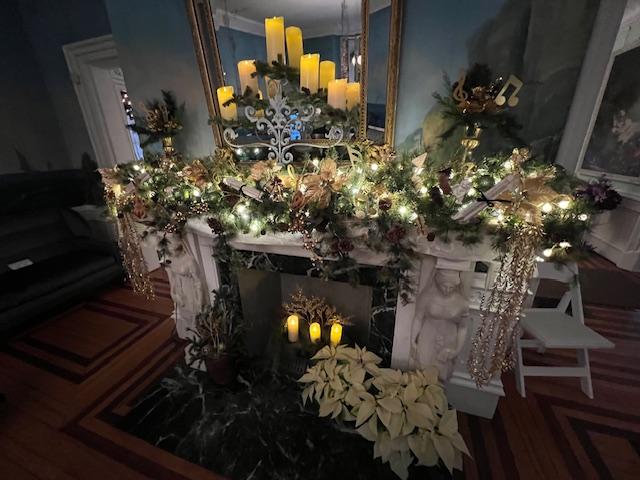
The last room I visited on the tour was the Music Room in the original Ryerson House. The room was used by both the Ryerson’s and the Hewitt’s for social occasions and the Hewitt’s were all musically inclined.
The Music Room at the Ringwood Manor
The Music Room at the Ringwood Manor.
The Music Room at the Ringwood Manor.
The fireplace in the Music Room decked out for the holidays.
The Music Room during Christmas time.
Each room had a docent to explain the decor or what the room’s use had been in the family’s time. A visitor can roam the house at their leisure and see the rooms as many times as they want. There is also a gift shop in a room off the formal dining room that contains some beautiful Christmas crafts for sale by the Women’s Club of New Milford. Some of these women are very creative and sell the most amazing Christmas ornaments made of glitter, wood, branches, walnuts and moss.
The Gift Shop in the old Carriage House was filled with homemade goodies and handmade crafts and ornaments.
The decor of the home changes over time and there are different things to see every year. The barn also on the property as you drive in has more artwork and crafts. In the Gardener’s Shed next to the house, the Society has a small cafe with sandwiches, desserts and coffee/tea/hot chocolate.
The Carriage House was used as a gift shop and a place to get something to eat.
The tour of Ringwood Manor is wonderful during the holiday season and the rest of the house opens up during the warmer months of the year.
History of the House:
This 582 acre historic site is open to the public year round. The historic house museum, Ringwood Manor is open Wednesday to Sundays year round.
History of 19th Century Manor House and Landscape:
The present manor house was begun by Martin J. Ryerson in 1807. He and his sons controlled not only the iron mines and forges on the property but also operated productions at four other locations in the area. The Ryerson family resided in their 10 room Federal style home for almost 50 years.
The entrance to the historical home.
In 1853, the Ryerson’s house and property were purchased by business partners Peter Cooper and his son in law Abram S. Hewitt. The 22,000 acre ironworks and the Ryerson’s home were purchased for a sum of $100,000. Their company, Cooper-Hewitt & Company, grew to be the fifth largest corporation in the United States. The Hewitt’s, one of the most influential and wealthiest families of the 19th century, fell in love with the Ringwood estate.
The expanded Ringwood Manor estate in the winter months.
Ringwood manor at the holidays.
They decided to make this site of their summer home, naming it The Forges and Manor of Ringwood. They enlarged the home of the Ryerson’s, constructing major additions or renovations in 1864, 1875, 1900 and 1910. The completed 51 room house is 226.5 feet long and features 28 bedrooms, 24 fireplaces and 13 bathrooms and more than 250 windows. The house was built in an eclectic style, typical of the Victorian period. In 1875, the Manor House was an excellent example of the Gothic Revival style of architecture. By 1900, the Hewitt’s changed the exterior facade to its present appearance, adding the neo-classical portico and columns of the front porch and affixing white stucco to the exterior walls. The furnishings of the house reflect the varying tastes and styles of the family and time period.
Ringwood Manor during the holidays.
The formal gardens surrounding the Manor House were developed by Mrs. Hewitt and her daughter, Eleanor around 1900. Their design was influenced by the Hewitt’s many trips overseas. The gardens possess a mysterious old world charm that captivates visitors as they enjoy the serenity of reflecting pools and the progression of blooms from early spring to late fall. Placed throughout the garden are French and Italian statuary and garden ornaments as well many interesting architectural items from New York City acquired while Abram Hewitt served as Mayor and Congressman. Examples of these features include columns from the old New York Life building, gates from the Astor family’s home and gate posts from Columbia College. Relics from the iron company that are found on the grounds include a trip hammer and anvil, cog wheel and a Dictator-class mortar the base of which was created by the Hewitt’s company and used at the Battle of Vicksburg in Mississippi during the Civil War.
History of Ringwood, NJ:
Colonial Ringwood:
Long before the Forges & Manor of Ringwood existed this property was occupied by the Native American people. Prehistoric artifacts found on the grounds confirm their inhabitants back to the Archaic and Woodlands periods. Living in a hunting and farming paradise, these Munsee-speaking Lenape peoples dwelled at the head of the Topompock or Ringwood River Valley. This paradise attracted colonial prospectors, who by 1740, came for the iron ore found in the ground. Recognizing the rich magnetite ores, Cornelius Board settled here in 1739 and first utilized the property for iron mining. He was followed shortly thereafter by the Ogden family who established the Ringwood Company and built the first blast furnace here in 1742.
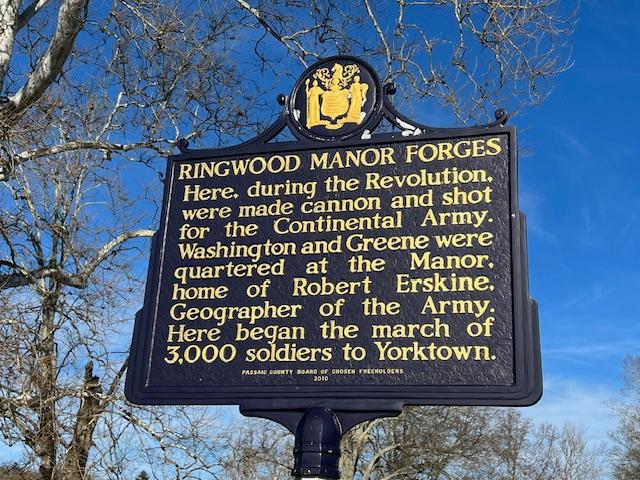
After twenty years of production, a German promoter, Peter Hasenclever, organized the American Iron Company to exploit the resources in colonial North America, purchasing the Ringwood area in 1764. He would also develop forges at Long Pond and Charlotteburg but made Ringwood the center of his iron empire. Hasenclever established iron plantations and developed the production of flax and timber across 50,00 acres of land stretching through New Jersey and New York, from present day Butler to New Foundland and Nova Scotia. The iron was said to have been “the best iron in the American colonies.” Robert Erskine, the last ironmaster of the American Iron Company, was sent from England in 1771 and would manage the company during the Revolutionary War.
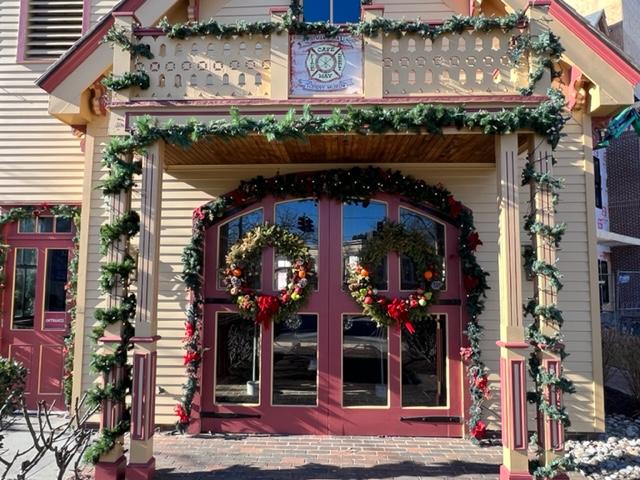
When I was in Cape May, NJ recently and came across the Cape May Fire Department Museum when walking around the town. It is interesting little museum that tells the history of the Cape May Fire Department.
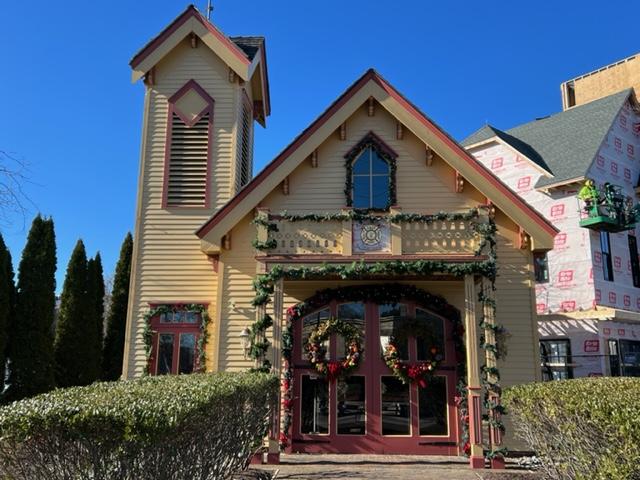
The museum decorated for Christmas 2022
The museum showcases the history Cape May Fire Department since its creation in the late 1880’s. There have been some serious fires over the years that have destroyed sections of the Cape May resort community.
Hotel fires displayed at the Cape May Fire Museum
Some of the resorts oldest and grandest hotels that were made of wood have been leveled by spectacular fires. The department has framed the articles around the building.
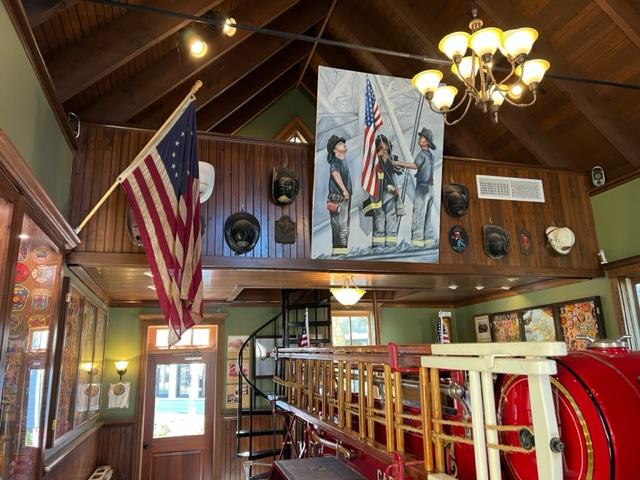
The inside of the Cape May Museum
There is also large collection of patches from fire departments all over the country, displays of equipment from all eras of firefighting and some displays that are dedicated to retired firemen from the department with their equipment.
Patches and Bunker gear
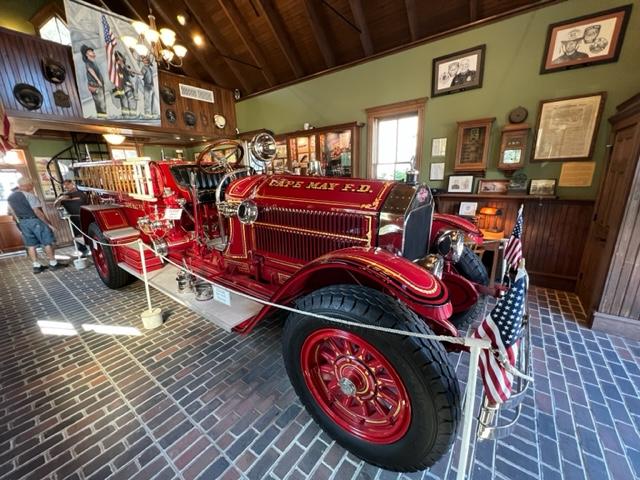
Some fascinating old fire equipment is on display as well. All of this is marked accordingly along the walls. In the middle of the museum there is an antique pumper to admire that has been fully restored. All the pieces of equipment are dated and described so that you can see the transition in fire fighting over the years.
The Chief’s desk
Cape May Fire Department News:
The museum is open and free to the public. Please come and enjoy the history of the City of Cape May Fire Department. Shirts can be purchased inside the Station. The career personnel on staff will be happy to assist you. The antique Fire Engine is a 1928 American La France and is house inside our museum.
The 9/11 exhibit at the Cape May Fire Museum
The back of the historic engine in the museum.
Disclaimer: I credit the Cape May Fire Department for this information, and I give them full credit on it. Please call the Department for hours of their museum.
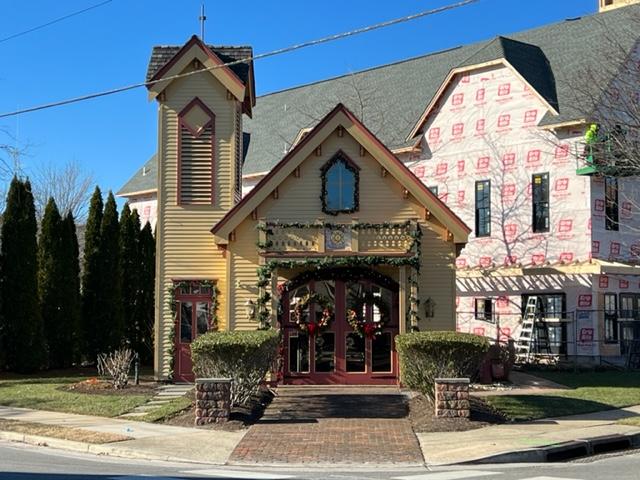
The Cape May Fire Museum in front of the new Firehouse in Cape May
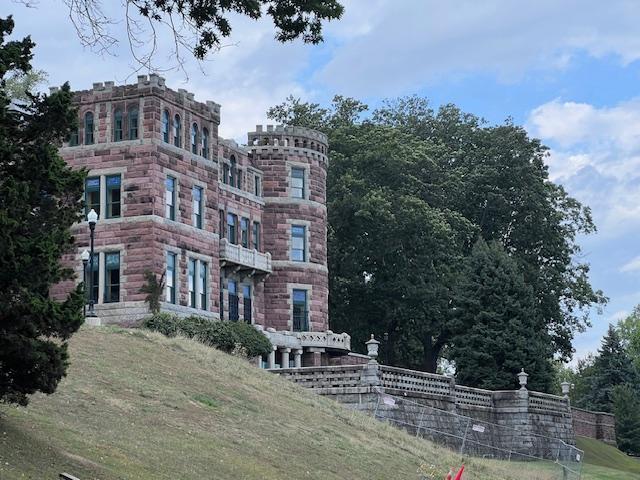
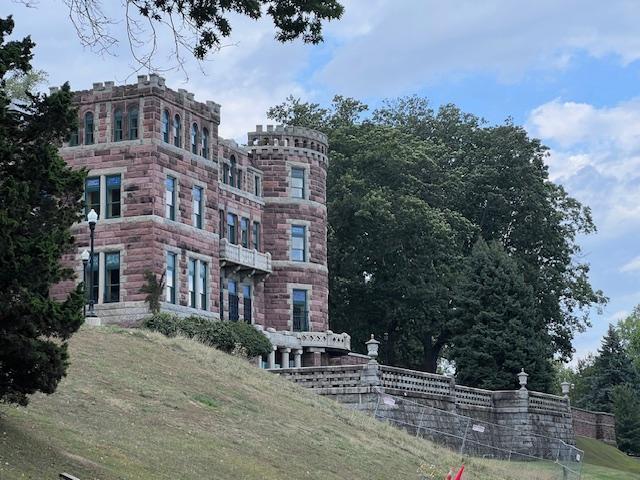
I have visited Lambert Castle a few times, most recently to see the Christmas decorations before they were taken down for the season. I found out from one of the director’s that they had not been put back up since their Holiday Bazaar back in November. I had seen them the year before and they had been very impressive.
Lambert Castle during the renovation in 2025
Right now the Castle is decorated for the Annual Christmas Craft Bazaar and it is just loaded with handmade crafts for the Christmas holidays. There are three floors of crafts and then on the third floor, there is a small restaurant to relax and look over the court of the house. After the bazaar in 2019, the Castle will close for a much needed five year renovation.
The Lambert Castle Christmas Bazaar 2019
I had a chance to visit the floors when they were not decorated for the holidays . The first floor is set up as if the family still lived there with the Billiards Room, Dining Room, Sitting Room, Music Room and Atrium still set as the family resided there. There is period furniture and decorations in all the first floor rooms to give a feel of what it must have been like to live there at that period.
The view of Lambert Castle from the second floor
The second floor galleries hold the collection of the Passaic County Historical Society with all sorts of objects, signs and historical items from all eras of the collection. You are able to see the footprint of the living quarters of the family.
The stained glass windows
The third floor at the time I was there was dedicated to the work of an Italian stone worker and artist who migrated and lived and worked in Paterson.
It is a very interesting way to see life at the turn of the last century in Paterson and the home offers a beautiful view of the City of Paterson and New York in the distance. I have never seen the grounds in the Spring but I am sure that they are quite lovely.
The view alone is worth the visit.
Don’t miss this virtual tour of the Castle and await until the renovations are done to visit again.
Bergecco-Parc Consulting Inc. commercial on Lambert Castle in 2019.
Bergecco-Parc Consulting Inc. Project: “Take me back to Paterson, NJ”.
Catholina Lambert was born in 1834 in Goose Eye, England. In 1851 at the young age of 17, Lambert left home to seek his fortune in the “Land of Opportunity” that was America. After several successful ventures in the silk industry, Lambert decided to build a home that would be reminiscent of the castles he recalled from his boyhood in England. In 1892, he built his own castle on Garret Mountain in Paterson, NJ, then known as the “Silk, City of the New World.”
Catholina Lambert
Lambert’s home was built to showcase his elaborate art collection of fine European and American paintings and sculpture. At one time, his collection was so vast that it was considered to be “the nucleus of an American Louvre.” In 1913, Lambert fell into debt and his fortune started to dwindle. As a result, he was forced to mortgage the Castle and eventually sell much of his art collection. The proceeds allowed him to live comfortably in the Castle until his death at age 89 in 1923.
After Lambert’s death, his son, Walter sold the Castle to the City of Paterson, which later sold it to the County of Passaic. Today the Castle is still owned by the County and serves as the headquarters of the Passaic County Historical Society. The Society, a private not for profit organization, owns the historical artifacts and works of art.
Catholina Lambert and Company
The home and the museum, exist as a reminder of a bygone era and as a tribute to the great accomplishment of the Castle’s creator. Although most of the furnishings today are not original to the Lambert’s home, they represent period furnishings that would have been found in the Castle during the Lambert era.
For more information about the rooms and decor, visit The Lambert Castle Blog at:
The Passaic County Historical Society is a private non-profit educational organization founded in 1926 and dedicated to cultivation of interest in the history and culture of Passaic County and former home of silk magnate Catholina Lambert was built in 1892. The Castle is owned by the County of Passaic and has been the home to the Society since 1934.
Library & Archives:
Located in the lower level of the Castle is the Elizabeth A. Beam Memorial Historical Research Library, operated by the Passaic County Historical Society. Here scholarly researchers, genealogists and historical enthusiasts may find books, manuscripts, maps, photographs, genealogy records and other information that reveals the history of Passaic County. Access to the library is included with regular admission to Lambert Castle.
Membership:
The Society depends upon the support of its membership as well as museum admission to sustain its important mission. Please consider becoming a member and helping to preserve the history of Passaic County.
The Second Floor Galleries:
The Castles’s second floor has several exhibition galleries, each presenting a different historical display from the Society’s collections. To the right of the fireplace on the walls of the second floor balcony is an exhibition of works by noted Paterson artist Julian Rix. On the opposite side are portraits of notable Passaic County residents and a collection of historic engravings of the Passaic Falls. Behind the fireplace are the Lambert’s private rooms. To the left, in the former sitting room and bedroom of Mr. Lambert, are the Curiosities and Local Folk Art galleries and the famous Brass Dog Sculpture that served for many years as an advertising sign for a tinsmith’s shop in nineteenth-century Paterson. In the adjacent room, the former bedroom of Mrs. Lambert, is the Local History Gallery which features historical images of prominent businesses and people.
The Third Floor Exhibition Gallery:
The Third floor of Lambert Castle is reserved for changing or seasonable exhibitions.
Disclaimer: This information comes directly from the Passaic County Historical Society & Museum pamphlet and I give them full credit of it. Rather than transcribing the whole pamphlet with the description of rooms, I attached their website and blog on WordPress.com for more detailed viewing.












































 Visiting a Museum: The Unique, Unusual, Obscure and Historical