Tag: NJ Historical Sites

Easton Tower                                                        Red Mill Road Route 4 & Saddle River Road                           Paramus, NJ 07652

Easton Tower Red Mill Road Route 4 & Saddle River Road Paramus, NJ 07652

The Easton Tower

Red Mill Road

Route 4 & Saddle River Road

Paramus, NJ  07652

http://www.co.bergen.nj.us

http://bergencountyhistory.org/Pages/redmill.html

Open: Dawn to Dusk

Fee: Free

TripAdvisor Review:

https://www.tripadvisor.com/Attraction_Review-g46712-d12591227-Reviews-Easton_Tower-Paramus_New_Jersey.html?m=19905

The back of the Easton Tower

The historic marker on the back of the tower

I recently visited the Easton Tower on a beautiful sunny day and it really is a treat to see. It is located on the Saddle River Bike Path, so you can access it from the other side of the park and park on that side of the road for easy access. After seeing the tower, take a walk up and down the Saddle River Bike Path. It is really beautiful to follow the river on a nice day. It is really picturesque and a wonderful place to take pictures and enjoy nature.

The historic Red Mill Marker

This information is provided by the Bergen County Division of Cultural and Historic Affairs:

The Easton Tower is a unique historic site in Bergen County, NJ. This stone and wood frame structure was built along the Saddle River in 1900 as part of a private landscaped park in the Arcola area Paramus. Surrounded by busy NJ roadways, it is now adjacent to the County’s Saddle River Bikeway.
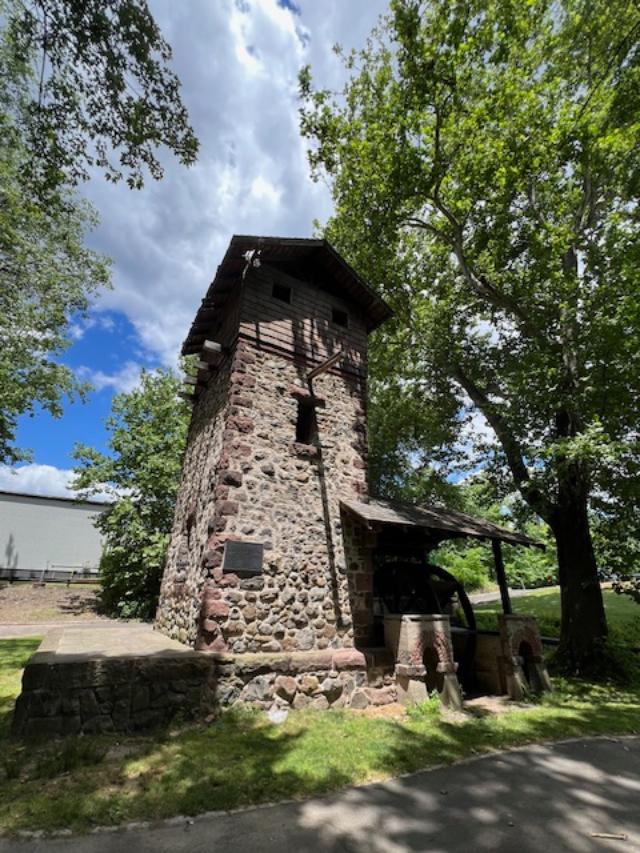
The front of the tower on the bike path

The tower sits near the Saddle River in the Saddle River Park

Once used to pump water to irrigate and provide a scenic setting for the estate of Edward Easton, it is a 20 foot rectangular, stone-masonry tower topped with a wood-frame structure and a wood-shingle, gabled roof. On the side is a large wood water wheel, which is under a wood-shingle roof.  The architect Henry Ihnen designed it.
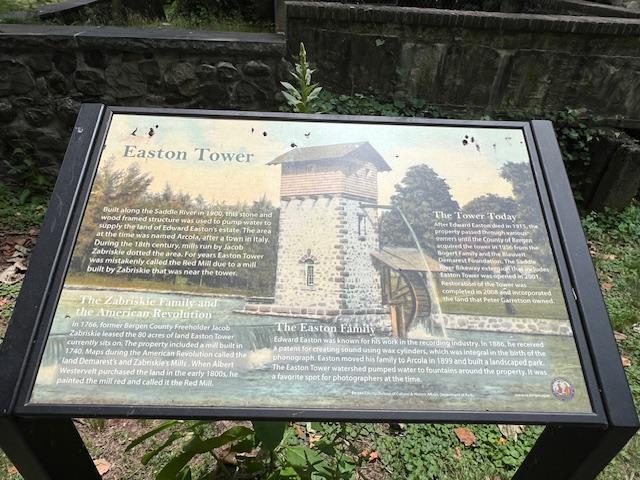
Easton Tower historical information sign

In the 18th century, this area along the Saddle River and near the heavily used Albany Post Road, was the location of many mills. Jacob Zabriskie, a Bergen County Freeholder during the Revolutionary War had leased the 80 acre mill site around 1766 and in 1771 acquired the mill that had been built in the 1740’s. Revolutionary maps identify it as “Demarest’s and Zabriskie’s Mills.”

The Easton Tower in Saddle River Park

Over time it was rebuilt or expanded and in the early 1800’s painted red by its owner Albert Westervelt. It is at this time it  acquired the “Red Mill” name often mistakenly applied to Easton Tower. By the 1800’s, the mill had fallen into disrepair and was demolished circa 1894.

The inside of the tower
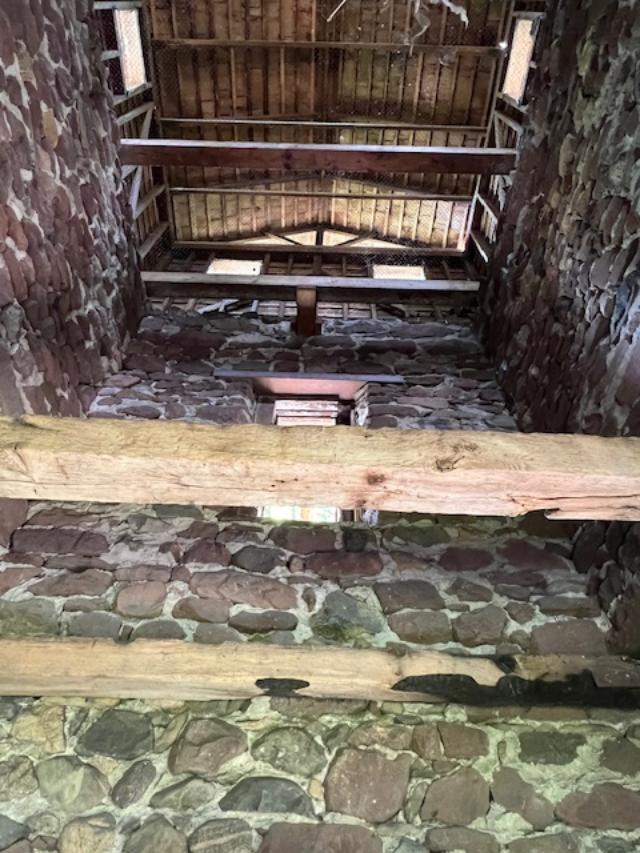
The Easton Tower inside

In 1899, Edward D. Easton (1856-1915), bought this almost 48 acre site, which included the mill pond and dam. The area was called “Arcola”. Easton’s father, a teacher, had originally brought his young  family to this area and suggested the name for the new settlement after a town in Italy. Edward Easton was a notable figure in American technological history. He started out as a stenographer, reporter and then a court stenographer In Washington DC, covering many famous trials in the 1880’s. After the 1886 patent was granted for the method of engraving sound by incising wax cylinders, Easton went on to make his fortune in the recording industry. He was a founder and eventually president of the Columbia Phonograph Company, which became one of the three major recording companies at the turn of the twentieth century.

The Easton Tower from the back

After opening an office in New York City, Eaton relocated his family from Washington DC to Arcola. He had a large house built on his property and commissioned the design of a landscaped park. The tower, to be built neat the site of the old Red Mill was a functioning structure pumping water to several fountains. There were also rustic bridges, lakes and expansive lawns. The tower was a favorite of photographers and appears in many contemporary postcards. People came from miles around to this beautiful spot to take boat rides and walks and in the winter, ice skate near the tower. Sources list the Easton home and park as having been used in early silent films.

After Easton’s death in 1915, the property went through various owners. In 1931,  construction of the Route 208 connection with Route 4 at “the Old Mill at Arcola” provided access to the recently opened George Washington Bridge. This destroyed sections of the landscaped park and isolated the tower. In 1940, the 1.26 acres site was sold at a sheriff’s sale to Clyde A. Bogert. The County acquired the tower from the Bogerts and the Blauvelt-Demarest Foundation in 1956. In 1967, the Bergen County Park Commission dedicated the tower. Easton Tower was placed on the State and National Register of Historic Places and in 2008 was completely restored by the County. It can be viewed from the Saddle River Bikeway and visited year round.

Disclaimer: This information is taken from the Bergen County Division of Cultural and Historic Affairs (C) 2015 pamphlet. The Bergen County Division of Cultural & Historic Affairs received an operating support grant from the New Jersey Historical Commission, a division of the Department of State.

Special Note: I visited the site recently and it is hard to get to by car. It is located right off Saddle River Road and it is off on a odd bend in the road. It is a quick turn to the right so pay attention to the directions.


The Bergen County Court House                           10 Main Street                                        Hackensack, New Jersey 07601

The Bergen County Court House 10 Main Street Hackensack, New Jersey 07601

The Bergen County Court House: Hackensack, New Jersey

10 Main Street

Hackensack, NJ 07601

(201) 221-0700

https://www.co.bergen.nj.us/component/rseventspro/location/16-bergen-county-courthouse

Open: Monday-Friday-8:30am-4:30pm

*Call about touring the facility when court is in session.

The Historic Courthouse at 10 Court Street in Hackensack, NJ.

The Bergen County Justice Complex (including the Bergen County Court House) was placed on the New Jersey and National Registers of Historic placed on November 22, 1982 and January 11, 1983 respectively. The Register nomination referred to the building’s significance as “important to the judicial of the Bergen County Justice Complex-the Court House, the Jail (now called the ‘Old Jail’), and the Administration Building-were the work of important architects and all possessed architectural quality and interesting examples of early 20th century technology.

The Historic marker

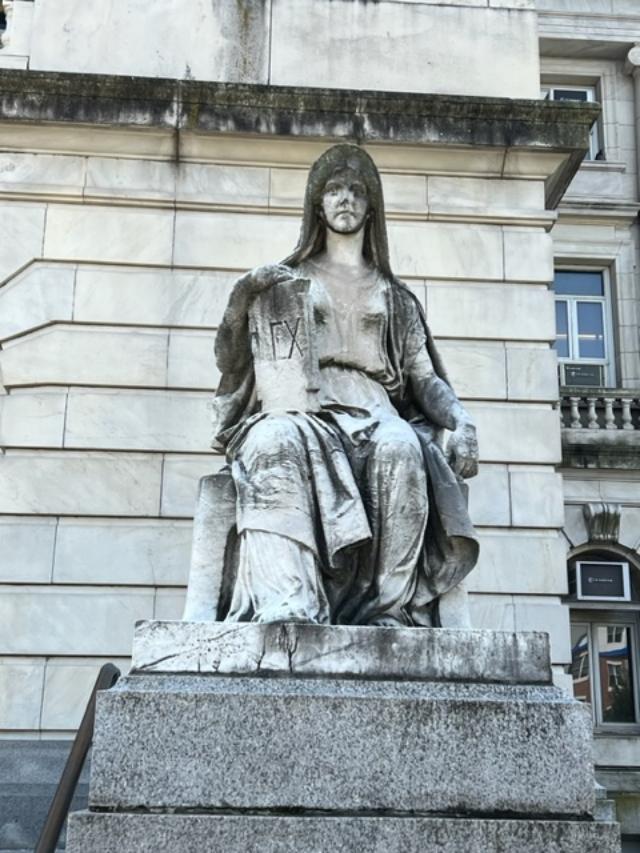
Designed by James Riely Gordon, in the Beaux Art style reflecting monuments of classical Rome and Italian Renaissance, the Court House incorporated rich materials including marble and bronze. With a dome modeled on the U.S. Capital, it incorporated other art forms including painting, sculpture and stained glass. The exterior contains many sculptures including the female statue of “Enlightenment Giving Power” on the dome’s cupola. The dome’s interior is decorated with Tiffany stained glass panels. Three of the courtrooms have elaborate stained glass skylights fabricated by the famous Lamb Studios. Some of the courtrooms also contain large murals painted in the 1930’s by artists working for the Federal Art Project of the Works Project Administration.

The Hackensack Green, Courthouse and Dutch Reformed Church and Cemetery.

The other side of The Green from the Courthouse.

The symbolic value of the Court House was recognized when it was built in 1910-1912. A local newspaper, The Hackensack Republican, wrote on July 7, 1910 that the courts “stand for the protection of rights, for the redressing of wrongs and for the punishment of crime. There are the great safeguards of the freedom of the people…Hence we build these courthouses as temples of justice-substantial, ornate and commodious as the appropriate form for the great duties which are here to exercised”.

Bergen County Court House 1715-1912 with the historic cemetery in the distance.

First Court House 1715: The Court House was combined jail and courthouse built on the site of three blocks south of the present County Administration  Building. It was located in an area known as Quacksack, later becoming part of the southern portion of Hackensack. It was built of stone laid up by two of the freeholders, John Stagg and Ryer Ryerson.

Second Court House 1734: This Court House, built on “land near the Dutch Church by Hackensack River.” was probably on or adjacent to the Green in Hackensack and closer to the river than the site of the current courthouse. It burned in 1780 during the Revolutionary War in the British raid of Hackensack.

Third Court House 1780: The 1780 Court House was something of a temporary structure built during the Revolutionary War away from Hackensack. It was a log building with the courthouse and jail housed under one roof, erected at “The Ponds” (Present day Oakland) in northwest Bergen County.

Fourth Court House 1786: The fourth Court House was built on a site “about 100 feet east of Main Street,” Hackensack where present day Bridge Street connects with Main Street (southern side of Bridge Street) fronting on the river. It was built on land bought from Peter Zabriskie, who lived in the magnificent Mansion House which faced the Green.

The unique statues that flank the front of the courthouse.

Fifth Court House 1819: The Fifth Court House was a brick structure built on the site of the present courthouse on land deeded to the county by Robert Campbell, a prominent Hackensack attorney and son of Archibald Campbell, whose tavern on the west side of Main Street faced the Green. Campbell specified that the land was deeded for the use of the county. If used for any other purpose, it was to revert to Campbell’s heirs. It was torn down in January 1912 when the present courthouse building had been completed on the side behind it and to its west.

The other statue that flanks the Green.

Sixth Court House 1912: The present Court House was designed by James Riely Gordon (1863-1937), a prominent architect responsible for the design of about 70 courthouses and two state capitals. The cornerstone was laid July 6, 1910 and was built by John T. Brady & Company of New York. Completed in February 1912 at the cost of $1,617,000, it was the subject of considerable investigation and lawsuits due to charges that there was over-payment of funds as well as added costs, which became the basis for political battles.

For Justice Center information: contact http://www.judiciary.state.nj.us/bergen/

http://www.co.bergen.nj.us

2015 Bergen County Division of Cultural and Historic Affairs

The Bergen County Division of Cultural & Historic Affairs received an operating support grant from the New Jersey Historical Commission, a division of the Department of State.

*Disclaimer: This information was taken directly from the Bergen County Division of Cultural & Historical Affairs pamphlet. Please refer to the website for tours and other information on visiting the site as it is a working courthouse. Please check the website and email or call before you visit.

Campbell-Christie House, Historic New Bridge Landing: A Bergen County Historic Site                                                                   1201 Main Street                                                                   River Edge, NJ 07661

Campbell-Christie House, Historic New Bridge Landing: A Bergen County Historic Site 1201 Main Street River Edge, NJ 07661

Campbell-Christie House, Historic New Bridge Landing: A Bergen County Historic Site

1201 Main Street

River Edge, NJ 07661

(201) 343-9492

A County Historic Site

http://www.co.bergen.nj.us

http://bergencountyhistory.org/

Fee: Donations are accepted and there are fees for the special events

Open: Check the website above for special events and times

TripAdvisor Review:

https://www.tripadvisor.com/Attraction_Review-g46776-d7603554-Reviews-Historic_New_Bridge_Landing-River_Edge_New_Jersey.html?m=19905

I recently visited the Steuben House for a Christmas concert which was an evening of Christmas songs, a talk on the history of Christmas before, during and after the Revolutionary War. It was a very lively evening of song and lecture and the ladies who entertained us sang beautifully.

The Campbell-Christie House was used as the ‘pub’ for diners that night

Linda Russell & Company sang Christmas songs of the time and then talked in between about how Christmas was celebrated during the War years. She was a delight in her discussion and her and her daughter and their friend did a wonderful job.

The concert was entertaining, and the talk was interesting in the Van Steuben House

A sample of Linda Russell’s music

It seemed that while the Puritans put a damper on the Christmas holidays in New England the Dutch New Jersey and New York thoroughly enjoyed the holiday season after all their hard work during the Fall harvest months.

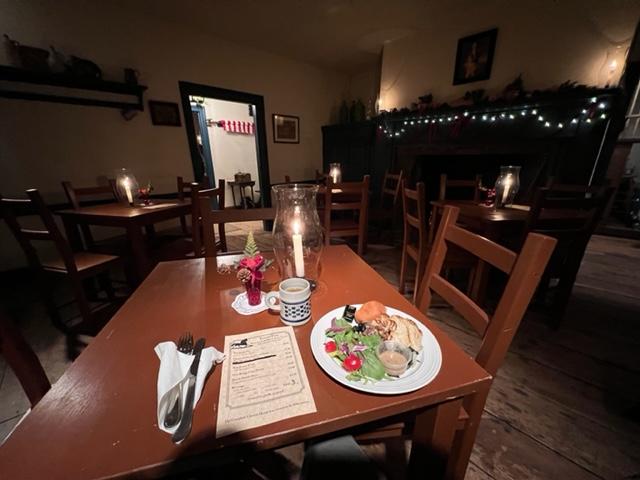
What was really nice was the Campbell-Christie House was open as a pub for dinner and light snacks and you could order things like Shepard Pie, Cheese & Onion Pie and Cake doughnuts and gingerbread for dessert while enjoying conversation by candlelight. It was an interesting and engaging history.

The Van Steuben House for the holidays was where the entertainment was that day

The house is nicely decorated for Christmas circa 1778

BCHS Xmas 2020 VI

The Campbell-Christie House at Christmas 2020 Historical Event

BCHS Xmasw 2020

Singer Linda Russell at the Christmas Tour Event at the BCHS 2020

Don’t miss their historic lectures and reenactments during the year. Check their website above for more activities.

https://revolutionarynj.org/event/sing-we-all-merrily-a-colonial-christmas-at-historic-new-bridge-landing-2/2019-12-15/2/

History of the Site:

BCHS Washington's Birthday X

The historic marker of the Campbell-Christie House

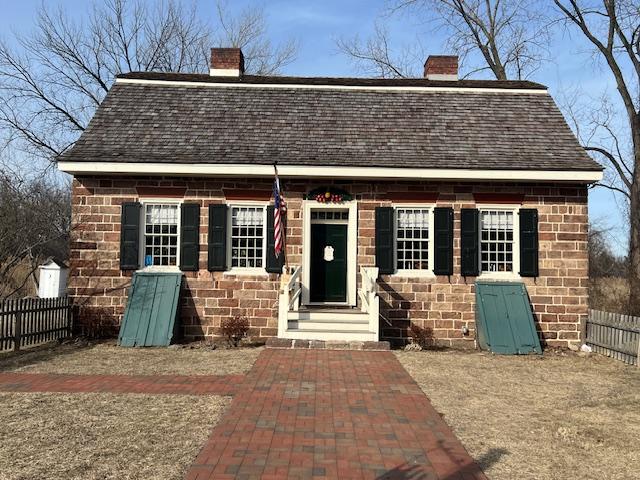
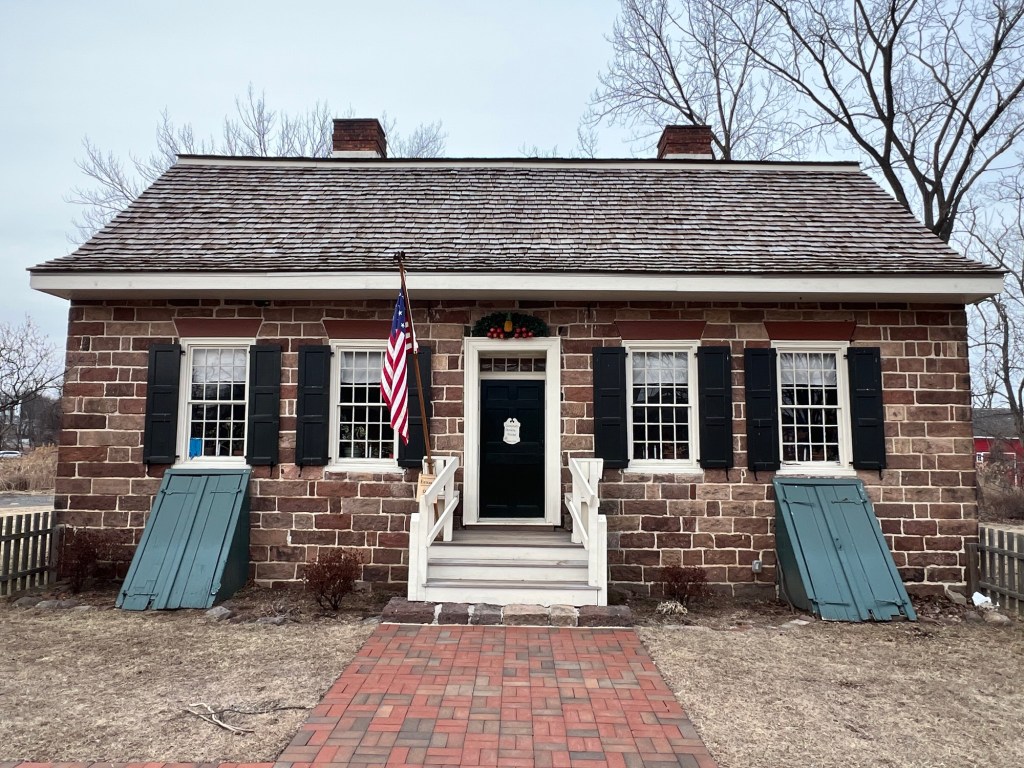
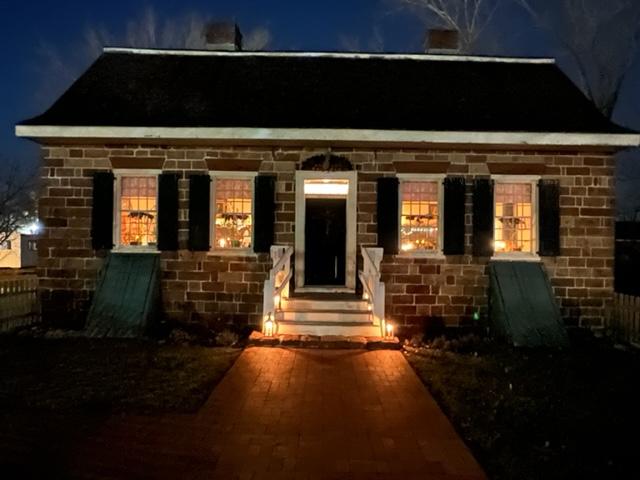
The Campbell-Christie House, an 18th century sandstone structure, is located in Historic New Bridge Landing State Park, River Edge. This historic building originally stood at the intersection of Henley Avenue & River Road, in New Milford, NJ. In 1977, in order to save it from demolition, Bergen County purchased and moved it south to this site next to the Hackensack River.

BCHS Washington's Birthday VIIII

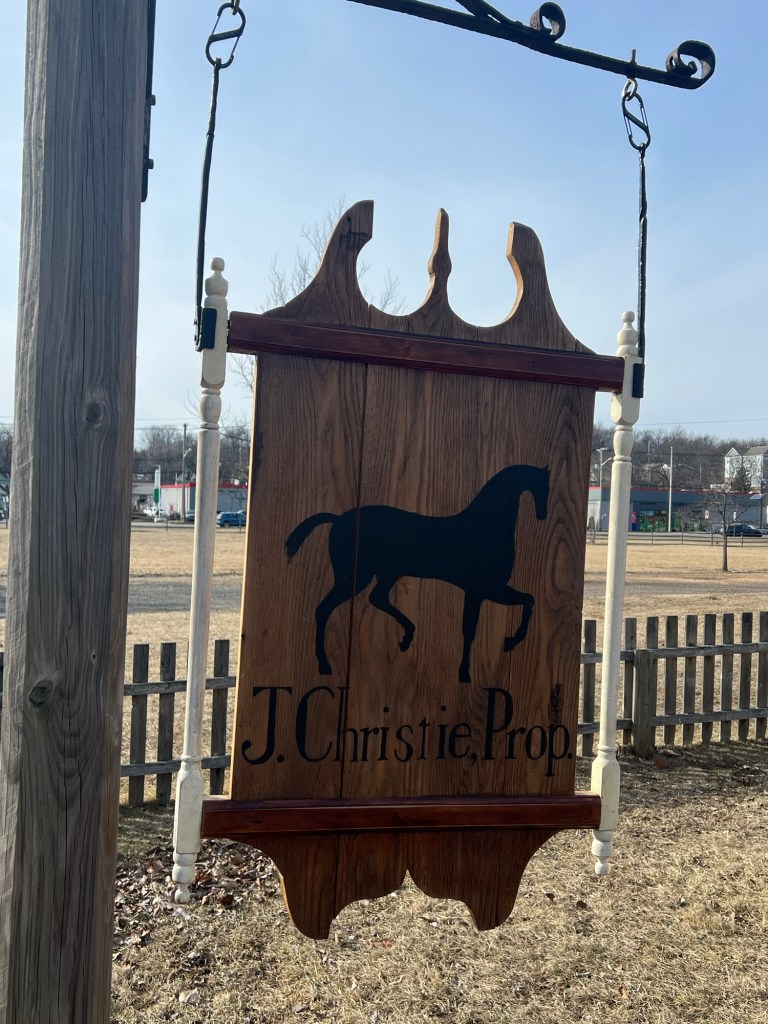
The Christie Family Pub sign

The house was used again for a pub for the Christmas concerts that returned to the site in December 2022. The house was set up as a restaurant with a limited menu before and after the concerts. The light fare was catered in and the menu was similar to what people would have eaten at that time but with a modern twist. The food was really good.

The house was used again for a pub on Christmas 2022 for the concert night

The Campbell-Christie House as the Blackhorse Pub for Christmas dinner

My Shepard’s Pie meal for the Christmas concert at the Blackhorse Pub

The Dutch Sweets dessert plate at the Blackhorse Pub in the Campbell-Christie House Christmas 2022

Sandstone houses were built continuously from the Dutch colonization of the 17th century through the founding of the Republic and the early years of the 19th century. The Campbell-Christie House, an outstanding example of this early regional architecture, is a 5 bay, 4 room center all building with two rooms to either side and two interior chimneys. This stone house form seems to have been built mainly after the Revolution and up to the turn of the century. The front wall is built out of well-dressed local sandstone with inset wooden trapezoidal lintels and side composed of roughly coursed sandstone.

BCHS Washington's Birthday VIII

The Campbell-Christie House during Washington’s Birthday Celebration

Historic New Bridge Landing.jpg

The Historic New Bridge Landing Site

Jacob Campbell, at the time of his marriage in 1774 built this house along the road (now Henley Avenue) that led from Old Bridge to the Schraalenburgh Church. Historical evidence records that Campbell, a mason by trade, also ran a tavern in his household. In 1795, the house was sold to John Christie, a blacksmith, who continued as a tavern keeper. Jacob Brinkerhoff-Christie, manager of the Comfort & Lumber Company, eventually inherited this large valuable homestead farm property along the Hackensack River. His son. John Walter, born in the house in 1865, was a famous inventor who built and raced cars (at one time holding the world’s speed record), invented the automotive front-wheel drive and is known as the “father of the modern tank”.

Historic New Bridge Landing Park is located at the narrows of the Hackensack River. Because of its strategic site along a tidal waterway it has been an active area of settlement, trade and commercial activities for thousands of years. The construction of the “New Bridge” in 1744 accelerated development of the area. Because of the nearness to Manhattan, New Bridge Landing was a principal base of operation during the Revolutionary  War and considered an important strategic route, guarded by troops from both sides at different times. General George Washington, who made his headquarters in Zabriske’s house, led his soldiers in retreat across here on November 20, 1776, saving his troops from entrapment by advancing British troops.

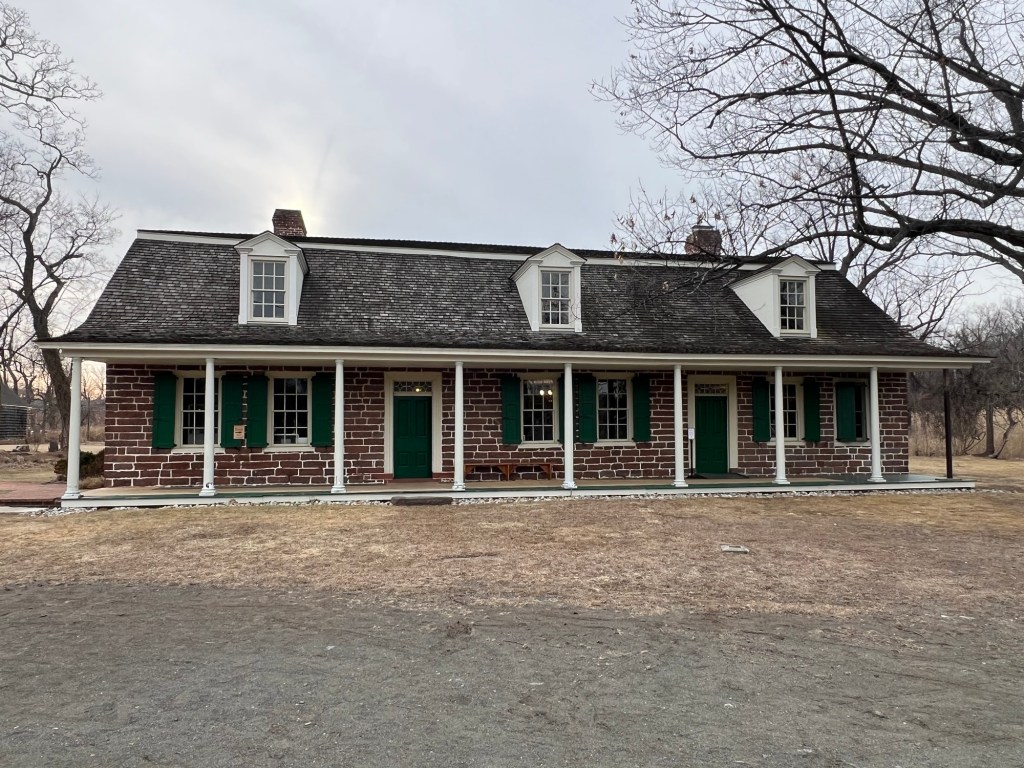
On the Hackensack River’s west bank, near the bridge, is the Steuben House. Originally  constructed by Jan Zabriskie in 1753 and doubled in size around 1765, it has been referred to as to as among the five “great houses” of Colonial Bergen County. The third stone house is the 18th century Demarest House, moved to this site in 1956 and owned by the Demarest-Blauvelt Foundation. The Historic New Bridge Landing Park Commission, a partnership of the Bergen County Historical Society, Blauvelt-Demarest Foundation, the County of Bergen, New Jersey Division of Parks & Forestry, New Milford Borough, River Edge Borough and Teaneck Township, operates the New Bridge Landing site.

This site also contains the County-owned 1888-89 Pratt-type, “pony” truss, iron swing bridge, the oldest highway swing bridge in New Jersey. The Campbell-Christie House, along with the other two houses and the bridge, is on the State & National Register of Historical Place. It is the headquarters of the Bergen County Historical Society and furnished with the furniture and collection owned by the Society. Open year round. For the FCHS calendar of event or go to http://www.bergencountyhistory.org.

http://www.co.bergen.nj.us

Kevin Wright’s Lecture on the Site (2015)

(2015 Bergen County Division of Cultural & Historic Affairs)

The Bergen County Division of Cultural & Affairs received an operating support grant from the New Jersey Historical Commission, a division of the Department of the State.

Disclaimer: This information is taken directly form my pamphlet from the Bergen County Division of Cultural & Historic Affairs. The site holds it position in its participation in the Revolutionary War and should not missed. I give them full credit for this information. Please call them for more information.

The reenactment of the Historic Bridge attack during the American Revolution at the Bergen County Historical Society. I give the Historical Society full credit for this information.

The Christie Pub sign

The pub exhibit at the Campbell-Christie House

The Meaning of the name “Bergen” (Bergen County, NJ)

The Meaning of the name “Bergen” (Bergen County, NJ)

The name was originally applied to the village of Bergen, settled in 1660, which is not the area known as Jersey City Heights. Some earlier writers believed the name was derived from the City of Bergen, Norway. Others said it was named after the small town of Bergen in Northern Holland. Since Colonial New Jersey’s Bergen was a Dutch town founded and governed by a Dutch colony, the name was most likely derived from a town in Holland or a geographical description in the Dutch Language.

The name “Bergen”, originally derived from the word for “hill” in Norway, Belgium and the Netherlands, was applied to towns located in the hills. New Jersey’s Bergen, was originally a settlement on a hill. Therefore, the currently accepted theory is, that the geographical location of the original town is the most likely reason it was called Bergen The name “Bergen” was applied to the County, which was established in 1683.

Disclaimer: this information is taken directly to the pamphlet from the Bergen County Division of Cultural and Historic Affairs. It tells the story of the county we live in here in New Jersey