Tag: Historical Sites

Visiting Stone Street in Lower Manhattan September 2017, November 2019 and April 2024

Visiting Stone Street in Lower Manhattan September 2017, November 2019 and April 2024

Visiting Stone Street in Lower Manhattan:

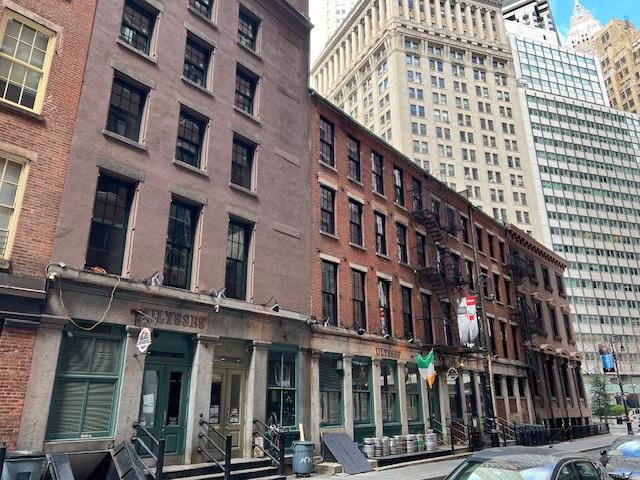
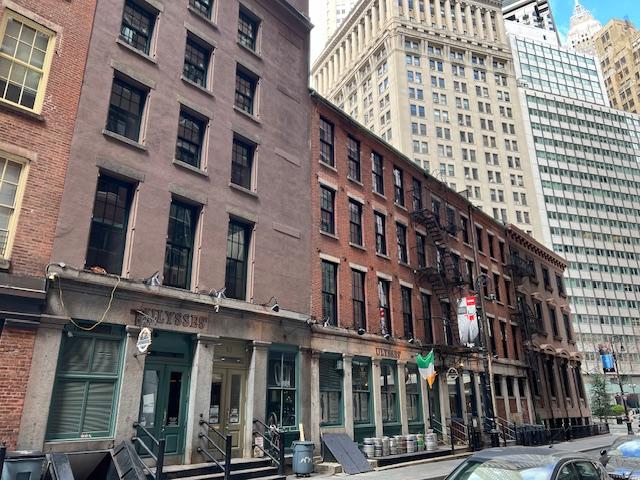
As part of my tour of Historic Bars and Pubs on Day One Hundred and Thirteen with the Cornell Club on May 9th, 2018, we toured the famous ‘Stone Street’ one of the original paved streets of Manhattan. You will not find architecture or pavings like this left in New York City. Here and there are streets or buildings that represent these times during the early to mid-1800’s but they are few and scattered in remote spots all over the island. Here the street still represents a different era of Manhattan.

Stone Street IV

The stores in the 90’s had been either boarded up or were used but in horrible shape. During the business hours not too many people inhabited this area of Lower Manhattan and it was ignored. The neighboring South Street Seaport was being transformed in the mid 80’s into a type of historic theme park and entertainment center by the Rouse Corporation. It put these old neighborhoods back into vogue and people started to return again.

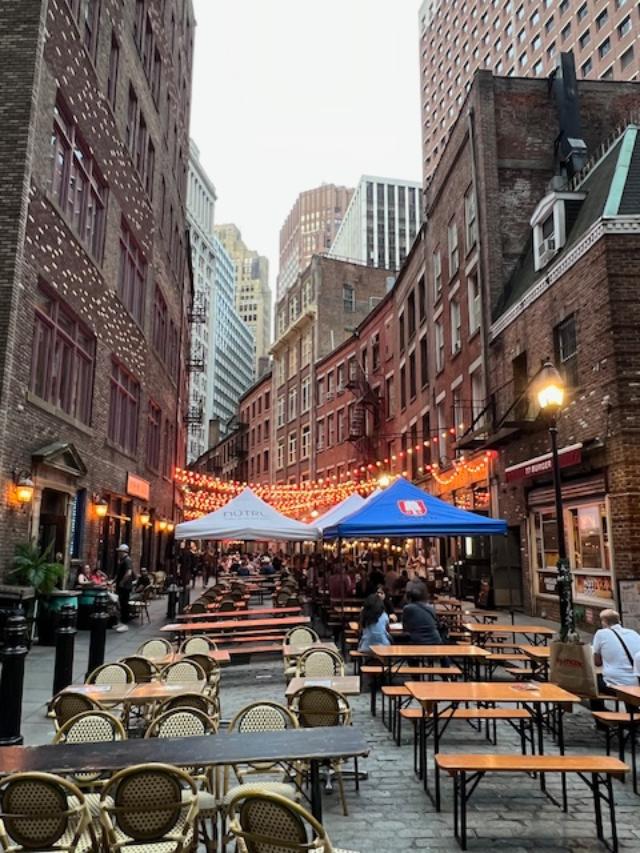
Over time, especially after 9/11 and the changes in downtown Manhattan, the street is now home to many trendy bars and restaurants and a hang out for the downtown business crowd. During the recent walking tour, the place was hopping with people spilling out of restaurants, ordering drinks during happy hour and eating pizza at the local pizzeria.

During ‘Happy Hour’ after work, the place is mobbed with people milling around having a good time. The tables toward the end of the street are filled with tourists taking pictures and at one end of the street is the famous “India House” and at the other is the Frances Tavern where George Washington gave his troops his farewell address.

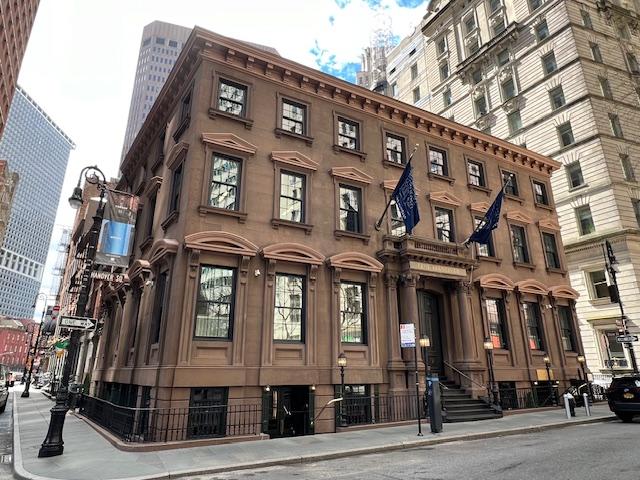
Stone Street’s India House

It is not only a historical neighborhood but loaded with things to see and do. The buildings which were once in horrible shape have been brought back to life and repositioned to use for the meals and entertainment. It is interesting to see how a neighborhood comes back in full circle in a 150 years.

The Stone Street dining area in the warmer months.

History of the area:

Stone Street is a short street in Manhattan’s Financial District. It originally ran from Broad Street to Hanover Square but was divided into two sections by the construction of the Goldman Sachs building at 85 Broad Street in the 1980’s. Today the cluster of historic buildings along Stone, South William, Pearl Streets and Coenties Alley form the Stone Street Historic District.

Fire of 1835 III

The area burned during the Fire of 1835

Stone Street is one of New York’s oldest streets. It was originally known by its Dutch name, Hoogh Staet (High Street). In 1632, the Dutch West India Company built the first commercial brewery in North America there. Around 1656, Hoogh Straet was shifted about twenty to twenty-five feet to align it with Brouwer Street, the extension of Hoogh Straet west of the Gracht and which in 1658 became the first paved street in Nieuw Amsterdam. Following the British conquest of the colony, the name Hoogh Straet was translated to High Street. It was then called Duke Street for the Duke of York during most of the 18th century. Leveled in 1771 and 1790, it was renamed Stone Street in 1794 because of it’s cobblestone paving as New Yorkers abandoned reminders of British Rule.

Fire of 1835

The Fire of 1835

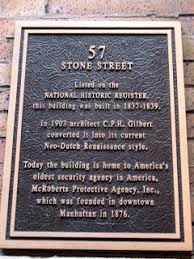
The street’s stores and loft were built for dry-goods merchants and importers, shortly after the Great Fire of 1835, which destroyed many remnants of New Amsterdam. Most buildings were used as storage. The building at 57 Stone Street was rebuilt in 1903 by C.P.H, Gilbert in Dutch Colonial Revivial architecture at the behest of the owner, Amos F. Eno as son of Amos R. Eno. The buildings to the back on South William 13-23 also were reconstructed in the Dutch revival style, evoking New Amsterdam.
Stone Street at night

Today is a busy series of bars and restaurants.

Following many decades of neglect, a joint partnership between the Landmarks Preservation Commission and other city agencies, the Alliance for Downtown New York and Stone Street owners has transformed Stone Street from a derelict back alley into one of Downtown’s liveliest scenes. Restored buildings, granite paving, bluestone sidewalks and period lights set the stage for the half dozen restaurants and cafes, whose outdoor tables are very popular on warm summer nights.

The eastern portion of the street and the surrounding buildings have been protected since 1996 by the New York City Landmarks Preservation Commission as the Stone Street Historic District and is pedestrian only. The historic district is now populated by several restaurants and bars and has a outdoor dining when the weather permits. The India House historic landmark is located at the Hanover Square end of the street.

(This information was taken directly from Wikipedia and I give them full credit)

Van Cortlandt House Museum in Van Cortlandt Park at Broadway & West 246 Street                                              Bronx, NY 10471

Van Cortlandt House Museum in Van Cortlandt Park at Broadway & West 246 Street Bronx, NY 10471

Van Cortlandt House Museum

Van Cortlandt Park at Broadway & West 246 Street

Bronx, NY  10471

(718) 543-3344

infor@vchm.org

Open: Tuesday-Friday 10:00am-4:00pm/Saturday & Sunday 11:00am-4:00pm

Admission: $5.00 for Adults/$3.00 for Seniors & Students/Children under 12 are free/General Admission is free on Wednesdays. Guided and group tours are available.

Review on TripAdvisor:

https://www.tripadvisor.com/Attraction_Review-g47369-d103501-Reviews-Van_Cortlandt_House-Bronx_New_York.html?m=19905

The Van Cortlandt House:

Welcome:

Van Cortlandt House during Christmas time

The entrance of the Van Cortlandt House decorated for the Revolutionary era Christmas

I visited the Van Cortlandt House Museum for the their Annual Christmas Decorated House event. The mansion was decorated for Christmas in the 1700’s so it was not overdone as it would during the Victorian times. The front of the house entrance was done with sprays of holly, mistletoe above the door and garlands of pine around the banister and fireplaces. The windows had candles in them and the dining room was set for Christmas luncheon in post-Revolutionary War era.
Van Cortlandt House VI.jpg

Van Cortlandt House for Christmas is Post-Revolutionary War in 2019

The entrance hall welcomes you to a Revolutionary era holiday season

While most of the house is represented during the Dutch era with floors with no rugs, vintage furniture and decorations and the second and third floors are set for family entertainment. The first floor is set for entertaining for the holidays with the formal dining room, family parlor and the formal living room for games and dancing. The formal dining room was the only room decorated post-Revolutionary War era.

van cortlandt mansion xmas ii

Van Cortlandt Mansion at Christmas 1800’s

The current entrance to the house from the back of the building

Until the Victorian era, Christmas was a more religious affair with church service in the morning and luncheon in the afternoon. Things were formal and less elaborate. The acts of gift giving, sleigh rides, tree decorating and card giving came during the affluence of Queen Victoria’s reign in the post Civil-War era. This is the reason why the house is decorated so simply and elegantly.

Dining Room set for Christmas lunch circa 1780’s

In 2019, the site celebrated the holidays with a Sinterklaas, a Dutch Christmas celebration, a candlelight tour and a reading from Santa Claus. Please check their website for more information on future events. The house was closed for most of the COVID years and nothing had been planned. The house was open in December of 2022 for touring again for the holidays but was not decorated as much as in the past.

In 2022, when the house reopened after a long period of COVID, the self-guided tours were back and you could tour the house at your own pace ($5.00 donation) and tour the three floors of furnished rooms. You can see how the family lived from the three generations that lived in the residence.

The tour starts at the front hallway where guests would be received for formal affairs and for business meetings with the head of the household.

You would be greeted by servants at the entrance of the home

On either side of the front hallway is the East and West Parlors where you would be directed where the family would receive you. The West Parlor would have been used for business calls and more informal meetings when meeting with the Van Cortlandt family. The family’s wealth would be on display with fine furniture, china and bric-a-brac that would show off the family’s merchant roots and business.

The West Parlor

The West Parlor decorated for Christmas

The East Parlor on the other side of the entranceway would have been used for more formal affairs. The East Parlor is where the family would formally entertain guests with dancing, music and card playing. This is where long evenings of entertaining would take place and the family would enjoy their holiday celebrations.

The East Parlor

The East Parlor decorated for the Christmas holidays

The Dining Room was toward the back of the hallway and was decorated in the Empire Design of the late 1700’s to early 1800’s. The look is very similar to styles used today and the wallpaper is a copy from one of the styles used by the family that was imported in from France. The table was set for Christmas luncheon circa the late 1780’s.

The Dining Room

The Dining Room at the Van Cortlandt House

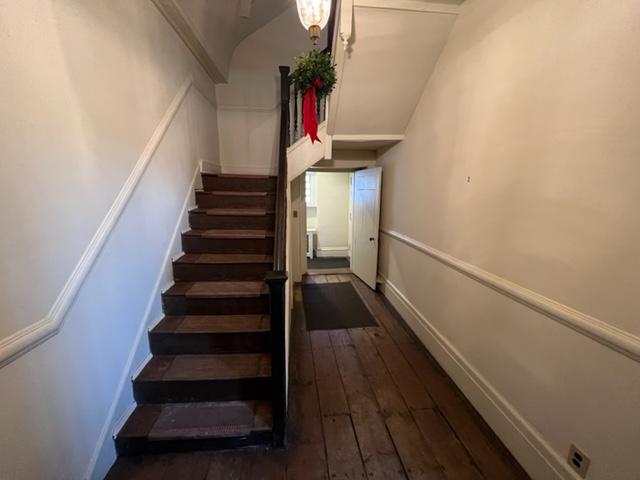
There are two sets of stairs to the second level of the house where the family bedrooms were located. There was the formal stairs and then there was the stairs that the servants used to go from floor to floor so that they would not be seen.

The steps upstairs to the second floor

On the second floor of the home are the bed chambers of the family. The main bedrooms for the family were located here and then the nursery and servants quarters were located on the Third floor of the home.

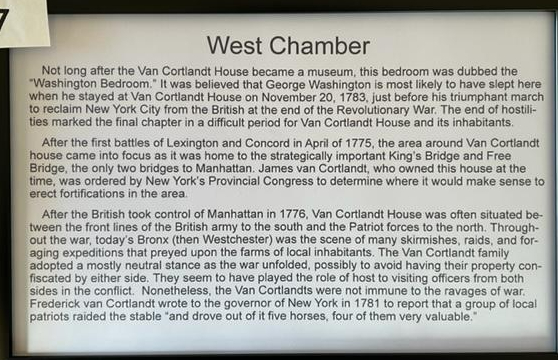
The West Chamber:

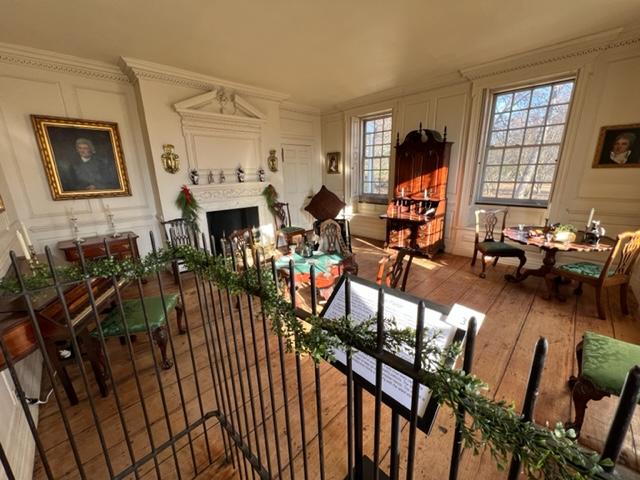
The bedroom

The ‘Washington Bedroom’ in the Van Cortlandt House

The East Chamber Bedroom:

The Bedroom:

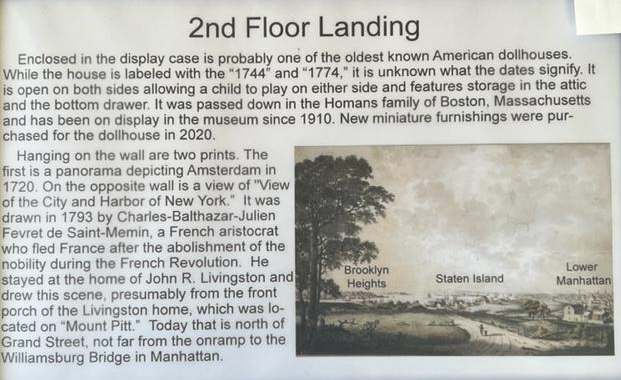
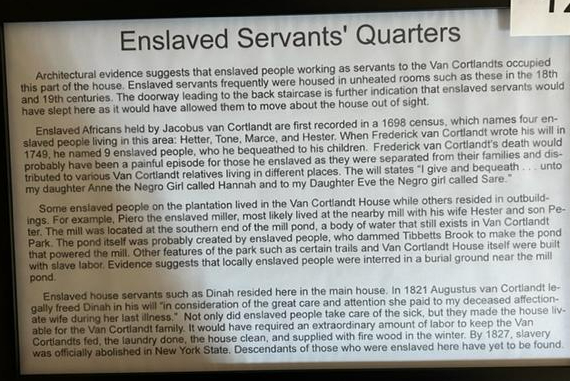
The Landing of the stairs to the third floor lead to the Nursery, an additional guest room and the enslaved servants quarters. These were kept out of site from the other members of the household. It is a reminder of the pecking order of the household and the conditions that people lived under at this time.

The Second Floor Landing leads to the nursery and servants quarters

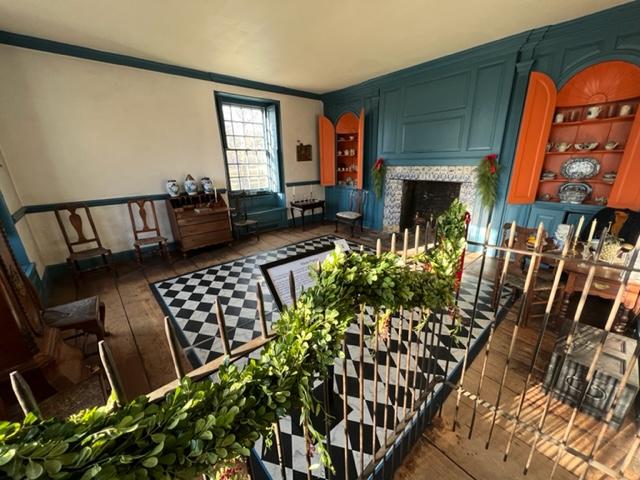
The Dutch Chamber was formerly a guest room that is used to show life in early Colonial New York City:

The Dutch Chamber:

The Dutch Chamber shows early life in Colonial America

The Second Floor Setup:

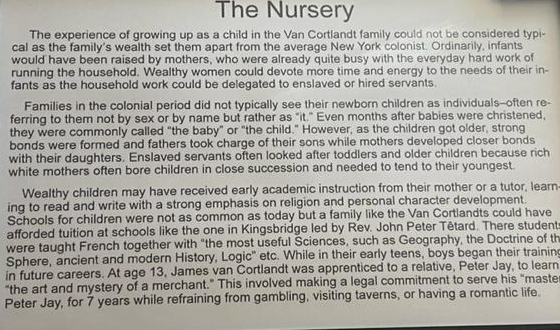
The Nursery:

The nursery set up room:

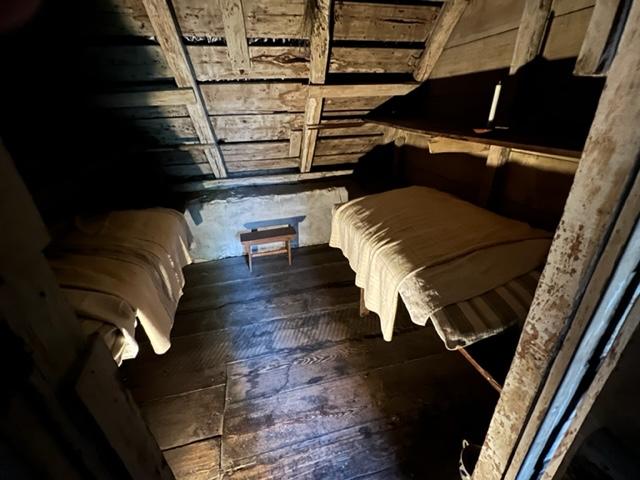
The servants quarters were to the back of the house and were not the most glamorous place to live in the house. There were drafty and not insulated. The amount of time a servant would be here would have been minimal.

The servants quarters:

The servants quarters:

History of the Van Cortlandt’s:

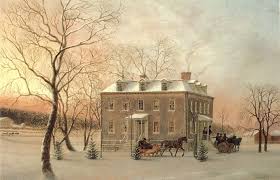
The Van Cortlandt House Museum, also known as Fredrick Van Cortlandt House or Van Cortlandt House, is the oldest surviving building in New York City’s borough of The Bronx. The Georgian style house, begun in 1748, was build of fieldstone by Fredrick Van Cortlandt (1699-1749) on the plantation that had been owned and farmed by his family since 1691. Fredrick intended the house to be a home for him and his wife, Francis Jay and daughters, Anna Maria, 14 and Eve, 13. His sons, Augustus, 21 and Fredrick, 19, were not intended to be permanent residents of the house.

Sadly, Fredrick died before the new house was completed. In his will written in 1759, Fredrick left the house to his son, James Van Cortlandt (1726-1781) and a lifetime tenancy to his widow, Francis Jay Van Cortlandt (1701-1780).

Van Cortlandt House IV.jpg

The Van Cortlandt House gardens in the Summer

The Van Cortlandt’s were a mercantile family prominent in New York affairs. Fredrick’s father, Jacobus, established a thriving wheat growing and processing business on the plantation including a grist mill for processing the wheat into flour and a fleet of shallow draft boats to carry the flour from the south end his lake down Tibbet’s Brook and out to the Harlem and Hudson Rivers to market. During the Revolutionary War, the house was used by Rochambeau, Lafayette and Washington.

(From History of Van Cortlandt House and Museum)

In 1887, after 140 years of occupancy by the Van Cortlandt family and the community of plantation workers, the property was sold to the City of New York and made a public parkland. Before the house became a museum, it saw a variety of uses including as a temporary police precinct house and as a dormitory for ranch hands responsible for taking care of a herd of buffalo.

Van Cortlandt House historic marker

By 1895, The National Society of Colonial Dames in the State of New York expressed their interest in restoring the house as a museum open to the public. There was only one obstacle keeping the Colonial Dames from this important project, there was no provision in the New York State Law allowing the stewardship of a publicly owned building by a private organization. Undaunted, the first Society President, Mrs. Townsend, took the Society’s cause to Albany where on May 22, 1896 in the 199th session of the New York Legislature, Chapter 837 was approved by the governor and passed by a 3/5 majority to become law.

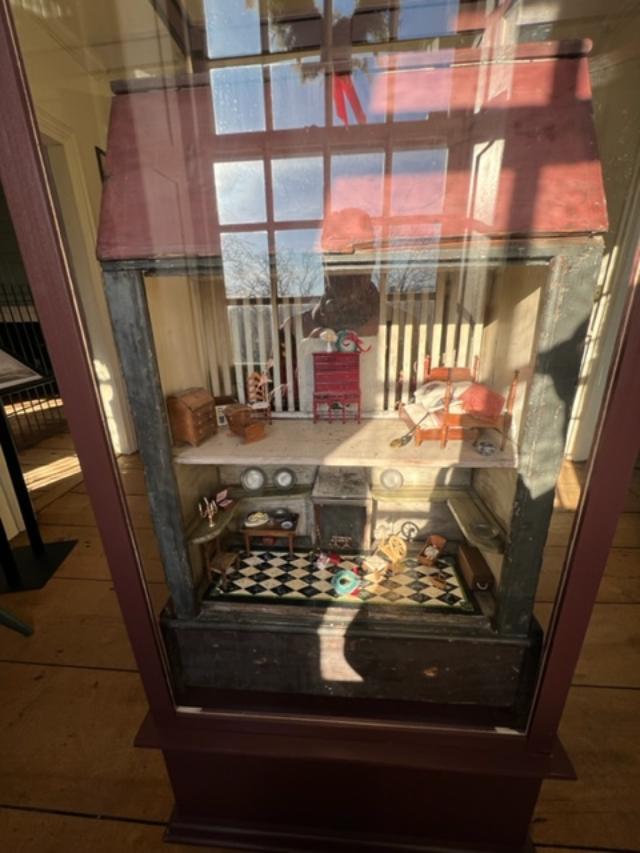
The Van Cortlandt House dollhouse

After nearly a year if repairs and restoration, Van Cortlandt House Museum was opened to great fanfare on May 25th of 1897. The original license agreement grained custody of the house to the National Society of Colonial Dames in the State of New York for a period of 25 years at a ‘peppercorn’ rent of $1.00 per year. Although the Society no longer pays the city rent, they remain, to this day as dedicated to Van Cortlandt House as they were in 1896.

Van Cortland Park.jpg

Van Cortlandt Park in the Summer Months

In 1967, Van Cortlandt House was added to the National Register of Historic Places and was designated a National Historic Landmark in 1967. The house was declared a New York City Landmark on March 15, 1966, recognizing the historic and architectural importance of both the exterior and interior.

(From the Van Cortlandt House Museum NSCDNY)

The Van Cortlandt House gardens during the winter of 2022

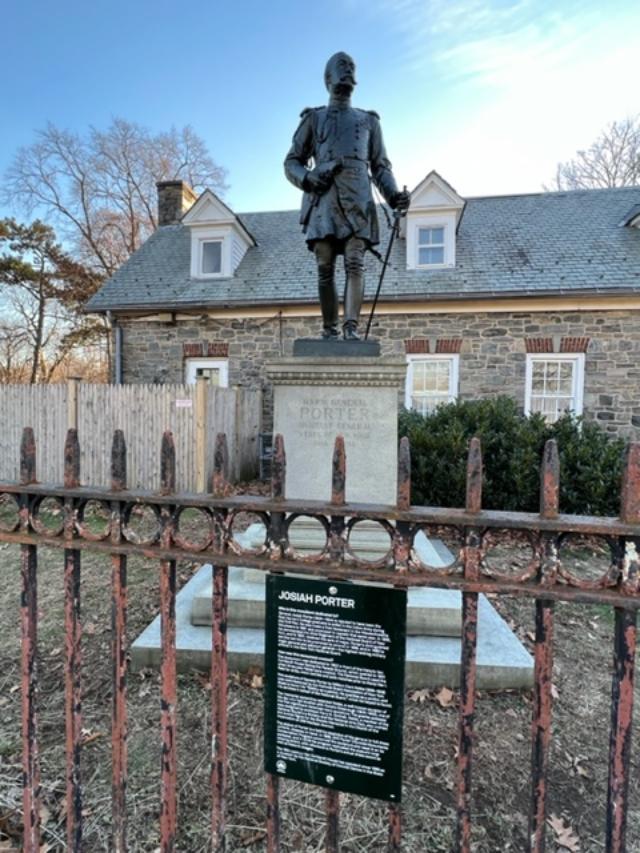
The General Porter Statute in front of the house

Lambert Castle/Passaic County Historical Society                   3 Valley Road                                                                                Paterson, NJ 07503

Lambert Castle/Passaic County Historical Society 3 Valley Road Paterson, NJ 07503

Lambert Castle/Passaic County Historical Society

3 Valley Road

Paterson, NJ  07503

Phone: (973) 247-0085

Fax: (973) 881-9434

info@lambertcastle.org

http://www.lambertcastle.org

https://lambertcastle.org

Hours:

Museum Wednesday-Sunday-1:00pm-4:00pm

The Castle closed for a five year renovation starting January 2020.

Library & Archives Wednesday-Friday-1:00pm-4:00pm/2nd and 4th Saturday of each month 1:00pm-4:00pm (Memorial Day through Labor Day: 12:00pm-4:00pm)

Admission: $5.00 Donation

My TripAdvisor Review:

https://www.tripadvisor.com/Attraction_Review-g46718-d1880569-Reviews-Lambert_Castle-Paterson_New_Jersey.html?m=19905

I have visited Lambert Castle a few times, most recently to see the Christmas decorations before they were taken down for the season. I found out from one of the director’s that they had not been put back up since their Holiday Bazaar back in November. I had seen them the year before and they had been very impressive.

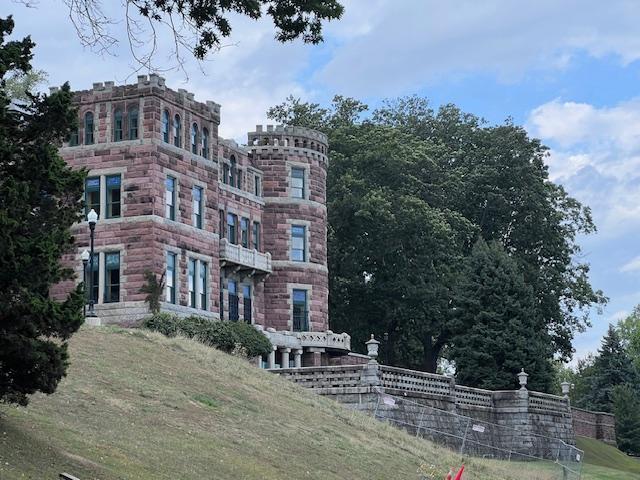
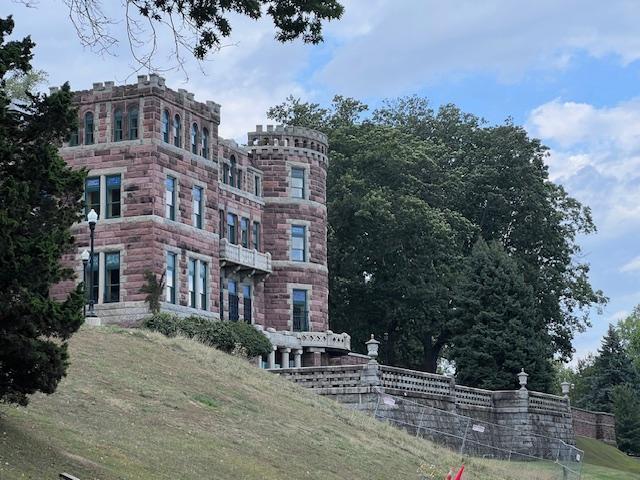
Lambert Castle during the renovation in 2025

Right now the Castle is decorated for the Annual Christmas Craft Bazaar and it is just loaded with handmade crafts for the Christmas holidays. There are three floors of crafts and then on the third floor, there is a small restaurant to relax and look over the court of the house. After the bazaar in 2019, the Castle will close for a much needed five year renovation.

lambert-castle-vi.jpg

The Lambert Castle Christmas Bazaar 2019

I had a chance to visit the floors when they were not decorated for the holidays . The first floor is set up as if the family still lived there with the Billiards Room, Dining Room, Sitting Room, Music Room and Atrium still set as the family resided there. There is period furniture and decorations in all the first floor rooms to give a feel of what it must have been like to live there at that period.

lambert castle ii

The view of Lambert Castle from the second floor

The second floor galleries hold the collection of the Passaic County Historical Society with all sorts of objects, signs and historical items from all eras of the collection. You are able to see the footprint of the living quarters of the family.

Lambert Castle V.jpg

The stained glass windows

The third floor at the time I was there was dedicated to the work of an Italian stone worker and artist who migrated and lived and worked in Paterson.

It is a very interesting way to see life at the turn of the last century in Paterson and the home offers a beautiful view of the City of Paterson and New York in the distance. I have never seen the grounds in the Spring but I am sure that they are quite lovely.

The view alone is worth the visit.

Don’t miss this virtual tour of the Castle and await until the renovations are done to visit again.

Bergecco-Parc Consulting Inc. commercial on Lambert Castle in 2019.

Bergecco-Parc Consulting Inc. Project: “Take me back to Paterson, NJ”.

History of Lambert Castle:

Catholina Lambert and his Castle:

Catholina Lambert was born in 1834 in Goose Eye, England. In 1851 at the young age of 17, Lambert left home to seek his fortune in the “Land of Opportunity” that was America. After several successful ventures in the silk industry, Lambert decided to build a home that would be reminiscent of the castles he recalled from his boyhood in England. In 1892, he built his own castle on Garret Mountain in Paterson, NJ, then known as the “Silk, City of the New World.”

Catholina Lambert II

Catholina Lambert

Lambert’s home was built to showcase his elaborate art collection  of fine European and American paintings and sculpture. At one time, his collection was so vast that it was considered to be “the nucleus of an American Louvre.” In 1913, Lambert fell into debt and his fortune started to dwindle. As a result, he was forced to mortgage the Castle and eventually sell much of his art collection. The proceeds allowed him to live comfortably in the Castle until his death at age 89 in 1923.

After Lambert’s death, his son, Walter sold the Castle to the City of Paterson, which later sold it to the County of Passaic. Today the Castle is still owned by the County and  serves as the headquarters of the Passaic County Historical Society. The Society, a private not for profit organization, owns the historical artifacts and works of art.

Catholina Lambert

Catholina Lambert and Company

The home and the museum, exist as a reminder of a bygone era and as a tribute to the great accomplishment of  the Castle’s creator. Although most of the furnishings today are not original to the Lambert’s home, they represent period furnishings that would have been found in the Castle during the Lambert era.

For more information about the rooms and decor, visit The Lambert Castle Blog at:

https://lambertcastleweb.wordpress.com/museum

Passaic Historical Society:

The Society & Museum:

The Passaic County Historical Society is a private non-profit educational organization founded in 1926 and dedicated to cultivation of interest in the history and culture of Passaic County and former home of silk magnate Catholina Lambert was built in 1892. The Castle is owned by the County of Passaic and has been the home to the Society since 1934.

Library & Archives:

Located in the lower level of the Castle is the Elizabeth A. Beam Memorial Historical Research Library, operated by the Passaic County Historical Society. Here scholarly researchers, genealogists and historical enthusiasts may find books, manuscripts, maps, photographs, genealogy records and other information that reveals the history of Passaic County. Access to the library is included with regular admission to Lambert Castle.

Membership:

The Society depends upon the support of its membership as well as museum admission to sustain its important mission. Please consider becoming a member and helping to preserve the history of Passaic County.

The Second Floor Galleries:

The Castles’s second floor has several exhibition galleries, each presenting a different historical display from the Society’s collections. To the right of the fireplace on the walls of the second floor balcony is an exhibition of works by noted Paterson artist Julian Rix. On the opposite side are portraits of notable Passaic County residents and a collection of historic engravings of the Passaic Falls. Behind the fireplace are the Lambert’s private rooms. To the left, in the former sitting room and bedroom of Mr. Lambert, are the Curiosities and Local Folk Art galleries and the famous Brass Dog Sculpture that served for many years as an advertising sign for a tinsmith’s shop in nineteenth-century Paterson. In the adjacent room, the former bedroom of Mrs. Lambert, is the Local History Gallery which features historical images of prominent businesses and people.

The Third Floor Exhibition Gallery:

The Third floor of Lambert Castle is reserved for changing or seasonable exhibitions.

Disclaimer: This information comes directly from the Passaic County Historical Society & Museum pamphlet and I give them full credit of it. Rather than transcribing the whole pamphlet with the description of rooms, I attached their website and blog on WordPress.com for more detailed viewing.

The New Jersey Firemen’s Museum at the New Jersey Firemen’s Home 565 Lathrop Avenue Boonton, NJ 07005

The New Jersey Firemen’s Museum at the New Jersey Firemen’s Home

565 Lathrop Avenue

Boonton, NJ  07005

(973) 334-0024

http://www.NJFH.org

Open: Sunday-Saturday 8:00am-4:00pm

Admission: Free

http://www.njfh.org/njfh-museum.php

My review on TripAdvisor:

Located inside the Boonton New Jersey Firemen’s Home, The New Jersey Firemen’s Museum is an 8000 square feet, two story museum that houses steamers, ornate hose carts and antique fire trucks from all eras.

The museum was established in May of 1985 and is home to many fire department in New Jersey’s memorabilia. It seems like everyone fire department in the State of New Jersey is represented here with old fire department pictures, patches from the fire companies, fire trucks from all eras and pictures of department fires from all over the state.

Filling the cases is antique fire equipment, badges from officers in many departments, figurines of fire equipment and ribbons from conventions of the past. There are old fire buckets from the beginnings of the fire service, horns to sound the alarms from the turn of the last century and helmets that retired chiefs from many departments donated with much honor.

Many companies donated their department pictures from fires of their past that were fought with much bravery. People forget that this job is very dangerous and we have to watch ourselves in every step.

The fire trucks are from every era from the carts that were dragged by hand to horse drawn engines to the original steam engines that were introduced with the advent of technology. All of the equipment has been carefully restored and shined to almost new. Much care has been taken to show the transition of the fire service over the years.

The tours are on your own and the admission is free. You don’t have to be a fire fighter or visiting a resident here to visit the museum. If you are a serious fire buff or have children that are really into fire fighting or being a fireman, this museum will give you all sorts of perspectives on the fire service and its development not just in New Jersey but all over the county as well.

Don’t miss the memorial to the victims of 9/11 off to the side. It is very touching and shows the support of the fire service to the members of the FDNY and their families.

9/11 is still fresh in all our minds

It is a nice afternoon out. The museum is free to the public. These pictures are just a glimpse of the collection of the NJ Firemen’s Home Museum. It is two floors of donated equipment, memorabilia, awards, dedications and department antiques that are so well preserved. If you love the history of firefighting, this is the museum for you.

Fire equipment from the past and present

Sound the Alarm

The Patch Board is extensive

The Convention Wall of attending as a delegate

Preparing for rescue

Don’t miss all the antique equipment