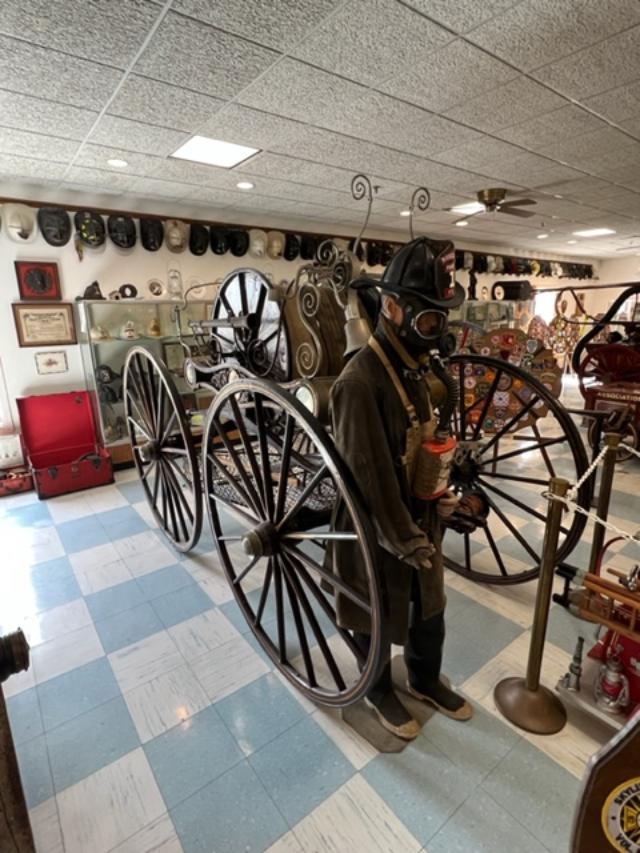
Located inside the Boonton New Jersey Firemen’s Home, The New Jersey Firemen’s Museum is an 8000 square feet, two story museum that houses steamers, ornate hose carts and antique fire trucks from all eras.
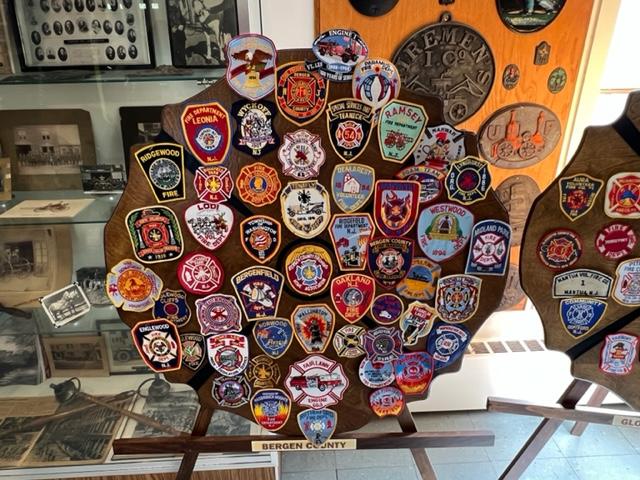
The museum was established in May of 1985 and is home to many fire department in New Jersey’s memorabilia. It seems like everyone fire department in the State of New Jersey is represented here with old fire department pictures, patches from the fire companies, fire trucks from all eras and pictures of department fires from all over the state.
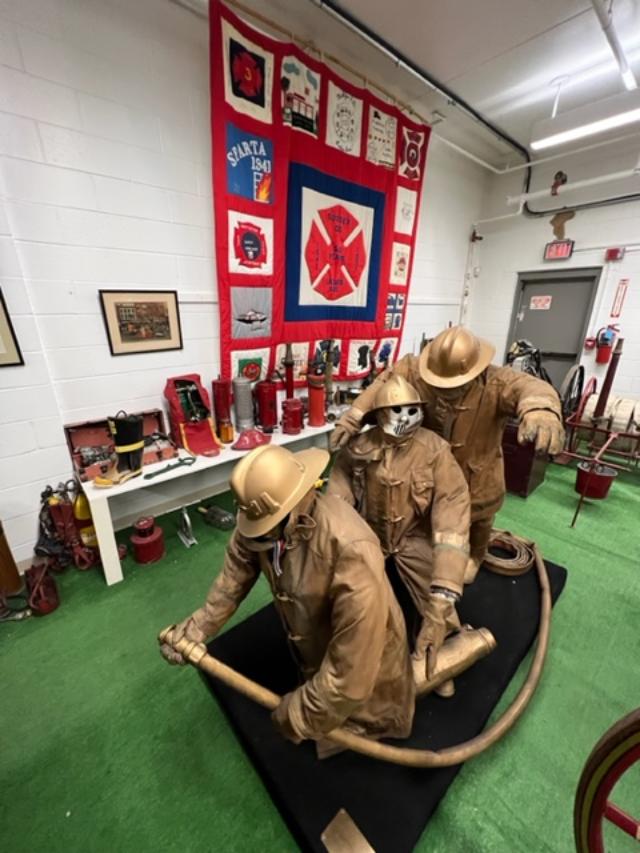
Filling the cases is antique fire equipment, badges from officers in many departments, figurines of fire equipment and ribbons from conventions of the past. There are old fire buckets from the beginnings of the fire service, horns to sound the alarms from the turn of the last century and helmets that retired chiefs from many departments donated with much honor.
Many companies donated their department pictures from fires of their past that were fought with much bravery. People forget that this job is very dangerous and we have to watch ourselves in every step.
The fire trucks are from every era from the carts that were dragged by hand to horse drawn engines to the original steam engines that were introduced with the advent of technology. All of the equipment has been carefully restored and shined to almost new. Much care has been taken to show the transition of the fire service over the years.
The tours are on your own and the admission is free. You don’t have to be a fire fighter or visiting a resident here to visit the museum. If you are a serious fire buff or have children that are really into fire fighting or being a fireman, this museum will give you all sorts of perspectives on the fire service and its development not just in New Jersey but all over the county as well.
Don’t miss the memorial to the victims of 9/11 off to the side. It is very touching and shows the support of the fire service to the members of the FDNY and their families.
9/11 is still fresh in all our minds
It is a nice afternoon out. The museum is free to the public. These pictures are just a glimpse of the collection of the NJ Firemen’s Home Museum. It is two floors of donated equipment, memorabilia, awards, dedications and department antiques that are so well preserved. If you love the history of firefighting, this is the museum for you.
I visited the Zabriskie House in May 2016 and 2019 for the Northwest Bergen History Coalition 6th Annual History Day. The house is left the way the last owner. Grace Zabriskie, willed it to the town with all the original furnishings.
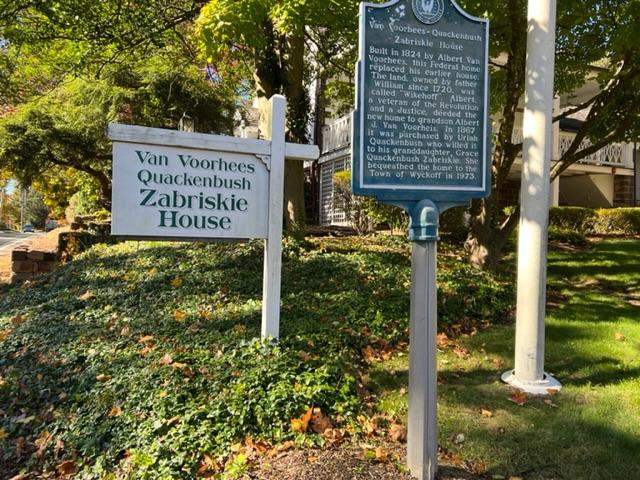
The historic signage
It has period furnishes, family heirlooms and antiques. The docents will take you on a tour of the house and show you where all the later additions were added and how they make up the whole house. As you walk through the house, you can see the difference in structure of the home plus how the last owner lived.
The Zabriske House in Wyckoff, NJ
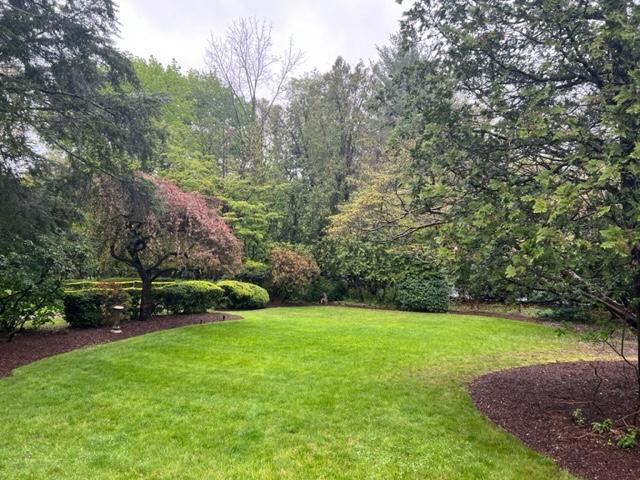
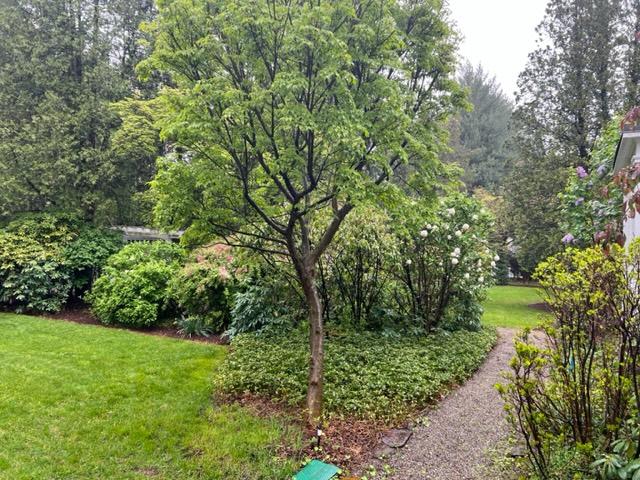
Don’t miss touring the gardens in the Spring as Mrs. Zabriskie worked with a Botanist to plant the gardens to bloom at different times. She planted it in stages so that she could entertain in them but still treated the gardens similar to the house as if you had to walk into a room. It is very nice and colorful in the Spring.
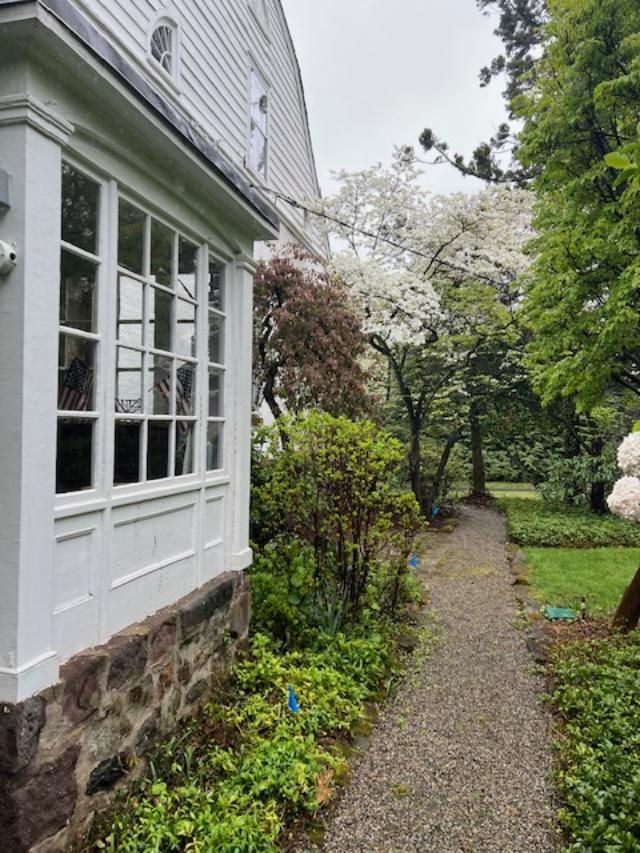
I have visited the house during the Northwest Bergen History Day and I was able to take a lot of pictures of the gardens next to the house on a rather gloomy day. The gardens were in full bloom in the middle of spring and the rain added a layer of beauty to the flowers and flowering bushes that lined the paths. They did a nice job maintaining the house.
On the terrace there are people to guide you through the house and docents to take tours. The ladies had a nice reception laid out for all of the people who came to visit.
The Van Voorhees-Quackenbush-Zabriskie House in the Fall of 2022
The original stone structure of the Van Voorhees-Quackenbush-Zabriskie House was built in 1730 by William Van Voorhees. It is believed to be the oldest house in Wyckoff, NJ. In 1824, William’s son, Albert, completed a major addition to the house in the classically Dutch colonial style. The original structure then became the dining room (NWBHC).
The historic part of the house from the 1700’s
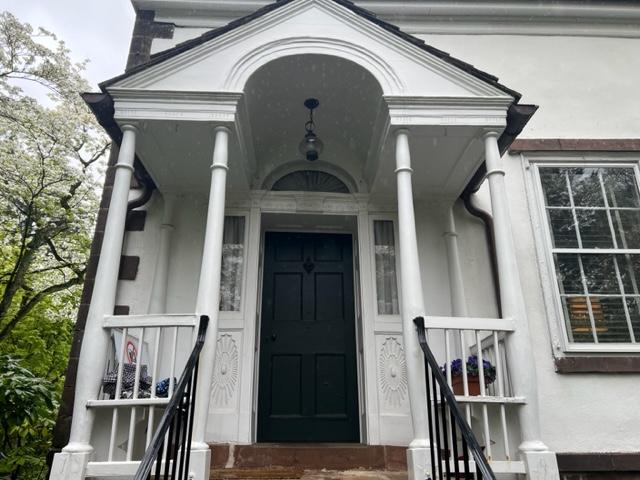
The entrance of the Zabriskie House
History of the House: (Taken from the Wyckoff History Page)
The Van Voorhees-Quackenbush-Zabriskie House has been a local landmark for over 275 years and is believed to be the oldest structure in the Town of Wyckoff, NJ. In 1720, William and John Van Voor Haze, yeoman of Bergen County, purchases 550 acres of land in what is now Wyckoff. The brothers were descended from Dutch settlers who emigrated from Holland in 1660 (Wyckoff History).
The historic part of the house
The first stone house was built circa 1730 by William. The land was cleared and the family farmed, raising table crops and staples such as grain, corn, potatoes and grapes. Over time, apple orchards and dairy farming became main occupations in the area. The Jersey Dutch were especially skilled at animal husbandry. They were considered the best farmers and gardeners in the American Colonies (Wyckoff History).
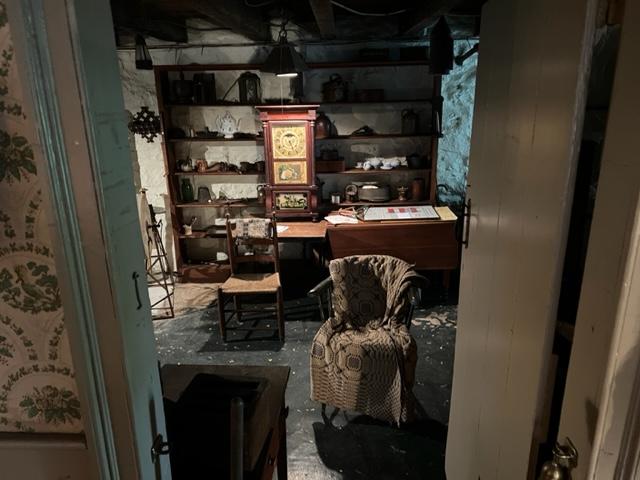
The historic kitchen in the original part of the house
There were only about 20 families in the area in 1775, when the house served as the village store and tavern. William’s son, Albert, served in the Militia in the Revolutionary War. The original stone structure later became the dining room of the house, when a large addition was added in 1824 by William’s son, Albert when he was 86 years old. He had just one son, John, but likely expanded the house for his nine grandchildren and their wives and children. Over the years, in addition to serving as a home, the house served as a not only home, tavern and store but also as a hotel and ballroom for area parties (Wyckoff History).
The gardens on the side of the house
The gardens in April 2023 on a gloomy day
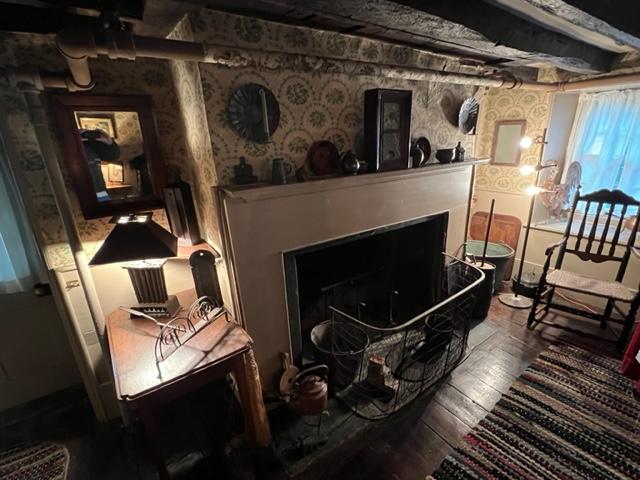
The original 1730 house has a steeply pitched roof and overhanging eaves designed to protect the building and foundation from rain. It has a two piece “Dutch” door to allow ventilation while keeping animals outside. Inside is a five foot high fireplace which originally was the sole source of heat and was used for all cooking (Wyckoff History).
The pathways to the gardens to the side of the house
The lawn next to the house
The pathways next to the house
The pathway to the gardens
The much larger 1824 structure is three stories originally tall with a sub-basement. It contains four fire places, again for heat. It has two half and four quarter moon windows and two oval windows. There are four bedroom with pegs to hand clothes on (no closets then). Its exterior demonstrates the classic Dutch Gambrel roof with an upper 23 degree roof line and then a lower 45 degrees roof line. This beautiful design was developed by the Dutch in northern New Jersey and up the Hudson River and is found nowhere else in the world. The typical Dutch front porch has two benches on either side of the entrance (Wyckoff History).
The house in the Fall
The property left the Van Voorhees family in the mid-1800’s. In 1867, it was purchased by Uriah Quackenbush. Uriah and Keziah Quackenbush had one son, John, who died as a young adult. Grace Quackenbush was his only child and was two years old when he died. She was raised in the house by her grandparents, who left the property to her when they passed on, after Grace had married John Zabriskie (Wyckoff History).
The Zabriskie Pond across the street
During her lifetime, Grace modernized the house (including adding an indoor bathroom) and restored the appearance of the home using authentic period antique furniture and furnishings. She also created three beautiful formal gardens on the landscaped property with her friend, Mrs. Elizabeth Spencer, a botany major (Wyckoff History).
The house is considered one of the finest examples of American architecture in northern New Jersey. The current House Museum has been called one of the finest in New Jersey. In 1973, Mrs. Grace Q. Zabriskie, who was the last resident, willed the house and its antique furnishings to the Township of Wyckoff, when she died that year. The “Zabriskie” house belongs to everyone in Wyckoff to enjoy (Wyckoff History).
The Zabriskie Pond in the Fall of 2022
Please check out their website for when the house is open to the public.
Open: The hours for the structure change throughout the year, so please check the website for time availability of the park and structure.
Admission: $8.00 Adults/$4.00 Children/Children under 2 free
Group Tours & Information:
Lucy is available year round for groups of 10 or more by appointment. For special holiday hours and weather closings, please call or check our website.
How to get to Lucy:
It is best to check the website for your location to the structure. For detailed instructions, please visit http://www.lucythe elephant.org.
I visited Lucy the Elephant in the fall of 2015 right before Christmas on a tour I was taking of Southern New Jersey and the shoreline. This unique structure was built to attract people to the shore to buy land and for development.
The view from the parking lot
There were two other ‘Lucy’s’ built one of them being the former ‘Elephant Hotel’ in Coney Island that burned down in the last century.
The front view of the elephant
This well preserved building has been renovated and part of the Jersey shore lore. It is well worth the visit in the off season on a nice day. I unfortunately visited on a rainy day in 2015 and was not able to go to the top and still have a free pass to go whenever I want to visit again.
Entering the elephant through the winding stairs
Still I was able to take the spiral staircase to her belly to learn the history of the structure and that is very interesting.
Lucy the Elephant in its full glory
I started my tour in 2025 at the door of her base
I visited Lucy again in 2025 and was finally able to visit the top of the statue, the howdah, and able to take in the view of the ocean and the surrounding area. Try to visit “Lucy” when it is a sunny day out. You will be able to take in the spectacular view of the ocean.
The tour starts in her inside, looking over the displays and where the bar was located where the owner would ply investors with liquor to have them invest in beach real estate.
Inside of Lucy the Elephant: the history and displays
The inside of Lucy on a recent tour
Touring the inside of Lucy
I was able to take my time because I visited in the off season on a nice day and since J was the only one on the tour, I got to take my time and talk with the tour guide.
I got to look through Lucy’s eyes and see the views of the ocean and of the surrounding areas was interesting.
Lucy’s eyes and truck
Lucy’s left eye
Lucy’s right eye
The former bathroom inside of Lucy
The inside displays of Lucy
The skylight that illuminates the inside
Then it was time to walk up to the howdah and enjoy the view. It was a somewhat over cast day but you could still enjoy the view.
The view from the howdah on the top of the elephant
The roof of the howdah
The view of the beach from the howdah
The view of Margate from the howdah
The view from the howdah showcases the view of both the beach and the City of Margate. You can see from mikes around and on a hot day, the breezes are amazing.
The restored wood work
The video of the views
The tour of Lucy is about an hour but the history of this shore landmark and its influence in shore real estate and the development of these towns is so interesting.
Leaving the elephant we could see her behind
The History of Lucy the Elephant:
Lucy was built by a real estate speculator who owned a great many parcels of open land at the Jersey shore. In order to attract visitors and potential buyer, he built Lucy as a novelty amusement. He patented his idea, ensuring that Lucy would remain a unique piece of architecture.
Eventually, a popular hotel business was built around Lucy. Presidents and royalty came from around the world to stay at the neighboring Elephant Hotel and climb the stairs to Lucy’s howdah.
Lucy facing the ocean
During her history, Lucy has survived hurricanes, ocean floods and even a fire accidentally stated by some inebriated party-goers when she served as tavern. However, by the 1960’s, it became apparent there was one disaster Lucy could not overcome-neglect. By that time, the once proud jewel of the South Jersey Isles had become an almost hopeless, condemned structure.
Eventually a developer purchased Lucy’s lot and intended to build a new condominium building on the site. The beach and the ocean could stay-but the elephant had to go!
Lucy the Elephant near the wrecking ball
To the rescue came the Save Lucy Committee. Within weeks, this small, concerned group of ordinary citizens had raised enough money to move the entire decaying structure two blocks away to a new site owned by the city. Thirty years and over one million dollars later, Lucy has been completely restored to her original splendor, inside and out.
In 1976, Lucy was designated a National Historic Landmark by the United States Government as the oldest surviving example of a unique form of “zoomorphic” architecture. Today, she is every bit as popular and beloved as she ever was.
The history of the elephant
The history of the park
The history of Lucy
The history of the park and who saved it
About the Park:
Lucy the Elephant is located along the beach in Josephine Harron Park (named for our co-founder) in Margate, NJ. Lucy is six stories high and is listed on the National Park Registry of Historical Landmarks. Our park is fenced and contained, making child supervision easy. Picnic tables are on site for eating outdoors. We also have friendly, trained volunteers and staff to assist you during your visit. On the tour, you will learn about Lucy’s unique architecture and her colorful history.
Lucy facing the sea
You will get to climb a spiral staircase through her insides and all the way up to the howdah on her back, providing a spectacular 360 degrees view of the surrounding shore area. Kids and adults alike are sure to enjoy visiting the only elephant in the world “you can walk through and come out alive”.
Lucy is also available by appointment for schools, groups and special events such as weddings or birthday parties. There are guided tours, a gift shop, free parking and all major credit cards are accepted.
Lucy the Elephant symbol of the town
Lucy from the front of the parking lot
Lucy from the ticket booth across the street
This information was taken from the pamphlet from The Save Lucy Committee. For more information, visit the online website at http://www.LucyTheElephant.org
*Disclaimer from author: All this information is located both on the pamphlet and on the website. Visiting Lucy is a treat and should be visited by all residents of New Jersey.
The gift shop the supports raising much needed funds for restoration.
Visit downtown Margate for lunch after your visit
Downtown Margate after my tour
I went to Pierre’s Pizza at 7 North Washington Avenue for lunch. Their cheese pizza is wonderful. The restaurant is two blocks from Lucy.
Pierre’s Pizza at 7 North Washington Street in Margate, NJ













 Visiting a Museum: The Unique, Unusual, Obscure and Historical