Tag: Exploring Closter NJ

The Nagel/Auryansen Cemetery                          42-50 Susan Drive                                                      Closter, NJ 07624

The Nagel/Auryansen Cemetery 42-50 Susan Drive Closter, NJ 07624

The Nagel/Auryansen Cemetery

42-50 Susan Drive

Closter, NJ 07624

https://closterhistory.com/properties/cemetary/index.html

https://www.findagrave.com/cemetery/2445456/nagel-auryansen-cemetery

https://www.hmdb.org/m.asp?m=63546

Open: Sunday-Saturday Open 24 hours during twilight hours

My review on TripAdvisor:

The Metropolitan Farm at 119 Hickory Lane in Closter, NJ:

https://www.metropolitanfarm.com/

https://www.facebook.com/MetropolitanFarm/

My review on TripAdvisor:

https://www.tripadvisor.com/Attraction_Review-g46367-d33075565-Reviews-Nagel_auryansen-Closter_New_Jersey.html

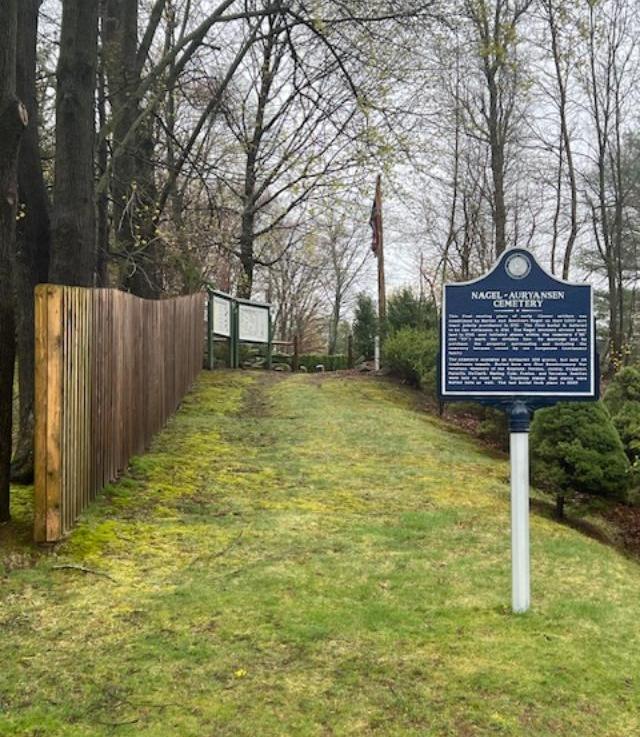
The entrance to the Nagel/Auryansen Cemetery in Closter, NJ

The historic marker sign

The History of the Cemetery:

(From the Boro of Closter, NJ website)

The Naugle/Auryansen Cemetery is significant in the early settlement period of Closter’s history. Documented burials date to circa 1722 and include Dutch pioneer families with names like Vervalen, Naugle (Nagle), DeClark, Ferdon, Parsells, Auryansen, Demarest, Haring, Cole, Kearney, Montague and Bogert. Seven Soldiers, Closter farmers, who served in the Bergen County Militia during the Revolutionary war and one veteran from the War of 1812 are known to be among the interred.

The cemetery once known only as the “Burying Place,” was part of the original lands purchased in 1710 by the Naugle brothers, Barent and Resolvent. They divided their lands in 1748 and the division stones carved with their initials (“BN” and “RN”) are still visible in the middle of the cemetery.

Later, the place became known as the Auryansen Grave Yard because this family took title to the land upon which it sits. Many of the sandstone and frame houses built by these families and their descendants are still standing in the Borough today.

The description sign of the cemeteries plot locations
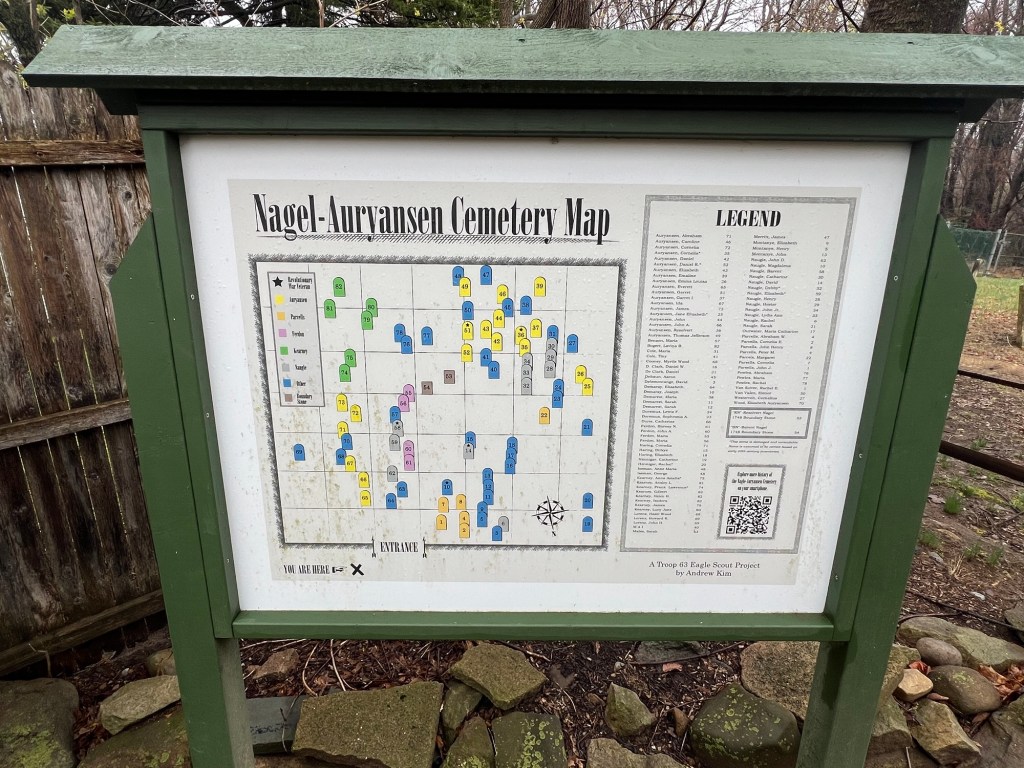
The plot location sign

The Historical Maintenance and care of the cemetery in the modern era:

(from the Boro of Closter, NJ website)

In 1996, the Closter Historical Society undertook a three year project to restore the 19th century sandstone gravemarkers. At that time a complete survey was done of the tombstones in the Cemetery and Tim Adriance is in the process of preparing this information for publication.

In 1961 Ralph Heaton of the American Legion obtained official granite plaques from the Veterans Administration and placed them at the foot of five Revolutionary soldiers’ graves.

Various caretakers have helped maintain and clean the cemetery through the years. Presently, Tim Adriance, the Auryansen family historian is the caretaker. This is still an active cemetery. From: 1999 “Revisions and Update” of the Historic Sites Survey, by Pat Morillo for the Closter Historic Preservation Commission – attached to the Bergen County Historic Sites Survey: Borough of Closter dated 1981-1982.

Recent work on the cemetery grounds has been overseen by the Closter Historic Preservation Commission and undertaken by the Closter DPW, as well as local Eagle Scouts. The cemetery now has an attractive rustic wooden fence and gate at the Susan Drive entrance, a newly refurbished flagpole with an historic American flag, new fencing along the perimeter, and other improvements to the Susan Drive entrance.

In 2010, the Bergen County Historical Society erected an historic blue marker describing the site. This marker is located at the Susan Drive entrance.

The Cemetery is open to the public through the new gate at the entrance on Susan Drive, between house numbers 42 and 50 Susan Drive, off Ruckman Road. This gate is unlocked, though the gate off the Hickory Lane entrance remains padlocked to prevent damage from off-road vehicles passing through the cemetery.

The inside of the cemetery on s gloomy afternoon

The Nagel family plot inside the cemetery

I visited the Nagel-Auryansen Cemetery one gloomy afternoon. This small cemetery is one of about a half dozen in Bergen County, NJ that were once part of family homesteads that are long gone.

These once important family farms started to disappear after the Civil War and with the coming of income tax, smaller families and automation of farming, these farms disappeared. These small cemeteries are what remains of these families legacies.

The grave of resident Abraham Auryansen
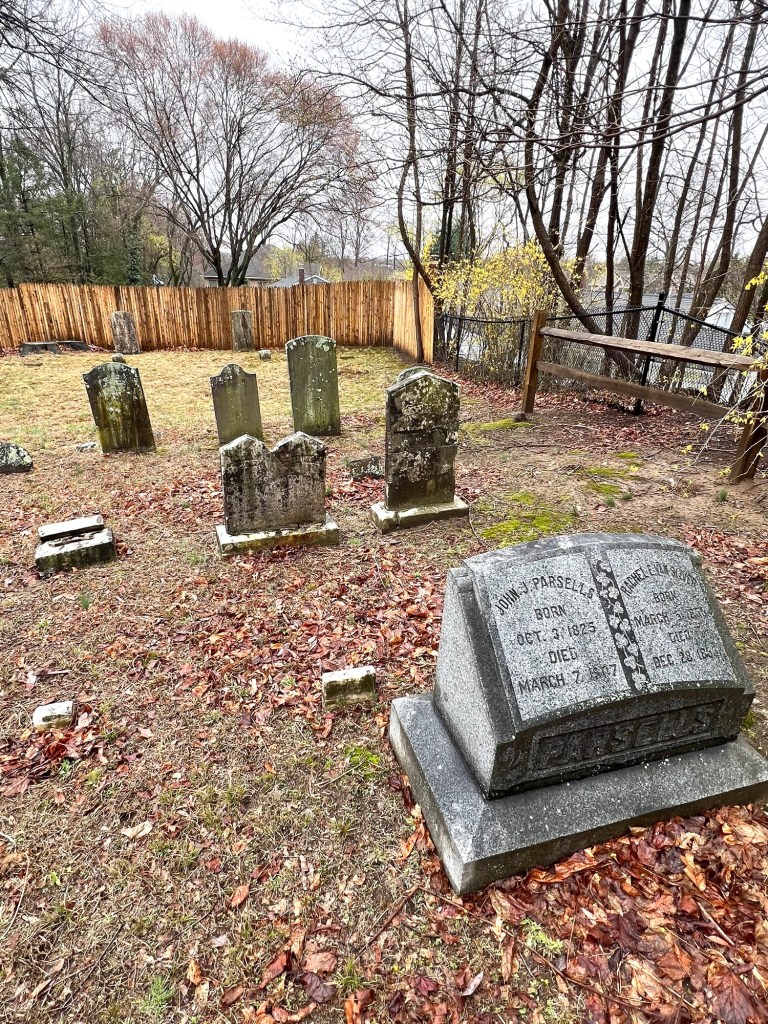
The Auryansen family plot inside the cemetery

The Nagel family plot inside the cemetery

The Auryansen family plot inside the cemetery towards the back
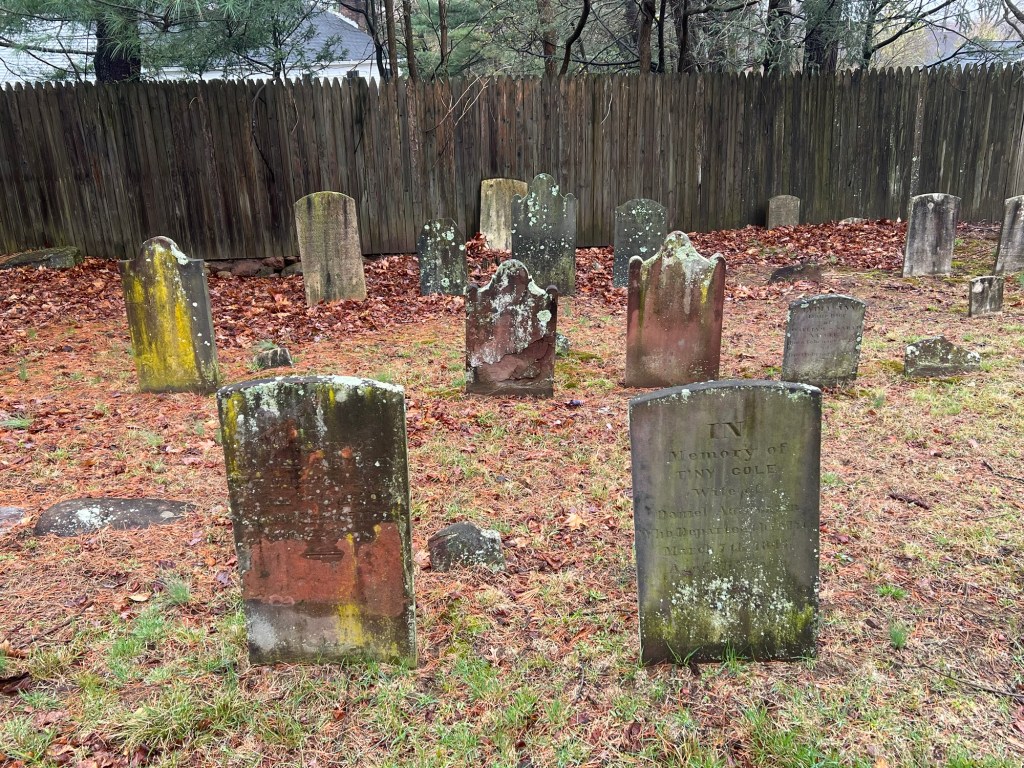
The Nagel and Haring family gravestones

The gravestones closer to the entrance of the cemetery

On the next block over, the original family farmhouse along with the Metropolitan farm still exists. The family farmhouse and nursery are still part of the community. It is the oldest continuous farms in the State of New Jersey.
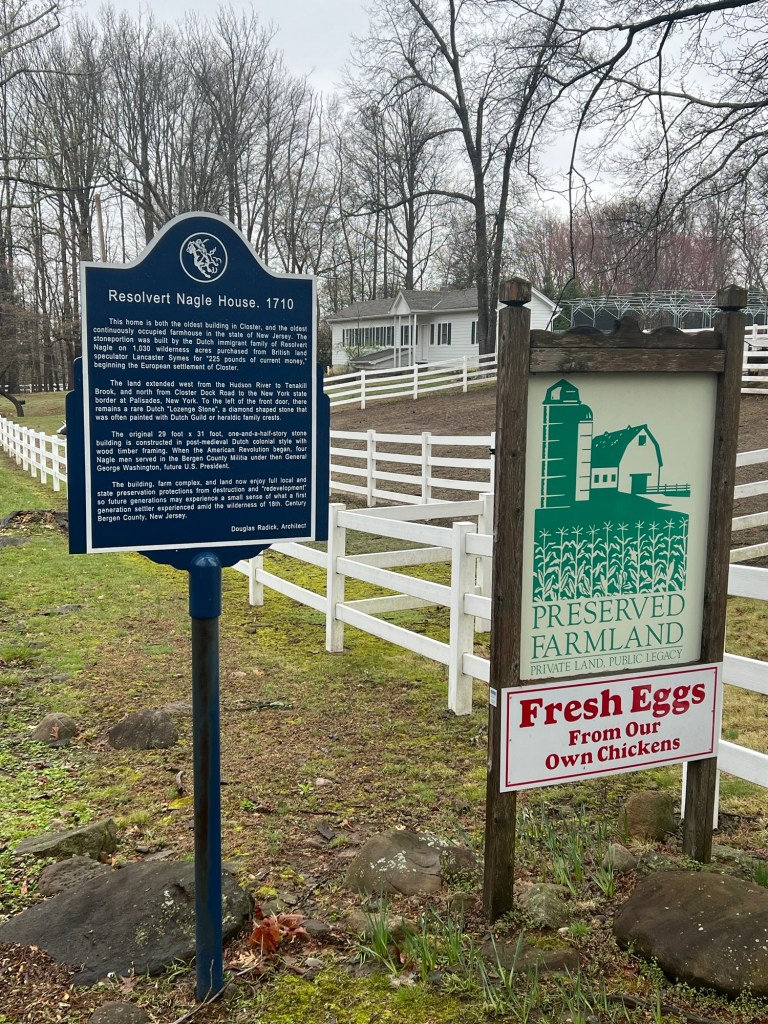
The Metropolitan Farm is home to the Resolvert Nagel Farmhouse and farm
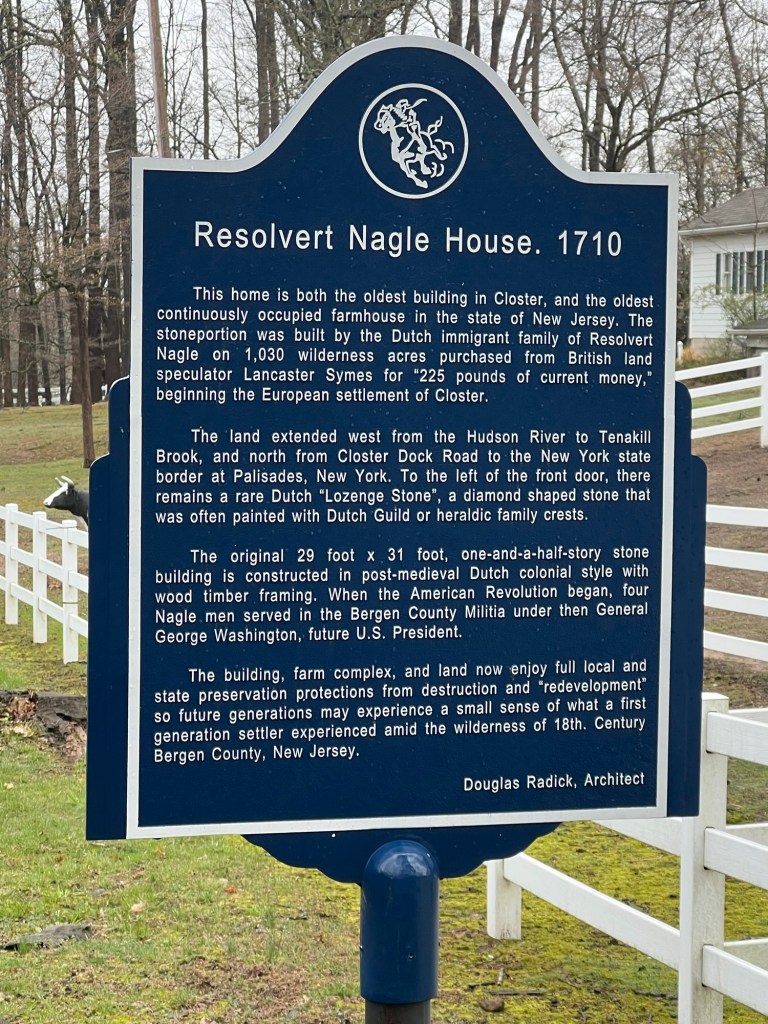
The historic marker to the home
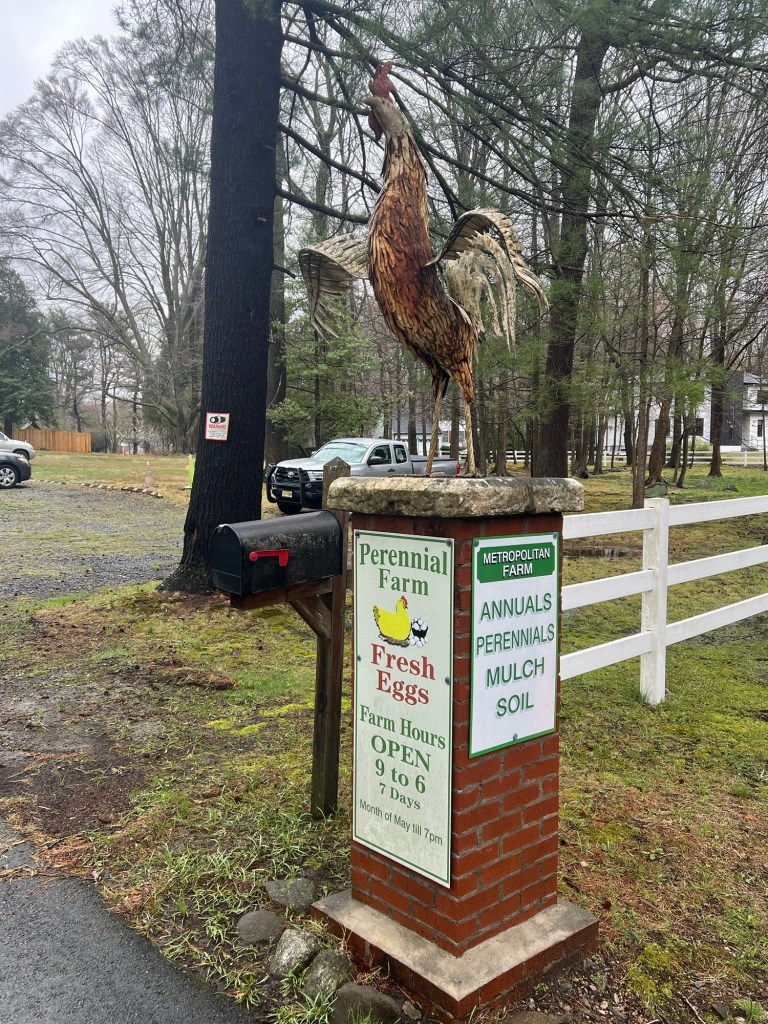
The entrance to the Metropolitan Farm at 119 Hickory Lane in Closter, NJ

https://www.metropolitanfarm.com/

My review on TripAdvisor:

History of the Farm:

(from the Metropolitan Farm website)

Started in 2012, our farm is located on the property which is the oldest working farm in the State of New Jersey. Every year, we are improving our ability to help you and make it more convenient to access our 70.000 perennials.

​Our perennial growers have been working with perennials in Northern New Jersey for over 30 years. In that time, they have discovered what works the best and what thrives in our hot summers and survives our bitter cold winters. We overwinter all our perennials that we carry and our products are ready to be planted and enjoyed wherever you may place them.

The original section of the Nagel family farmhouse

The History of the farmhouse:

(from the Metropolitan Farm website)

The Stone Farmhouse dates back to the early 1700’s. The Auryansen/Naugle family lived here for generations and owned over 1000 acres from the hudson river to the farm. (Currently parts of Alpine and Closter). It was sold to several other families and was put into the Historic Commission in 1980. The house was sold to the current owners in 2012 along with the rest of the property and was renovated to restore some of its original beauty and architecture. Part of the current family lives there now.

The modern farmhouse today with modern addition

The Metropolitan Farm and Nursery

The outside plants at the farm
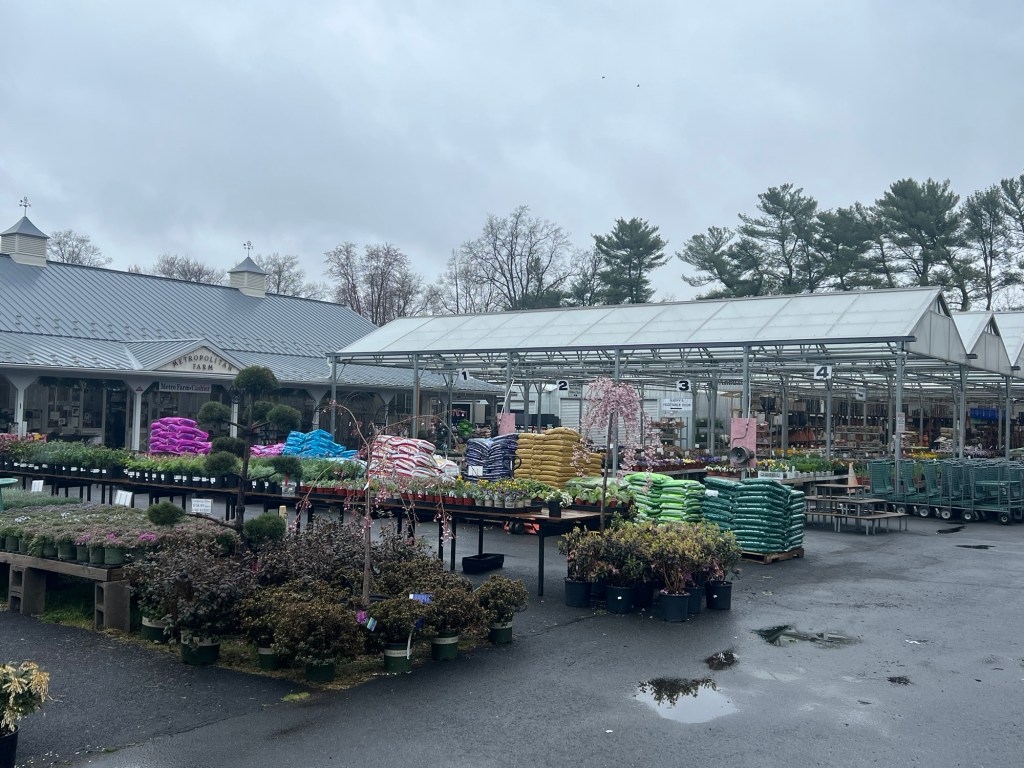
The outside plant and shrubs
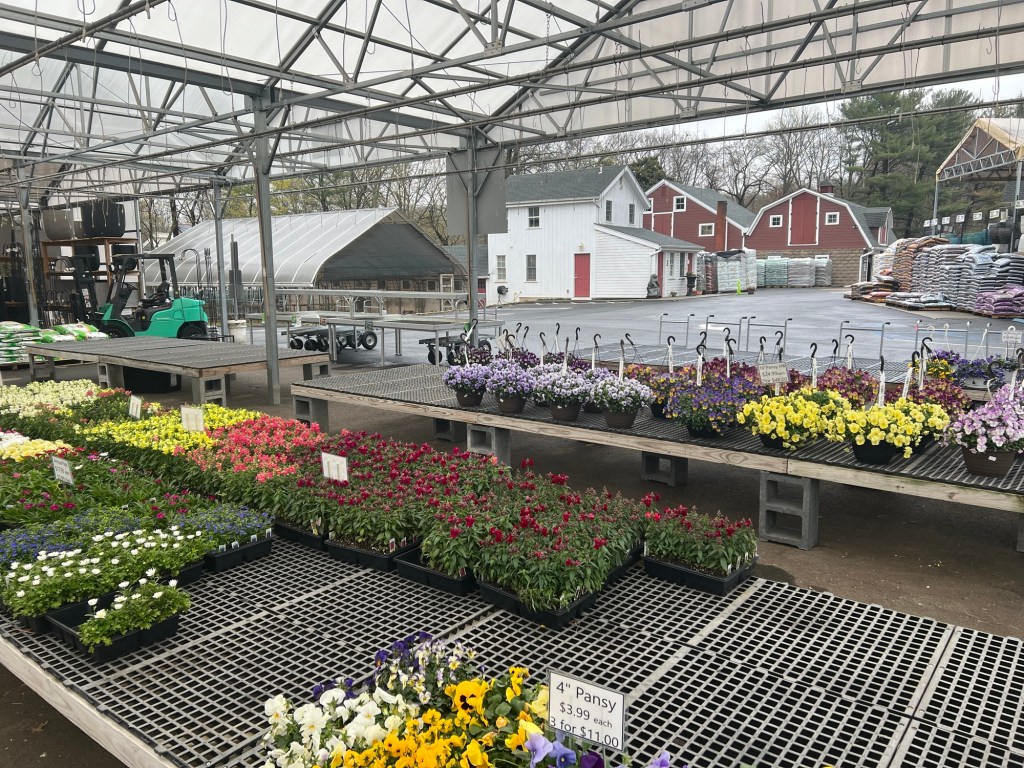
The perennials for sale on the farm

The greenhouse flowers
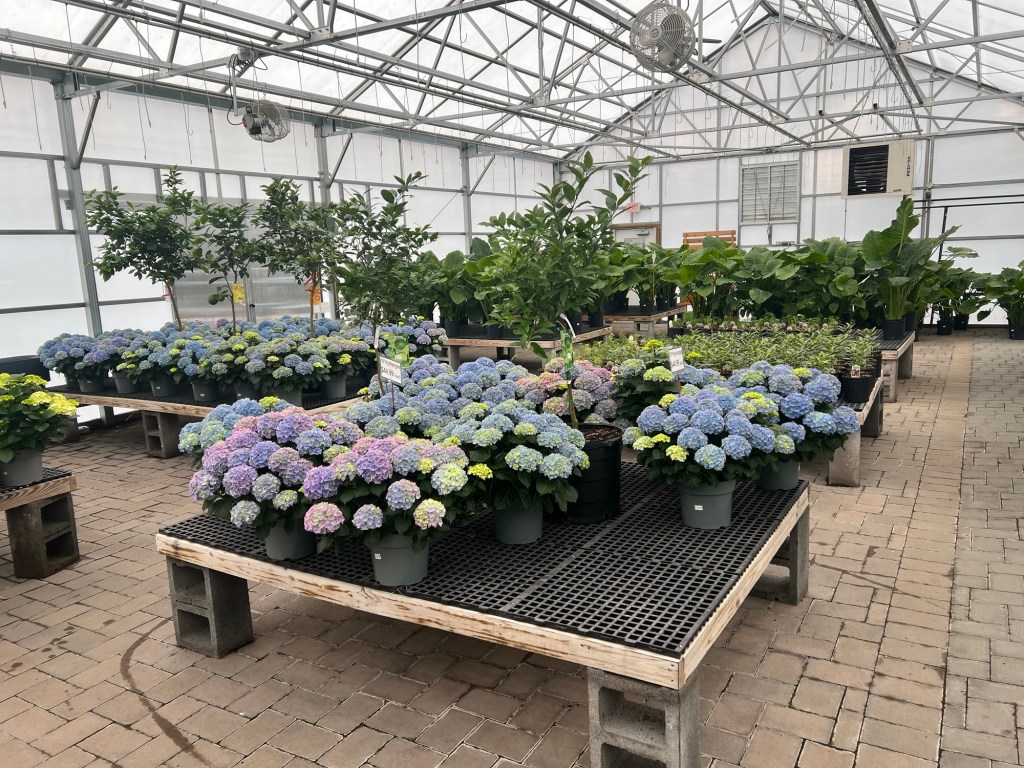
The greenhouse flowers and plants

The inside of the farm store
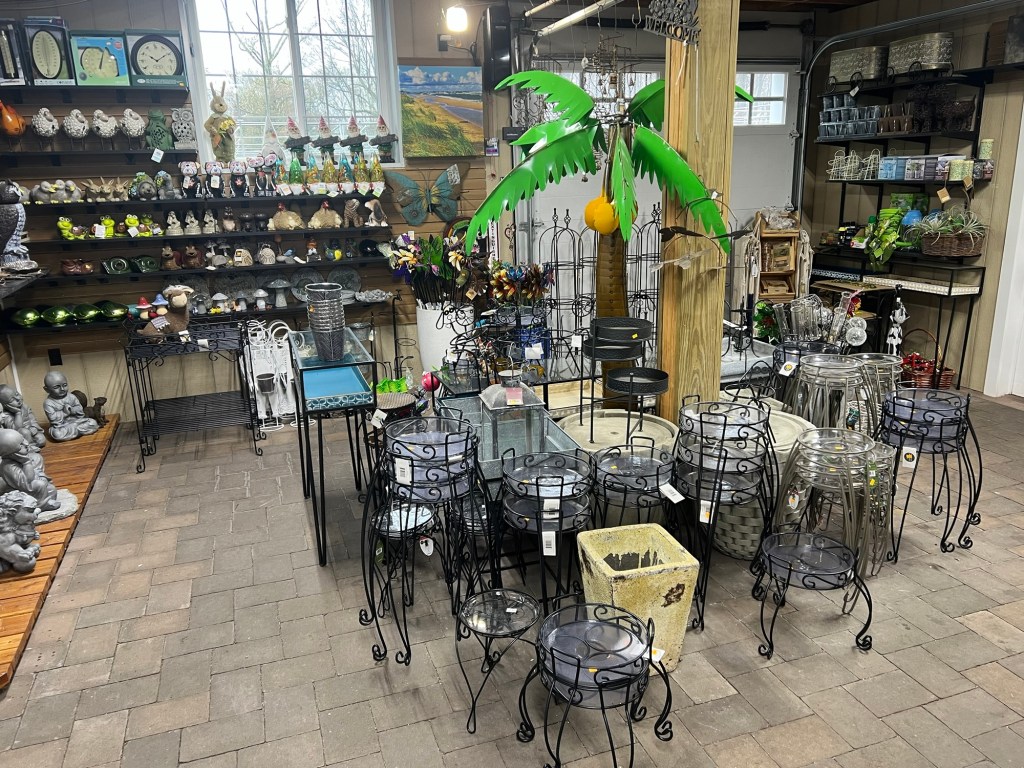
Inside the farm store

The beautiful flowers on sale at the store
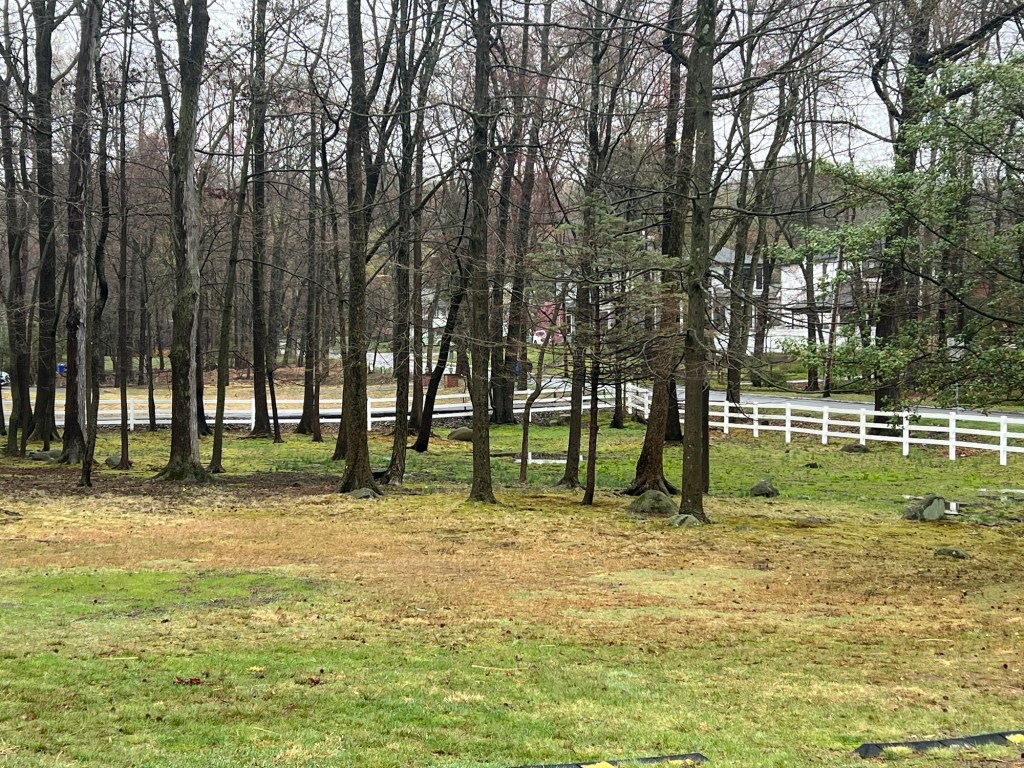
The outside grounds and the property left of this historical farm in Closter, NJ

It is interesting to see how the legacy of this family still lives on in the Twentieth century as a nursery farm but it shows how it has matured and adapted to today’s population.

Some of the descendants of these families still call Bergen County home and are also names we see on streets, towns and schools in the area.
The Harold Hess Lustron House                                         421 Durie Avenue                                                            Closter, NJ 07624

The Harold Hess Lustron House 421 Durie Avenue Closter, NJ 07624

The Harold Hess Lustron House

421 Durie Avenue

Closter, NJ 07624

(201) 784-0600

https://en.wikipedia.org/wiki/Harold_Hess_Lustron_House

https://www.facebook.com/Lustronhouse/

https://closterhistory.com/properties/lustron/index.html

Open: Sunday-Friday Closed/ Second Saturday of the Month 12:00pm-2:00pm

Admission: Free but donations are accepted

My review on TripAdvisor:

https://www.tripadvisor.com/Profile/R4960NKjustinw/photo/798682171?m=19905

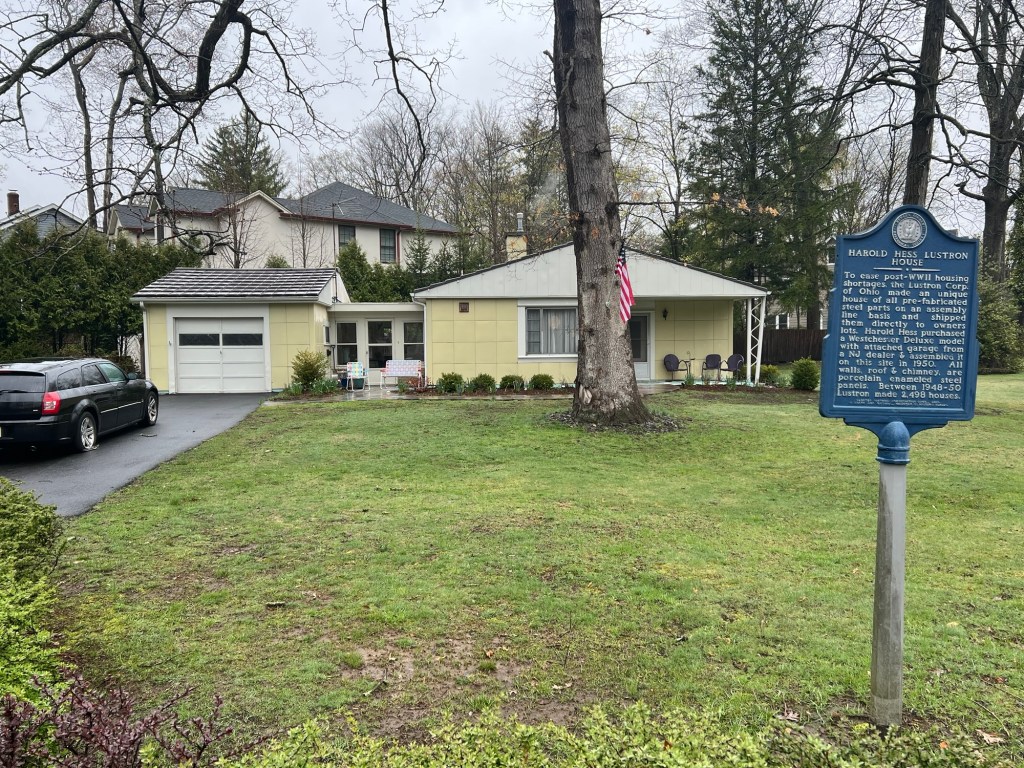
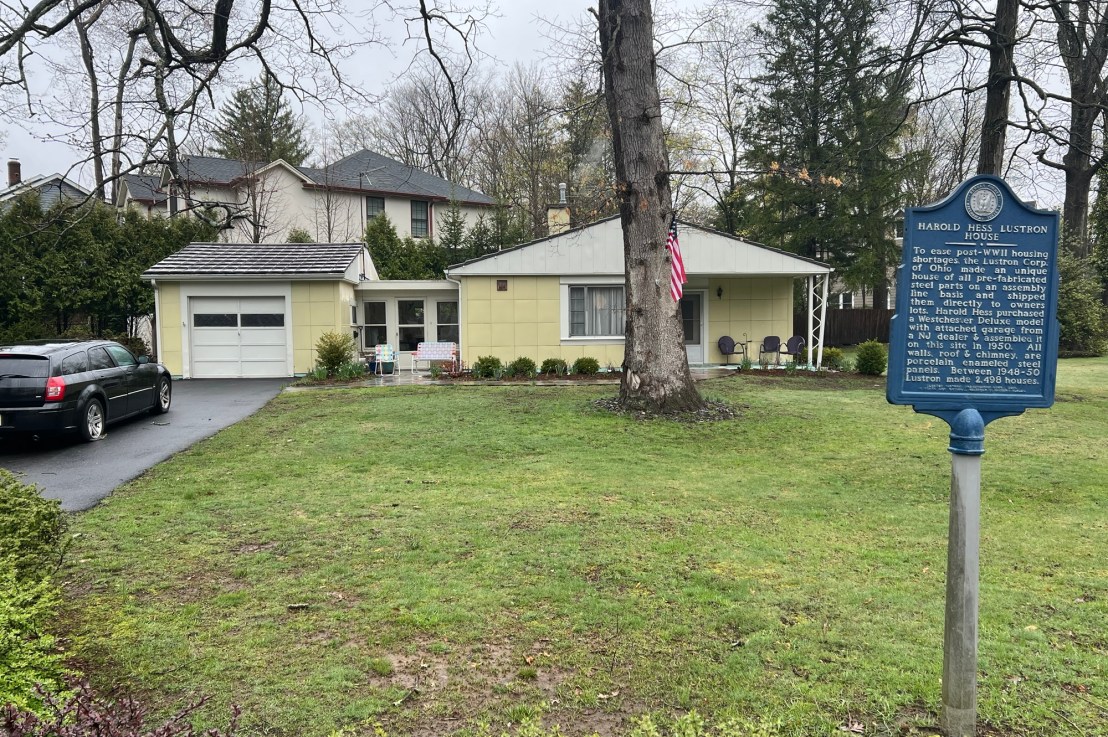
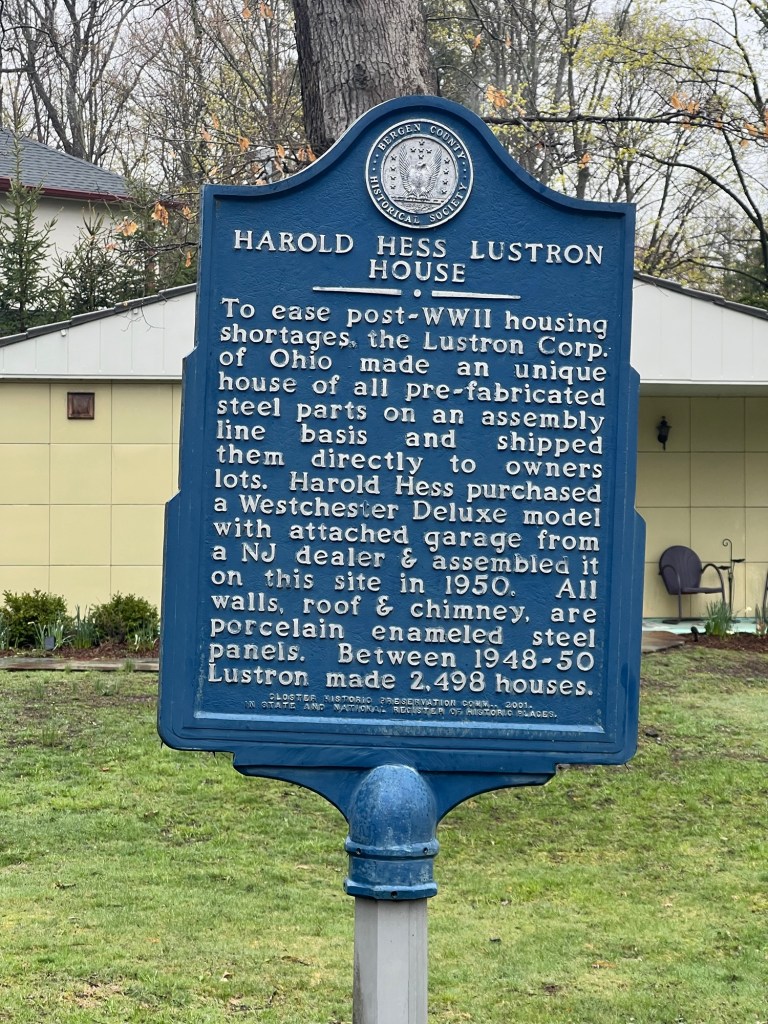
The historic marker outside the Lustron House

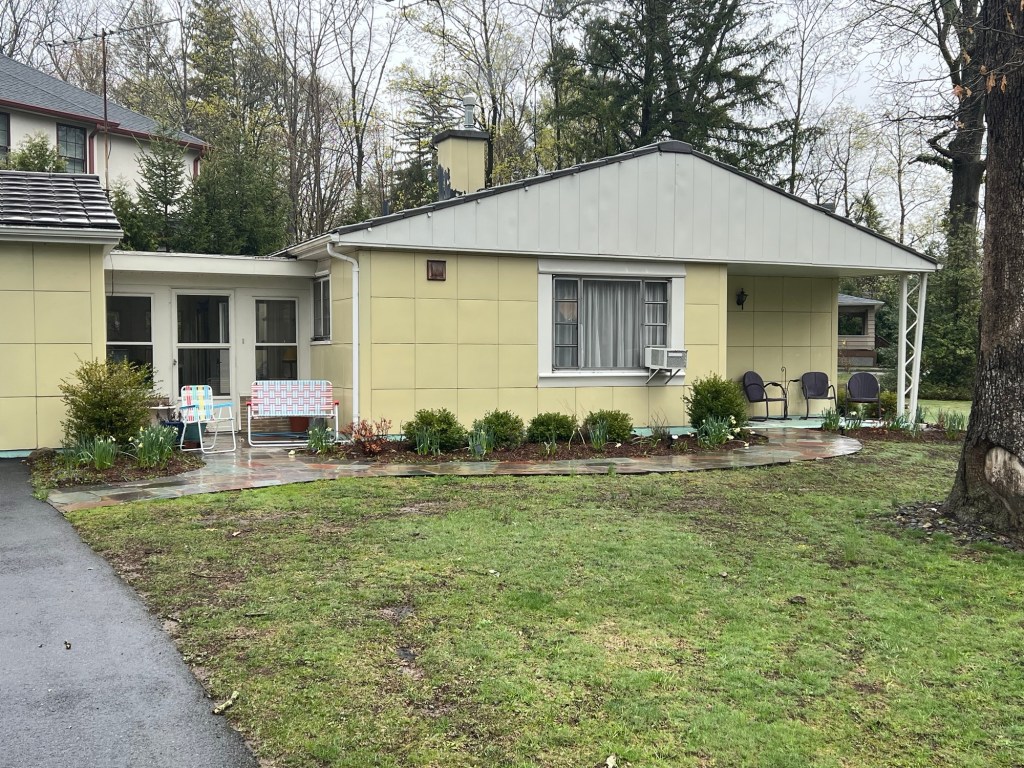
The outside the home

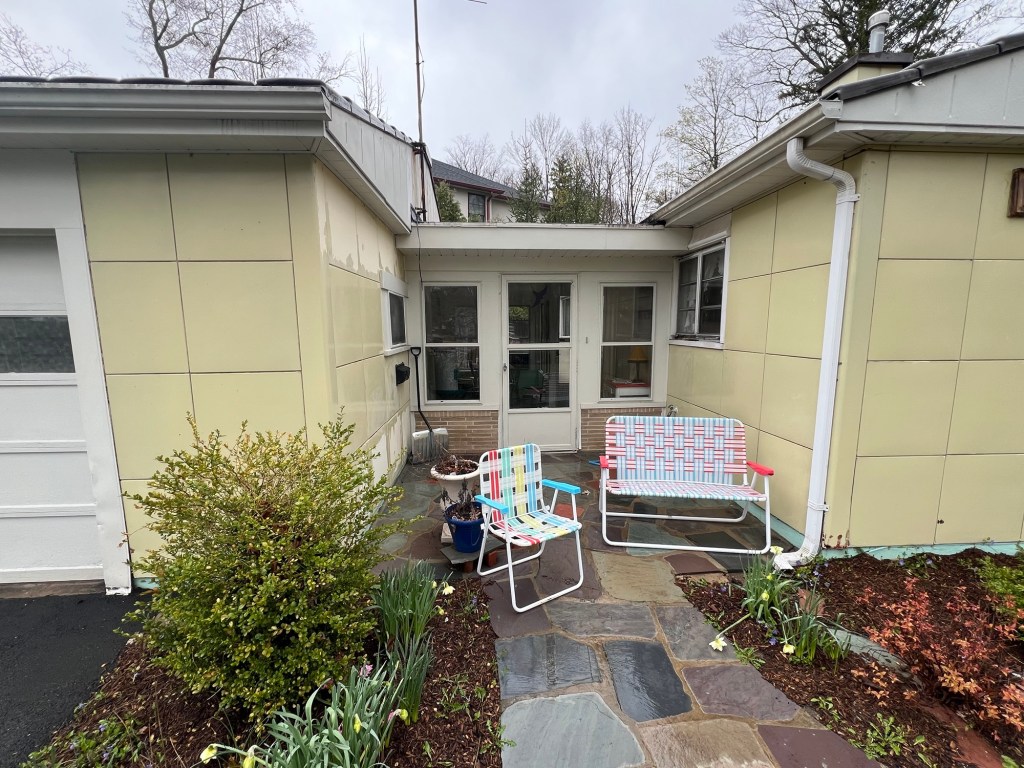
The breezeway and the outside of the house

The breezeway of the home. This was for entrance of the home

Location of the house:

(from the Borough of Closter, NJ website)

The Harold Hess Lustron House, located at 421 Durie Avenue, Closter NJ 07624, is currently owned by the Borough of Closter and is operated as a house museum by the Friends of the Lustron Committee of the Closter Historic Society.  It is open to the public on the second Saturday of each month from noon to 2 p.m. (Boro of Closter, NJ website).

History of the Harold Hess Lustron House:

(from the Borough of Closter, NJ website)

In 1949, Harold Hess, a recently married returning WWII veteran saw a sample Lustron House displayed at Palisades Amusement Park. In 1950, he purchased the Westchester Deluxe model with attached breezeway and one car garage. Originally he wanted the 3 bedroom, two car garage model but felt fortunate to receive what he got as the company was already heading into bankruptcy. Mr. Hess faced six months of planning and zoning board meetings in Fort Lee. He failed to get a permit to erect the modern metal house and turned to the Closter area where more relaxed building codes provided an opportunity to build the novel construction of the all-steel prefabricated house.

World War II vet Hess never lost faith in his house of tomorrow and was the proud owner till his death in 2004. He raised his family here and remained pleased with the house until the end, noting that there were some adjustments such as finding repairmen with enough problem solving creativity to make repairs to a steel house with a combination dishwasher/clothes washing machine next to and filled by the kitchen sink faucet. Other minor matters were hanging pictures with large industrial magnets and interior spring cleaning with automobile wax. The attractive steel walls never need painting or wallpapering so the color scheme never changed.

Closter’s Harold Hess Lustron House, listed on both the state and national registers of historic places, was scheduled for demolition in 2014. Thanks to advocacy by then-mayor Sophie Heymann and positive action by the Zoning Board, an unusual compromise was reached with the developer-owner of the property to donate the historic house to the Borough of Closter. The Borough of Closter applied for a $25,000 grant in 2016 to have a Preservation Plan written for the Lustron House. The grant was awarded by the New Jersey State Historic Preservation Office with monies provided by the National Park Service and did not require any local matching funds. The plan was completed in 2017, work has begun and will be implemented fully over time.

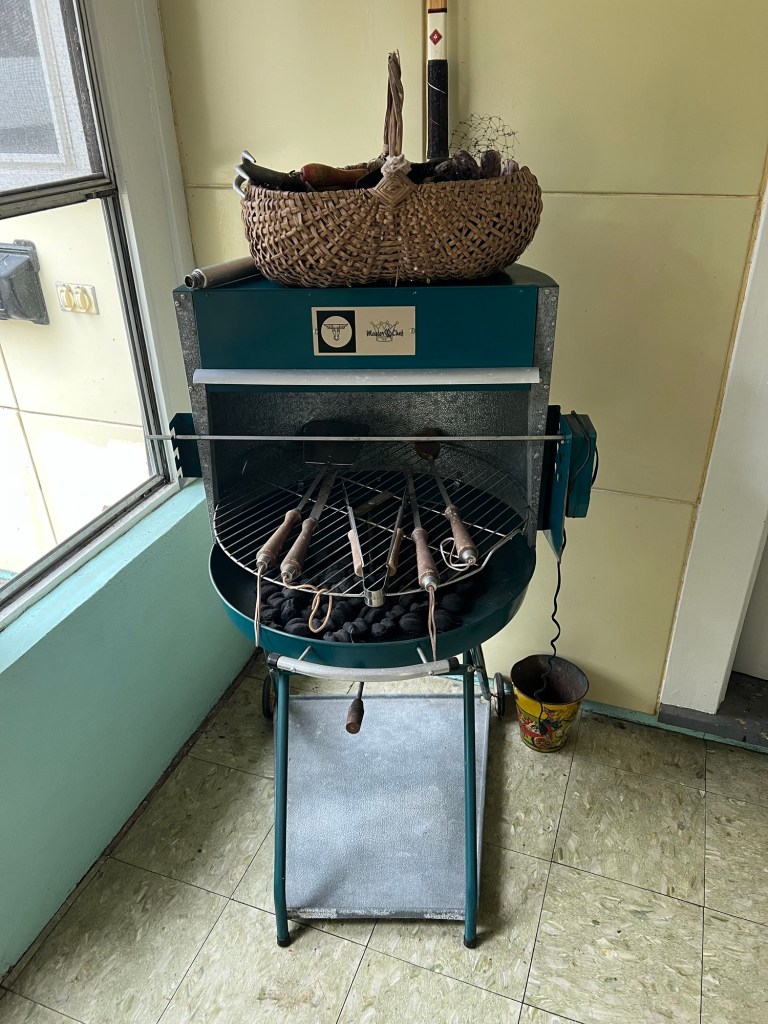
The barbecue grill in the breezeway

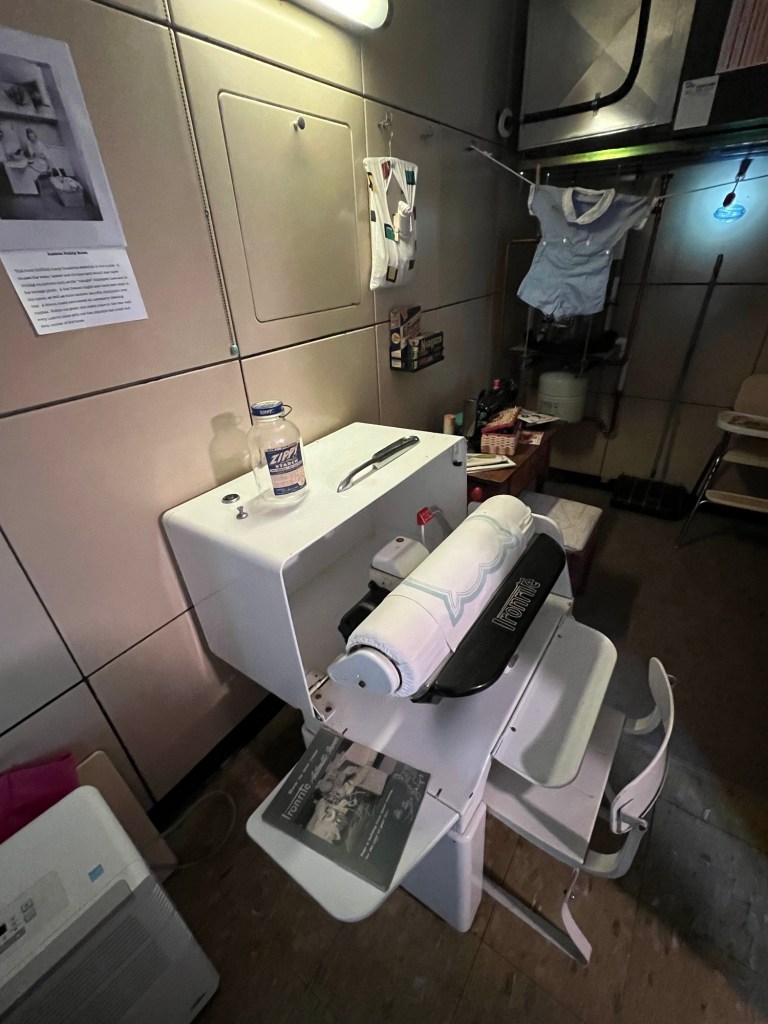
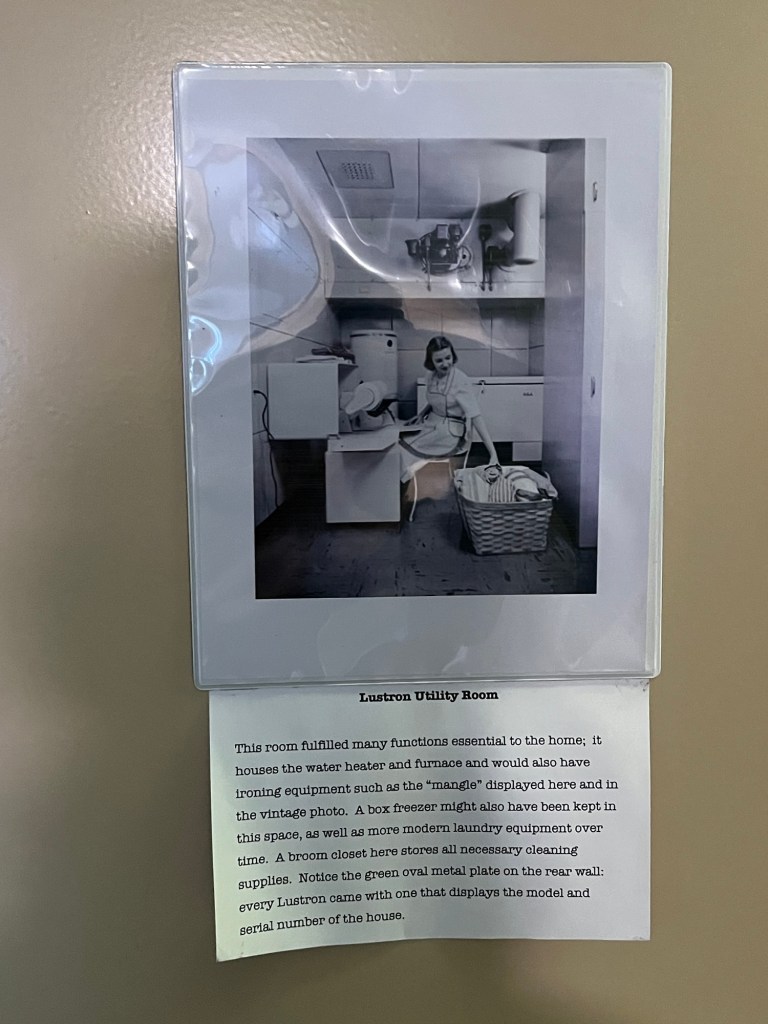
The Laundry Room as you walk into the house

The display on Laundry room

History of the Lustron House: Current day

(from the Borough of Closter, NJ website)

There are only two Lustron houses remaining in Bergen County. The other is located in Alpine and has no local historic preservation protection. Approximately nine have survived statewide and an estimated 1500 remain nationwide.

“Lustron” is a trademarked name that stands for “Luster on Steel.” The shiny efficiency of these homes mirrors the optimism that was felt by this country as its GI’s re- turned home triumphant from the Great War. Lustron homes are one-story ranch-style houses built on concrete slabs. They are very modest in size, averaging 1000 square feet of living space. Most of the Lustrons built were two- bedroom models, although a three-bedroom model did be- come available towards the end of production.

The Lustron house was the brainchild of Carl G. Strandlund, who saw the possibilities of utilizing steel left behind from the war effort to create needed housing. Strandlund had previously worked for the Chicago Vitreous Enamel Products Company that manufactured steel enamelware for refrigerators, stoves, and other household appliances. Connecting this technology to the housing industry was the ticket to success in securing federal funding necessary to start production. The Lustron Corporation opened a one-million-square-foot plant in Columbus, Ohio in 1947. But just as quickly as the company’s star rose, it plummeted, and the Lustron Corporation closed in 1950 due to overwhelming debt.

Elements of streamline design abound in Lustron homes, which feature built-in vanities, bookshelves and dining room/kitchen cabinetry, as well as pocket doors and sliding closet doors – all made of porcelain-enameled steel. Lustron homes were marketed as having “cheerful convenience” and “easy-to-keep-clean brightness.” They cost approximately $10,000 each and came in four colors: maize yellow, surf blue, desert tan and dove gray. All of the pieces of a Lustron home could be carried to the building site in one specially designed truck, and construction could be completed in as little as one week.

Interesting features of the Lustron house included the “Thor” dishwasher-clothes washing machine that was located in the cabinetry next to the kitchen sink. Another unique aspect of these homes was the heating system, which supplied radiant heat through a plenum chamber in the space above the metal ceiling panels. Each Lustron house came fitted with a metal identification tag stamped with the model and serial numbers and located on the back wall of the utility room.

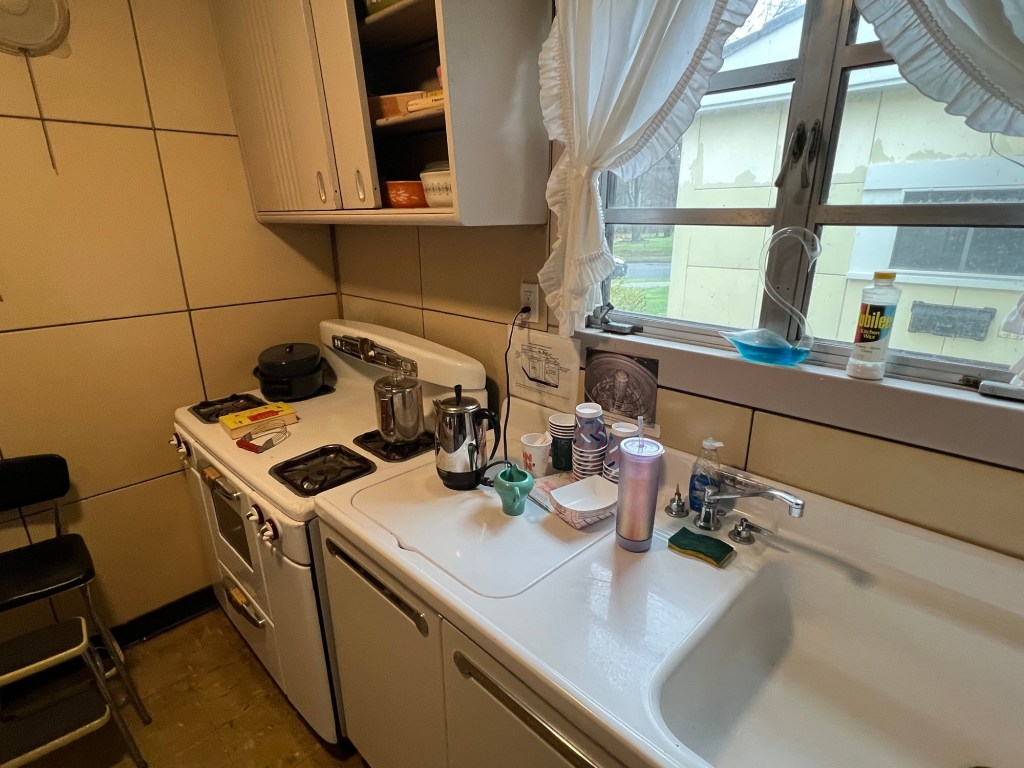
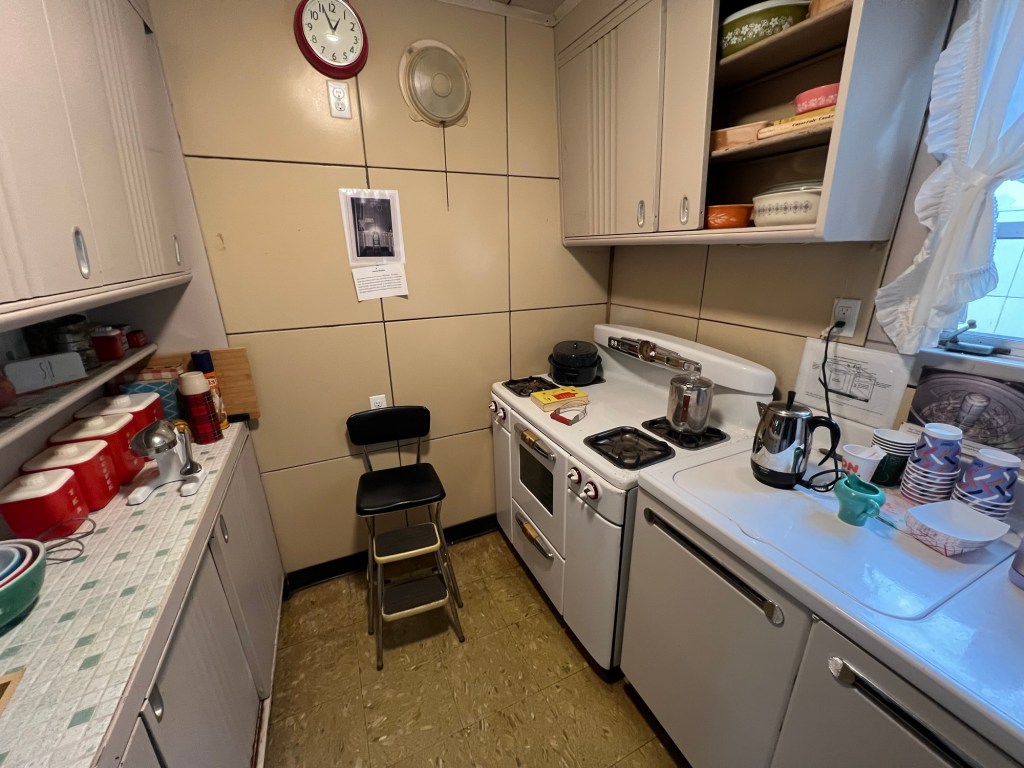
The kitchen looked like a complete replica of my grandmother’s and my aunt and mother’s houses in the late 1960’s and early 70’s.

The late 1950’s kitchen

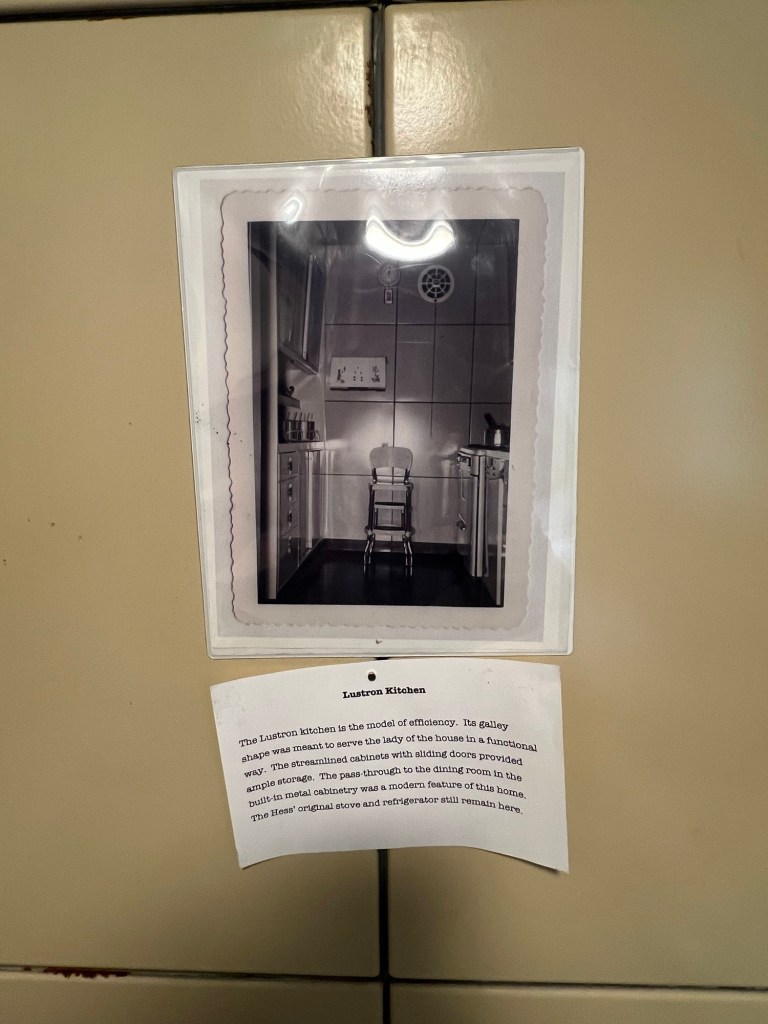
The kitchen of the past

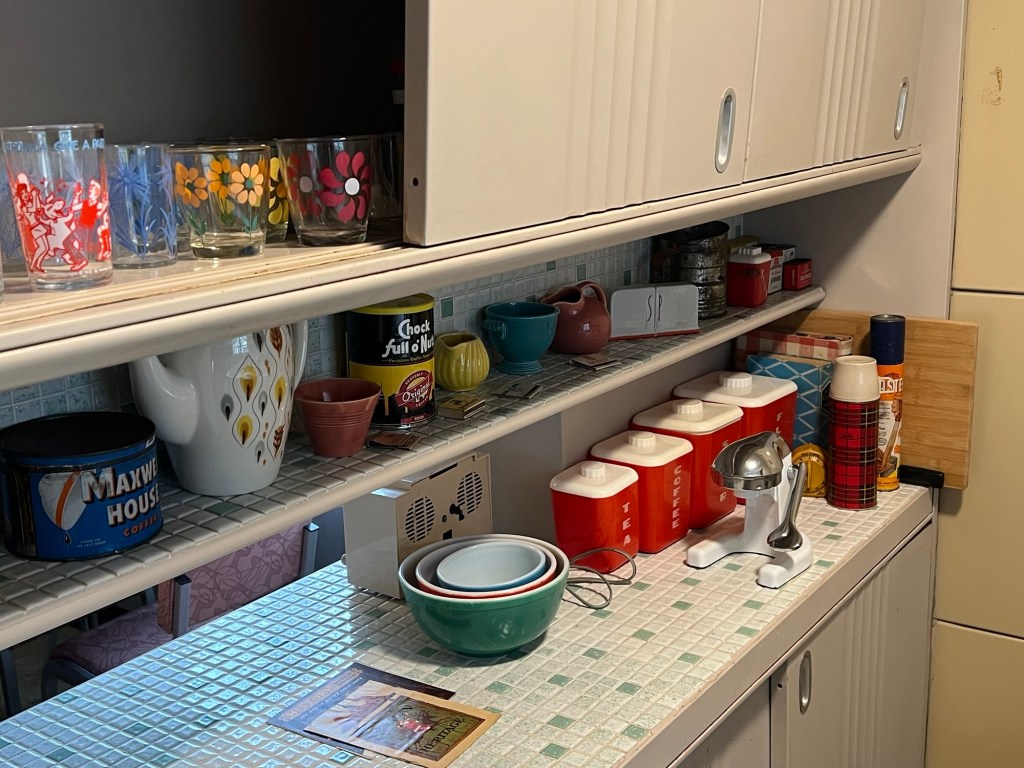
A closer look to the kitchen of the past

The kitchen’s of the past were designed for efficiency but not for socialization. This is why kitchens have grown over the last seventy years to accommodate socialization of everyone ending up in the kitchen.

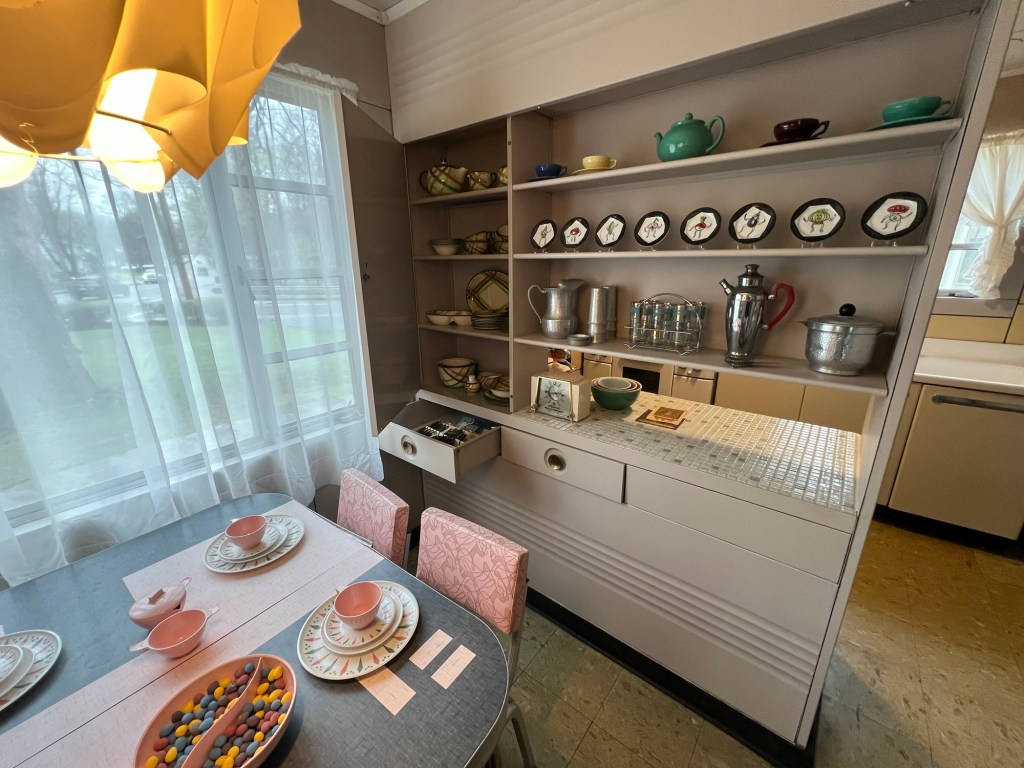
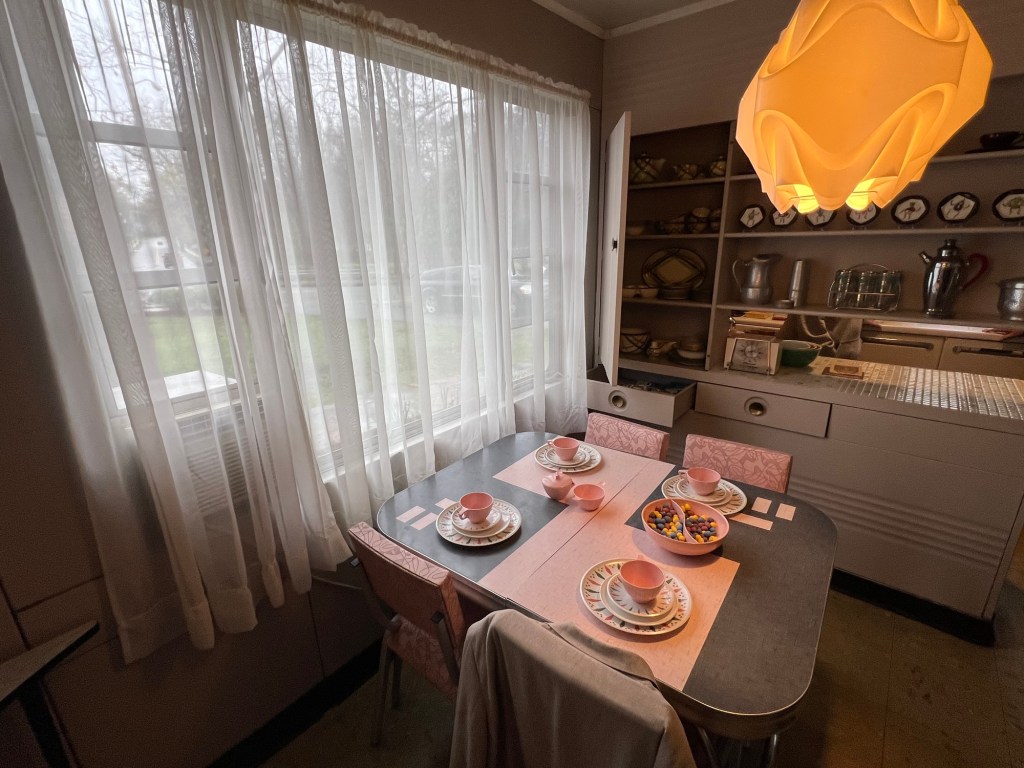
The Dining Room area off the kitchen

The seating area for the family had lots of light but could be quite tight

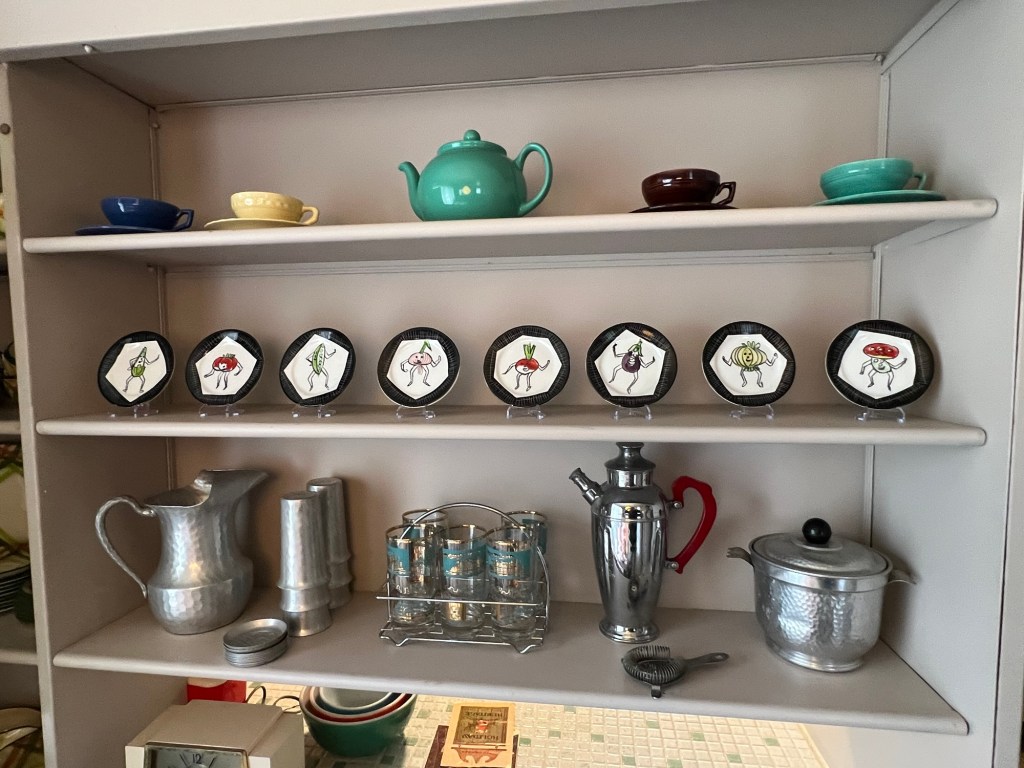
Everything was in its place on the shelves

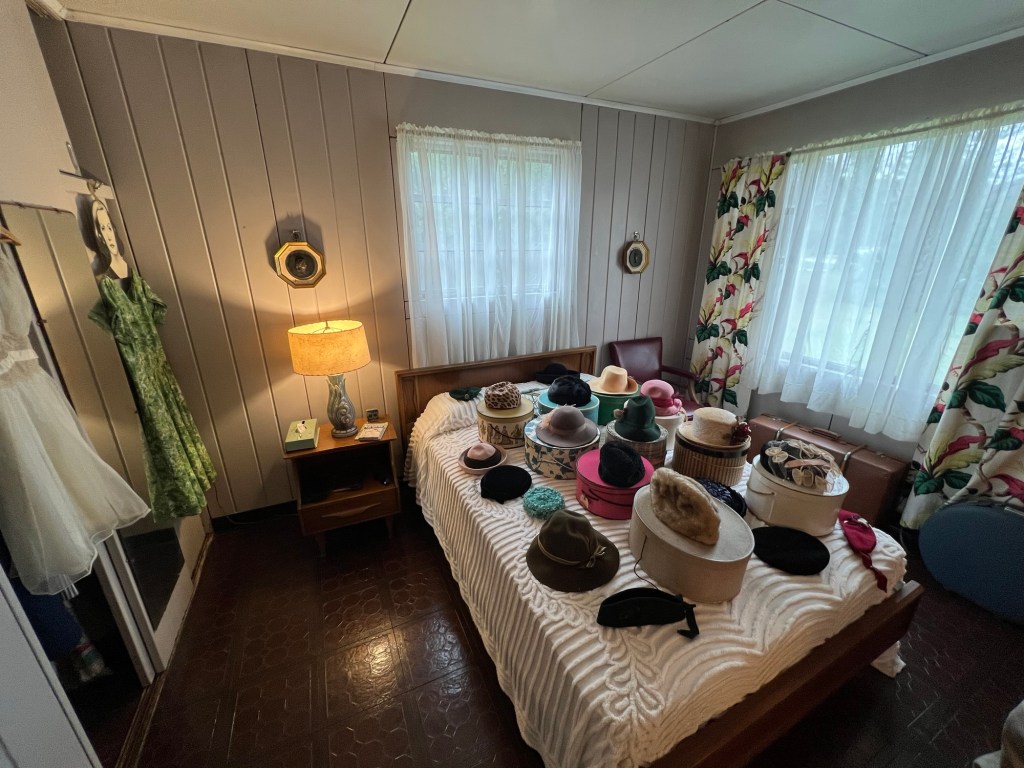
The next part of the tour was the bedrooms which were off to the back of the house. Each was decorated with period clothing, furniture and other Knick knacks.

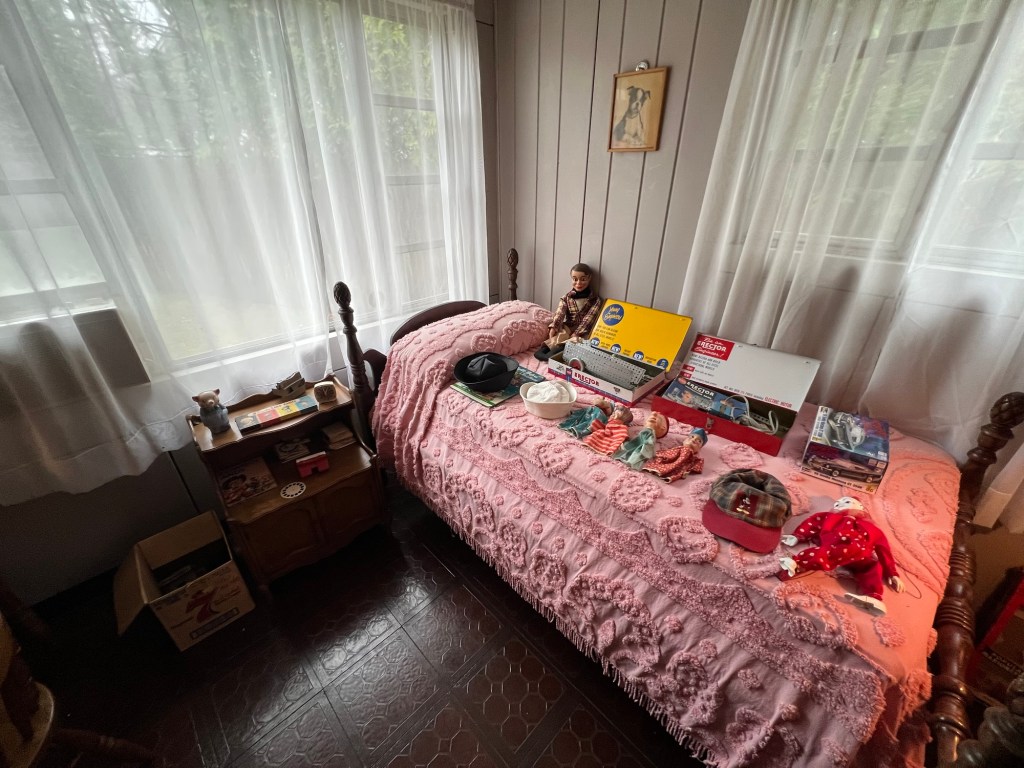
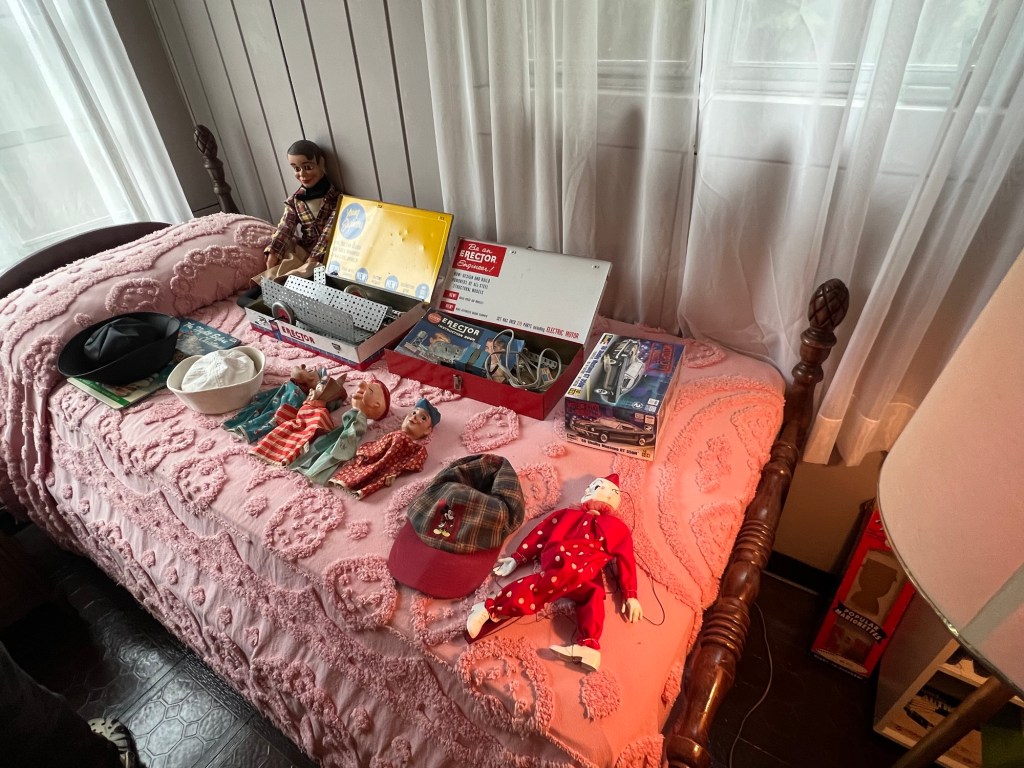
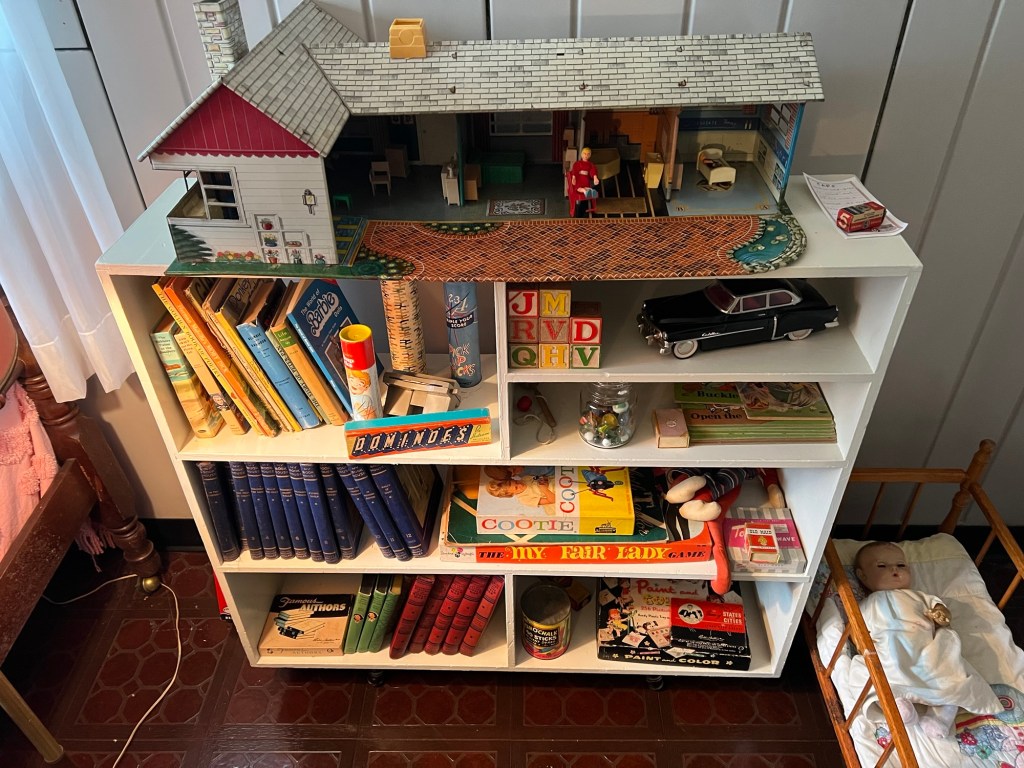
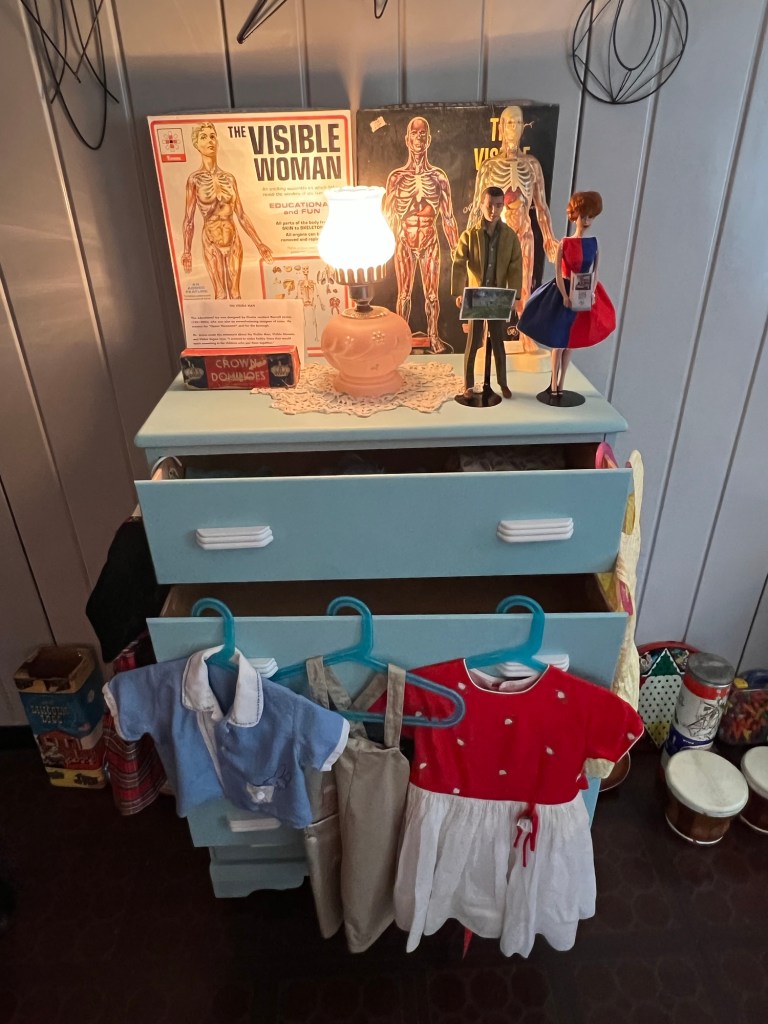
The Children’s bedroom was the first stop. I saw many toys from my childhood.

The bed had all sorts of puppets and games on it

The shelves were lined with books and board games from the era of the late 50’s and 60’s

Vintage science sets and clothing were on display in the Children’s room

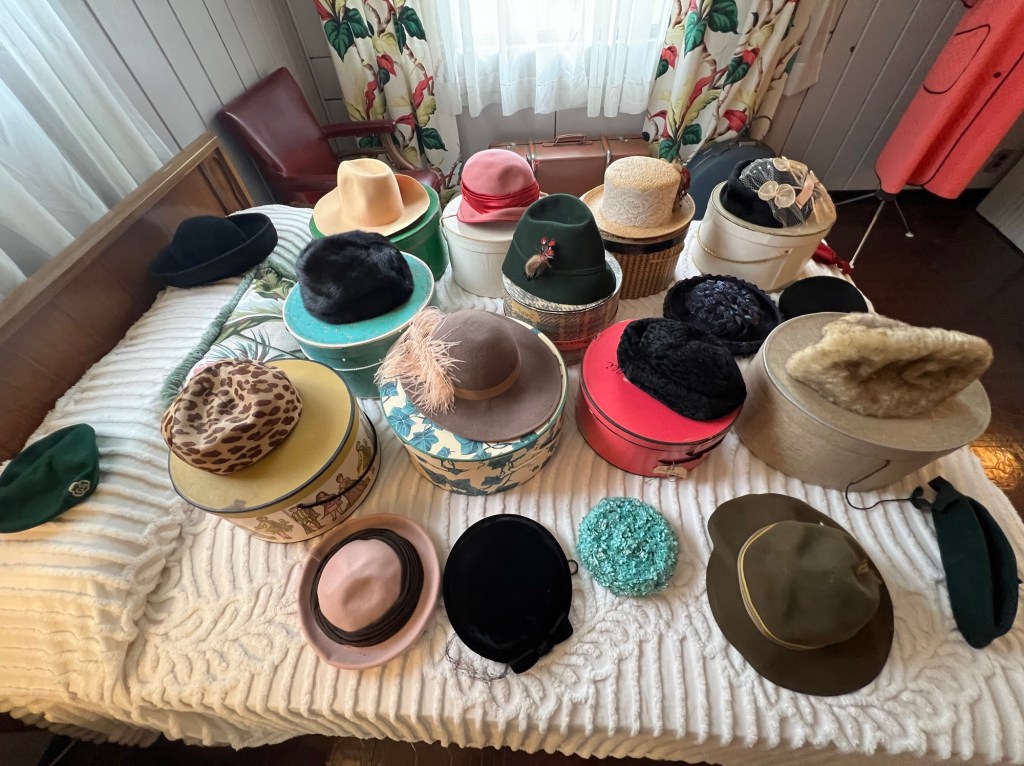
The Master Bedroom had a display of Easter hats

The selection of hats from the 1950’s and 60’s

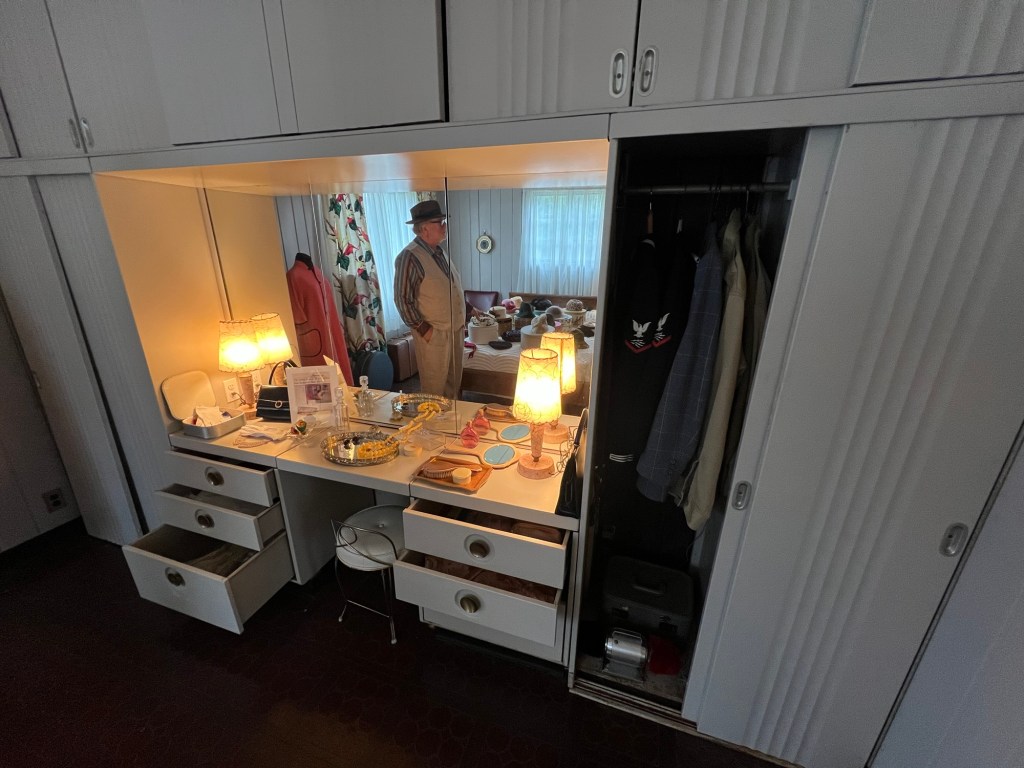
The Vanity was stocked with jewelry and perfume while the drawers were filled with girdles, white gloves and corsets

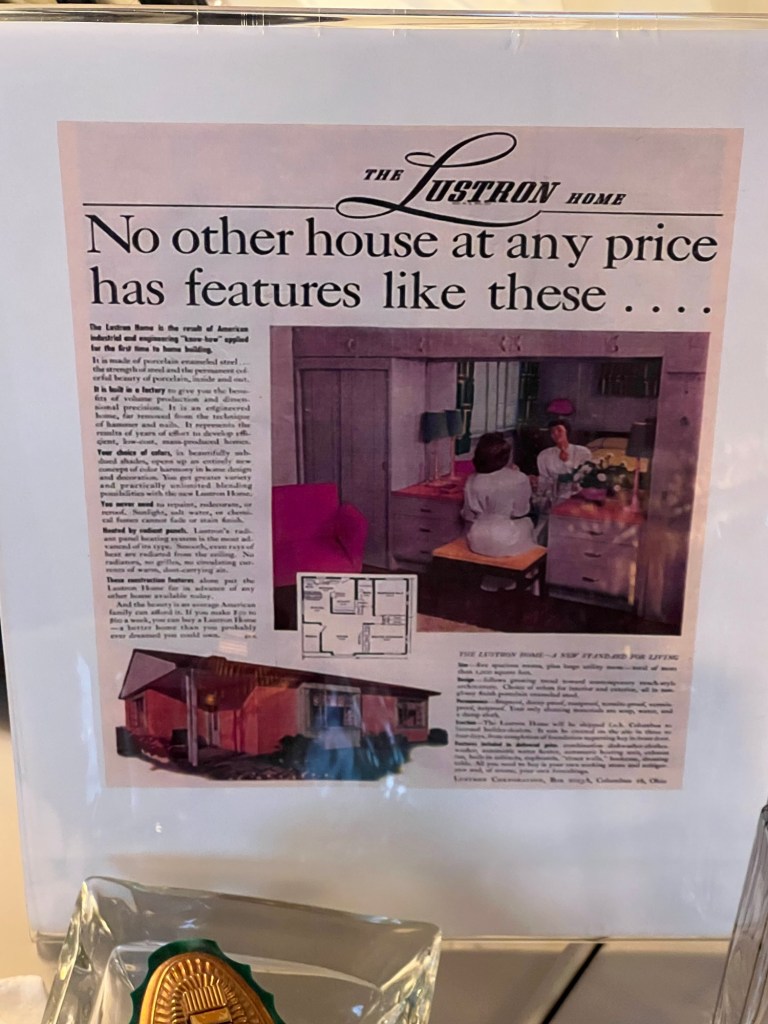
The advertising for this home offered all the wonderful amenities

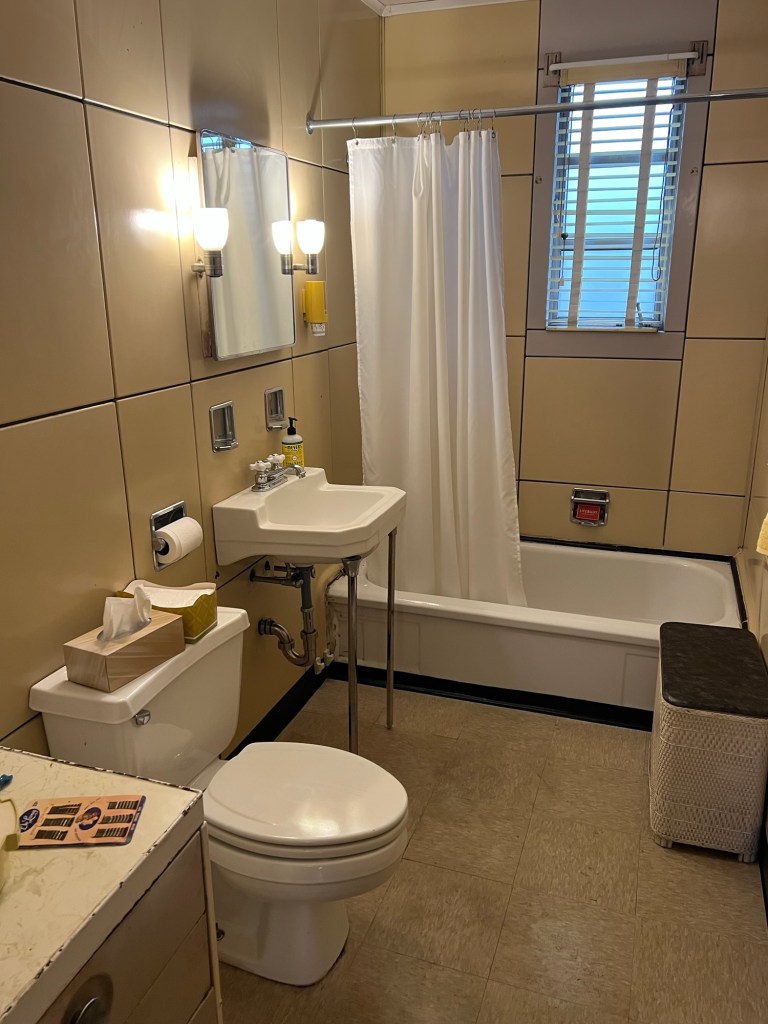
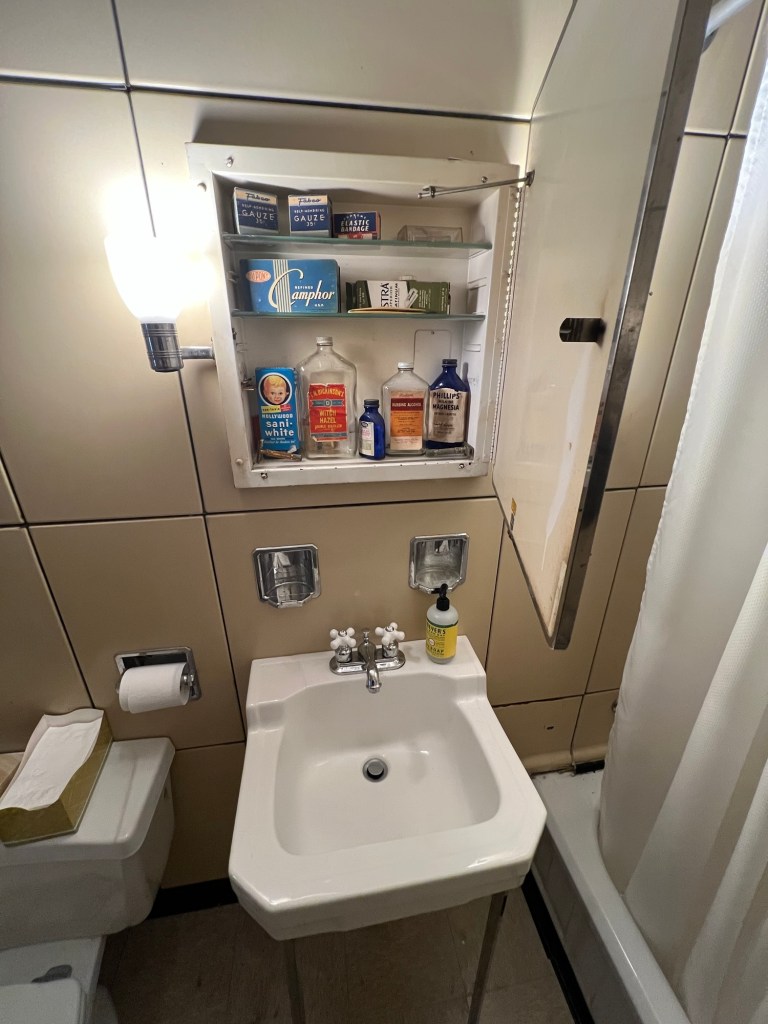
We next moved onto the bathroom which looked like my old bathroom before the renovation

The bathroom

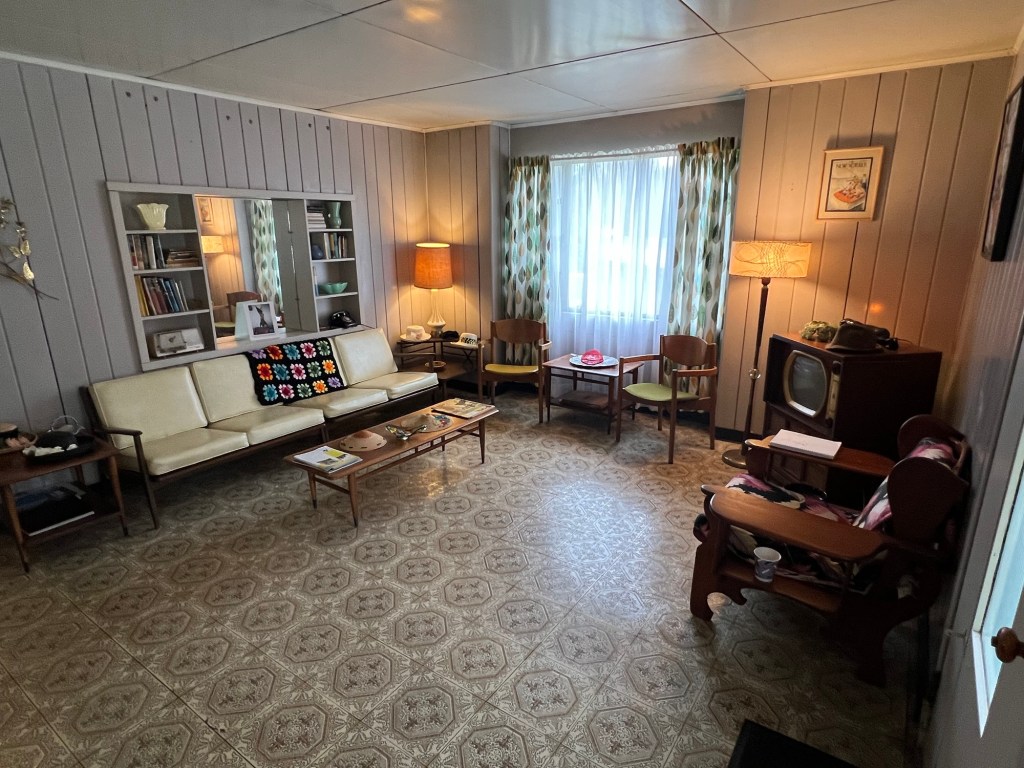
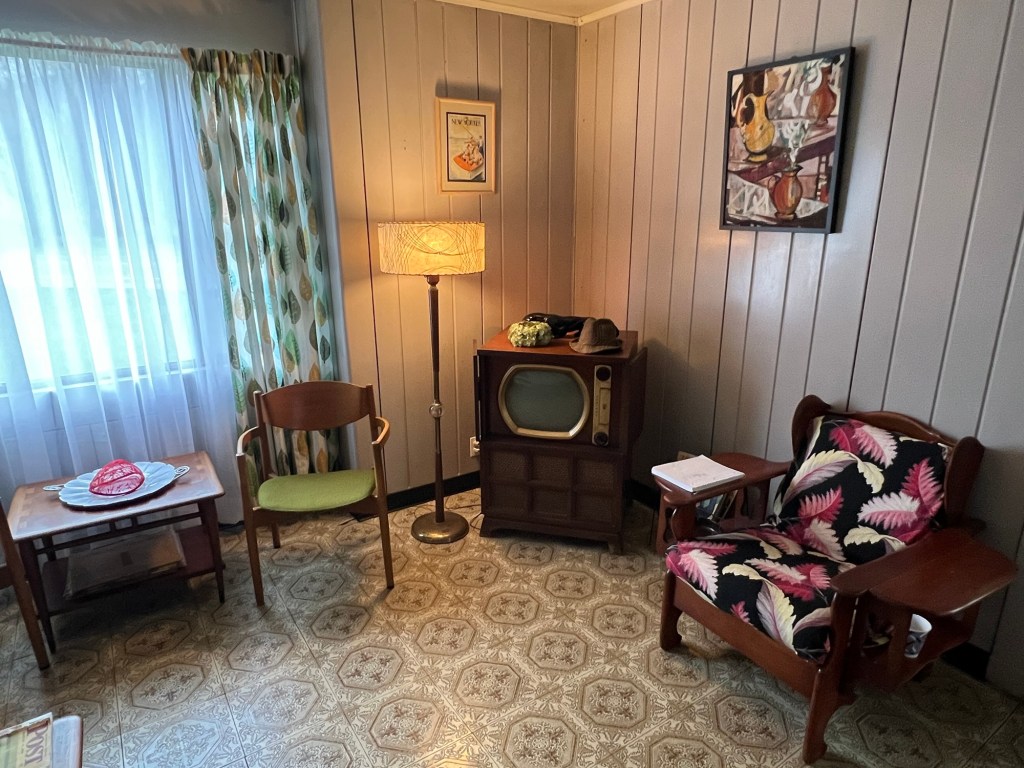
The last room we toured was the Living Room. The room was designed with Danish inspired furniture and clean lines. The room is full of furnishings and decorations from the 1960’s and 70’s done in the Modern Danish look. The room has a very early 1970’s feel about it.

The Living Room

The Living Room

As we finished our tour of the house, we passed through the breezeway again and the patio area. There was an outdoor seating area on the patio.
The Patio just outside the breezeway

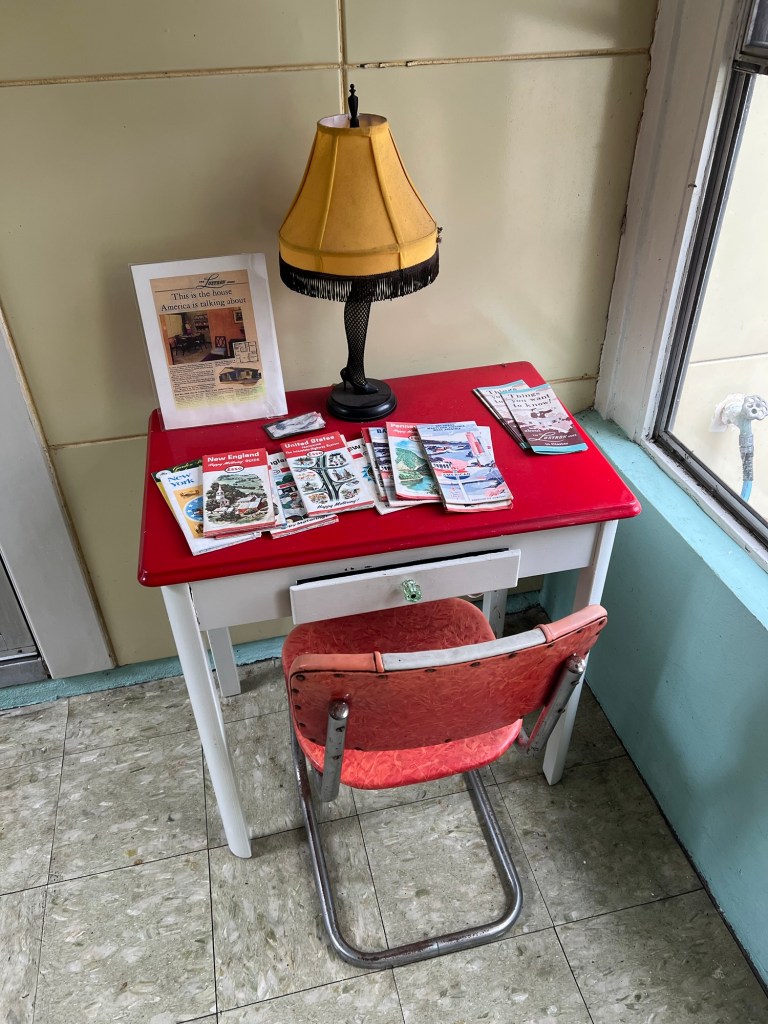
The private desk just outside the breezeway

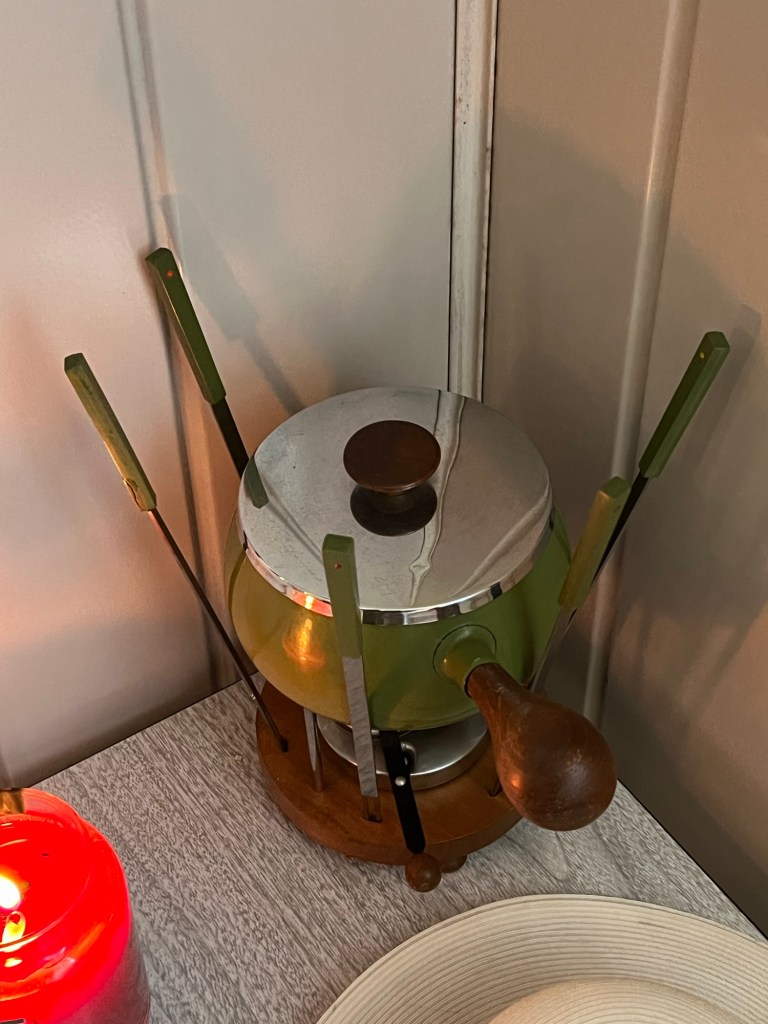
The fondue pot in the corner

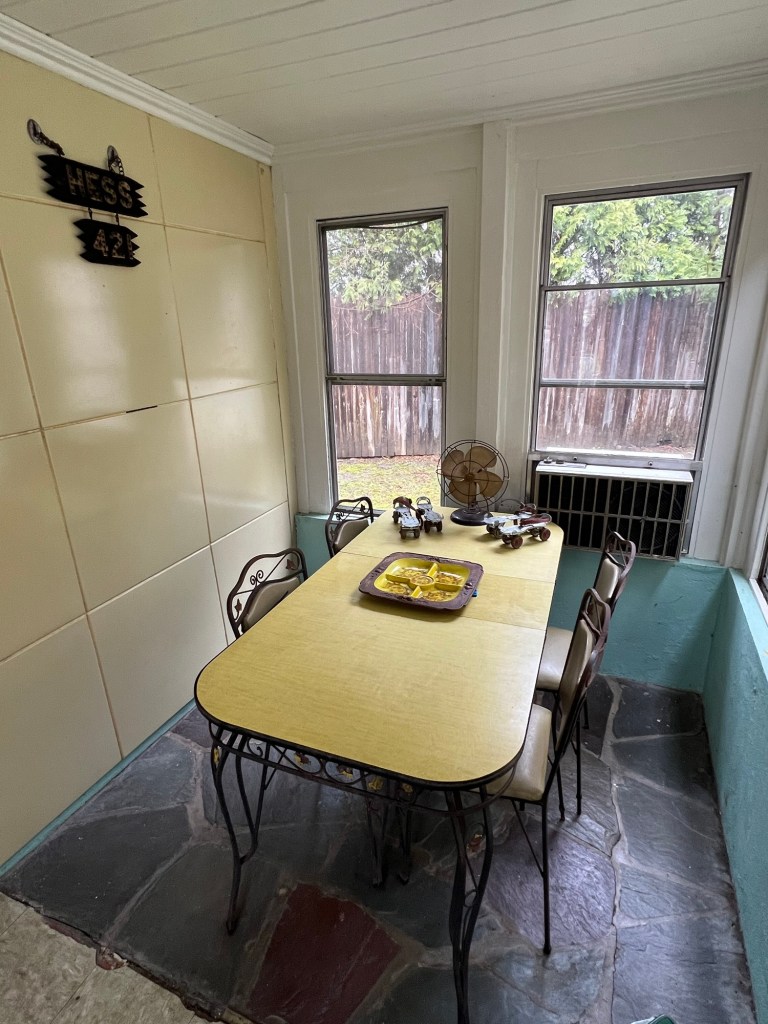
The table on the breezeway

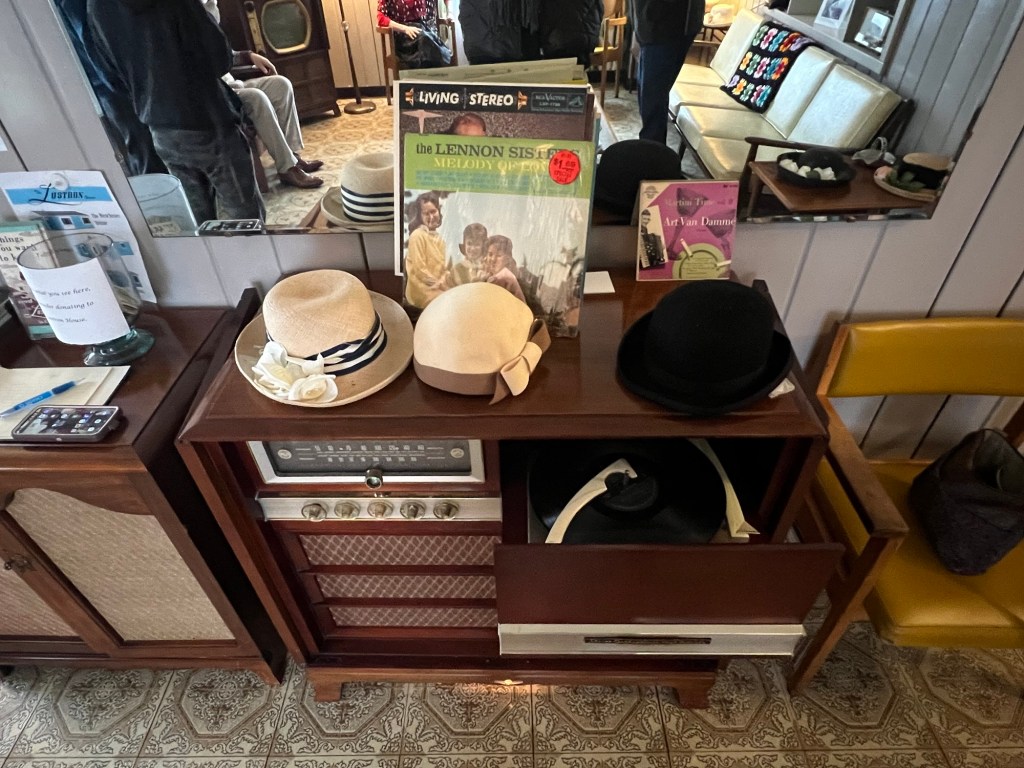
When I got back into the house from the outside, I toured one more time and walked around the Living Room. That’s when they showed us the record player.

Seemed like a good place to hide the household’s records

It really was like walking through a time capsule of my past. As I walked through every room, I felt like I was going to see my Grandmother and Great Aunt walking through the door and my mother in her early 30’s yelling at us again to get off her furniture. For a Gen X visitor, it is a step back into our past. What a unique museum.

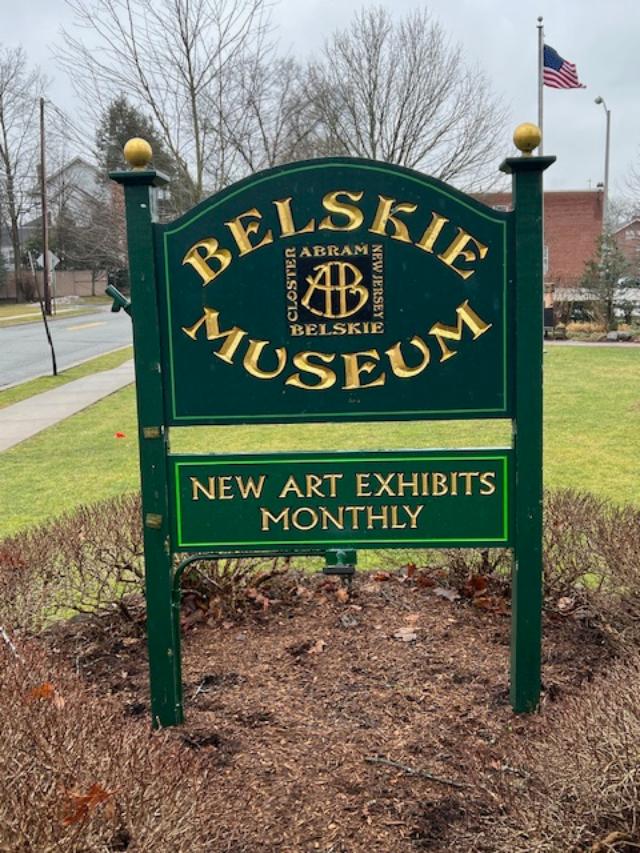
The Belskie Museum of Art & Science, Inc.                           280 High Street                                                                    Closter, NJ 07624

The Belskie Museum of Art & Science, Inc. 280 High Street Closter, NJ 07624

The Belskie Museum of Art & Science Inc.

280 High Street

Closter, NJ  07624

(201) 768-0286

http://www.belskiemuseum.com

http://www.belskiemuseum.com/homepage.asp

https://www.facebook.com/Belskie-Museum-of-Art-Science-184088978288696/

Open: Saturday & Sunday  1:00pm-5:00pm

Free Admission

Closed July and August

TripAdvisor Review:

https://www.tripadvisor.com/Attraction_Review-g46367-d13833492-Reviews-Belskie_Museum_of_Art_Science-Closter_New_Jersey.html?m=19905

The History:

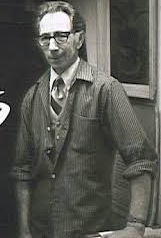
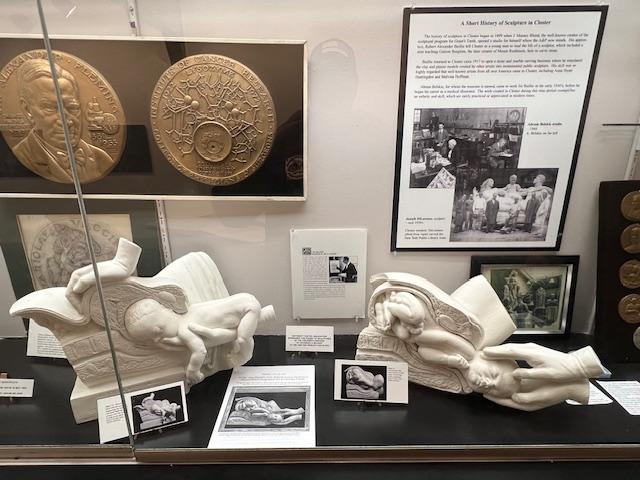
The Belskie Museum, a tax exempt non-profit corporation, was founded in Closter, New Jersey in 1993 to save, restore and exhibit the works of Abram Belskie (1907-1988), one of our country’s most accomplished sculptors and one of the most eminent medical of times.

Abrame Belskie

Abram Belskie

https://americanart.si.edu/artist/abram-belskie-332

Mr. Belskie was a resident of Closter his entire adult life.

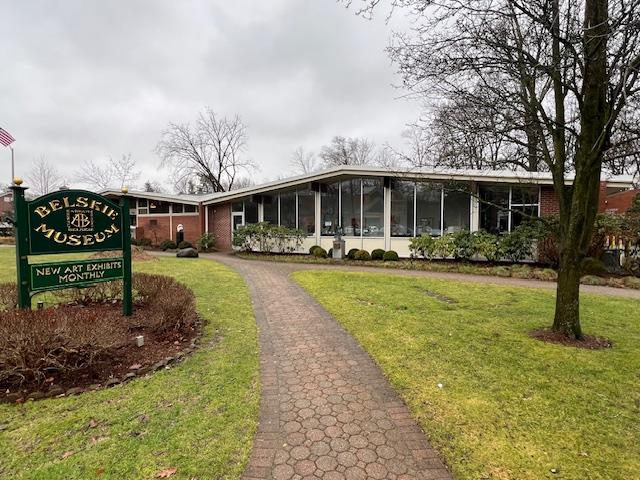
The museum’s 3,900 square feet modern building was built entirely by the Closter Lions Club and donated to the Borough of Closter upon its completion in 1994.

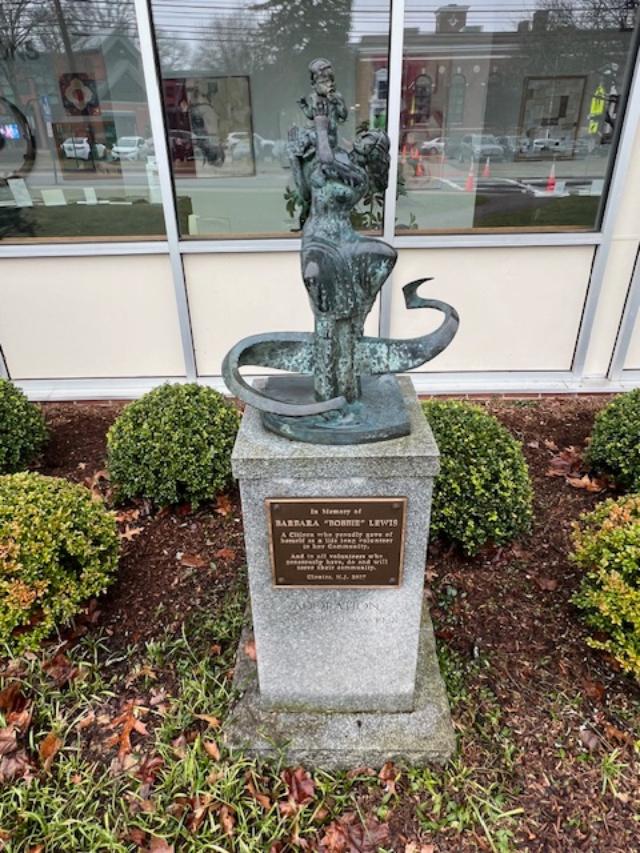
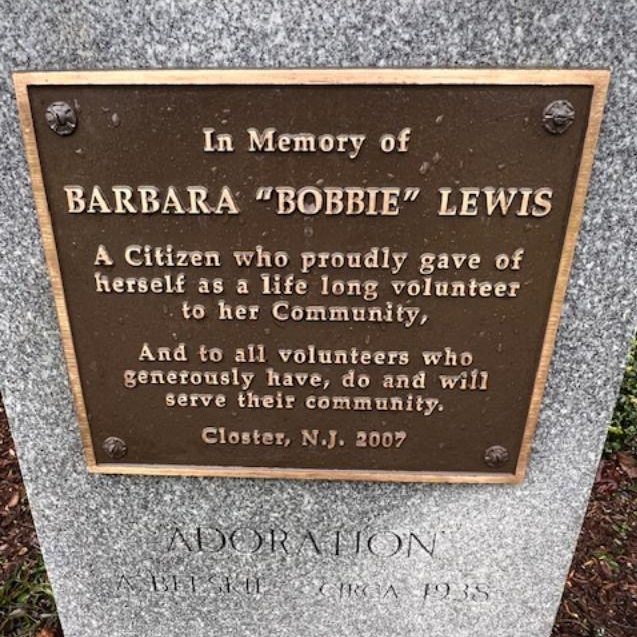
The Memorial Statue “Adoration” outside the museum.

In addition to housing the many works of Abram Belskie, the museum also hosts monthly art exhibits by local, national and international artists and as a result, has become one of Bergen County’s leading forum for the arts.

The Belskie Collection of Art:

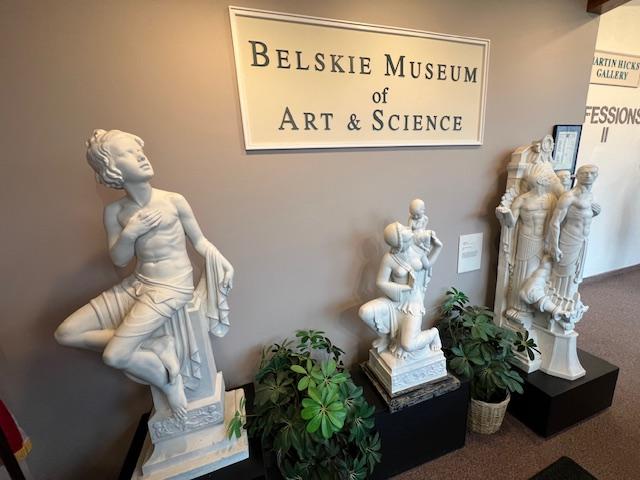
The entrance of the Belskie Museum with the works of Mr. Belskie

Past exhibitors include the estate of world famous photographer Andre Kertesz and Italian painter/sculptors Emilio & Ugo Baracco. A featured exhibit of photography in March 2003 was by Academy Award and Tony Award winning actress Ellen Burstyn. The museum also hosts exhibits from the local schools and colleges and many local artists.

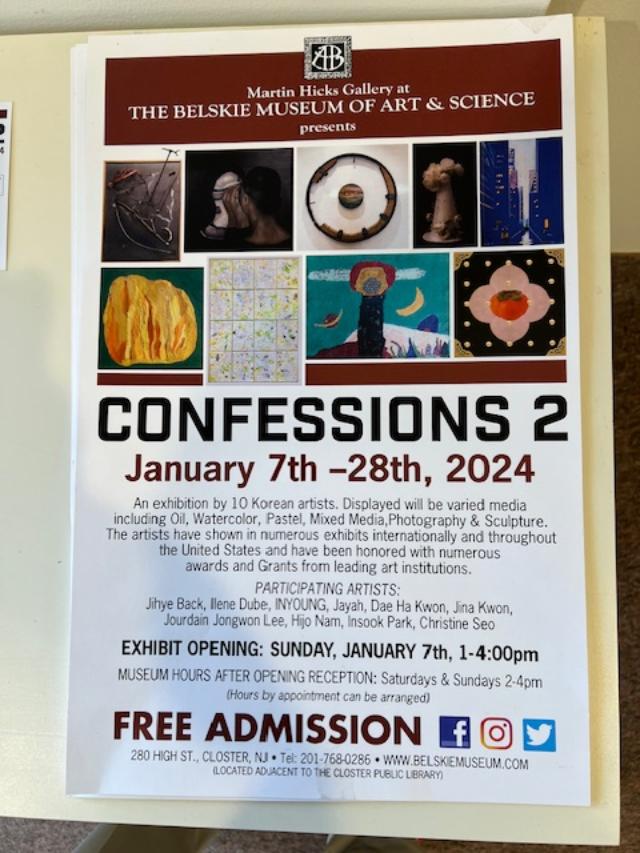
In January of 2024, the museum hosted the exhibition ‘Confessions Two’, featuring the works ten Korean artists displaying varied media including oil, watercolor, pastels, mixed media, photography and sculpture.

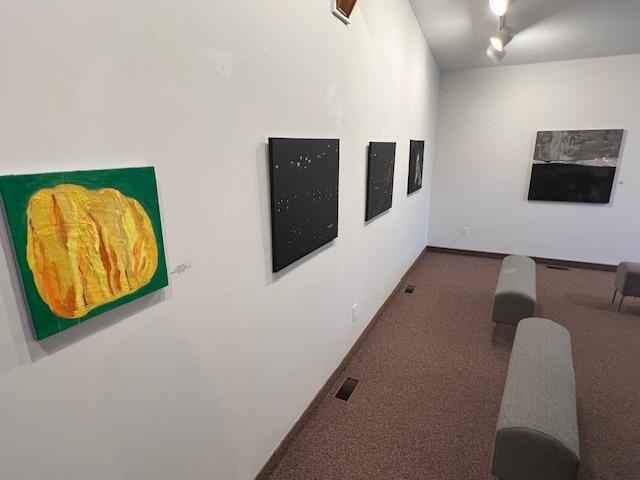
The “Confessions Two” Exhibition of Korean art.

The Gallery featuring the exhibition “Confessions Two”

The museum is operated entirely by volunteers under the direction of a six-member Board of Directors (also entirely volunteer) appointed by the Borough of Closter, The Closter Lions Club and the Closter Public Library Trustees. Funding is from grants, memberships, fundraising exhibitions and donors. The museum has new art, history and science exhibits throughout the year. Open on Saturdays, Sundays and by appointment.

The works of Abram Belskie are in the back gallery.

Disclaimer: This information was taken directly from The Belskie Museum of Art & Science Inc. pamphlet. Please call the above number or email them for more information of hours of operation. The museum does change their exhibitions almost every month.