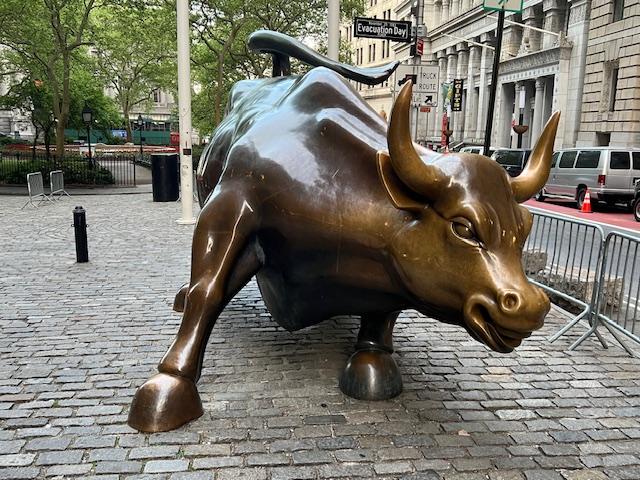
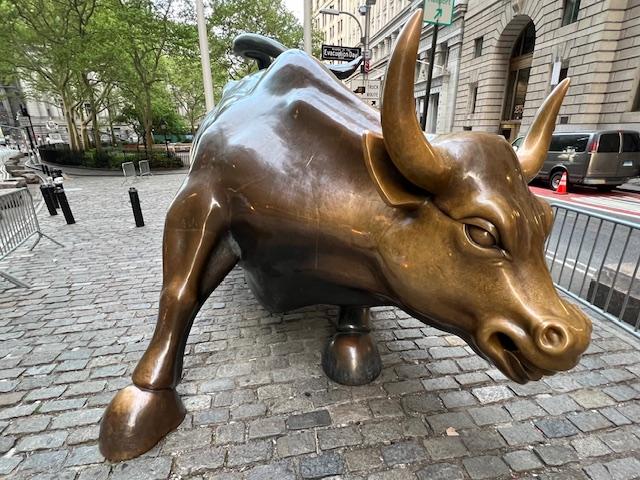
When you are in lower Manhattan and are visiting the Battery Park and/or Wall Street area don’t miss the Charging Bull statue by artist Arturo Di Modica. The artist created this piece of ‘guerrilla’ art after the Crash of 1987, when we were about to enter the depths of another major recession, one that went from the end of 1987 until the summer of 1995.
This interesting piece of New York history is actually a recent addition to the street art of New York City. The statue was created and cast in 1987 following the Crash and made its first appearance outside the New York Stock Exchange on December 15, 1989.
The bull according to the artist, “represents the symbol of the strength and power of the American people’ following the Crash. It has taken on many meanings since such as the power of Wall Street and the progressiveness of money and power in the Financial industry.
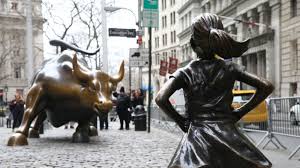
During the high tourist season expect to see the statue surrounded by tourist taking pictures in all directions. The statue of ‘Charging Bull’ is now paired with ‘Fearless Girl’ by artist Kristen Visbal. Some have commented that it has changed the meaning of the statue but I think it is how you interpret both works. Its best to visit and make your own opinion.
The ‘Charging Bull’ with ‘Fearless Girl’
While you are visiting the statue, take time to visit this historic section of Manhattan and visit the other sites that include Bowling Green Park, the Museum of the Native Americans, Frances Tavern and Stone Street as well as the boats to Governor’s, Ellis and Liberty Islands. It is a wonderful way to spend the afternoon.
Please refer to my blog, ‘MywalkinManhattan.com’- “Day One Hundred and Thirteen Tour of Historic Pubs and Bars in Lower Manhattan with the Cornell Club” for a full list of things to see in this section of the City.
History of Charging Bull:
Construction and installation:
The Bull by Bowling Green Park in the early morning hours.
The bull was cast by the Bedi-Makky Art Foundry in Greenpoint, Brooklyn. Di Modica spent around $360,000 to create, cast and install the sculpture following the 1987 stock market crash as a symbol of the ‘strength and power of the American people’. The sculpture was Di Modica’s idea and in an act of ‘guerrilla art’, Bedi Makky Art Foundry and Di Modica trucked it to Lower Manhattan. On December 15, 1989, they installed it beneath a 60 foot (18m) Christmas tree in the middle of Broad Street in front of the New York Stock Exchange as a Christmas gift to New Yorkers. That day, hundreds of onlookers stopped to admire and analyze it as Di Modica handed out copies of a flier about his artwork (Wiki).
NYSE officials called the police later that day and the NYPD seized the sculpture and placed it into a impound lot. The ensuing public outcry led the New York City Department of Parks & Recreation to reinstall it two blocks south of the Exchange in the Bowling Green, with a ceremony on December 21, 1989. It faces up Broadway at Whitehall Street (Wiki).
Confusion over ownership:
The sculpture technically has a temporary permit allowing it to stand on city property since the city does not own the sculpture but the temporary permission has lasted since 1989, when city officials said the new location would not be permanent. Art on loan is usually limited to a year’s display and although the city does not buy art, it does accept donations. A writer in the New York Daily News wrote in 1998 that the statue’s placement was ‘beginning to look a mite permanent.’ According to an article in Art Monthly, Di Modica as well as officials and New Yorkers, ‘view it as a permanent feature of Lower Manhattan (Wiki).
In 2004, Di Modica announced that the bull sculpture was for sale, on condition the buyer does not move it from its present location. Di Modica continues to own the artistic copyright to the statue. In 2006, Di Modica sued Walmart and other companies for illegally benefiting from his copyright, by selling replicas of the bull and using it in advertising campaigns. In 2009, Di Modica sued Random House for using a photo of the bull on the cover of a book discussing the collapse of financial services firm Lehman Brothers (Wiki).
Arturo Di Modica first conceived of the Charging Bull as a way to celebrate the can-do spirit of America and especially New York, where people from all over the world come regardless of their origin or circumstances and through determination and hard work overcome every obstacle to become successful. It’s this symbol of virility and courage that Arturo saw as the perfect antidote to the Wall Street Crash of 1987.
The artist was born in Vittoria, Italy in 1941 and studied at the Academia Del Nudo Libra in Florence, Italy in 1960. In 1973, he relocated to New York City to a Lower Manhattan space. ‘Charging Bull’ is his most famous piece (Artnet).
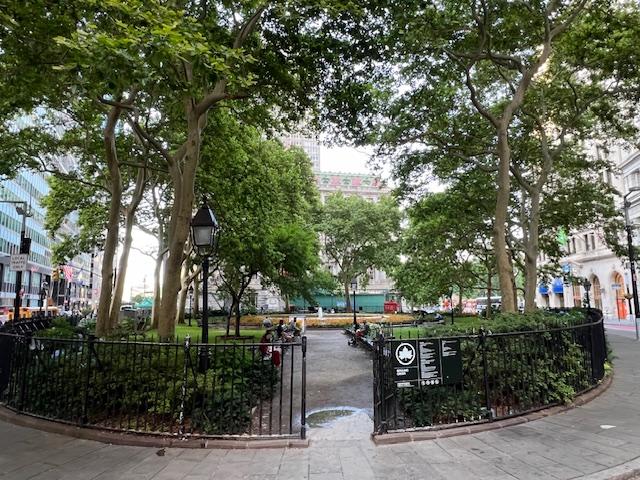
Bowling Green Park on the first day of summer 2024
I visited this wonderful park for my walking project, ‘MywalkinManhattan.com-Day 113-Walking the Historical Bars & Pubs of New York City’.
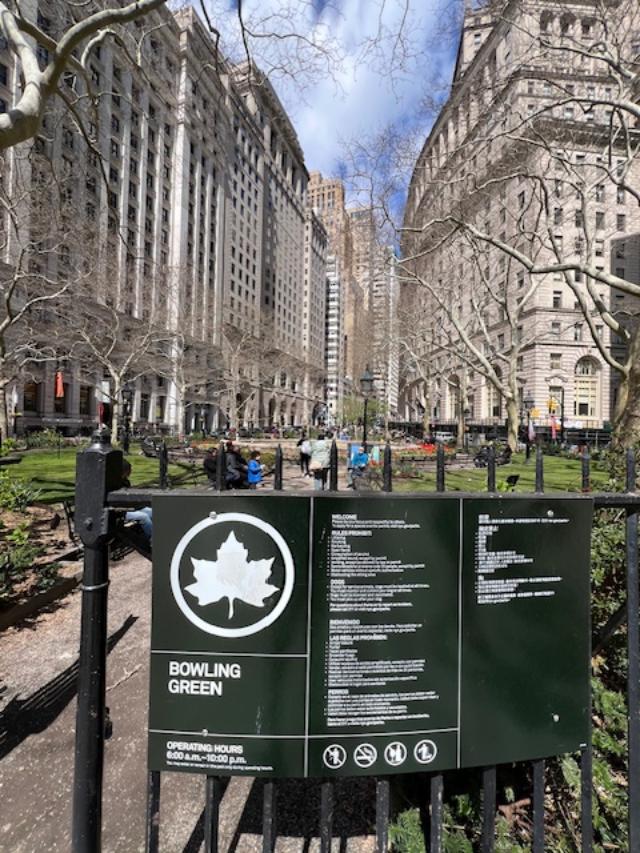
The entrance to the park.
This is one of the most fascinating parks in New York City and probably one the most historical in the shaping of the United States. Located on the grounds of the original Dutch settlement, this tiny park placed an important role in the confrontation of the Loyalist versus the Patriots when deciding who to support during the Revolutionary War.
The toppling of the King George Statue was the beginning of a new Republic. Along the historic fence which has been standing in the park since the late 1700’s are the markings where the tiny crowns were sawed off by the Patriots in defiance to the Crown.
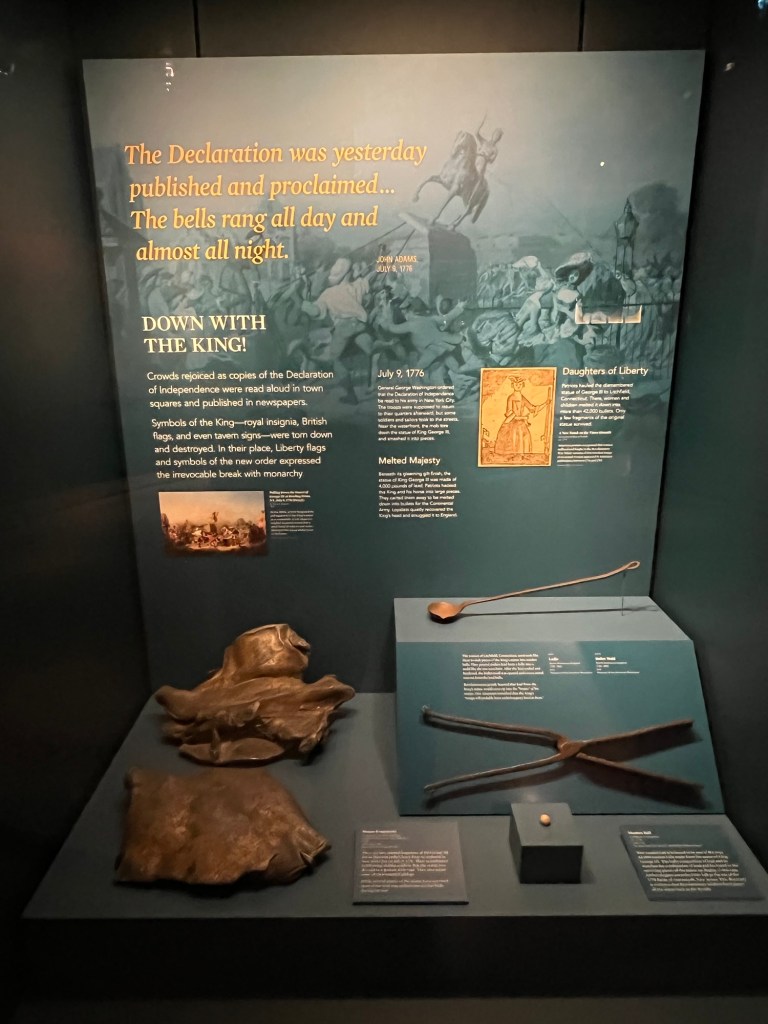
The toppling of the statute of King George (parts of the statue are at the Museum of the American Revolution in Philadelphia, PA-read my blog on this.)
The exhibit at the Museum of the American Revolution in Philadelphia on the King George Statue
Now it is a resting spot for tired tourists off the boats from Ellis and Liberty Islands and for Wall Street workers who need a nice place to eat their lunch. It is still a relaxing little park with tree lined paths and a beautifully landscaped fountain area. In the later summer, the flowers are still in bloom and the colorful highlights of the trees accent all sides of the park and keep it private. Even in this secrete setting it is mind boggling of the fact that people put their lives on the line to establish this country right from this tiny park.
Map of Lower Manhattan
Take time to walk through the cool paths of trees to the edges of the park, which are lines with historic buildings with decorative stone work and look at the beautiful statuary work on the old U.S. Custom House that now serves as the Museum of the American Indian. Take a quick tour of Stone Street just a few blocks away and see the development of the New York City after the Great Fire of 1823, which destroyed most of lower Manhattan.
Just at the tip of the norther part of the park is the famous statue of ‘Charging Bull’ a gift to the City by artist Arturo Di Modica to show the ‘strength of the American people’ and the now becoming famous statue of “Fearless Girl” by artist Kristen Visbal which was erected for International Women’s Day. Both statues have created quite the debate since they were both placed here in 1989 and 2017 and their fate is up to the City.
Take time to really see what all these symbols mean to the Bowling Green.
History of the Park:
The beauty of Bowling Green Park in the early morning hours.
The Bowling Green is New York City’s oldest park. According to tradition, this spot served as the council ground for Native American tribes and was the site of the legendary sale of Manhattan to Peter Minuit in 1626. The Dutch called the area “the Plain” and used it for several purposes including a parade ground, meeting place and cattle market. It marked the beginning of Heere Staat (High Street, now Broadway), a trade route which extended north through Manhattan and the Bronx. In 1686, the site was designated as public property, when the City Charter put all ‘waste, vacant, unpatented and unappropriated lands’ under municipal domain (NYC Parks.org).
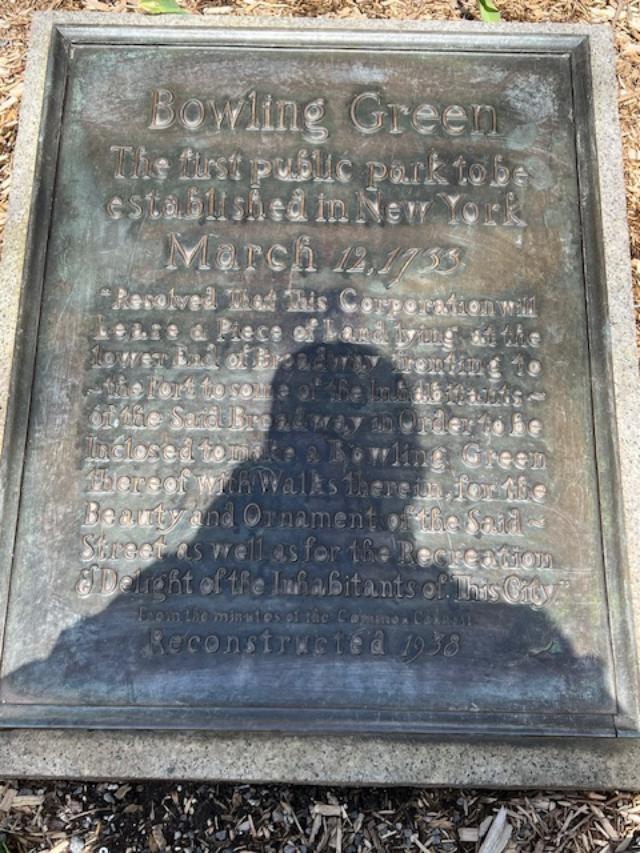
The historic marker for the park.
Bowling Green was first designated as a park in 1733, when it was offered for rent at the cost of one peppercorn per year. Lessees John Chambers, Peter Bayard and Peter Jay were responsible for improving the site with grass, trees and a wood fence “for the Beauty & Ornament of the Said Street as well as for the Recreation & delight of the Inhabitants of this City.”
A gilded lead statue of King George III was erected here in 1770 and the iron fence (now a New York City landmark) was installed in 1771. On July 9, 1776, after the first public reading in New York State of the Declaration of Independence, this monument was toppled by angry citizens who dragged it up Broadway, sent it Connecticut, melted it down and recast it as ammunition.
The exhibit at the Museum of the American Revolution in Philadelphia:
The pieces of the statue are on display at the Museum of the American Revolution in Philadelphia
The pieces of the statue
Portions of the statue are held by the Museum of the City of New York and the New York Historical Society (which also possesses musket balls made from the statue’s head) (NYC Parks.org).
The park with the buildings in the background.
By the late 18th Century, Bowling Green was the center of New York’s most fashionable residential district, surrounded by rows of Federal-style townhouses. In 1819, the Common Council that neighbors could plant and tend the area in return for the exclusive use of the park by their families. By mid-century, shipping offices inhabited the old townhouses and the park was returned to more public use. Monuments installed in the park in the 19th century include two fountains (now gone) and a statue of New York’s early Mayor and later colonial Supreme Court Judge Abraham DePeyster (1896, by artist George Bissell). DePeyster was moved to nearby Hanover Square in 1976 and finally to Thomas Paine Park in 2014 (NYC Parks.org).
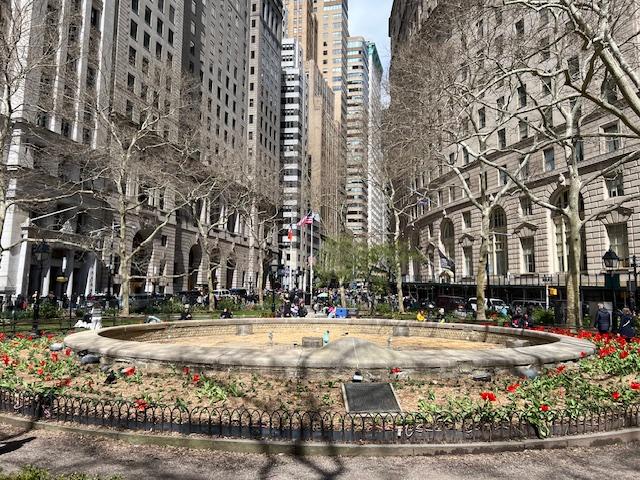
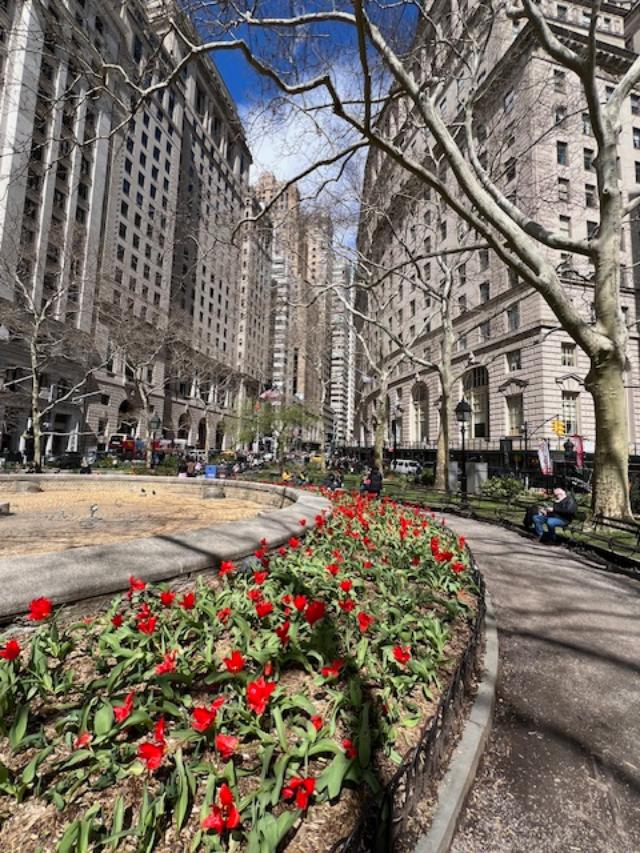
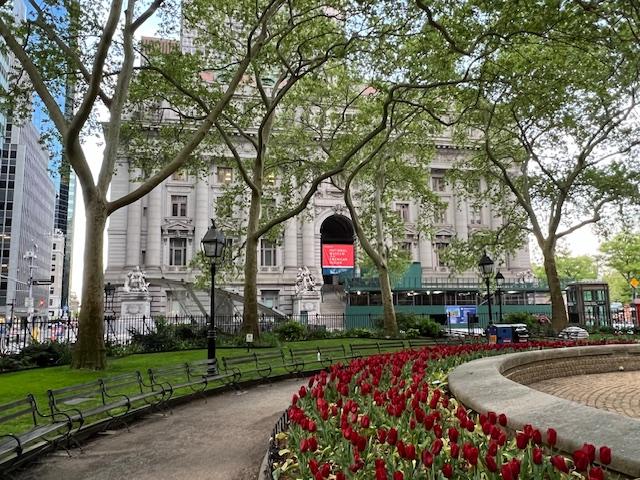
Bowling Green Park Spring 2024
Bowling Green Park Spring 2024.
In the first decade of the 20th Century, Bowling Green was disrupted by the construction of the IRT subway. The park was rebuilt as part of citywide improvements made in preparation for visitors to the 1939 World’s Fair. Renovations to Bowling Green included removing the fountain basin, relocating the interior walkways, installing new benches and providing new plantings. Mayor Fiorello LaGuardia, Parks Commissioner Robert Moses, members of the Board of Estimate and local businessmen participated in the rededication ceremony held on April 6, 1939. Despite unseasonable late snow, the ceremony included a demonstration of colonial era lawn bowling (NYC Parks.org).
The tulips at Bowling Green Park in Spring 2024.
A 1976-77 capital investment restored Bowling Green to its 18th century appearance. Improvements included the redistribution of subway entrances, the installation of new lampposts and benches and landscaping. Publisher and philanthropist George Delacourte (best known for the Alice in Wonderland statue in Central Park) donated the park’s central fountain (NYC Parks.org).
The Spring time flowers at the Bowling Green Park.
Since December of 1989, the statue of Charging Bull (1987-89) has been on display at the north end of the park. Its sculptor, Arturo Di Modica, says the three ton and a half bronze statue represents “the strength, power and hope of the American people for the future.” It has been linked to the property enjoyed by Wall Street in the past decade.
The park in the Summer of 2025
In 2004, the reconstruction of the park included new perimeter bluestones sidewalks and interior paths, landscaping, plantings and the re-sodding of the lawn. Antique-style gas lamps and hoof benches were also placed in the park with the addition of a new irrigation system for the parks fountain (New York Parks.org).
The “Charging Bull” sculpture.
Disclaimer: This information was taken directly from the New York City Parks.org site and I given them full credit for it. This is one of the special parks of the City so take some time to visit it while on your way to one of the other tourist sites or to Liberty Island or Ellis Island.
I have visited the Vanderbilt Estate many times over the years and every time I visit I learn something new about the family and about the property. It takes many visits to truly see the beauty of the house and grounds.
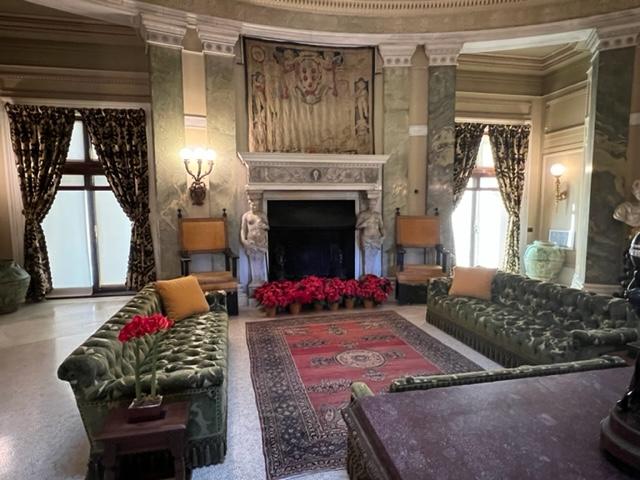
The Vanderbilt Mansion foyer on the first floor decorated for the holidays
I found the best time to visit is in the late Spring as the buds are coming in and Christmas time when the house is decorated for the holidays. It is quite spectacular. The holiday tour is amazing and after Thanksgiving, make a special trip to the Hudson River Valley and go mansion hopping as all the houses are decorated for the holidays.
The Christmas tree in the library of the Vanderbilt Mansion
The tour will take you to three floors of the house: the first floor with the living room, dining room, parlors, and studies. Then there is the second floor with Fredrick, Louise and the guest family and single women rooms. The last floor you will visit is the basement workrooms, servant quarters and kitchen.
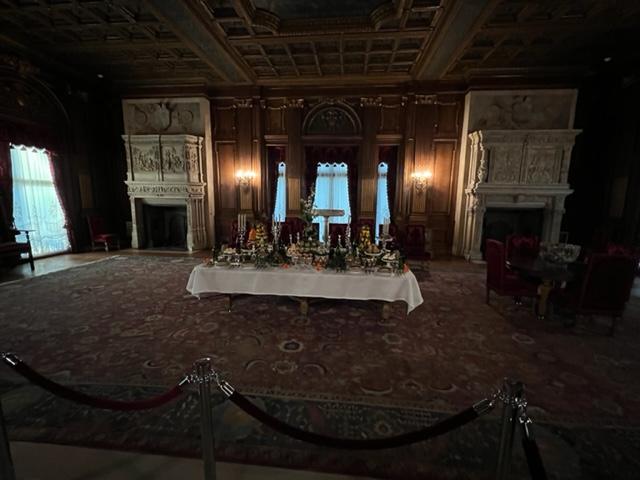
On the first floor is the formal dining room and the library, the offices of both Fredrick and Louise for their social and business obligations and the formal receiving foyer of the home. Things were decorated for the Christmas holiday season and it gave a very festive appearance.
The Library was set up for the Christmas holidays
The other side of the Library for the Christmas holidays
The house was only used about four months out of the year, being used in the Spring and then again in the Fall from the end of September to right after Thanksgiving and then the family would go to New York City for the social season. After Louise’s death, Fredrick sold his other houses and moved here permanently. The house was used full time and Fredrick must have enjoyed his time here.
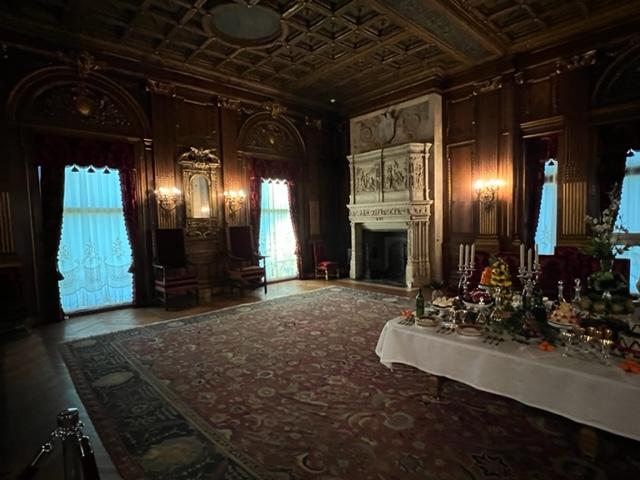
When she was alive, they used to have a very active social life and were active in local affairs. The formal dining room was used for parties and get togethers. For the holiday season, the room was decorated for a formal Christmas dinner.
The Dining Room set for holiday dinner
The beautiful fireplaces and paneling of the Dining Room
The Dining Room table set for the Christmas holidays
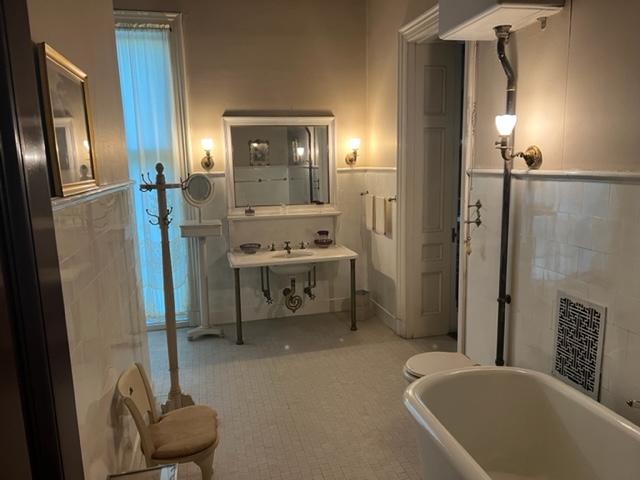
The formal staircase takes you up the to the bedrooms and the formal baths. The house was one of the first in the community to have electricity and hot and cold running water with all modern plumbing.
The stairs were wide and long due to the ladies dresses of the time
The artwork on the walls and landings was just breathtaking
The artwork on the landings and hallways is magnificent
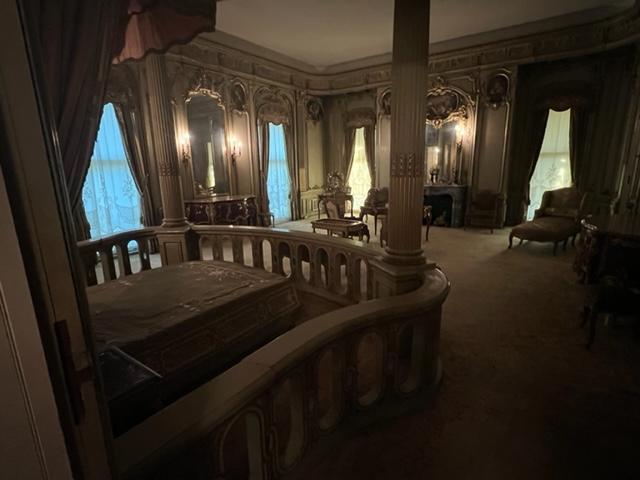
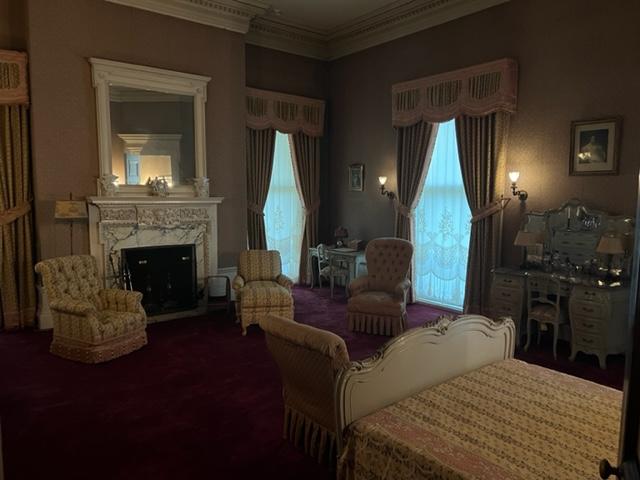
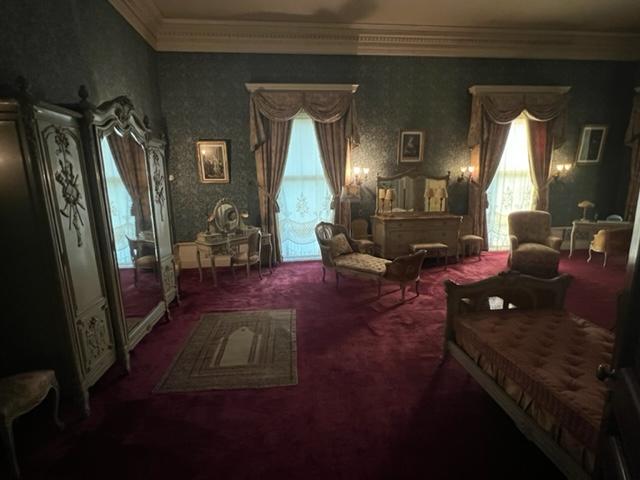
The bedrooms on the second floor are as elaborate as the rest of the house. While Fredrick’s bedroom was very plain in comparison to Louise’s who designed her bedroom after Marie Antoinette’s that she saw at Versailles. The room has a railing around it.
Louise’s Bedroom was based on what she saw in Europe.
Fredrick’s bedroom is less formal
The Bathroom with its modern plumbing and lighting
The elaborate rooms of the Vanderbilt Mansion
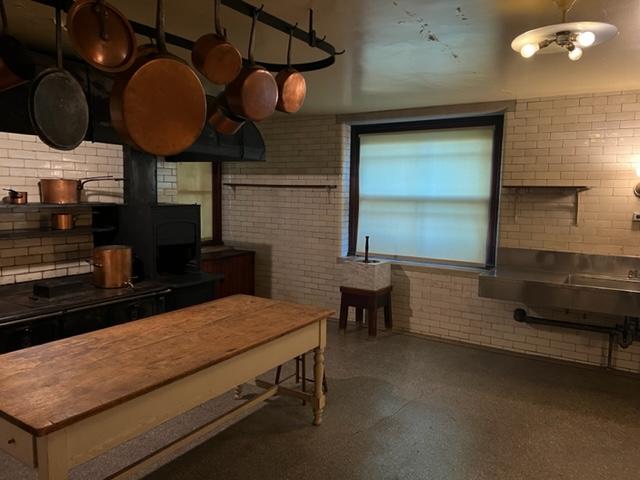
The household had a staff of over thirty people to attend to the household and grounds with their formal gardens. The kitchen staff had a well attended kitchen to work with and according to the tour guide, the staff was well treated at the Vanderbilt mansion. Fredrick was a good boss and provided well for his loyal staff.
The basement kitchen of the Vanderbilt Mansion
Touring the Vanderbilt Mansion at the Christmas holidays is always a treat but if you miss it, you can go during the year and still the elaborate rooms and beautiful grounds during the summer months. Take time to walk around the extensive lawns and gardens.
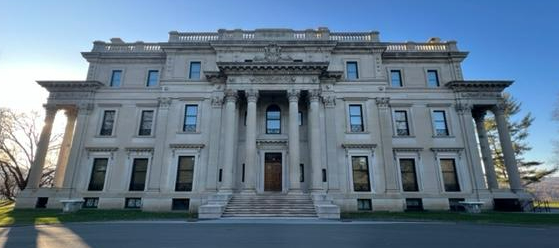
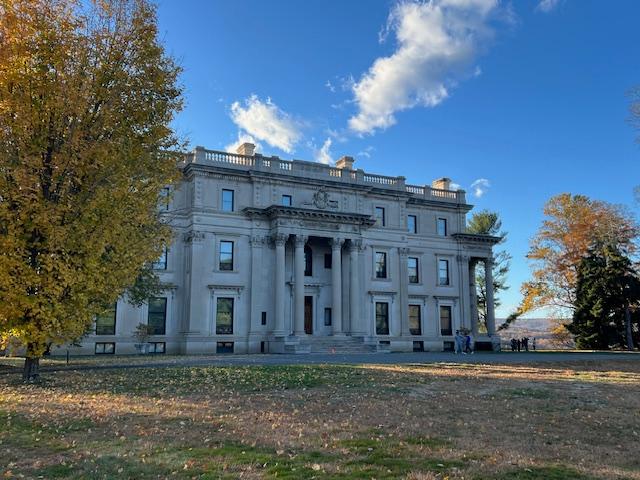
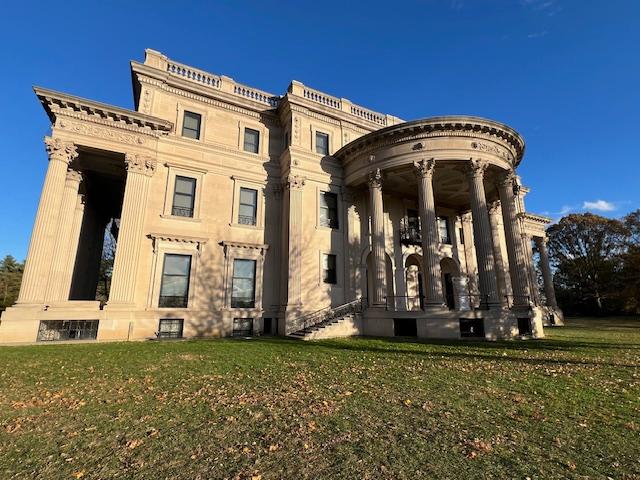
The Vanderbilt Mansion in the Fall of 2024
The Vanderbilt Estate in the Fall of 2024
The back of the mansion facing the Hudson River
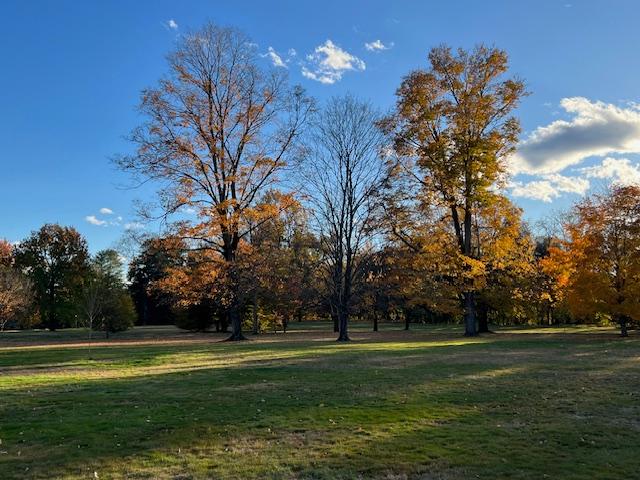
The estate grounds in the Fall of 2024
The estate in the Fall of 2024
History of the Vanderbilt Mansion:
The Gilded Age, the period following the Civil War to the turn of the century, was a time of unparalleled growth in industry, technology and immigration. Captains of industry, men like Cornelius Vanderbilt, Andrew Carnegie, J.P. Morgan, John D. Rockefeller and others who amassed unimaginable wealth, while the average annual income in the US was around $380, well below the poverty line.
The term “Gilded Age” was coined by Mark Twain and Charles Dudley Warner in their 1873 book, The Gilded Age: A Tale of Today. The term refers to the process of gilding an object with a superficial layer of gold to improve its appearance. Established millionaires viewed nouveau riche families like the Vanderbilt’s, who flaunted their wealth by building ostentatious homes, throwing extravagant balls and using their money to buy social prominence, as gilded-all show, no substance.
Cornelius “Commodore” Vanderbilt (1794-1877) rose from poverty to become a shipping and railroad tycoon. He turned a 100 dollar loan from his parents into a multi-million dollar fortune and left the bulk of his money to his eldest son William.
William expanded the railroad operations doubling the Vanderbilt fortune in just eight years but his eight children lived lives of excess, extravagance and self-indulgence. They built 40 opulent mansions and country estates and entertained lavishly, largely depleting the family money.
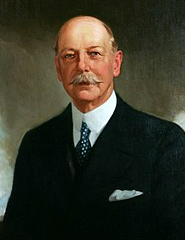
Fredrick William Vanderbilt later in life
In 1895, William’s son, Fredrick (1856-1938) and his wife, Louise (1854-1926) bought Hyde Park to use its their spring and fall country estate. McKim, Mead & White, America’s top architecture firm, designated the mansion in the neoclassical style with Beaux-Arts ornamentation and incorporated the latest innovations: electricity, central heating and indoor plumbing.
They added the Pavilion, a coach house, power station, gate houses, two new bridges over Crum Elbow Creek, boat docks, a railroad station and extensive landscaping. Many of the mansion’s contents were bought in Europe from wealthy families who had fallen on hard times. Furnishings and construction coast totaled around $2,250,000.
Louise Vanderbilt
Hyde Park was in many ways self-sustaining, providing food and flowers for the family’s needs here and at their other homes. When the Vanderbilt’s were in residence, as many as 60 staff worked here. Staff lived on or near the property and attended to the grounds and extensive farm. Personal staff traveled with the Vanderbilt’s and lived in the mansion with the family. Seasonal laborers were hired from the community and lived in the servants’ quarters.
The Vanderbilt Mansion in Hyde Park, NY in Fall 2024
The Vanderbilt Estate in Fall 2024
Fredrick, a quiet man, preferred to avoid social occasions but Louise loved to entertain, throwing lavish weekend parties with horseback riding, golf , tennis and swimming followed by formal dinners and dancing.
When Louise died in 1926, Fredrick sold his other houses and returned to this estate for the last 12 years of his life. He was active in business, directing 22 railroads until his death in 1938. His estate totaled $76 million, over 1.2 billion today. Gilded Age estates like this flourished in the 1890’s until the income tax (1913), World War I (1914) and Great Depression (1930’s) made their upkeep all but impossible.
The couple had no children and left the Hyde Park mansion to Louise’s niece, Margaret Louise Van Alen, who tried to sell the estate but there were no buyers. Her neighbor, Franklin D. Roosevelt, suggested she donate the estate to the National Park Service as a monument to the Gilded Age. She agreed and the Vanderbilt Mansion National Historic Site opened to the public in 1940.
The farmlands were not part of the donation and remain in private hands. The lavish mansion and its contents remain virtually unchanged from the time the Vanderbilt’s lived here.
(The National Park Foundation pamphlet)
The Vanderbilt Family History:
1650: Jan Aertsen Van Der Bilt is the first Vanderbilt ancestor known to reside in American.
1794: Cornelius “Commodore” Vanderbilt born on Staten Island, New York City, to Cornelius and Phoebe Hand Vanderbilt.
1810: Cornelius borrows $100 from parents and buys first two-masted sailing barge to start a ferry service from Staten Island to Manhattan.
1817: Cornelius captains a steamship for Thomas Gibbons and assists in legal battle against steamship monopolies, opening the way for his own shipping business.
1821: William Henry Vanderbilt, one of 13 children and first son, born Cornelius and first wife Sophia.
1830’s-1840’s: Cornelius expands shipping empire, begins railroad management.
1841: William marries Maria Kissam. They have eight children.
1851: Cornelius’ Accessory Transit Company provides shorter, cheaper transportation from New York to San Francisco. He gains national prominence.
1856: Fredrick, sixth child, is born to William and Maria
1861-65: During the Civil War, Cornelius donates steamship to the Union Navy. Receives Congressional Gold Medal. Acquires and consolidates rail lines in the Northeast and Midwest.
1870’s: Cornelius consolidates two core companies, creating New York Central & Hudson Railroad. William slashes cost, increases efficiency, turning it into one of the most profitable large enterprises in America.
1871: Cornelius opens Grand Central Depot on 42nd Street, New York City, the largest train station in North America
1877: Cornelius dies. William inherits most of his father’s fortune, nearly $100 million, to great displeasure of his siblings.
1878: Fredrick graduates from Sheffield Scientific School (Yale). Marries Louise Anthony.
1885: William dies, leaving an estate of $195 million to his eight children.
1895: Fredrick and Louise purchase the Hyde Park estate.
1899: Grand Central Depot is enlarged and becomes Grand Central Station.
1904-13: The new Grand Central Terminal (GCT) is built in sections on Depot site. Design insures trains are not delayed.
1926: Louise dies.
1938: Fredrick dies, leave the Hyde Park estate to niece Margaret Louise Van Alen.
1940: Vanderbilt Mansion National Historic Site established.
1949: 65 million passengers pass through GCT, equivalent 40% of the American population.
1950: Glory days of rail travel end.
1967: GCT designated New York City landmark, saving it from demolition.
1968: New York Central merges with Pennsylvania Railroad to form Penn Central.
1970: Penn Central files for bankruptcy and is dissolved by the courts.
1994: Metro-North takes over the GCT operation and restores it to 1913 splendor.
(The National Park Foundation pamphlet)
A legacy of landscape design:
The estate’s landscape was first developed by Dr. Samuel Bard, who died here in 1821. In the European picturesque style, he planted exotic plants and probably the gingko tree, one of the continent’s oldest dating back to 1799. Bard’s son, William sold the to his father’s medical partner, Dr. David Hosack, who built the first formal gardens and greenhouses. After his death, the estate was broken up. Later Walter Langdon Jr. reunited the estate, laid out the formal garden’s and hired Boston architects to design a gardener’s cottage, tool houses and garden walls. These structures, the only ones to pre-date Vanderbilt ownership, still exists. Vanderbilt redesigned the formal gardens and planted hundreds of trees and shrubs. On weekends, Fredrick and Louise liked to walk through the gardens twice a day. Today the landscape, restored to its 1930’s appearance, encompassing five acres of tiered gardens, gravel paths, shady arbors, ornate statues and bubbling fountains.
(The National Park Foundation pamphlet)
Disclaimer: This information comes directly from the National Park Service pamphlet of the Vanderbilt Estate and I give the author full credit on the information. Please refer to the National Park System website for any further information on the site as the hours vary during the different times of the year.
The Mount Vernon Hotel Museum at 421 East 61st Street
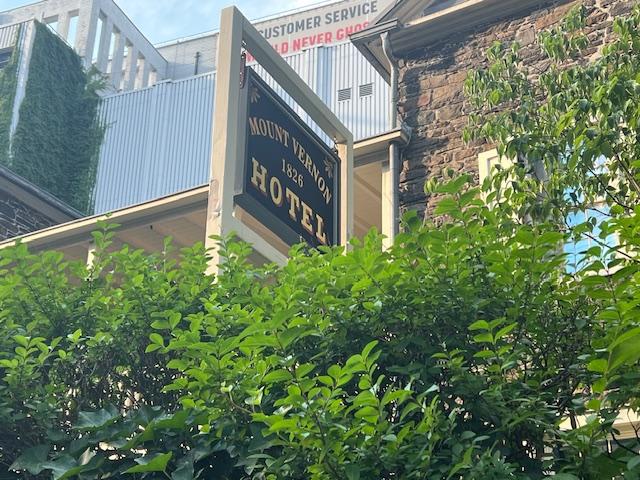
Mount Vernon historical sign during the summer months
The history of the building
The model of the building
I had come across the Mount Vernon Hotel Museum when I was walking on East 61st Street for my blog and went to take the tour of the building. It is a one hour (or more as I there for almost two hours but I was by myself) tour of both floors. You start with a film and a quick talk about the history of the building. The hotel building has had several owners and uses over its over hundred years.
I visited the museum during the holiday season in 2025 and I got to see all the decorations around the hotel. There was elegant decorations in most of the rooms and got to see how people ate during the holiday season as well as with visits guests would have indulged in when they came for the day.
Then you start the tour of the upper room where the ladies would gather and talk. This is where they might have tea, musical recitals and read and sew. They would gather with other women for conversation and debate.
The Upstairs foyer gallery
The foyer landing decorated for the holidays with the former traveler, James Taylor, who discussed in his memoir about visiting the hotel
The Ladies Parlor
The upstairs is where the sleeping rooms and the ladies parlors are located, where female guests would enjoy tea, games, music and reading. The main landing was for dancing and for gatherings.
The Ladies Palour with the Chinese writing desk and festive decorations.
The room set for tea with Englishware
The holiday set up afternoon service
The sleeping rooms were kept simple and functional
The Men’s game room
The main floor was the Men’s gaming rooms, where there is a bar and two rooms for male activities such as cards, gambling and reading. Here the men would discuss politics and business over a drink and games of chance.
The main games room
The main entrance was used as the dining room for dinner (our lunch), which was the biggest meal of the day served around 2:00pm.
The bar area where spirits are sold
The afternoon supper was part of the package and couples would join one another for a several course meal, which would serve as the main meal of the day.
Dinner time at the Mount Vernon Hotel Museum
The tour guide went over what would have been served, menu’s and meal times. Dinner would have been served at 2:00pm, tea time would have been around 4:00pm-6:00pm and Supper around 8:00pm.
The multi course meal for everyday on display
The meal would include popular dishes such as turkey and oysters and a specialty, Turtle soup. Fresh vegetables and fancy desserts would be part of the package.
The tour of the kitchen show preparation of foods, recipe books and all kitchen equipment including the stoves and baking materials.
The kitchen for both the hotel and house
The kitchen used to cook afternoon meals
The area used for baking and roasting
If you like the history of “Old New York” and like old homes, hotels and buildings, this is a very interesting tour that deals with the City’s growing middle-class and the new ‘leisure time’ that was coming with the changes in the work week. There are many pieces of period furniture all over the building that show the growth of affluence of the time.
The side board set with holiday desserts
The side board ladened with holiday treats
Don’t miss the formal walled in garden in the back. It is a place of relaxation from the rest of the city. There are stone walk ways and landscaped gardens as well as an herb garden. The building is owned and maintained by the Colonial Dames of America.
The walled gardens during the winter
The walled garden in the winter
I revisited the museum for the holidays and the hotel was decked out in garland and holy based on the decor traditional for the Revolutionary War era Christmas. The archways and tables were lined with greenery and the tables were loaded with oranges plunged with cloves to give the homes at that time a rich citrus smell.
The downstairs dining table was set for a Christmas meal of wild turkey, mock turtle soup, and apple and pumpkin pies. This would have been served in the afternoon as the main meal while it was still light out.
Holiday goodies at the Mount Vernon Hotel Museum getting ready for the holidays
There had been a light snow while we were touring the hotel so when we visited the gardens, it really did have that Christmas feel to it with that light snow all over the pine and the bushes.
How the neighborhood has changed
The old stable area
During the time of the Revolutionary War and afterwards, homes were not as elaborately decorated as they would have been during Victorian times after the Civil War. Homes were lined with greenery that would have given the home the fragrant smell of pine and strings of cranberries and popcorn would have been used to decorate mantles.
The hotel decorated for the holidays
The hotel was getting ready for one of its many special events during the holidays so there was a lot of commotion going on downstairs. It is a very festive looking place for the holidays so try to tour it when it is open in the month of December.
The museum in the 2025 holiday season
What is the Museum:
Constructed in 1799 as a carriage house and converted into a ‘day hotel’ in 1826, the Museum transports visitors back to Mount Vernon Hotel, a 19th Century country resort for New Yorkers escaping the crowded city below 14th Street.
The model of the original house layout
Recognizing the building as one of the few remaining 18th century sites and the only surviving day hotel in New York City Historic Landmark in 1967, added to the National Register of Historic Places in 1973 and accredited by the American Association of Museums in 1983.
History of the House:
The Mount Vernon Hotel Museum & Garden presents the period of the Mount Vernon Hotel which operated from 1826 until 1833.
Constructed in 1799 as a carriage house for a 23 acre estate and converted into the Mount Vernon in 1826, this stone building sits on land originally owned by Colonel William Stephens Smith and his wife, Abigail Adams Smith, the daughter of John Adams.
This fashionable country resort was popular among New Yorkers who wished to escape the hustle among the bustle of the city, which at that time extended only as far north 14th Street. The Hotel advertised “free from the noise and dust of the public roads and fitted up and intended for only the most gentle respectable” clientele. In those days, one could take the stagecoach or steamboat up to 61st Street spend the day at the hotel sipping lemonade in the ladies parlor or playing cards in the gentlemen’s.
In 1833, the house became the home for three generations of a New York City family. In 1905, as the area became more industrialized, the building was purchased by Standard Gas Light Company (today’s Con-Edison). The Colonial Dames of America, a woman’s patriotic society purchased the building in 1924 and did an extensive restoration to the structure, the Colonial Dames opened the site to the public in 1939. The building endures as a rare reminder of an important era in New York City’s history.
What the organization does:
*Welcome 5000 school children annually in grades-pre-K through high school for field trips.
*Summer History Weeks for children ages 6-12
*A Summer High School Internship for 15 students to support college readiness skills and career exploration.
*Two summer Hearst Fellowships for undergraduates or graduate students.
*40+public programs each year, including:
-monthly free Story time
-monthly Lunchtimes lectures
-holiday programs, garden concerts, hands on craft and cooking workshops.
*Temporary exhibitions on facets of life in early 19th century NYC, some promoting local contemporary artists.
*Special programs for individuals with Alzheimer’s and their caregivers.
*Outreach programs to schools, senior centers and homeless shelters.
*Themed group tours focused on 19th century food, decorative arts or literature.
*Three options for team building events.
*Two free admission days: Smithsonian Museum Day and Open House New York.
Programs are made possible in part by the support of the New York City Department of Cultural Affairs in partnership with the City Council and Council Member Ben Kallos, the New York State Council on the Arts with the support of Governor Andrew Cuomo and the New York State Legislature, the Manhattan Borough President Gale Brewer, the Institute of Museum and Library Services, the Rosenthal Foundation and the Michael Tuch Foundation.
(Mount Vernon Hotel Pamphlet)
The Colonial Dames of America:
With these words, spoken in April 1890, Maria Denning “May” Van Rensselaer imitated what was to become the oldest colonial lineage society for women in the United States. The Colonial Dames of America. Its mission is to preserve historic sites and objects, award scholarships, educate the public about American history, inspire patriotism and promote fellowship among its members.


























 Visiting a Museum: The Unique, Unusual, Obscure and Historical